<h4>by DAVID ROLINSON</h4>
<p><strong>Writer:</strong> David Whitaker; <b>Director:</b> Douglas Camfield; <b>Producer:</b> Verity Lambert</p>
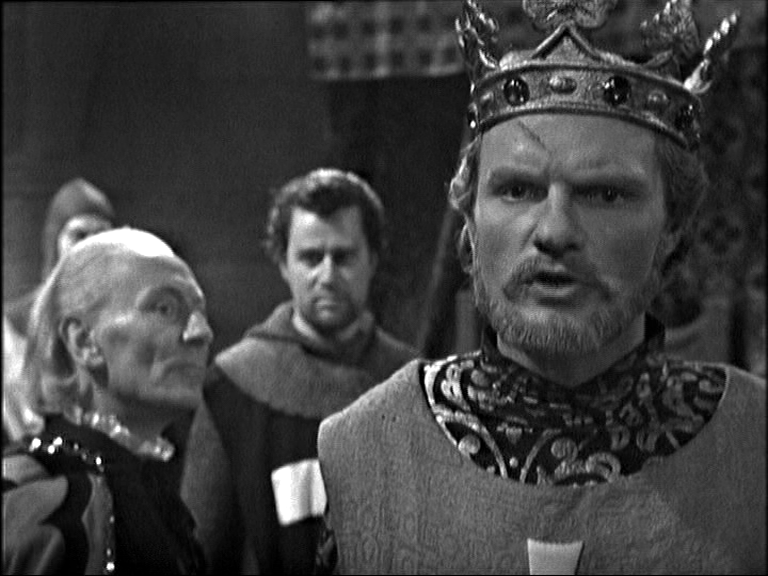
<div id="attachment_767" style="width: 310px" class="wp-caption alignright"><a href="http://www.britishtelevisiondrama.org.uk/wp-content/uploads/2010/10/vlcsnap-2010-10-12-19h25m22s84.png"><img loading="lazy" decoding="async" aria-describedby="caption-attachment-767" class="size-medium wp-image-767" title="Doctor, Leicester, Richard" src="http://www.britishtelevisiondrama.org.uk/wp-content/uploads/2010/10/vlcsnap-2010-10-12-19h25m22s84-300x225.png" alt="" width="300" height="225" srcset="http://www.britishtelevisiondrama.org.uk/wp-content/uploads/2010/10/vlcsnap-2010-10-12-19h25m22s84-300x225.png 300w, http://www.britishtelevisiondrama.org.uk/wp-content/uploads/2010/10/vlcsnap-2010-10-12-19h25m22s84.png 768w" sizes="auto, (max-width: 300px) 100vw, 300px" /></a><p id="caption-attachment-767" class="wp-caption-text">The Doctor, Earl of Leicester and Richard I</p></div>
<p>A literary costume drama set around the courts of Richard I and Saladin,<em> The Crusade</em> (1965) is an example of how important non-science-fiction historical stories were in the early years of <em>Doctor Who</em>. This essay looks at how <em>The Crusade</em> approaches history, in particular the characterisation of Richard I (&#8220;the Lionheart&#8221;). There will be attention paid to the programme&#8217;s attempts at historical accuracy, although that shouldn&#8217;t be our only focus because the historical study of popular culture too often ignores the specific qualities of popular culture (and also history) by depending on the accuracy question. Depictions of Richard I change for various reasons including historians’ debates, school curricula, changes in media institutions, shifting dramatic styles and reactions to previous dramas. These explain why <em>Richard the Lionheart</em> (ITV, 1961-65) uses Richard differently from Richard Lester’s film <em>Robin and Marian</em> (1976), which is in turn different from the series <em>Robin of Sherwood</em> (ITV, 1984-86) and <em>Robin Hood</em> (BBC, 2006-2009). This essay will therefore take <em>Doctor Who</em>’s version of Richard I as a starting point to think about how history and screen fictions build narratives around figures like Richard I. I’m drawing from unused sections of the research I conducted for a forthcoming academic publication on neo-medievalism,<sup id="rf1-1035"><a href="#fn1-1035" title="My chapter on neomedievalism in &lt;em&gt;Who&lt;/em&gt;, for the collection &lt;em&gt;Neo-medievalism in the Media: Essays on Film, Television, and Electronic Games&lt;/em&gt;, appeared in 2012. That chapter focuses on &lt;em&gt;Doctor Who&lt;/em&gt;’s pseudo-historical stories – defined elsewhere in this website essay – and avoids pure historicals such as &lt;em&gt;The Crusade&lt;/em&gt;. This website essay salvages notes and analysis which I prepared while researching that chapter in 2006: I have updated and rewritten these notes to remove academic jargon and theoretical perspectives." rel="footnote">1</a></sup> but any references to academic theory will be rooted in discussion of the choices made by writer David Whitaker and director Douglas Camfield.</p>

<hr class="footnotes"><ol class="footnotes" style="list-style-type:decimal"><li id="fn1-1035"><p >My chapter on neomedievalism in <em>Who</em>, for the collection <em>Neo-medievalism in the Media: Essays on Film, Television, and Electronic Games</em>, appeared in 2012. That chapter focuses on <em>Doctor Who</em>’s pseudo-historical stories – defined elsewhere in this website essay – and avoids pure historicals such as <em>The Crusade</em>. This website essay salvages notes and analysis which I prepared while researching that chapter in 2006: I have updated and rewritten these notes to remove academic jargon and theoretical perspectives.&nbsp;<a href="#rf1-1035" class="backlink" title="Return to footnote 1.">&#8617;</a></p></li></ol></hr>{"id":1035,"date":"2010-11-05T16:07:55","date_gmt":"2010-11-05T16:07:55","guid":{"rendered":"http:\/\/www.britishtelevisiondrama.org.uk\/?p=1035"},"modified":"2024-08-30T11:45:48","modified_gmt":"2024-08-30T10:45:48","slug":"richard-i-in-tv-drama-doctor-who-the-crusade-1965-and-beyond","status":"publish","type":"post","link":"http:\/\/www.britishtelevisiondrama.org.uk\/?p=1035","title":{"rendered":"Richard I in TV Drama &#8211; <em>Doctor Who<\/em>: <em>The Crusade<\/em> (1965) and beyond"},"content":{"rendered":"<h4>by DAVID ROLINSON<\/h4>\n<p><strong>Writer:<\/strong> David Whitaker; <b>Director:<\/b> Douglas Camfield; <b>Producer:<\/b> Verity Lambert<\/p>\n<div id=\"attachment_767\" style=\"width: 310px\" class=\"wp-caption alignright\"><a href=\"http:\/\/www.britishtelevisiondrama.org.uk\/wp-content\/uploads\/2010\/10\/vlcsnap-2010-10-12-19h25m22s84.png\"><img loading=\"lazy\" decoding=\"async\" aria-describedby=\"caption-attachment-767\" class=\"size-medium wp-image-767\" title=\"Doctor, Leicester, Richard\" src=\"http:\/\/www.britishtelevisiondrama.org.uk\/wp-content\/uploads\/2010\/10\/vlcsnap-2010-10-12-19h25m22s84-300x225.png\" alt=\"\" width=\"300\" height=\"225\" srcset=\"http:\/\/www.britishtelevisiondrama.org.uk\/wp-content\/uploads\/2010\/10\/vlcsnap-2010-10-12-19h25m22s84-300x225.png 300w, http:\/\/www.britishtelevisiondrama.org.uk\/wp-content\/uploads\/2010\/10\/vlcsnap-2010-10-12-19h25m22s84.png 768w\" sizes=\"auto, (max-width: 300px) 100vw, 300px\" \/><\/a><p id=\"caption-attachment-767\" class=\"wp-caption-text\">The Doctor, Earl of Leicester and Richard I<\/p><\/div>\n<p>A literary costume drama set around the courts of Richard I and Saladin,<em> The Crusade<\/em> (1965) is an example of how important non-science-fiction historical stories were in the early years of <em>Doctor Who<\/em>. This essay looks at how <em>The Crusade<\/em> approaches history, in particular the characterisation of Richard I (&#8220;the Lionheart&#8221;). There will be attention paid to the programme&#8217;s attempts at historical accuracy, although that shouldn&#8217;t be our only focus because the historical study of popular culture too often ignores the specific qualities of popular culture (and also history) by depending on the accuracy question. Depictions of Richard I change for various reasons including historians\u2019 debates, school curricula, changes in media institutions, shifting dramatic styles and reactions to previous dramas. These explain why <em>Richard the Lionheart<\/em> (ITV, 1961-65) uses Richard differently from Richard Lester\u2019s film <em>Robin and Marian<\/em> (1976), which is in turn different from the series <em>Robin of Sherwood<\/em> (ITV, 1984-86) and <em>Robin Hood<\/em> (BBC, 2006-2009). This essay will therefore take <em>Doctor Who<\/em>\u2019s version of Richard I as a starting point to think about how history and screen fictions build narratives around figures like Richard I. I\u2019m drawing from unused sections of the research I conducted for a forthcoming academic publication on neo-medievalism,<sup id=\"rf1-1035\"><a href=\"#fn1-1035\" title=\"My chapter on neomedievalism in &lt;em&gt;Who&lt;\/em&gt;, for the collection &lt;em&gt;Neo-medievalism in the Media: Essays on Film, Television, and Electronic Games&lt;\/em&gt;, appeared in 2012. That chapter focuses on &lt;em&gt;Doctor Who&lt;\/em&gt;\u2019s pseudo-historical stories \u2013 defined elsewhere in this website essay \u2013 and avoids pure historicals such as &lt;em&gt;The Crusade&lt;\/em&gt;. This website essay salvages notes and analysis which I prepared while researching that chapter in 2006: I have updated and rewritten these notes to remove academic jargon and theoretical perspectives.\" rel=\"footnote\">1<\/a><\/sup> but any references to academic theory will be rooted in discussion of the choices made by writer David Whitaker and director Douglas Camfield.<\/p>\n<p><!--more--><\/p>\n<h3>Introduction: &#8220;pure&#8221; and &#8220;pseudo&#8221; historicals<\/h3>\n<p>&#8220;Real&#8221; historical figures appear constantly in post-2005 <em>Doctor Who<\/em>, but they are brought into the Doctor\u2019s world, the programme\u2019s narrative structure, and audience expectations: therefore, although <em>Victory of the Daleks<\/em> (2010) contains some sound historical detail, Winston Churchill\u2019s primary function is a narrative one: to help engage the Daleks.<sup id=\"rf2-1035\"><a href=\"#fn2-1035\" title=\"The extent to which the play of &#8220;icons&#8221; smooths over historical function, and whether the Doctor would be warm friends with someone whose political past conflicts with his own often-stated values, are questions to return to elsewhere.\" rel=\"footnote\">2<\/a><\/sup> However, much of the drama in <em>The Crusade<\/em> comes from a sense of time and place, a world which we enter as viewers of the continuing adventure of <em>Doctor Who<\/em>. Therefore, there\u2019s a distinction between types of historical stories, which fan critics long ago categorised as &#8220;pure historical&#8221; and &#8220;pseudo-historical&#8221; stories. In a vital article on the subject, Daniel O\u2019 Mahony observed that the pure historical had the series\u2019 lead characters as &#8220;the only science fictional intrusion into a narrative that features only historical elements (or fictional elements that can be plausibly passed off as historically contextual)&#8221;. <em>The Crusade<\/em> is therefore a &#8220;pure historical&#8221;. Meanwhile, the &#8220;pseudo-historical&#8221; was a type of story in which &#8220;the historical period has either been invaded by a science-fictional presence before the Doctor shows up\u2026 or turns out to be a fabrication mocked up by the villains&#8221;<sup id=\"rf3-1035\"><a href=\"#fn3-1035\" title=\"Daniel O\u2019 Mahony, \u2018\u201cNow how is that wolf able to impersonate a grandmother?\u201d: History, pseudo-history and genre in Doctor Who\u2019, in David Butler (editor), &lt;em&gt;Time and Relative Dissertations in Space: Critical Perspectives on Doctor Who&lt;\/em&gt; (Manchester: Manchester University Press, 2007), pp. 57-58.\" rel=\"footnote\">3<\/a><\/sup>. <em>Victory of the Daleks<\/em> is therefore a &#8220;pseudo-historical&#8221;. In its first four seasons (1963-67), <em>Doctor Who<\/em> alternated science fiction stories with historicals: some were &#8220;pure&#8221; and serious &#8211; such as <em>Marco Polo (<\/em>1964) &#8211; and others were &#8220;pure&#8221; but essentially comedic &#8211; such as the lighter moments of <em>The Romans <\/em>(1965) partly influenced by <em>Carry On Cleo<\/em> (1964)<sup id=\"rf4-1035\"><a href=\"#fn4-1035\" title=\"Mentioning the polished comedy at work in &lt;em&gt;The Romans&lt;\/em&gt; should not suggest that it is not also &#8220;serious&#8221;. The same applies to my next example, &lt;em&gt;The Time Meddler&lt;\/em&gt;.\" rel=\"footnote\">4<\/a><\/sup> &#8211; and others were &#8220;pseudo&#8221;, such as the audacious anachronisms of Peter Butterworth\u2019s time-travelling Meddling Monk in <em>The Time Meddler<\/em> (1965). After 1967 the &#8220;pure&#8221; historicals were phased out \u2013 <em>Black Orchid<\/em> (1982) is a rare exception \u2013 for reasons that fans and critics still debate.<sup id=\"rf5-1035\"><a href=\"#fn5-1035\" title=\"Their alleged unpopularity with audiences doesn&#8217;t quite tally with the viewing figures.\" rel=\"footnote\">5<\/a><\/sup><\/p>\n<p>I\u2019ve written elsewhere on pseudo-historical stories such as <em>The Time Warrior<\/em> (1973-74), where Crusade-era England is invaded by Sontarans and misread by Sarah-Jane Smith as a nostalgic pageant; the anachronism of her &#8220;Women&#8217;s Lib&#8221; values is interestingly handled. In the same piece, I\u2019ve written about how futuristic stories use medieval tropes.<sup id=\"rf6-1035\"><a href=\"#fn6-1035\" title=\"This is so fundamental that it applies to the backstory of the Doctor himself. See my 2012 article.\" rel=\"footnote\">6<\/a><\/sup> It\u2019s oversimplistic to separate &#8220;pure&#8221; and &#8220;pseudo&#8221; historicals as they both serve the requirements of genre and format, and also both make us aware of anachronism in the way that time-travellers interpret or misinterpret their surroundings. <em>The Crusade<\/em> may be more &#8220;pure&#8221;, in terms of historical accuracy, than <em>The Time Warrior<\/em>, but it still works as a<em> Doctor Who<\/em> adventure.<\/p>\n<h3>The Crusade as pure historical<\/h3>\n<blockquote>\n<p>&#8220;There\u2019s something new in you, yet something older than the sky itself.&#8221; (Joanna)<\/p>\n<\/blockquote>\n<p>Critics assert the &#8220;purity&#8221; of early <em>Doctor Who<\/em> historicals. Philip MacDonald describes plots &#8220;motivated by the particular demands and trials of living in that period&#8221;,<sup id=\"rf7-1035\"><a href=\"#fn7-1035\" title=\"Philip MacDonald, \u2018A Foreign Country\u2019, &lt;em&gt;Doctor Who Magazine&lt;\/em&gt;, Issue 194, December 1992, p. 42.\" rel=\"footnote\">7<\/a><\/sup> in stories in which &#8220;character took the place of spectacle&#8221;.<sup id=\"rf8-1035\"><a href=\"#fn8-1035\" title=\"Philip MacDonald, \u2018Whitaker\u2019s World\u2019, &lt;em&gt;Doctor Who Magazine&lt;\/em&gt;, Issue 200, June 1993, p. 10\" rel=\"footnote\">8<\/a><\/sup> For instance, in <em>Marco Polo<\/em>, the Doctor and his companions travel across thirteenth-century Cathay with Marco Polo, suffering intrigues and water shortages. Viewers who join the trek leave behind science-fiction trappings over seven weekly episodes, as the lead characters were the only anachronism, as producer Verity Lambert told John Tulloch and Manuel Alvarado.<sup id=\"rf9-1035\"><a href=\"#fn9-1035\" title=\"John Tulloch and Manuel Alvarado, &lt;em&gt;Doctor Who: The Unfolding Text&lt;\/em&gt; (New York: St Martin\u2019s Press, 1983), p. 39.\" rel=\"footnote\">9<\/a><\/sup> O\u2019 Mahony notes the perceived &#8220;virtues&#8221; of these stories: &#8220;high-minded storytelling, educational content and historical fidelity&#8221;, rooted in the &#8220;educational&#8221; motives which underpinned the programme\u2019s early remit within the BBC and the BBC\u2019s reputation within the culture.<sup id=\"rf10-1035\"><a href=\"#fn10-1035\" title=\"O\u2019 Mahony, \u2018Now how is that wolf\u2019, p. 60.\" rel=\"footnote\">10<\/a><\/sup><\/p>\n<div id=\"attachment_753\" style=\"width: 310px\" class=\"wp-caption alignleft\"><a href=\"http:\/\/www.britishtelevisiondrama.org.uk\/wp-content\/uploads\/2010\/10\/vlcsnap-2010-10-12-19h09m44s170.png\"><img loading=\"lazy\" decoding=\"async\" aria-describedby=\"caption-attachment-753\" class=\"size-medium wp-image-753\" title=\"The Lion_regular cast\" src=\"http:\/\/www.britishtelevisiondrama.org.uk\/wp-content\/uploads\/2010\/10\/vlcsnap-2010-10-12-19h09m44s170-300x225.png\" alt=\"\" width=\"300\" height=\"225\" srcset=\"http:\/\/www.britishtelevisiondrama.org.uk\/wp-content\/uploads\/2010\/10\/vlcsnap-2010-10-12-19h09m44s170-300x225.png 300w, http:\/\/www.britishtelevisiondrama.org.uk\/wp-content\/uploads\/2010\/10\/vlcsnap-2010-10-12-19h09m44s170.png 768w\" sizes=\"auto, (max-width: 300px) 100vw, 300px\" \/><\/a><p id=\"caption-attachment-753\" class=\"wp-caption-text\">Barbara, Vicki, the Doctor and Ian<\/p><\/div>\n<p><em>The Crusade <\/em> is set in Jaffa, Palestine, and depicts a stalemate between Richard and Saladin. It is clearly set in either 1191 or 1192, and fan sources usually locate it in October 1191, although it is difficult to prove or disprove this with any certainty because of its occasional reordering of historical details.<sup id=\"rf11-1035\"><a href=\"#fn11-1035\" title=\"Richard&#8217;s plans relating to Joanna&#8217;s marital status confirm October, but other details point to the stalemate&#8217;s wearying days of 1192.\" rel=\"footnote\">11<\/a><\/sup> The Doctor (William Hartnell) and his companions Ian (William Russell), Barbara (Jacqueline Hill) and Vicki (Maureen O\u2019 Brien) are drawn into court intrigue: early in the story, the Doctor and Vicki remain with Richard while Ian is sent to return the captured Barbara from Saladin\u2019s camp (unaware that the brutal El Akir has kidnapped her). <em>The Crusade <\/em>draws from a familiar setting, because, as James Chapman notes, historicals &#8220;tended to focus on periods [\u2026] that were taught in schools and would, therefore, be familiar to children&#8221;, including 1066 England and the Roman Empire.<sup id=\"rf12-1035\"><a href=\"#fn12-1035\" title=\"James Chapman, &lt;em&gt;Inside the Tardis: The Worlds of Doctor Who &lt;\/em&gt;(London: I.B. Tauris, 2006), p. 32.\" rel=\"footnote\">12<\/a><\/sup> From the second season onwards, after Whitaker\u2019s departure as story editor, the selection of historical periods was shaped by popular culture, with <em>The Romans<\/em> and <em>The Gunfighters<\/em> (1966) serving as film pastiches and, occasionally, postmodern collages of playful quotations. These developments explain why <em>The Crusade<\/em>, which took place mid-way through the second season,<em> <\/em>is often praised as &#8220;a return to the more serious style of the first season historicals&#8221; such as <em>Marco Polo<\/em>.<sup id=\"rf13-1035\"><a href=\"#fn13-1035\" title=\"David J. Howe, Mark Stammers and Stephen James Walker, &lt;em&gt;Doctor Who: The Handbook &#8211; The First Doctor &lt;\/em&gt;(London: Doctor Who Books [Virgin], 1994), p. 97.\" rel=\"footnote\">13<\/a><\/sup><\/p>\n<h3>Starring Richard the Lionheart: other media and generic coding<\/h3>\n<p>However, in selecting the Third Crusade, the production team inherited ideas from education and popular culture. Ralph V. Turner and Richard R. Heiser note that Richard has become a &#8220;leading character in novels, films and television series&#8221; who is presented today &#8220;much as he has been for centuries: a model of kingly virtues because of his military exploits, chivalric courtesy and crusading ardour&#8221;.<sup id=\"rf14-1035\"><a href=\"#fn14-1035\" title=\"Ralph V. Turner and Richard R. Heiser, &lt;em&gt;The Reign of Richard Lionheart: Ruler of the Angevin Empire, 1189-99&lt;\/em&gt; (Harlow: Pearson Education, 2000), p. 1.\" rel=\"footnote\">14<\/a><\/sup> <em>The Crusade <\/em>departs from this depiction in interesting ways, but Richard\u2019s afterlife as a &#8220;fictional&#8221; character provides a cultural backdrop that has as much of an influence as any historical sources. Richard is depicted in <em>Richard the Lionheart<\/em>, a Danziger Brothers series which ran for four seasons, and in movies such as Cecil B. DeMille\u2019s <em>The Crusades<\/em> (1935), in turn informed in part by Sir Walter Scott\u2019s 1825 novel <em>The Talisman<\/em>.<sup id=\"rf15-1035\"><a href=\"#fn15-1035\" title=\"See John Aberth, &lt;em&gt;A Knight at the Movies: Medieval History on Film&lt;\/em&gt; (New York: Routledge, 2003), pp. 63-147.\" rel=\"footnote\">15<\/a><\/sup><\/p>\n<p>When films and programmes locate Robin Hood during the Third Crusade, Richard inevitably guest stars, as in the film <em>The Adventures of Robin Hood<\/em> (1938), the television series <em>The Adventures of Robin Hood <\/em>(1955-58) and <em>Robin Hood<\/em>, the films <em>Robin and Marian<\/em> and <em>Robin Hood: Prince of Thieves<\/em> (1991) or the inventive series <em>Legend of Robin Hood<\/em> (1975) and <em>Robin of Sherwood<\/em>. In the 1950s series and early <em>Robin of Sherwood<\/em>, loyalty to Richard during his absence at the Crusades, plus his kidnapping in Austria and his subsequent battles in France, are crucial elements. From its second season onwards, <em>Robin of Sherwood <\/em>takes a different turn as Richard\u2019s death leads to John\u2019s corrupt reign. Although cinema treatments often end with Richard\u2019s arrival to provide a <em>deus ex machina <\/em>solution, episodic series can partly move away from this, although Richard\u2019s temporary return to England forms the climax to the first season of both <em>Adventures <\/em>and <em>Sherwood<\/em>, in the episodes <em>Secret Mission<\/em> and <em>Richard the Lion-heart<\/em> (both 1955) in the former and <em>The King\u2019s Fool<\/em> (1984) in the latter. The politics of Richard\u2019s reign before he leaves for the Crusades form an important part of the fascinating costume-drama <em>Legend of Robin Hood<\/em>. However, romanticized narratives of the &#8220;lionhearted&#8221; king and the chivalrous Saladin are not restricted to genre series: they are present in some historical sources.<\/p>\n<p>The <em>Doctor Who<\/em> &#8220;pure historical&#8221; is generically coded. It shares with the futuristic stories the need for a villain and for &#8220;cliff-hanger&#8221; endings to entice the audience back for the next episode, but it also exists intertextually in the generic coding of costume dramas and historical adventure series from the same period, which in turn draw from models of medieval romance. When Ian is knighted and dashes to rescue Barbara, there are echoes of <em>The Adventures of Sir Lancelot<\/em> (1956-57), a filmed series in which William Russell (Ian in <em>Doctor Who<\/em>) played Lancelot. (Typically for the largely studio-bound recorded-as-live early <em>Doctor Who<\/em>, there are pre-prepared film sequences in episode 1 \u2013 to allow a fight to be staged more expansively and edited with greater pace and sensitivity than it was then possible to stage in a typical studio recording \u2013 and in episode 3 because Russell was on holiday during the studio recording.) Noting the &#8220;educational&#8221; motivations of <em>Doctor Who<\/em>\u2019s historicals within the series\u2019 initially &#8220;pedagogic discourse&#8221; (usefully, Ian and Barbara were teachers of science and history respectively), Tulloch and Alvarado add that the programme competed for &#8220;audiences which ITV\u2019s successful <em>Robin Hood<\/em>, <em>Ivanhoe<\/em>, <em>William Tell<\/em> and <em>Rob Roy<\/em> had established&#8221;.<sup id=\"rf16-1035\"><a href=\"#fn16-1035\" title=\"Tulloch and Alvarado, &lt;em&gt;The Unfolding Text&lt;\/em&gt;, p. 39.\" rel=\"footnote\">16<\/a><\/sup> While noting those series, Verity Lambert insisted that early <em>Who<\/em>\u2019s production team \u2018spent a lot of time and trouble making sure\u2019 stories were &#8220;historically accurate&#8221;. This approach attracted letters from teachers who &#8220;were very grateful that we were not trying to bend history&#8221;.<sup id=\"rf17-1035\"><a href=\"#fn17-1035\" title=\"Ibid.\" rel=\"footnote\">17<\/a><\/sup> That wasn\u2019t always the case: James Chapman notes that <em>The Reign of Terror<\/em> (1964), a story which was technically a &#8220;pure&#8221; historical but aimed more for the feeling of Baroness Orczy&#8217;s <em>The Scarlet Pimpernel <\/em>(play 1903, novel 1905, many screen versions since 1917) than historical accuracy, attracted complaints from the honorary secretary of the Napoleon I Society: &#8220;That which children see on television will stick in their minds for many years despite the lectures of teachers and the lessons learnt from the text books&#8221;.<sup id=\"rf18-1035\"><a href=\"#fn18-1035\" title=\"Chapman, &lt;em&gt;Inside the Tardis&lt;\/em&gt;, p. 33.\" rel=\"footnote\">18<\/a><\/sup><\/p>\n<h3>Kidnap and marriage<\/h3>\n<p>Inevitably, historical events are reshaped for dramatic purposes. For instance, as Andrew Pixley observed, the first episode begins with the Saracen ambush on Richard\u2019s hunting party in late November 1191, in which William de Preux helped Richard\u2019s escape by claiming to be Richard; he is joined by Barbara, who briefly pretends to be Joanna.<sup id=\"rf19-1035\"><a href=\"#fn19-1035\" title=\"Andrew Pixley, \u2018Archive: &lt;em&gt;The Crusade&lt;\/em&gt;\u2019, &lt;em&gt;Doctor Who Magazine&lt;\/em&gt;, Issue 259, December 1997, p. 37.\" rel=\"footnote\">19<\/a><\/sup> This restructuring of events suits the series\u2019 format, because the ambush provides a typically striking opening scene which separates the travellers from each other and the safety of the TARDIS. Although Whitaker serves the format\u2019s need for a villain, he does so not by making Saladin or Muslims the villains <em>en masse<\/em>, but by making El Akir (Walter Randall) the villain and signposting his wickedness as unusual, as well as providing a comparably volatile (if not wicked) figure in Richard&#8217;s court, the Earl of Leicester, whose suspicion towards the Doctor causes problems. As Paul Cornell, Martin Day and Keith Topping observe, the relatively \u2018adult storyline\u2019 avoids stereotype by &#8220;presenting Arabic culture with integrity&#8221;.<sup id=\"rf20-1035\"><a href=\"#fn20-1035\" title=\"Paul Cornell, Martin Day and Keith Topping, &lt;em&gt;Doctor Who: The Discontinuity Guide &lt;\/em&gt;(London: Doctor Who Books [Virgin], 1995), p. 37.\" rel=\"footnote\">20<\/a><\/sup><\/p>\n<p>Two sequences are worth isolating to illustrate how the format interacts with the attempted historical depiction. One example, from episode three, dramatizes (across two scenes) the suggestion that Joanna should marry Saladin\u2019s brother Saphadin. According to historians, Saladin consented because he was &#8220;confident that Richard would never consent\u2019,<sup id=\"rf21-1035\"><a href=\"#fn21-1035\" title=\"Geoffrey Hindley,&lt;em&gt; A Brief History of The Crusades&lt;\/em&gt; (London: Constable &amp; Robinson, 2004), p. 137.\" rel=\"footnote\">21<\/a><\/sup> but Richard did consent because it made strategic sense even if &#8220;a medieval marriage between a Christian and a Muslim&#8221; seemed &#8220;preposterous&#8221;.<sup id=\"rf22-1035\"><a href=\"#fn22-1035\" title=\"Aberth, &lt;em&gt;A Knight at the Movies&lt;\/em&gt;, p. 75.\" rel=\"footnote\">22<\/a><\/sup> Richard\u2019s position in <em>The Crusade <\/em>supports this view, as he responds to doubts by saying: &#8220;You should say, \u201chow can she refuse to stem the blood, bind up the wounds and give a host of men lives and futures?\u201d Now there\u2019s a marriage contract that puts sacrifice to shame and makes a saint of any woman.&#8221; Aberth states that the proposal is absent from historical records relating to Richard (the <em>Itinerarium<\/em>) and Saladin (Imad al-Din), arguing that &#8220;we are given no indication as to what the feelings of the lady were on the matter&#8221;.<sup id=\"rf23-1035\"><a href=\"#fn23-1035\" title=\"Aberth, &lt;em&gt;A Knight at the Movies&lt;\/em&gt;, p. 75.\" rel=\"footnote\">23<\/a><\/sup><\/p>\n<div id=\"attachment_764\" style=\"width: 310px\" class=\"wp-caption alignleft\"><a href=\"http:\/\/www.britishtelevisiondrama.org.uk\/wp-content\/uploads\/2010\/10\/vlcsnap-2010-10-12-19h28m54s162.png\"><img loading=\"lazy\" decoding=\"async\" aria-describedby=\"caption-attachment-764\" class=\"size-medium wp-image-764\" title=\"Richard and Joanna\" src=\"http:\/\/www.britishtelevisiondrama.org.uk\/wp-content\/uploads\/2010\/10\/vlcsnap-2010-10-12-19h28m54s162-300x225.png\" alt=\"\" width=\"300\" height=\"225\" srcset=\"http:\/\/www.britishtelevisiondrama.org.uk\/wp-content\/uploads\/2010\/10\/vlcsnap-2010-10-12-19h28m54s162-300x225.png 300w, http:\/\/www.britishtelevisiondrama.org.uk\/wp-content\/uploads\/2010\/10\/vlcsnap-2010-10-12-19h28m54s162.png 768w\" sizes=\"auto, (max-width: 300px) 100vw, 300px\" \/><\/a><p id=\"caption-attachment-764\" class=\"wp-caption-text\">&quot;This unconsulted partner has no wish to marry!&quot; Joanna resists her role<\/p><\/div>\n<p>By contrast, Geoffrey Hindley observes from other sources that Joanna &#8220;seems to have objected forcibly to marrying an infidel&#8221;.<sup id=\"rf24-1035\"><a href=\"#fn24-1035\" title=\"Hindley, &lt;em&gt;A Brief History&lt;\/em&gt;, p. 137.\" rel=\"footnote\">24<\/a><\/sup> Joanna\u2019s reaction in <em>Doctor Who<\/em> sits comfortably with historical record but is also presented in a performance which constitutes and acknowledges theatricality, as she mocks the roles she is being asked to play: &#8220;This unconsulted partner has no wish to marry! I am no sack of flour to be given in exchange\u2026 Bathed in oriental perfume, I suppose, suppliant, tender and affectionate. Soft-eyed and trembling\u2026 I will not have it!&#8221;<\/p>\n<h3>Introducing Saladin<\/h3>\n<p>Another scene in the first episode is also worth looking at: Saladin\u2019s introduction in the first episode and Camfield\u2019s cut from this to the next scene, which features Richard. Despite El Akir\u2019s boasts about his captives, Saladin unravels William and Barbara\u2019s performances as Richard and Joanna. &#8220;I salute your chivalry&#8221;, Saladin says of William\u2019s defence of Barbara. Counteracting the displeasure of Saphadin \u2013 who is interested in the real Joanna \u2013 and El Akir\u2019s suggestions of barbaric punishment, Saladin says that &#8220;I cannot dispense life and death lightly&#8221;. (This does not mean he is not prepared for war: as he says in episode 3, &#8220;Hold one hand out in friendship, but keep the other on your sword&#8221;.) This is consistent with Saladin\u2019s chivalrous reputation. As Helen Nicholson notes, Saladin is renowned as &#8220;a just and merciful leader&#8221; who is &#8220;kind to the weak&#8221;, even among medieval Western writers who attributed him with Western ancestors or Christian conversion in deference to &#8220;the epitome of the chivalrous, cultured, and pious ruler \u2013 in implied contrast to the Christian rulers of the West&#8221;.<sup id=\"rf25-1035\"><a href=\"#fn25-1035\" title=\"Helen Nicholson, \u2018The Third Crusade: A Campaign of Europe\u2019s \u00c9lite\u2019, in Thomas F. Madden (editor), &lt;em&gt;Crusades: The Illustrated History&lt;\/em&gt; (London: Duncan Baird Publishers, 2004), p. 93.\" rel=\"footnote\">25<\/a><\/sup> John France observes Saladin\u2019s courteous help for the family of Balian of Ibelin, despite Balian contravening a deal with Saladin,<sup id=\"rf26-1035\"><a href=\"#fn26-1035\" title=\"John France, \u2018The Second Crusade: War Cruel and Unremitting\u2019, in Madden (editor), &lt;em&gt;Crusades: The Illustrated History&lt;\/em&gt;, p. 76.\" rel=\"footnote\">26<\/a><\/sup> while Aberth recounts Saladin\u2019s Arab biographer, Baha al-Din, telling of Saladin\u2019s &#8220;most famous act of mercy \u2013 rescuing a Christian girl from a Muslim slave market and returning her to her mother&#8221;.<sup id=\"rf27-1035\"><a href=\"#fn27-1035\" title=\"Aberth, &lt;em&gt;A Knight at the Movies&lt;\/em&gt;, p. 70.\" rel=\"footnote\">27<\/a><\/sup> <em>Doctor Who<\/em> is just one of the depictions that reinforces this image. Christopher Tyerman notes that &#8220;Saladin\u2019s reputation as a noble adversary of honour, chivalry and justice, invented in the immediate aftermath of the Third Crusade, became a staple image of crusading from the vernacular cycles of crusade epics and romances of the thirteenth century into the pulp history of the twenty-first&#8221;.<sup id=\"rf28-1035\"><a href=\"#fn28-1035\" title=\"Christopher Tyerman, &lt;em&gt;God\u2019s War: A New History of the Crusades&lt;\/em&gt; (London: Allen Lane [Penguin], 2006, pp. 350-351.\" rel=\"footnote\">28<\/a><\/sup><\/p>\n<p>Saladin is characterised here not as a stereotypical aggressor but in a pensive, restrained performance by Bernard Kay. His depiction is consistent with the representation of Saladin\u2019s state of mind in some history and fiction: the Arab sources, positive Western sources and parts of Ridley Scott\u2019s film <em>Kingdom of Heaven <\/em>(2005). Saladin&#8217;s depiction here resembles the twelfth-century <em>Life of Saladin<\/em>, which argued that &#8220;The Holy War and the suffering involved in it weighed heavily on his heart and his whole being in every limb\u2026 on God\u2019s path he left his family and his sons, his homeland, his house\u2026 to live in the shade of his tent, where the winds blew him from every side&#8221;.<sup id=\"rf29-1035\"><a href=\"#fn29-1035\" title=\"France, \u2018The Second Crusade\u2019, p. 71.\" rel=\"footnote\">29<\/a><\/sup> Similarly, Hindley described Saladin, during the Palestinian hiatus, as &#8220;terminally exhausted after years of almost unbroken campaigning and under doctors\u2019 orders for a chronic stomach complaint&#8221;.<sup id=\"rf30-1035\"><a href=\"#fn30-1035\" title=\"Hindley, &lt;em&gt;A Brief History&lt;\/em&gt;, pp. 123-124.\" rel=\"footnote\">30<\/a><\/sup><\/p>\n<p>Having said this, any admiration for the programme&#8217;s depiction of Saladin has to negotiate some unsettling aspects of its presentation. Although the story avoids racial stereotyping of the kind that has worried fan critics in even the most acclaimed <em>Doctor Who<\/em> stories,<sup id=\"rf31-1035\"><a href=\"#fn31-1035\" title=\"See Graeme Burk, \u2018The Talons of Stereotyping\u2019, &lt;em&gt;Time Unincorporated The Doctor Who Fanzine Archives Volume 2 &lt;\/em&gt;(Des Moines, IA: Mad Norwegian Press, 2010), pp. 125-131.\" rel=\"footnote\">31<\/a><\/sup> many modern viewers will feel uncomfortable to see Saladin being played by a white actor in make-up, while actors from ethnic origins serve mostly as silent background figures. The context of the times provides precedents, of course: theatre and screen versions of <em>Othello<\/em>; David Lean\u2019s casting of Alec Guinness in <em>A Passage to India<\/em> (as late as 1984); or the argument that there was a lack of actors from black and other ethnic backgrounds in times such as the 1960s. However, those claims are factually dubious, as is clear from awareness of plays from the 1950s and 1960s such as <em>A Man from the Sun<\/em> (1956) and <em>Fable<\/em> (1965), and the defences often unconvincing. But these are bigger issues to which this site will return.<\/p>\n<h3>War-weary Richard<\/h3>\n<p>Richard\u2019s depiction is also thoughtful. The programme\u2019s attempted historical fidelity is reinforced by Julian Glover, who plays Richard here (and later appeared as Richard in a 1982 production of <em>Ivanhoe<\/em> for the same director, Douglas Camfield). Glover argues that &#8220;we all know about&#8221; Richard and, despite <em>Doctor<\/em> <em>Who<\/em>\u2019s fantastical underpinnings, <em>The Crusade<\/em> did not present &#8220;any more peculiar a set of circumstances than any other set of circumstances that Richard had to cope with&#8221;. However, he also noted restrictions on Whitaker and Camfield\u2019s interpretation: &#8220;We had to soft pedal on\u2026 the suggestion that the relationship between him and his sister was not just that of siblings&#8221;, after being told that &#8220;you couldn\u2019t splash around in those sorts of waters in a children\u2019s programme&#8221;.<sup id=\"rf32-1035\"><a href=\"#fn32-1035\" title=\"Peter Linford, \u2018Acting the part: Julian Glover\u2019, &lt;em&gt;Doctor Who Magazine&lt;\/em&gt;, Issue&lt;em&gt; &lt;\/em&gt;205, October 1993, p. 15.\" rel=\"footnote\">32<\/a><\/sup> Despite the adventure element of Ian rescuing Barbara, this largely studio-bound drama necessarily focuses on character more than ITV\u2019s action-based filmed medieval series of the same time. Moreover, Chapman argues that adventure &#8220;is secondary to Whitaker\u2019s historically revisionist exploration of\u2026 Richard&#8221;.<sup id=\"rf33-1035\"><a href=\"#fn33-1035\" title=\"Chapman, &lt;em&gt;Inside the Tardis&lt;\/em&gt;, p. 33.\" rel=\"footnote\">33<\/a><\/sup> It compares interestingly with other children\u2019s sources, such as the romanticised, warlike images in the Ladybird History book <em>Richard the Lionheart<\/em> published the same year, 1965. One such illustration, as Tyerman notes, shows a &#8220;contrast between the imposing figure of Richard and the semi-clad \u2018native\u2019 opponents&#8221; which demonstrates both &#8220;lingering 19th-century imperialism and stock fabrications of popular neo-medievalism&#8221;.<sup id=\"rf34-1035\"><a href=\"#fn34-1035\" title=\"Christopher Tyerman, &lt;em&gt;The Crusades: A Very Short Introduction &lt;\/em&gt;(Oxford: Oxford University Press, 2004), p. 4.\" rel=\"footnote\">34<\/a><\/sup><\/p>\n<p>Also, Chapman notes that the &#8220;warmonger of popular historiography&#8221; is seen here more as &#8220;a war-weary warrior (\u201cAll wise men look for peace\u201d) who is sickened by warfare (\u201cThis blood-letting must stop!\u201d).&#8221;<sup id=\"rf35-1035\"><a href=\"#fn35-1035\" title=\"Chapman, &lt;em&gt;Inside the Tardis&lt;\/em&gt;, p. 33.\" rel=\"footnote\">35<\/a><\/sup> The story focuses not on warfare but on the psychology which led these proud men to settle peacefully in the Treaty of Jaffa of September 1192. Whitaker traces Richard\u2019s development in a way which contrasts with DeMille\u2019s film, in which, according to Aberth, Richard makes &#8220;unconvincing&#8221; movements from &#8220;gruff, cynical [and] warlike&#8221; to a &#8220;mild-mannered true believer&#8221; and &#8220;an agent of peace&#8221;.<sup id=\"rf36-1035\"><a href=\"#fn36-1035\" title=\"Aberth, &lt;em&gt;A Knight at the Movies&lt;\/em&gt;, p. 88.\" rel=\"footnote\">36<\/a><\/sup><\/p>\n<h3>From Richard to Saladin: sophisticated cuts<\/h3>\n<p>Other popular depictions often include historically-inaccurate scenes of Richard and Saladin meeting. Instead, <em>The Crusade<\/em> replaces this with Camfield\u2019s use of visual technique to parallel the two leaders and contrast their behaviour.<\/p>\n<div id=\"attachment_762\" style=\"width: 310px\" class=\"wp-caption alignleft\"><a href=\"http:\/\/www.britishtelevisiondrama.org.uk\/wp-content\/uploads\/2010\/10\/vlcsnap-2010-10-12-19h16m55s137.png\"><img loading=\"lazy\" decoding=\"async\" aria-describedby=\"caption-attachment-762\" src=\"http:\/\/www.britishtelevisiondrama.org.uk\/wp-content\/uploads\/2010\/10\/vlcsnap-2010-10-12-19h16m55s137-300x225.png\" alt=\"Barbara, part of a &#039;band of players&#039;? Saladin and Scheherazade\" title=\"Barbara and Saladin\" width=\"300\" height=\"225\" class=\"size-medium wp-image-762\" srcset=\"http:\/\/www.britishtelevisiondrama.org.uk\/wp-content\/uploads\/2010\/10\/vlcsnap-2010-10-12-19h16m55s137-300x225.png 300w, http:\/\/www.britishtelevisiondrama.org.uk\/wp-content\/uploads\/2010\/10\/vlcsnap-2010-10-12-19h16m55s137.png 768w\" sizes=\"auto, (max-width: 300px) 100vw, 300px\" \/><\/a><p id=\"caption-attachment-762\" class=\"wp-caption-text\">Barbara, part of a 'band of players'? Saladin and Scheherazade<\/p><\/div>\n<div id=\"attachment_763\" style=\"width: 310px\" class=\"wp-caption alignleft\"><a href=\"http:\/\/www.britishtelevisiondrama.org.uk\/wp-content\/uploads\/2010\/10\/vlcsnap-2010-10-12-19h17m22s136.png\"><img loading=\"lazy\" decoding=\"async\" aria-describedby=\"caption-attachment-763\" src=\"http:\/\/www.britishtelevisiondrama.org.uk\/wp-content\/uploads\/2010\/10\/vlcsnap-2010-10-12-19h17m22s136-300x225.png\" alt=\"\" title=\"Richard and servant\" width=\"300\" height=\"225\" class=\"size-medium wp-image-763\" srcset=\"http:\/\/www.britishtelevisiondrama.org.uk\/wp-content\/uploads\/2010\/10\/vlcsnap-2010-10-12-19h17m22s136-300x225.png 300w, http:\/\/www.britishtelevisiondrama.org.uk\/wp-content\/uploads\/2010\/10\/vlcsnap-2010-10-12-19h17m22s136.png 768w\" sizes=\"auto, (max-width: 300px) 100vw, 300px\" \/><\/a><p id=\"caption-attachment-763\" class=\"wp-caption-text\">'A tragedy of fortunes': the cut to Richard<\/p><\/div>\n<p>Saladin and Barbara discuss her need to tell stories \u2013 although Saladin is threatening Barbara (in an understated way), he is also being chivalrous towards her, and his movement is smooth and elegant as he starts to exit frame right. During this movement, with our attention on the foregrounded Barbara, we hear the sound from the next scene: a growl, which we realise came from Richard as Camfield uses an abrupt cut (as Saladin reaches extreme right of frame) to Richard, who is right of frame looking left. Quickly Camfield cuts to a long shot, as Richard angrily throws his servant to the ground. This action does not feature in Whitaker\u2019s script, in which the servant is &#8220;pushed away&#8221; later, although it underlines Whitaker\u2019s stage direction of Richard being &#8220;in his darkest mood&#8221;.<sup id=\"rf37-1035\"><a href=\"#fn37-1035\" title=\"David Whitaker, &lt;em&gt;The Script Books: The Crusade&lt;\/em&gt;, edited by John McElroy (London: Virgin Books, 1994), p. 51.\" rel=\"footnote\">37<\/a><\/sup> A rare expressive cut in early <em>Doctor Who<\/em>,<sup id=\"rf38-1035\"><a href=\"#fn38-1035\" title=\"There are exceptions, not least the series\u2019 debut, episode 1 of &lt;em&gt;An Unearthly Child&lt;\/em&gt; (1963), whose accomplished visual style warrants a future essay of its own.\" rel=\"footnote\">38<\/a><\/sup> this captures the fits of rage noted in sources on Richard. However, even Richard\u2019s most notorious rages, such as his execution of 3,000 Muslim hostages in August 1191, were, according to Nicholson, &#8220;part of the &#8216;superhuman&#8217; image that the king created around himself&#8221;.<sup id=\"rf39-1035\"><a href=\"#fn39-1035\" title=\"Nicholson, p. 90.\" rel=\"footnote\">39<\/a><\/sup> This image motivates the cliff-hanger ending of the first episode, as Richard refuses to help rescue Barbara, who &#8220;can rot in one of Saladin\u2019s prisons until her hair turns white before I\u2019ll trade with the man who killed my friends!&#8221; <\/p>\n<p><img loading=\"lazy\" decoding=\"async\" src=\"http:\/\/www.britishtelevisiondrama.org.uk\/wp-content\/uploads\/2013\/10\/BTVD_hood_inf_2-e1380983159725.png\" alt=\"BTVD_hood_inf_2\" width=\"250\" height=\"188\" class=\"alignleft size-full wp-image-4065\" \/><br \/>\n<img loading=\"lazy\" decoding=\"async\" src=\"http:\/\/www.britishtelevisiondrama.org.uk\/wp-content\/uploads\/2013\/10\/BTVD_hood_inf_5-e1380983179269.png\" alt=\"BTVD_hood_inf_5\" width=\"250\" height=\"188\" class=\"alignleft size-full wp-image-4066\" \/><br \/>\nThe cut between Saladin and Richard (and the moment in which images of Saladin and Barbara are accompanied by the sound of Richard\u2019s growl) also makes me think of the romanticised image used by Sir Walter Scott and illustrated in the aforementioned Ladybird book, of the King breaking an iron bar with his sword while Saladin slices a silk handkerchief with his sharp scimitar. As Tyerman notes, this shows &#8220;Eastern sophistication&#8221; confronting &#8220;Western brute force&#8221; in &#8220;a typology [that] traces its ancestry to Gibbon in the 18th century and beyond&#8221;.<sup id=\"rf40-1035\"><a href=\"#fn40-1035\" title=\"Tyerman, &lt;em&gt;Crusades&lt;\/em&gt;, p. 5.\" rel=\"footnote\">40<\/a><\/sup> This comparison was already part of popular television&#8217;s retelling. In &#8216;The Infidel&#8217;, an episode of <em>The Adventures of Robin Hood<\/em>, a Saracen and Robin Hood tell Robin&#8217;s band a version of this story, re-enacting it: one of Robin&#8217;s band fails to cut a handkerchief with a sword before the Saracen slices it in two.<sup id=\"rf41-1035\"><a href=\"#fn41-1035\" title=\"&lt;em&gt;The Adventures of Robin Hood&lt;\/em&gt;: &#8216;The Infidel&#8217;, wr. John Dyson and Basil Dawson, dr. Terence Fisher, tx. ITV, 12 May 1957 (though the first transmission dates for this series are often open to wide regional variations). By way of comparison with the later &lt;em&gt;Doctor Who&lt;\/em&gt; story, the performance of the Saracen is sensitive but similarly played by a white actor &#8211; Francis Matthews &#8211; in make-up.\" rel=\"footnote\">41<\/a><\/sup> <\/p>\n<h3>Iambic pentameter: eloquence, literary quotation and theatricality<\/h3>\n<p>The argument that Richard was performing a kind of self-image, which later shaped historical narratives, is reflected in the story\u2019s theatricality. Richard speaks in elegant language, including iambic pentameter:<\/p>\n<blockquote>\n<p>Friends cut down about my ears or stolen. My armies roust about and clutter up the streets of Jaffa with the garbage of their vices. And now I learn that John, my brother, finds a thirst for power, drinking great draughts of it, although it is not his to take\u2026 A tragedy of fortunes and I\u2019m too much beset by them.<\/p>\n<\/blockquote>\n<p>Philip MacDonald notes Whitaker\u2019s skill in using &#8220;language in a context to raise the dramatic level of a scene&#8221;, for instance the &#8220;disjunction&#8221; between the &#8220;functional&#8221; language used in the scenes in Lydda and the &#8220;heightened, archaic court diction&#8221; of Richard, Joanna, Leicester and the Chamberlain in Richard\u2019s court at Jaffa which adds &#8220;sub-Shakespearean grandeur&#8221;.<sup id=\"rf42-1035\"><a href=\"#fn42-1035\" title=\"MacDonald, \u2018Whitaker\u2019s World\u2019, p. 9.\" rel=\"footnote\">42<\/a><\/sup><\/p>\n<p>The story\u2019s themes of myth-making, storytelling and performance (foregrounded in de Preux\u2019s opening substitution of Richard, which echoes <em>Henry IV Part 1 <\/em>(1597)) feed back into arguments about historical depiction. Before the ambush, Richard jokingly discusses &#8220;a subject for our troubadours and actors&#8221;. The Doctor, Ian and Vicki (herself performing, because she is initally disguised as a boy) persuade Richard to aid Barbara\u2019s escape by noting the propaganda potential of Saladin\u2019s arrest of a substitute: &#8220;You could turn this into a good story against Saladin\u2026 spread this tale by word of mouth and all the world would know that Saladin fears you.&#8221; The Earl of Leicester queries peace talks, saying that &#8220;When you men of eloquence have stunned each other with your words, we the soldiers will have to face it out&#8221;, thereby drawing attention to different kinds of acting: performing and committing an &#8220;act&#8221;. In captivity, Barbara describes previous journeys through space and history (previous adventures in the series), upon which Saladin interprets the TARDIS crew as &#8220;a band of players&#8221; and requests entertainment from this &#8220;teller of stories&#8221; (threatened, as Barbara notes, like Scheherazade in <em>The Arabian Nights<\/em>).<\/p>\n<p>This highlights a tendency for &#8220;historical&#8221; figures to interpret the TARDIS and its occupants in their own terms. The TARDIS is described as a &#8220;caravan&#8221; and offered to Kublai Khan in <em>Marco Polo<\/em>, as a &#8220;temple&#8221; (while the Doctor is amusingly mistaken for Zeus) in <em>The Myth Makers<\/em> and as a &#8220;cave&#8221; in <em>An Unearthly Child <\/em>(1963). In <em>The Crusade<\/em>, Barbara has to re-interpret the world that she, and the audience, knows. Barbara improvises a mix of <em>Gulliver\u2019s Travels<\/em> (1726) and Anderson\u2019s fairy tales, thereby utilising comparable fictional structures to those from the series. Although never as self-aware as the erudite parody <em>The Myth Makers<\/em> or farce elements of <em>The Romans<\/em>, <em>The Crusade <\/em>foregrounds performance and is open to allusion and intertextuality. Cornell, Day and Topping call this an unusually &#8220;literate&#8221; <em>Who <\/em>story in which Ian quotes <em>King Lear<\/em> (approx. 1606) (&#8220;A most poor man made tame to fortune\u2019s blows&#8221;) and <em>The Merchant of Venice<\/em> (&#8220;What judgement shall I fear, doing no wrong?&#8221;) while Barbara quotes Shelley\u2019s <em>Epipsychidion<\/em> (1821) (&#8220;One heaven, one hell, one immortality&#8221;).<sup id=\"rf43-1035\"><a href=\"#fn43-1035\" title=\"Cornell, Day and Topping, p. 36.\" rel=\"footnote\">43<\/a><\/sup> Barbara\u2019s story represents another collage of myth and sources, in a story which, according to MacDonald, &#8220;operates on a level more akin to that of folklore than pure historical fact&#8221; as the series starts &#8220;moving towards specific myths from folk-history&#8221;. In drawing upon the Joanna plot, Whitaker was &#8220;capitalising on imaginatively inspiring moments&#8221;, thereby anticipating the programme\u2019s &#8220;pseudo-historical&#8221; move from &#8220;period drama&#8221; to &#8220;historical pastiche&#8221;.<sup id=\"rf44-1035\"><a href=\"#fn44-1035\" title=\"MacDonald, \u2018A Foreign Country\u2019, p. 44.\" rel=\"footnote\">44<\/a><\/sup> O\u2019 Mahony\u2019s argument that the historicals themselves become &#8220;both a genre and a set of virtues invested in that genre&#8221; is borne out in a depiction of the Crusades which is shaped by genre, production circumstances and expected modes of address.<sup id=\"rf45-1035\"><a href=\"#fn45-1035\" title=\"O\u2019 Mahony, p. 91.\" rel=\"footnote\">45<\/a><\/sup><\/p>\n<h3>Films and history: reshaping the Crusades?<\/h3>\n<p>But this argument could, of course, be applied to any depiction of historical figures. Therefore, although we might look at DeMille&#8217;s 1930 film and <em>Doctor Who<\/em>&#8216;s 1960s interpretation and explain their differences through different media contexts, their attitudes are also shaped by changing historical perspectives. For example, Aberth views the pacifism in DeMille\u2019s <em>The Crusades<\/em> in the context of the passage of the first neutrality law in Congress in 1935 and wonders &#8220;what the film may have looked like if it was made just half a decade later&#8221;.<sup id=\"rf46-1035\"><a href=\"#fn46-1035\" title=\"Aberth, p. 91.\" rel=\"footnote\">46<\/a><\/sup> Aberth discusses Youseff Chahine\u2019s Egyptian film <em>Saladin<\/em> (1963) in the context of Suez as a rebuttal of Western imperialism.<\/p>\n<p>Some historical studies talk about how historical narratives about the Crusades might be shaped by ideological shifts. Aberth\u2019s response to DeMille\u2019s film stresses that historical visions have shifted, as the &#8220;cult of Saladin as a countercrusade hero for the Muslim world did not really begin until he was rediscovered by Arab scholars in the late nineteenth century&#8221;.<sup id=\"rf47-1035\"><a href=\"#fn47-1035\" title=\"Aberth, p. 71.\" rel=\"footnote\">47<\/a><\/sup> Depictions of Richard have also shifted. Turner and Heiser describe Richard as an &#8220;example of how historians\u2019 judgments of leaders are periodically revised&#8221;. In medieval sources from &#8220;an era of religious fervour and warrior ethos&#8221;, Richard is praised for &#8220;martial skills and generous spirit&#8221; embodying &#8220;chivalric virtues&#8221;, particularly for the Church. The &#8220;old principle of kingship&#8221; stressed that a ruler was not merely a mighty general but had &#8220;responsibility for his people\u2019s well-being&#8221; akin to &#8220;a father\u2019s care&#8221; for his &#8220;children&#8221; in twelfth century sources.<sup id=\"rf48-1035\"><a href=\"#fn48-1035\" title=\"Turner and Heiser, pp. 1-4.\" rel=\"footnote\">48<\/a><\/sup><\/p>\n<p>While Charles Mills criticized &#8220;Enlightenment scholars such as Edward Gibbon for projecting modern values on medieval men&#8221;,<sup id=\"rf49-1035\"><a href=\"#fn49-1035\" title=\"Madden, p. 8.\" rel=\"footnote\">49<\/a><\/sup> Turner and Heiser demonstrate that historians since the seventeenth century have &#8220;measured Richard by yardsticks adapted to their own ages&#8221;. Negative views &#8220;became common&#8221; in the twentieth century as historians &#8220;discredited the &#8216;great man&#8217; theory of history&#8221;, motivated by World Wars and the increasing dominance in academic studies of theoretical approaches &#8211; in particular those based on &#8220;meta-narratives&#8221;, such as Marxism, within which individuals act. In 2006, historians Frank McLynn and Nicholas Vincent wrote adversarial pieces in <em>BBC History Magazine<\/em> discussing whether Richard was &#8220;incompetent&#8221; or &#8220;misunderstood&#8221;, an irresponsible absentee king or a skilled medieval leader whose absence was inevitable given the large amount of land which he governed.<sup id=\"rf50-1035\"><a href=\"#fn50-1035\" title=\"Frank McLynn and Nicholas Vincent, &#8216;Richard the Lionheart: A Good King or a &#8220;Bad Thing&#8221;?&#8217; &lt;em&gt;BBC History Magazine&lt;\/em&gt; Volume 7 Number 1, September 2006, pp. 32-35.\" rel=\"footnote\">50<\/a><\/sup> The observation by Turner and Heiser that recent scholars &#8220;have undertaken a re-evaluation of Richard by seeking to place him in his proper late twelfth-century context&#8221; seems problematic given developments in postmodern historiography.<sup id=\"rf51-1035\"><a href=\"#fn51-1035\" title=\"Turner and Heiser, p. 5.\" rel=\"footnote\">51<\/a><\/sup><\/p>\n<p>There\u2019s a link to be made here between the way that these revisitations made by historians and constructed into narratives \u2013 as Hayden White might put it, &#8220;a plot structure with which [the reader\/viewer] is familiar as a part of his cultural endowment&#8221;<sup id=\"rf52-1035\"><a href=\"#fn52-1035\" title=\"Hayden White, \u2018The Historical Text\u2019, p. 20.\" rel=\"footnote\">52<\/a><\/sup> \u2013 and the way that genre narratives work in series such as <em>Doctor Who<\/em>. Elswhere I&#8217;ve tackled this idea in more theoretical terms, but to close this website essay I&#8217;ll avoid historical theory and postmodern historiography to just think about history as itself a form of visit to the past. <sup id=\"rf53-1035\"><a href=\"#fn53-1035\" title=\"I\u2019ve started to use Hayden White and other postmodern historiography in relation to television drama narrative in Dave Rolinson, &lt;em&gt;Alan Clarke&lt;\/em&gt; (Manchester: Manchester University Press, 2005). \" rel=\"footnote\">53<\/a><\/sup><\/p>\n<p><em>Doctor Who<\/em>\u2019s format encourages us as viewers to interact with an historical period, but to do so from a modern perspective: we identify with characters like Ian and Barbara, who (like us) have travelled &#8220;back&#8221; to &#8220;then&#8221; from &#8220;now&#8221;. Like the historians who, as we\u2019ve just seen, not only revisit the past but interpret it differently, TARDIS travellers confront tensions between observing and interacting with history. In O\u2019 Mahony\u2019s words, in the &#8220;pure historical&#8221; stories, &#8220;history itself&#8221; is often &#8220;a topic for debate&#8221;.<sup id=\"rf54-1035\"><a href=\"#fn54-1035\" title=\"O\u2019 Mahony, p. 87.\" rel=\"footnote\">54<\/a><\/sup> In <em>The Aztecs <\/em>(1964), Barbara opposes sacrifice and superstition on the basis that &#8220;everything good would survive when Cortes lands&#8221;. However, the Doctor\u2019s reply is firm: &#8220;You can\u2019t rewrite history! Not one line!&#8221; In the bleak crisis of <em>The Massacre<\/em> (1966), the Doctor tells companion Steven that &#8220;history can sometimes give us a terrible shock&#8221; because &#8220;we\u2019re all too small to realise its final pattern. Therefore, don\u2019t try and judge it from where you stand.&#8221; Interpreting the past from the present is to be expected, according to debates in moral history, such as the claim by David Harlan that &#8220;Content is more important than context. Understanding what Lincoln\u2019s Second Inaugural Address says to us\u2026 is more important than understanding what it said to Americans living in the middle of the nineteenth century. Else why should we bother with it?&#8221;<sup id=\"rf55-1035\"><a href=\"#fn55-1035\" title=\"David Harlan, &lt;em&gt;The Degredation of American History (&lt;\/em&gt;Chicago: University of Chicago Press, 1997), p. 187.\" rel=\"footnote\">55<\/a><\/sup> Or, in the famous, elegant phrase of E. H. Carr, &#8220;To learn about the present in light of the past means also to learn about the past in the light of the present. The function of history is to promote a profounder understanding of both past and present through the interrelation between them.&#8221;<sup id=\"rf56-1035\"><a href=\"#fn56-1035\" title=\"E.H. Carr, &lt;em&gt;What is History? &lt;\/em&gt;(Basingstoke: Macmillan, 1961, p. 62.\" rel=\"footnote\">56<\/a><\/sup><\/p>\n<p>These tensions add weight to O\u2019 Mahony\u2019s sense that even such a &#8220;serious&#8221; historical story as <em>The Aztecs <\/em>can be viewed as a genre piece, because it is partly &#8220;a science fiction story about a time traveller\u2019s failure to change the course of history&#8221; and because &#8220;History is a construct of the present. Viewed through the prism of popular fiction, it can become genre&#8221;.<sup id=\"rf57-1035\"><a href=\"#fn57-1035\" title=\"O\u2019 Mahony, pp. 95-96.\" rel=\"footnote\">57<\/a><\/sup> While individual stories may be &#8220;accurate&#8221; or &#8220;sensitive&#8221;, those stories operate within structures \u2013 series structure, televisual formats, genre \u2013 which alter the positioning and reception of those stories. Indeed, in Whitaker\u2019s novelisation of the serial, the time between journeys presents readers with a narrative by which we might then read the visit to the period of the Crusades, as the Doctor says:<\/p>\n<blockquote>\n<p>The next time we visit Earth\u2026 I hope we encounter a situation where two men are opposed to each other, each for the best reasons. That is the only way to understand the folly, the stupidity and horror of war. When both sides, in their own way, are totally right.<sup id=\"rf58-1035\"><a href=\"#fn58-1035\" title=\"Whitaker, &lt;em&gt;Doctor Who: The Crusade&lt;\/em&gt;.\" rel=\"footnote\">58<\/a><\/sup> <\/p>\n<\/blockquote>\n<div id=\"attachment_774\" style=\"width: 310px\" class=\"wp-caption alignleft\"><a href=\"http:\/\/www.britishtelevisiondrama.org.uk\/wp-content\/uploads\/2010\/10\/vlcsnap-2010-10-12-19h08m17s76.png\"><img loading=\"lazy\" decoding=\"async\" aria-describedby=\"caption-attachment-774\" class=\"size-medium wp-image-774\" title=\"The Lion title caption\" src=\"http:\/\/www.britishtelevisiondrama.org.uk\/wp-content\/uploads\/2010\/10\/vlcsnap-2010-10-12-19h08m17s76-300x225.png\" alt=\"\" width=\"300\" height=\"225\" srcset=\"http:\/\/www.britishtelevisiondrama.org.uk\/wp-content\/uploads\/2010\/10\/vlcsnap-2010-10-12-19h08m17s76-300x225.png 300w, http:\/\/www.britishtelevisiondrama.org.uk\/wp-content\/uploads\/2010\/10\/vlcsnap-2010-10-12-19h08m17s76.png 768w\" sizes=\"auto, (max-width: 300px) 100vw, 300px\" \/><\/a><p id=\"caption-attachment-774\" class=\"wp-caption-text\">The central anachronism: the TARDIS<\/p><\/div>\n<p>If the medieval period here is an illusion (the studio theatricality underlines it), the programme\u2019s time travel format is fascinating because we both visit the past (which we take seriously) and experience it <em>as<\/em> an illusion. (How this fits into debates on neo-medievalism is another issue saved for a more specialist forum.) This is yet another reason why the TARDIS is so magical in the guise of a twentieth-century British police telephone box. It doesn\u2019t <em>belong<\/em>, it\u2019s impossible. But it\u2019s also from a fixed time, and cannot hide its anachronism, it reminds us that the characters (often representative of us) are outsiders. <em>The Crusade<\/em> combines the stirring sense of excitement and danger, and the pull of empathy and understanding, that shows how a programme so often associated with imagined and future spaces is so often enthralling when it is based in a recognisable past.<\/p>\n<p><a href=\"http:\/\/www.britishtelevisiondrama.org.uk\/wp-content\/uploads\/2010\/10\/Lost-in-Time-DVD-cover.jpg\"><\/a><a href=\"http:\/\/www.britishtelevisiondrama.org.uk\/wp-content\/uploads\/2010\/10\/Lost-in-Time-DVD-cover.jpg\"><\/a><\/p>\n<div><em> <\/em><\/div>\n<p><div id=\"attachment_775\" style=\"width: 226px\" class=\"wp-caption aligncenter\"><a href=\"http:\/\/www.britishtelevisiondrama.org.uk\/wp-content\/uploads\/2010\/10\/Lost-in-Time-DVD-cover.jpg\"><img loading=\"lazy\" decoding=\"async\" aria-describedby=\"caption-attachment-775\" class=\"size-medium wp-image-775\" title=\"Lost in Time DVD cover\" src=\"http:\/\/www.britishtelevisiondrama.org.uk\/wp-content\/uploads\/2010\/10\/Lost-in-Time-DVD-cover-216x300.jpg\" alt=\"\" width=\"216\" height=\"300\" srcset=\"http:\/\/www.britishtelevisiondrama.org.uk\/wp-content\/uploads\/2010\/10\/Lost-in-Time-DVD-cover-216x300.jpg 216w, http:\/\/www.britishtelevisiondrama.org.uk\/wp-content\/uploads\/2010\/10\/Lost-in-Time-DVD-cover.jpg 300w\" sizes=\"auto, (max-width: 216px) 100vw, 216px\" \/><\/a><p id=\"caption-attachment-775\" class=\"wp-caption-text\">The Crusade parts 1 (\u2018The Lion\u2019) and 3 (\u2018The Wheel of Fortune\u2019) are available on the DVD Lost in Time (2004), a collection of rediscovered episodes and segments from incomplete stories. Parts 2 and 4 now only exist in audio, also on the Lost in Time set.<\/p><\/div><br \/>\n<div id=\"attachment_1098\" style=\"width: 212px\" class=\"wp-caption aligncenter\"><a href=\"http:\/\/www.britishtelevisiondrama.org.uk\/wp-content\/uploads\/2010\/11\/Kings-Demons-DVD-cover.jpg\"><img loading=\"lazy\" decoding=\"async\" aria-describedby=\"caption-attachment-1098\" src=\"http:\/\/www.britishtelevisiondrama.org.uk\/wp-content\/uploads\/2010\/11\/Kings-Demons-DVD-cover-202x300.jpg\" alt=\"\" title=\"The King&#039;s Demons DVD cover\" width=\"202\" height=\"300\" class=\"size-medium wp-image-1098\" srcset=\"http:\/\/www.britishtelevisiondrama.org.uk\/wp-content\/uploads\/2010\/11\/Kings-Demons-DVD-cover-202x300.jpg 202w, http:\/\/www.britishtelevisiondrama.org.uk\/wp-content\/uploads\/2010\/11\/Kings-Demons-DVD-cover.jpg 353w\" sizes=\"auto, (max-width: 202px) 100vw, 202px\" \/><\/a><p id=\"caption-attachment-1098\" class=\"wp-caption-text\">See also: <em>Magna Carta<\/em>, a documentary in which prominent medieval historians discuss King John, the Magna Carta (both featured in <em>The King's Demons<\/em>) and Richard I (illustrated by clips from <em>The Crusade<\/em>). A feature made as a DVD extra for <em>The King's Demons<\/em>, part of the <em>Kamelion Tales<\/em> DVD box-set.<\/p><\/div><\/p>\n<p><em>Originally posted: 5 November 2010.<br \/>\n[This piece is new but draws from research in 2006 for my essay &#8216;&#8221;You&#8217;re still living in the Middle Ages!&#8221;: Time Travel in Doctor Who and Pseudo-Historical, Neomedieval, Alternate Realities&#8217;, in Carol L. Robinson and Pamela Clements (editors), Neomedievalism in the Media : Film, Television, and Electronic Games (Edwin Mellen, 2012).]<br \/>\nUpdates:<br \/>\n7 January 2013: Updated information regarding the neo-medievalism chapter; minor typographical changes.<br \/>\n5 October 2013: Added reference to &#8216;The Infidel&#8217; and the two images accompanying it.<\/em><\/p>\n<p><body><!-- Start of StatCounter Code --><br \/>\n<script type=\"text\/javascript\">\nvar sc_project=5750652; \nvar sc_invisible=1; \nvar sc_partition=68; \nvar sc_click_stat=1; \nvar sc_security=\"6dd1aa39\"; \n<\/script><\/p>\n<p><script type=\"text\/javascript\"\nsrc=\"http:\/\/www.statcounter.com\/counter\/counter.js\"><\/script><noscript>\n<div<br \/>\nclass=&#8221;statcounter&#8221;><a title=\"wordpress stats \"<br \/>\nhref=&#8221;http:\/\/www.statcounter.com\/wordpress.org\/&#8221;<br \/>\ntarget=&#8221;_blank&#8221;><img class=\"statcounter\"<br \/>\nsrc=&#8221;http:\/\/c.statcounter.com\/5750652\/0\/6dd1aa39\/1\/&#8221;<br \/>\nalt=&#8221;wordpress stats &#8221; ><\/a><\/div>\n<p><\/noscript><br \/>\n<!-- End of StatCounter Code --><\/body><\/p>\n<hr class=\"footnotes\"><ol class=\"footnotes\" style=\"list-style-type:decimal\"><li id=\"fn1-1035\"><p >My chapter on neomedievalism in <em>Who<\/em>, for the collection <em>Neo-medievalism in the Media: Essays on Film, Television, and Electronic Games<\/em>, appeared in 2012. That chapter focuses on <em>Doctor Who<\/em>\u2019s pseudo-historical stories \u2013 defined elsewhere in this website essay \u2013 and avoids pure historicals such as <em>The Crusade<\/em>. This website essay salvages notes and analysis which I prepared while researching that chapter in 2006: I have updated and rewritten these notes to remove academic jargon and theoretical perspectives.&nbsp;<a href=\"#rf1-1035\" class=\"backlink\" title=\"Return to footnote 1.\">&#8617;<\/a><\/p><\/li><li id=\"fn2-1035\"><p >The extent to which the play of &#8220;icons&#8221; smooths over historical function, and whether the Doctor would be warm friends with someone whose political past conflicts with his own often-stated values, are questions to return to elsewhere.&nbsp;<a href=\"#rf2-1035\" class=\"backlink\" title=\"Return to footnote 2.\">&#8617;<\/a><\/p><\/li><li id=\"fn3-1035\"><p >Daniel O\u2019 Mahony, \u2018\u201cNow how is that wolf able to impersonate a grandmother?\u201d: History, pseudo-history and genre in Doctor Who\u2019, in David Butler (editor), <em>Time and Relative Dissertations in Space: Critical Perspectives on Doctor Who<\/em> (Manchester: Manchester University Press, 2007), pp. 57-58.&nbsp;<a href=\"#rf3-1035\" class=\"backlink\" title=\"Return to footnote 3.\">&#8617;<\/a><\/p><\/li><li id=\"fn4-1035\"><p >Mentioning the polished comedy at work in <em>The Romans<\/em> should not suggest that it is not also &#8220;serious&#8221;. The same applies to my next example, <em>The Time Meddler<\/em>.&nbsp;<a href=\"#rf4-1035\" class=\"backlink\" title=\"Return to footnote 4.\">&#8617;<\/a><\/p><\/li><li id=\"fn5-1035\"><p >Their alleged unpopularity with audiences doesn&#8217;t quite tally with the viewing figures.&nbsp;<a href=\"#rf5-1035\" class=\"backlink\" title=\"Return to footnote 5.\">&#8617;<\/a><\/p><\/li><li id=\"fn6-1035\"><p >This is so fundamental that it applies to the backstory of the Doctor himself. See my 2012 article.&nbsp;<a href=\"#rf6-1035\" class=\"backlink\" title=\"Return to footnote 6.\">&#8617;<\/a><\/p><\/li><li id=\"fn7-1035\"><p >Philip MacDonald, \u2018A Foreign Country\u2019, <em>Doctor Who Magazine<\/em>, Issue 194, December 1992, p. 42.&nbsp;<a href=\"#rf7-1035\" class=\"backlink\" title=\"Return to footnote 7.\">&#8617;<\/a><\/p><\/li><li id=\"fn8-1035\"><p >Philip MacDonald, \u2018Whitaker\u2019s World\u2019, <em>Doctor Who Magazine<\/em>, Issue 200, June 1993, p. 10&nbsp;<a href=\"#rf8-1035\" class=\"backlink\" title=\"Return to footnote 8.\">&#8617;<\/a><\/p><\/li><li id=\"fn9-1035\"><p >John Tulloch and Manuel Alvarado, <em>Doctor Who: The Unfolding Text<\/em> (New York: St Martin\u2019s Press, 1983), p. 39.&nbsp;<a href=\"#rf9-1035\" class=\"backlink\" title=\"Return to footnote 9.\">&#8617;<\/a><\/p><\/li><li id=\"fn10-1035\"><p >O\u2019 Mahony, \u2018Now how is that wolf\u2019, p. 60.&nbsp;<a href=\"#rf10-1035\" class=\"backlink\" title=\"Return to footnote 10.\">&#8617;<\/a><\/p><\/li><li id=\"fn11-1035\"><p >Richard&#8217;s plans relating to Joanna&#8217;s marital status confirm October, but other details point to the stalemate&#8217;s wearying days of 1192.&nbsp;<a href=\"#rf11-1035\" class=\"backlink\" title=\"Return to footnote 11.\">&#8617;<\/a><\/p><\/li><li id=\"fn12-1035\"><p >James Chapman, <em>Inside the Tardis: The Worlds of Doctor Who <\/em>(London: I.B. Tauris, 2006), p. 32.&nbsp;<a href=\"#rf12-1035\" class=\"backlink\" title=\"Return to footnote 12.\">&#8617;<\/a><\/p><\/li><li id=\"fn13-1035\"><p >David J. Howe, Mark Stammers and Stephen James Walker, <em>Doctor Who: The Handbook &#8211; The First Doctor <\/em>(London: Doctor Who Books [Virgin], 1994), p. 97.&nbsp;<a href=\"#rf13-1035\" class=\"backlink\" title=\"Return to footnote 13.\">&#8617;<\/a><\/p><\/li><li id=\"fn14-1035\"><p >Ralph V. Turner and Richard R. Heiser, <em>The Reign of Richard Lionheart: Ruler of the Angevin Empire, 1189-99<\/em> (Harlow: Pearson Education, 2000), p. 1.&nbsp;<a href=\"#rf14-1035\" class=\"backlink\" title=\"Return to footnote 14.\">&#8617;<\/a><\/p><\/li><li id=\"fn15-1035\"><p >See John Aberth, <em>A Knight at the Movies: Medieval History on Film<\/em> (New York: Routledge, 2003), pp. 63-147.&nbsp;<a href=\"#rf15-1035\" class=\"backlink\" title=\"Return to footnote 15.\">&#8617;<\/a><\/p><\/li><li id=\"fn16-1035\"><p >Tulloch and Alvarado, <em>The Unfolding Text<\/em>, p. 39.&nbsp;<a href=\"#rf16-1035\" class=\"backlink\" title=\"Return to footnote 16.\">&#8617;<\/a><\/p><\/li><li id=\"fn17-1035\"><p >Ibid.&nbsp;<a href=\"#rf17-1035\" class=\"backlink\" title=\"Return to footnote 17.\">&#8617;<\/a><\/p><\/li><li id=\"fn18-1035\"><p >Chapman, <em>Inside the Tardis<\/em>, p. 33.&nbsp;<a href=\"#rf18-1035\" class=\"backlink\" title=\"Return to footnote 18.\">&#8617;<\/a><\/p><\/li><li id=\"fn19-1035\"><p >Andrew Pixley, \u2018Archive: <em>The Crusade<\/em>\u2019, <em>Doctor Who Magazine<\/em>, Issue 259, December 1997, p. 37.&nbsp;<a href=\"#rf19-1035\" class=\"backlink\" title=\"Return to footnote 19.\">&#8617;<\/a><\/p><\/li><li id=\"fn20-1035\"><p >Paul Cornell, Martin Day and Keith Topping, <em>Doctor Who: The Discontinuity Guide <\/em>(London: Doctor Who Books [Virgin], 1995), p. 37.&nbsp;<a href=\"#rf20-1035\" class=\"backlink\" title=\"Return to footnote 20.\">&#8617;<\/a><\/p><\/li><li id=\"fn21-1035\"><p >Geoffrey Hindley,<em> A Brief History of The Crusades<\/em> (London: Constable &amp; Robinson, 2004), p. 137.&nbsp;<a href=\"#rf21-1035\" class=\"backlink\" title=\"Return to footnote 21.\">&#8617;<\/a><\/p><\/li><li id=\"fn22-1035\"><p >Aberth, <em>A Knight at the Movies<\/em>, p. 75.&nbsp;<a href=\"#rf22-1035\" class=\"backlink\" title=\"Return to footnote 22.\">&#8617;<\/a><\/p><\/li><li id=\"fn23-1035\"><p >Aberth, <em>A Knight at the Movies<\/em>, p. 75.&nbsp;<a href=\"#rf23-1035\" class=\"backlink\" title=\"Return to footnote 23.\">&#8617;<\/a><\/p><\/li><li id=\"fn24-1035\"><p >Hindley, <em>A Brief History<\/em>, p. 137.&nbsp;<a href=\"#rf24-1035\" class=\"backlink\" title=\"Return to footnote 24.\">&#8617;<\/a><\/p><\/li><li id=\"fn25-1035\"><p >Helen Nicholson, \u2018The Third Crusade: A Campaign of Europe\u2019s \u00c9lite\u2019, in Thomas F. Madden (editor), <em>Crusades: The Illustrated History<\/em> (London: Duncan Baird Publishers, 2004), p. 93.&nbsp;<a href=\"#rf25-1035\" class=\"backlink\" title=\"Return to footnote 25.\">&#8617;<\/a><\/p><\/li><li id=\"fn26-1035\"><p >John France, \u2018The Second Crusade: War Cruel and Unremitting\u2019, in Madden (editor), <em>Crusades: The Illustrated History<\/em>, p. 76.&nbsp;<a href=\"#rf26-1035\" class=\"backlink\" title=\"Return to footnote 26.\">&#8617;<\/a><\/p><\/li><li id=\"fn27-1035\"><p >Aberth, <em>A Knight at the Movies<\/em>, p. 70.&nbsp;<a href=\"#rf27-1035\" class=\"backlink\" title=\"Return to footnote 27.\">&#8617;<\/a><\/p><\/li><li id=\"fn28-1035\"><p >Christopher Tyerman, <em>God\u2019s War: A New History of the Crusades<\/em> (London: Allen Lane [Penguin], 2006, pp. 350-351.&nbsp;<a href=\"#rf28-1035\" class=\"backlink\" title=\"Return to footnote 28.\">&#8617;<\/a><\/p><\/li><li id=\"fn29-1035\"><p >France, \u2018The Second Crusade\u2019, p. 71.&nbsp;<a href=\"#rf29-1035\" class=\"backlink\" title=\"Return to footnote 29.\">&#8617;<\/a><\/p><\/li><li id=\"fn30-1035\"><p >Hindley, <em>A Brief History<\/em>, pp. 123-124.&nbsp;<a href=\"#rf30-1035\" class=\"backlink\" title=\"Return to footnote 30.\">&#8617;<\/a><\/p><\/li><li id=\"fn31-1035\"><p >See Graeme Burk, \u2018The Talons of Stereotyping\u2019, <em>Time Unincorporated The Doctor Who Fanzine Archives Volume 2 <\/em>(Des Moines, IA: Mad Norwegian Press, 2010), pp. 125-131.&nbsp;<a href=\"#rf31-1035\" class=\"backlink\" title=\"Return to footnote 31.\">&#8617;<\/a><\/p><\/li><li id=\"fn32-1035\"><p >Peter Linford, \u2018Acting the part: Julian Glover\u2019, <em>Doctor Who Magazine<\/em>, Issue<em> <\/em>205, October 1993, p. 15.&nbsp;<a href=\"#rf32-1035\" class=\"backlink\" title=\"Return to footnote 32.\">&#8617;<\/a><\/p><\/li><li id=\"fn33-1035\"><p >Chapman, <em>Inside the Tardis<\/em>, p. 33.&nbsp;<a href=\"#rf33-1035\" class=\"backlink\" title=\"Return to footnote 33.\">&#8617;<\/a><\/p><\/li><li id=\"fn34-1035\"><p >Christopher Tyerman, <em>The Crusades: A Very Short Introduction <\/em>(Oxford: Oxford University Press, 2004), p. 4.&nbsp;<a href=\"#rf34-1035\" class=\"backlink\" title=\"Return to footnote 34.\">&#8617;<\/a><\/p><\/li><li id=\"fn35-1035\"><p >Chapman, <em>Inside the Tardis<\/em>, p. 33.&nbsp;<a href=\"#rf35-1035\" class=\"backlink\" title=\"Return to footnote 35.\">&#8617;<\/a><\/p><\/li><li id=\"fn36-1035\"><p >Aberth, <em>A Knight at the Movies<\/em>, p. 88.&nbsp;<a href=\"#rf36-1035\" class=\"backlink\" title=\"Return to footnote 36.\">&#8617;<\/a><\/p><\/li><li id=\"fn37-1035\"><p >David Whitaker, <em>The Script Books: The Crusade<\/em>, edited by John McElroy (London: Virgin Books, 1994), p. 51.&nbsp;<a href=\"#rf37-1035\" class=\"backlink\" title=\"Return to footnote 37.\">&#8617;<\/a><\/p><\/li><li id=\"fn38-1035\"><p >There are exceptions, not least the series\u2019 debut, episode 1 of <em>An Unearthly Child<\/em> (1963), whose accomplished visual style warrants a future essay of its own.&nbsp;<a href=\"#rf38-1035\" class=\"backlink\" title=\"Return to footnote 38.\">&#8617;<\/a><\/p><\/li><li id=\"fn39-1035\"><p >Nicholson, p. 90.&nbsp;<a href=\"#rf39-1035\" class=\"backlink\" title=\"Return to footnote 39.\">&#8617;<\/a><\/p><\/li><li id=\"fn40-1035\"><p >Tyerman, <em>Crusades<\/em>, p. 5.&nbsp;<a href=\"#rf40-1035\" class=\"backlink\" title=\"Return to footnote 40.\">&#8617;<\/a><\/p><\/li><li id=\"fn41-1035\"><p ><em>The Adventures of Robin Hood<\/em>: &#8216;The Infidel&#8217;, wr. John Dyson and Basil Dawson, dr. Terence Fisher, tx. ITV, 12 May 1957 (though the first transmission dates for this series are often open to wide regional variations). By way of comparison with the later <em>Doctor Who<\/em> story, the performance of the Saracen is sensitive but similarly played by a white actor &#8211; Francis Matthews &#8211; in make-up.&nbsp;<a href=\"#rf41-1035\" class=\"backlink\" title=\"Return to footnote 41.\">&#8617;<\/a><\/p><\/li><li id=\"fn42-1035\"><p >MacDonald, \u2018Whitaker\u2019s World\u2019, p. 9.&nbsp;<a href=\"#rf42-1035\" class=\"backlink\" title=\"Return to footnote 42.\">&#8617;<\/a><\/p><\/li><li id=\"fn43-1035\"><p >Cornell, Day and Topping, p. 36.&nbsp;<a href=\"#rf43-1035\" class=\"backlink\" title=\"Return to footnote 43.\">&#8617;<\/a><\/p><\/li><li id=\"fn44-1035\"><p >MacDonald, \u2018A Foreign Country\u2019, p. 44.&nbsp;<a href=\"#rf44-1035\" class=\"backlink\" title=\"Return to footnote 44.\">&#8617;<\/a><\/p><\/li><li id=\"fn45-1035\"><p >O\u2019 Mahony, p. 91.&nbsp;<a href=\"#rf45-1035\" class=\"backlink\" title=\"Return to footnote 45.\">&#8617;<\/a><\/p><\/li><li id=\"fn46-1035\"><p >Aberth, p. 91.&nbsp;<a href=\"#rf46-1035\" class=\"backlink\" title=\"Return to footnote 46.\">&#8617;<\/a><\/p><\/li><li id=\"fn47-1035\"><p >Aberth, p. 71.&nbsp;<a href=\"#rf47-1035\" class=\"backlink\" title=\"Return to footnote 47.\">&#8617;<\/a><\/p><\/li><li id=\"fn48-1035\"><p >Turner and Heiser, pp. 1-4.&nbsp;<a href=\"#rf48-1035\" class=\"backlink\" title=\"Return to footnote 48.\">&#8617;<\/a><\/p><\/li><li id=\"fn49-1035\"><p >Madden, p. 8.&nbsp;<a href=\"#rf49-1035\" class=\"backlink\" title=\"Return to footnote 49.\">&#8617;<\/a><\/p><\/li><li id=\"fn50-1035\"><p >Frank McLynn and Nicholas Vincent, &#8216;Richard the Lionheart: A Good King or a &#8220;Bad Thing&#8221;?&#8217; <em>BBC History Magazine<\/em> Volume 7 Number 1, September 2006, pp. 32-35.&nbsp;<a href=\"#rf50-1035\" class=\"backlink\" title=\"Return to footnote 50.\">&#8617;<\/a><\/p><\/li><li id=\"fn51-1035\"><p >Turner and Heiser, p. 5.&nbsp;<a href=\"#rf51-1035\" class=\"backlink\" title=\"Return to footnote 51.\">&#8617;<\/a><\/p><\/li><li id=\"fn52-1035\"><p >Hayden White, \u2018The Historical Text\u2019, p. 20.&nbsp;<a href=\"#rf52-1035\" class=\"backlink\" title=\"Return to footnote 52.\">&#8617;<\/a><\/p><\/li><li id=\"fn53-1035\"><p >I\u2019ve started to use Hayden White and other postmodern historiography in relation to television drama narrative in Dave Rolinson, <em>Alan Clarke<\/em> (Manchester: Manchester University Press, 2005). &nbsp;<a href=\"#rf53-1035\" class=\"backlink\" title=\"Return to footnote 53.\">&#8617;<\/a><\/p><\/li><li id=\"fn54-1035\"><p >O\u2019 Mahony, p. 87.&nbsp;<a href=\"#rf54-1035\" class=\"backlink\" title=\"Return to footnote 54.\">&#8617;<\/a><\/p><\/li><li id=\"fn55-1035\"><p >David Harlan, <em>The Degredation of American History (<\/em>Chicago: University of Chicago Press, 1997), p. 187.&nbsp;<a href=\"#rf55-1035\" class=\"backlink\" title=\"Return to footnote 55.\">&#8617;<\/a><\/p><\/li><li id=\"fn56-1035\"><p >E.H. Carr, <em>What is History? <\/em>(Basingstoke: Macmillan, 1961, p. 62.&nbsp;<a href=\"#rf56-1035\" class=\"backlink\" title=\"Return to footnote 56.\">&#8617;<\/a><\/p><\/li><li id=\"fn57-1035\"><p >O\u2019 Mahony, pp. 95-96.&nbsp;<a href=\"#rf57-1035\" class=\"backlink\" title=\"Return to footnote 57.\">&#8617;<\/a><\/p><\/li><li id=\"fn58-1035\"><p >Whitaker, <em>Doctor Who: The Crusade<\/em>.&nbsp;<a href=\"#rf58-1035\" class=\"backlink\" title=\"Return to footnote 58.\">&#8617;<\/p><\/li><\/p><\/ol><\/hr>","protected":false},"excerpt":{"rendered":null,"protected":false},"author":1,"featured_media":0,"comment_status":"open","ping_status":"open","sticky":false,"template":"","format":"standard","meta":{"footnotes":""},"categories":[140,137],"tags":[30,15,54,58,55,48,57,14,56],"class_list":["post-1035","post","type-post","status-publish","format-standard","hentry","category-david-rolinson","category-essays","tag-1960s","tag-adaptation","tag-david-whitaker","tag-doctor-who","tag-douglas-camfield","tag-historical-events","tag-robin-hood","tag-telefantasy","tag-verity-lambert"],"_links":{"self":[{"href":"http:\/\/www.britishtelevisiondrama.org.uk\/index.php?rest_route=\/wp\/v2\/posts\/1035","targetHints":{"allow":["GET"]}}],"collection":[{"href":"http:\/\/www.britishtelevisiondrama.org.uk\/index.php?rest_route=\/wp\/v2\/posts"}],"about":[{"href":"http:\/\/www.britishtelevisiondrama.org.uk\/index.php?rest_route=\/wp\/v2\/types\/post"}],"author":[{"embeddable":true,"href":"http:\/\/www.britishtelevisiondrama.org.uk\/index.php?rest_route=\/wp\/v2\/users\/1"}],"replies":[{"embeddable":true,"href":"http:\/\/www.britishtelevisiondrama.org.uk\/index.php?rest_route=%2Fwp%2Fv2%2Fcomments&post=1035"}],"version-history":[{"count":41,"href":"http:\/\/www.britishtelevisiondrama.org.uk\/index.php?rest_route=\/wp\/v2\/posts\/1035\/revisions"}],"predecessor-version":[{"id":8309,"href":"http:\/\/www.britishtelevisiondrama.org.uk\/index.php?rest_route=\/wp\/v2\/posts\/1035\/revisions\/8309"}],"wp:attachment":[{"href":"http:\/\/www.britishtelevisiondrama.org.uk\/index.php?rest_route=%2Fwp%2Fv2%2Fmedia&parent=1035"}],"wp:term":[{"taxonomy":"category","embeddable":true,"href":"http:\/\/www.britishtelevisiondrama.org.uk\/index.php?rest_route=%2Fwp%2Fv2%2Fcategories&post=1035"},{"taxonomy":"post_tag","embeddable":true,"href":"http:\/\/www.britishtelevisiondrama.org.uk\/index.php?rest_route=%2Fwp%2Fv2%2Ftags&post=1035"}],"curies":[{"name":"wp","href":"https:\/\/api.w.org\/{rel}","templated":true}]}}