<h4>by DAVID ROLINSON</h4>
<p><em>Screenplay</em> <strong>Writer</strong>: Arthur Ellis, <strong>Producer</strong>: Brenda Reid, <strong>Director</strong>: Guy Slater</p>
<p><a href="http://www.britishtelevisiondrama.org.uk/wp-content/uploads/2011/04/Lamp_Filth.jpg"><img loading="lazy" decoding="async" src="http://www.britishtelevisiondrama.org.uk/wp-content/uploads/2011/04/Lamp_Filth-300x221.jpg" alt="" title="Lamp_Filth" width="300" height="221" class="alignleft size-medium wp-image-1477" srcset="http://www.britishtelevisiondrama.org.uk/wp-content/uploads/2011/04/Lamp_Filth-300x221.jpg 300w, http://www.britishtelevisiondrama.org.uk/wp-content/uploads/2011/04/Lamp_Filth-150x110.jpg 150w, http://www.britishtelevisiondrama.org.uk/wp-content/uploads/2011/04/Lamp_Filth.jpg 336w" sizes="auto, (max-width: 300px) 100vw, 300px" /></a><br />
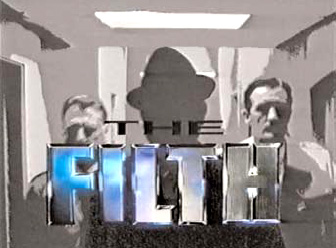
Transporting a character from one era of policing to another, and asking us to consider how both policing and its television representation had changed: these are some of the reasons why <em>Life on Mars</em> (2006-7) and <em>Ashes to Ashes</em> (2008-2010) were rightly acclaimed, but these tactics had previously been attempted in a more ideological way in 1988 by <em>The Black and Blue Lamp</em>. This <em>Screenplay</em> production transported characters from the world of Ealing film <em>The Blue Lamp</em> (1949) to the corrupt, violent world of 1980s policing, here fictionalised as a drama-within-a-drama, <em>The Filth</em>. Whilst Gene Hunt became a popular cultural figure referenced by politicians and media, this play&#8217;s view of the police, and of police drama, was so controversial that it has never been repeated or commercially released. Recapped at the start of the play, <em>The Blue Lamp</em> introduces P. C. George Dixon (Jack Warner), the archetypal British policeman, the kind of &#8220;bobby on the beat&#8221; idealised by successive Home Secretaries. Dixon outlived the film by 26 years (some feat given that the character is killed in the film), appearing in his own series, <em>Dixon of Dock Green</em> (1955-1976), during which time there were marked changes in television drama&#8217;s attitudes to the police. <em>The Black and Blue Lamp</em> juxtaposes the world of Dixon with more cynical modern depictions of the police, producing an Ortonesque darkly comic farce in which there isn&#8217;t simply a comedy of culture-clash but a deconstruction of the Dixon icon and a witty, political questioning of the relationship between fictional treatments of the police and their role in society.</p>
<p>This essay will focus on ideas raised by the play (&#8220;reading&#8221; police drama on the terms set by the play, with the inevitable biases of that approach). I gave a more historical account, with a very detailed synopsis, the history of the <em>Screenplay</em> strand including an interview with producer David M. Thompson, previously unpublished production documentation and correspondence with cast and crew such as Ralph Brown and Sean Chapman, in a piece in 2004.<sup id="rf1-1429"><a href="#fn1-1429" title="That 2004 production file was available for many years &lt;a href=&quot;http://www.the-mausoleum-club.org.uk/Index/Gazette/Black%20and%20Blue%20Lamp.pdf&quot; target=&quot;“_self”&quot; rel=&quot;noopener&quot;&gt;available at &lt;em&gt;The Mausoleum Club&lt;/em&gt; (as a PDF)&lt;/a&gt; but, as of 2021, is no longer accessible. As well as that production file, this website essay draws from some of the material produced for two different conference papers, listed at the end of this essay." rel="footnote">1</a></sup></p>

<hr class="footnotes"><ol class="footnotes" style="list-style-type:decimal"><li id="fn1-1429"><p >That 2004 production file was available for many years <a href="http://www.the-mausoleum-club.org.uk/Index/Gazette/Black%20and%20Blue%20Lamp.pdf" target="“_self”" rel="noopener">available at <em>The Mausoleum Club</em> (as a PDF)</a> but, as of 2021, is no longer accessible. As well as that production file, this website essay draws from some of the material produced for two different conference papers, listed at the end of this essay.&nbsp;<a href="#rf1-1429" class="backlink" title="Return to footnote 1.">&#8617;</a></p></li></ol></hr>{"id":1429,"date":"2011-04-24T16:30:30","date_gmt":"2011-04-24T15:30:30","guid":{"rendered":"http:\/\/www.britishtelevisiondrama.org.uk\/?p=1429"},"modified":"2024-08-30T11:44:23","modified_gmt":"2024-08-30T10:44:23","slug":"from-the-blue-lamp-to-the-black-and-blue-lamp-the-police-in-tv-drama","status":"publish","type":"post","link":"http:\/\/www.britishtelevisiondrama.org.uk\/?p=1429","title":{"rendered":"From <em>The Blue Lamp<\/em> to <em>The Black and Blue Lamp<\/em>: The Police in TV Drama"},"content":{"rendered":"<h4>by DAVID ROLINSON<\/h4>\n<p><em>Screenplay<\/em> <strong>Writer<\/strong>: Arthur Ellis, <strong>Producer<\/strong>: Brenda Reid, <strong>Director<\/strong>: Guy Slater<\/p>\n<p><a href=\"http:\/\/www.britishtelevisiondrama.org.uk\/wp-content\/uploads\/2011\/04\/Lamp_Filth.jpg\"><img loading=\"lazy\" decoding=\"async\" src=\"http:\/\/www.britishtelevisiondrama.org.uk\/wp-content\/uploads\/2011\/04\/Lamp_Filth-300x221.jpg\" alt=\"\" title=\"Lamp_Filth\" width=\"300\" height=\"221\" class=\"alignleft size-medium wp-image-1477\" srcset=\"http:\/\/www.britishtelevisiondrama.org.uk\/wp-content\/uploads\/2011\/04\/Lamp_Filth-300x221.jpg 300w, http:\/\/www.britishtelevisiondrama.org.uk\/wp-content\/uploads\/2011\/04\/Lamp_Filth-150x110.jpg 150w, http:\/\/www.britishtelevisiondrama.org.uk\/wp-content\/uploads\/2011\/04\/Lamp_Filth.jpg 336w\" sizes=\"auto, (max-width: 300px) 100vw, 300px\" \/><\/a><br \/>\nTransporting a character from one era of policing to another, and asking us to consider how both policing and its television representation had changed: these are some of the reasons why <em>Life on Mars<\/em> (2006-7) and <em>Ashes to Ashes<\/em> (2008-2010) were rightly acclaimed, but these tactics had previously been attempted in a more ideological way in 1988 by <em>The Black and Blue Lamp<\/em>. This <em>Screenplay<\/em> production transported characters from the world of Ealing film <em>The Blue Lamp<\/em> (1949) to the corrupt, violent world of 1980s policing, here fictionalised as a drama-within-a-drama, <em>The Filth<\/em>. Whilst Gene Hunt became a popular cultural figure referenced by politicians and media, this play&#8217;s view of the police, and of police drama, was so controversial that it has never been repeated or commercially released. Recapped at the start of the play, <em>The Blue Lamp<\/em> introduces P. C. George Dixon (Jack Warner), the archetypal British policeman, the kind of &#8220;bobby on the beat&#8221; idealised by successive Home Secretaries. Dixon outlived the film by 26 years (some feat given that the character is killed in the film), appearing in his own series, <em>Dixon of Dock Green<\/em> (1955-1976), during which time there were marked changes in television drama&#8217;s attitudes to the police. <em>The Black and Blue Lamp<\/em> juxtaposes the world of Dixon with more cynical modern depictions of the police, producing an Ortonesque darkly comic farce in which there isn&#8217;t simply a comedy of culture-clash but a deconstruction of the Dixon icon and a witty, political questioning of the relationship between fictional treatments of the police and their role in society.<\/p>\n<p>This essay will focus on ideas raised by the play (&#8220;reading&#8221; police drama on the terms set by the play, with the inevitable biases of that approach). I gave a more historical account, with a very detailed synopsis, the history of the <em>Screenplay<\/em> strand including an interview with producer David M. Thompson, previously unpublished production documentation and correspondence with cast and crew such as Ralph Brown and Sean Chapman, in a piece in 2004.<sup id=\"rf1-1429\"><a href=\"#fn1-1429\" title=\"That 2004 production file was available for many years &lt;a href=&quot;http:\/\/www.the-mausoleum-club.org.uk\/Index\/Gazette\/Black%20and%20Blue%20Lamp.pdf&quot; target=&quot;\u201c_self\u201d&quot; rel=&quot;noopener&quot;&gt;available at &lt;em&gt;The Mausoleum Club&lt;\/em&gt; (as a PDF)&lt;\/a&gt; but, as of 2021, is no longer accessible. As well as that production file, this website essay draws from some of the material produced for two different conference papers, listed at the end of this essay.\" rel=\"footnote\">1<\/a><\/sup><\/p>\n<p><!--more--><\/p>\n<p>According to the film\u2019s press book, <em>The Blue Lamp<\/em> establishes veteran Dixon as \u201crepresentative of all policemen throughout the country, steady-going, tolerant, unarmed, carrying out a multitude of duties\u201d.<sup id=\"rf2-1429\"><a href=\"#fn2-1429\" title=\"&lt;em&gt;The Blue Lamp&lt;\/em&gt; press book, quoted in Steve Chibnall, &#8216;The teenage trilogy: &lt;em&gt;The Blue Lamp&lt;\/em&gt;, &lt;em&gt;I Believe in You&lt;\/em&gt; and &lt;em&gt;Violent Playground&lt;\/em&gt;\u2019, in Alan Burton, Tim O\u2019 Sullivan, Paul Wells (editors), &lt;em&gt;Liberal Directions: Basil Dearden and Postwar British Film Culture&lt;\/em&gt; (Trowbridge: Flicks Books, 1997), p. 139. For more on Dearden, including comments on &lt;em&gt;The Black and Blue Lamp&lt;\/em&gt; quoting the earlier version of my essay, see Alan Burton and Tim O\u2019 Sullivan, &lt;em&gt;The Cinema of Basil Dearden and Michael Relph&lt;\/em&gt; (Edinburgh: Edinburgh University Press, 2009).\" rel=\"footnote\">2<\/a><\/sup> Dixon passes on to PC Andy Mitchell (Jimmy Hanley) his local knowledge, gained from years of experience as a copper both of and from the community, and integrates Mitchell into inter-related families: Dixon\u2019s own family (replacing Dixon\u2019s dead son), and the occupational family of the police, which with its choir, darts team and camaraderie is, as Steve Chibnall noted, \u201crepetitively signified as being loosely integrated within the wider community\u201d.<sup id=\"rf3-1429\"><a href=\"#fn3-1429\" title=\"Chibnall, \u2018The teenage trilogy\u2026\u2019, p. 140.\" rel=\"footnote\">3<\/a><\/sup> In this community and the police service, to quote a song sung by Dixon and repeated by the 1980s Hughes in <em>The Black and Blue Lamp<\/em>, \u201call\u201d is \u201ccorrect\u201d. But this society is under threat from a crime wave, personified in Riley (Dirk Bogarde), a young delinquent excluded from the film\u2019s normalised society. Unlike Mitchell, Riley fails to join an occupational family, as the criminal underworld rejects him for lacking the \u201ccode, experience and self-discipline of the professional thief\u201d. The juxtaposition between them is reinforced by editing, as in a cut from Mitchell shining a torch to Hanley lighting a cigarette, on their respective night beats around contrasting London streets &#8211; Riley\u2019s being the jazz-scored neon-lit underworld. The film cuts between Dixon, his wife and Andy in their respectable working-class house to the squalid flat in which we find Riley, his girlfriend Diana and associate Spud. The Dixon family, including visiting colleagues, are filmed in a placid cinematic style, as if we too are sitting contentedly round the table with them. By contrast, Riley, Diana and Spud argue in compositions stressing their disunity, each seeking dominance in the frame, and stylised camera angles which almost expressionistically show this as an off-balance world.<\/p>\n<p>These two worlds come into conflict in the film\u2019s pivotal scene, around halfway through, when Riley shoots Dixon. What\u2019s striking is the powerlessness of the armed man, who commits the cardinal sin in British cinema of losing control (the rest of the film shows him to be sexually charged). His own accomplices scream and call him a \u201cmaniac\u201d, and as the getaway car careers around the streets, the subtext is clear: the policeman\u2019s enemy is a danger to the rest of us too. After this we see the controlled professionalism of the police, in a semi-documentary montage of police procedure as they process the information. This begins to restore order: they will trace the threat on our behalf. Dixon\u2019s sacrifice is good propaganda, reminiscent of the death of a fireman in Humphrey Jennings&#8217;s <em>Fires Were Started-<\/em> (1943), a plot development that was requested by the Ministry of Information to warn of the sacrifices that would be required to defeat Nazi Germany.<sup id=\"rf4-1429\"><a href=\"#fn4-1429\" title=\"&lt;em&gt;Fires Were Started-&lt;\/em&gt; (1943), directed by Humphrey Jennings, the only fiction feature &#8211; in effect drama documentary &#8211; by this important documentary filmmaker.\" rel=\"footnote\">4<\/a><\/sup> Dixon may be the lead character, but as reviewer Dilys Powell argued, \u201cThe real hero of the piece, in fact, is the police force\u201d.<sup id=\"rf5-1429\"><a href=\"#fn5-1429\" title=\"Dilys Powell, \u2018The Blue Lamp\u2019, January 1950, reproduced in &lt;em&gt;The Golden Screen: Fifty Years of Films&lt;\/em&gt; (London: Pavilion Books Limited, 1990 edition, p. 87.\" rel=\"footnote\">5<\/a><\/sup>  <em>The Blue Lamp<\/em> was made with the unprecedented support of the Metropolitan Police (who warmly welcomed it at a time when they were developing new public relations strategies), and is dedicated to them.<\/p>\n<p>The collision between Dixon and Riley is particularly effective because they represent conflicting aspects of post-war society. <em>The Blue Lamp<\/em> shares the core elements by which an image of Britishness was constructed in comedies made by the same studio, Ealing: a belief in community and tradition, stoicism and stability.<sup id=\"rf6-1429\"><a href=\"#fn6-1429\" title=\"This is developed by Charles Barr in his landmark Ealing study: see Barr, &lt;em&gt;Ealing Studios&lt;\/em&gt; (London: Cameron &#038; Tayleur, 1980.\" rel=\"footnote\">6<\/a><\/sup> This connection was heightened by the allocation of the screenplay to T.E.B. Clarke, author of key Ealing comedies; <em>The Blue Lamp<\/em> and Dixon\u2019s character had been developed by Jan Read and by Ted Willis, the writer who was subsequently often viewed as his sole creator. Dixon is a reassuring figure, representing the normative qualities of a nation to be returned to after wartime upheaval. This is reflected structurally: we are given a sense of community, it is threatened by an outsider, and then, as the community reasserts itself, all returns to normal (the fact that <em>The Black and Blue Lamp<\/em> shares this structure, but restores a very different normality, adds to its sense of bitter critique). The restoration of normality is related to the police in the repetition of images from the start of the film at its end: a blue lamp outside a police station, and Mitchell giving the same directions to a member of the public that Dixon gave at the start &#8211; one generation takes over from another, but continues its values. <\/p>\n<p><a href=\"http:\/\/www.britishtelevisiondrama.org.uk\/wp-content\/uploads\/2011\/04\/Lamp_Lamp.jpg\"><img loading=\"lazy\" decoding=\"async\" src=\"http:\/\/www.britishtelevisiondrama.org.uk\/wp-content\/uploads\/2011\/04\/Lamp_Lamp-300x224.jpg\" alt=\"\" title=\"Lamp_Lamp\" width=\"300\" height=\"224\" class=\"alignleft size-medium wp-image-1480\" srcset=\"http:\/\/www.britishtelevisiondrama.org.uk\/wp-content\/uploads\/2011\/04\/Lamp_Lamp-300x224.jpg 300w, http:\/\/www.britishtelevisiondrama.org.uk\/wp-content\/uploads\/2011\/04\/Lamp_Lamp-150x112.jpg 150w, http:\/\/www.britishtelevisiondrama.org.uk\/wp-content\/uploads\/2011\/04\/Lamp_Lamp.jpg 360w\" sizes=\"auto, (max-width: 300px) 100vw, 300px\" \/><\/a><br \/>\nDixon\u2019s killer is equally the product of war. A voice-over describes Diana as \u201cshowing the effect of a childhood spent in a home broken and demoralised by war\u201d, producing delinquents who are \u201cresponsible for the post-war increase in crime\u201d. However, the idea that war has caused social dislocation is underplayed, and must be placed in the context of Riley\u2019s capture at White City. The dangerous loner is repelled by the community, including the criminal underworld. Consensus is therefore rooted in wartime rhetoric &#8211; it\u2019s another menace that we can defeat together, if we stoically overcome traumatic losses. After his death, Dixon\u2019s absence dominates the film. A sense of lost fathers works its way through the film (an auteurist critic might point out here that director Basil Dearden lost his own father as a child during the First World War): Mitchell finds a surrogate father, Riley doesn\u2019t (arguably, he kills him, refusing to give up his gun as Dixon asks &#8211; and a psychoanalytical reading could find performative evidence in the phallic way Bogarde handles the gun in later scenes). The association of the police with paternalism is part of the film\u2019s representation of the police, and that representation has retained its symbolic potency.<\/p>\n<p><a href=\"http:\/\/www.britishtelevisiondrama.org.uk\/wp-content\/uploads\/2011\/04\/Lamp_Dixon.png\"><img loading=\"lazy\" decoding=\"async\" src=\"http:\/\/www.britishtelevisiondrama.org.uk\/wp-content\/uploads\/2011\/04\/Lamp_Dixon-300x245.png\" alt=\"\" title=\"Lamp_Dixon\" width=\"300\" height=\"245\" class=\"alignleft size-medium wp-image-1476\" srcset=\"http:\/\/www.britishtelevisiondrama.org.uk\/wp-content\/uploads\/2011\/04\/Lamp_Dixon-300x245.png 300w, http:\/\/www.britishtelevisiondrama.org.uk\/wp-content\/uploads\/2011\/04\/Lamp_Dixon-150x122.png 150w, http:\/\/www.britishtelevisiondrama.org.uk\/wp-content\/uploads\/2011\/04\/Lamp_Dixon.png 360w\" sizes=\"auto, (max-width: 300px) 100vw, 300px\" \/><\/a><br \/>\nThese ideas were reinforced by <em>Dixon of Dock Green<\/em>, which relocated Dixon from the real Paddington Green to the fictional Dock Green. That his return was so successful was hardly surprising: <em>The Blue Lamp<\/em> had been 1950\u2019s most successful film, and won Best British Film, whilst Jack Warner remained a major star. Making his name in radio series like <em>Garrison Theatre<\/em><sup id=\"rf7-1429\"><a href=\"#fn7-1429\" title=\"&lt;em&gt;Garrison Theatre&lt;\/em&gt;, tx. BBC, 1939-41.\" rel=\"footnote\">7<\/a><\/sup>, in which his comic songs on censorship earned him the sobriquet Jack \u201cBlue Pencil\u201d Warner, Warner had played the father of the Huggett family in four 1940s films from <em>Holiday Camp<\/em><sup id=\"rf8-1429\"><a href=\"#fn8-1429\" title=\"&lt;em&gt;Holiday Camp&lt;\/em&gt; (1947, directed by Ken Annakin.\" rel=\"footnote\">8<\/a><\/sup> to <em>The Huggetts Abroad<\/em><sup id=\"rf9-1429\"><a href=\"#fn9-1429\" title=\"&lt;em&gt;The Huggetts Abroad&lt;\/em&gt; (1949, directed by Ken Annakin).\" rel=\"footnote\">9<\/a><\/sup>, and the Huggetts transferred across media too, appearing in the radio hit <em>Meet the Huggetts<\/em> between 1952 and 1961.<sup id=\"rf10-1429\"><a href=\"#fn10-1429\" title=\"&lt;em&gt;Meet the Huggetts&lt;\/em&gt;, tx. BBC, 1952-61.\" rel=\"footnote\">10<\/a><\/sup> Warner soon became synonymous with policemen, to the extent that a famous song was reworded \u201cIf you want to know the time, ask Jack Warner\u201d.<sup id=\"rf11-1429\"><a href=\"#fn11-1429\" title=\"\u2018P.C. Warner\u2019, &lt;em&gt;Radio Times&lt;\/em&gt;, 1 June 1956, p. 7.\" rel=\"footnote\">11<\/a><\/sup> In the mid-1950s, the early Dixon years, he appeared as policemen in such diverse films as Ealing\u2019s dark comedy <em>The Ladykillers<\/em><sup id=\"rf12-1429\"><a href=\"#fn12-1429\" title=\"&lt;em&gt;The Ladykillers&lt;\/em&gt; (1955), directed by Alexander Mackendrick\" rel=\"footnote\">12<\/a><\/sup> and the science-fiction horror <em>The Quatermass Xperiment <\/em><sup id=\"rf13-1429\"><a href=\"#fn13-1429\" title=\"&lt;em&gt;The Quatermass Xperiment&lt;\/em&gt; (1955), directed by Val Guest, adapted from Nigel Kneale&#8217;s BBC serial &lt;em&gt;The Quatermass Experiment&lt;\/em&gt; (1953).\" rel=\"footnote\">13<\/a><\/sup> In 1965, after Dixon was finally promoted to sergeant, the Queen presented him with an OBE and told him that she looked on Dixon as part of the fabric of Britain. <em>Dixon of Dock Green<\/em> drew large audiences well into the 1970s &#8211; even though Dixon had been approaching retirement age back in 1949 \u2013 and ended in 1976, when Warner was 80 years old. The series was overseen by Ted Willis, who &#8211; ironically, given the dominance of police series in the schedules ever since \u2013 was sceptical that he could find enough material to fill six half-hours. He needn\u2019t have worried, as the series ran for 430 episodes over twenty-two seasons.<\/p>\n<p>Opening episode &#8216;P.C. Crawford\u2019s First Pinch&#8217;<sup id=\"rf14-1429\"><a href=\"#fn14-1429\" title=\"&lt;em&gt;Dixon of Dock Green&lt;\/em&gt;: &#8216;P.C. Crawford&#8217;s First Pinch&#8217;, tx. 9 July 1955, written by Ted Willis, directed by Douglas Moodie\" rel=\"footnote\">14<\/a><\/sup> introduces the series as a mid-1950s variation on <em>The Blue Lamp<\/em>. It borrows the film\u2019s structure \u2013 Dixon assimilates a rookie P.C. called Andy into the police family \u2013 but also introduces us to Dixon\u2019s daughter, whom Andy will soon marry. Displacing the psychological tension and post-war symbolism of the Dixons\u2019 dead son, Mary is the Dixons\u2019 daughter, whose homely qualities offer Andy a more literal marriage into the family. The series remains evocative, with its opening sequence ripe for nostalgia \u2013 the blue lamp of the police station, the whistled theme (initially \u201cMaybe It\u2019s Because I\u2019m A Londoner\u201d, later \u201cAn Ordinary Copper\u201d), the to-camera introduction (\u201cEvenin\u2019 all\u201d) and conclusion by Dixon, as episodic drama\u2019s need for weekly narrative resolution led to the replication each week of the film\u2019s sense of all returning to normal. This device was quoted in Ben Elton\u2019s sitcom <em>The Thin Blue Line<\/em>,<sup id=\"rf15-1429\"><a href=\"#fn15-1429\" title=\"&lt;em&gt;The Thin Blue Line&lt;\/em&gt;, tx. BBC1, 1995-1996\" rel=\"footnote\">15<\/a><\/sup> with Rowan Atkinson\u2019s quaintly anachronistic copper affectionately satirising Dixon (at one point reprimanding armed robbers with the line \u201cI\u2019ve never seen such naughtiness\u201d). <\/p>\n<p>That is the stereotypical view of Dixon: that this old-fashioned promoter of family values did not change along with the times, and that the show became \u201can anachronism, and a dangerously na\u00efve one at that\u201d.<sup id=\"rf16-1429\"><a href=\"#fn16-1429\" title=\"Paul Cornell, Martin Day, Keith Topping, \u2018&lt;em&gt;Dixon of Dock Green&lt;\/em&gt;\u2019, &lt;em&gt;The Guinness Book of Classic British TV&lt;\/em&gt; (Enfield: Guinness Publishing, 1996, 2nd edition, p. 217.\" rel=\"footnote\">16<\/a><\/sup> Its representations of race have certainly dated \u2013 take Dixon\u2019s unmasking of an Eastern religious guru as a blacked-up white conman in &#8216;Bangles, Baubles and Beads\u2019 in 1975<sup id=\"rf17-1429\"><a href=\"#fn17-1429\" title=\"&lt;em&gt;Dixon of Dock Green&lt;\/em&gt;: &#8216;Bangles, Baubles and Beads&#8217;, tx. 15 March 1975, Wr: Derek Ingrey, Dir: Joe Waters\" rel=\"footnote\">17<\/a><\/sup> \u2013 as has Dixon\u2019s attitude to domestic violence. In <em>The Blue Lamp<\/em>, he laughed at Mitchell hurrying to an incident because the husband \u201cdon\u2019t kill his old woman off too quick as a rule\u201d; and in the early <em>Dixon<\/em> episode &#8216;Pound of Flesh&#8217;<sup id=\"rf18-1429\"><a href=\"#fn18-1429\" title=\"&lt;em&gt;Dixon of Dock Green&lt;\/em&gt;: &#8216;Pound of Flesh&#8217;,  tx. 25 August 1956, Wr: Ted Willis, Dir: Douglas Moodie\" rel=\"footnote\">18<\/a><\/sup> observed that \u201cif I arrested every bloke in Dock Green who clocked his wife, I\u2019d be working overtime\u201d.<\/p>\n<p><em>Dixon of Dock Green<\/em>\u2019s supposedly transitory qualities are heightened by the BBC\u2019s archive holdings: only 43 episodes still exist, and only 5 of these are from its 1950s peak. But the series remains interesting, not least for its longevity: as <em>The Listener<\/em> noted in 1976, it \u201chas reflected changes in society, in attitudes to the police, and in the police forces themselves\u201d.<sup id=\"rf19-1429\"><a href=\"#fn19-1429\" title=\"Jack Waterman, &lt;em&gt;The Listener&lt;\/em&gt;, 15 April 1976, quoted in Geoffrey Hurd, \u2018The Television Presentation of the Police\u2019, Tony Bennett, Susan Boyd-Bowman, Colin Mercer, Janet Woollacott (editors), &lt;em&gt;Popular Television and Film&lt;\/em&gt; (London: British Film Institute, 1981), p. 53. Also anthologised in Simon Holdaway (editor), &lt;em&gt;The British Police&lt;\/em&gt; (London: Edward Arnold, 1979).\" rel=\"footnote\">19<\/a><\/sup> Also, <em>Dixon of Dock Green<\/em> does comment on its own worldview. In &#8216;The Roaring Boy&#8217; in 1956, Dixon is held hostage by an armed man who sneers at Dixon\u2019s daughter marrying a cop because \u201cyou lot stick together closer than ants\u201d, and rejects Dixon\u2019s paternalism, snapping at his repeated use of the term \u201cson\u201d.<sup id=\"rf20-1429\"><a href=\"#fn20-1429\" title=\"&lt;em&gt;Dixon of Dock Green&lt;\/em&gt;: &#8216;The Roaring Boy&#8217;, tx. 18 August 1956. Written by Ted Willis, directed by Douglas Moodie.\" rel=\"footnote\">20<\/a><\/sup> Of particular interest are episodes that discuss the possibility of police corruption or incompetence. In 1965, &#8216;The Late Customer&#8217; looks at the possible conviction of an innocent man,<sup id=\"rf21-1429\"><a href=\"#fn21-1429\" title=\"&lt;em&gt;Dixon of Dock Green&lt;\/em&gt;: &#8216;The Late Customer&#8217;, tx. 4 December 1965. Written by Gerald Kelsey, directed by G.B. Lupino.\" rel=\"footnote\">21<\/a><\/sup> while in 1974, &#8216;Firearms Were Issued&#8217; showed the CID being investigated after shooting an unarmed criminal with a gun issued by Dixon. As in <em>The Blue Lamp<\/em>, crises close with the resolution of the status quo; the latter episode ends with Dixon\u2019s complacent statement that \u201cI think I\u2019d\u2019ve done the same\u2026 in those circumstances. Goodnight all\u201d.<sup id=\"rf22-1429\"><a href=\"#fn22-1429\" title=\"&lt;em&gt;Dixon of Dock Green&lt;\/em&gt;: &#8216;Firearms Were Issued&#8217;, tx. 20 April 1974. Written by N.J. Crisp. Directed by Vere Lorrimer.\" rel=\"footnote\">22<\/a><\/sup> The earliest surviving episode, &#8216;The Rotten Apple&#8217; from 1956, shows Dixon angrily confronting Paul Eddington\u2019s corrupt PC: \u201cThere\u2019s nothing worse than a rotten copper\u2026 the lowest thing that crawls on God\u2019s Earth\u201d. That the miscreant is the rotten apple in the barrel, separate from the police as an institution, is shown symbolically in Dixon\u2019s refusal to arrest him until he has removed his uniform, and is then reinforced by Dixon\u2019s closing speech: \u201cthat was the only bad copper I ever met\u2026 the police have to build on trust\u2026 when we find a bad \u2018un we\u2019re down on him like a ton of bricks\u201d.<sup id=\"rf23-1429\"><a href=\"#fn23-1429\" title=\"&lt;em&gt;Dixon of Dock Green&lt;\/em&gt;: &#8216;The Rotten Apple&#8217;, tx. 11 August 1956. Written by Ted Willis. Directed by Douglas Moodie.\" rel=\"footnote\">23<\/a><\/sup> He may not have been \u201cthe only bad copper\u201d on duty in the 1950s, but he was certainly a rare sight on television.<\/p>\n<p>The officers of <em>Z Cars<\/em> (BBC-1, 1962-78) were initially promoted as a reaction against Dixon: flawed men, with less conventional family lives (and in Steele&#8217;s case, as likely to commit domestic violence as investigate it) and an occasionally more cynical attitude to police work &#8211; notably, the prospect of confronting an armed robber in &#8216;Ambush&#8217; doesn&#8217;t fill Lynch with the desire for a Dixon-style sacrifice.<sup id=\"rf24-1429\"><a href=\"#fn24-1429\" title=\"&lt;em&gt;Z Cars&lt;\/em&gt;: &#8216;Ambush&#8217;, tx. 21 November 1962.\" rel=\"footnote\">24<\/a><\/sup> Director John McGrath insisted that the show should have \u201cNo slick tie-ups. No reassuring endings, where decency and family life triumph\u201d.<sup id=\"rf25-1429\"><a href=\"#fn25-1429\" title=\"John McGrath, \u2018TV Drama: The Case Against Naturalism\u2019, &lt;em&gt;Sight and Sound&lt;\/em&gt;, volume 46, number 2, Spring 1977, p. 103.\" rel=\"footnote\">25<\/a><\/sup> Where Dixon\u2019s officers brought \u201ccare\u201d to their own community, changes to social cohesion were reflected in <em>Z Cars<\/em>\u2019 \u2018Newtown\u2019 setting. The series was welcomed by critics as a welcome relief from Dixon\u2019s \u201csugary nonsense\u201d, a \u201ctoo good to be true copper\u201d written by Willis who, for those critics, seemed to be \u201cthe police\u2019s PRO\u201d.<sup id=\"rf26-1429\"><a href=\"#fn26-1429\" title=\"Frederick Laws, &lt;em&gt;The Listener&lt;\/em&gt;, 18 January 1962, p.145 and Derek Hill, &lt;em&gt;The Listener&lt;\/em&gt;, 3 May 1962, quoted in Stuart Laing, \u2018Banging in Some Reality: The Original Z Cars\u2019, in John Corner (editor), &lt;em&gt;Popular Television in Britain&lt;\/em&gt; (London: British Film Institute, 1991, pp. 130-131.\" rel=\"footnote\">26<\/a><\/sup> A 14-year-old letter writer stated that \u201cIf <em>Dock Green<\/em> is authentic I am not surprised at the high crime rate in this country\u201d.<sup id=\"rf27-1429\"><a href=\"#fn27-1429\" title=\"Jane Halton, letters column, &lt;em&gt;Radio Times&lt;\/em&gt;, 29 March1962, quoted in Laing, \u2018Banging In Some Reality\u2019, p. 131.\" rel=\"footnote\">27<\/a><\/sup> <\/p>\n<p>And yet, the series remained popular, precisely because of its style and setting. The series did have a core of research; Willis based Dixon on a P.C. that he met at Leman Street Police Station while researching <em>The Blue Lamp<\/em>, and years later reiterated that if you \u201cgo into any London police station\u2026 you will find a Dixon\u201d.<sup id=\"rf28-1429\"><a href=\"#fn28-1429\" title=\"Ted Willis, &lt;em&gt;The Listener&lt;\/em&gt;, 17 May 1962, p.787, quoted in Laing, \u2018Banging in Some Reality\u2019, p. 131.\" rel=\"footnote\">28<\/a><\/sup> Before each series, Willis would visit Scotland Yard\u2019s Public Relations Officer, who \u201coutlines the main points they would like to put over. He doesn\u2019t interfere with the programme in any way, but he mentions such things as \u2018can you put in a bit about locking your car when you leave it?\u2019\u2026 This advice keeps things topical\u201d.<sup id=\"rf29-1429\"><a href=\"#fn29-1429\" title=\"Ted Willis, \u2018Just an Ordinary Copper\u2019, &lt;em&gt;Radio Times&lt;\/em&gt;, 27 November 1959, p. 7. Shades there of the kind of police involvement typical in the period &#8211; see for instance the lengthy advice offered to the Grove family, and therefore us, in &lt;em&gt;The Grove Family&lt;\/em&gt; episode &#8216;Prevention and Cure&#8217;, tx. 21 March 1956.\" rel=\"footnote\">29<\/a><\/sup> Its take on the \u201cpolice procedural\u201d series represents a purity for which later series, notably <em>The Bill<\/em> (ITV, 1983-2010) in its first decade, strived. In its own way, Dixon was innovative, as Ted Willis sought \u201cto break away from the accepted formula for police and crime stories. Dixon couldn\u2019t be Dixon in a programme which was full of wailing sirens, screeching brakes, gun fights\u2026 The average policeman might go through a life-time of service without being involved in one murder-case. His life is one of routine\u2026 Would [viewers] take simple, human stories about a simple ordinary copper and the people he meets?\u201d<sup id=\"rf30-1429\"><a href=\"#fn30-1429\" title=\"Ted Willis, \u2018George Dixon of Dock Green is Back\u2019, &lt;em&gt;Radio Times&lt;\/em&gt;, 4 January 1957, p. 5.\" rel=\"footnote\">30<\/a><\/sup> Ironically, this search for routine and de-dramatized ordinariness is what marks out some of the most distinctive early <em>Z Cars<\/em> episodes, especially those written by Alan Plater. Meanwhile, it would be ironic to attack the show now given the popularity of <em>Heartbeat<\/em> (ITV, 1992-2010), a quiet, primetime family drama set around an idealised representation of old-fashioned police, though this was made a consciously nostalgic package &#8211; through its period detail and pop music &#8211; as if signifying that people wouldn\u2019t accept that the police are like this now.<\/p>\n<p>Though <em>The Sweeney<\/em> (ITV, 1974-78) is often described as smashing up Dixon\u2019s cosy world, this ignores a number of other police series from the period that are also worthy of attention (and to which this site will return), but it also ignores the anomaly that <em>Dixon of Dock Green<\/em> survived into this era (with Dixon a desk sergeant and Andy Crawford in CID involved with \u201cshooters\u201d and \u201cblags\u201d). Furthermore, according to Arthur Ellis, and this is the interpretation that underpins <em>The Black and Blue Lamp<\/em>, there is a fundamental connection between the likes of <em>The Sweeney<\/em> and <em>Dixon of Dock Green<\/em>: \u201cin the mid 70s, when Jack Warner was about 200 years old\u2026 the idea of a decent beat copper was supplanted by John Thaw\u2019s Regan, who was a tad more aggressive in his pursuit of criminal scum &#8211; aggressive, but non bent &#8211; pretty much an updated version of Barlow [from <em>Z Cars<\/em>]. The interesting thing was, both series, requiring cops as heroes, played into the hands of the Met, in terms of PR\u2026 The only variant was that <em>The Sweeney<\/em>, cashing in on what was happening all around it in films, romanticised screen violence, which gave the Met a nice tough little image that invariably helped them employ it\u201d. Of far more consequence was <em>Law and Order<\/em> from 1978.<sup id=\"rf31-1429\"><a href=\"#fn31-1429\" title=\"&lt;em&gt;Law and Order&lt;\/em&gt;, tx. BBC2, 6-27 April 1978.\" rel=\"footnote\">31<\/a><\/sup> As Cornell, Day and Topping put it, writer G.F. Newman, \u201ca graduate of the \u2018all coppers are bastards\u2019 school\u201d, provided such brutal and corrupt characters that <em>Law and Order<\/em> \u201cmade <em>The Sweeney<\/em> look like boy scouts\u201d.<sup id=\"rf32-1429\"><a href=\"#fn32-1429\" title=\"Cornell, Day, Topping and Nick Cooper, \u2018G.F. Newman\u2019, Guinness Book, p. 405.\" rel=\"footnote\">32<\/a><\/sup> Far from Dixon\u2019s \u201cone bad apple\u201d, Newman believed that \u201cthe person who becomes a policeman has almost exactly the same pathology as the criminal\u201d.<sup id=\"rf33-1429\"><a href=\"#fn33-1429\" title=\"G.F. Newman, 1993 interview, quoted in ibid.\" rel=\"footnote\">33<\/a><\/sup> The impact of <em>Law and Order<\/em> has been documented recently in a new study by Charlotte Brunsdon for the BFI\u2019s TV Classics range.<sup id=\"rf34-1429\"><a href=\"#fn34-1429\" title=\"Charlotte Brunsdon, &lt;em&gt;Law and Order&lt;\/em&gt; (London: Palgrave, 2010).\" rel=\"footnote\">34<\/a><\/sup><\/p>\n<p>In <em>The Black and Blue Lamp<\/em>, Arthur Ellis confronts the 1949 Tom Riley with this breed of copper, charting the changing perceptions of the police in the media and society. Ellis was friendly with Newman, and admired Newman&#8217;s Terry Sneed novels, which began with <em>Sir, You Bastard<\/em>, a book which \u201centirely changed the perception of how the police operated. They also had a high influence on officers themselves, who for the first time saw themselves written about as in fact they would like to be perceived\u2026 [meeting a cop a few years later, he said that] a few years back the books, though fiction, were documenting procedure and lingo, now the lingo was being adopted by the incoming cops. Fiction was influencing fact\u201d.<sup id=\"rf35-1429\"><a href=\"#fn35-1429\" title=\"G.F. Newman, &lt;em&gt;Sir, You Bastard&lt;\/em&gt; (Simon and Schuster, 1970).\" rel=\"footnote\">35<\/a><\/sup> <em>Law and Order<\/em> in turn \u201ccompletely changed the way TV looked at cops, with an authority that had no basis in <em>The Sweeney<\/em>\u2019s romantic and Met friendly propaganda. Naturally enough The Police Federation and the police in general loathed the series and demanded redress\u201d.<sup id=\"rf36-1429\"><a href=\"#fn36-1429\" title=\"Ellis, correspondence with Dave Rolinson.\" rel=\"footnote\">36<\/a><\/sup> Writing for the <em>Screenplay<\/em> strand to which he had earlier contributed drug addiction piece <em>Christine<\/em> in collaboration with Alan Clarke,<sup id=\"rf37-1429\"><a href=\"#fn37-1429\" title=\"&lt;em&gt;Screenplay&lt;\/em&gt;: &lt;em&gt;Christine&lt;\/em&gt;, tx. 23 September 1987, written by Arthur Ellis and Alan Clarke, directed by Alan Clarke.\" rel=\"footnote\">37<\/a><\/sup> Ellis found himself writing a more traditional television studio play, of the kind which was being phased out. Ellis recalls that producer Brenda Reid \u201chad a 60 minute studio tape slot she needed filling and nothing to fill it with. I wrote up the 2 page premise and, as I recall, within four days or so, was given the nod by Brenda to write up the script\u2026 The only rule given me was that there could be absolutely no exterior or location filming. The entire thing had to be shot in the studio. Which was fine by me. It gave me boundaries, format, discipline and structure, without having to think about them\u2026 I completed the script within maybe a month or so\u201d.<sup id=\"rf38-1429\"><a href=\"#fn38-1429\" title=\"Arthur Ellis, correspondence with Dave Rolinson.\" rel=\"footnote\">38<\/a><\/sup><\/p>\n<p>After an opening montage of clips from <em>The Blue Lamp<\/em> (a sequence that Ellis would now &#8220;compress [&#8230;] because it&#8217;s way too long&#8221;),<sup id=\"rf39-1429\"><a href=\"#fn39-1429\" title=\"Ellis, written memoir.\" rel=\"footnote\">39<\/a><\/sup> <em>The Black and Blue Lamp<\/em> enters borderline telefantasy territory as, in an engagingly unexplained switch, Riley and Hughes end up in a 1980s police station. Riley observes the markers: graffiti on the walls, a radiator, strip lighting, and the sound of police sirens, modern telephones and screams. Riley\u2019s period banter draws Superintendent Cherry (Kenneth Cranham)\u2019s response: \u201cyou\u2019re gonna put your hands up to this one, son, or I\u2019ll take your bollocks off with a Stanley knife\u201d. As that realisation sinks in, we see another title sequence, this time for imaginary 1980s police series <em>The Filth<\/em>. Nicely observed in terms of its graphics and shots of officers striding purposefully down corridors, it also shows a chain of bribery. This sequence is the third title sequence to feature in the play, after those of <em>The Black and Blue Lamp<\/em> itself and <em>The Blue Lamp<\/em>. This repetition of title sequences underlines that police dramas are representations which use codes and conventions to guide our reading not only of the fiction but of the world to which they correspond. This is echoed by the play&#8217;s end credits, which feature a melancholy alternative theme, as if recalling the end credits of <em>The Sweeney<\/em>. <\/p>\n<p><a href=\"http:\/\/www.britishtelevisiondrama.org.uk\/wp-content\/uploads\/2011\/04\/Lamp_CherryRiley.png\"><img loading=\"lazy\" decoding=\"async\" src=\"http:\/\/www.britishtelevisiondrama.org.uk\/wp-content\/uploads\/2011\/04\/Lamp_CherryRiley-300x245.png\" alt=\"\" title=\"Lamp_CherryRiley\" width=\"300\" height=\"245\" class=\"alignleft size-medium wp-image-1475\" srcset=\"http:\/\/www.britishtelevisiondrama.org.uk\/wp-content\/uploads\/2011\/04\/Lamp_CherryRiley-300x245.png 300w, http:\/\/www.britishtelevisiondrama.org.uk\/wp-content\/uploads\/2011\/04\/Lamp_CherryRiley-150x122.png 150w, http:\/\/www.britishtelevisiondrama.org.uk\/wp-content\/uploads\/2011\/04\/Lamp_CherryRiley.png 360w\" sizes=\"auto, (max-width: 300px) 100vw, 300px\" \/><\/a><br \/>\nRiley and Hughes have replaced 1980s versions of Riley and Hughes, after the murder of an 80s version of Dixon. <em>The Blue Lamp<\/em> is playfully satirised &#8211; Cherry takes one look at the Bogarde character and asks, \u201cIs that the presence of a hardened criminal? He looks like he\u2019s just come out of RADA\u201d. Hammond sneers: \u201cTwenty-five years a pissing woodentop and old George still didn\u2019t learn anything\u2026 you wouldn\u2019t catch me trying to win an award with some wanker aiming a twelve-gauge at my meat-and-two-veg\u201d. Indeed, it\u2019s no coincidence that one of the first lines is \u201cDixon. Isn\u2019t anything sacred?\u201d The comment that Dixon\u2019s killing is \u201cgood PR\u201d \u2013 \u201cthe training schools\u2019ll be having them in and out quicker than a pork sword in a knocking shop\u201d \u2013 is reminiscent of <em>The Blue Lamp<\/em>\u2019s origins as police propaganda &#8211; as Dearden\u2019s collaborator Michael Relph said, <em>The Blue Lamp<\/em> was \u201cmore an animated recruitment poster than an analysis of youthful crime\u201d.<sup id=\"rf40-1429\"><a href=\"#fn40-1429\" title=\"Chibnall, \u2018The teenage trilogy\u2019, p. 137.\" rel=\"footnote\">40<\/a><\/sup> Cherry ruminates on what makes \u201can old-fashioned PC\u201d: \u201cA man of experience, unswerving in his desire to serve the public, polite yet chirpy, conciliatory but always ethical, a bastion of moral fibre and a power of example. And then we join the Filth\u201d. The case against Riley can be enhanced by fingerprints added to a sawn-off shotgun and, to suit the zeitgeist, a VHS of <em>Rambo<\/em>,<sup id=\"rf41-1429\"><a href=\"#fn41-1429\" title=\"Rambo: First Blood Part II (1985, dir. George P. Cosmatos).\" rel=\"footnote\">41<\/a><\/sup> while the comment that a character has had a mild stroke prompts Hammond&#8217;s response: &#8220;Genuine, or one of ours?&#8221; Worse still is the realisation that Dixon\u2019s death saved him from facing unsavoury allegations \u2013 as Cherry puts it, \u201cBlimey, a case of P.C. Paedophile. I don&#8217;t remember this one on <em>Scotland Yard Mysteries<\/em>\u201d. Ellis admits that \u201cI was expecting flak from Ted Willis, creator of Dixon, for suggesting his character was involved in child swapping parties. But not a word from him. However, The Police Federation came out vehemently against the play via a full page <em>Daily Mail<\/em> article, even though they hadn\u2019t then seen it. Thousand and thousands of pro police TV hours, and they resent the occasional hour going the other way\u201d.<sup id=\"rf42-1429\"><a href=\"#fn42-1429\" title=\"Ellis, correspondence with Dave Rolinson.\" rel=\"footnote\">42<\/a><\/sup><\/p>\n<p><em>The Black and Blue Lamp<\/em> isn\u2019t simply a parody of <em>The Blue Lamp<\/em>, after all Ellis &#8220;loved <em>The Blue Lamp<\/em>&#8220;,<sup id=\"rf43-1429\"><a href=\"#fn43-1429\" title=\"Ibid.\" rel=\"footnote\">43<\/a><\/sup> but is a brilliant inversion of its source film, with Riley carrying Forties values into a view of the police which is just as mythologised as Dixon\u2019s cosy world. When P.C. Hughes&#8217;s breakdown leads him to challenge Riley with a gun, the scene directly quotes the scene from <em>The Blue Lamp<\/em> in which Riley shoots Dixon, but this time it is the unarmed villain who is trying to talk down the armed policeman: their dialogue is the same, and when Riley is shot, Sean Chapman captures Jack Warner\u2019s facial expression as he falls. Given that the dialogue reverberating in Hughes&#8217;s head is a surprisingly harsh line from <em>The Blue Lamp<\/em> &#8211; \u201cWe\u2019re onto the bastard that shot George Dixon\u201d &#8211; it has an eerie sense of 1940s coppers acting out vengeful impulses which that film could not represent. By this stage in the play, \u201cthe difference between them and us\u201d<sup id=\"rf44-1429\"><a href=\"#fn44-1429\" title=\"Ibid.\" rel=\"footnote\">44<\/a><\/sup> has gone, and the play implicates the act of representation in this. After all, it is Hughes who commits the worst atrocities in an identity crisis caused by discovering that he \u201cwas not the affable beat bobby he was back in the late 40s\u201d, and by being corrupted by this mode of representation. That the 80s Hughes is \u201cirredeemably bent\u201d had been made even clearer the first draft, which, as Ellis explained, contained a scene in which his wife visits him at the station \u201cto ask for more money to pay off her innumerable debts and the rental of Taffy\u2019s splash pad \u2013 a rented room where Taffy (in his post modern existence) had sex with a variety of young boys and girls, and stashed his graft\u2026 The scene was cut due to Brenda not wanting me to present the only female in the story as a leech\u2026 [and by me wanting] to make the entire play a male arena\u201d. Another element which was \u201cwatered down, though still in the script somewhere, was the fact that Taffy\u2019s father was, as a young man, at Rourke\u2019s Drift (see <em>Zulu<\/em>), and though discovering proof of his own corruption, needed to believe himself more heroic and courageous than the slowly revealing facts were telling him\u2026 he saw himself as a VC winning soldier (with John Barry\u2019s <em>Zulu<\/em> score written into the script), just like his old man, and not as the corrupt character\u201d.<sup id=\"rf45-1429\"><a href=\"#fn45-1429\" title=\"Ibid. &lt;em&gt;Zulu&lt;\/em&gt; (1963), directed by Cy Endfield, a director Ellis hugely admires. I&#8217;ve written on Endfield elsewhere, in the DVD booklet for the Special Edition of &lt;em&gt;Hell Drivers&lt;\/em&gt; (1957).\" rel=\"footnote\">45<\/a><\/sup> <\/p>\n<p>The play revolves around the collision of conventions of set design, costume (Cherry\u2019s wardrobe contains a row of identical macs) and, particularly, dialogue. As Mark Lawson wrote, Ellis \u201cwas alert to a war of words\u201d, and \u201cdelighted in the time-travel of language so that the chump, chummy, mug, mullarkey of Tom Riley met the blag, monkeys, shooters and copy-cat Rambos of Supt Cherry and Sgt Hammond\u201d.<sup id=\"rf46-1429\"><a href=\"#fn46-1429\" title=\"Mark Lawson, \u2018From Bobby to Old Bill\u2019, &lt;em&gt;The Independent&lt;\/em&gt;, 8 September 1988, p. 14.\" rel=\"footnote\">46<\/a><\/sup> Turning wearily from a conversation about a \u201cfag blag\u201d, Hammond observes that when he retires he\u2019ll be happy to put this \u201cCID semaphore behind me. Janet hasn\u2019t understood a word I\u2019ve been saying for twenty years\u201d. Meanwhile, Riley is beaten up after not knowing what a \u201cblag\u201d is, while Hughes is shocked by hearing policemen \u201cusing rude words\u201d. The sense you\u2019re left with is that <em>The Blue Lamp<\/em>, <em>Dixon of Dock Green<\/em> and the programmes on which <em>The Filth<\/em> is based have tricky relationships with their times.<\/p>\n<p><em>The Blue Lamp<\/em> itself isn\u2019t afraid to satirise its own vision of consensus &#8211; a robbery victim who tries to hide his identity because he is with his mistress is frustrated by interfering busybodies who swarm around to help or to ring 999, and a driver berates Mitchell for stopping her for a petty violation when there\u2019s a cop killer on the loose. Far from being a consensual nation with the occasional dangerous loner, Britain was suffering a crime wave. As has been recently documented, that most mythologised of consensual eras, the Second World War, was in fact plagued by robbery, rape and murder, from such relatively famous figures as John George Haig and \u2018Chicago Joe and the Showgirl\u2019 to innumerable unsolved cases.<sup id=\"rf47-1429\"><a href=\"#fn47-1429\" title=\"Studies include Angus Calder, &lt;em&gt;The Myth of the Blitz&lt;\/em&gt;; Stuart Hylton, &lt;em&gt;Their Darkest Hour&lt;\/em&gt;; and &lt;em&gt;Secret History&lt;\/em&gt;: \u2018Wartime Crime\u2019, tx. Channel 4, 6 September 2001.\" rel=\"footnote\">47<\/a><\/sup> Furthermore, <em>The Blue Lamp<\/em> was inspired by a real-life killing, that of P.C. Nat Edgar by the 22-year-old army deserter Donald Thomas. Following the 1948 Criminal Justice Act, Thomas was not hung, a decision that angered the police and indirectly led, according to David Yallop and others, to the hanging of the young and innocent \u201cdelinquent\u201d Derek Bentley in 1952, one of many miscarriages of justice that were not a part of George Dixon\u2019s world.<sup id=\"rf48-1429\"><a href=\"#fn48-1429\" title=\"See for instance David Yallop\u2019s investigation of the Craig-Bentley case, &lt;em&gt;To Encourage the Others&lt;\/em&gt; (London: W.H. Allen, 1971.\" rel=\"footnote\">48<\/a><\/sup> <\/p>\n<p>A Royal Commission was set up in 1960 after bribery and corruption scandals emerged. Later, Leeds detectives were found to be involved in a child porn ring. Meanwhile, the famously hard-working and much-commended Detective Sergeant Harold Challenor was investigated under the 1964 Police Act for his overzealous policing techniques (not least fabricating evidence and attacking prisoners), finally suspended in February 1965. Joe Orton, reportedly obsessed by Challenor, used him as the basis for Inspector Truscott in his 1966 play <em>Loot<\/em>, borrowing the line Challenor is reputed to have said to a protestor at a royal visit: \u201cYou\u2019re fucking nicked, my old beauty\u201d (later repeated by <em>Monty Python\u2019s Life of Brian<\/em>).<sup id=\"rf49-1429\"><a href=\"#fn49-1429\" title=\"See Joe Orton, &lt;em&gt;Loot&lt;\/em&gt;, in &lt;em&gt;The Complete Plays&lt;\/em&gt; (London: Methuen, 1976.).\" rel=\"footnote\">49<\/a><\/sup> Orton argued that \u201cit\u2019s very unhealthy for a society to love the police the way the English do\u2026 When you have that kind of affection for authority, you begin to have the makings of a police state\u201d. In the published version of <em>Loot<\/em>, Orton uses an epigram from George Bernard Shaw\u2019s <\/em>Misalliance: \u201cAnarchism is a game at which the police can beat you\u201d.<sup id=\"rf50-1429\"><a href=\"#fn50-1429\" title=\"John Lahr, &lt;em&gt;Prick Up Your Ears&lt;\/em&gt; (London: Allen Lane, 1978, pp. 236-238.).\" rel=\"footnote\">50<\/a><\/sup> Sean Chapman picked up on this, eulogising the \u201csheer, delicious mania of Arthur\u2019s script, which struck me as a brilliant post \u2018Ortonesque\u2019 statement about the disparity between the Official, sanctified face of Policing and the actual reality\u201d.<sup id=\"rf51-1429\"><a href=\"#fn51-1429\" title=\"Sean Chapman, correspondence with the editor of &lt;em&gt;The Mausoleum Club&lt;\/em&gt; for this essay.\" rel=\"footnote\">51<\/a><\/sup> In the 1980s, the \u201cthem and us\u201d relationship between the public and the police was worsened by their deployment as state troops during inner city riots and the miners\u2019 strike. Chapman observes that the play \u201cwas written against a recent background of Police catastrophes such as the battles at Broadwater Farm, the Miner\u2019s Strike\/Orgreave and the emerging scandal of the Guildford Four. The exposure of corruption in the West Midlands Special Branch was shortly to make the action in The Black and Blue Lamp all too plausible\u201d.<sup id=\"rf52-1429\"><a href=\"#fn52-1429\" title=\"Ibid.\" rel=\"footnote\">52<\/a><\/sup> It\u2019s a moot point whether television has changed the public\u2019s perception of the police, or the media had just got around to reporting incidents that they could not report in Dixon\u2019s heyday.<\/p>\n<p>\u201cOne of the things that\u2019s interesting about <em>The Blue Lamp<\/em>\u201d, writes Arthur Ellis, \u201cis that its certain authenticity \u2013 procedure, location filming etc \u2013 is sponsored in a credit at the opening of the film by the then Scotland Yard Commissioner, Harold Scott. Naturally enough, part of the deal (implicit) for Scotland Yard\u2019s help would have been a script that showed his men in a good light\u2026 In no small way, because of TV and film\u2019s portrayal of probitious cops who always get their man, rampant on UK TV through the 60s \u2013 <em>Gideon\u2019s Way<\/em>, <em>No Hiding Place<\/em> etc \u2013 the facts of police corruption were entirely unmentionable, allowing police corruption to thrive with absolutely no scrutiny until the issue was raised in the Kray and Richardson trials, and only followed through a few years later, exploding with Humphries and, ironically, his Flying Squad Soho porn jiffy bag collections. And at that time, retirement with full pension intact, prior to any trial, was de rigeur. The crime wasn\u2019t being bent, it was being caught being bent\u201d.<sup id=\"rf53-1429\"><a href=\"#fn53-1429\" title=\"Ibid. &lt;em&gt;Gideon\u2019s Way&lt;\/em&gt;, ATV, tx. 1965-65; &lt;em&gt;No Hiding Place&lt;\/em&gt;, Associated Rediffusion, tx. 1959-67.\" rel=\"footnote\">53<\/a><\/sup> Viewing the ending of Dixon episode <em>The Rotten Apple<\/em> with this in mind, Dixon\u2019s anger at the corrupt officer, and subsequent disclaimer, feel slightly more sinister. <\/p>\n<p>In <em>The Black and Blue Lamp<\/em>, George Dixon is eulogised by a policeman, but that character is himself suffering from concussion, lending Dixon\u2019s whole representation the aura of a deluded daydream. Even at the time of <em>The Blue Lamp<\/em>, one critic wrote that Dixon and Mitchell were not \u201cpolicemen as they really are but policemen as an indulgent tradition has chosen to think they are\u201d.<sup id=\"rf54-1429\"><a href=\"#fn54-1429\" title=\"&lt;em&gt;The Times&lt;\/em&gt;, 20 January 1950, p.8, quoted in Clive Emsley, \u2018The English Bobby: An Indulgent Tradition\u2019, in Roy Porter (editor), &lt;em&gt;Myths of the English&lt;\/em&gt; (Cambridge: Polity Press, 1992, p.114.\" rel=\"footnote\">54<\/a><\/sup> Dixon-style \u201csoft\u201d policing became a term of abuse in police circles according to some studies, but the potency of the Dixon myth remains. Roger Graef, whose noted fly-on-the-wall documentaries include <em>Police<\/em> and <em>Police 2001<\/em> (tx: BBC-2, 25th November 2001),<sup id=\"rf55-1429\"><a href=\"#fn55-1429\" title=\"&lt;em&gt;Police&lt;\/em&gt;, tx. BBC1, 4 January \u2013 15 March 1982; &lt;em&gt;Police 2001&lt;\/em&gt;, tx. BBC2, 25 November 2001.\" rel=\"footnote\">55<\/a><\/sup> has argued that, although Dixon may not have existed literally, \u201ca trust between police and their community did\u2026 Affection for Dixon\u2019s avuncular persona reflected approval of the police by a huge majority of postwar Britain\u201d.<sup id=\"rf56-1429\"><a href=\"#fn56-1429\" title=\"Roger Graef, \u2018Whose Side Are You On?\u2019, &lt;em&gt;The Guardian&lt;\/em&gt;, Weekend, 24 November 2001, p. 45.\" rel=\"footnote\">56<\/a><\/sup> Steve Chibnall casts doubt on the nature of the public\u2019s acceptance of Dixon: \u201cit would be na\u00efve to suppose that the Dixon image was embraced as a realistic representation of the policeman, rather than a romantic idea of what he should be like\u201d.<sup id=\"rf57-1429\"><a href=\"#fn57-1429\" title=\"Chibnall, \u2018The teenage trilogy\u2026\u2019, p. 139.\" rel=\"footnote\">57<\/a><\/sup> The police remain a core social myth, and such representations will always outnumber counter-myths. Like <em>Law and Order<\/em> before it, <em>The Black and Blue Lamp<\/em> attracted the ire of the police (see Ellis above), and neither programme has ever been repeated or sold abroad. This contrasts with the popularity within the force not only of Dixon (after Warner\u2019s death in 1981, his coffin was borne by Paddington Green officers) but also of <em>The Sweeney<\/em>\u2019s Regan and Carter, who as Ellis indicates were great PR at a time when the Police Federation sought a \u201claw and order\u201d platform. Despite stylistic and tonal shifts in police dramas, \u201cthe dominant myths of the British police retain core (\u2018caring\u2019 and \u2018humane\u2019) values which do not change\u201d.<sup id=\"rf58-1429\"><a href=\"#fn58-1429\" title=\"John Tulloch, &lt;em&gt;Television Drama: Agency, Audience and Myth&lt;\/em&gt; (London: Routledge, 1990, p. 7.\" rel=\"footnote\">58<\/a><\/sup><\/p>\n<p>Tracing a \u201cdialectical progression\u201d in the politics of policing, Robert Reiner argues that <em>Dixon of Dock Green<\/em> represents the \u201cthesis\u201d, presenting the police \u201cprimarily as carers, lightning rods for the postwar consensus climate\u201d; that <em>The Sweeney<\/em> is the \u201cantithesis\u201d, presenting the police \u201cprimarily as controllers\u201d; and that <em>The Bill<\/em> represents the \u201csynthesis\u201d, suggesting that \u201ccare and control are interdependent\u201d.<sup id=\"rf59-1429\"><a href=\"#fn59-1429\" title=\"Robert Reiner, \u2018The Dialectics of Dixon: The Changing Image of the TV Cop\u2019, in Mike Stephens and Saul Becker (editors), &lt;em&gt;Police Force, Police Service&lt;\/em&gt; (Basingstoke: MacMillan, 1994, p. 20.\" rel=\"footnote\">59<\/a><\/sup> This core notion of community \u201ccarer\u201d policing demonstrates that, even in an age of cynicism toward institutions, the ideal represented by George Dixon remains attractive.<\/p>\n<p>Ellis\u2019s script superbly incorporates such ambitious themes within a darkly entertaining and knowing structure. He recalls that he \u201chad a lot of fun writing it\u2026 The general approach to writing it was to try to get laughs from credibly twisted situations. Parody certainly plays an element, but I wanted more to get the feel of a farce, with an increasing number of bodies\u201d. Ralph Brown recalls that the cast \u201call had the utmost respect for the script\u201d, and that Ellis was \u201ca true original\u201d, with whom he later worked in Ellis\u2019s full-length directorial debut (after several highly-respected short films) <em>Don\u2019t Get Me Started<\/em> (1994, aka <em>Psychotherapy<\/em>).<sup id=\"rf60-1429\"><a href=\"#fn60-1429\" title=\"Ralph Brown, correspondence with the editor of The Mausoleum Club for the earlier version of this essay.\" rel=\"footnote\">60<\/a><\/sup> The production doesn\u2019t always live up to the script \u2013 see the <em>Mausoleum Club<\/em> PDF for comments by the writer and cast criticising the play\u2019s direction for overplaying laughs, over-choreographing reactions and for visual techniques that undermined the play\u2019s vital aspects.<sup id=\"rf61-1429\"><a href=\"#fn61-1429\" title=\"See the correspondence quoted from Brown, Chapman and Ellis, the latter of whom \u201cthreatened, impotently I might add, to chuck [the director] out of the TV Centre fifth floor window\u201d.\" rel=\"footnote\">61<\/a><\/sup><\/p>\n<p>The play\u2019s coda is a treat, inverting the rest of the play by showing the modern-day Riley in the world of <em>The Blue Lamp<\/em>: when he\u2019s told a detective will want to \u201cgrill\u201d him, Riley replies: \u201cWhat\u2019s he think I am, a fucking sausage?\u201d This ending is so fitting that it\u2019s surprising that Ellis heard &#8211; not from producer or director &#8211; \u201cthat they had decided to cut the final scene [&#8230;] Though the one \u2018fucking\u2019 had been in it all along, for some reason they felt the play would be better without it, failing to take into account that the last scene offered an insight into the parallel world that might have occurred in reverse\u2026 It was only through the intervention of Michael Winner, and by default <em>Private Eye<\/em> magazine, that the scene was pressured to remain\u201d.<sup id=\"rf62-1429\"><a href=\"#fn62-1429\" title=\"Ellis, correspondence with Dave Rolinson.\" rel=\"footnote\">62<\/a><\/sup><\/p>\n<p>The reviews, some of which I have already quoted from, were largely excellent. Mark Lawson called this \u201ca cracking play\u201d and \u201ca velvety black comedy\u201d, and praised Kenneth Cranham and John Woodvine, for playing their parts \u201clike glorious anti-auditions for <em>The Bill<\/em>\u201d.<sup id=\"rf63-1429\"><a href=\"#fn63-1429\" title=\"Mark Lawson, \u2018From Bobby to Old Bill\u2019.\" rel=\"footnote\">63<\/a><\/sup> Peter Waymark of the <em>Times<\/em> was less impressed: \u201cI suspect there was serious intent\u2026 but it ends up like a Monty Python sketch which has outstayed its welcome\u2026 There are many good jokes in <em>The Black and Blue Lamp<\/em> but in the end they defeat their purpose. If the modern segment is supposed to be a parody of <em>The Bill<\/em>\u2026 it is not a very subtle one\u201d.<sup id=\"rf64-1429\"><a href=\"#fn64-1429\" title=\"Peter Waymark, \u2018An arresting contrast\u2019, &lt;em&gt;Times&lt;\/em&gt;, 7 September 1988, p. 19.\" rel=\"footnote\">64<\/a><\/sup> But <em>Television Today<\/em>\u2019s Peter Lennon loved it, and put the play in an important context: \u201cT.E.B. Clarke and Basil Dearden\u2019s 84 minutes of goody-goody law and order was the lace curtain behind which bent coppers went about their felonious little affairs for more than 20 years\u2026 Arthur Ellis\u2019s witty and cunningly crafted video play landed at a moment when many of us must be weary of the relentless, mechanistic recording of law enforcement barbarity, particularly since this element has quite lost its moral force\u201d. Though \u201cfarcical\u201d, the play was \u201cmore than burlesque\u201d. \u201cIt stirred regret for the old days, along with a proper perplexity about the gulf between the two images that we have accepted about the police\u2026 How true was the image of the kindly, honest, reliable copper? He certainly existed for many &#8211; those who were not slum kids or blacks or Chinese, or poor European foreigners, or labouring Irishmen, or East End Jews, etc. But has this Bobby totally vanished? Myths have a powerful force, and while the old myth of courtesy and scrupulous fairness still prevailed, perhaps most coppers had to conform to it. But when it was loosened, the Bobby had, again for conformity\u2019s sake, to join the Filth. Ellis satirised received opinions of both tribes, and could usefully start scriptwriters pondering what new approach they could manufacture\u201d.<sup id=\"rf65-1429\"><a href=\"#fn65-1429\" title=\"Peter Lennon, \u2018In the nick of time\u2019, &lt;em&gt;The Stage and Television Today&lt;\/em&gt;, 15 September 1988, p. 47.\" rel=\"footnote\">65<\/a><\/sup><\/p>\n<p><a href=\"http:\/\/www.britishtelevisiondrama.org.uk\/wp-content\/uploads\/2011\/04\/Lamp_Mars.png\"><img loading=\"lazy\" decoding=\"async\" src=\"http:\/\/www.britishtelevisiondrama.org.uk\/wp-content\/uploads\/2011\/04\/Lamp_Mars-300x167.png\" alt=\"\" title=\"Lamp_Mars\" width=\"300\" height=\"167\" class=\"alignleft size-medium wp-image-1478\" srcset=\"http:\/\/www.britishtelevisiondrama.org.uk\/wp-content\/uploads\/2011\/04\/Lamp_Mars-300x167.png 300w, http:\/\/www.britishtelevisiondrama.org.uk\/wp-content\/uploads\/2011\/04\/Lamp_Mars-150x83.png 150w, http:\/\/www.britishtelevisiondrama.org.uk\/wp-content\/uploads\/2011\/04\/Lamp_Mars.png 534w\" sizes=\"auto, (max-width: 300px) 100vw, 300px\" \/><\/a><br \/>\nThe success of Gene Hunt in <em>Life on Mars<\/em> and <em>Ashes to Ashes<\/em> shows the continued relevance of <em>The Black and Blue Lamp<\/em>\u2019s approach and its Ortonesque questioning of the relationship between representation and public perceptions of policing. However, Hunt\u2019s success also underlines the political context in which questioning depictions are noticeably absent (notwithstanding the reduction in provocative drama across the board, as noted by Chapman in correspondence). A recent <em>Time Shift<\/em> documentary on the miscarriages of justice series <em>Rough Justice<\/em> related the success of <em>Life on Mars<\/em> to the \u201cnew emphasis\u201d of New Labour legislation and a climate of \u201ccatching criminals at all costs\u201d which meant that \u201cthe process of proving someone innocent all but disappeared from TV screens\u201d. The documentary reasonably argues that Hunt\u2019s popularity \u201cmirrored a nostalgia for the bad old days of police work that <em>Rough Justice<\/em> had done so much to expose.\u201d<sup id=\"rf66-1429\"><a href=\"#fn66-1429\" title=\"&lt;em&gt;Time Shift&lt;\/em&gt;: &lt;em&gt;Re-trial by TV: The Rise and Fall of Rough Justice&lt;\/em&gt;, tx. BBC Four, 3 April 2011. &lt;em&gt;Rough Justice&lt;\/em&gt;, tx. BBC1, 1982-2007\" rel=\"footnote\">66<\/a><\/sup> As this essay has demonstrated, nostalgia and myth have indeed played a part in the development and popularity of police depictions in drama. However, although <em>Life on Mars<\/em> and <em>Ashes to Ashes<\/em> play on nostalgia to produce a less ideological reading than <em>The Black and Blue Lamp<\/em>, there are other ways in which these series share vital questions with that play. If Ellis&#8217;s play shows the queried idealised golden age of Dixon yielding to brutal new Hunt-style tropes, Tyler seems (in episode 1) to lament the passing of an idealised (though also queried) golden age of Hunt-style tropes, but it&#8217;s not a simple swap as Tyler interrogates those tropes, as if trying to construct the thesis-antithesis-synthesis model in his own mind. When Tyler and Alex Drake are transported to other versions of police drama, their worlds are often constructed from unreliable memory and postmodern collages of various texts including police dramas (though <em>Life on Mars<\/em> and <em>Ashes to Ashes<\/em> certainly make room for real-life corruption cases). Furthermore, the central question of whether their lead characters are in comas or an afterlife signposts the whole depiction of the police as the kind of \u201cbenevolent daydream\u201d mentioned earlier.<\/p>\n<p>2012 edit: for more coverage of <em>Dixon of Dock Green<\/em> in the 1970s, <a href=\"http:\/\/www.britishtelevisiondrama.org.uk\/?p=2843\" target=\"_self\" rel=\"noopener\">please see this post<\/a>.<\/p>\n<p>&#8211;<\/p>\n<p><em>Thanks to Arthur Ellis for his generously detailed correspondence (March 2002), and to David M. Thompson (interview, BBC Films, Mortimer Street, London, 7 November 2002), Sean Chapman (letter, November 2003), Ralph Brown (letter, December 2003). Thanks also to Erin O\u2019 Neill at BBC Written Archives, Nick Cooper, and to Mr Wolf at <em>The Mausoleum Club<\/em> for additional research, inspiration and continuing to host my original production file.<\/em><\/p>\n<p><em>Originally posted: 24 April 2011.<br \/>\nUpdates:<br \/>\n29 April 2021: removed link and updated text to acknowledge that the Mausoleum Club piece is no longer available online.<\/p>\n<p>[This essay collates, in rewritten, revised and abbreviated form, three previous pieces:<br \/>\nConference paper \u2018The afterlife of P.C. George Dixon: from <em>The Blue Lamp<\/em> to <em>The Black and Blue Lamp<\/em>\u2019 at the University of Leeds conference &#8220;Retrieving the 1940s&#8221; in 2002.<br \/>\nPiece for the Mausoleum Club website in 2004.<br \/>\nConference paper \u2018The afterlife of P.C. George Dixon: from <em>The Blue Lamp<\/em> to <em>The Black and Blue Lamp<\/em>\u2019 &#8211; a slightly different paper at the University of Hull conference &#8220;Ealing Revisited&#8221; in 2006.<\/em><\/p>\n<\/div>\n<p><body><!-- Start of StatCounter Code --><br \/>\n<script type=\"text\/javascript\">\nvar sc_project=5750652; \nvar sc_invisible=1; \nvar sc_partition=68; \nvar sc_click_stat=1; \nvar sc_security=\"6dd1aa39\"; \n<\/script><\/p>\n<p><script type=\"text\/javascript\"\nsrc=\"http:\/\/www.statcounter.com\/counter\/counter.js\"><\/script><noscript>\n<div<br \/>\nclass=&#8221;statcounter&#8221;><a title=\"wordpress stats \"<br \/>\nhref=&#8221;http:\/\/www.statcounter.com\/wordpress.org\/&#8221;<br \/>\ntarget=&#8221;_blank&#8221;><img class=\"statcounter\"<br \/>\nsrc=&#8221;http:\/\/c.statcounter.com\/5750652\/0\/6dd1aa39\/1\/&#8221;<br \/>\nalt=&#8221;wordpress stats &#8221; ><\/a><\/div>\n<p><\/noscript><br \/>\n<!-- End of StatCounter Code --><\/body><\/p>\n<hr class=\"footnotes\"><ol class=\"footnotes\" style=\"list-style-type:decimal\"><li id=\"fn1-1429\"><p >That 2004 production file was available for many years <a href=\"http:\/\/www.the-mausoleum-club.org.uk\/Index\/Gazette\/Black%20and%20Blue%20Lamp.pdf\" target=\"\u201c_self\u201d\" rel=\"noopener\">available at <em>The Mausoleum Club<\/em> (as a PDF)<\/a> but, as of 2021, is no longer accessible. As well as that production file, this website essay draws from some of the material produced for two different conference papers, listed at the end of this essay.&nbsp;<a href=\"#rf1-1429\" class=\"backlink\" title=\"Return to footnote 1.\">&#8617;<\/a><\/p><\/li><li id=\"fn2-1429\"><p ><em>The Blue Lamp<\/em> press book, quoted in Steve Chibnall, &#8216;The teenage trilogy: <em>The Blue Lamp<\/em>, <em>I Believe in You<\/em> and <em>Violent Playground<\/em>\u2019, in Alan Burton, Tim O\u2019 Sullivan, Paul Wells (editors), <em>Liberal Directions: Basil Dearden and Postwar British Film Culture<\/em> (Trowbridge: Flicks Books, 1997), p. 139. For more on Dearden, including comments on <em>The Black and Blue Lamp<\/em> quoting the earlier version of my essay, see Alan Burton and Tim O\u2019 Sullivan, <em>The Cinema of Basil Dearden and Michael Relph<\/em> (Edinburgh: Edinburgh University Press, 2009).&nbsp;<a href=\"#rf2-1429\" class=\"backlink\" title=\"Return to footnote 2.\">&#8617;<\/a><\/p><\/li><li id=\"fn3-1429\"><p >Chibnall, \u2018The teenage trilogy\u2026\u2019, p. 140.&nbsp;<a href=\"#rf3-1429\" class=\"backlink\" title=\"Return to footnote 3.\">&#8617;<\/a><\/p><\/li><li id=\"fn4-1429\"><p ><em>Fires Were Started-<\/em> (1943), directed by Humphrey Jennings, the only fiction feature &#8211; in effect drama documentary &#8211; by this important documentary filmmaker.&nbsp;<a href=\"#rf4-1429\" class=\"backlink\" title=\"Return to footnote 4.\">&#8617;<\/a><\/p><\/li><li id=\"fn5-1429\"><p >Dilys Powell, \u2018The Blue Lamp\u2019, January 1950, reproduced in <em>The Golden Screen: Fifty Years of Films<\/em> (London: Pavilion Books Limited, 1990 edition, p. 87.&nbsp;<a href=\"#rf5-1429\" class=\"backlink\" title=\"Return to footnote 5.\">&#8617;<\/a><\/p><\/li><li id=\"fn6-1429\"><p >This is developed by Charles Barr in his landmark Ealing study: see Barr, <em>Ealing Studios<\/em> (London: Cameron &#038; Tayleur, 1980.&nbsp;<a href=\"#rf6-1429\" class=\"backlink\" title=\"Return to footnote 6.\">&#8617;<\/a><\/p><\/li><li id=\"fn7-1429\"><p ><em>Garrison Theatre<\/em>, tx. BBC, 1939-41.&nbsp;<a href=\"#rf7-1429\" class=\"backlink\" title=\"Return to footnote 7.\">&#8617;<\/a><\/p><\/li><li id=\"fn8-1429\"><p ><em>Holiday Camp<\/em> (1947, directed by Ken Annakin.&nbsp;<a href=\"#rf8-1429\" class=\"backlink\" title=\"Return to footnote 8.\">&#8617;<\/a><\/p><\/li><li id=\"fn9-1429\"><p ><em>The Huggetts Abroad<\/em> (1949, directed by Ken Annakin).&nbsp;<a href=\"#rf9-1429\" class=\"backlink\" title=\"Return to footnote 9.\">&#8617;<\/a><\/p><\/li><li id=\"fn10-1429\"><p ><em>Meet the Huggetts<\/em>, tx. BBC, 1952-61.&nbsp;<a href=\"#rf10-1429\" class=\"backlink\" title=\"Return to footnote 10.\">&#8617;<\/a><\/p><\/li><li id=\"fn11-1429\"><p >\u2018P.C. Warner\u2019, <em>Radio Times<\/em>, 1 June 1956, p. 7.&nbsp;<a href=\"#rf11-1429\" class=\"backlink\" title=\"Return to footnote 11.\">&#8617;<\/a><\/p><\/li><li id=\"fn12-1429\"><p ><em>The Ladykillers<\/em> (1955), directed by Alexander Mackendrick&nbsp;<a href=\"#rf12-1429\" class=\"backlink\" title=\"Return to footnote 12.\">&#8617;<\/a><\/p><\/li><li id=\"fn13-1429\"><p ><em>The Quatermass Xperiment<\/em> (1955), directed by Val Guest, adapted from Nigel Kneale&#8217;s BBC serial <em>The Quatermass Experiment<\/em> (1953).&nbsp;<a href=\"#rf13-1429\" class=\"backlink\" title=\"Return to footnote 13.\">&#8617;<\/a><\/p><\/li><li id=\"fn14-1429\"><p ><em>Dixon of Dock Green<\/em>: &#8216;P.C. Crawford&#8217;s First Pinch&#8217;, tx. 9 July 1955, written by Ted Willis, directed by Douglas Moodie&nbsp;<a href=\"#rf14-1429\" class=\"backlink\" title=\"Return to footnote 14.\">&#8617;<\/a><\/p><\/li><li id=\"fn15-1429\"><p ><em>The Thin Blue Line<\/em>, tx. BBC1, 1995-1996&nbsp;<a href=\"#rf15-1429\" class=\"backlink\" title=\"Return to footnote 15.\">&#8617;<\/a><\/p><\/li><li id=\"fn16-1429\"><p >Paul Cornell, Martin Day, Keith Topping, \u2018<em>Dixon of Dock Green<\/em>\u2019, <em>The Guinness Book of Classic British TV<\/em> (Enfield: Guinness Publishing, 1996, 2nd edition, p. 217.&nbsp;<a href=\"#rf16-1429\" class=\"backlink\" title=\"Return to footnote 16.\">&#8617;<\/a><\/p><\/li><li id=\"fn17-1429\"><p ><em>Dixon of Dock Green<\/em>: &#8216;Bangles, Baubles and Beads&#8217;, tx. 15 March 1975, Wr: Derek Ingrey, Dir: Joe Waters&nbsp;<a href=\"#rf17-1429\" class=\"backlink\" title=\"Return to footnote 17.\">&#8617;<\/a><\/p><\/li><li id=\"fn18-1429\"><p ><em>Dixon of Dock Green<\/em>: &#8216;Pound of Flesh&#8217;,  tx. 25 August 1956, Wr: Ted Willis, Dir: Douglas Moodie&nbsp;<a href=\"#rf18-1429\" class=\"backlink\" title=\"Return to footnote 18.\">&#8617;<\/a><\/p><\/li><li id=\"fn19-1429\"><p >Jack Waterman, <em>The Listener<\/em>, 15 April 1976, quoted in Geoffrey Hurd, \u2018The Television Presentation of the Police\u2019, Tony Bennett, Susan Boyd-Bowman, Colin Mercer, Janet Woollacott (editors), <em>Popular Television and Film<\/em> (London: British Film Institute, 1981), p. 53. Also anthologised in Simon Holdaway (editor), <em>The British Police<\/em> (London: Edward Arnold, 1979).&nbsp;<a href=\"#rf19-1429\" class=\"backlink\" title=\"Return to footnote 19.\">&#8617;<\/a><\/p><\/li><li id=\"fn20-1429\"><p ><em>Dixon of Dock Green<\/em>: &#8216;The Roaring Boy&#8217;, tx. 18 August 1956. Written by Ted Willis, directed by Douglas Moodie.&nbsp;<a href=\"#rf20-1429\" class=\"backlink\" title=\"Return to footnote 20.\">&#8617;<\/a><\/p><\/li><li id=\"fn21-1429\"><p ><em>Dixon of Dock Green<\/em>: &#8216;The Late Customer&#8217;, tx. 4 December 1965. Written by Gerald Kelsey, directed by G.B. Lupino.&nbsp;<a href=\"#rf21-1429\" class=\"backlink\" title=\"Return to footnote 21.\">&#8617;<\/a><\/p><\/li><li id=\"fn22-1429\"><p ><em>Dixon of Dock Green<\/em>: &#8216;Firearms Were Issued&#8217;, tx. 20 April 1974. Written by N.J. Crisp. Directed by Vere Lorrimer.&nbsp;<a href=\"#rf22-1429\" class=\"backlink\" title=\"Return to footnote 22.\">&#8617;<\/a><\/p><\/li><li id=\"fn23-1429\"><p ><em>Dixon of Dock Green<\/em>: &#8216;The Rotten Apple&#8217;, tx. 11 August 1956. Written by Ted Willis. Directed by Douglas Moodie.&nbsp;<a href=\"#rf23-1429\" class=\"backlink\" title=\"Return to footnote 23.\">&#8617;<\/a><\/p><\/li><li id=\"fn24-1429\"><p ><em>Z Cars<\/em>: &#8216;Ambush&#8217;, tx. 21 November 1962.&nbsp;<a href=\"#rf24-1429\" class=\"backlink\" title=\"Return to footnote 24.\">&#8617;<\/a><\/p><\/li><li id=\"fn25-1429\"><p >John McGrath, \u2018TV Drama: The Case Against Naturalism\u2019, <em>Sight and Sound<\/em>, volume 46, number 2, Spring 1977, p. 103.&nbsp;<a href=\"#rf25-1429\" class=\"backlink\" title=\"Return to footnote 25.\">&#8617;<\/a><\/p><\/li><li id=\"fn26-1429\"><p >Frederick Laws, <em>The Listener<\/em>, 18 January 1962, p.145 and Derek Hill, <em>The Listener<\/em>, 3 May 1962, quoted in Stuart Laing, \u2018Banging in Some Reality: The Original Z Cars\u2019, in John Corner (editor), <em>Popular Television in Britain<\/em> (London: British Film Institute, 1991, pp. 130-131.&nbsp;<a href=\"#rf26-1429\" class=\"backlink\" title=\"Return to footnote 26.\">&#8617;<\/a><\/p><\/li><li id=\"fn27-1429\"><p >Jane Halton, letters column, <em>Radio Times<\/em>, 29 March1962, quoted in Laing, \u2018Banging In Some Reality\u2019, p. 131.&nbsp;<a href=\"#rf27-1429\" class=\"backlink\" title=\"Return to footnote 27.\">&#8617;<\/a><\/p><\/li><li id=\"fn28-1429\"><p >Ted Willis, <em>The Listener<\/em>, 17 May 1962, p.787, quoted in Laing, \u2018Banging in Some Reality\u2019, p. 131.&nbsp;<a href=\"#rf28-1429\" class=\"backlink\" title=\"Return to footnote 28.\">&#8617;<\/a><\/p><\/li><li id=\"fn29-1429\"><p >Ted Willis, \u2018Just an Ordinary Copper\u2019, <em>Radio Times<\/em>, 27 November 1959, p. 7. Shades there of the kind of police involvement typical in the period &#8211; see for instance the lengthy advice offered to the Grove family, and therefore us, in <em>The Grove Family<\/em> episode &#8216;Prevention and Cure&#8217;, tx. 21 March 1956.&nbsp;<a href=\"#rf29-1429\" class=\"backlink\" title=\"Return to footnote 29.\">&#8617;<\/a><\/p><\/li><li id=\"fn30-1429\"><p >Ted Willis, \u2018George Dixon of Dock Green is Back\u2019, <em>Radio Times<\/em>, 4 January 1957, p. 5.&nbsp;<a href=\"#rf30-1429\" class=\"backlink\" title=\"Return to footnote 30.\">&#8617;<\/a><\/p><\/li><li id=\"fn31-1429\"><p ><em>Law and Order<\/em>, tx. BBC2, 6-27 April 1978.&nbsp;<a href=\"#rf31-1429\" class=\"backlink\" title=\"Return to footnote 31.\">&#8617;<\/a><\/p><\/li><li id=\"fn32-1429\"><p >Cornell, Day, Topping and Nick Cooper, \u2018G.F. Newman\u2019, Guinness Book, p. 405.&nbsp;<a href=\"#rf32-1429\" class=\"backlink\" title=\"Return to footnote 32.\">&#8617;<\/a><\/p><\/li><li id=\"fn33-1429\"><p >G.F. Newman, 1993 interview, quoted in ibid.&nbsp;<a href=\"#rf33-1429\" class=\"backlink\" title=\"Return to footnote 33.\">&#8617;<\/a><\/p><\/li><li id=\"fn34-1429\"><p >Charlotte Brunsdon, <em>Law and Order<\/em> (London: Palgrave, 2010).&nbsp;<a href=\"#rf34-1429\" class=\"backlink\" title=\"Return to footnote 34.\">&#8617;<\/a><\/p><\/li><li id=\"fn35-1429\"><p >G.F. Newman, <em>Sir, You Bastard<\/em> (Simon and Schuster, 1970).&nbsp;<a href=\"#rf35-1429\" class=\"backlink\" title=\"Return to footnote 35.\">&#8617;<\/a><\/p><\/li><li id=\"fn36-1429\"><p >Ellis, correspondence with Dave Rolinson.&nbsp;<a href=\"#rf36-1429\" class=\"backlink\" title=\"Return to footnote 36.\">&#8617;<\/a><\/p><\/li><li id=\"fn37-1429\"><p ><em>Screenplay<\/em>: <em>Christine<\/em>, tx. 23 September 1987, written by Arthur Ellis and Alan Clarke, directed by Alan Clarke.&nbsp;<a href=\"#rf37-1429\" class=\"backlink\" title=\"Return to footnote 37.\">&#8617;<\/a><\/p><\/li><li id=\"fn38-1429\"><p >Arthur Ellis, correspondence with Dave Rolinson.&nbsp;<a href=\"#rf38-1429\" class=\"backlink\" title=\"Return to footnote 38.\">&#8617;<\/a><\/p><\/li><li id=\"fn39-1429\"><p >Ellis, written memoir.&nbsp;<a href=\"#rf39-1429\" class=\"backlink\" title=\"Return to footnote 39.\">&#8617;<\/a><\/p><\/li><li id=\"fn40-1429\"><p >Chibnall, \u2018The teenage trilogy\u2019, p. 137.&nbsp;<a href=\"#rf40-1429\" class=\"backlink\" title=\"Return to footnote 40.\">&#8617;<\/a><\/p><\/li><li id=\"fn41-1429\"><p >Rambo: First Blood Part II (1985, dir. George P. Cosmatos).&nbsp;<a href=\"#rf41-1429\" class=\"backlink\" title=\"Return to footnote 41.\">&#8617;<\/a><\/p><\/li><li id=\"fn42-1429\"><p >Ellis, correspondence with Dave Rolinson.&nbsp;<a href=\"#rf42-1429\" class=\"backlink\" title=\"Return to footnote 42.\">&#8617;<\/a><\/p><\/li><li id=\"fn43-1429\"><p >Ibid.&nbsp;<a href=\"#rf43-1429\" class=\"backlink\" title=\"Return to footnote 43.\">&#8617;<\/a><\/p><\/li><li id=\"fn44-1429\"><p >Ibid.&nbsp;<a href=\"#rf44-1429\" class=\"backlink\" title=\"Return to footnote 44.\">&#8617;<\/a><\/p><\/li><li id=\"fn45-1429\"><p >Ibid. <em>Zulu<\/em> (1963), directed by Cy Endfield, a director Ellis hugely admires. I&#8217;ve written on Endfield elsewhere, in the DVD booklet for the Special Edition of <em>Hell Drivers<\/em> (1957).&nbsp;<a href=\"#rf45-1429\" class=\"backlink\" title=\"Return to footnote 45.\">&#8617;<\/a><\/p><\/li><li id=\"fn46-1429\"><p >Mark Lawson, \u2018From Bobby to Old Bill\u2019, <em>The Independent<\/em>, 8 September 1988, p. 14.&nbsp;<a href=\"#rf46-1429\" class=\"backlink\" title=\"Return to footnote 46.\">&#8617;<\/a><\/p><\/li><li id=\"fn47-1429\"><p >Studies include Angus Calder, <em>The Myth of the Blitz<\/em>; Stuart Hylton, <em>Their Darkest Hour<\/em>; and <em>Secret History<\/em>: \u2018Wartime Crime\u2019, tx. Channel 4, 6 September 2001.&nbsp;<a href=\"#rf47-1429\" class=\"backlink\" title=\"Return to footnote 47.\">&#8617;<\/a><\/p><\/li><li id=\"fn48-1429\"><p >See for instance David Yallop\u2019s investigation of the Craig-Bentley case, <em>To Encourage the Others<\/em> (London: W.H. Allen, 1971.&nbsp;<a href=\"#rf48-1429\" class=\"backlink\" title=\"Return to footnote 48.\">&#8617;<\/a><\/p><\/li><li id=\"fn49-1429\"><p >See Joe Orton, <em>Loot<\/em>, in <em>The Complete Plays<\/em> (London: Methuen, 1976.).&nbsp;<a href=\"#rf49-1429\" class=\"backlink\" title=\"Return to footnote 49.\">&#8617;<\/a><\/p><\/li><li id=\"fn50-1429\"><p >John Lahr, <em>Prick Up Your Ears<\/em> (London: Allen Lane, 1978, pp. 236-238.).&nbsp;<a href=\"#rf50-1429\" class=\"backlink\" title=\"Return to footnote 50.\">&#8617;<\/a><\/p><\/li><li id=\"fn51-1429\"><p >Sean Chapman, correspondence with the editor of <em>The Mausoleum Club<\/em> for this essay.&nbsp;<a href=\"#rf51-1429\" class=\"backlink\" title=\"Return to footnote 51.\">&#8617;<\/a><\/p><\/li><li id=\"fn52-1429\"><p >Ibid.&nbsp;<a href=\"#rf52-1429\" class=\"backlink\" title=\"Return to footnote 52.\">&#8617;<\/a><\/p><\/li><li id=\"fn53-1429\"><p >Ibid. <em>Gideon\u2019s Way<\/em>, ATV, tx. 1965-65; <em>No Hiding Place<\/em>, Associated Rediffusion, tx. 1959-67.&nbsp;<a href=\"#rf53-1429\" class=\"backlink\" title=\"Return to footnote 53.\">&#8617;<\/a><\/p><\/li><li id=\"fn54-1429\"><p ><em>The Times<\/em>, 20 January 1950, p.8, quoted in Clive Emsley, \u2018The English Bobby: An Indulgent Tradition\u2019, in Roy Porter (editor), <em>Myths of the English<\/em> (Cambridge: Polity Press, 1992, p.114.&nbsp;<a href=\"#rf54-1429\" class=\"backlink\" title=\"Return to footnote 54.\">&#8617;<\/a><\/p><\/li><li id=\"fn55-1429\"><p ><em>Police<\/em>, tx. BBC1, 4 January \u2013 15 March 1982; <em>Police 2001<\/em>, tx. BBC2, 25 November 2001.&nbsp;<a href=\"#rf55-1429\" class=\"backlink\" title=\"Return to footnote 55.\">&#8617;<\/a><\/p><\/li><li id=\"fn56-1429\"><p >Roger Graef, \u2018Whose Side Are You On?\u2019, <em>The Guardian<\/em>, Weekend, 24 November 2001, p. 45.&nbsp;<a href=\"#rf56-1429\" class=\"backlink\" title=\"Return to footnote 56.\">&#8617;<\/a><\/p><\/li><li id=\"fn57-1429\"><p >Chibnall, \u2018The teenage trilogy\u2026\u2019, p. 139.&nbsp;<a href=\"#rf57-1429\" class=\"backlink\" title=\"Return to footnote 57.\">&#8617;<\/a><\/p><\/li><li id=\"fn58-1429\"><p >John Tulloch, <em>Television Drama: Agency, Audience and Myth<\/em> (London: Routledge, 1990, p. 7.&nbsp;<a href=\"#rf58-1429\" class=\"backlink\" title=\"Return to footnote 58.\">&#8617;<\/a><\/p><\/li><li id=\"fn59-1429\"><p >Robert Reiner, \u2018The Dialectics of Dixon: The Changing Image of the TV Cop\u2019, in Mike Stephens and Saul Becker (editors), <em>Police Force, Police Service<\/em> (Basingstoke: MacMillan, 1994, p. 20.&nbsp;<a href=\"#rf59-1429\" class=\"backlink\" title=\"Return to footnote 59.\">&#8617;<\/a><\/p><\/li><li id=\"fn60-1429\"><p >Ralph Brown, correspondence with the editor of The Mausoleum Club for the earlier version of this essay.&nbsp;<a href=\"#rf60-1429\" class=\"backlink\" title=\"Return to footnote 60.\">&#8617;<\/a><\/p><\/li><li id=\"fn61-1429\"><p >See the correspondence quoted from Brown, Chapman and Ellis, the latter of whom \u201cthreatened, impotently I might add, to chuck [the director] out of the TV Centre fifth floor window\u201d.&nbsp;<a href=\"#rf61-1429\" class=\"backlink\" title=\"Return to footnote 61.\">&#8617;<\/a><\/p><\/li><li id=\"fn62-1429\"><p >Ellis, correspondence with Dave Rolinson.&nbsp;<a href=\"#rf62-1429\" class=\"backlink\" title=\"Return to footnote 62.\">&#8617;<\/a><\/p><\/li><li id=\"fn63-1429\"><p >Mark Lawson, \u2018From Bobby to Old Bill\u2019.&nbsp;<a href=\"#rf63-1429\" class=\"backlink\" title=\"Return to footnote 63.\">&#8617;<\/a><\/p><\/li><li id=\"fn64-1429\"><p >Peter Waymark, \u2018An arresting contrast\u2019, <em>Times<\/em>, 7 September 1988, p. 19.&nbsp;<a href=\"#rf64-1429\" class=\"backlink\" title=\"Return to footnote 64.\">&#8617;<\/a><\/p><\/li><li id=\"fn65-1429\"><p >Peter Lennon, \u2018In the nick of time\u2019, <em>The Stage and Television Today<\/em>, 15 September 1988, p. 47.&nbsp;<a href=\"#rf65-1429\" class=\"backlink\" title=\"Return to footnote 65.\">&#8617;<\/a><\/p><\/li><li id=\"fn66-1429\"><p ><em>Time Shift<\/em>: <em>Re-trial by TV: The Rise and Fall of Rough Justice<\/em>, tx. BBC Four, 3 April 2011. <em>Rough Justice<\/em>, tx. BBC1, 1982-2007&nbsp;<a href=\"#rf66-1429\" class=\"backlink\" title=\"Return to footnote 66.\">&#8617;<\/p><\/li><\/p><\/ol><\/hr>","protected":false},"excerpt":{"rendered":null,"protected":false},"author":1,"featured_media":0,"comment_status":"open","ping_status":"open","sticky":false,"template":"","format":"standard","meta":{"footnotes":""},"categories":[140,137],"tags":[35,33,150,154,152,156,151,158,149,148,155,153],"class_list":["post-1429","post","type-post","status-publish","format-standard","hentry","category-david-rolinson","category-essays","tag-alan-clarke","tag-alan-plater","tag-arthur-ellis","tag-dixon-of-dock-green","tag-ealing","tag-gf-newman","tag-guy-slater","tag-life-on-mars","tag-police","tag-screenplay","tag-the-sweeney","tag-z-cars"],"_links":{"self":[{"href":"http:\/\/www.britishtelevisiondrama.org.uk\/index.php?rest_route=\/wp\/v2\/posts\/1429","targetHints":{"allow":["GET"]}}],"collection":[{"href":"http:\/\/www.britishtelevisiondrama.org.uk\/index.php?rest_route=\/wp\/v2\/posts"}],"about":[{"href":"http:\/\/www.britishtelevisiondrama.org.uk\/index.php?rest_route=\/wp\/v2\/types\/post"}],"author":[{"embeddable":true,"href":"http:\/\/www.britishtelevisiondrama.org.uk\/index.php?rest_route=\/wp\/v2\/users\/1"}],"replies":[{"embeddable":true,"href":"http:\/\/www.britishtelevisiondrama.org.uk\/index.php?rest_route=%2Fwp%2Fv2%2Fcomments&post=1429"}],"version-history":[{"count":72,"href":"http:\/\/www.britishtelevisiondrama.org.uk\/index.php?rest_route=\/wp\/v2\/posts\/1429\/revisions"}],"predecessor-version":[{"id":8304,"href":"http:\/\/www.britishtelevisiondrama.org.uk\/index.php?rest_route=\/wp\/v2\/posts\/1429\/revisions\/8304"}],"wp:attachment":[{"href":"http:\/\/www.britishtelevisiondrama.org.uk\/index.php?rest_route=%2Fwp%2Fv2%2Fmedia&parent=1429"}],"wp:term":[{"taxonomy":"category","embeddable":true,"href":"http:\/\/www.britishtelevisiondrama.org.uk\/index.php?rest_route=%2Fwp%2Fv2%2Fcategories&post=1429"},{"taxonomy":"post_tag","embeddable":true,"href":"http:\/\/www.britishtelevisiondrama.org.uk\/index.php?rest_route=%2Fwp%2Fv2%2Ftags&post=1429"}],"curies":[{"name":"wp","href":"https:\/\/api.w.org\/{rel}","templated":true}]}}