<h4>by DAVID ROLINSON</h4>
<p><a href="http://www.britishtelevisiondrama.org.uk/wp-content/uploads/2011/09/Sullivan_OnlyFools1.jpg"><img loading="lazy" decoding="async" src="http://www.britishtelevisiondrama.org.uk/wp-content/uploads/2011/09/Sullivan_OnlyFools1-300x224.jpg" alt="" title="Sullivan_OnlyFools1" width="300" height="224" class="alignleft size-medium wp-image-1854" srcset="http://www.britishtelevisiondrama.org.uk/wp-content/uploads/2011/09/Sullivan_OnlyFools1-300x224.jpg 300w, http://www.britishtelevisiondrama.org.uk/wp-content/uploads/2011/09/Sullivan_OnlyFools1.jpg 450w" sizes="auto, (max-width: 300px) 100vw, 300px" /></a><br />
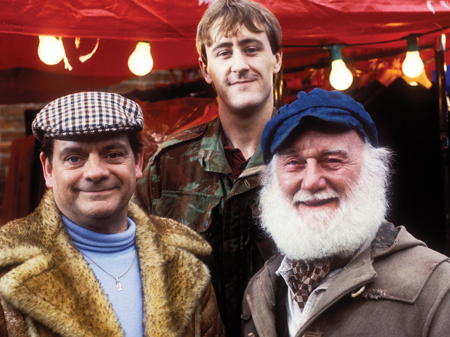
After passing away in late April, writer John Sullivan (1946-2011) was paid tributes by many people from different walks of life, who reminisced about his great shows and great moments. Inevitably the long-running <em>Only Fools and Horses</em> (1981-2003) was central to those tributes, as so many of us remember visits to the Nag’s Head like reunions with friends, and can trace our lives with memories not just of the show but of the circumstances in which we watched it. Sullivan wrote some of television’s finest and most popular comedy series, but even that isn’t high enough praise. Sullivan’s best work belongs in the lineage of the great writers who inspired him, such as Johnny Speight and Ray Galton and Alan Simpson. Like them, Sullivan reflected everyday life back at his audience with respect for their experience and intelligence, and the audience’s recognition of truth produced not only laughs for his one-liners and set-pieces but also an emotional commitment and sense of social awareness of the kind critics usually associate with genres other than this less critically-respected popular form. He was a television writer in its purest sense, and in the ways by which we define key television playwrights: he mastered a genre whilst refining its capabilities and playing to his audience’s awareness of its functions, and for a while became as visible a “name” – whose credit on a programme produced certain expectations – as any more vaunted auteur. At his peak – surely the 1980s, given that unbroken run of success that included the early years of <em>Only Fools and Horses</em> plus <em>Just Good Friends</em> (1983-86) and <em>Dear John</em> (1986-87) – he changed the way we speak to each other.</p>{"id":1849,"date":"2011-09-08T11:51:50","date_gmt":"2011-09-08T10:51:50","guid":{"rendered":"http:\/\/www.britishtelevisiondrama.org.uk\/?p=1849"},"modified":"2024-08-30T11:43:43","modified_gmt":"2024-08-30T10:43:43","slug":"john-sullivan","status":"publish","type":"post","link":"http:\/\/www.britishtelevisiondrama.org.uk\/?p=1849","title":{"rendered":"John Sullivan"},"content":{"rendered":"<h4>by DAVID ROLINSON<\/h4>\n<p><a href=\"http:\/\/www.britishtelevisiondrama.org.uk\/wp-content\/uploads\/2011\/09\/Sullivan_OnlyFools1.jpg\"><img loading=\"lazy\" decoding=\"async\" src=\"http:\/\/www.britishtelevisiondrama.org.uk\/wp-content\/uploads\/2011\/09\/Sullivan_OnlyFools1-300x224.jpg\" alt=\"\" title=\"Sullivan_OnlyFools1\" width=\"300\" height=\"224\" class=\"alignleft size-medium wp-image-1854\" srcset=\"http:\/\/www.britishtelevisiondrama.org.uk\/wp-content\/uploads\/2011\/09\/Sullivan_OnlyFools1-300x224.jpg 300w, http:\/\/www.britishtelevisiondrama.org.uk\/wp-content\/uploads\/2011\/09\/Sullivan_OnlyFools1.jpg 450w\" sizes=\"auto, (max-width: 300px) 100vw, 300px\" \/><\/a><br \/>\nAfter passing away in late April, writer John Sullivan (1946-2011) was paid tributes by many people from different walks of life, who reminisced about his great shows and great moments. Inevitably the long-running <em>Only Fools and Horses<\/em> (1981-2003) was central to those tributes, as so many of us remember visits to the Nag\u2019s Head like reunions with friends, and can trace our lives with memories not just of the show but of the circumstances in which we watched it. Sullivan wrote some of television\u2019s finest and most popular comedy series, but even that isn\u2019t high enough praise. Sullivan\u2019s best work belongs in the lineage of the great writers who inspired him, such as Johnny Speight and Ray Galton and Alan Simpson. Like them, Sullivan reflected everyday life back at his audience with respect for their experience and intelligence, and the audience\u2019s recognition of truth produced not only laughs for his one-liners and set-pieces but also an emotional commitment and sense of social awareness of the kind critics usually associate with genres other than this less critically-respected popular form. He was a television writer in its purest sense, and in the ways by which we define key television playwrights: he mastered a genre whilst refining its capabilities and playing to his audience\u2019s awareness of its functions, and for a while became as visible a \u201cname\u201d \u2013 whose credit on a programme produced certain expectations \u2013 as any more vaunted auteur. At his peak \u2013 surely the 1980s, given that unbroken run of success that included the early years of <em>Only Fools and Horses<\/em> plus <em>Just Good Friends<\/em> (1983-86) and <em>Dear John<\/em> (1986-87) \u2013 he changed the way we speak to each other.<\/p>\n<p><!--more--><\/p>\n<p><a href=\"http:\/\/www.britishtelevisiondrama.org.uk\/wp-content\/uploads\/2011\/09\/Sullivan_Sullivan.jpg\"><img loading=\"lazy\" decoding=\"async\" src=\"http:\/\/www.britishtelevisiondrama.org.uk\/wp-content\/uploads\/2011\/09\/Sullivan_Sullivan-172x300.jpg\" alt=\"\" title=\"Sullivan_Sullivan\" width=\"172\" height=\"300\" class=\"alignleft size-medium wp-image-1855\" srcset=\"http:\/\/www.britishtelevisiondrama.org.uk\/wp-content\/uploads\/2011\/09\/Sullivan_Sullivan-172x300.jpg 172w, http:\/\/www.britishtelevisiondrama.org.uk\/wp-content\/uploads\/2011\/09\/Sullivan_Sullivan.jpg 233w\" sizes=\"auto, (max-width: 172px) 100vw, 172px\" \/><\/a><br \/>\nBorn into a working-class family in Balham, South London, Sullivan left school at 15 with no qualifications, though he had enjoyed writing and had a love for Charles Dickens, who \u201cwas writing about areas that I knew about and the class system that was familiar to me\u201d.<sup id=\"rf1-1849\"><a href=\"#fn1-1849\" title=\"Elements of this essay\u2019s history of Sullivan and &lt;em&gt;Only Fools and Horses&lt;\/em&gt; are drawn from Steve Clarke, &lt;em&gt;The Only Fools and Horses Story&lt;\/em&gt; (London: BBC Worldwide, 1998), which is highly recommended. I also consulted several tribute programmes, of decreasing value: &lt;em&gt;The Story of Only Fools and Horses&lt;\/em&gt; (BBC1, tx. 20 December 2002), &lt;em&gt;Comedy Connections&lt;\/em&gt;: \u2018Only Fools and Horses\u2019 (BBC1, tx. 14 July 2003), and &lt;em&gt;Britain\u2019s Best Sitcom&lt;\/em&gt;: \u2018Only Fools and Horses\u2019 (BBC2, 28 February 2004).\" rel=\"footnote\">1<\/a><\/sup> He often talked about the inspiration of his family, particularly his father, a plumber with a hatred for the class system that was heightened by his spell in a prisoner of war camp. Sullivan\u2019s childhood, family and pre-fame experiences fed into his writing. This goes beyond characters being drawn from real people, and into dynamics that run through his work: family relationships, generational tensions and political positions, and how they impact on dialogue, and especially \u2013 harder to describe than it is to experience \u2013 atmosphere. He drew from experience, honing real incidents into classic set pieces, such as the chandelier incident (in <em>Only Fools<\/em> episode \u2018A Touch of Glass\u2019), which had befallen his father with less comic consequences.<\/p>\n<p>As Sullivan told Steve Clarke, he was typical of working-class kids who \u201cwanted to get out and earn some money to help the family out\u201d, and though he took the 11-Plus \u201cit never seemed to matter if we passed or not because we were all going to work in factories anyway\u201d.<sup id=\"rf2-1849\"><a href=\"#fn2-1849\" title=\"Clarke, &lt;em&gt;The Only Fools and Horses Story&lt;\/em&gt;.\" rel=\"footnote\">2<\/a><\/sup> Writers and producers in light entertainment and comedy offer a neglected alternative narrative to the well-known history of British television drama practitioners of the same period who came from working-class backgrounds, passed their 11-Plus and moved through grammar school and University before seeking out television as an anti-elitist mass medium. The likes of Dennis Potter and Tony Garnett discussed the tensions in their formal separation from their class experience, and it motivates their work in very different ways. In comedy, Speight, Galton, Simpson, Sullivan and others spoke from within that experience. It is unsurprising that <em>Steptoe and Son<\/em> (1962-74) had such an impact on Sullivan: \u201cI suddenly realised what you can do with comedy, because it was so funny and just filled with drama and pathos\u201d. <em>Steptoe<\/em> was to have a profound impact on early <\/em>Only Fools<\/em>, in the sense of being trapped by family circumstances (\u201cYou suffocate me\u201d) either because they are frustratingly unable, or complexly unwilling, to escape. The conventional sitcom format reinforces that to an extent: hence Raymond Williams\u2019s shift from highly praising <em>Steptoe and Son<\/em>\u2019s first episode to worrying, in the 1970s, that the series form \u201cprevents any full working-through\u201d of its issues, a statement that I\u2019ve compared with academic work on the form\u2019s alleged conservatism.<sup id=\"rf3-1849\"><a href=\"#fn3-1849\" title=\"Raymond Williams, &lt;em&gt;Raymond Williams on Television&lt;\/em&gt; (New York: Routledge, 1989), p. 124. See Rolinson, \u2018Small Screens and Big Voices\u2019 \u2013 full reference in subsequent endnote.\" rel=\"footnote\">3<\/a><\/sup><\/p>\n<p>Sullivan\u2019s early jobs included working as a messenger for Reuters and for the advertising agency that David Puttnam and Alan Parker worked for, but more lucrative work followed: cleaning cars, plumbing, or working for a brewery, during the latter of which Sullivan co-wrote a script (after Paul Saunders learned that Speight earned \u00a31,000 per script). Although rejected, their joint script <em>Gentlemen<\/em>, with an Ealing-sounding set-up (an old-fashioned establishment under threat from a more polished but hollow rival), seems to have recognisable Sullivan elements: aspiration in limiting circumstances, a dignity in labour\/community and, in the ex-soldier clinging to a role in a dingy environment, the seeds of the much later <em>Heartburn Hotel<\/em> (1998-2000).<\/p>\n<p>Going it alone, Sullivan sought further education, both in classes (shades of Rodney) and in television. Having had numerous script rejections, he tried to learn more about television by applying (in 1974) for a job at the BBC. His jobs included props and scene-shifting: he helped put down the waterproofing and kerbstones for the Morecambe and Wise <em>Singin\u2019 in the Rain<\/em> homage (Christmas 1976). The popular narrative of Sullivan going from scene-shifter to scriptwriter is only partly true: already a (failing) writer, the job was a way in, as he exploited this position to approach producers and stars, gaining commissions for <em>The Two Ronnies<\/em> (1971-87) and the 1977 pilot that led to four series of <em>Citizen Smith<\/em> (1977-80). <\/p>\n<p><a href=\"http:\/\/www.britishtelevisiondrama.org.uk\/wp-content\/uploads\/2011\/09\/Sullivan_CitizenSmith.jpg\"><img loading=\"lazy\" decoding=\"async\" src=\"http:\/\/www.britishtelevisiondrama.org.uk\/wp-content\/uploads\/2011\/09\/Sullivan_CitizenSmith-300x225.jpg\" alt=\"\" title=\"Sullivan_CitizenSmith\" width=\"300\" height=\"225\" class=\"alignleft size-medium wp-image-1852\" srcset=\"http:\/\/www.britishtelevisiondrama.org.uk\/wp-content\/uploads\/2011\/09\/Sullivan_CitizenSmith-300x225.jpg 300w, http:\/\/www.britishtelevisiondrama.org.uk\/wp-content\/uploads\/2011\/09\/Sullivan_CitizenSmith.jpg 400w\" sizes=\"auto, (max-width: 300px) 100vw, 300px\" \/><\/a><br \/>\nSullivan\u2019s work skilfully underscores reality with surrealism\/the absurd. It\u2019s there in the memorable dialogue in his Sid and George sketches for <em>The Two Ronnies<\/em>. David Quantick rightly picks one out: \u201cThe scene where Sid, in a rare moment of existential doubt, asks George what the point of life and human existence is, and receives the reply, \u2018Something to do, I suppose,\u2019 would make Beckett envious.\u201d<sup id=\"rf4-1849\"><a href=\"#fn4-1849\" title=\"David Quantick, \u2018John Sullivan: a master of comedy\u2019, &lt;em&gt;Daily Telegraph&lt;\/em&gt;, 24 April 2011,&lt;br \/&gt;\n&lt;a href=&quot;\/\/www.telegraph.co.uk\/culture\/tvandradio\/8471675\/John-Sullivan-A-master-of-comedy.html\u201d&quot; target=&quot;\u201d_self\u201d&quot; rel=&quot;noopener&quot;&gt;available here&lt;\/a&gt;.\" rel=\"footnote\">4<\/a><\/sup> It\u2019s in <em>Citizen Smith<\/em>, where the conflation of social observation and outright absurdity in Wolfie Smith\u2019s actions for the Tooting Popular Front is grounded in the frustrated aspirations of a dreamer, whose personal relationships bring him up against different models of working-class experience and masculinity. Sullivan\u2019s follow-up <em>Over the Moon<\/em> (1980), with another aspiring dreamer, this time a football manager, got as far as a pilot and script commissions before the plug was pulled, and there was little initial enthusiasm for what became its follow-up, <em>Only Fools and Horses<\/em>\u2026<\/p>\n<p>Sullivan\u2019s concept of a sitcom based around \u201cpubs, clubs and tower blocks\u201d, in \u201ca modern, vibrant, multi-racial new slang London where a lot of working-class guys had suits and a bit of dosh in their pockets\u201d, would be focused around wheeler-dealers of the type experienced by Sullivan and producer Ray Butt (whose own story is fascinating; his dad had a stall on the Roman Road, where Tommy Cooper \u201cused to sell saccharine and elastic\u201d). The BBC had already rejected this idea when ITV started <em>Minder<\/em>. \u201cShit. That idea\u2019s gone,\u201d thought Sullivan, who was \u201cchoked because I thought they\u2019d done that modern London\u201d. Even when the series got the go-ahead, it was subject to much negotiation and its future questioned, especially after the relative failure of its first season.<\/p>\n<p>Of course, <em>Only Fools<\/em> became a ratings juggernaut, a weapon against the BBC\u2019s critics, and part of the attempt to construct a promotional brand through the repetition of \u201ciconic\u201d moments: Ricky Gervais dancing, Basil Fawlty thrashing a car, \u201cDel falling through the bar\u201d, all moments designed not only to trigger memory of the programmes but of the mode of transmission, of communal viewing in a fragmenting media landscape. But the moments were so removed from context that they\u2019re almost a negative shorthand, and Del falling through the bar has been much parodied. It is one of the finest moments in British television history, but that\u2019s because of context. The fall itself was not the joke \u2013 having witnessed a less dramatic version of this incident in a pub, Sullivan held onto the idea for years until finding the right context. \u2018Yuppy Love\u2019 (1989) puts political discourse about social mobility against the realities of the class system. Rodney is trying to go up in the world through education, and meets the higher-class Cassandra, while Del goes for the surface elements, in his yuppy makeover referencing Oliver Stone\u2019s Wall Street (1987). Del may call yuppies his sort of people, but they sneer at his dropped aitches. Del and Trigger are already floundering in this environment before the fall: my favourite part of that scene comes when Trigger, encouraged to \u201ctalk about money\u201d to City types, says, \u201cI saw one of them old five pound notes the other day\u201d. The fall symbolises how out-of-place they are, how unfamiliar with the terrain, and how dependent on a form of support that, it transpires, isn\u2019t there. Yes, it\u2019s a great stunt, superbly planned (the surprise heightened by the lack of cuts as we get a single developing shot \u2013 ironically, refusing to separate it as a moment) and performed (even David Jason\u2019s hair is funny). As Quantick put it, \u201cthe moment manages to puncture Del Boy&#8217;s dignity while highlighting his nervousness outside his comfort zone, and is also side-cripplingly funny. Which is not bad for a five-second sight gag.\u201d<sup id=\"rf5-1849\"><a href=\"#fn5-1849\" title=\"Quantick, \u2018John Sullivan: a master of comedy\u2019.\" rel=\"footnote\">5<\/a><\/sup><\/p>\n<p>The BBC-heritage branding of Del\u2019s fall could even seem unintentionally ironic. That joke came eight years into <em>Only Fools<\/em> \u2013 its effect depends on our knowledge of those eight years, and its very existence depends on the BBC\u2019s support of the show during its lean years. Therefore, BBC\u2019s self-congratulatory use of it \u2013 to signal their support for comedy \u2013 seems justified. However, by the time that campaign ran, it was normal for failing new sitcoms to be pulled from the schedules and replaced by repeats of <em>Only Fools<\/em> (from the early years, when it was facing a similar fate). Countless series fell through the bar. And in his later years, the BBC was to press for an ill-advised <em>Only Fools<\/em> comeback after the satisfying ending in 1996, and made <em>Only Fools<\/em> spin-offs such as <em>The Green Green Grass<\/em> (2005-2009) and <em>Rock &#038; Chips<\/em> (2010-2011), rather than original Sullivan projects.<\/p>\n<p>The BBC\u2019s dependence on <em>Only Fools<\/em>, and the once-pervasive repeat seasons, were understandable. Yes, it plays rightly on nostalgia: when I remember great moments from Sullivan\u2019s 1980s work, it\u2019s in the context of shared family laughter and recitation at school, and when as many as 24 million people have the same warm memories, this is clearly a very special writer. There are too many moments to list, from <em>Cwying<\/em> in \u2018Stage Fright\u2019 (1991) and Peckham Spring in \u2018Mother Nature\u2019s Son\u2019 (1992) to the dubious leisure merchandise in \u2018Danger UXD\u2019 (1989). The repeats stood up, and will continue to do so. And like repeats of <em>Till Death Us Do Part<\/em> (1965-75) and <em>Steptoe and Son<\/em>, they\u2019ll take on more of a sense of social documents. Comedy is an important part of television social realism, and I\u2019ve recently included sitcoms, from <em>Steptoe and Son<\/em> to <em>Rab C Nesbitt<\/em> (1988-    ), in a long chapter on the history of TV social realism.<sup id=\"rf6-1849\"><a href=\"#fn6-1849\" title=\"See Dave Rolinson, \u2018Small Screens and Big Voices: Televisual Social Realism and the Popular\u2019, in David Tucker (editor), &lt;em&gt;British Social Realism in the Arts since 1940&lt;\/em&gt; (Basingstoke: Palgrave Macmillan, 2011), pp. 172-217).\" rel=\"footnote\">6<\/a><\/sup><\/p>\n<p>Stephen Wagg discusses Del (\u201cculturally working class, but technically working for himself\u201d) and the show in the context of the 1980s, and notes how Del\u2019s flash style owes much to Sullivan\u2019s \u201cvisit to a pub in the Old Kent Road in the late 1970s \u2018to find that the tough guys with callouses on their knuckles, who used to like a pint, were now sipping umbrella-topped cocktails\u2019.\u201d<sup id=\"rf7-1849\"><a href=\"#fn7-1849\" title=\"Stephen Wagg, &lt;em&gt;Because I Tell a Joke or Two: Comedy, Politics and Social Difference&lt;\/em&gt; (London: Routledge, 1998), pp. 1-31.\" rel=\"footnote\">7<\/a><\/sup> As Wagg notes, the docks are declining, and community too, though Del\u2019s world survives riots. The show\u2019s politics are often fascinating. Del may be a Thatcherite, but the sitcom form means those values constantly fail, and thanks to Sullivan\u2019s inspired schemes, often seem absurd. Those values are often challenged, sometimes by Rodney but by the show itself in \u2018He Ain\u2019t Heavy, He\u2019s My Uncle\u2019 (1991), when Uncle Albert visits the yuppified docklands developments where his birthplace used to be. As a Thatcherite, Del is in favour of the development, but while he speaks, Albert and Rodney walk away from him \u2013 it\u2019s an unresolved moment with no comic outcome. The scene throws up all kinds of associations. Del\u2019s speech is a bitterly ironic inversion of the lament for working-class unity in the last episode of Alan Bleasdale\u2019s <em>Boys from the Blackstuff<\/em> (1982), and the fact that Albert\u2019s birthplace was called Tobacco Road brings to mind Erskine Caldwell\u2019s book <em>Tobacco Road<\/em> (1932, filmed in 1941 by John Ford). In <em>Only Fools<\/em>, there clearly <em>is<\/em> such a thing as society. <\/p>\n<p>So there is anger in <em>Only Fools<\/em>, and moments of heartfelt drama. There is Grandad\u2019s lament in \u2018The Russians Are Coming\u2019 (1981) that instead of \u201chomes fit for heroes\u201d, Britain produced \u201cheroes fit for homes\u201d (a scene that wears its <em>Steptoe<\/em> influence on its sleeve). There is \u2018Strained Relations\u2019 (1985), a raw and superbly-handled episode in which Grandad is buried, after the recent death of the peerless Lennard Pearce. Del opening up about how much of his bluster is performance puts much of the rest of the series in a different light. The move to 50-minute episodes gave more time for supporting characters, more breathing space for plots, and more scope for characterisation in a more overtly comedy-drama format which, like the best soap, allowed the Trotters\u2019 lives to change in ways that mirrored changes in society and in families watching. There\u2019s been academic debate on what Lez Cooke has described, in a piece on <em>Clocking Off<\/em> (2000-2003), as \u201cthe new social realism\u201d, as single plays gave way in the 1990s onwards to series, there followed \u201ca postmodern shift in the representation of social realism in twenty-first-century television drama\u201d, as the concerns of single plays embraced different stylistic influences and hybridised with other forms such as soap<sup id=\"rf8-1849\"><a href=\"#fn8-1849\" title=\"Lez Cooke, \u2018The new social realism of Clocking Off\u2019, in Jonathan Bignell and Stephen Lacey (editors), &lt;em&gt;Popular Television Drama: Critical Perspectives&lt;\/em&gt; (Manchester: Manchester University Press, 2005), p. 188. As I state in my article in the Tucker collection, Cooke accurately reflects debates in the industry and academia on the subject, though we\u2019d probably agree that the history of British television drama includes many hybridised, complex forms of drama with distinctive approaches to social realism, and not a monolithic set of approaches that \u201cthe new social realism\u201d has problematised.\" rel=\"footnote\">8<\/a><\/sup> I can\u2019t help thinking that Sullivan\u2019s work could be seen in that context. Of course, placing sitcom within debates on television drama is nothing new \u2013 aiming to explore \u2018the boundaries of genre\u2019, a section of <em>Popular Television Drama: Critical Perspectives<\/em> includes chapters on <em>Butterflies<\/em> (1978-83) and <em>Dad\u2019s Army<\/em> (1968-77). I\u2019ve written recently on how <em>The Royle Family<\/em> \u201cdevelops a new sitcom-realist hybrid\u201d, but perhaps the sitcom-tragi-soap elements of <em>Only Fools<\/em> make Sullivan\u2019s work a neglected case study.<sup id=\"rf9-1849\"><a href=\"#fn9-1849\" title=\"Rolinson, \u2018Small Screens and Big Voices\u2019, p. 205.\" rel=\"footnote\">9<\/a><\/sup><\/p>\n<p><a href=\"http:\/\/www.britishtelevisiondrama.org.uk\/wp-content\/uploads\/2011\/09\/Sullivan_DearJohn.jpg\"><img loading=\"lazy\" decoding=\"async\" src=\"http:\/\/www.britishtelevisiondrama.org.uk\/wp-content\/uploads\/2011\/09\/Sullivan_DearJohn-300x225.jpg\" alt=\"\" title=\"Sullivan_DearJohn\" width=\"300\" height=\"225\" class=\"alignleft size-medium wp-image-1853\" srcset=\"http:\/\/www.britishtelevisiondrama.org.uk\/wp-content\/uploads\/2011\/09\/Sullivan_DearJohn-300x225.jpg 300w, http:\/\/www.britishtelevisiondrama.org.uk\/wp-content\/uploads\/2011\/09\/Sullivan_DearJohn.jpg 400w\" sizes=\"auto, (max-width: 300px) 100vw, 300px\" \/><\/a><br \/>\n<em>Only Fools<\/em> connects, but even without that, Sullivan leaves a great body of work. As well as <em>Citizen Smith<\/em>, there\u2019s the hit <em>Just Good Friends<\/em>, a romantic comedy in a different world (albeit playing on class tensions) with a strong female lead as Sullivan addressed concerns (notably from <em>Citizen Smith<\/em>\u2019s Cheryl Hall) that he didn\u2019t write women well. <em>Dear John<\/em> is one of my favourite sitcoms, and its American remake ran in decent slots on BBC1 as well. The skill as a dramatist which was so vital to his comedies found an outlet in comedy-drama such as <em>Over Here<\/em> (1996) and <em>Micawber<\/em> (2001), which also provided an outlet for his love of Dickens, though this angle on <em>David Copperfield<\/em> only emerged on ITV after an acrimonious falling-out with the BBC. The sense that comes across in the 1996 climax of <em>Only Fools<\/em>, of changing social status and financial success impinging on ducking and diving, comes across in other work too: <em>Sitting Pretty<\/em> (1992-93) for instance, or elements of <em>Rock &#038; Chips<\/em> and <em>The Green Green Grass<\/em>. But <em>The Green Green Grass<\/em> shows that, even in Sullivan\u2019s supposedly lesser work, there are moments of comedy gold. Comedy-drama <em>Roger Roger<\/em> (1996-2003) contains many of my favourite Sullivan moments, and in the <em>Bodyguard<\/em> joke, one of my favourite Sullivan gags. It\u2019s unfortunate that <em>Heartburn Hotel<\/em> (co-written with Steve Glover) is trapped in the body of a studio sitcom (on which terms it\u2019s patchy at best), as there\u2019s a fascinating, bitter comedy drama in there somewhere. It places a left-wing dreamer against a right-wing realist\/brutalist \u2013 nothing new there, it was a feature of <em>Only Fools<\/em> and <em>Citizen Smith<\/em>, in their twist on Galton and Simpson pairings such as Tony Hancock and Sid James in <em>Hancock\u2019s Half Hour<\/em> (1956-61) and Harold and Albert Steptoe. However, if early <em>Only Fools<\/em> had a surprisingly nasty edge, <em>Heartburn Hotel<\/em> is at times unpleasant, but the shabby little-Englander setting and critique at work (the situation stemming from the Falklands and from a British Olympic bid) reminds us that <em>Only Fools<\/em> did not always share the worldview of some of the tabloids who endorsed it. <\/p>\n<p>To be fair, tabloid critics were sometimes more astute reviewers of Sullivan\u2019s work than broadsheet critics. I say this not to generalise about critical resistance to popular forms (there are exceptions), but to note that the tendencies and movements which broadsheets rushed to label neglected the type of studio situation comedy at which Sullivan excelled. The sophistication of <em>Only Fools<\/em> lies in its writing and performance, in storytelling craft, an ear for dialogue and its grounding in a community, rather than in format. It does not need faux-docusoap style to signpost the relationship with reality at the heart of its comedy of recognition. Maurice Gran has compared Sullivan\u2019s work with modern TV comedy that \u201caims for irony and ends up snide and charmless\u201d, especially \u201cpseudo-documentaries\u201d copying <em>The Office<\/em> (but \u201cwithout the talent of Stephen Merchant and Ricky Gervais\u201d), which \u201cend up unkind\u201d.<sup id=\"rf10-1849\"><a href=\"#fn10-1849\" title=\"Maurice Gran, \u2018Del Boy creator John Sullivan whose genius shames today\u2019s charmless comics\u2019, &lt;em&gt;Daily Mail&lt;\/em&gt;, 27 April 2011, &lt;a href=&quot;\/\/www.dailymail.co.uk\/tvshowbiz\/article-1380237\/John-Sullivan-Only-Fools-creater-dies-Genius-shames-todays-charmless-comics.html\u201d&quot; target=&quot;\u201d_self\u201d&quot; rel=&quot;noopener&quot;&gt;available here&lt;\/a&gt;.\" rel=\"footnote\">10<\/a><\/sup><\/p>\n<p>With Sullivan, we don\u2019t sit at a superior remove from characters at whose behaviour we cringe. We watch with affection, and as part of the community derive pleasure from well-turned phrases, well-told anecdotes and superbly-crafted incident. Though Sullivan moved towards creating and overseeing (for instance, on <em>The Green Green Grass<\/em>), his work disproves the broadsheet favourite call for British comedies to be written along the American model, with gangs of gag writers. Sullivan was a skilled gag-writer (Grandad in <em>Only Fools<\/em>: \u201cI\u2019ve had lots of sobering thoughts in my time. That\u2019s what started me drinking\u201d), but there is in his best work an organic connection of characters, jokes and incidents that is the result of craft, and evidence of a great television writer. Bonjour.<\/p>\n<p><em>Originally posted: 8 September 2011.<br \/>\n[This piece first appeared on the This Way Up website on 9 May 2011. It is presented here with revisions, new material and endnotes.] <\/em><\/p>\n<p><body><!-- Start of StatCounter Code --><br \/>\n<script type=\"text\/javascript\">\nvar sc_project=5750652; \nvar sc_invisible=1; \nvar sc_partition=68; \nvar sc_click_stat=1; \nvar sc_security=\"6dd1aa39\"; \n<\/script><\/p>\n<p><script type=\"text\/javascript\"\nsrc=\"http:\/\/www.statcounter.com\/counter\/counter.js\"><\/script><noscript>\n<div<br \/>\nclass=&#8221;statcounter&#8221;><a title=\"wordpress stats \"<br \/>\nhref=&#8221;http:\/\/www.statcounter.com\/wordpress.org\/&#8221;<br \/>\ntarget=&#8221;_blank&#8221;><img class=\"statcounter\"<br \/>\nsrc=&#8221;http:\/\/c.statcounter.com\/5750652\/0\/6dd1aa39\/1\/&#8221;<br \/>\nalt=&#8221;wordpress stats &#8221; ><\/a><\/div>\n<p><\/noscript><br \/>\n<!-- End of StatCounter Code --><\/body><\/p>\n<hr class=\"footnotes\"><ol class=\"footnotes\" style=\"list-style-type:decimal\"><li id=\"fn1-1849\"><p >Elements of this essay\u2019s history of Sullivan and <em>Only Fools and Horses<\/em> are drawn from Steve Clarke, <em>The Only Fools and Horses Story<\/em> (London: BBC Worldwide, 1998), which is highly recommended. I also consulted several tribute programmes, of decreasing value: <em>The Story of Only Fools and Horses<\/em> (BBC1, tx. 20 December 2002), <em>Comedy Connections<\/em>: \u2018Only Fools and Horses\u2019 (BBC1, tx. 14 July 2003), and <em>Britain\u2019s Best Sitcom<\/em>: \u2018Only Fools and Horses\u2019 (BBC2, 28 February 2004).&nbsp;<a href=\"#rf1-1849\" class=\"backlink\" title=\"Return to footnote 1.\">&#8617;<\/a><\/p><\/li><li id=\"fn2-1849\"><p >Clarke, <em>The Only Fools and Horses Story<\/em>.&nbsp;<a href=\"#rf2-1849\" class=\"backlink\" title=\"Return to footnote 2.\">&#8617;<\/a><\/p><\/li><li id=\"fn3-1849\"><p >Raymond Williams, <em>Raymond Williams on Television<\/em> (New York: Routledge, 1989), p. 124. See Rolinson, \u2018Small Screens and Big Voices\u2019 \u2013 full reference in subsequent endnote.&nbsp;<a href=\"#rf3-1849\" class=\"backlink\" title=\"Return to footnote 3.\">&#8617;<\/a><\/p><\/li><li id=\"fn4-1849\"><p >David Quantick, \u2018John Sullivan: a master of comedy\u2019, <em>Daily Telegraph<\/em>, 24 April 2011,<br \/>\n<a href=\"\/\/www.telegraph.co.uk\/culture\/tvandradio\/8471675\/John-Sullivan-A-master-of-comedy.html\u201d\" target=\"\u201d_self\u201d\" rel=\"noopener\">available here<\/a>.&nbsp;<a href=\"#rf4-1849\" class=\"backlink\" title=\"Return to footnote 4.\">&#8617;<\/a><\/p><\/li><li id=\"fn5-1849\"><p >Quantick, \u2018John Sullivan: a master of comedy\u2019.&nbsp;<a href=\"#rf5-1849\" class=\"backlink\" title=\"Return to footnote 5.\">&#8617;<\/a><\/p><\/li><li id=\"fn6-1849\"><p >See Dave Rolinson, \u2018Small Screens and Big Voices: Televisual Social Realism and the Popular\u2019, in David Tucker (editor), <em>British Social Realism in the Arts since 1940<\/em> (Basingstoke: Palgrave Macmillan, 2011), pp. 172-217).&nbsp;<a href=\"#rf6-1849\" class=\"backlink\" title=\"Return to footnote 6.\">&#8617;<\/a><\/p><\/li><li id=\"fn7-1849\"><p >Stephen Wagg, <em>Because I Tell a Joke or Two: Comedy, Politics and Social Difference<\/em> (London: Routledge, 1998), pp. 1-31.&nbsp;<a href=\"#rf7-1849\" class=\"backlink\" title=\"Return to footnote 7.\">&#8617;<\/a><\/p><\/li><li id=\"fn8-1849\"><p >Lez Cooke, \u2018The new social realism of Clocking Off\u2019, in Jonathan Bignell and Stephen Lacey (editors), <em>Popular Television Drama: Critical Perspectives<\/em> (Manchester: Manchester University Press, 2005), p. 188. As I state in my article in the Tucker collection, Cooke accurately reflects debates in the industry and academia on the subject, though we\u2019d probably agree that the history of British television drama includes many hybridised, complex forms of drama with distinctive approaches to social realism, and not a monolithic set of approaches that \u201cthe new social realism\u201d has problematised.&nbsp;<a href=\"#rf8-1849\" class=\"backlink\" title=\"Return to footnote 8.\">&#8617;<\/a><\/p><\/li><li id=\"fn9-1849\"><p >Rolinson, \u2018Small Screens and Big Voices\u2019, p. 205.&nbsp;<a href=\"#rf9-1849\" class=\"backlink\" title=\"Return to footnote 9.\">&#8617;<\/a><\/p><\/li><li id=\"fn10-1849\"><p >Maurice Gran, \u2018Del Boy creator John Sullivan whose genius shames today\u2019s charmless comics\u2019, <em>Daily Mail<\/em>, 27 April 2011, <a href=\"\/\/www.dailymail.co.uk\/tvshowbiz\/article-1380237\/John-Sullivan-Only-Fools-creater-dies-Genius-shames-todays-charmless-comics.html\u201d\" target=\"\u201d_self\u201d\" rel=\"noopener\">available here<\/a>.&nbsp;<a href=\"#rf10-1849\" class=\"backlink\" title=\"Return to footnote 10.\">&#8617;<\/p><\/li><\/p><\/ol><\/hr>","protected":false},"excerpt":{"rendered":null,"protected":false},"author":1,"featured_media":0,"comment_status":"open","ping_status":"open","sticky":false,"template":"","format":"standard","meta":{"footnotes":""},"categories":[13,140],"tags":[15,178,179,175,174,177,176],"class_list":["post-1849","post","type-post","status-publish","format-standard","hentry","category-biographies","category-david-rolinson","tag-adaptation","tag-clocking-off","tag-dickens","tag-galton-and-simpson","tag-john-sullivan","tag-sitcom","tag-social-realism"],"_links":{"self":[{"href":"http:\/\/www.britishtelevisiondrama.org.uk\/index.php?rest_route=\/wp\/v2\/posts\/1849","targetHints":{"allow":["GET"]}}],"collection":[{"href":"http:\/\/www.britishtelevisiondrama.org.uk\/index.php?rest_route=\/wp\/v2\/posts"}],"about":[{"href":"http:\/\/www.britishtelevisiondrama.org.uk\/index.php?rest_route=\/wp\/v2\/types\/post"}],"author":[{"embeddable":true,"href":"http:\/\/www.britishtelevisiondrama.org.uk\/index.php?rest_route=\/wp\/v2\/users\/1"}],"replies":[{"embeddable":true,"href":"http:\/\/www.britishtelevisiondrama.org.uk\/index.php?rest_route=%2Fwp%2Fv2%2Fcomments&post=1849"}],"version-history":[{"count":31,"href":"http:\/\/www.britishtelevisiondrama.org.uk\/index.php?rest_route=\/wp\/v2\/posts\/1849\/revisions"}],"predecessor-version":[{"id":8301,"href":"http:\/\/www.britishtelevisiondrama.org.uk\/index.php?rest_route=\/wp\/v2\/posts\/1849\/revisions\/8301"}],"wp:attachment":[{"href":"http:\/\/www.britishtelevisiondrama.org.uk\/index.php?rest_route=%2Fwp%2Fv2%2Fmedia&parent=1849"}],"wp:term":[{"taxonomy":"category","embeddable":true,"href":"http:\/\/www.britishtelevisiondrama.org.uk\/index.php?rest_route=%2Fwp%2Fv2%2Fcategories&post=1849"},{"taxonomy":"post_tag","embeddable":true,"href":"http:\/\/www.britishtelevisiondrama.org.uk\/index.php?rest_route=%2Fwp%2Fv2%2Ftags&post=1849"}],"curies":[{"name":"wp","href":"https:\/\/api.w.org\/{rel}","templated":true}]}}