<h4>by DAVID ROLINSON</h4>
<blockquote><p> “in keeping with the modernist sensibility and self-reflexivity of <em>Hide and Seek</em> and <em>Only Make Believe</em>, the decision to root a view of the past in the experiences and imagination of a writer protagonist, emphasises the fact that, far from being an objective assessment, any perspective on history can only ever be subjective” &#8211; John R. Cook.<sup id="rf1-2164"><a href="#fn1-2164" title="John R. Cook, &lt;em&gt;Dennis Potter: A Life on Screen&lt;/em&gt; (Manchester: Manchester University Press, 1998), p. 217. Second edition. &lt;em&gt;Play for Today&lt;/em&gt;: &lt;em&gt;Only Make Believe&lt;/em&gt;, tx. BBC1, 12 February 1973." rel="footnote">1</a></sup>  </p></blockquote>
<p><a href="http://www.britishtelevisiondrama.org.uk/wp-content/uploads/2012/09/BTVD_SingingDetective_01.png"><img loading="lazy" decoding="async" src="http://www.britishtelevisiondrama.org.uk/wp-content/uploads/2012/09/BTVD_SingingDetective_01-300x225.png" alt="" title="TSD_title" width="300" height="225" class="alignleft size-medium wp-image-2917" srcset="http://www.britishtelevisiondrama.org.uk/wp-content/uploads/2012/09/BTVD_SingingDetective_01-300x225.png 300w, http://www.britishtelevisiondrama.org.uk/wp-content/uploads/2012/09/BTVD_SingingDetective_01.png 768w" sizes="auto, (max-width: 300px) 100vw, 300px" /></a><br />
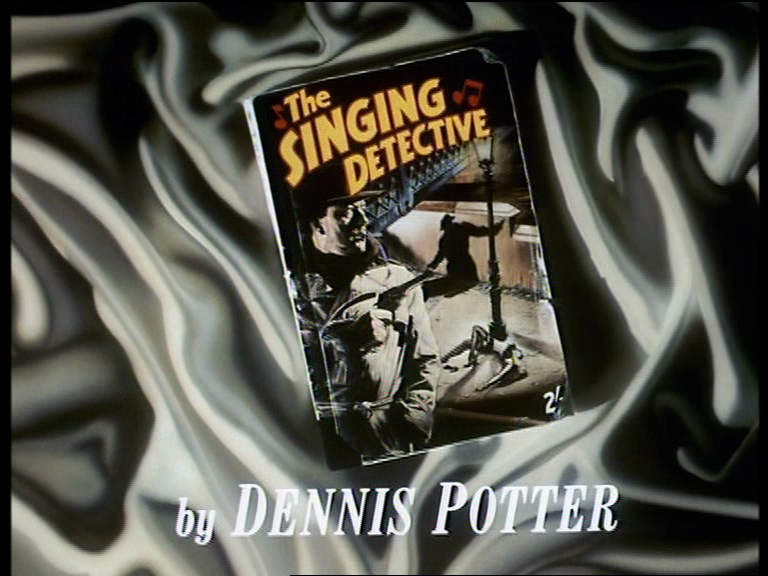
This one-day symposium, staged by Royal Holloway University of London on 10 December 2011, celebrated the 25th anniversary of <em>The Singing Detective</em> (1986).<sup id="rf2-2164"><a href="#fn2-2164" title="&lt;em&gt;The Singing Detective&lt;/em&gt;, tx. BBC1, 16 November 1986-21 December 1986." rel="footnote">2</a></sup> It paid tribute to the serial’s “narrative complexity, generic hybridity and formal experimentation” and placed writer Dennis Potter’s contribution alongside the contributions made by his collaborators, several of whom were present: producer Kenith Trodd, choreographer Quinny Sacks and actors Patrick Malahide and Bill Paterson.<sup id="rf3-2164"><a href="#fn3-2164" title="Quotation from the conference blurb, which is still available, with the day’s running order, at &lt;a href=&quot;http://ies.sas.ac.uk/events/conferences/2011/SingingDetective/&quot; target=&quot;“_self”&quot; rel=&quot;noopener&quot;&gt; http://ies.sas.ac.uk/events/conferences/2011/SingingDetective/&lt;/a&gt;" rel="footnote">3</a></sup> Other guests included Peter Bowker (as a modern television writer inspired by Potter), plus academic speakers and, mixing practitioner and academic perspectives, Professor Jonathan Powell, who was Head of Drama at the BBC when <em>The Singing Detective</em> was made. This mixture of academic and practitioner perspectives has been a welcome and often rewarding feature of British television drama conferences in recent years: see, for instance, the conference proceedings published as part of <em>British Television Drama: Past, Present and Future</em>.<sup id="rf4-2164"><a href="#fn4-2164" title="Jonathan Bignell, Madeleine Macmurraugh-Kavanagh and Stephen Lacey (editors), &lt;em&gt;British Television Drama: Past, Present and Future&lt;/em&gt; (Basingstoke: Palgrave, 2000)." rel="footnote">4</a></sup> </p>

<hr class="footnotes"><ol class="footnotes" style="list-style-type:decimal"><li id="fn1-2164"><p >John R. Cook, <em>Dennis Potter: A Life on Screen</em> (Manchester: Manchester University Press, 1998), p. 217. Second edition. <em>Play for Today</em>: <em>Only Make Believe</em>, tx. BBC1, 12 February 1973.&nbsp;<a href="#rf1-2164" class="backlink" title="Return to footnote 1.">&#8617;</a></p></li><li id="fn2-2164"><p ><em>The Singing Detective</em>, tx. BBC1, 16 November 1986-21 December 1986.&nbsp;<a href="#rf2-2164" class="backlink" title="Return to footnote 2.">&#8617;</a></p></li><li id="fn3-2164"><p >Quotation from the conference blurb, which is still available, with the day’s running order, at <a href="http://ies.sas.ac.uk/events/conferences/2011/SingingDetective/" target="“_self”" rel="noopener"> http://ies.sas.ac.uk/events/conferences/2011/SingingDetective/</a>&nbsp;<a href="#rf3-2164" class="backlink" title="Return to footnote 3.">&#8617;</a></p></li><li id="fn4-2164"><p >Jonathan Bignell, Madeleine Macmurraugh-Kavanagh and Stephen Lacey (editors), <em>British Television Drama: Past, Present and Future</em> (Basingstoke: Palgrave, 2000).&nbsp;<a href="#rf4-2164" class="backlink" title="Return to footnote 4.">&#8617;</a></p></li></ol></hr>{"id":2164,"date":"2011-12-20T23:27:57","date_gmt":"2011-12-20T23:27:57","guid":{"rendered":"http:\/\/www.britishtelevisiondrama.org.uk\/?p=2164"},"modified":"2024-08-30T11:43:04","modified_gmt":"2024-08-30T10:43:04","slug":"the-singing-detective-25th-anniversary-event-10-december-2011","status":"publish","type":"post","link":"http:\/\/www.britishtelevisiondrama.org.uk\/?p=2164","title":{"rendered":"<em>The Singing Detective<\/em> 25th Anniversary Event (2011)"},"content":{"rendered":"<h4>by DAVID ROLINSON<\/h4>\n<blockquote><p> \u201cin keeping with the modernist sensibility and self-reflexivity of <em>Hide and Seek<\/em> and <em>Only Make Believe<\/em>, the decision to root a view of the past in the experiences and imagination of a writer protagonist, emphasises the fact that, far from being an objective assessment, any perspective on history can only ever be subjective\u201d &#8211; John R. Cook.<sup id=\"rf1-2164\"><a href=\"#fn1-2164\" title=\"John R. Cook, &lt;em&gt;Dennis Potter: A Life on Screen&lt;\/em&gt; (Manchester: Manchester University Press, 1998), p. 217. Second edition. &lt;em&gt;Play for Today&lt;\/em&gt;: &lt;em&gt;Only Make Believe&lt;\/em&gt;, tx. BBC1, 12 February 1973.\" rel=\"footnote\">1<\/a><\/sup>  <\/p><\/blockquote>\n<p><a href=\"http:\/\/www.britishtelevisiondrama.org.uk\/wp-content\/uploads\/2012\/09\/BTVD_SingingDetective_01.png\"><img loading=\"lazy\" decoding=\"async\" src=\"http:\/\/www.britishtelevisiondrama.org.uk\/wp-content\/uploads\/2012\/09\/BTVD_SingingDetective_01-300x225.png\" alt=\"\" title=\"TSD_title\" width=\"300\" height=\"225\" class=\"alignleft size-medium wp-image-2917\" srcset=\"http:\/\/www.britishtelevisiondrama.org.uk\/wp-content\/uploads\/2012\/09\/BTVD_SingingDetective_01-300x225.png 300w, http:\/\/www.britishtelevisiondrama.org.uk\/wp-content\/uploads\/2012\/09\/BTVD_SingingDetective_01.png 768w\" sizes=\"auto, (max-width: 300px) 100vw, 300px\" \/><\/a><br \/>\nThis one-day symposium, staged by Royal Holloway University of London on 10 December 2011, celebrated the 25th anniversary of <em>The Singing Detective<\/em> (1986).<sup id=\"rf2-2164\"><a href=\"#fn2-2164\" title=\"&lt;em&gt;The Singing Detective&lt;\/em&gt;, tx. BBC1, 16 November 1986-21 December 1986.\" rel=\"footnote\">2<\/a><\/sup> It paid tribute to the serial\u2019s \u201cnarrative complexity, generic hybridity and formal experimentation\u201d and placed writer Dennis Potter\u2019s contribution alongside the contributions made by his collaborators, several of whom were present: producer Kenith Trodd, choreographer Quinny Sacks and actors Patrick Malahide and Bill Paterson.<sup id=\"rf3-2164\"><a href=\"#fn3-2164\" title=\"Quotation from the conference blurb, which is still available, with the day\u2019s running order, at &lt;a href=&quot;http:\/\/ies.sas.ac.uk\/events\/conferences\/2011\/SingingDetective\/&quot; target=&quot;\u201c_self\u201d&quot; rel=&quot;noopener&quot;&gt; http:\/\/ies.sas.ac.uk\/events\/conferences\/2011\/SingingDetective\/&lt;\/a&gt;\" rel=\"footnote\">3<\/a><\/sup> Other guests included Peter Bowker (as a modern television writer inspired by Potter), plus academic speakers and, mixing practitioner and academic perspectives, Professor Jonathan Powell, who was Head of Drama at the BBC when <em>The Singing Detective<\/em> was made. This mixture of academic and practitioner perspectives has been a welcome and often rewarding feature of British television drama conferences in recent years: see, for instance, the conference proceedings published as part of <em>British Television Drama: Past, Present and Future<\/em>.<sup id=\"rf4-2164\"><a href=\"#fn4-2164\" title=\"Jonathan Bignell, Madeleine Macmurraugh-Kavanagh and Stephen Lacey (editors), &lt;em&gt;British Television Drama: Past, Present and Future&lt;\/em&gt; (Basingstoke: Palgrave, 2000).\" rel=\"footnote\">4<\/a><\/sup> <\/p>\n<p><!--more--><\/p>\n<p>This piece is partly a report of the day\u2019s proceedings, and partly an essay responding to some of the ideas raised. In the interests of maintaining topicality, it was written in a bit of a rush and my writing here has some rough edges, but hopefully there are enough points of interests to compensate for the more clunkily-written and long-winded bits, and for my assumption that you already know a little about the series, its production and how it&#8217;s been studied.<\/p>\n<p>After introductions, and Trodd paying tribute to absent friends \u2013 those who were billed but unable to attend, plus Potter himself \u2013 the first main panel, \u2018The Creators: Innovation in Production\u2019, began with a clip of the serial\u2019s ending, the first of Trodd\u2019s carefully-programmed extracts. Trodd\u2019s opening address combined a return to his earlier paper \u2018Whose Dennis Is It Anyway?\u2019<sup id=\"rf5-2164\"><a href=\"#fn5-2164\" title=\"Kenith Trodd, \u2018Whose Dennis Is It Anyway?\u2019, in Vernon W. Gras and John R. Cook, &lt;em&gt;The Passion of Dennis Potter: International Collected Essays&lt;\/em&gt; (New York: St Martin\u2019s Press, 2000), pp. 231-238.\" rel=\"footnote\">5<\/a><\/sup> with new asides, including his verdict on <em>Emergency Ward 9<\/em>, a <em>Thirty Minute Theatre<\/em> play written by Potter and story-edited by Trodd, which had been recently rediscovered.<sup id=\"rf6-2164\"><a href=\"#fn6-2164\" title=\"&lt;em&gt;Thirty Minute Theatre&lt;\/em&gt;: &lt;em&gt;Emergency Ward 9&lt;\/em&gt;, tx. BBC2, 11 April 1966.\" rel=\"footnote\">6<\/a><\/sup> Mindful of the fact that this was to be screened the next day at the National Film Theatre as part of Missing Believed Wiped 2011, Trodd resisted spoilers but indicated his \u201cshock\u201d at some of its content (racial attitudes which, as he indicated, were presented but left to the audience to negotiate), noting that he had not got this from the printed word, an interesting observation given the difficulties that scholars face in reconstructing missing drama from scripts, documents, audios and other materials.<sup id=\"rf7-2164\"><a href=\"#fn7-2164\" title=\"A model of this approach can be found in Jason Jacobs, &lt;em&gt;The Intimate Screen: Early British Television Drama&lt;\/em&gt; (Oxford: Clarendon Press, 2000).\" rel=\"footnote\">7<\/a><\/sup> I was at the Missing Believed Wiped screening the next day, where Trodd introduced <em>Emergency Ward 9<\/em>, and indeed it does warrant re-examination by critics over and above what has been done with the written text: as Trodd testified, his recurring anecdote about an actor protractedly messing up a scene was not reflected in the content. For the many <em>Doctor Who<\/em> fans in the Missing Believed Wiped audience, the two rediscovered <em>Doctor Who<\/em> episodes had comparable moments \u2013 but I\u2019ve written about those episodes, and forms of memory, in the new issue of fanzine <em>Panic Moon<\/em>, so will say no more here.<sup id=\"rf8-2164\"><a href=\"#fn8-2164\" title=\"See &lt;a href=&quot;http:\/\/panicmoonfanzine.blogspot.com\/&quot; target=&quot;_self&quot; rel=&quot;noopener&quot;&gt; Panic Moon&lt;\/a&gt; for ordering details.\" rel=\"footnote\">8<\/a><\/sup> The screening of <em>Emergency Ward 9<\/em> was well-received by the Missing Believed Wiped audience, and was a perfectly-timed rediscovery, given that several elements from it were reworked by Potter in <em>The Singing Detective<\/em>.<sup id=\"rf9-2164\"><a href=\"#fn9-2164\" title=\"For an analysis of the &lt;em&gt;Emergency Ward 9&lt;\/em&gt; screening, see Matthew Kilburn\u2019s post at &lt;a href=&quot;http:\/\/stjamesseveningpost.blogspot.com\/2011\/12\/notes-from-missing-believed-wiped-2011.html&quot; target=&quot;_self&quot; rel=&quot;noopener&quot;&gt; The St. James&#8217;s Evening Post&lt;\/a&gt; site; a BBC4 repeat of this play and &lt;em&gt;The Singing Detective&lt;\/em&gt; are due in early 2012.\" rel=\"footnote\">9<\/a><\/sup><\/p>\n<p><a href=\"http:\/\/www.britishtelevisiondrama.org.uk\/wp-content\/uploads\/2012\/09\/BTVD_SingingDetective_02.png\"><img loading=\"lazy\" decoding=\"async\" src=\"http:\/\/www.britishtelevisiondrama.org.uk\/wp-content\/uploads\/2012\/09\/BTVD_SingingDetective_02-300x225.png\" alt=\"\" title=\"TSD_bed\" width=\"300\" height=\"225\" class=\"alignleft size-medium wp-image-2918\" srcset=\"http:\/\/www.britishtelevisiondrama.org.uk\/wp-content\/uploads\/2012\/09\/BTVD_SingingDetective_02-300x225.png 300w, http:\/\/www.britishtelevisiondrama.org.uk\/wp-content\/uploads\/2012\/09\/BTVD_SingingDetective_02.png 768w\" sizes=\"auto, (max-width: 300px) 100vw, 300px\" \/><\/a><br \/>\nTrodd\u2019s introduction established some useful contexts, even if this necessarily meant covering familiar ground for Potter scholars. He discussed his professional experience with Potter \u2013 that famously combustible writer-producer relationship \u2013 and critiqued Potter\u2019s post-<em>Singing Detective<\/em> work on the grounds that Potter had become \u201cconfused by the spell of his own eminence\u201d and had stopped listening, resulting in a hollowing-out exemplified by the problematic Potter-directed <em>Blackeyes<\/em>.<sup id=\"rf10-2164\"><a href=\"#fn10-2164\" title=\"&lt;em&gt;Blackeyes&lt;\/em&gt;, tx. BBC2, 29 November 1989-20 December 1989.\" rel=\"footnote\">10<\/a><\/sup> Of course, this came after his falling-out with Trodd. Trodd was not writing off Potter\u2019s later career \u2013 at other points during the day he was keen to advance the case for <em>Karaoke<\/em> and <em>Cold Lazarus<\/em> &#8211; but attesting to the power of <em>The Singing Detective<\/em>.<sup id=\"rf11-2164\"><a href=\"#fn11-2164\" title=\"Away from Potter-specific studies, there have been accounts of these final plays. See, for instance, Christine Sprengler, \u2018The Future of History in Dennis Potter\u2019s &lt;em&gt;Cold Lazarus&lt;\/em&gt;, in Tobias Hochscherf and James Leggott (editors), &lt;em&gt;British Science Fiction Film and Television&lt;\/em&gt; (Jefferson: MacFarland, 2011), pp. 117-127. &lt;em&gt;Karaoke&lt;\/em&gt;, tx. BBC1, 28 April 1996-20 May 1996 with same-week repeats on Channel 4. &lt;em&gt;Cold Lazarus&lt;\/em&gt;, tx. Channel 4, 26 May 1996-17 June 1996 with same-week repeats on BBC1.\" rel=\"footnote\">11<\/a><\/sup>  This power also troubled Potter, whom Trodd described as being unable to speak after Trodd screened an emotionally overpowering extract from <em>The Singing Detective<\/em>. Filling in details on their place within the BBC, Trodd noted the irony that they felt like guerrillas fighting within what is now seen as a golden age. <\/p>\n<p>Trodd\u2019s amusing description of Potter\u2019s \u201cannoying\u201d claim to not be writing autobiography but using the form of autobiography was also worth making, setting up some of the academic content later in the day. Although not developed in this talk, this point is central to the interplay of memory and authorship, subjectivity, Creation and creation in the serial. Again not discussed on the day, biographical-auteurist approaches reward but also imprison critics and viewers of <em>The Singing Detective<\/em>. As John R. Cook noted in his superb book on Potter, Mary Whitehouse\u2019s assumption that Potter must by a dirty sex-obsessed writer because <em>he<\/em>, like Marlow, must have caught his mother up to no good, led to legal consequences.<sup id=\"rf12-2164\"><a href=\"#fn12-2164\" title=\"Action taken by Potter\u2019s mother against the BBC and the &lt;em&gt;Listener&lt;\/em&gt; after a Whitehouse interview. John R. Cook, &lt;em&gt;Dennis Potter: A Life on Screen&lt;\/em&gt; (Manchester: Manchester University Press, 2000), p. 350, n.94.\" rel=\"footnote\">12<\/a><\/sup> We could add Potter\u2019s description of autobiography as \u201cthe most boot-lickingly brutish of all the literary arts, especially when it purports to wrestle with personal motive [\u2026] an inherently dishonest category of mislabelled fiction\u201d.<sup id=\"rf13-2164\"><a href=\"#fn13-2164\" title=\"Dennis Potter, \u2018Some Sort of Preface\u2019, &lt;em&gt;Waiting for the Boat&lt;\/em&gt; (London: Faber, 1984), p. 12.\" rel=\"footnote\">13<\/a><\/sup> But he knew that, as he told Melvyn Bragg, \u201cWhen the novelist says \u2018I\u2019 you know he doesn\u2019t mean \u2018I\u2019, and yet you want him to mean \u2018I\u2019\u201d.<sup id=\"rf14-2164\"><a href=\"#fn14-2164\" title=\"Dennis Potter, in &lt;em&gt;Without Walls&lt;\/em&gt;: \u2018An Interview with Dennis Potter\u2019, tx. Channel 4, 5 April 1994.\" rel=\"footnote\">14<\/a><\/sup><\/p>\n<p>Questions of writer-centred analysis have already been problematised, in the studies by Joost Hunningher and others of Potter\u2019s unprecedently close collaboration with director Jon Amiel,<sup id=\"rf15-2164\"><a href=\"#fn15-2164\" title=\"Joost Hunningher, \u2018The Singing Detective (Dennis Potter): Who Done It?\u2019, &lt;em&gt;British Television Drama in the 1980s&lt;\/em&gt; (Cambridge: Cambridge University Press, 1993), pp. 234-257.\" rel=\"footnote\">15<\/a><\/sup> and the symposium\u2019s next guest, Quinny Sacks, raised intriguing extra layers to the idea of authorial voice in the serial. Inevitably, the legendary Dem Dry Bones sequence served as introduction.<br \/>\n<iframe loading=\"lazy\"  id=\"_ytid_55231\"  width=\"584\" height=\"438\"  data-origwidth=\"584\" data-origheight=\"438\" src=\"https:\/\/www.youtube.com\/embed\/IDOe7Npinl4?enablejsapi=1&#038;autoplay=0&#038;cc_load_policy=0&#038;cc_lang_pref=&#038;iv_load_policy=1&#038;loop=0&#038;rel=1&#038;fs=1&#038;playsinline=0&#038;autohide=2&#038;theme=dark&#038;color=red&#038;controls=1&#038;disablekb=0&#038;\" class=\"__youtube_prefs__  epyt-is-override  no-lazyload\" title=\"YouTube player\"  allow=\"fullscreen; accelerometer; autoplay; clipboard-write; encrypted-media; gyroscope; picture-in-picture; web-share\" referrerpolicy=\"strict-origin-when-cross-origin\" allowfullscreen data-no-lazy=\"1\" data-skipgform_ajax_framebjll=\"\"><\/iframe><br \/>\nInterviewed by Trodd and Powell, Sacks discussed the \u201ccollaborative\u201d role of choreographers, her preference for reading the whole script in order to try to capture the script and the director\u2019s vision, rather than merely coming in to \u201cdo steps\u201d. With something as \u201cintangible\u201d as dance, such routines would not be created by the writer. Indeed, other than the carefully-specified song and recording, the leeway for specifics is indicated by Potter\u2019s published script:<\/p>\n<blockquote><p>The consultant and his team lip-sync to the zestful vocals, complete with clicking dry-bone sounds and bouncy music, whereas the rest of the ward (initially) carries on unaffected, unconcerned.<br \/>\n     Driving, crashing rhythm, bone sounds, and then, up and down the ward [\u2026] exuberant, gleeful, the medical team move up a gear into the bone-by-bone enumeration of the song. Suddenly, and of course inexplicably, they have little reflex-testing hammers in their hands.<sup id=\"rf16-2164\"><a href=\"#fn16-2164\" title=\"Dennis Potter, &lt;em&gt;The Singing Detective&lt;\/em&gt; (London: Faber, 1986), p. 29. My edition: 1987.\" rel=\"footnote\">16<\/a><\/sup> <\/p><\/blockquote>\n<p>The description continues for longer than this, but you get the point. Also, Potter\u2019s script uses the word \u201cdiaphonous\u201d in relation to one costume, which Sacks noted was one of the elements changed by herself and production designer Jim Clay. Choreography went beyond the music, into other elements of the sequence \u2013 including the medical staff\u2019s walk into the ward \u2013 and elsewhere, such as Michael Gambon\u2019s graceful movement. Sacks intriguingly stated that choreography is itself a form of writing (\u201c-graphy\u201d), adding another layer, and contrasted the approach here with the standard use of choreography in film \u2013 for instance, making choreography to an extent \u201cinvisible\u201d. <\/p>\n<p><a href=\"http:\/\/www.britishtelevisiondrama.org.uk\/wp-content\/uploads\/2012\/09\/BTVD_PFH_01.png\"><img loading=\"lazy\" decoding=\"async\" src=\"http:\/\/www.britishtelevisiondrama.org.uk\/wp-content\/uploads\/2012\/09\/BTVD_PFH_01-300x225.png\" alt=\"\" title=\"PFH_song\" width=\"300\" height=\"225\" class=\"alignleft size-medium wp-image-2924\" srcset=\"http:\/\/www.britishtelevisiondrama.org.uk\/wp-content\/uploads\/2012\/09\/BTVD_PFH_01-300x225.png 300w, http:\/\/www.britishtelevisiondrama.org.uk\/wp-content\/uploads\/2012\/09\/BTVD_PFH_01.png 768w\" sizes=\"auto, (max-width: 300px) 100vw, 300px\" \/><\/a><br \/>\nOther issues discussed included the impact on dance routines of the dramatic spaces in which they operated \u2013 the multi-camera studio for some of the songs in <em>Pennies from Heaven<\/em>, location filming on <em>The Singing Detective<\/em> \u2013 and the institutional spaces.<sup id=\"rf17-2164\"><a href=\"#fn17-2164\" title=\"&lt;em&gt;Pennies from Heaven&lt;\/em&gt;, tx. BBC1, 7 March 1978-11 April 1978.\" rel=\"footnote\">17<\/a><\/sup> Sacks, Clay and director of photography Ken Westbury were in effect left to their own devices for a few days. Trodd described the challenging conditions of staging such routines in the multi-camera video studio, with the clock ticking down to a 10pm finish, and felt that the serial worked in spite of the conditions and not because of them. This tallies with many academics\u2019 privileging of cinema discourses as television\u2019s final destination and barometer of \u201cQuality TV\u201d, but undersells the specificity of that environment, the way in which it presented \u201cthe possibility of a \u2018poetic\u2019 and metaphoric approach to social reality\u201d as \u201cthe experiments and discoveries of contemporary, anti-naturalist theatre\u201d were \u201cshared with a television audience\u201d.<sup id=\"rf18-2164\"><a href=\"#fn18-2164\" title=\"Bignell et al, &lt;em&gt;British Television Drama: Past, Present and Future&lt;\/em&gt;, p. 38. I\u2019ve talked about the potential of the studio, and industrial perceptions of its potential qualities, in Dave Rolinson, &lt;em&gt;Alan Clarke&lt;\/em&gt; (Manchester: Manchester University Press, 2005).\" rel=\"footnote\">18<\/a><\/sup> Indeed, as Graham Fuller observed, the cinema remake of <em>Pennies from Heaven<\/em> (1981) was a \u201cformal failure\u201d.<sup id=\"rf19-2164\"><a href=\"#fn19-2164\" title=\"Graham Fuller, &lt;em&gt;Potter on Potter&lt;\/em&gt; (London: Faber, 1993), p. 80.\" rel=\"footnote\">19<\/a><\/sup> If the essence of the method relied on the vital \u201cseamlessness of the transition from conscious thought to song, back to conscious thought\u201d,<sup id=\"rf20-2164\"><a href=\"#fn20-2164\" title=\"Ibid.\" rel=\"footnote\">20<\/a><\/sup> then television studio techniques play a part in this, resulting in transitions that are somehow more troubling and more difficult to reconcile in <em>Pennies from Heaven<\/em> than they are in <em>The Singing Detective<\/em>. Given that these stories depend, as John R. Cook observed, on Potter\u2019s \u201cpsychological expressionism\u201d, his \u201cmodernist impulse to \u2018express\u2019 individual subjectivity as more significant and more \u2018real\u2019 in many ways than external reality\u201d<sup id=\"rf21-2164\"><a href=\"#fn21-2164\" title=\"Cook, p. 40.\" rel=\"footnote\">21<\/a><\/sup>, the contrary nature of the studio, as theatrical-external space for psychological interiority, serves these ideas in interesting ways. To be fair, Trodd qualified his comments on the studio by reminding us that Potter wanted the hospital scenes of <em>The Singing Detective<\/em> to be shot on video in the studio, with a sense of wanting those scenes to be the most naturalistic, when multi-camera video was the dominant form of naturalism across television, and would persist as such in soap opera. But as Trodd noted, none of the directors approached for the series would countenance not shooting entirely on film, a marker of the shift to the pre-eminence of directors and cinematic approaches in certain dramatic forms in the period, but also of the reputation of the name directors who turned the series down.<\/p>\n<p>Powell amusingly described his discussions with Potter; the disparity between the finished product and the Potter concepts that the BBC pre-sold around the world; the need to commission all six scripts at once; and the prevention of Powell commenting on the scripts between the sizeable payment and delivery. <\/p>\n<p>Subsequent questions, both from Powell and the audience, brought extra fascinating detail from Sacks. Noting how the Dem Dry Bones sequence not only lightens the episode but \u201ctakes you inside to another layer of reality\u201d, Sacks noted that lip-syncing is best achieved when the cast sing (not mime) on set, and that a whole routine was created: the choreographer can often be involved in an edit owing to its precision, but even this superbly rhythmical, layered sequence emerged not from a restrictive pre-ordained set of requirements but from choices made from the options her routine left the director and editor.<\/p>\n<p>There was an enforced change of plan regarding the second \u2018Creators\u2019 panel, \u2018Innovation in Performance\u2019, so we ended up with two separate panels. Although different in tone, the separate Trodd interviews with Bill Paterson and Patrick Malahide were enjoyable and thought-provoking.<\/p>\n<p><a href=\"http:\/\/www.britishtelevisiondrama.org.uk\/wp-content\/uploads\/2012\/09\/BTVD_SingingDetective_03.png\"><img loading=\"lazy\" decoding=\"async\" src=\"http:\/\/www.britishtelevisiondrama.org.uk\/wp-content\/uploads\/2012\/09\/BTVD_SingingDetective_03-300x225.png\" alt=\"\" title=\"TSD_reader\" width=\"300\" height=\"225\" class=\"alignleft size-medium wp-image-2920\" srcset=\"http:\/\/www.britishtelevisiondrama.org.uk\/wp-content\/uploads\/2012\/09\/BTVD_SingingDetective_03-300x225.png 300w, http:\/\/www.britishtelevisiondrama.org.uk\/wp-content\/uploads\/2012\/09\/BTVD_SingingDetective_03.png 768w\" sizes=\"auto, (max-width: 300px) 100vw, 300px\" \/><\/a><br \/>\nPaterson was an amusing and lively interviewee. There were reminiscences about the readthrough (the whole thing over two or three days) and the value of a readthrough, both in general and in particular for such a layered piece of work in which different actors worked in separate but thematically interlinked blocks. Paterson described his first meeting with Potter \u2013 seemingly spiky but on Potter\u2019s terms friendly \u2013 and Potter\u2019s set visits, the detail of design in Gibbon\u2019s room, plus the omnipresence of disused hospitals for filmmakers. Anecdotes about productions ranged from amusing readthrough moments through to specific examples of contemporary television\u2019s regular \u201cflakiness\u201d and \u201clack of preparation\u201d even for top-level drama.<\/p>\n<p><a href=\"http:\/\/www.britishtelevisiondrama.org.uk\/wp-content\/uploads\/2011\/12\/BTR-TSD01.png\"><img loading=\"lazy\" decoding=\"async\" src=\"http:\/\/www.britishtelevisiondrama.org.uk\/wp-content\/uploads\/2011\/12\/BTR-TSD01-150x150.png\" alt=\"\" title=\"BTR-TSD01\" width=\"150\" height=\"150\" class=\"alignleft size-thumbnail wp-image-2191\" \/><\/a><br \/>\n<a href=\"http:\/\/www.britishtelevisiondrama.org.uk\/wp-content\/uploads\/2011\/12\/BTR-TSD02.png\"><img loading=\"lazy\" decoding=\"async\" src=\"http:\/\/www.britishtelevisiondrama.org.uk\/wp-content\/uploads\/2011\/12\/BTR-TSD02-150x150.png\" alt=\"\" title=\"BTR-TSD02\" width=\"150\" height=\"150\" class=\"alignleft size-thumbnail wp-image-2192\" \/><\/a><br \/>\nThere was a screening of <em>Between Two Rivers<\/em>, a 1960 Denis Mitchell documentary fronted by Potter, whose feelings regarding his depiction of the Forest of Dean fed directly into events in <em>Stand Up, Nigel Barton<\/em> and a recurring traitor theme, and provided a milieu that attended to another layer of <em>The Singing Detective<\/em>.<sup id=\"rf22-2164\"><a href=\"#fn22-2164\" title=\"&lt;em&gt;Between Two Rivers&lt;\/em&gt;, tx. BBC, 3 June 1960. &lt;em&gt;The Wednesday Play&lt;\/em&gt;: &lt;em&gt;Stand Up, Nigel Barton&lt;\/em&gt;, tx. BBC1, 8 December 1965.\" rel=\"footnote\">22<\/a><\/sup> I must confess to ducking out of the screening, having rewatched the documentary and early Potter plays several times last year while researching an article, and having screened it in the past when teaching <em>The Singing Detective<\/em>.<sup id=\"rf23-2164\"><a href=\"#fn23-2164\" title=\"Dave Rolinson, \u2018\u2018Small Screens and Big Voices: Televisual Social Realism and the Popular\u2019, in David Tucker (editor), &lt;em&gt;British Social Realism in the Arts Since 1940&lt;\/em&gt; (Palgrave, 2011).\" rel=\"footnote\">23<\/a><\/sup> But its inclusion was clearly highly relevant, and judging from the response from scholars who were newer to Potter\u2019s work, impactful.<br \/>\n<a href=\"http:\/\/www.britishtelevisiondrama.org.uk\/wp-content\/uploads\/2011\/12\/BTR-TSD03.png\"><img loading=\"lazy\" decoding=\"async\" src=\"http:\/\/www.britishtelevisiondrama.org.uk\/wp-content\/uploads\/2011\/12\/BTR-TSD03-150x150.png\" alt=\"\" title=\"BTR-TSD03\" width=\"150\" height=\"150\" class=\"alignleft size-thumbnail wp-image-2193\" \/><\/a><br \/>\n<a href=\"http:\/\/www.britishtelevisiondrama.org.uk\/wp-content\/uploads\/2011\/12\/BTR_TSD04.png\"><img loading=\"lazy\" decoding=\"async\" src=\"http:\/\/www.britishtelevisiondrama.org.uk\/wp-content\/uploads\/2011\/12\/BTR_TSD04-150x150.png\" alt=\"\" title=\"BTR_TSD04\" width=\"150\" height=\"150\" class=\"alignleft size-thumbnail wp-image-2194\" \/><\/a><\/p>\n<p>Again interviewed by Trodd, Malahide discussed the challenges of playing Binney\/Finney, in effect \u2013 as he put it \u2013 three manifestations of the same character, from the Third Man strand to Nicola\u2019s manipulative lover (agent\/agent). Malahide made a thoughtful and precise contribution, with an insight into how we \u201cpeel away the layers\u201d of the story. He gave examples of moments when the complexity of narrative layers caught Amiel off-guard, such as a sudden switch between Binney and Finney which Malahide realised had not been shot, with Amiel wondering if the script\u2019s use of names was just Potter being \u201ccareless\u201d (Trodd gave a similar anecdote). Malahide graciously attributed success to the script, and noted that it hardly changed from readthrough to finished product, although Trodd usefully problematised this by pointing out that Potter and Amiel\u2019s collaboration had led to it being reworked before the readthrough stage. <\/p>\n<p><a href=\"http:\/\/www.britishtelevisiondrama.org.uk\/wp-content\/uploads\/2011\/12\/TSD_BBF1.png\"><img loading=\"lazy\" decoding=\"async\" src=\"http:\/\/www.britishtelevisiondrama.org.uk\/wp-content\/uploads\/2011\/12\/TSD_BBF1-150x150.png\" alt=\"\" title=\"TSD_BBF1\" width=\"150\" height=\"150\" class=\"alignleft size-thumbnail wp-image-2205\" \/><\/a><br \/>\n<a href=\"http:\/\/www.britishtelevisiondrama.org.uk\/wp-content\/uploads\/2011\/12\/TSD_BBF2.png\"><img loading=\"lazy\" decoding=\"async\" src=\"http:\/\/www.britishtelevisiondrama.org.uk\/wp-content\/uploads\/2011\/12\/TSD_BBF2-150x150.png\" alt=\"\" title=\"TSD_BBF2\" width=\"150\" height=\"150\" class=\"alignleft size-thumbnail wp-image-2206\" \/><\/a><br \/>\n<a href=\"http:\/\/www.britishtelevisiondrama.org.uk\/wp-content\/uploads\/2011\/12\/TSD_BBF3.png\"><img loading=\"lazy\" decoding=\"async\" src=\"http:\/\/www.britishtelevisiondrama.org.uk\/wp-content\/uploads\/2011\/12\/TSD_BBF3-150x150.png\" alt=\"\" title=\"TSD_BBF3\" width=\"150\" height=\"150\" class=\"alignleft size-thumbnail wp-image-2207\" \/><\/a><br \/>\nAgain, discussion turned towards the differences between television production then and now, which served an important role in reminding academics of the facilitating role played by industry, institutional discourses and spaces. A 1990s John Birt seminar was discussed, at which the bottom-up commissioning structure, with regional centres, was to be replaced by a committee and the second-guessing of what the public might want to see. Here, Malahide asked who would commission a drama about a writer in bed with psoriasis, set to music. This restructure was described as reversing the organics of British television. Malahide provided grim examples, from his career as writer, of faults in the commissioning process, and also noted, from his work as an actor, how late green-lighting can cause chaos on productions. In terms of filming, the time for readthroughs, breaks for rehearsals and other lost elements were put in context by Powell\u2019s stark description of how the production pattern of <em>Tinker, Tailor, Soldier, Spy<\/em> would now be different.<sup id=\"rf24-2164\"><a href=\"#fn24-2164\" title=\"&lt;em&gt;Tinker, Tailor, Soldier, Spy&lt;\/em&gt;, tx. BBC2, 10 September \u2013 22 October 1979.\" rel=\"footnote\">24<\/a><\/sup> At the end of the panel, Trodd recalled a seminar on the BBC\u2019s future at which market share was the only topic \u2013 as Trodd put it, without other criteria the BBC cannot survive \u2013 and both criticised the concept of \u201cmarket fault\u201d (BBC services such as Radio 4 which exist because the market cannot provide them), stating instead that the BBC model produced great shows and, as Malahide noted, paradoxically also created shows that could make money.<\/p>\n<p>In a gripping section, Malahide described the unpleasant personal impact of the tabloid furore over the serial\u2019s sex scenes, and provided some amusing anecdotes of \u201cdroll recognition moments\u201d, but the confidential tone makes me avoid going into either set of anecdotes here. He also discussed his battles to prevent the most famous scene from being used in clip shows out of context.<\/p>\n<p>Malahide\u2019s enthusiasm for the show was clear \u2013 he explained that it was his experience as a writer that contributed to his hearty laughter during the clip that introduced him, in which a studio requested rewrites and shattered Nicola\u2019s dreams. (However, given that this scene was itself a creation by Marlow, more time for questions might have led to probing on how an actor handles such a sequence: interviewees have in the past indicated Potter unsettling Malahide\u2019s vision of one of the characters by crushingly pointing out that that character was not real.) When asked what else in his career compared with <em>The Singing Detective<\/em>, Malahide bluntly replied \u201cvery little\u201d, though he spoke warmly of <em>Middlemarch<\/em> and <em>Minder<\/em> (asked a similar question, Paterson identified <em>The Crow Road<\/em>).<\/p>\n<p>After John Ellis paid deserved tribute to Trodd\u2019s generous presentation stint, the symposium\u2019s emphasis shifted to the academic with two papers which, while a little marooned as the only papers of their type, and hamstrung by seemingly pre-set limits (the understandable if reductive theme of the serial&#8217;s subsequent influence), brought some key issues into sharp focus.<\/p>\n<p>First speaker, noted film scholar Professor Timothy Corrigan, opened his case for <em>The Singing Detective<\/em>\u2019s influence on cinema by claiming it as an \u201calmost futuristic\u201d, prophetic piece. Corrigan focused on its narrative innovations, in particular those relating to convergence and adaptation. The ways in which the serial explores classical film narrative and overlapping narrative discourses were put in the context of cinematic antecedents including <em>film noir<\/em> (Marlow versus Bogart\u2019s Marlowe), wherein the detective is normally outside events whereas in <em>The Singing Detective<\/em>, the detective is inside them. For Corrigan, the dissipation and deconstruction of classical narrative \u2013 amidst the serial\u2019s \u201cdisjunctive\u201d qualities and \u201ccontending discourses\u201d \u2013made this a timely pinpointing of the modern narrative crisis: \u201call solutions and no clues\u201d.<\/p>\n<p>Corrigan related <em>The Singing Detective<\/em> to developments in recent cinema, including the rise of \u201cvideo game logic\u201d and Jeffrey Sconce\u2019s concept of \u201csmart cinema\u201d as discussed in the film journal <em>Screen<\/em> in 2002.<sup id=\"rf25-2164\"><a href=\"#fn25-2164\" title=\"Jeffrey Sconce, \u2018Irony, Nihilism and the New American \u201cSmart\u201d Film\u2019, &lt;em&gt;Screen&lt;\/em&gt;, Volume 43, Number 4, Winter 2002, pp. 349-369.\" rel=\"footnote\">25<\/a><\/sup> Reading Sconce\u2019s piece after the symposium, it\u2019s a useful reference point: true, there are moments that limit smart cinema\u2019s potential application to Potter\u2019s specific contexts \u2013 its discourses of art cinema and irony, its displacement of \u201csubjectivity\u201d (surely crucial to <em>The Singing Detective<\/em>). However, its references to nihilism and \u201cthe \u2018personal politics\u2019 of power, communication, emotional dysfunction and identity\u201d are of clear relevance.<sup id=\"rf26-2164\"><a href=\"#fn26-2164\" title=\"Sconce, p. 352.\" rel=\"footnote\">26<\/a><\/sup><\/p>\n<p>Corrigan explored useful parallels between <em>The Singing Detective<\/em> &#8211; with its blurring of worlds, disruption of linear causality and querying of reality \u2013 and what Thomas Elsaesser called \u201cmind game films\u201d. Referring to the \u201cnew spectator and audience relationship\u201d, Corrigan noted the viewer\u2019s need to reorganise narrative space. Indeed, this relationship has been discussed by Potter scholars in the past, such as George Brandt\u2019s statement that Potter\u2019s narrative strategies \u201cenergise the viewer [\u2026] to put in some effort in order to follow the story\u201d<sup id=\"rf27-2164\"><a href=\"#fn27-2164\" title=\"Hunningher, p. 241.\" rel=\"footnote\">27<\/a><\/sup> Corrigan noted the \u201cdynamic of viewer interactivity\u201d, the relationship between temporality and consciousness, contingency and chance. Elsaesser\u2019s \u201cproductive pathologies\u201d were briefly mapped onto Marlow, and Corrigan contemplated its \u201cadaptive pathologies\u201d, its suspension of distinctions between sanity and insanity, and its recurring manifestation of \u201cmoments\u201d.<\/p>\n<p>Corrigan rightly brought up the \u201cextraordinary meta-adaptation\u201d at work in <em>The Singing Detective<\/em>. This series, with an \u201cafterlife\u201d as a script book, both featuring a writer rewriting his own book \u201cinto something else in my head\u201d, was usefully related to \u201cconvergence cultures\u201d. However, Corrigan\u2019s (openly and fairly acknowledged) lack of detailed Potter scholarship closed off the development of these excellent ideas of convergence and \u201cmulti-authorship\u201d. Take the prose from the fictional book <em>The Singing Detective<\/em> that Gibbon reads back to its author, Marlow: our consideration of the idea of the writer\u2019s sickness and subjectivity is complicated precisely by convergence and multi-authorship, as this is actually a section from Potter\u2019s own book <em>Hide and Seek<\/em>, which the serial revisits and reworks just as it reworks <em>Emergency Ward 9<\/em> for its hospital scenes, <em>Stand Up, Nigel Barton<\/em> for the school scenes, as well as making reference to other series like <em>Pennies from Heaven<\/em>.<sup id=\"rf28-2164\"><a href=\"#fn28-2164\" title=\"Dennis Potter, &lt;em&gt;Hide and Seek&lt;\/em&gt; (London: Andr\u00e9 Deutsch\/Quartet Books, 1973. See Cook for a more detailed discussion of these issues.\" rel=\"footnote\">28<\/a><\/sup> There is a sense of Potter in conversation with himself, not simply on an autobiographical level but a form of multi-authorship multi-media convergence taking place across his works.<sup id=\"rf29-2164\"><a href=\"#fn29-2164\" title=\"As I mentioned in the subsequent Q&#038;A.\" rel=\"footnote\">29<\/a><\/sup> That is to say that &#8211; brace yourselves! &#8211; Potter\u2019s book is partly adapted as Marlow\u2019s book, which is adapted by Marlow in his head while a traitor tries to sell a film adaptation (though this too is Marlow adapting reality, complete with spoken punctuation), while Reginald reads his book in time to the television serial\u2019s adaptation of the script, which became a script book, and was adapted into a cinema screenplay in which Potter \u201ctotally re-thought\u201d the serial),<sup id=\"rf30-2164\"><a href=\"#fn30-2164\" title=\"Potter, in Fuller, p. 111.\" rel=\"footnote\">30<\/a><\/sup>  reworked other previous plays, and was made for the cinema after his death: and all these layers are grounded in Potter\/Marlow\/both\/neither quote-unquote autobiography. (And Potter\u2019s <em>Karaoke<\/em> and <em>Cold Lazarus<\/em> return to elements of the serial too, as Trodd intimated.) Characters confront their own fictionality, though Potter\u2019s idea of making \u2018Noddy\u2019 the real author were among the ideas lost to Amiel\u2019s testing collaboration.<\/p>\n<p>Of course, Corrigan\u2019s lack of Potter scholarship does not detract from the usefulness of placing his work within these reference points. To examine this, I&#8217;ll dip out of reporting the conference for a while and try to think through some of the ideas raised. For instance, if we return to Elsaesser\u2019s \u2018The Mind-Game Film\u2019, we find the identification of \u201cnew forms of spectator engagement and new forms of audience address\u201d which reveal a \u201ccrisis in the spectator-film relation\u201d:<\/p>\n<blockquote><p>\u2026the traditional \u201csuspension of disbelief\u201d or the classical spectator positions of \u201cvoyeur,\u201d \u201cwitness,\u201d \u201cobserver\u201d and their related cinematic regimes or techniques (point-of-view shot, \u201csuture,\u201d restricted\/omniscient narration, \u201cfly on the wall\u201d transparency, mise-en-sc\u00e8ne of the long take\/depth of field) are no longer deemed appropriate, compelling, or challenging enough\u2026<sup id=\"rf31-2164\"><a href=\"#fn31-2164\" title=\"Thomas Elsaesser, \u2018The Mind-Game Film\u2019, in Warren Buckland (editor), &lt;em&gt;Puzzle Films: Complex Storytelling in Contemporary Cinema&lt;\/em&gt;, p. 18. Punctuation in original.\" rel=\"footnote\">31<\/a><\/sup> <\/p><\/blockquote>\n<p>The rise of digital and DVD box set culture and its scope for multiple viewings had therefore encouraged greater complexity in certain areas of popular cinema, which Elsaesser observes as a tendency rather than a genre. The extent to which these are actually characteristics of art cinema \u2013 Elsaesser observes the \u201cirresolvable ambiguities and inconsistencies\u201d in David Lynch\u2019s <em>Lost Highway<\/em> (1997)<sup id=\"rf32-2164\"><a href=\"#fn32-2164\" title=\"Elsaesser, p. 35.\" rel=\"footnote\">32<\/a><\/sup> \u2013 could also be of interest, since Potter, in common with many television dramatists of the period, respected the mass audience\u2019s intelligence and receptiveness to techniques that would now be seen as avant-garde. For British television drama, and its audiences, many of the debates and strategies associated with complex narrative are old news.<\/p>\n<p>Academic debates on complex narrative throw up further useful points of reference for Potter\u2019s work. In a special double issue of <em>Film Criticism<\/em>, Charles Ramirez Borg provided a taxonomy of \u201calternative plots\u201d: the polyphonic or ensemble plot, the parallel plot, the multiple personality (branched) plot, the Daisy Chain plot, the backwards plot, the repeated action plot (whether one character repeating an action or one action being seen from different perspectives), the Hub and Spoke plot (intersecting storylines), the jumbled plot, the subjective plot (\u201ca character\u2019s internal or \u2018filtered\u2019 perspective\u201d), the existential plot and the metanarrative plot.<sup id=\"rf33-2164\"><a href=\"#fn33-2164\" title=\"Charles Ramirez Berg, \u2018A Taxonomy of Alternative Plots in Recent Films: Classifying the \u201cTarantino Effect\u201d\u2019, &lt;em&gt;Film Criticism&lt;\/em&gt;, Volume XXXI, Numbers 1-2, Fall\/Winter 2006, pp. 5-61.\" rel=\"footnote\">33<\/a><\/sup> Several of these sub-headings provide points of interest in relation to <em>The Singing Detective<\/em>, but it and, inevitably, British television drama in its entirety are absent. <em>The Singing Detective<\/em> would have been an excellent reference point for Elliot Panek\u2019s piece in the same issue on poets, detectives and psychological puzzle films.<sup id=\"rf34-2164\"><a href=\"#fn34-2164\" title=\"Elliot Panek, \u2018The Poet and the Detective: Defining the Psychological Puzzle Film\u2019.\" rel=\"footnote\">34<\/a><\/sup><\/p>\n<p>Therefore, Corrigan has provided a useful service in relating debates on narrative complexity to <em>The Singing Detective<\/em>, and we can hope that other dramas and dramatists are incorporated into such debates on complex narrative, which remain associated with American film and contemporary American television. The <em>Film Criticism<\/em> piece helpfully lists a variety of antecedents \u2013 from <em>Sherlock Jr<\/em> (1924) to <em>8\u00bd<\/em> (1963)  &#8211; to add to its modern examples from <em>Fight Club<\/em> (1999) to Gus Van Sant\u2019s <em>Elephant<\/em> (2003), itself an example of multi-authored convergence from Alan Clarke\u2019s 1989 British television <em>Elephant<\/em>. <\/p>\n<p>Returning to Corrigan&#8217;s paper: whether claiming Potter as \u201cprophetic\u201d or a direct influence, Corrigan\u2019s references to films such as <em>Adaptation<\/em> (2002), <em>Inception<\/em> (2010) and <em>Being John Malkovich<\/em> (1999) provide useful points of reference for Potter scholars and film scholars alike. Of course, identifying influence is a problematic approach for academics, too often leading to reductive work, and leaving space for shared influences. For example, the sex-and-death cross-cutting scene in <em>The Singing Detective<\/em> has direct echoes of a scene from <em>Bad Timing<\/em> (1980) by Nicolas Roeg, whose work shares so many signatures with Potter that when they finally worked together on <em>Track 29<\/em> (1988), critics noted the difficulties of disentangling their respective, shared signatures. (<em>Track 29<\/em> was also another Potter self-adaptation, revisiting <em>Schmoedipus<\/em>.)<sup id=\"rf35-2164\"><a href=\"#fn35-2164\" title=\"&lt;em&gt;Play for Today&lt;\/em&gt;: &lt;em&gt;Schmoedipus&lt;\/em&gt;, tx. BBC1, 20 June 1974. See also my piece on Potter\u2019s &lt;em&gt;Traitor&lt;\/em&gt;, another piece with Roeg parallels, &lt;a href=&quot;http:\/\/www.britishtelevisiondrama.org.uk\/?p=952\u201d target=&quot;_self&quot;&gt;elsewhere on this site.&lt;\/a&gt;\" rel=\"footnote\">35<\/a><\/sup><\/p>\n<p>If Corrigan preferred notation of prophecy to the mapping of influence, the next speaker, Glen Creeber, was careful to evidence the direct, stated influence of Potter on high-profile American television dramas, with direct quotation and welcome use of extracts. Although I\u2019m familiar with Creeber\u2019s earlier work on Potter, I must confess that at time of writing I haven\u2019t yet read his BFI TV Classics book on <em>The Singing Detective<\/em>,<sup id=\"rf36-2164\"><a href=\"#fn36-2164\" title=\"Glen Creeber, &lt;em&gt;BFI TV Classics&lt;\/em&gt;: &lt;em&gt;The Singing Detective&lt;\/em&gt; (London: British Film Institute, 2007).\" rel=\"footnote\">36<\/a><\/sup>, so am aware that my responses may be suggesting things that he\u2019s already done\u2026<\/p>\n<p>Creeber began by relating <em>The Singing Detective<\/em> to Potter\u2019s response to Troy Kennedy Martin\u2019s often-cited \u2018Nats go home\u2019 call for non-naturalistic form, as well as seeking to contextualise Potter\u2019s representation of \u201cthe inner flux of the mind\u201d to the work of Virginia Woolf, Alain Resnais and others. Addressing the difficulty of gauging influence, Creeber quoted the likes of Mark Frost \u2013 co-visionary of <em>Twin Peaks<\/em> &#8211; and Tom Fontana. Creeber claimed <em>Oz<\/em> as Potter\u2019s \u201cillegitimate child\u201d, given Fontana\u2019s inspiration \u2013 seeing <em>Pennies from Heaven<\/em>, Fontana felt that \u201cthe possibilities of TV are so much more than what we are doing\u201d \u2013 and used the following clip as evidence. (Warning: contains stuff that TV announcers would warn you about.)<br \/>\n<iframe loading=\"lazy\"  id=\"_ytid_62466\"  width=\"584\" height=\"329\"  data-origwidth=\"584\" data-origheight=\"329\" src=\"https:\/\/www.youtube.com\/embed\/M4lkQ1N-q1I?enablejsapi=1&#038;autoplay=0&#038;cc_load_policy=0&#038;cc_lang_pref=&#038;iv_load_policy=1&#038;loop=0&#038;rel=1&#038;fs=1&#038;playsinline=0&#038;autohide=2&#038;theme=dark&#038;color=red&#038;controls=1&#038;disablekb=0&#038;\" class=\"__youtube_prefs__  epyt-is-override  no-lazyload\" title=\"YouTube player\"  allow=\"fullscreen; accelerometer; autoplay; clipboard-write; encrypted-media; gyroscope; picture-in-picture; web-share\" referrerpolicy=\"strict-origin-when-cross-origin\" allowfullscreen data-no-lazy=\"1\" data-skipgform_ajax_framebjll=\"\"><\/iframe><br \/>\nAugustus Hill\u2019s statements that \u201cthe fact that the mind can survive is a miracle\u201d showed him as a comparable \u201celoquent tour guide in his own private hell\u201d. This fascinating parallel also encourages me to revisit the often startling <em>Oz<\/em>, for which many thanks.<\/p>\n<p>Creeber also used a clip from <em>The Sopranos<\/em> with clear thematic parallels: Tony Soprano remembering his childhood witnessing of a crime (from behind a tree!) that changed his outlook. Of course, the parallel here is thematic rather than formal. There is none of the formal experimentation or non-naturalism with which the paper started. Tony looks into a mirror, signposting clearly that he is looking into himself \u2013 and we see what he remembers, using the conventional, classical form of a flashback. Earlier in the day, Kenith Trodd argued that more study should be made of how <em>The Singing Detective<\/em> enters and leaves flashbacks (which some of my students have done superbly over the years when I&#8217;ve set that task). This sort of analysis shows that, in <em>The Sopranos<\/em>, we do not enter Tony\u2019s subjectivity in any comparable way \u2013 the worlds remain clearly demarcated \u2013 but come to achieve more understanding of character motivation through watching his origins, in a classical representation of character centrality. This is by no means a weakness, but raises issues of form and content that are worth pausing to consider.<\/p>\n<p><a href=\"http:\/\/www.britishtelevisiondrama.org.uk\/wp-content\/uploads\/2011\/12\/SFU.jpg\"><img loading=\"lazy\" decoding=\"async\" src=\"http:\/\/www.britishtelevisiondrama.org.uk\/wp-content\/uploads\/2011\/12\/SFU-150x150.jpg\" alt=\"\" title=\"SFU\" width=\"150\" height=\"150\" class=\"alignleft size-thumbnail wp-image-2215\" \/><\/a><br \/>\nCreeber\u2019s most compelling comparison with Potter \u2013 the \u201cmessy\u201d and \u201ccomplex\u201d <em>Six Feet Under<\/em> &#8211; was illustrated by a moment in which musical elements serve as disruptive interruption, which got me thinking about how often (though not in Creeber&#8217;s case!) critics are in danger of minimising Potter\u2019s achievement by claiming dramas are Potteresque because they have musical elements \u2013 quick reference is made to <em>Buffy the Vampire Slayer<\/em>\u2019s musical episode \u2013 without that being mapped onto formal experimentation or modernist non-naturalism. Indeed, we could use Potter\u2019s comments on the series <em>Cop Rock<\/em> to note his own distinction between different uses of music:<\/p>\n<blockquote><p> [It] was a long way from what I was trying to do, because first of all the music was new music, and secondly it seemed to be a comment upon the scenes. In <em>Pennies<\/em> the music didn\u2019t come out of a character situation as instinctively as a speech would have done, and it wasn\u2019t a comment upon the speech. It shifted the scene [\u2026] it wasn\u2019t an interlude, it wasn\u2019t added on, it was part of the drama. [\u2026] it\u2019s that very subtle distinction between using the music in one particular and fertile way with all its resonances, and using it as something added on. That\u2019s what the MGM <em>Pennies<\/em> became \u2013 a series of production numbers that made little connection with the characters.<sup id=\"rf37-2164\"><a href=\"#fn37-2164\" title=\"Potter, in Fuller, pp. 85, 111-112.\" rel=\"footnote\">37<\/a><\/sup> <\/p><\/blockquote>\n<p>Creeber\u2019s paper focused on American television, following the dominant broadsheet\/academic position that British television has lost its capacity for experimentation and entered a \u201cconservative phase in terms of form\u201d. Creeber isn\u2019t arguing that British television is not capable of radical drama, and he openly acknowledged that there would be exceptions, which he encouraged us to debate in questions after the paper (although sadly the day\u2019s overrun meant that there would be no time for this). There are indeed exceptions, and more striking ones than his own suggestion of <em>Bleak House<\/em> as radical drama: for instance, <em>Random<\/em> in 2011 was both socially conscious <em>and<\/em> subjective as interiority broke into external drama.<sup id=\"rf38-2164\"><a href=\"#fn38-2164\" title=\"&lt;em&gt;Random&lt;\/em&gt;, tx. Channel 4, 23 August 2011.\" rel=\"footnote\">38<\/a><\/sup> A playful variation on Potter&#8217;s <em>Hide and Seek<\/em> and other works can be found in <em>Reichenbach Falls<\/em>, with its interplay of character, author and influence.<sup id=\"rf39-2164\"><a href=\"#fn39-2164\" title=\"&lt;em&gt;Reichenbach Falls&lt;\/em&gt;, tx. Channel 4, 1 March 2007. I added this reference in February 2012 after returning to this play for its take on Sir Arthur Conan Doyle.\" rel=\"footnote\">39<\/a><\/sup> Creeber\u2019s argument that Potter would now be working for HBO is unobjectionable in the sense that his reputation remains high amongst noted practitioners, and it creates enticing counterfactuals. However, it does also neglect the fact that HBO collaborate with the BBC for creatively ambitious projects (such as <em>God on Trial<\/em>) and the fact that HBO is a subscription channel for those with \u201ctaste\u201d and money (interlinked in British broadsheets, as ever) which is the antithesis of Potter\u2019s belief in television as a democratic medium overturning establishment status boundaries. (Not that Potter was averse to contradicting himself.) Creeber clearly acknowledged this potential objection by making reference to complex narrative in network drama. (Similarly, Peter Bowker later picked out <em>The West Wing<\/em> as a better comparison with Potter than some, because it was attracting wider audiences on a major channel.)<\/p>\n<p>Where British television drama has failed \u2013 and the practitioner anecdotes of Malahide, Paterson and others helped to put this into industrial contexts \u2013 is in eroding the space for the kind of authored, modernist, non-naturalistic dramas that Potter made. The lack of bold drama of this type is undeniable and damaging \u2013 but then we could debate the extent to which American television drama has this sort of drama either. American television has indeed had a wealth of complex <em>series<\/em> which rightly make it the centre of interest for many scholars, from genre series which use those tropes for social comment to the showrunner model as a form of \u201cauthored\u201d drama. The rich variety of American series can indeed be superior to comparable forms in Britain. It would be weird to attack American television drama for its lack of other dramatic forms (the radical single play or authored serial) or for its lack of Potteresque modernist subjectivity. We can agree that <em>Deadwood<\/em> and <em>The Wire<\/em> are excellent without being concerned that they aren\u2019t in the Potter tradition. But let\u2019s be consistent \u2013 British television drama is not allowed similar slack in terms of what it <em>does<\/em> compensating for what it <em>doesn\u2019t do<\/em>. It seems disingenuous to use <em>The Sopranos<\/em> as an example of quality American television <em>of a different type<\/em>, while condemning British television drama without reference to <em>its<\/em> compelling work of a different type, from <em>Random<\/em> to the one-offs and serials of people like Peter Kosminsky, campaigning drama documentary and other forms that remain bold and distinctive elements of contemporary British TV drama. This is not a criticism of Creeber\u2019s paper, but of the broadsheet critics used during the paper (entirely reasonably) as evidence of critical tendencies. Despite contributing a lot to Television Studies, \u201cQuality TV\u201d debates have had the unfortunate (side?) effect of factoring-out forms of ideologically, politically and formally radical and\/or oppositional forms of drama. Amusingly, as if to spell this out, early in Creeber\u2019s paper, mention of some of the inspirations of Potter\u2019s generation, including Brecht, was met by a fire alarm that left delegates standing in the car park, admiring the Orwellian surroundings of Senate House. Either that, or Creeber fell foul of the Brecht Alarm that has been set up in many Universities. (Or perhaps I\u2019m underestimating Glen and he did it on purpose to make sure we were immediately distanciated.)<\/p>\n<p>In the interests of balance, the final panel \u2013 and one of the day&#8217;s highlights \u2013 was an interview between contemporary British television writer Peter Bowker and the excellent Potter scholar John R. Cook. A lively, analytical and often very funny interviewee (I\u2019ve removed the swearwords), Bowker attended not only to Potter\u2019s influence on his work but to their respective careers.<\/p>\n<p>Following a clip of the opening sequence of <em>Blackpool<\/em>,<sup id=\"rf40-2164\"><a href=\"#fn40-2164\" title=\"&lt;em&gt;Blackpool&lt;\/em&gt;, tx. BBC1, 11 November \u2013 16 December 2004; &lt;em&gt;Viva Blackpool&lt;\/em&gt;, tx. BBC1, 10 June 2006.\" rel=\"footnote\">40<\/a><\/sup> Bowker described the differences between his and Potter\u2019s use of songs in conception and application (for instance, being able to hear the singers&#8217;\/mimers&#8217; voices), his own karaoke metaphor, music used \u201cto represent a heightened form of dialogue\u201d, and the space for different voices \u2013 indeed, he found <em>Pennies from Heaven<\/em> a bigger influence than <em>The Singing Detective<\/em>. Whereas Arthur in <em>Pennies from Heaven<\/em> had no other way to express himself than in song, characters in <em>Blackpool<\/em> (and in Blackpool) were in a world in which people broke into song\/karaoke. Bowker amusingly described the budgetary restrictions on choices of songs \u2013 occasionally making \u201cvirtues\u201d out of &#8220;tacky&#8221; songs. Songs had to fit characters\u2019 likely musical awareness \u2013 Bowker dropped a Nick Cave song \u2013 and in some cases (the Smiths\u2019 <em>The Boy With The Thorn In His Side<\/em>) avoided giving a song to the character who would get that song in a conventional musical. The following clip wasn&#8217;t shown during the paper, but I need little encouragement to use it.<br \/>\n<iframe loading=\"lazy\"  id=\"_ytid_57855\"  width=\"584\" height=\"329\"  data-origwidth=\"584\" data-origheight=\"329\" src=\"https:\/\/www.youtube.com\/embed\/e8tY8zElvRw?enablejsapi=1&#038;autoplay=0&#038;cc_load_policy=0&#038;cc_lang_pref=&#038;iv_load_policy=1&#038;loop=0&#038;rel=1&#038;fs=1&#038;playsinline=0&#038;autohide=2&#038;theme=dark&#038;color=red&#038;controls=1&#038;disablekb=0&#038;\" class=\"__youtube_prefs__  epyt-is-override  no-lazyload\" title=\"YouTube player\"  allow=\"fullscreen; accelerometer; autoplay; clipboard-write; encrypted-media; gyroscope; picture-in-picture; web-share\" referrerpolicy=\"strict-origin-when-cross-origin\" allowfullscreen data-no-lazy=\"1\" data-skipgform_ajax_framebjll=\"\"><\/iframe><br \/>\nBowker stressed that he had been more influenced by Potter in thematic terms than in the specific use of music. (Later, Cook noted some fascinating thematic parallels between Potter\u2019s work and the ideas in <em>Blackpool<\/em> that Bowker had not overtly considered but which he acknowledged were there.) Pressed by Cook on the \u201cinternalising\u201d function of songs in <em>The Singing Detective<\/em>, Bowker discussed the issue of whether characters know that other characters are singing.<\/p>\n<p>Using the analogy of people choosing not to play football after seeing George Best play, Bowker described his willingness to \u201chave a go\u201dwith devices that others may have been frightened to use given their associations with Potter (\u201cPeter Bowker\u2019s doing a Dennis Potter\u201d): this and other tools were things no longer exploited in British television, which even for Bowker, a successful writer in modern British television drama, was less \u201caudacious\u201d and \u201cadventurous\u201d than American television drama. Bowker partly related this to critical tendencies in Britain (working in parallel with Cook\u2019s observation of the lack of unanimity in praise for Potter\u2019s serial), quoting a certain <em>Radio Times<\/em> critic\u2019s astonishing statement that <em>Blackpool<\/em> was a great show ruined by the song and dance elements that were in fact central to it, and critics\u2019 dislike for his movement from the seemingly naturalistic <em>Occupation<\/em> to seemingly more frivolous approaches in his next work.<sup id=\"rf41-2164\"><a href=\"#fn41-2164\" title=\"&lt;em&gt;Occupation&lt;\/em&gt;, tx. BBC1, 16-18 June 2009.\" rel=\"footnote\">41<\/a><\/sup> Bowker convincingly described the more multi-layered thematic and intertextual bases of <em>Occupation<\/em> to challenge this. For Bowker, the dominant journalistic question \u2013 \u201cIs this <em>true<\/em>?\u201d neglected the idea that work can be \u201ctrue\u201d in a deeper sense. Although the same question has led to the neglect of other forms, such as even the most journalistic of drama documentary work, this sense of deeper truth compromised by obsession with the literal &#8220;truth&#8221; of its surface elements is the sort of issue that Potter was often forced to counter with this sense of a deeper truth.<\/p>\n<p>Responding to earlier comments about the failings of British television drama, Cook and Bowker\u2019s conversation took in a wide range of television, from scripted-reality shows to <em>Clocking Off<\/em>, from Jimmy McGovern to <em>The Promise<\/em> and <em>The Shadow Line<\/em>, an apprenticeship on <em>Casualty<\/em> to script-doctoring <em>Rome<\/em>. Bowker insisted that \u201cthere <em>are<\/em> ways of punching through\u201d, with examples including the genesis of his <em>Flesh and Blood<\/em>.<sup id=\"rf42-2164\"><a href=\"#fn42-2164\" title=\"&lt;em&gt;Flesh and Blood&lt;\/em&gt;, tx. BBC2, 25 September 2002.\" rel=\"footnote\">42<\/a><\/sup> The \u201cfundamentals of story remain the same\u201d, although he did acknowledge issues regarding infrastructure. The conversation, and subsequent questions, took in advice for new writers, the impact of the showrunner model, and the space to not necessarily write <em>his<\/em> opinion of an issue because drama is not about that (a useful addition to Trodd\u2019s earlier comments on <em>Emergency Ward 9<\/em>).<\/p>\n<p>Bowker\u2019s admiration for <em>The Singing Detective<\/em> shone through, with references to magical moments (such as Gambon\u2019s performance in the closing scenes), and his admiration for Potter. If anything, he thought that his own career was nearer to that of Alan Plater or Jack Rosenthal than of Potter \u2013 however, as he memorably commented, <em>nobody\u2019s<\/em> career is like Dennis Potter\u2019s.<\/p>\n<p>A closing announcement regarding a special edition of the <em>Journal of Screenwriting<\/em> stressed not only the space for academics and practitioners to contribute, but also the welcome space for people beyond academia and production &#8211; namely, viewers &#8211; who are encouraged to send their memories of watching the series.<\/p>\n<p>If I\u2019ve interrogated some of the comments and papers here, it\u2019s not an itemisation of faults (of which there were very, very few), but because I\u2019m an academic (sorry). It was a very stimulating and enjoyable day, with lots of chatty tea breaks with friends and colleagues old and new, and an interesting mixed approach that made for a fitting tribute to a drama (and a mode of drama) that was both popular and serious without any question of dividing those into separate categories.<\/p>\n<p><em>Originally posted: 20 December 2011<br \/>\nUpdates:<br \/>\n10 December 2011: minor corrections to expression.<br \/>\nFebruary 2012: added reference to Reichenbach Falls.<br \/>\n31 March 2012: added details of a doctoral research studentship (Glasgow Caledonian University and the University of Gloucestershire) on the topic &#8216;Seeing the Blossom&#8217;: Original Manuscript Research within the Dennis Potter Archive, Forest of Dean, Gloucestershire. (Deadline Friday 13th April 2012.)<br \/>\n12 September 2012: removed details of scholarship. Briefly tidied expression in a couple of paragraphs. Replaced some of the poorly-done screengrabs (squeezed, wrong ratio) with correct ones. <\/em><\/p>\n<p><body><!-- Start of StatCounter Code --><br \/>\n<script type=\"text\/javascript\">\nvar sc_project=5750652; \nvar sc_invisible=1; \nvar sc_partition=68; \nvar sc_click_stat=1; \nvar sc_security=\"6dd1aa39\"; \n<\/script><\/p>\n<p><script type=\"text\/javascript\"\nsrc=\"http:\/\/www.statcounter.com\/counter\/counter.js\"><\/script><noscript>\n<div<br \/>\nclass=&#8221;statcounter&#8221;><a title=\"wordpress stats \"<br \/>\nhref=&#8221;http:\/\/www.statcounter.com\/wordpress.org\/&#8221;<br \/>\ntarget=&#8221;_blank&#8221;><img class=\"statcounter\"<br \/>\nsrc=&#8221;http:\/\/c.statcounter.com\/5750652\/0\/6dd1aa39\/1\/&#8221;<br \/>\nalt=&#8221;wordpress stats &#8221; ><\/a><\/div>\n<p><\/noscript><br \/>\n<!-- End of StatCounter Code --><\/body><\/p>\n<hr class=\"footnotes\"><ol class=\"footnotes\" style=\"list-style-type:decimal\"><li id=\"fn1-2164\"><p >John R. Cook, <em>Dennis Potter: A Life on Screen<\/em> (Manchester: Manchester University Press, 1998), p. 217. Second edition. <em>Play for Today<\/em>: <em>Only Make Believe<\/em>, tx. BBC1, 12 February 1973.&nbsp;<a href=\"#rf1-2164\" class=\"backlink\" title=\"Return to footnote 1.\">&#8617;<\/a><\/p><\/li><li id=\"fn2-2164\"><p ><em>The Singing Detective<\/em>, tx. BBC1, 16 November 1986-21 December 1986.&nbsp;<a href=\"#rf2-2164\" class=\"backlink\" title=\"Return to footnote 2.\">&#8617;<\/a><\/p><\/li><li id=\"fn3-2164\"><p >Quotation from the conference blurb, which is still available, with the day\u2019s running order, at <a href=\"http:\/\/ies.sas.ac.uk\/events\/conferences\/2011\/SingingDetective\/\" target=\"\u201c_self\u201d\" rel=\"noopener\"> http:\/\/ies.sas.ac.uk\/events\/conferences\/2011\/SingingDetective\/<\/a>&nbsp;<a href=\"#rf3-2164\" class=\"backlink\" title=\"Return to footnote 3.\">&#8617;<\/a><\/p><\/li><li id=\"fn4-2164\"><p >Jonathan Bignell, Madeleine Macmurraugh-Kavanagh and Stephen Lacey (editors), <em>British Television Drama: Past, Present and Future<\/em> (Basingstoke: Palgrave, 2000).&nbsp;<a href=\"#rf4-2164\" class=\"backlink\" title=\"Return to footnote 4.\">&#8617;<\/a><\/p><\/li><li id=\"fn5-2164\"><p >Kenith Trodd, \u2018Whose Dennis Is It Anyway?\u2019, in Vernon W. Gras and John R. Cook, <em>The Passion of Dennis Potter: International Collected Essays<\/em> (New York: St Martin\u2019s Press, 2000), pp. 231-238.&nbsp;<a href=\"#rf5-2164\" class=\"backlink\" title=\"Return to footnote 5.\">&#8617;<\/a><\/p><\/li><li id=\"fn6-2164\"><p ><em>Thirty Minute Theatre<\/em>: <em>Emergency Ward 9<\/em>, tx. BBC2, 11 April 1966.&nbsp;<a href=\"#rf6-2164\" class=\"backlink\" title=\"Return to footnote 6.\">&#8617;<\/a><\/p><\/li><li id=\"fn7-2164\"><p >A model of this approach can be found in Jason Jacobs, <em>The Intimate Screen: Early British Television Drama<\/em> (Oxford: Clarendon Press, 2000).&nbsp;<a href=\"#rf7-2164\" class=\"backlink\" title=\"Return to footnote 7.\">&#8617;<\/a><\/p><\/li><li id=\"fn8-2164\"><p >See <a href=\"http:\/\/panicmoonfanzine.blogspot.com\/\" target=\"_self\" rel=\"noopener\"> Panic Moon<\/a> for ordering details.&nbsp;<a href=\"#rf8-2164\" class=\"backlink\" title=\"Return to footnote 8.\">&#8617;<\/a><\/p><\/li><li id=\"fn9-2164\"><p >For an analysis of the <em>Emergency Ward 9<\/em> screening, see Matthew Kilburn\u2019s post at <a href=\"http:\/\/stjamesseveningpost.blogspot.com\/2011\/12\/notes-from-missing-believed-wiped-2011.html\" target=\"_self\" rel=\"noopener\"> The St. James&#8217;s Evening Post<\/a> site; a BBC4 repeat of this play and <em>The Singing Detective<\/em> are due in early 2012.&nbsp;<a href=\"#rf9-2164\" class=\"backlink\" title=\"Return to footnote 9.\">&#8617;<\/a><\/p><\/li><li id=\"fn10-2164\"><p ><em>Blackeyes<\/em>, tx. BBC2, 29 November 1989-20 December 1989.&nbsp;<a href=\"#rf10-2164\" class=\"backlink\" title=\"Return to footnote 10.\">&#8617;<\/a><\/p><\/li><li id=\"fn11-2164\"><p >Away from Potter-specific studies, there have been accounts of these final plays. See, for instance, Christine Sprengler, \u2018The Future of History in Dennis Potter\u2019s <em>Cold Lazarus<\/em>, in Tobias Hochscherf and James Leggott (editors), <em>British Science Fiction Film and Television<\/em> (Jefferson: MacFarland, 2011), pp. 117-127. <em>Karaoke<\/em>, tx. BBC1, 28 April 1996-20 May 1996 with same-week repeats on Channel 4. <em>Cold Lazarus<\/em>, tx. Channel 4, 26 May 1996-17 June 1996 with same-week repeats on BBC1.&nbsp;<a href=\"#rf11-2164\" class=\"backlink\" title=\"Return to footnote 11.\">&#8617;<\/a><\/p><\/li><li id=\"fn12-2164\"><p >Action taken by Potter\u2019s mother against the BBC and the <em>Listener<\/em> after a Whitehouse interview. John R. Cook, <em>Dennis Potter: A Life on Screen<\/em> (Manchester: Manchester University Press, 2000), p. 350, n.94.&nbsp;<a href=\"#rf12-2164\" class=\"backlink\" title=\"Return to footnote 12.\">&#8617;<\/a><\/p><\/li><li id=\"fn13-2164\"><p >Dennis Potter, \u2018Some Sort of Preface\u2019, <em>Waiting for the Boat<\/em> (London: Faber, 1984), p. 12.&nbsp;<a href=\"#rf13-2164\" class=\"backlink\" title=\"Return to footnote 13.\">&#8617;<\/a><\/p><\/li><li id=\"fn14-2164\"><p >Dennis Potter, in <em>Without Walls<\/em>: \u2018An Interview with Dennis Potter\u2019, tx. Channel 4, 5 April 1994.&nbsp;<a href=\"#rf14-2164\" class=\"backlink\" title=\"Return to footnote 14.\">&#8617;<\/a><\/p><\/li><li id=\"fn15-2164\"><p >Joost Hunningher, \u2018The Singing Detective (Dennis Potter): Who Done It?\u2019, <em>British Television Drama in the 1980s<\/em> (Cambridge: Cambridge University Press, 1993), pp. 234-257.&nbsp;<a href=\"#rf15-2164\" class=\"backlink\" title=\"Return to footnote 15.\">&#8617;<\/a><\/p><\/li><li id=\"fn16-2164\"><p >Dennis Potter, <em>The Singing Detective<\/em> (London: Faber, 1986), p. 29. My edition: 1987.&nbsp;<a href=\"#rf16-2164\" class=\"backlink\" title=\"Return to footnote 16.\">&#8617;<\/a><\/p><\/li><li id=\"fn17-2164\"><p ><em>Pennies from Heaven<\/em>, tx. BBC1, 7 March 1978-11 April 1978.&nbsp;<a href=\"#rf17-2164\" class=\"backlink\" title=\"Return to footnote 17.\">&#8617;<\/a><\/p><\/li><li id=\"fn18-2164\"><p >Bignell et al, <em>British Television Drama: Past, Present and Future<\/em>, p. 38. I\u2019ve talked about the potential of the studio, and industrial perceptions of its potential qualities, in Dave Rolinson, <em>Alan Clarke<\/em> (Manchester: Manchester University Press, 2005).&nbsp;<a href=\"#rf18-2164\" class=\"backlink\" title=\"Return to footnote 18.\">&#8617;<\/a><\/p><\/li><li id=\"fn19-2164\"><p >Graham Fuller, <em>Potter on Potter<\/em> (London: Faber, 1993), p. 80.&nbsp;<a href=\"#rf19-2164\" class=\"backlink\" title=\"Return to footnote 19.\">&#8617;<\/a><\/p><\/li><li id=\"fn20-2164\"><p >Ibid.&nbsp;<a href=\"#rf20-2164\" class=\"backlink\" title=\"Return to footnote 20.\">&#8617;<\/a><\/p><\/li><li id=\"fn21-2164\"><p >Cook, p. 40.&nbsp;<a href=\"#rf21-2164\" class=\"backlink\" title=\"Return to footnote 21.\">&#8617;<\/a><\/p><\/li><li id=\"fn22-2164\"><p ><em>Between Two Rivers<\/em>, tx. BBC, 3 June 1960. <em>The Wednesday Play<\/em>: <em>Stand Up, Nigel Barton<\/em>, tx. BBC1, 8 December 1965.&nbsp;<a href=\"#rf22-2164\" class=\"backlink\" title=\"Return to footnote 22.\">&#8617;<\/a><\/p><\/li><li id=\"fn23-2164\"><p >Dave Rolinson, \u2018\u2018Small Screens and Big Voices: Televisual Social Realism and the Popular\u2019, in David Tucker (editor), <em>British Social Realism in the Arts Since 1940<\/em> (Palgrave, 2011).&nbsp;<a href=\"#rf23-2164\" class=\"backlink\" title=\"Return to footnote 23.\">&#8617;<\/a><\/p><\/li><li id=\"fn24-2164\"><p ><em>Tinker, Tailor, Soldier, Spy<\/em>, tx. BBC2, 10 September \u2013 22 October 1979.&nbsp;<a href=\"#rf24-2164\" class=\"backlink\" title=\"Return to footnote 24.\">&#8617;<\/a><\/p><\/li><li id=\"fn25-2164\"><p >Jeffrey Sconce, \u2018Irony, Nihilism and the New American \u201cSmart\u201d Film\u2019, <em>Screen<\/em>, Volume 43, Number 4, Winter 2002, pp. 349-369.&nbsp;<a href=\"#rf25-2164\" class=\"backlink\" title=\"Return to footnote 25.\">&#8617;<\/a><\/p><\/li><li id=\"fn26-2164\"><p >Sconce, p. 352.&nbsp;<a href=\"#rf26-2164\" class=\"backlink\" title=\"Return to footnote 26.\">&#8617;<\/a><\/p><\/li><li id=\"fn27-2164\"><p >Hunningher, p. 241.&nbsp;<a href=\"#rf27-2164\" class=\"backlink\" title=\"Return to footnote 27.\">&#8617;<\/a><\/p><\/li><li id=\"fn28-2164\"><p >Dennis Potter, <em>Hide and Seek<\/em> (London: Andr\u00e9 Deutsch\/Quartet Books, 1973. See Cook for a more detailed discussion of these issues.&nbsp;<a href=\"#rf28-2164\" class=\"backlink\" title=\"Return to footnote 28.\">&#8617;<\/a><\/p><\/li><li id=\"fn29-2164\"><p >As I mentioned in the subsequent Q&#038;A.&nbsp;<a href=\"#rf29-2164\" class=\"backlink\" title=\"Return to footnote 29.\">&#8617;<\/a><\/p><\/li><li id=\"fn30-2164\"><p >Potter, in Fuller, p. 111.&nbsp;<a href=\"#rf30-2164\" class=\"backlink\" title=\"Return to footnote 30.\">&#8617;<\/a><\/p><\/li><li id=\"fn31-2164\"><p >Thomas Elsaesser, \u2018The Mind-Game Film\u2019, in Warren Buckland (editor), <em>Puzzle Films: Complex Storytelling in Contemporary Cinema<\/em>, p. 18. Punctuation in original.&nbsp;<a href=\"#rf31-2164\" class=\"backlink\" title=\"Return to footnote 31.\">&#8617;<\/a><\/p><\/li><li id=\"fn32-2164\"><p >Elsaesser, p. 35.&nbsp;<a href=\"#rf32-2164\" class=\"backlink\" title=\"Return to footnote 32.\">&#8617;<\/a><\/p><\/li><li id=\"fn33-2164\"><p >Charles Ramirez Berg, \u2018A Taxonomy of Alternative Plots in Recent Films: Classifying the \u201cTarantino Effect\u201d\u2019, <em>Film Criticism<\/em>, Volume XXXI, Numbers 1-2, Fall\/Winter 2006, pp. 5-61.&nbsp;<a href=\"#rf33-2164\" class=\"backlink\" title=\"Return to footnote 33.\">&#8617;<\/a><\/p><\/li><li id=\"fn34-2164\"><p >Elliot Panek, \u2018The Poet and the Detective: Defining the Psychological Puzzle Film\u2019.&nbsp;<a href=\"#rf34-2164\" class=\"backlink\" title=\"Return to footnote 34.\">&#8617;<\/a><\/p><\/li><li id=\"fn35-2164\"><p ><em>Play for Today<\/em>: <em>Schmoedipus<\/em>, tx. BBC1, 20 June 1974. See also my piece on Potter\u2019s <em>Traitor<\/em>, another piece with Roeg parallels, <a>elsewhere on this site.<\/a>&nbsp;<a href=\"#rf35-2164\" class=\"backlink\" title=\"Return to footnote 35.\">&#8617;<\/a><\/p><\/li><li id=\"fn36-2164\"><p >Glen Creeber, <em>BFI TV Classics<\/em>: <em>The Singing Detective<\/em> (London: British Film Institute, 2007).&nbsp;<a href=\"#rf36-2164\" class=\"backlink\" title=\"Return to footnote 36.\">&#8617;<\/a><\/p><\/li><li id=\"fn37-2164\"><p >Potter, in Fuller, pp. 85, 111-112.&nbsp;<a href=\"#rf37-2164\" class=\"backlink\" title=\"Return to footnote 37.\">&#8617;<\/a><\/p><\/li><li id=\"fn38-2164\"><p ><em>Random<\/em>, tx. Channel 4, 23 August 2011.&nbsp;<a href=\"#rf38-2164\" class=\"backlink\" title=\"Return to footnote 38.\">&#8617;<\/a><\/p><\/li><li id=\"fn39-2164\"><p ><em>Reichenbach Falls<\/em>, tx. Channel 4, 1 March 2007. I added this reference in February 2012 after returning to this play for its take on Sir Arthur Conan Doyle.&nbsp;<a href=\"#rf39-2164\" class=\"backlink\" title=\"Return to footnote 39.\">&#8617;<\/a><\/p><\/li><li id=\"fn40-2164\"><p ><em>Blackpool<\/em>, tx. BBC1, 11 November \u2013 16 December 2004; <em>Viva Blackpool<\/em>, tx. BBC1, 10 June 2006.&nbsp;<a href=\"#rf40-2164\" class=\"backlink\" title=\"Return to footnote 40.\">&#8617;<\/a><\/p><\/li><li id=\"fn41-2164\"><p ><em>Occupation<\/em>, tx. BBC1, 16-18 June 2009.&nbsp;<a href=\"#rf41-2164\" class=\"backlink\" title=\"Return to footnote 41.\">&#8617;<\/a><\/p><\/li><li id=\"fn42-2164\"><p ><em>Flesh and Blood<\/em>, tx. BBC2, 25 September 2002.&nbsp;<a href=\"#rf42-2164\" class=\"backlink\" title=\"Return to footnote 42.\">&#8617;<\/p><\/li><\/p><\/ol><\/hr>","protected":false},"excerpt":{"rendered":null,"protected":false},"author":1,"featured_media":0,"comment_status":"open","ping_status":"open","sticky":false,"template":"","format":"standard","meta":{"footnotes":""},"categories":[140,137],"tags":[31,191,188,34,58,183,185,186,76,189,327,190,325,329,328,187,326],"class_list":["post-2164","post","type-post","status-publish","format-standard","hentry","category-david-rolinson","category-essays","tag-1980s","tag-blackpool","tag-complex-narrative","tag-dennis-potter","tag-doctor-who","tag-emergency-ward-9","tag-jon-amiel","tag-jonathan-powell","tag-kenith-trodd","tag-missing-believed-wiped","tag-oz","tag-peter-bowker","tag-random","tag-reichenbach-falls","tag-six-feet-under","tag-the-singing-detective","tag-the-sopranos"],"_links":{"self":[{"href":"http:\/\/www.britishtelevisiondrama.org.uk\/index.php?rest_route=\/wp\/v2\/posts\/2164","targetHints":{"allow":["GET"]}}],"collection":[{"href":"http:\/\/www.britishtelevisiondrama.org.uk\/index.php?rest_route=\/wp\/v2\/posts"}],"about":[{"href":"http:\/\/www.britishtelevisiondrama.org.uk\/index.php?rest_route=\/wp\/v2\/types\/post"}],"author":[{"embeddable":true,"href":"http:\/\/www.britishtelevisiondrama.org.uk\/index.php?rest_route=\/wp\/v2\/users\/1"}],"replies":[{"embeddable":true,"href":"http:\/\/www.britishtelevisiondrama.org.uk\/index.php?rest_route=%2Fwp%2Fv2%2Fcomments&post=2164"}],"version-history":[{"count":101,"href":"http:\/\/www.britishtelevisiondrama.org.uk\/index.php?rest_route=\/wp\/v2\/posts\/2164\/revisions"}],"predecessor-version":[{"id":8298,"href":"http:\/\/www.britishtelevisiondrama.org.uk\/index.php?rest_route=\/wp\/v2\/posts\/2164\/revisions\/8298"}],"wp:attachment":[{"href":"http:\/\/www.britishtelevisiondrama.org.uk\/index.php?rest_route=%2Fwp%2Fv2%2Fmedia&parent=2164"}],"wp:term":[{"taxonomy":"category","embeddable":true,"href":"http:\/\/www.britishtelevisiondrama.org.uk\/index.php?rest_route=%2Fwp%2Fv2%2Fcategories&post=2164"},{"taxonomy":"post_tag","embeddable":true,"href":"http:\/\/www.britishtelevisiondrama.org.uk\/index.php?rest_route=%2Fwp%2Fv2%2Ftags&post=2164"}],"curies":[{"name":"wp","href":"https:\/\/api.w.org\/{rel}","templated":true}]}}