<h4>by DAVID ROLINSON</h4>
<p><img loading="lazy" decoding="async" src="http://www.britishtelevisiondrama.org.uk/wp-content/uploads/2016/02/BTVD_Steptoe_The-Offer-1-e1454449905562.png" alt="BTVD_Steptoe_The Offer 1" width="250" height="200" class="alignleft size-full wp-image-5831" /></p>
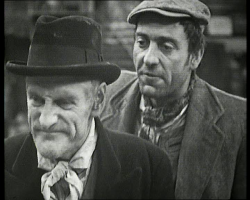
<p>Today marks the fiftieth anniversary of Ray Galton and Alan Simpson’s <em>Steptoe and Son</em> (1962-74): on 5 January 1962, the BBC broadcast ‘The Offer’, the <em>Comedy Playhouse</em> one-off that led to the series that started later the same year.<sup id="rf1-2346"><a href="#fn1-2346" title="Transmission date verified at BFI database." rel="footnote">1</a></sup> It’s a landmark series, and it’s a shame that, like <em>Z Cars</em> earlier this week (2 January), its fiftieth anniversary hasn’t seen an official BBC commemoration, especially since repeats continue to do decent business for BBC Two.<sup id="rf2-2346"><a href="#fn2-2346" title="&#8216;The Desperate Hours&#8217; was repeated on BBC Two on 7 January as part of a tribute to John Howard Davies." rel="footnote">2</a></sup> It&#8217;s not that the BBC entirely resist anniversary celebrations &#8211; it&#8217;s just that those usually commemorate, and play a part in branding, currently ongoing programmes &#8211; and they have shown awareness that Galton and Simpson are among the greats of British television writing, including a profile by <em>Arena</em>.<sup id="rf3-2346"><a href="#fn3-2346" title="&lt;em&gt;Arena&lt;/em&gt;: ‘Galton and Simpson’, tx. BBC2, 25 December 2005." rel="footnote">3</a></sup> However, the anniversary does provide a welcome prod to revisit the series. In that spirit, this site presents an essay celebrating some of the series’ ideas and themes, trying to do some justice to the quality and depth of the writing.</p>

<hr class="footnotes"><ol class="footnotes" style="list-style-type:decimal"><li id="fn1-2346"><p >Transmission date verified at BFI database.&nbsp;<a href="#rf1-2346" class="backlink" title="Return to footnote 1.">&#8617;</a></p></li><li id="fn2-2346"><p >&#8216;The Desperate Hours&#8217; was repeated on BBC Two on 7 January as part of a tribute to John Howard Davies.&nbsp;<a href="#rf2-2346" class="backlink" title="Return to footnote 2.">&#8617;</a></p></li><li id="fn3-2346"><p ><em>Arena</em>: ‘Galton and Simpson’, tx. BBC2, 25 December 2005.&nbsp;<a href="#rf3-2346" class="backlink" title="Return to footnote 3.">&#8617;</a></p></li></ol></hr>{"id":2346,"date":"2012-01-05T23:33:32","date_gmt":"2012-01-05T23:33:32","guid":{"rendered":"http:\/\/www.britishtelevisiondrama.org.uk\/?p=2346"},"modified":"2024-08-30T11:42:52","modified_gmt":"2024-08-30T10:42:52","slug":"you-dirty-old-man-masculinity-and-class-in-steptoe-and-son-1962-74","status":"publish","type":"post","link":"http:\/\/www.britishtelevisiondrama.org.uk\/?p=2346","title":{"rendered":"&#8216;You Dirty Old Man!&#8217;: Masculinity and Class in <em>Steptoe and Son<\/em> (1962-74)"},"content":{"rendered":"<h4>by DAVID ROLINSON<\/h4>\n<p><img loading=\"lazy\" decoding=\"async\" src=\"http:\/\/www.britishtelevisiondrama.org.uk\/wp-content\/uploads\/2016\/02\/BTVD_Steptoe_The-Offer-1-e1454449905562.png\" alt=\"BTVD_Steptoe_The Offer 1\" width=\"250\" height=\"200\" class=\"alignleft size-full wp-image-5831\" \/><\/p>\n<p>Today marks the fiftieth anniversary of Ray Galton and Alan Simpson\u2019s <em>Steptoe and Son<\/em> (1962-74): on 5 January 1962, the BBC broadcast \u2018The Offer\u2019, the <em>Comedy Playhouse<\/em> one-off that led to the series that started later the same year.<sup id=\"rf1-2346\"><a href=\"#fn1-2346\" title=\"Transmission date verified at BFI database.\" rel=\"footnote\">1<\/a><\/sup> It\u2019s a landmark series, and it\u2019s a shame that, like <em>Z Cars<\/em> earlier this week (2 January), its fiftieth anniversary hasn\u2019t seen an official BBC commemoration, especially since repeats continue to do decent business for BBC Two.<sup id=\"rf2-2346\"><a href=\"#fn2-2346\" title=\"&#8216;The Desperate Hours&#8217; was repeated on BBC Two on 7 January as part of a tribute to John Howard Davies.\" rel=\"footnote\">2<\/a><\/sup> It&#8217;s not that the BBC entirely resist anniversary celebrations &#8211; it&#8217;s just that those usually commemorate, and play a part in branding, currently ongoing programmes &#8211; and they have shown awareness that Galton and Simpson are among the greats of British television writing, including a profile by <em>Arena<\/em>.<sup id=\"rf3-2346\"><a href=\"#fn3-2346\" title=\"&lt;em&gt;Arena&lt;\/em&gt;: \u2018Galton and Simpson\u2019, tx. BBC2, 25 December 2005.\" rel=\"footnote\">3<\/a><\/sup> However, the anniversary does provide a welcome prod to revisit the series. In that spirit, this site presents an essay celebrating some of the series\u2019 ideas and themes, trying to do some justice to the quality and depth of the writing.<\/p>\n<p><!--more--><\/p>\n<p><b>Introduction<\/b><\/p>\n<p>This essay revisits a talk I gave at a conference in 2002 \u2013 perhaps appropriately totting some old junk out of my filing cabinet. (It&#8217;s \u2018new\u2019 in the sense that I\u2019ve never repeated it or tried to publish it elsewhere.) The conference was devoted to masculinity in literature and media between 1954 and 1963, so this piece uses that period, and the conference\u2019s set aims, as its focus. Inevitably what follows does neglect some of the things I feel made the series great \u2013 needs more jokes \u2013 but I\u2019ve also stripped away the more academic jargon to hopefully make it more engaging for a wider audience. But I won\u2019t apologise for being a bit serious in order to state the case for <em>Steptoe and Son<\/em> as one of British television\u2019s finest series.<sup id=\"rf4-2346\"><a href=\"#fn4-2346\" title=\"Dave Rolinson, \u2018\u201cYou dirty old man!\u201d: masculinity and class in &lt;em&gt;Steptoe and Son&lt;\/em&gt;, presented on July 2002 at Froebel College University of Surrey Roehampton\u2019s conference &lt;em&gt;The Importance of Being Arthur: Representations of Men and Masculinity 1954-1963&lt;\/em&gt;, which ran over the weekend &#8211; yes, Saturday night and Sunday morning &#8211; of 13-14 July 2002. It was a fascinating conference with a wide variety of papers, and was graced by the presence of the great Alan Sillitoe. I was still quite early in my academic career and would approach the paper quite differently now, but the version presented on this site is faithful to the talk I gave for all its faults, bar some occasional rewriting.\" rel=\"footnote\">4<\/a><\/sup> <\/p>\n<p>I aimed to use <em>Steptoe and Son<\/em> to look at how key discourses of masculinity and class moved beyond neo-realist fiction and British New Wave cinema in the early 1960s. With key authors becoming marginalised and British cinema becoming dependent upon American finance and experiencing critics\u2019 lazy stereotyping of \u201ckitchen sink\u201d (as a pejorative term) cinema,<sup id=\"rf5-2346\"><a href=\"#fn5-2346\" title=\"See Dave Rolinson, &lt;em&gt;This Sporting Life&lt;\/em&gt; booklet, 2008 Network DVD release. I\u2019m citing myself a lot today! I\u2019m really not on royalties.\" rel=\"footnote\">5<\/a><\/sup> it fell to television to represent neglected areas of British life. As discussed elsewhere on this site, television\u2019s engagement is often credited to play strands like <em>The Wednesday Play<\/em> and <em>Play for Today<\/em>, and the new approaches of writers like Jim Allen and directors like Ken Loach (Loach in particular has often stated his reservations with the aesthetics of the British New Wave). However, social realist discourses and issues of class were also addressed in situation comedy, a form much less often discussed in academic writing.<sup id=\"rf6-2346\"><a href=\"#fn6-2346\" title=\"Again, see the John Sullivan piece\u2019s endnotes for some suggestions of academic reading on comedy.\" rel=\"footnote\">6<\/a><\/sup> The most often-cited examples are <em>The Likely Lads<\/em> by Dick Clement and Ian La Frenais, <em>Till Death Us Do Part<\/em> by Johnny Speight, and <em>Steptoe and Son<\/em>.<sup id=\"rf7-2346\"><a href=\"#fn7-2346\" title=\"&lt;em&gt;The Likely Lads&lt;\/em&gt;, tx. BBC, 1964-1966; &lt;em&gt;Whatever Happened To The Likely Lads&lt;\/em&gt;, tx. BBC, 1973-1974. &lt;em&gt;Till Death Us Do Part&lt;\/em&gt;, tx. BBC, 1966-1968, 1972-1975; also &lt;em&gt;In Sickness and In Health&lt;\/em&gt;.\" rel=\"footnote\">7<\/a><\/sup> Creating a space for working-class representation, <em>Steptoe and Son<\/em> had a long-lasting impact on the landscape of British television fiction in various forms.<\/p>\n<p><em>Steptoe and Son<\/em>, of course, features a father and son who work as rag-and-bone men (collectors and traders in second-hand goods) living in a junk yard in Shepherd\u2019s Bush. The father, Albert Steptoe (Wilfrid Brambell), often seems a lazy, xenophobic old man of questionable personal hygiene, who runs the home while his son Harold (Harry H. Corbett) goes out on the horse and cart to look for junk. (I say \u201cseems\u201d because the writing is too nuanced to let such stereotypes stand.) Harold had been taken out of school at an early age to follow in his father\u2019s footsteps, but still dreams of finding room at the top. But, as the intensely claustrophobic first episode \u2018The Offer\u2019 proves, this is easier said than done. Harold, belittled by his father as a rotten rag-and-bone man, is desperate to move away, and reveals that he has had another \u201coffer\u201d, but he is trapped, by the psychological stranglehold of his father \u2013 for whom he feels obliged to care in his old age<sup id=\"rf8-2346\"><a href=\"#fn8-2346\" title=\"Despite all his attempts at escape, when pushed Harold makes it clear that providing for Albert is his &#8220;duty&#8221;, though Albert objects to Harold using that word instead of &#8220;love&#8221; &#8211; &#8216;The Colour Problem&#8217;.\" rel=\"footnote\">8<\/a><\/sup> \u2013 and by the constraints of his upbringing. This essay will try to show how the series connects family psychology and class boundaries, and how they form the battleground for Harold\u2019s sense of his own masculinity.<\/p>\n<p><b>Know thy place: the junkyard<\/b><\/p>\n<p>In a 1974 episode we\u2019re told that Harold\u2019s school\u2019s motto was \u201cKnow thy place and be grateful\u201d, but he can hardly <em>avoid<\/em> knowing his place.<sup id=\"rf9-2346\"><a href=\"#fn9-2346\" title=\"1974 Christmas special.\" rel=\"footnote\">9<\/a><\/sup> The junkyard setting offers an ideological and psychologised space \u2013 whether in the yard or the house, the characters are swamped with junk and debris. The <em>mise-en-sc\u00e8ne<\/em> is cramped \u2013 often comically so \u2013 and the details in production design reveal a lot about them. They are living off the dregs of society \u2013 literally so, since their &#8220;wine cellar&#8221; is stocked from leftover bottles.<sup id=\"rf10-2346\"><a href=\"#fn10-2346\" title=\"&#8216;The Offer&#8217;.\" rel=\"footnote\">10<\/a><\/sup> They often get their clothes off the round, though as a mobile young man Harold takes pride in new suits \u2013 a detail resonant to viewers of Free Cinema and the British New Wave.<sup id=\"rf11-2346\"><a href=\"#fn11-2346\" title=\"See &lt;em&gt;We Are The Lambeth Boys&lt;\/em&gt; or &lt;em&gt;Saturday Night and Sunday Morning&lt;\/em&gt;.\" rel=\"footnote\">11<\/a><\/sup> Neglected by the education system, Harold is an autodidact, learning from second-hand books gained on the round. He often resembles the star of Galton and Simpson\u2019s previous success, <em>Hancock\u2019s Half Hour<\/em>, in which Tony Hancock\u2019s pretensions to greatness and orations on issues whose nuances he did not entirely comprehend made him a comic inversion of the &#8220;angry young man&#8221;, the East Cheam Jimmy Porter. <em>Steptoe and Son<\/em> continues to act as a comic inversion of the British New Wave.<\/p>\n<p><a href=\"http:\/\/www.britishtelevisiondrama.org.uk\/wp-content\/uploads\/2012\/01\/Steptoe_essay_pic_2.jpg\"><img loading=\"lazy\" decoding=\"async\" src=\"http:\/\/www.britishtelevisiondrama.org.uk\/wp-content\/uploads\/2012\/01\/Steptoe_essay_pic_2-224x300.jpg\" alt=\"\" title=\"Steptoe_essay_pic_2\" width=\"224\" height=\"300\" class=\"alignleft size-medium wp-image-2363\" srcset=\"http:\/\/www.britishtelevisiondrama.org.uk\/wp-content\/uploads\/2012\/01\/Steptoe_essay_pic_2-224x300.jpg 224w, http:\/\/www.britishtelevisiondrama.org.uk\/wp-content\/uploads\/2012\/01\/Steptoe_essay_pic_2.jpg 392w\" sizes=\"auto, (max-width: 224px) 100vw, 224px\" \/><\/a><\/p>\n<p>The squalor of the Steptoe house seems a far cry from the mythologised Swinging London taking place in British cinema of the time, even if the Edwardiana hoarded by the Steptoes foreshadows the fashions of <em>Sergeant Pepper\u2019s Lonely Hearts Club Band<\/em> and <em>Adam Adamant Lives!<\/em><sup id=\"rf12-2346\"><a href=\"#fn12-2346\" title=\"See Aldgate, Chapman, Marwick, &lt;em&gt;Windows on the Sixties&lt;\/em&gt; (London: I. B. Tauris, 2000).\" rel=\"footnote\">12<\/a><\/sup> In some episodes, Harold is affluent and mobile, akin to characters in the New Wave and other forms, though as we\u2019ll see, those tropes are inverted or satirised. One of the series\u2019 recurring storylines is Harold\u2019s attempt at home improvements, to match the changing material conditions of the working class. Attempts at betterment include installing a bathroom to prevent Albert dunking his pickled onions while abluting in a tin bath in the living room,<sup id=\"rf13-2346\"><a href=\"#fn13-2346\" title=\"\u2018The Bath\u2019, 1963.\" rel=\"footnote\">13<\/a><\/sup> attempting DIY central heating,<sup id=\"rf14-2346\"><a href=\"#fn14-2346\" title=\"\u2018Those Magnificent Men and Their Heating Machines\u2019, 1965.\" rel=\"footnote\">14<\/a><\/sup> and dividing the house into separate living accommodation in &#8216;Divided We Stand&#8217;, an episode that never fails to move siblings who share bedrooms.<sup id=\"rf15-2346\"><a href=\"#fn15-2346\" title=\"&#8216;Divided We Stand&#8217;, 1972.\" rel=\"footnote\">15<\/a><\/sup> Every time, the result is carnage, structural damage and near-patricide. Some critics have seen this setting as anachronistic, without reading it for meaning. Are Albert\u2019s traditional working-class values meant to seem anachronistic, an anachronistic way of life, a redundant version of dirty old masculinity? Is the Steptoes\u2019 alienation a result of their separation from the modes of production, as they \u2013 like Britain \u2013 have moved from the industrial base to the service economy? Let\u2019s not allow an eye for <em>mise-en-sc\u00e8ne<\/em> to steer us into too crass a mapping of social developments onto details, but the series does at times invite a reading of the house in relation to Britain\u2019s perceived decline. The living room is cluttered with ethnic relics of empire and Britishness \u2013 objects, costumes, photographs \u2013 constantly overlooked by a giant stuffed bear.<sup id=\"rf16-2346\"><a href=\"#fn16-2346\" title=\"In 2002, my thoughts turned to the \u201cbear\u201d of Soviet Russia. Being much less fun these days, I\u2019m now less likely to do this sort of thing.\" rel=\"footnote\">16<\/a><\/sup> This is a business powered not by the white heat of technology but by a shagged-out old horse: as Harold puts it, \u201ca relic of our inefficient past\u201d.<sup id=\"rf17-2346\"><a href=\"#fn17-2346\" title=\"\u2018The Economist\u2019, 1962.\" rel=\"footnote\">17<\/a><\/sup><\/p>\n<p>Totting is an unusual occupation for fictional treatment, derived from Alan Simpson\u2019s memories of his own background.<sup id=\"rf18-2346\"><a href=\"#fn18-2346\" title=\"Although it hadn\u2019t been made when I gave the original version of this paper, see the &lt;em&gt;Arena&lt;\/em&gt; mentioned earlier.\" rel=\"footnote\">18<\/a><\/sup> It is important that the Steptoes live and work in the same space: though New Wave films broke new ground in showing characters at their workplaces, the focus of their narratives was often on leisure time. This seemed to reinforce Eli Zaretsky\u2019s argument that capitalist development \u201ccreated a \u2018separate\u2019 sphere of personal life, seemingly divorced from the mode of production\u201d.<sup id=\"rf19-2346\"><a href=\"#fn19-2346\" title=\"Eli Zaretsky, &lt;em&gt;Capitalism, The Family and Personal Life&lt;\/em&gt;, p. 30 \u2013 taken from Hill, next reference.\" rel=\"footnote\">19<\/a><\/sup> As John Hill argued, this refusal to represent labour inhibited treatment of character, as \u201cwork is not outside and separate from the personal life at all, but a crucial determinant of how that personal life is expressed\u201d.<sup id=\"rf20-2346\"><a href=\"#fn20-2346\" title=\"John Hill, &lt;em&gt;Sex, Class and Realism: British Cinema 1956-63&lt;\/em&gt; (London: British Film Institute, 1986), p. 139.\" rel=\"footnote\">20<\/a><\/sup> For the Steptoes, as Harold puts it, \u201cIf it wasn\u2019t for the wall in-between, I wouldn\u2019t know where the yard finishes and the house starts.\u201d<sup id=\"rf21-2346\"><a href=\"#fn21-2346\" title=\"\u2018The Colour Problem\u2019, 1970.\" rel=\"footnote\">21<\/a><\/sup> In \u2018The Offer\u2019, Harold\u2019s attempt to escape job and family is connected, as he argued that \u201cI\u2019ll never make a name for myself here\u201d as long as he is merely \u201cand Son\u201d. This interconnectedness of work and family is surprisingly complex \u2013 while Harold is trying to evade the know-your-place familial rhetoric of capitalist organisation, Albert represents the internalization of economic systems into the family unit, raising Harold only for manual labour.<sup id=\"rf22-2346\"><a href=\"#fn22-2346\" title=\"It was rare that I didn\u2019t mention the internalization of the dominant ideology in those days. Among Harold&#8217;s many statements to this effect, he denies that Albert has ever been his father: &#8220;cheap labour, that&#8217;s all I was&#8221; &#8211; &#8216;The Bird&#8217;, 1962.\" rel=\"footnote\">22<\/a><\/sup> Albert is at times the epitome of working-class conservatism\/Conservatism or, as far as Harold is concerned, a complacent dupe or a &#8220;dyed-in-the-wool, fascist, reactionary&#8221;,<sup id=\"rf23-2346\"><a href=\"#fn23-2346\" title=\"&#8216;Divided We Stand&#8217;, 1972.\" rel=\"footnote\">23<\/a><\/sup> for attitudes such as these:<\/p>\n<blockquote><p>You&#8217;ve been reading too many books [&#8230; people] all reading books, giving themselves ideas, filling their heads up, making themselves dissatisfied with what they&#8217;ve got [&#8230;] If I had my way, I&#8217;d close all the libraries, burn all the books and leave book reading to those that understands it [&#8230;] book-reading leads to Communism&#8221; &#8211; Albert<sup id=\"rf24-2346\"><a href=\"#fn24-2346\" title=\"&#8216;The Economist&#8217;, 1962.\" rel=\"footnote\">24<\/a><\/sup> <\/p><\/blockquote>\n<p>Albert rebukes Harold\u2019s socialism, his wish to go it alone and dispense with management, with the lovely phrase, \u201cDon\u2019t call me \u2018brother\u2019, I\u2019m your father\u201d. Albert\u2019s hold on Harold also evokes the stranglehold of class history on the construction of masculine roles. History is a constant presence. There are memories of two World Wars in which the workers were (according to the series) cannon fodder: Albert constantly describes his war experience as more brutal than Harold&#8217;s later war experience, which he describes as a &#8220;picnic&#8221;,<sup id=\"rf25-2346\"><a href=\"#fn25-2346\" title=\"My post originally mentioned Harold&#8217;s experience in the Second World War. A commenter pointed out that Harold fought in a different conflict. Confusingly, my original post and the comment are both correct. In \u2018The Bird\u2019 (1962) it is explicitly stated that Harold is 37 and that he joined the army at 18 (approximately 1943) for four years. When Albert talks about the local area during the Second World War, Harold says he was out fighting for King and Country. This is where Albert (for the first time, but it becomes a running joke) says that his experience in the First World War was not a picnic like the one that Harold was in. In an interview with Robert Ross, Alan Simpson said \u201cHarry had, originally, in our minds been involved in the Second World War.\u201d However, when Steptoe and Son came back in the 1970s, Galton and Simpson changed some of the chronology because Harold was, despite the gap between the 1960s and 1970s series, roughly the same age. So, said Simpson, \u201cwe changed Harold\u2019s military background to the Malaya conflict.\u201d Simpson said that Harold was 37 in 1962 and 39 in 1974. Galton said that \u201cit seriously buggered up the our histories of the Steptoes.\u201d &#8211; interview quotations from Ray Galton and Alan Simpson with Robert Ross, &lt;em&gt;Steptoe and Son&lt;\/em&gt; (London: BBC, 2002), p. 139. No wonder finding a precise (or, better, vague) wording was tricky.\" rel=\"footnote\">25<\/a><\/sup> and the treatment of old soldiers will come up in &#8216;Homes Fit For Heroes&#8217;.<sup id=\"rf26-2346\"><a href=\"#fn26-2346\" title=\"&#8216;Homes Fit For Heroes&#8217;, 1964.\" rel=\"footnote\">26<\/a><\/sup> War, national identity and the Steptoes&#8217; identities are intermingled even in their middle names: Albert Edward Ladysmith Steptoe and Harold Albert Kitchener Steptoe.<sup id=\"rf27-2346\"><a href=\"#fn27-2346\" title=\"&#8216;The Colour Problem&#8217;, 1970. Having said that, Galton and Simpson delight in loaded middle names. So impactful was their naming of Tony Hancock as Anthony Aloysius St John Hancock that at least one interviewer mistook this for his real name.\" rel=\"footnote\">27<\/a><\/sup> There is also the fight against \u201cgrasping capitalists\u201d in \u2018The Siege of Steptoe Street\u2019, with its references to the siege of Sidney Street.<sup id=\"rf28-2346\"><a href=\"#fn28-2346\" title=\"\u2018The Siege of Steptoe Street\u2019, 1965.\" rel=\"footnote\">28<\/a><\/sup> Harold often traces his failure to the 1926 General Strike as a snuffing-out of working-class potential, and asks Albert why the working class did not take their opportunity, though Albert stresses that he is \u201cmanagement\u201d rather than working class and Harold accuses him of being \u201ca traitor to the working class\u201d.<sup id=\"rf29-2346\"><a href=\"#fn29-2346\" title=\"&#8216;The Lodger&#8217;.\" rel=\"footnote\">29<\/a><\/sup><\/p>\n<p><b>Stronger than Pinter: reception of &#8216;The Offer&#8217; and the move to a series<\/b><br \/>\n<img loading=\"lazy\" decoding=\"async\" src=\"http:\/\/www.britishtelevisiondrama.org.uk\/wp-content\/uploads\/2016\/02\/BTVD_Steptoe_The-Offer-2-e1454452073284.png\" alt=\"BTVD_Steptoe_The Offer 2\" width=\"250\" height=\"200\" class=\"alignleft size-full wp-image-5832\" \/><\/p>\n<p>In \u2018The Offer\u2019, Harold\u2019s desire to take another businessman\u2019s &#8220;offer&#8221; has a clear social resonance in terms of the wider &#8220;offer&#8221; of purported new opportunities for the working class. However, in practice, Harold needs money, and he needs to use the horse to move his belongings out of the yard. Albert won\u2019t let him use it, so he tries to pull the cart out himself, which he is unable to do. It\u2019s a painful scene, as Harold strains at the cart, holding back tears, saying that \u201cI\u2019ve got to get away\u201d. Harold is trapped, and has discovered that, beneath the rhetoric of social mobility which he quotes, nothing has changed because he is literally powerless. When first shown as a <em>Comedy Playhouse<\/em> one-off, \u2018The Offer\u2019 was reviewed with unusually highbrow points of reference for newspaper reviews of sitcoms: Ibsen, Dickens, Beckett, Chekhov (the reviewer for the <em>Times<\/em> noted its \u201calmost Chekhovian ambience\u201d<sup id=\"rf30-2346\"><a href=\"#fn30-2346\" title=\"M. Wiggin, &lt;em&gt;Times&lt;\/em&gt;, 1 July 1962.\" rel=\"footnote\">30<\/a><\/sup> ) and Strindberg. Raymond Williams located it in the literary tradition of \u201cmen trapped in rooms, working out a general experience of being cheated and frustrated on the most immediately available target: the others inside the cage\u201d.<sup id=\"rf31-2346\"><a href=\"#fn31-2346\" title=\"Raymond Williams, &lt;em&gt;The Listener&lt;\/em&gt; review, reproduced in &lt;em&gt;Raymond Williams On Television&lt;\/em&gt; (New York: Routledge, 1989).\" rel=\"footnote\">31<\/a><\/sup> <\/p>\n<p>Galton and Simpson have often been quoted as saying that they resisted turning this <em>Comedy Playhouse<\/em> episode into a series: \u201cwe think we\u2019ve written a little piece of Pinter here and we can\u2019t repeat it!\u201d<sup id=\"rf32-2346\"><a href=\"#fn32-2346\" title=\"Quoted in Paul Cornell, Martin Day and Keith Topping, &lt;em&gt;The Guinness Book of Classic British TV&lt;\/em&gt; (Enfield: Guinness, 1996), p. 75.\" rel=\"footnote\">32<\/a><\/sup> However, the resulting series <em>Steptoe and Son<\/em> was such a phenomenon in Britain that stories are often told about it winning Labour the 1964 General Election, as Harold Wilson urged the BBC to re-schedule an election night episode to get Labour voters out of the house.<sup id=\"rf33-2346\"><a href=\"#fn33-2346\" title=\"Robert Rowland, \u2018&lt;em&gt;Panorama&lt;\/em&gt; in the Sixties\u2019, in Aldgate, Chapman, Marwick, &lt;em&gt;Windows on the Sixties&lt;\/em&gt; (London: I. B. Tauris, 2000), p. 173. Galton and Simpson discuss the story, though without corroborating it, with reference to the perceived voting patterns of different classes, in the aforementioned &lt;em&gt;Arena&lt;\/em&gt; profile.\" rel=\"footnote\">33<\/a><\/sup> It is clearly a remarkable body of work. Comedy writer Denis Norden argued that television comedy&#8217;s greatest influence was &#8220;on the language, when you\u2019ve got people like Galton and Simpson, whose writing is on a par with Pinter\u2019s, and should be set for O-Levels in the way that it captures the idiom of people\u2019s speech and the poetry of people\u2019s speech.&#8221;<sup id=\"rf34-2346\"><a href=\"#fn34-2346\" title=\"Denis Norden, interviewed on &lt;em&gt;Television&lt;\/em&gt;: &#8216;Canned Laughter&#8217;, tx. ITV, 23 April 1985.\" rel=\"footnote\">34<\/a><\/sup> <\/p>\n<p>However, not everyone welcomed the move to a continuing series. For Raymond Williams, the series was inevitably inferior to &#8216;The Offer&#8217;. Williams wrote that the form of the continuing situation comedy \u201cprevents any full working-through\u201d, resulting in \u201cendless evasion and opportunism: hints and temporary effects\u201d. However, he accepted that this pattern does capture \u201cthe continuing experience of a trapped and frustrating society\u201d.<sup id=\"rf35-2346\"><a href=\"#fn35-2346\" title=\"Raymond Williams, in &lt;em&gt;The Listener&lt;\/em&gt;, 1970, reproduced as \u2018Galton and Simpson\u2019s &lt;em&gt;Steptoe and Son&lt;\/em&gt;, in &lt;em&gt;Raymond Williams on Television&lt;\/em&gt;.\" rel=\"footnote\">35<\/a><\/sup> Dissatisfied with the series, Williams located it alongside a period from the late 1940s to the early 1960s:<\/p>\n<blockquote><p>a period dominated and symbolised by Orwell\u2019s conviction that it is all a swindle, good and bad alike: a despair that was wrought into viable commercial forms, superficially tough-minded and demotic. When I now read late Orwell or Braine or Amis or Pinter or Osborne, I have the sense of a past, and the Steptoes, essentially, belong to it.<sup id=\"rf36-2346\"><a href=\"#fn36-2346\" title=\"Williams, ibid, p. 125.\" rel=\"footnote\">36<\/a><\/sup> <\/p><\/blockquote>\n<p>The format also concerned Dennis Potter, given his comments on the series in 1967, when comparing the series with <em>Till Death Us Do Part<\/em>: &#8220;Galton and Simpson&#8217;s rag-and-bone men are splendid creations, almost too brilliant for the confines of the half-hour comedy format and the cruel temptations of a studio audience.&#8221; Unlike <em>Till Death<\/em>, whose characters, he felt, &#8220;seem to expire with the final credits and re-emerge only to fight the same old battles&#8221;, for Potter &#8220;The Steptoes remain human beings: there is a flow of sympathy between them, a pathos which hardly ever topples into easy sentimentality.&#8221; Potter wondered &#8220;what heights the series might have attained&#8221; without an audience and the labelling of &#8220;comedy&#8221;. (Potter doubted &#8220;that <em>Till Death Us Do Part<\/em> will last in anything like the triumphant way as the Steptoes, good though it undoubtedly is.&#8221;)<sup id=\"rf37-2346\"><a href=\"#fn37-2346\" title=\"All Potter quotations here from Dennis Potter, &#8216;Repeats&#8217;, &lt;em&gt;New Statesman&lt;\/em&gt;, 21 July 1967, p. 98.\" rel=\"footnote\">37<\/a><\/sup><\/p>\n<p>Williams had a point that <em>Steptoe and Son<\/em> wrought its ideas into a viable commercial form, but the argument that its tough-mindedness is superficial is more problematic. Dennis Potter &#8211; perhaps unsurprisingly for one so inspired by Williams &#8211; spoke in similar terms in that he saw Galton and Simpson &#8220;continually threaten&#8221; sitcom&#8217;s &#8220;rigid conventions&#8221;, but thought that they should &#8220;have been encouraged to fracture them altogether: half-hour, budget and all&#8221;.<sup id=\"rf38-2346\"><a href=\"#fn38-2346\" title=\"Potter, &#8216;Repeats&#8217;.\" rel=\"footnote\">38<\/a><\/sup> Episode after episode details Harold\u2019s failure to escape, and I believe that this repetition of denial forms the core of the series\u2019 power and meaning. Working-class stories often include the narrative device of the individual\u2019s escape \u2013 from the problematised social climbing of <em>Room at the Top<\/em> (1959) to the heart-warming triumph of <em>Billy Elliot<\/em> (2000).<sup id=\"rf39-2346\"><a href=\"#fn39-2346\" title=\"I\u2019ve often compared this problematic individual escape \u2013 while the social problems related to the miners\u2019 strike continue for everyone else \u2013 with the ending of &lt;em&gt;Kes&lt;\/em&gt; (1969), applying ideas on politics and narrative from John Hill. Fittingly, Hill has since written a typically persuasive study of this same contrast.\" rel=\"footnote\">39<\/a><\/sup> <\/p>\n<p><b>&#8220;Happens all the time with married couples&#8221;: frustrated aspirations<\/b><\/p>\n<p><a href=\"http:\/\/www.britishtelevisiondrama.org.uk\/wp-content\/uploads\/2012\/01\/Steptoe_essay_pic.jpg\"><img loading=\"lazy\" decoding=\"async\" src=\"http:\/\/www.britishtelevisiondrama.org.uk\/wp-content\/uploads\/2012\/01\/Steptoe_essay_pic-300x217.jpg\" alt=\"\" title=\"Steptoe_essay_pic\" width=\"300\" height=\"217\" class=\"alignleft size-medium wp-image-2357\" srcset=\"http:\/\/www.britishtelevisiondrama.org.uk\/wp-content\/uploads\/2012\/01\/Steptoe_essay_pic-300x217.jpg 300w, http:\/\/www.britishtelevisiondrama.org.uk\/wp-content\/uploads\/2012\/01\/Steptoe_essay_pic.jpg 640w\" sizes=\"auto, (max-width: 300px) 100vw, 300px\" \/><\/a><br \/>\nHarold will never escape \u2013 the series form means that we are repetitively shown him smashing his head against the glass ceiling. When he tries out as a Labour candidate, he is rejected in favour of a faceless outsider intended to attract \u201ca growing middle-class electorate.\u201d<sup id=\"rf40-2346\"><a href=\"#fn40-2346\" title=\"\u2018My Old Man\u2019s A Tory\u2019, 1965. Not, sadly, \u2018Vote Vote Vote for Harold Steptoe\u2019.\" rel=\"footnote\">40<\/a><\/sup> His attempts to escape through creative means \u2013 literature or classical music, amateur dramatics or ballroom dancing \u2013 end in disaster. If Billy Elliot\u2019s surname had been Steptoe, he would\u2019ve broken his legs slipping on horse shit. Although Harold can take scraps from the rich, he is not allowed into their culture. His occasional affluence means that he can take options that were previously beyond the working class, but his belief that \u201cif you\u2019ve got the loot, you\u2019re in\u201d is constantly disproved, as disaster results from his attempts to go on skiing trips,<sup id=\"rf41-2346\"><a href=\"#fn41-2346\" title=\"\u2018A Winter\u2019s Tale\u2019 (1970), though this is not thwarted for snobbish reasons \u2013 see the 1973 Christmas special for that.\" rel=\"footnote\">41<\/a><\/sup> join tennis clubs,<sup id=\"rf42-2346\"><a href=\"#fn42-2346\" title=\"\u2018Loathe Story\u2019, 1972.\" rel=\"footnote\">42<\/a><\/sup> or move to a more affluent area.<sup id=\"rf43-2346\"><a href=\"#fn43-2346\" title=\"\u2018Without Prejudice\u2019, 1970 \u2013 though when they are bought off by nervy residents, they use this to their financial advantage, which according to taste is either fitting revenge or complicity in alienation. Yes, and funny. I\u2019m really not forgetting that.\" rel=\"footnote\">43<\/a><\/sup> So in <em>Steptoe and Son<\/em>, class is determined not culturally but economically. Harold needs to learn that lesson. He believes that \u201cWhen I\u2019ve got my decent clobber on I\u2019m completely classless. Providing I don\u2019t open my mouth I could pass for anybody.\u201d<sup id=\"rf44-2346\"><a href=\"#fn44-2346\" title=\"1974 Christmas Special. As an example of Harold&#8217;s occasional belief in class as culturally determined, in &#8216;The Bird&#8217;, 1962, he describes Albert&#8217;s propensity for 6pm tea as &#8220;dead working-class&#8221;. Later, he&#8217;ll find class discourse in Albert&#8217;s sequencing of milk when making cups of tea.\" rel=\"footnote\">44<\/a><\/sup> While Harold resists confronting the bitter irony of that statement, Albert is, as Hancock and Nathan put it, an \u201cimplacable realist with no illusions about the nature of society and the impregnability of its defences.\u201d<sup id=\"rf45-2346\"><a href=\"#fn45-2346\" title=\"Freddie Hancock and David Nathan, &lt;em&gt;Hancock&lt;\/em&gt;, pp. 197-1978.\" rel=\"footnote\">45<\/a><\/sup><\/p>\n<p>Albert\u2019s sabotaging of Harold\u2019s ambitions, and their love-hate relationship, are motivated by a collision between competing definitions of masculinity. If Britain is the \u2018dirty old man\u2019 of Europe, it finds its symbol in Albert, whose pre-Suez imperial conservatism is rooted in wartime discipline and class deference. It\u2019s hard enough for him that his son has taken his role as breadwinner &#8211; Harold berates Albert for laziness at home while he is out working, but is pulled up short by a doctor&#8217;s analysis of Albert&#8217;s loss of masculinity and self-esteem having been replaced as the head of the family (and in effect imprisoned in the domestic space). This being <em>Steptoe and Son<\/em>, the diagnosis is slightly undercut &#8211; the doctor confesses to being an ear, nose and throat specialist rather than psychiatrist &#8211; but is consistent with Albert&#8217;s own tensions.<sup id=\"rf46-2346\"><a href=\"#fn46-2346\" title=\"&#8216;The Colour Problem&#8217;, though he is right to state that he knows as much as anyone else given the behaviour of the psychiatrist in &#8216;Loathe Story&#8217;.\" rel=\"footnote\">46<\/a><\/sup> So, this is bad enough for Albert but he is further distanced from his son\u2019s effete book-reading tendencies; he takes a hammer to Harold\u2019s Wagner collection, and gets them both thrown out of an art film: given the choice between Fellini and <em>Nudes of 1964<\/em>, Albert would rather skip <em>8 \u00bd<\/em> for some \u201cbird\u2019s\u201d 48\u00bd.<sup id=\"rf47-2346\"><a href=\"#fn47-2346\" title=\"\u2018Sunday for Seven Days\u2019, 1964.\" rel=\"footnote\">47<\/a><\/sup> A shame, really, because he might have appreciated a film concerned with identity and being trapped. (Yes, I mean <em>8 \u00bd<\/em>.) This shows a tension that runs throughout the series: the association of culture with failed masculinity, and occasionally (but problematically) homosexuality. When Harold learns ballroom dancing, it\u2019s the woman\u2019s steps,<sup id=\"rf48-2346\"><a href=\"#fn48-2346\" title=\"\u2018Come Dancing\u2019, 1970.\" rel=\"footnote\">48<\/a><\/sup> and when he meets a man with whom he can discuss art and literature and drink fine wine, that man inevitably tries to seduce him, leaving Harold desperate to prove himself purely a \u201ccrumpet man\u201d, at which point Albert can tearfully bid him \u201cwelcome back, son\u201d.<sup id=\"rf49-2346\"><a href=\"#fn49-2346\" title=\"\u2018Any Old Iron?\u2019, 1970. In &#8216;The Piano&#8217;, 1962, Albert&#8217;s immediate response to a cultured rich man with slippers to protect his carpet is to describe him as &#8220;kinky&#8221; and encourage Harold to watch his step.\" rel=\"footnote\">49<\/a><\/sup> Given that Galton and Simpson worked with Kenneth Williams, it\u2019s tempting to speculate on correlations between Albert and Harold\u2019s relationship and Williams\u2019s relationship with his father Charlie.<\/p>\n<p>The most common source of denial in the series is Harold and Albert sabotaging each other\u2019s relationships with women. This partly represents a conflation of class and gender politics to match the British New Wave films and the literature that preceded it, which have been accused of misogyny owing to their depiction of women trapping men in the bourgeois values of the newly consumerist society and taking them away from \u2018genuine\u2019 working-class culture.<sup id=\"rf50-2346\"><a href=\"#fn50-2346\" title=\"See Hill, &lt;em&gt;Sex, Class and Realism&lt;\/em&gt;.\" rel=\"footnote\">50<\/a><\/sup> Harold constantly escapes the fate of the protagonists of <em>Saturday Night and Sunday Morning<\/em> or <em>A Kind of Loving<\/em> (1962). After one cruel separation, Albert gloats: \u201cThat\u2019s the way to treat \u2018em, son. I\u2019m proud of you.\u201d<sup id=\"rf51-2346\"><a href=\"#fn51-2346\" title=\"\u2018The Bird\u2019, 1962.\" rel=\"footnote\">51<\/a><\/sup> The episode \u2018Is That Your Horse Outside?\u2019 openly references <em>Room at the Top<\/em> and, to an extent, <em>This Sporting Life<\/em> (1963).<sup id=\"rf52-2346\"><a href=\"#fn52-2346\" title=\"\u2018Is That Your Horse Outside\u2019, 1963.\" rel=\"footnote\">52<\/a><\/sup> Harold spends a day in bed with a higher-class woman, and na\u00efvely falls in love, in part happy to have found someone with whom he can discuss culture and politics. But when he returns the next day, he finds the coal man in his place. Albert has to explain that she was only \u201cafter a bit of rough\u201d. Given that, around this time, the film <em>Tom Jones<\/em> pointed British cinema in a new direction, this episode seems oddly prophetic of the way in which certain directors\u2019 passion for working-class subjects passed, and the way that more radical filmmakers in television in the 1960s and 1970s questioned their sincerity.<\/p>\n<p>Most failed relationships in the series are motivated by the major complicating factor in the series\u2019 view of masculinity \u2013 the influence of Albert\u2019s dead wife, Harold\u2019s dead mother. We hear her voice, joltingly, in the ghostly shenanigans of \u2018S\u00e9ance in a Wet Rag and Bone Yard\u2019, after which Harold runs off to sleep with his dad.<sup id=\"rf53-2346\"><a href=\"#fn53-2346\" title=\"\u2018S\u00e9ance in a Wet Rag and Bone Yard\u2019, 1974.\" rel=\"footnote\">53<\/a><\/sup> However, it is usually her absence that dominates the stories. The psychological tension is often Oedipal, playfully so at times. Harold often fantasises about killing his father, and tells his mother\u2019s photograph: \u201cWhy couldn\u2019t it have just been you and me? Why did you need him to come along and spoil it?\u201d<sup id=\"rf54-2346\"><a href=\"#fn54-2346\" title=\"\u2018The Stepmother\u2019, 1963.\" rel=\"footnote\">54<\/a><\/sup> If that wasn\u2019t Oedipal enough, Harold at one point finds an old What the Butler Saw machine featuring his dad in youthful porn employment, and experiences trauma at this primal scene, though ultimately it is Albert\u2019s trauma, mapped onto a class reading of the poverty that forced him into that work.<sup id=\"rf55-2346\"><a href=\"#fn55-2346\" title=\"\u2018Porn Yesterday\u2019, 1974.\" rel=\"footnote\">55<\/a><\/sup> Harold will not let Albert take another woman in his mother\u2019s bed \u2013 \u201cYou and another woman\u2026 in my mum\u2019s bed\u2026 As soon as she\u2019s gone, you\u2019re bringing strange birds back here!\u201d \u2013 and accuses him of being a lecher (Albert\u2019s wounded reply: \u201cTwo birds in 45 years? That ain\u2019t leching!\u201d)<sup id=\"rf56-2346\"><a href=\"#fn56-2346\" title=\"\u2018The Stepmother\u2019, 1963.\" rel=\"footnote\">56<\/a><\/sup> Pretending to be psychopathic, Harold rants a little too convincingly: \u201cI\u2019m not mad, I just want my mother. <em>I want my mother<\/em>.\u201d<sup id=\"rf57-2346\"><a href=\"#fn57-2346\" title=\"\u2018Two\u2019s Company\u2019, 1970.\" rel=\"footnote\">57<\/a><\/sup> That speech comes in the same episode as Harold\u2019s solution to discovering that his dad\u2019s new girlfriend is one of his own old flames: that she can stay but switch to his bed.<sup id=\"rf58-2346\"><a href=\"#fn58-2346\" title=\"\u2018Two\u2019s Company\u2019, 1970.\" rel=\"footnote\">58<\/a><\/sup> Albert and Harold are locked in a bizarre form of marriage: after Harold is spurned on his wedding day, he takes his dad on honeymoon.<sup id=\"rf59-2346\"><a href=\"#fn59-2346\" title=\"The wonderful \u2018And Afterwards At\u2026\u2019, 1965.\" rel=\"footnote\">59<\/a><\/sup> Harold expects Albert to have his tea ready when he gets in from work, and fussily straightens his tie when they go out. In &#8216;Loathe Story&#8217;, an acerbic part-deconstruction of the show&#8217;s own format, Harold finally goes to a psychiatrist after trying to hack his father to death while sleepwalking, and the cause is said to be \u201cthe hypertension when two people live in close proximity in claustrophobic conditions unable to pursue their outside interests. Happens all the time with married couples\u201d.<sup id=\"rf60-2346\"><a href=\"#fn60-2346\" title=\"\u2018Loathe Story\u2019, 1972.\" rel=\"footnote\">60<\/a><\/sup> This represents a state that Harold describes as \u201cnot natural\u201d,<sup id=\"rf61-2346\"><a href=\"#fn61-2346\" title=\"For instance, in \u2018A Winter\u2019s Tale\u2019, 1970.\" rel=\"footnote\">61<\/a><\/sup> but he has become too emotionally stunted, too unsure of his masculinity and class position (as always, intertwined), to strike out on his own.<\/p>\n<p>Ultimately, <em>Steptoe and Son<\/em> invigorated the major themes of all great situation comedy ever since: claustrophobia, confinement and a yearning for escape. It\u2019s striking that its central idea of disrupted domesticity \u2013 men living without women \u2013 has become a sitcom archetype. It says a lot about the reputation of masculinity in modern society that its inadequacy and failure are taken to be reassuring and comedic, yet also full of pathos. The series is often as satisfying dramatically as comically, and pathos plays an important part: as Christopher Dunkley noted, \u201cThe laughs in <em>Steptoe<\/em> are induced as often by pathos or the wry recognition of some eternal truth about the human condition as by \u2018funny\u2019 lines.\u201d<sup id=\"rf62-2346\"><a href=\"#fn62-2346\" title=\"Christopher Dunkley, \u2018When comedians were craftsmen\u2019, &lt;em&gt;Financial Times&lt;\/em&gt;.\" rel=\"footnote\">62<\/a><\/sup> This even includes the statement of problematic patriarchal discourse. Harold often shares the fate of his mother, who had had a career as a teacher before Albert &#8220;soon knocked that on the head&#8221;.<sup id=\"rf63-2346\"><a href=\"#fn63-2346\" title=\"&#8216;The Offer&#8217;, 1962. Admittedly, the mother character&#8217;s reputation changes a little over the years&#8230;\" rel=\"footnote\">63<\/a><\/sup> It\u2019s hard to imagine a focus-grouped commissioning process running with a sitcom about a son who offers his father his shaving blade and encourages him to &#8220;cut your throat [&#8230;] how about a wrist&#8221;,<sup id=\"rf64-2346\"><a href=\"#fn64-2346\" title=\"&#8216;The Bird&#8217;, 1962.\" rel=\"footnote\">64<\/a><\/sup> let alone for that series to become a massive ratings winner. There are some appalling statements from Albert which Harold is appalled by on our behalf, such as Albert&#8217;s reminiscence, complete with a wistful look in his eye: \u201cThey didn\u2019t stand a chance, women in them days. One word out of place and she\u2019d get a gas bracket wrapped round her head. Many\u2019s the night she spent locked in the coal hole screaming her head off.\u201d<sup id=\"rf65-2346\"><a href=\"#fn65-2346\" title=\"\u2018Those Magnificent Men and Their Heating Machines\u2019, 1964.\" rel=\"footnote\">65<\/a><\/sup> The unseen relationship between Albert and his wife conflates class and gender politics, and that relationship and the wife&#8217;s own behaviour shifts according to Albert&#8217;s willingness to wind up his son. Such comments are also part of Galton and Simpson&#8217;s taste for inverted nostalgia, as in Harold\u2019s memories of army life: \u201cI had foot-rot, malaria, I was wounded twice. I had three doses of dysentery. Oh God. They were the happiest days of my life.\u201d<sup id=\"rf66-2346\"><a href=\"#fn66-2346\" title=\"\u2018Loathe Story\u2019, 1972.\" rel=\"footnote\">66<\/a><\/sup> Indeed, in &#8216;The Desperate Hours&#8217;, they envy the conditions of struggling prisoners,<sup id=\"rf67-2346\"><a href=\"#fn67-2346\" title=\"&#8216;The Desperate Hours&#8217;, 1972.\" rel=\"footnote\">67<\/a><\/sup> as they face their own, less literal, sentence. This is predicted as early as &#8216;The Bird&#8217;, 1962, when Harold states: &#8220;I&#8217;ve been a prisoner all my life&#8221; and compares his treatment with a dog that Albert had, wouldn&#8217;t let out, and left unprepared for the outside world when it escaped. <\/p>\n<p>Indeed, the series&#8217; sense of history is often sardonic. For example, there is this key speech from Harold:<\/p>\n<blockquote><p>Ain&#8217;t it pathetic, your faith in the healing powers of a cup of tea! [&#8230;] the Englishman&#8217;s panacea! Mother just died? Oh what a shame, have a cup of tea. Just been run over? Never mind, have a cup of tea. I have been offered tea for disasters, funerals, operations, floods, wars, Dunkirk, the Blitz, Coronations, piles, hysteria, hunger marches and insomnia. Nice cup of tea in one hand and thumbs up to the camera in the other&#8230; Britain can take it! Well they can have it.<\/p><\/blockquote>\n<p>Corbett acknowledges the camera as he presents the &#8220;thumbs up to the camera&#8221; of wartime propaganda films, and the often-satirised taste for tea in British cinema &#8211; the timing of a recommended brew in <em>The Blue Lamp<\/em> (1949) being a particular favourite. (In retrospect, this speech makes it all the more poignant when you revisit &#8216;The Offer&#8217; &#8211; when Harold, at his most broken, is soothed by Albert&#8217;s offer to &#8220;make a cup of tea&#8221;.<sup id=\"rf68-2346\"><a href=\"#fn68-2346\" title=\"&#8216;The Offer&#8217;, 1962.\" rel=\"footnote\">68<\/a><\/sup> But it&#8217;s such a lovely speech by Galton and Simpson, with &#8220;Coronations&#8221; following a string of catastrophes and being followed with cruel abruptness by &#8220;piles&#8221;, before going on to &#8220;hysteria&#8221; and &#8220;hunger marches&#8221; like a linked class narrative. <\/p>\n<p><em>Steptoe and Son<\/em> is an important class representation because, in the terms stated by Loach and others regarding radical drama, it gave its characters the dignity of being worthy subjects for drama away from stereotype. Or, as Harold put it: \u201cI am sick and tired of being a cheerful chirpy Cockney sparrow. I am entitled to be as miserable and depressed as anybody else.\u201d <\/p>\n<p><b>Afterlife<\/b><\/p>\n<p><img loading=\"lazy\" decoding=\"async\" src=\"http:\/\/www.britishtelevisiondrama.org.uk\/wp-content\/uploads\/2016\/02\/BTVD_Steptoe_translations-1-e1454448032216.png\" alt=\"BTVD_Steptoe_translations 1\" width=\"250\" height=\"203\" class=\"alignleft size-full wp-image-5825\" \/><br \/>\nThe series has lived on beyond its geographical and temporal origins. The earlier reference to Strindberg is unsurprising, given <em>Steptoe and Son<\/em>\u2019s play of neurosis, class and sexuality. Sweden had their own version of <em>Steptoe and Son<\/em>, <em>Albert Och Herbert<\/em>. Alan Simpson has recalled that, during a trip to provide extra material in the 1980s, some Swedes could not believe that the show was not their own idea.<sup id=\"rf69-2346\"><a href=\"#fn69-2346\" title=\"See Ray Galton and Alan Simpson with Robert Ross, &lt;em&gt;Steptoe and Son&lt;\/em&gt;, p. 189. There are arguably other antecedents too, like Samuel Beckett: tramps waiting for something to happen in &lt;em&gt;Waiting for Godot&lt;\/em&gt; for instance, like Harold saying he will leave but then not doing so. It would be twisting it too much to make Albert and Harold one blind man and his helper wrestling with the meaning of life from inside dustbins, like some sort of East&lt;em&gt;Endgame&lt;\/em&gt;. And no, I didn\u2019t say any of this in my paper, obviously.\" rel=\"footnote\">69<\/a><\/sup> <\/p>\n<p><img loading=\"lazy\" decoding=\"async\" src=\"http:\/\/www.britishtelevisiondrama.org.uk\/wp-content\/uploads\/2016\/02\/BTVD_Steptoe_translations-2-e1454448045988.png\" alt=\"BTVD_Steptoe_translations 2\" width=\"250\" height=\"203\" class=\"alignleft size-full wp-image-5826\" \/><br \/>\n<img loading=\"lazy\" decoding=\"async\" src=\"http:\/\/www.britishtelevisiondrama.org.uk\/wp-content\/uploads\/2016\/02\/BTVD_Steptoe_translations-3-e1454448056294.png\" alt=\"BTVD_Steptoe_translations 3\" width=\"250\" height=\"203\" class=\"alignleft size-full wp-image-5827\" \/><br \/>\nIndeed, despite the seemingly specifically British nature of the programme&#8217;s language and references, and what Alan Simpson calls the &#8220;myth that comedy doesn&#8217;t travel&#8221;,<sup id=\"rf70-2346\"><a href=\"#fn70-2346\" title=\"Alan Simpson, interviewed on &lt;em&gt;Television&lt;\/em&gt;: &#8216;Canned Laughter&#8217;, tx. ITV, 23 April 1985.\" rel=\"footnote\">70<\/a><\/sup> <em>Steptoe and Son<\/em> generated other remakes too, such as <em>Stiefbeen en Zoon<\/em> in Holland and <em>Sanford and Son<\/em> in America, where black actors complicated the signposting of class dimensions from the original.<sup id=\"rf71-2346\"><a href=\"#fn71-2346\" title=\"The images from these three programmes are taken from &lt;em&gt;Television&lt;\/em&gt;: &#8216;Canned Laughter&#8217;, tx. ITV, 23 April 1985.\" rel=\"footnote\">71<\/a><\/sup><\/p>\n<p>Should we be doing more to celebrate anniversaries like <em>Steptoe and Son<\/em>\u2019s fiftieth? Primetime repeats of <em>Dad&#8217;s Army<\/em> and daytime repeats do decent business for BBC Two, so the reluctance with repeats (outwith the UKTV channels) is a shame though this also continues a long thread in discussions of television: as far back as 1967, Dennis Potter defended television from &#8220;familiar growls from those letter-writing viewers who regard any re-run of a programme which they have already seen as an affront almost too great to be endured&#8221;. He observed the recent repeats of programmes ranging from <em>Steptoe and Son<\/em> to Harold Pinter works, stressing that repeats &#8220;can be valuable&#8221;, for programme-makers, for viewers and also for critics to &#8220;add a few second (or even second-hand) thoughts to their initial assessments&#8221;.<sup id=\"rf72-2346\"><a href=\"#fn72-2346\" title=\"Potter, &#8216;Repeats&#8217;.\" rel=\"footnote\">72<\/a><\/sup> Perhaps, by being left to dig out the episodes, we&#8217;re able to reclaim the joy of the series.<\/p>\n<p><img loading=\"lazy\" decoding=\"async\" src=\"http:\/\/www.britishtelevisiondrama.org.uk\/wp-content\/uploads\/2016\/02\/BTVD_Steptoe_Curse-of-Steptoe-2-e1454454225626.png\" alt=\"BTVD_Steptoe_Curse of Steptoe 2\" width=\"250\" height=\"205\" class=\"alignleft size-full wp-image-5848\" \/><br \/>\n<img loading=\"lazy\" decoding=\"async\" src=\"http:\/\/www.britishtelevisiondrama.org.uk\/wp-content\/uploads\/2016\/02\/BTVD_Steptoe_Curse-of-Steptoe-1-e1454454193834.png\" alt=\"BTVD_Steptoe_Curse of Steptoe 1\" width=\"250\" height=\"205\" class=\"alignleft size-full wp-image-5846\" \/><br \/>\nThis reclamation is important given that some programmes have revisited the series with other intentions, from grubby documentaries (in particular <em>When Steptoe Met Son<\/em>) to docudramas in which the invention, talent and fun of the series and its performers is sublimated to the revelation of personal demons and tears-of-a-clown clich\u00e9.<sup id=\"rf73-2346\"><a href=\"#fn73-2346\" title=\"&lt;em&gt;When Steptoe Met Son&lt;\/em&gt;, tx. Channel 4, 20 August 2002.\" rel=\"footnote\">73<\/a><\/sup> <em>The Curse of Steptoe<\/em> combined the best and worst features of the BBC Four television biopic about television. It has wonderful central performances, reminds us of the esteem with which the actors were seen before they took the parts, gives a sense of the original programme in development &#8211; and a sense that this is sufficiently important to warrant such close attention &#8211; and is part of a fascinating trend in biopics to reconstruct the spaces of 1960s and 1970s television studio production. However, it also too easily conflated the entrapment felt by the characters with the alleged feelings of the actors (increasingly to the detriment of the series) and made dramatic choices that led to complaints from relatives regarding inaccuracies, resulting in changes to BBC policy and alterations that mean that the original broadcast version might never again be seen in that form; writer Brian Fillis discussed the pros and cons of the biopic form, and how it has changed, in <a href=\"http:\/\/indevelopmentuk.blogspot.com\/2011\/07\/tv-drama-writers-festival-bbc.html\" target=\"_self\" rel=\"noopener noreferrer\">this report on a 2011 event<\/a>. I say more about <em>The Curse of Steptoe<\/em>, and the &#8220;television biopics about television&#8221; sub-genre, in a new article forthcoming in 2016.<\/p>\n<p>Clearly, I didn&#8217;t finish with <em>Steptoe and Son<\/em> in 2002. In a book chapter in 2011 I discussed <em>Steptoe and Son<\/em>, <em>Rab C. Nesbitt<\/em> (1988- ), <em>Only Fools and Horses<\/em> (1981-2003), <em>The Royle Family<\/em> (2000- ) and other sitcoms in a long history of TV social realism, which also does more with the idea treated briefly above related to the alleged radicalism or otherwise of particular television forms.<sup id=\"rf74-2346\"><a href=\"#fn74-2346\" title=\"See Dave Rolinson, \u2018Small Screens and Big Voices: Televisual Social Realism and the Popular\u2019, in David Tucker (editor), &lt;em&gt;British Social Realism in the Arts Since 1940&lt;\/em&gt; (Basingstoke: Palgrave Macmillan, 2011), pp. 172-217).\" rel=\"footnote\">74<\/a><\/sup> I also discussed this a little in my post about John Sullivan elsewhere on this site.<sup id=\"rf75-2346\"><a href=\"#fn75-2346\" title=\"Dave Rolinson, \u2018John Sullivan\u2019, at &lt;a href=&quot;http:\/\/www.britishtelevisiondrama.org.uk\/?p=1849&quot; target=&quot;\u201c_self\u201d&quot; rel=&quot;noopener noreferrer&quot;&gt;this page.\" rel=\"footnote\">75<\/a><\/sup>  I\u2019ve also used <em>Steptoe and Son<\/em> in teaching over the years: certainly whenever I tried to ground introductory audience-based film theory I always like to use the Steptoes\u2019 ill-fated visit to Fellini\u2019s <em>8 \u00bd<\/em> in \u2018Sunday for Seven Days\u2019. There is still much more to be said about this, <em>Hancock&#8217;s Half Hour<\/em> and also some of Galton and Simpson&#8217;s less celebrated work.<sup id=\"rf76-2346\"><a href=\"#fn76-2346\" title=\"See for instance Richard Kilborn&#8217;s new piece about &lt;em&gt;Hancock&#8217;s Half Hour&lt;\/em&gt; and &lt;em&gt;Steptoe and Son&lt;\/em&gt;, &#8216;A Golden Age of British Sitcom?&#8217;, in J. Kamm, B. Neumann, K. McGregor and F. Klepner (editors), &lt;em&gt;British TV Comedies: Cultural Concepts, Contexts and Controversies&lt;\/em&gt; (Basingstoke: Palgrave Macmillan, 2016), pp. 23-35.\" rel=\"footnote\">76<\/a><\/sup><\/p>\n<p>In the meantime, how about a nice cup of tea?<\/p>\n<p><em>Thanks to John Williams for drawing my attention to the Steptoe and Son coverage in Dennis Potter&#8217;s piece &#8216;Repeats&#8217;. Elements of my essay first appeared as a conference paper at the University of Surrey Roehampton conference &#8220;The Importance of Being Arthur: Representations of Men and Masculinity 1954-1963, on 13 July 2002. It is posted here with substantial revisions, new material and endnotes.<\/em><\/p>\n<p><em>Originally posted: 5 January 2012.<br \/>\nUpdates:<br \/>\n25 January 2012: added new notes from Dennis Potter&#8217;s reviews.<br \/>\nEarly 2012: added a small number of points, drawn from rewatching further episodes, such as the block quotation from &#8216;The Economist&#8217; and some comments in endnotes.<br \/>\n2 February 2016: substantial revision &#8211; added new images from &#8216;The Offer&#8217; and from overseas remakes of Steptoe and Son; moved existing images and YouTube extract to different stages of essay; added sub-headings as part of clarifying structure; made many minor corrections or alterations to phrasing; amended tenses and references relating to the fiftieth anniversary and then-current BBC Four drama strategies; deleted in-text acknowledgement of the addition of new comments; new comment about middle names; moved some sections (such as Dennis Potter&#8217;s comments on repeats and my comments on revisiting Steptoe after 2002) to different stages of the essay; referred to new 2016 piece.<br \/>\n4 September 2020: slight rewording to remove specific mention of the Second World War after a reader comment.<br \/>\n6 October 2020: added endnote to clarify (and provide evidence) that the Second World War mention was correct but that Galton and Simpson changed the chronology of Harold&#8217;s wartime experience between the 1960s and 1970s runs, so that the war in which he fought changed.<br \/>\n8 November 2022: deleted one footnote relating to wanting to write something new about the programme.<\/em><br \/>\n<iframe loading=\"lazy\"  id=\"_ytid_43274\"  width=\"584\" height=\"438\"  data-origwidth=\"584\" data-origheight=\"438\" src=\"https:\/\/www.youtube.com\/embed\/WG20ofy2w7M?enablejsapi=1&#038;autoplay=0&#038;cc_load_policy=0&#038;cc_lang_pref=&#038;iv_load_policy=1&#038;loop=0&#038;rel=1&#038;fs=1&#038;playsinline=0&#038;autohide=2&#038;theme=dark&#038;color=red&#038;controls=1&#038;disablekb=0&#038;\" class=\"__youtube_prefs__  epyt-is-override  no-lazyload\" title=\"YouTube player\"  allow=\"fullscreen; accelerometer; autoplay; clipboard-write; encrypted-media; gyroscope; picture-in-picture; web-share\" referrerpolicy=\"strict-origin-when-cross-origin\" allowfullscreen data-no-lazy=\"1\" data-skipgform_ajax_framebjll=\"\"><\/iframe><br \/>\n<em>You might also be interested in Walter Dunlop&#8217;s <a href=\"http:\/\/ladydontfallbackwards.wordpress.com\/\" target=\"_self\" rel=\"noopener noreferrer\">review of a repeat of &#8216;The Desperate Hours&#8217; and comments on the non-celebration of the 50th anniversary<\/em><a>. <\/p>\n<p><body><!-- Start of StatCounter Code --><br \/>\n<script type=\"text\/javascript\">\nvar sc_project=5750652; \nvar sc_invisible=1; \nvar sc_partition=68; \nvar sc_click_stat=1; \nvar sc_security=\"6dd1aa39\"; \n<\/script><\/p>\n<p><script type=\"text\/javascript\"\nsrc=\"http:\/\/www.statcounter.com\/counter\/counter.js\"><\/script><noscript>\n<div<br \/>\nclass=&#8221;statcounter&#8221;><a title=\"wordpress stats \"<br \/>\nhref=&#8221;http:\/\/www.statcounter.com\/wordpress.org\/&#8221;<br \/>\ntarget=&#8221;_blank&#8221;><img class=\"statcounter\"<br \/>\nsrc=&#8221;http:\/\/c.statcounter.com\/5750652\/0\/6dd1aa39\/1\/&#8221;<br \/>\nalt=&#8221;wordpress stats &#8221; ><\/a><\/div>\n<p><\/noscript><br \/>\n<!-- End of StatCounter Code --><\/body><\/p>\n<hr class=\"footnotes\"><ol class=\"footnotes\" style=\"list-style-type:decimal\"><li id=\"fn1-2346\"><p >Transmission date verified at BFI database.&nbsp;<a href=\"#rf1-2346\" class=\"backlink\" title=\"Return to footnote 1.\">&#8617;<\/a><\/p><\/li><li id=\"fn2-2346\"><p >&#8216;The Desperate Hours&#8217; was repeated on BBC Two on 7 January as part of a tribute to John Howard Davies.&nbsp;<a href=\"#rf2-2346\" class=\"backlink\" title=\"Return to footnote 2.\">&#8617;<\/a><\/p><\/li><li id=\"fn3-2346\"><p ><em>Arena<\/em>: \u2018Galton and Simpson\u2019, tx. BBC2, 25 December 2005.&nbsp;<a href=\"#rf3-2346\" class=\"backlink\" title=\"Return to footnote 3.\">&#8617;<\/a><\/p><\/li><li id=\"fn4-2346\"><p >Dave Rolinson, \u2018\u201cYou dirty old man!\u201d: masculinity and class in <em>Steptoe and Son<\/em>, presented on July 2002 at Froebel College University of Surrey Roehampton\u2019s conference <em>The Importance of Being Arthur: Representations of Men and Masculinity 1954-1963<\/em>, which ran over the weekend &#8211; yes, Saturday night and Sunday morning &#8211; of 13-14 July 2002. It was a fascinating conference with a wide variety of papers, and was graced by the presence of the great Alan Sillitoe. I was still quite early in my academic career and would approach the paper quite differently now, but the version presented on this site is faithful to the talk I gave for all its faults, bar some occasional rewriting.&nbsp;<a href=\"#rf4-2346\" class=\"backlink\" title=\"Return to footnote 4.\">&#8617;<\/a><\/p><\/li><li id=\"fn5-2346\"><p >See Dave Rolinson, <em>This Sporting Life<\/em> booklet, 2008 Network DVD release. I\u2019m citing myself a lot today! I\u2019m really not on royalties.&nbsp;<a href=\"#rf5-2346\" class=\"backlink\" title=\"Return to footnote 5.\">&#8617;<\/a><\/p><\/li><li id=\"fn6-2346\"><p >Again, see the John Sullivan piece\u2019s endnotes for some suggestions of academic reading on comedy.&nbsp;<a href=\"#rf6-2346\" class=\"backlink\" title=\"Return to footnote 6.\">&#8617;<\/a><\/p><\/li><li id=\"fn7-2346\"><p ><em>The Likely Lads<\/em>, tx. BBC, 1964-1966; <em>Whatever Happened To The Likely Lads<\/em>, tx. BBC, 1973-1974. <em>Till Death Us Do Part<\/em>, tx. BBC, 1966-1968, 1972-1975; also <em>In Sickness and In Health<\/em>.&nbsp;<a href=\"#rf7-2346\" class=\"backlink\" title=\"Return to footnote 7.\">&#8617;<\/a><\/p><\/li><li id=\"fn8-2346\"><p >Despite all his attempts at escape, when pushed Harold makes it clear that providing for Albert is his &#8220;duty&#8221;, though Albert objects to Harold using that word instead of &#8220;love&#8221; &#8211; &#8216;The Colour Problem&#8217;.&nbsp;<a href=\"#rf8-2346\" class=\"backlink\" title=\"Return to footnote 8.\">&#8617;<\/a><\/p><\/li><li id=\"fn9-2346\"><p >1974 Christmas special.&nbsp;<a href=\"#rf9-2346\" class=\"backlink\" title=\"Return to footnote 9.\">&#8617;<\/a><\/p><\/li><li id=\"fn10-2346\"><p >&#8216;The Offer&#8217;.&nbsp;<a href=\"#rf10-2346\" class=\"backlink\" title=\"Return to footnote 10.\">&#8617;<\/a><\/p><\/li><li id=\"fn11-2346\"><p >See <em>We Are The Lambeth Boys<\/em> or <em>Saturday Night and Sunday Morning<\/em>.&nbsp;<a href=\"#rf11-2346\" class=\"backlink\" title=\"Return to footnote 11.\">&#8617;<\/a><\/p><\/li><li id=\"fn12-2346\"><p >See Aldgate, Chapman, Marwick, <em>Windows on the Sixties<\/em> (London: I. B. Tauris, 2000).&nbsp;<a href=\"#rf12-2346\" class=\"backlink\" title=\"Return to footnote 12.\">&#8617;<\/a><\/p><\/li><li id=\"fn13-2346\"><p >\u2018The Bath\u2019, 1963.&nbsp;<a href=\"#rf13-2346\" class=\"backlink\" title=\"Return to footnote 13.\">&#8617;<\/a><\/p><\/li><li id=\"fn14-2346\"><p >\u2018Those Magnificent Men and Their Heating Machines\u2019, 1965.&nbsp;<a href=\"#rf14-2346\" class=\"backlink\" title=\"Return to footnote 14.\">&#8617;<\/a><\/p><\/li><li id=\"fn15-2346\"><p >&#8216;Divided We Stand&#8217;, 1972.&nbsp;<a href=\"#rf15-2346\" class=\"backlink\" title=\"Return to footnote 15.\">&#8617;<\/a><\/p><\/li><li id=\"fn16-2346\"><p >In 2002, my thoughts turned to the \u201cbear\u201d of Soviet Russia. Being much less fun these days, I\u2019m now less likely to do this sort of thing.&nbsp;<a href=\"#rf16-2346\" class=\"backlink\" title=\"Return to footnote 16.\">&#8617;<\/a><\/p><\/li><li id=\"fn17-2346\"><p >\u2018The Economist\u2019, 1962.&nbsp;<a href=\"#rf17-2346\" class=\"backlink\" title=\"Return to footnote 17.\">&#8617;<\/a><\/p><\/li><li id=\"fn18-2346\"><p >Although it hadn\u2019t been made when I gave the original version of this paper, see the <em>Arena<\/em> mentioned earlier.&nbsp;<a href=\"#rf18-2346\" class=\"backlink\" title=\"Return to footnote 18.\">&#8617;<\/a><\/p><\/li><li id=\"fn19-2346\"><p >Eli Zaretsky, <em>Capitalism, The Family and Personal Life<\/em>, p. 30 \u2013 taken from Hill, next reference.&nbsp;<a href=\"#rf19-2346\" class=\"backlink\" title=\"Return to footnote 19.\">&#8617;<\/a><\/p><\/li><li id=\"fn20-2346\"><p >John Hill, <em>Sex, Class and Realism: British Cinema 1956-63<\/em> (London: British Film Institute, 1986), p. 139.&nbsp;<a href=\"#rf20-2346\" class=\"backlink\" title=\"Return to footnote 20.\">&#8617;<\/a><\/p><\/li><li id=\"fn21-2346\"><p >\u2018The Colour Problem\u2019, 1970.&nbsp;<a href=\"#rf21-2346\" class=\"backlink\" title=\"Return to footnote 21.\">&#8617;<\/a><\/p><\/li><li id=\"fn22-2346\"><p >It was rare that I didn\u2019t mention the internalization of the dominant ideology in those days. Among Harold&#8217;s many statements to this effect, he denies that Albert has ever been his father: &#8220;cheap labour, that&#8217;s all I was&#8221; &#8211; &#8216;The Bird&#8217;, 1962.&nbsp;<a href=\"#rf22-2346\" class=\"backlink\" title=\"Return to footnote 22.\">&#8617;<\/a><\/p><\/li><li id=\"fn23-2346\"><p >&#8216;Divided We Stand&#8217;, 1972.&nbsp;<a href=\"#rf23-2346\" class=\"backlink\" title=\"Return to footnote 23.\">&#8617;<\/a><\/p><\/li><li id=\"fn24-2346\"><p >&#8216;The Economist&#8217;, 1962.&nbsp;<a href=\"#rf24-2346\" class=\"backlink\" title=\"Return to footnote 24.\">&#8617;<\/a><\/p><\/li><li id=\"fn25-2346\"><p >My post originally mentioned Harold&#8217;s experience in the Second World War. A commenter pointed out that Harold fought in a different conflict. Confusingly, my original post and the comment are both correct. In \u2018The Bird\u2019 (1962) it is explicitly stated that Harold is 37 and that he joined the army at 18 (approximately 1943) for four years. When Albert talks about the local area during the Second World War, Harold says he was out fighting for King and Country. This is where Albert (for the first time, but it becomes a running joke) says that his experience in the First World War was not a picnic like the one that Harold was in. In an interview with Robert Ross, Alan Simpson said \u201cHarry had, originally, in our minds been involved in the Second World War.\u201d However, when Steptoe and Son came back in the 1970s, Galton and Simpson changed some of the chronology because Harold was, despite the gap between the 1960s and 1970s series, roughly the same age. So, said Simpson, \u201cwe changed Harold\u2019s military background to the Malaya conflict.\u201d Simpson said that Harold was 37 in 1962 and 39 in 1974. Galton said that \u201cit seriously buggered up the our histories of the Steptoes.\u201d &#8211; interview quotations from Ray Galton and Alan Simpson with Robert Ross, <em>Steptoe and Son<\/em> (London: BBC, 2002), p. 139. No wonder finding a precise (or, better, vague) wording was tricky.&nbsp;<a href=\"#rf25-2346\" class=\"backlink\" title=\"Return to footnote 25.\">&#8617;<\/a><\/p><\/li><li id=\"fn26-2346\"><p >&#8216;Homes Fit For Heroes&#8217;, 1964.&nbsp;<a href=\"#rf26-2346\" class=\"backlink\" title=\"Return to footnote 26.\">&#8617;<\/a><\/p><\/li><li id=\"fn27-2346\"><p >&#8216;The Colour Problem&#8217;, 1970. Having said that, Galton and Simpson delight in loaded middle names. So impactful was their naming of Tony Hancock as Anthony Aloysius St John Hancock that at least one interviewer mistook this for his real name.&nbsp;<a href=\"#rf27-2346\" class=\"backlink\" title=\"Return to footnote 27.\">&#8617;<\/a><\/p><\/li><li id=\"fn28-2346\"><p >\u2018The Siege of Steptoe Street\u2019, 1965.&nbsp;<a href=\"#rf28-2346\" class=\"backlink\" title=\"Return to footnote 28.\">&#8617;<\/a><\/p><\/li><li id=\"fn29-2346\"><p >&#8216;The Lodger&#8217;.&nbsp;<a href=\"#rf29-2346\" class=\"backlink\" title=\"Return to footnote 29.\">&#8617;<\/a><\/p><\/li><li id=\"fn30-2346\"><p >M. Wiggin, <em>Times<\/em>, 1 July 1962.&nbsp;<a href=\"#rf30-2346\" class=\"backlink\" title=\"Return to footnote 30.\">&#8617;<\/a><\/p><\/li><li id=\"fn31-2346\"><p >Raymond Williams, <em>The Listener<\/em> review, reproduced in <em>Raymond Williams On Television<\/em> (New York: Routledge, 1989).&nbsp;<a href=\"#rf31-2346\" class=\"backlink\" title=\"Return to footnote 31.\">&#8617;<\/a><\/p><\/li><li id=\"fn32-2346\"><p >Quoted in Paul Cornell, Martin Day and Keith Topping, <em>The Guinness Book of Classic British TV<\/em> (Enfield: Guinness, 1996), p. 75.&nbsp;<a href=\"#rf32-2346\" class=\"backlink\" title=\"Return to footnote 32.\">&#8617;<\/a><\/p><\/li><li id=\"fn33-2346\"><p >Robert Rowland, \u2018<em>Panorama<\/em> in the Sixties\u2019, in Aldgate, Chapman, Marwick, <em>Windows on the Sixties<\/em> (London: I. B. Tauris, 2000), p. 173. Galton and Simpson discuss the story, though without corroborating it, with reference to the perceived voting patterns of different classes, in the aforementioned <em>Arena<\/em> profile.&nbsp;<a href=\"#rf33-2346\" class=\"backlink\" title=\"Return to footnote 33.\">&#8617;<\/a><\/p><\/li><li id=\"fn34-2346\"><p >Denis Norden, interviewed on <em>Television<\/em>: &#8216;Canned Laughter&#8217;, tx. ITV, 23 April 1985.&nbsp;<a href=\"#rf34-2346\" class=\"backlink\" title=\"Return to footnote 34.\">&#8617;<\/a><\/p><\/li><li id=\"fn35-2346\"><p >Raymond Williams, in <em>The Listener<\/em>, 1970, reproduced as \u2018Galton and Simpson\u2019s <em>Steptoe and Son<\/em>, in <em>Raymond Williams on Television<\/em>.&nbsp;<a href=\"#rf35-2346\" class=\"backlink\" title=\"Return to footnote 35.\">&#8617;<\/a><\/p><\/li><li id=\"fn36-2346\"><p >Williams, ibid, p. 125.&nbsp;<a href=\"#rf36-2346\" class=\"backlink\" title=\"Return to footnote 36.\">&#8617;<\/a><\/p><\/li><li id=\"fn37-2346\"><p >All Potter quotations here from Dennis Potter, &#8216;Repeats&#8217;, <em>New Statesman<\/em>, 21 July 1967, p. 98.&nbsp;<a href=\"#rf37-2346\" class=\"backlink\" title=\"Return to footnote 37.\">&#8617;<\/a><\/p><\/li><li id=\"fn38-2346\"><p >Potter, &#8216;Repeats&#8217;.&nbsp;<a href=\"#rf38-2346\" class=\"backlink\" title=\"Return to footnote 38.\">&#8617;<\/a><\/p><\/li><li id=\"fn39-2346\"><p >I\u2019ve often compared this problematic individual escape \u2013 while the social problems related to the miners\u2019 strike continue for everyone else \u2013 with the ending of <em>Kes<\/em> (1969), applying ideas on politics and narrative from John Hill. Fittingly, Hill has since written a typically persuasive study of this same contrast.&nbsp;<a href=\"#rf39-2346\" class=\"backlink\" title=\"Return to footnote 39.\">&#8617;<\/a><\/p><\/li><li id=\"fn40-2346\"><p >\u2018My Old Man\u2019s A Tory\u2019, 1965. Not, sadly, \u2018Vote Vote Vote for Harold Steptoe\u2019.&nbsp;<a href=\"#rf40-2346\" class=\"backlink\" title=\"Return to footnote 40.\">&#8617;<\/a><\/p><\/li><li id=\"fn41-2346\"><p >\u2018A Winter\u2019s Tale\u2019 (1970), though this is not thwarted for snobbish reasons \u2013 see the 1973 Christmas special for that.&nbsp;<a href=\"#rf41-2346\" class=\"backlink\" title=\"Return to footnote 41.\">&#8617;<\/a><\/p><\/li><li id=\"fn42-2346\"><p >\u2018Loathe Story\u2019, 1972.&nbsp;<a href=\"#rf42-2346\" class=\"backlink\" title=\"Return to footnote 42.\">&#8617;<\/a><\/p><\/li><li id=\"fn43-2346\"><p >\u2018Without Prejudice\u2019, 1970 \u2013 though when they are bought off by nervy residents, they use this to their financial advantage, which according to taste is either fitting revenge or complicity in alienation. Yes, and funny. I\u2019m really not forgetting that.&nbsp;<a href=\"#rf43-2346\" class=\"backlink\" title=\"Return to footnote 43.\">&#8617;<\/a><\/p><\/li><li id=\"fn44-2346\"><p >1974 Christmas Special. As an example of Harold&#8217;s occasional belief in class as culturally determined, in &#8216;The Bird&#8217;, 1962, he describes Albert&#8217;s propensity for 6pm tea as &#8220;dead working-class&#8221;. Later, he&#8217;ll find class discourse in Albert&#8217;s sequencing of milk when making cups of tea.&nbsp;<a href=\"#rf44-2346\" class=\"backlink\" title=\"Return to footnote 44.\">&#8617;<\/a><\/p><\/li><li id=\"fn45-2346\"><p >Freddie Hancock and David Nathan, <em>Hancock<\/em>, pp. 197-1978.&nbsp;<a href=\"#rf45-2346\" class=\"backlink\" title=\"Return to footnote 45.\">&#8617;<\/a><\/p><\/li><li id=\"fn46-2346\"><p >&#8216;The Colour Problem&#8217;, though he is right to state that he knows as much as anyone else given the behaviour of the psychiatrist in &#8216;Loathe Story&#8217;.&nbsp;<a href=\"#rf46-2346\" class=\"backlink\" title=\"Return to footnote 46.\">&#8617;<\/a><\/p><\/li><li id=\"fn47-2346\"><p >\u2018Sunday for Seven Days\u2019, 1964.&nbsp;<a href=\"#rf47-2346\" class=\"backlink\" title=\"Return to footnote 47.\">&#8617;<\/a><\/p><\/li><li id=\"fn48-2346\"><p >\u2018Come Dancing\u2019, 1970.&nbsp;<a href=\"#rf48-2346\" class=\"backlink\" title=\"Return to footnote 48.\">&#8617;<\/a><\/p><\/li><li id=\"fn49-2346\"><p >\u2018Any Old Iron?\u2019, 1970. In &#8216;The Piano&#8217;, 1962, Albert&#8217;s immediate response to a cultured rich man with slippers to protect his carpet is to describe him as &#8220;kinky&#8221; and encourage Harold to watch his step.&nbsp;<a href=\"#rf49-2346\" class=\"backlink\" title=\"Return to footnote 49.\">&#8617;<\/a><\/p><\/li><li id=\"fn50-2346\"><p >See Hill, <em>Sex, Class and Realism<\/em>.&nbsp;<a href=\"#rf50-2346\" class=\"backlink\" title=\"Return to footnote 50.\">&#8617;<\/a><\/p><\/li><li id=\"fn51-2346\"><p >\u2018The Bird\u2019, 1962.&nbsp;<a href=\"#rf51-2346\" class=\"backlink\" title=\"Return to footnote 51.\">&#8617;<\/a><\/p><\/li><li id=\"fn52-2346\"><p >\u2018Is That Your Horse Outside\u2019, 1963.&nbsp;<a href=\"#rf52-2346\" class=\"backlink\" title=\"Return to footnote 52.\">&#8617;<\/a><\/p><\/li><li id=\"fn53-2346\"><p >\u2018S\u00e9ance in a Wet Rag and Bone Yard\u2019, 1974.&nbsp;<a href=\"#rf53-2346\" class=\"backlink\" title=\"Return to footnote 53.\">&#8617;<\/a><\/p><\/li><li id=\"fn54-2346\"><p >\u2018The Stepmother\u2019, 1963.&nbsp;<a href=\"#rf54-2346\" class=\"backlink\" title=\"Return to footnote 54.\">&#8617;<\/a><\/p><\/li><li id=\"fn55-2346\"><p >\u2018Porn Yesterday\u2019, 1974.&nbsp;<a href=\"#rf55-2346\" class=\"backlink\" title=\"Return to footnote 55.\">&#8617;<\/a><\/p><\/li><li id=\"fn56-2346\"><p >\u2018The Stepmother\u2019, 1963.&nbsp;<a href=\"#rf56-2346\" class=\"backlink\" title=\"Return to footnote 56.\">&#8617;<\/a><\/p><\/li><li id=\"fn57-2346\"><p >\u2018Two\u2019s Company\u2019, 1970.&nbsp;<a href=\"#rf57-2346\" class=\"backlink\" title=\"Return to footnote 57.\">&#8617;<\/a><\/p><\/li><li id=\"fn58-2346\"><p >\u2018Two\u2019s Company\u2019, 1970.&nbsp;<a href=\"#rf58-2346\" class=\"backlink\" title=\"Return to footnote 58.\">&#8617;<\/a><\/p><\/li><li id=\"fn59-2346\"><p >The wonderful \u2018And Afterwards At\u2026\u2019, 1965.&nbsp;<a href=\"#rf59-2346\" class=\"backlink\" title=\"Return to footnote 59.\">&#8617;<\/a><\/p><\/li><li id=\"fn60-2346\"><p >\u2018Loathe Story\u2019, 1972.&nbsp;<a href=\"#rf60-2346\" class=\"backlink\" title=\"Return to footnote 60.\">&#8617;<\/a><\/p><\/li><li id=\"fn61-2346\"><p >For instance, in \u2018A Winter\u2019s Tale\u2019, 1970.&nbsp;<a href=\"#rf61-2346\" class=\"backlink\" title=\"Return to footnote 61.\">&#8617;<\/a><\/p><\/li><li id=\"fn62-2346\"><p >Christopher Dunkley, \u2018When comedians were craftsmen\u2019, <em>Financial Times<\/em>.&nbsp;<a href=\"#rf62-2346\" class=\"backlink\" title=\"Return to footnote 62.\">&#8617;<\/a><\/p><\/li><li id=\"fn63-2346\"><p >&#8216;The Offer&#8217;, 1962. Admittedly, the mother character&#8217;s reputation changes a little over the years&#8230;&nbsp;<a href=\"#rf63-2346\" class=\"backlink\" title=\"Return to footnote 63.\">&#8617;<\/a><\/p><\/li><li id=\"fn64-2346\"><p >&#8216;The Bird&#8217;, 1962.&nbsp;<a href=\"#rf64-2346\" class=\"backlink\" title=\"Return to footnote 64.\">&#8617;<\/a><\/p><\/li><li id=\"fn65-2346\"><p >\u2018Those Magnificent Men and Their Heating Machines\u2019, 1964.&nbsp;<a href=\"#rf65-2346\" class=\"backlink\" title=\"Return to footnote 65.\">&#8617;<\/a><\/p><\/li><li id=\"fn66-2346\"><p >\u2018Loathe Story\u2019, 1972.&nbsp;<a href=\"#rf66-2346\" class=\"backlink\" title=\"Return to footnote 66.\">&#8617;<\/a><\/p><\/li><li id=\"fn67-2346\"><p >&#8216;The Desperate Hours&#8217;, 1972.&nbsp;<a href=\"#rf67-2346\" class=\"backlink\" title=\"Return to footnote 67.\">&#8617;<\/a><\/p><\/li><li id=\"fn68-2346\"><p >&#8216;The Offer&#8217;, 1962.&nbsp;<a href=\"#rf68-2346\" class=\"backlink\" title=\"Return to footnote 68.\">&#8617;<\/a><\/p><\/li><li id=\"fn69-2346\"><p >See Ray Galton and Alan Simpson with Robert Ross, <em>Steptoe and Son<\/em>, p. 189. There are arguably other antecedents too, like Samuel Beckett: tramps waiting for something to happen in <em>Waiting for Godot<\/em> for instance, like Harold saying he will leave but then not doing so. It would be twisting it too much to make Albert and Harold one blind man and his helper wrestling with the meaning of life from inside dustbins, like some sort of East<em>Endgame<\/em>. And no, I didn\u2019t say any of this in my paper, obviously.&nbsp;<a href=\"#rf69-2346\" class=\"backlink\" title=\"Return to footnote 69.\">&#8617;<\/a><\/p><\/li><li id=\"fn70-2346\"><p >Alan Simpson, interviewed on <em>Television<\/em>: &#8216;Canned Laughter&#8217;, tx. ITV, 23 April 1985.&nbsp;<a href=\"#rf70-2346\" class=\"backlink\" title=\"Return to footnote 70.\">&#8617;<\/a><\/p><\/li><li id=\"fn71-2346\"><p >The images from these three programmes are taken from <em>Television<\/em>: &#8216;Canned Laughter&#8217;, tx. ITV, 23 April 1985.&nbsp;<a href=\"#rf71-2346\" class=\"backlink\" title=\"Return to footnote 71.\">&#8617;<\/a><\/p><\/li><li id=\"fn72-2346\"><p >Potter, &#8216;Repeats&#8217;.&nbsp;<a href=\"#rf72-2346\" class=\"backlink\" title=\"Return to footnote 72.\">&#8617;<\/a><\/p><\/li><li id=\"fn73-2346\"><p ><em>When Steptoe Met Son<\/em>, tx. Channel 4, 20 August 2002.&nbsp;<a href=\"#rf73-2346\" class=\"backlink\" title=\"Return to footnote 73.\">&#8617;<\/a><\/p><\/li><li id=\"fn74-2346\"><p >See Dave Rolinson, \u2018Small Screens and Big Voices: Televisual Social Realism and the Popular\u2019, in David Tucker (editor), <em>British Social Realism in the Arts Since 1940<\/em> (Basingstoke: Palgrave Macmillan, 2011), pp. 172-217).&nbsp;<a href=\"#rf74-2346\" class=\"backlink\" title=\"Return to footnote 74.\">&#8617;<\/a><\/p><\/li><li id=\"fn75-2346\"><p >Dave Rolinson, \u2018John Sullivan\u2019, at <a href=\"http:\/\/www.britishtelevisiondrama.org.uk\/?p=1849\" target=\"\u201c_self\u201d\" rel=\"noopener noreferrer\">this page.&nbsp;<a href=\"#rf75-2346\" class=\"backlink\" title=\"Return to footnote 75.\">&#8617;<\/a><\/p><\/li><li id=\"fn76-2346\"><p >See for instance Richard Kilborn&#8217;s new piece about <em>Hancock&#8217;s Half Hour<\/em> and <em>Steptoe and Son<\/em>, &#8216;A Golden Age of British Sitcom?&#8217;, in J. Kamm, B. Neumann, K. McGregor and F. Klepner (editors), <em>British TV Comedies: Cultural Concepts, Contexts and Controversies<\/em> (Basingstoke: Palgrave Macmillan, 2016), pp. 23-35.&nbsp;<a href=\"#rf76-2346\" class=\"backlink\" title=\"Return to footnote 76.\">&#8617;<\/a><\/p><\/li><\/a><\/a><\/p><\/ol><\/hr>","protected":false},"excerpt":{"rendered":null,"protected":false},"author":1,"featured_media":0,"comment_status":"open","ping_status":"open","sticky":false,"template":"","format":"standard","meta":{"footnotes":""},"categories":[140,137],"tags":[193,175,174,192],"class_list":["post-2346","post","type-post","status-publish","format-standard","hentry","category-david-rolinson","category-essays","tag-british-new-wave","tag-galton-and-simpson","tag-john-sullivan","tag-steptoe-and-son"],"_links":{"self":[{"href":"http:\/\/www.britishtelevisiondrama.org.uk\/index.php?rest_route=\/wp\/v2\/posts\/2346","targetHints":{"allow":["GET"]}}],"collection":[{"href":"http:\/\/www.britishtelevisiondrama.org.uk\/index.php?rest_route=\/wp\/v2\/posts"}],"about":[{"href":"http:\/\/www.britishtelevisiondrama.org.uk\/index.php?rest_route=\/wp\/v2\/types\/post"}],"author":[{"embeddable":true,"href":"http:\/\/www.britishtelevisiondrama.org.uk\/index.php?rest_route=\/wp\/v2\/users\/1"}],"replies":[{"embeddable":true,"href":"http:\/\/www.britishtelevisiondrama.org.uk\/index.php?rest_route=%2Fwp%2Fv2%2Fcomments&post=2346"}],"version-history":[{"count":72,"href":"http:\/\/www.britishtelevisiondrama.org.uk\/index.php?rest_route=\/wp\/v2\/posts\/2346\/revisions"}],"predecessor-version":[{"id":8297,"href":"http:\/\/www.britishtelevisiondrama.org.uk\/index.php?rest_route=\/wp\/v2\/posts\/2346\/revisions\/8297"}],"wp:attachment":[{"href":"http:\/\/www.britishtelevisiondrama.org.uk\/index.php?rest_route=%2Fwp%2Fv2%2Fmedia&parent=2346"}],"wp:term":[{"taxonomy":"category","embeddable":true,"href":"http:\/\/www.britishtelevisiondrama.org.uk\/index.php?rest_route=%2Fwp%2Fv2%2Fcategories&post=2346"},{"taxonomy":"post_tag","embeddable":true,"href":"http:\/\/www.britishtelevisiondrama.org.uk\/index.php?rest_route=%2Fwp%2Fv2%2Ftags&post=2346"}],"curies":[{"name":"wp","href":"https:\/\/api.w.org\/{rel}","templated":true}]}}