<h4>by DAVID ROLINSON</h4>
<p><a href="http://www.britishtelevisiondrama.org.uk/wp-content/uploads/2012/07/CW_image1.png"><img loading="lazy" decoding="async" src="http://www.britishtelevisiondrama.org.uk/wp-content/uploads/2012/07/CW_image1-300x225.png" alt="" title="CW_image1" width="300" height="225" class="alignleft size-medium wp-image-2796" srcset="http://www.britishtelevisiondrama.org.uk/wp-content/uploads/2012/07/CW_image1-300x225.png 300w, http://www.britishtelevisiondrama.org.uk/wp-content/uploads/2012/07/CW_image1.png 768w" sizes="auto, (max-width: 300px) 100vw, 300px" /></a><br />
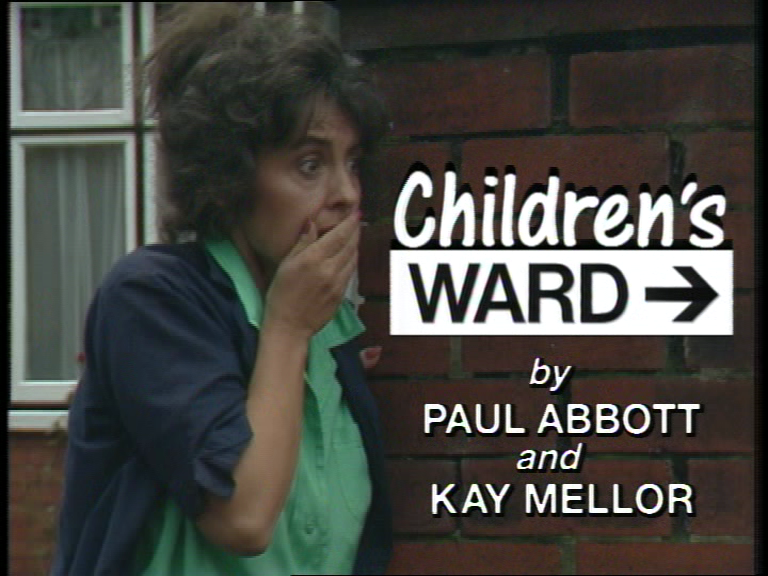
These days, teatime ITV means repeats of <em>Midsomer Murders</em> or reality formats so recycled that their pitches were delivered in a green caddy. But <em>Children’s Ward</em> is a reminder that this slot used to house children’s programmes, including three great drama series that started in 1989: <em>Press Gang</em> (on 6 January), <em>Children’s Ward</em> (on 15 March, after a 1988 one-off) and <em>Byker</em> (Byker!) <em>Grove</em> (on 8 November). Given that the 1990 Broadcasting Act entrenched deregulation, it’s tempting to see these shows clinging to pre-1990 public service values, and aiming to give children the same range of programming that was available to adults. </p>
<p>What would ITV do now to have shows in the same week written by Paul Abbott, Kay Mellor and Steven Moffat? That happened for the first few weeks of <em>Children’s Ward</em>’s run (<em>Press Gang</em> Mondays, <em>Children’s Ward</em> Wednesdays). Welcoming an Ofcom review of children’s programming, Mark Wright at <em>Television Today</em> argued that, despite there being numerous digital channels for children, there aren’t many “original, home grown shows that nurture not only young and upcoming talent, but bring new audiences” to television rather than encouraging kids to “sod off to the Internet”.<sup id="rf1-2789"><a href="#fn1-2789" title="Mark Wright, &#8216;ITV denies the talent of the future&#8230;&#8217;, &lt;em&gt;The Stage and Television Today&lt;/em&gt;, 14 February 2007, &lt;a href=&quot;http://blogs.thestage.co.uk/tvtoday/2007/02/itv-denies-the-talent-of-the-future/&quot; target=&quot;_self&quot; rel=&quot;noopener&quot;&gt;accessed here&lt;/a&gt;." rel="footnote">1</a></sup> As Wright notes, many of <em>Children’s Ward</em>’s alumni are now “among the premier drama writers in the country”: Abbott, Mellor and (from later seasons) Russell T. Davies, Matt Jones, and Sally Wainwright. </p>

<hr class="footnotes"><ol class="footnotes" style="list-style-type:decimal"><li id="fn1-2789"><p >Mark Wright, &#8216;ITV denies the talent of the future&#8230;&#8217;, <em>The Stage and Television Today</em>, 14 February 2007, <a href="http://blogs.thestage.co.uk/tvtoday/2007/02/itv-denies-the-talent-of-the-future/" target="_self" rel="noopener">accessed here</a>.&nbsp;<a href="#rf1-2789" class="backlink" title="Return to footnote 1.">&#8617;</a></p></li></ol></hr>{"id":2789,"date":"2012-07-31T10:49:05","date_gmt":"2012-07-31T09:49:05","guid":{"rendered":"http:\/\/www.britishtelevisiondrama.org.uk\/?p=2789"},"modified":"2024-08-30T11:41:38","modified_gmt":"2024-08-30T10:41:38","slug":"childrens-ward-series-1","status":"publish","type":"post","link":"http:\/\/www.britishtelevisiondrama.org.uk\/?p=2789","title":{"rendered":"<em>Children&#8217;s Ward<\/em> Series 1"},"content":{"rendered":"<h4>by DAVID ROLINSON<\/h4>\n<p><a href=\"http:\/\/www.britishtelevisiondrama.org.uk\/wp-content\/uploads\/2012\/07\/CW_image1.png\"><img loading=\"lazy\" decoding=\"async\" src=\"http:\/\/www.britishtelevisiondrama.org.uk\/wp-content\/uploads\/2012\/07\/CW_image1-300x225.png\" alt=\"\" title=\"CW_image1\" width=\"300\" height=\"225\" class=\"alignleft size-medium wp-image-2796\" srcset=\"http:\/\/www.britishtelevisiondrama.org.uk\/wp-content\/uploads\/2012\/07\/CW_image1-300x225.png 300w, http:\/\/www.britishtelevisiondrama.org.uk\/wp-content\/uploads\/2012\/07\/CW_image1.png 768w\" sizes=\"auto, (max-width: 300px) 100vw, 300px\" \/><\/a><br \/>\nThese days, teatime ITV means repeats of <em>Midsomer Murders<\/em> or reality formats so recycled that their pitches were delivered in a green caddy. But <em>Children\u2019s Ward<\/em> is a reminder that this slot used to house children\u2019s programmes, including three great drama series that started in 1989: <em>Press Gang<\/em> (on 6 January), <em>Children\u2019s Ward<\/em> (on 15 March, after a 1988 one-off) and <em>Byker<\/em> (Byker!) <em>Grove<\/em> (on 8 November). Given that the 1990 Broadcasting Act entrenched deregulation, it\u2019s tempting to see these shows clinging to pre-1990 public service values, and aiming to give children the same range of programming that was available to adults. <\/p>\n<p>What would ITV do now to have shows in the same week written by Paul Abbott, Kay Mellor and Steven Moffat? That happened for the first few weeks of <em>Children\u2019s Ward<\/em>\u2019s run (<em>Press Gang<\/em> Mondays, <em>Children\u2019s Ward<\/em> Wednesdays). Welcoming an Ofcom review of children\u2019s programming, Mark Wright at <em>Television Today<\/em> argued that, despite there being numerous digital channels for children, there aren\u2019t many \u201coriginal, home grown shows that nurture not only young and upcoming talent, but bring new audiences\u201d to television rather than encouraging kids to \u201csod off to the Internet\u201d.<sup id=\"rf1-2789\"><a href=\"#fn1-2789\" title=\"Mark Wright, &#8216;ITV denies the talent of the future&#8230;&#8217;, &lt;em&gt;The Stage and Television Today&lt;\/em&gt;, 14 February 2007, &lt;a href=&quot;http:\/\/blogs.thestage.co.uk\/tvtoday\/2007\/02\/itv-denies-the-talent-of-the-future\/&quot; target=&quot;_self&quot; rel=&quot;noopener&quot;&gt;accessed here&lt;\/a&gt;.\" rel=\"footnote\">1<\/a><\/sup> As Wright notes, many of <em>Children\u2019s Ward<\/em>\u2019s alumni are now \u201camong the premier drama writers in the country\u201d: Abbott, Mellor and (from later seasons) Russell T. Davies, Matt Jones, and Sally Wainwright. <\/p>\n<p><!--more--><\/p>\n<p>I watched <em> Children&#8217;s Ward<\/em> and <em>Press Gang<\/em> from the start, though I was more passionate about <em>Press Gang<\/em>\u2019s <em>His Girl Friday<\/em>\/<em>Moonlighting<\/em> wit and complexity, and now <em>Children&#8217;s Ward<\/em> tends to be less highly regarded. Others champion <em>Byker<\/em> (Byker! Byker!) <em>Grove<\/em>: the <em>Guinness Book of Classic British TV<\/em> (one of whose writers, Paul Cornell, soon wrote for <em>Children\u2019s Ward<\/em>) qualifies its positive statement about <em>Children\u2019s Ward<\/em> by saying that the CBBC show handled issues more \u201cboldly\u201d.<sup id=\"rf2-2789\"><a href=\"#fn2-2789\" title=\"Paul Cornell, Martin Day and Keith Topping, &lt;em&gt;The Guinness Book of Classic British TV&lt;\/em&gt; (Enfield: Guinness, 1996).\" rel=\"footnote\">2<\/a><\/sup> (I don\u2019t know, we were a CITV house \u2013 in itself an archaic statement.) The hospital setting obviously isn\u2019t new \u2013 that tidy pretext for social microcosms has dominated TV for decades. The children\u2019s ward setting isn\u2019t new either: in <em>The Hill and Beyond<\/em>, Alistair McGown and Mark Docherty discuss ATV\u2019s <em>Why Can\u2019t I Go Home?<\/em> (script-edited by David Fisher) from 1979. Unlike that earlier series, <em>Children\u2019s Ward<\/em> was a long-running success (ending in 2000).<sup id=\"rf3-2789\"><a href=\"#fn3-2789\" title=\"Alistair D. McGown and Mark J. Docherty, &lt;em&gt;The Hill and Beyond: Children&#8217;s Television Drama &#8211; An Encyclopedia&lt;\/em&gt; (London: British Film Institute, 2003.\" rel=\"footnote\">3<\/a><\/sup><\/p>\n<p>Although I\u2019ve rewatched <em>Press Gang<\/em> many times over two decades, I\u2019d never revisited <em>Children\u2019s Ward<\/em>, and it\u2019s been a pleasure. Written entirely by Paul Abbott and Kay Mellor (and directed on videotape, mostly in the studio but with a couple of key location sequences, by Nicholas Mallett, Alistair Clark and producer Rod Natkiel), the first season is quality soap opera, in terms of storylining and writing, as you\u2019d expect from writers with their pedigree then (especially on <em>Coronation Street<\/em>) and since.<\/p>\n<p><a href=\"http:\/\/www.britishtelevisiondrama.org.uk\/wp-content\/uploads\/2012\/07\/CW_image2.png\"><img loading=\"lazy\" decoding=\"async\" src=\"http:\/\/www.britishtelevisiondrama.org.uk\/wp-content\/uploads\/2012\/07\/CW_image2-150x150.png\" alt=\"\" title=\"CW_image2\" width=\"150\" height=\"150\" class=\"alignleft size-thumbnail wp-image-2797\" \/><\/a><br \/>\nThe DVD includes what is in effect the pilot, \u2018Blackbird Singing in the Dead of Night\u2019, Abbott and Mellor\u2019s 1988 play for <em>Dramarama<\/em> (a single play anthology on Children\u2019s ITV), directed by Spencer Campbell. It introduces some of the series\u2019 central elements (a central boy\/girl relationship, a male nurse\/female doctor partnership, an overeating boy, constant radio and a girl having trauma flashbacks) though its characters are different and it\u2019s a lovely play on its own terms. Kim, a girl whose hearing was damaged in an explosion, is frustrated by constant readmissions for treatment that doesn\u2019t work, and snaps at staff or clams up, but we\u2019re privy to her thoughts through voice-overs, a subjective device (not used in the series) pushing the child\u2019s perspective. She opens up to Danny, who was also initially aggressive, and as the ending makes clear, her injury works within the play\u2019s metaphorical approach to childhood by flagging up ideas of talking and listening.<\/p>\n<p>That <em>Children\u2019s Ward<\/em> will be less reflective is clear from Episode 1\u2019s jolting pre-credits location sequence in which 13-year-old Fiona (Rebecca Sowden, i.e. Callard) runs into the road after arguing with her mother about seeing an Iron Maiden concert, and becomes the victim of a hit-and-run driver. She\u2019s rushed to our location, South Park General Hospital. (When that name stops bringing to mind a different TV series, in a later episode a child is taken to Springfield House.) Fiona spends much of the season in a coma, overseen by her mother. In the ward, our focal points are older than in the pilot: troubled 15-year-olds Keely (Jenny Luckraft) and Billy (Tim Vincent), whose dialogue (the odd \u201cdickhead\u201d, \u201cknobhead\u201d or \u201cslag\u201d) is sometimes choice for the timeslot. <\/p>\n<p>But as in the play, the series mixes children of different ages and backgrounds, including over-eating Ben (who\u2019s posh enough to talk of \u201cnosh and pop\u201d, though sadly doesn\u2019t say \u201cSlurp! Sloo!\u201d), the demanding Dawn and amiable gunshot victim Alex. The tone can switch from relatively bleak (some children can\u2019t be cured) to fun for younger viewers, as the kids gang up on tyrannical confectioner Jack (\u201cWHO\u2019S AGGRESSIVE?!\u201d), who has \u201cseen borstals run better than this\u201d. Like Danny in the pilot, Billy wanted to be on an adult ward, and it\u2019s tempting to think the show wants to defuse the oft-noted concern that many children dislike watching younger children. But <em>EastEnders<\/em> always features high up the lists of programmes most watched by children, and <em>Children\u2019s Ward<\/em> respects that.<br \/>\n<iframe loading=\"lazy\"  id=\"_ytid_44571\"  width=\"584\" height=\"329\"  data-origwidth=\"584\" data-origheight=\"329\" src=\"https:\/\/www.youtube.com\/embed\/GKm8dYGOXlQ?enablejsapi=1&#038;autoplay=0&#038;cc_load_policy=0&#038;cc_lang_pref=&#038;iv_load_policy=1&#038;loop=0&#038;rel=1&#038;fs=1&#038;playsinline=0&#038;autohide=2&#038;theme=dark&#038;color=red&#038;controls=1&#038;disablekb=0&#038;\" class=\"__youtube_prefs__  epyt-is-override  no-lazyload\" title=\"YouTube player\"  allow=\"fullscreen; accelerometer; autoplay; clipboard-write; encrypted-media; gyroscope; picture-in-picture; web-share\" referrerpolicy=\"strict-origin-when-cross-origin\" allowfullscreen data-no-lazy=\"1\" data-skipgform_ajax_framebjll=\"\"><\/iframe><br \/>\nThere\u2019s also a strong focus on staff, their tangled personal relationships (albeit on a teenage-drama \u201cdating\u201d level) and professional lives, with scenes devoted to discussing cases, protocol and administration. Though they\u2019re all dedicated, they make mistakes and show temper, especially with misbehaving kids whom Dave sometimes \u201ccould actually throttle\u201d. The show credits several medical advisors, plus the Paediatric Unit of Bolton General Hospital, its real-life setting. There\u2019s the politics of involving a psychiatrist (the admirably doomy Dr Yin) or social worker (Steve), and lots of useful advice: it\u2019s not just sickly kids who get asthma, it\u2019s not just tramps who are alcoholics, epilepsy is like letters misdelivered by the Post Office, the big problem with asthma isn\u2019t breathing in but breathing out, and caravans have VCRs too.<\/p>\n<p>Admittedly the gear changes are a bit creaky early on: the surprise that a woman can be a doctor (Dave not having seen the pilot), a new male nurse\u2019s mistakes are entertaining but strain credulity, the dialogue doesn\u2019t always sing and there\u2019s lots of the soap device of an argument followed by an apology in the next scene or \u201cabout last night\u201d as recap-device in the next episode. My biggest fear was Episode 8 but it was better than I\u2019d remembered: the long-threatened visit of DJ Bruno Brookes to try to get a listener out of a coma (haven\u2019t thought that through) generates so much hysteria you\u2019d swear his agent wrote the script, but it also prompts sardonic details such as a never-before-seen administrator hogging publicity and steering a journalist away from the coma victim\u2019s less photogenic friends, and the fact that he first meets the indomitable Mags (Rita Mays), who has no idea who he is. Joking aside, Bruno Brookes (the show only allows his full name) is a sport and also helps continuity with vocal appearances in other episodes. (Celebs visiting in later seasons include Mark Radcliffe and Robbie Fowler.) The ward\u2019s ever-present radio has Ross King (\u201cRoss the Boss \u2013 adios\u201d) presenting a commercial-radio soundtrack for 1989, from Wet Wet Wet, S\u2019Express and the Proclaimers to Morrissey\u2019s <em>Last of the Famous International Playboys<\/em> and Chris de Burgh. Only when there\u2019s a tape deck do we get the more representative sounds of, er, <em>The Chicken Song<\/em>.<\/p>\n<p><em>Children\u2019s Ward<\/em> soon settles into its own rhythm as a compulsive soap opera, packed with continuing storylines, threads to resolve, dramatic conflict and some potent cliffhanger endings (recapped at the start of episodes like <em>Neighbours<\/em>): Fiona struggles for life; a mysterious zombie-like child is dumped at the ward; a character yields to their addiction; the coma victim briefly (and creepily) opens her eyes, unnoticed; a big confrontation reveals home truths. The last four episodes are particularly strong, with powerful confrontations and a late plot twist.<\/p>\n<p>As I\u2019ve said, Keely and Billy are central to the season (Keely would stay in the show for nine seasons). Both are in the ward for injuries (Billy\u2019s leg, Keely\u2019s tattoo poisoning) but more serious problems emerge. Both have clearly built protective shells: Keely\u2019s bubbliness and makeovers and Billy\u2019s bullying aggression. They\u2019re gradually revealed as vulnerable people deflecting help. Medical emergencies arise organically out of, and shed light on, character, as opposed to later seasons which (according to McGown and Docherty) \u201ctended towards the kind of contrived melodramatic incidents favoured by <em>Casualty<\/em>\u201d.<sup id=\"rf4-2789\"><a href=\"#fn4-2789\" title=\"McGown and Docherty.\" rel=\"footnote\">4<\/a><\/sup> External, physical injuries reveal psychological issues, and diagnosing and treating those often involves getting families to confront their home lives.<\/p>\n<p>It\u2019s more complex than parents being feckless or neglectful: a doting mother faces her over-protectiveness (indeed, Fiona recovers when her mother is absent), separated parents who provide material comforts realise they haven\u2019t had time to listen, and another loving parent just didn\u2019t realise how hurt their child was by the parent\u2019s own, largely hidden, unhappiness. Communication is the answer, as one child says after attending the psychiatric unit: \u201cwe never talk like that at home [\u2026] you\u2019re not used to being asked how you really feel\u201d. Even the comedic battles between the children and Jack are relevant, as he expects theft from the kids because they\u2019re from a particular area, but Dr Wood \u2013 herself from the same area \u2013 angrily confronts his prejudices. Judging by appearances is not the way to make a diagnosis at South Park.<\/p>\n<p>Abbott and Mellor\u2019s subsequent profiles might prompt auteurist critics to dig for autobiographical elements they didn\u2019t observe in 1989. Bits crop up in their later work, from bits of background that resemble Abbott\u2019s <em>Shameless<\/em> to the anorexia and dieting elements that foreshadow Mellor\u2019s <em>Fat Friends<\/em>. But autobiography could take us into dark places here. Billy broke his leg while drunk, because (though this turns out to be a lie) he fell off a roof at a party; meanwhile, Fiona is hit by a car. Abbott jumped off a roof when he was 13, for more harrowing reasons documented in sources including a profile of the writer in the <em>Telegraph<\/em>,<sup id=\"rf5-2789\"><a href=\"#fn5-2789\" title=\"&lt;em&gt;Telegraph&lt;\/em&gt;, 24 April 2009, &lt;a href=&quot;http:\/\/www.telegraph.co.uk\/culture\/film\/starsandstories\/5212726\/Paul-Abbott-profile-for-State-of-Play.html&quot; target=&quot;_self&quot; rel=&quot;noopener&quot;&gt;accessed here&lt;\/a&gt;.\" rel=\"footnote\">5<\/a><\/sup> and covered the truth with a different story (which involved being hit by a car). But it\u2019s reductive to simply attribute storylines to writers\u2019 backgrounds or work out which one of Abbott and Mellor wrote which storyline \u2013 instead, let\u2019s say that <em>Children\u2019s Ward<\/em> is at its best when the stories of different characters overlap or collide: when that happens with Billy and Keely late in the season (for reasons I won\u2019t spoiler), <em>Children\u2019s Ward<\/em> is at its compelling best.<\/p>\n<p><em>Originally posted: 31 July 2012.<br \/>\n[This piece first appeared on the website Tachyon TV in July 2011. It is reproduced here with minor revisions, endnotes and fewer jokes.] <\/em><\/p>\n<p><body><!-- Start of StatCounter Code --><br \/>\n<script type=\"text\/javascript\">\nvar sc_project=5750652; \nvar sc_invisible=1; \nvar sc_partition=68; \nvar sc_click_stat=1; \nvar sc_security=\"6dd1aa39\"; \n<\/script><\/p>\n<p><script type=\"text\/javascript\"\nsrc=\"http:\/\/www.statcounter.com\/counter\/counter.js\"><\/script><noscript>\n<div<br \/>\nclass=&#8221;statcounter&#8221;><a title=\"wordpress stats \"<br \/>\nhref=&#8221;http:\/\/www.statcounter.com\/wordpress.org\/&#8221;<br \/>\ntarget=&#8221;_blank&#8221;><img class=\"statcounter\"<br \/>\nsrc=&#8221;http:\/\/c.statcounter.com\/5750652\/0\/6dd1aa39\/1\/&#8221;<br \/>\nalt=&#8221;wordpress stats &#8221; ><\/a><\/div>\n<p><\/noscript><br \/>\n<!-- End of StatCounter Code --><\/body><\/p>\n<hr class=\"footnotes\"><ol class=\"footnotes\" style=\"list-style-type:decimal\"><li id=\"fn1-2789\"><p >Mark Wright, &#8216;ITV denies the talent of the future&#8230;&#8217;, <em>The Stage and Television Today<\/em>, 14 February 2007, <a href=\"http:\/\/blogs.thestage.co.uk\/tvtoday\/2007\/02\/itv-denies-the-talent-of-the-future\/\" target=\"_self\" rel=\"noopener\">accessed here<\/a>.&nbsp;<a href=\"#rf1-2789\" class=\"backlink\" title=\"Return to footnote 1.\">&#8617;<\/a><\/p><\/li><li id=\"fn2-2789\"><p >Paul Cornell, Martin Day and Keith Topping, <em>The Guinness Book of Classic British TV<\/em> (Enfield: Guinness, 1996).&nbsp;<a href=\"#rf2-2789\" class=\"backlink\" title=\"Return to footnote 2.\">&#8617;<\/a><\/p><\/li><li id=\"fn3-2789\"><p >Alistair D. McGown and Mark J. Docherty, <em>The Hill and Beyond: Children&#8217;s Television Drama &#8211; An Encyclopedia<\/em> (London: British Film Institute, 2003.&nbsp;<a href=\"#rf3-2789\" class=\"backlink\" title=\"Return to footnote 3.\">&#8617;<\/a><\/p><\/li><li id=\"fn4-2789\"><p >McGown and Docherty.&nbsp;<a href=\"#rf4-2789\" class=\"backlink\" title=\"Return to footnote 4.\">&#8617;<\/a><\/p><\/li><li id=\"fn5-2789\"><p ><em>Telegraph<\/em>, 24 April 2009, <a href=\"http:\/\/www.telegraph.co.uk\/culture\/film\/starsandstories\/5212726\/Paul-Abbott-profile-for-State-of-Play.html\" target=\"_self\" rel=\"noopener\">accessed here<\/a>.&nbsp;<a href=\"#rf5-2789\" class=\"backlink\" title=\"Return to footnote 5.\">&#8617;<\/p><\/li><\/p><\/ol><\/hr>","protected":false},"excerpt":{"rendered":null,"protected":false},"author":1,"featured_media":0,"comment_status":"open","ping_status":"open","sticky":false,"template":"","format":"standard","meta":{"footnotes":""},"categories":[140,306],"tags":[317,315,316,313,319,308,312,307,310,314,318,309,311,51,320,90],"class_list":["post-2789","post","type-post","status-publish","format-standard","hentry","category-david-rolinson","category-dvd-reviews","tag-alistair-clark","tag-byker-grove","tag-childrens-drama","tag-childrens-ward","tag-dramarama","tag-kay-mellor","tag-nicholas-mallett","tag-paul-abbott","tag-paul-cornell","tag-press-gang","tag-rod-natkiel","tag-russell-t-davies","tag-sally-wainwright","tag-soap","tag-spencer-campbell","tag-steven-moffat"],"_links":{"self":[{"href":"http:\/\/www.britishtelevisiondrama.org.uk\/index.php?rest_route=\/wp\/v2\/posts\/2789","targetHints":{"allow":["GET"]}}],"collection":[{"href":"http:\/\/www.britishtelevisiondrama.org.uk\/index.php?rest_route=\/wp\/v2\/posts"}],"about":[{"href":"http:\/\/www.britishtelevisiondrama.org.uk\/index.php?rest_route=\/wp\/v2\/types\/post"}],"author":[{"embeddable":true,"href":"http:\/\/www.britishtelevisiondrama.org.uk\/index.php?rest_route=\/wp\/v2\/users\/1"}],"replies":[{"embeddable":true,"href":"http:\/\/www.britishtelevisiondrama.org.uk\/index.php?rest_route=%2Fwp%2Fv2%2Fcomments&post=2789"}],"version-history":[{"count":42,"href":"http:\/\/www.britishtelevisiondrama.org.uk\/index.php?rest_route=\/wp\/v2\/posts\/2789\/revisions"}],"predecessor-version":[{"id":8290,"href":"http:\/\/www.britishtelevisiondrama.org.uk\/index.php?rest_route=\/wp\/v2\/posts\/2789\/revisions\/8290"}],"wp:attachment":[{"href":"http:\/\/www.britishtelevisiondrama.org.uk\/index.php?rest_route=%2Fwp%2Fv2%2Fmedia&parent=2789"}],"wp:term":[{"taxonomy":"category","embeddable":true,"href":"http:\/\/www.britishtelevisiondrama.org.uk\/index.php?rest_route=%2Fwp%2Fv2%2Fcategories&post=2789"},{"taxonomy":"post_tag","embeddable":true,"href":"http:\/\/www.britishtelevisiondrama.org.uk\/index.php?rest_route=%2Fwp%2Fv2%2Ftags&post=2789"}],"curies":[{"name":"wp","href":"https:\/\/api.w.org\/{rel}","templated":true}]}}