<h4>by DAVID ROLINSON</h4>
<p><a href="http://www.britishtelevisiondrama.org.uk/wp-content/uploads/2012/08/Dixon05_Sounds_DixonCrawford.png"><img loading="lazy" decoding="async" src="http://www.britishtelevisiondrama.org.uk/wp-content/uploads/2012/08/Dixon05_Sounds_DixonCrawford-300x225.png" alt="" title="Dixon05_Sounds_DixonCrawford" width="300" height="225" class="alignleft size-medium wp-image-2871" srcset="http://www.britishtelevisiondrama.org.uk/wp-content/uploads/2012/08/Dixon05_Sounds_DixonCrawford-300x225.png 300w, http://www.britishtelevisiondrama.org.uk/wp-content/uploads/2012/08/Dixon05_Sounds_DixonCrawford.png 768w" sizes="auto, (max-width: 300px) 100vw, 300px" /></a></p>
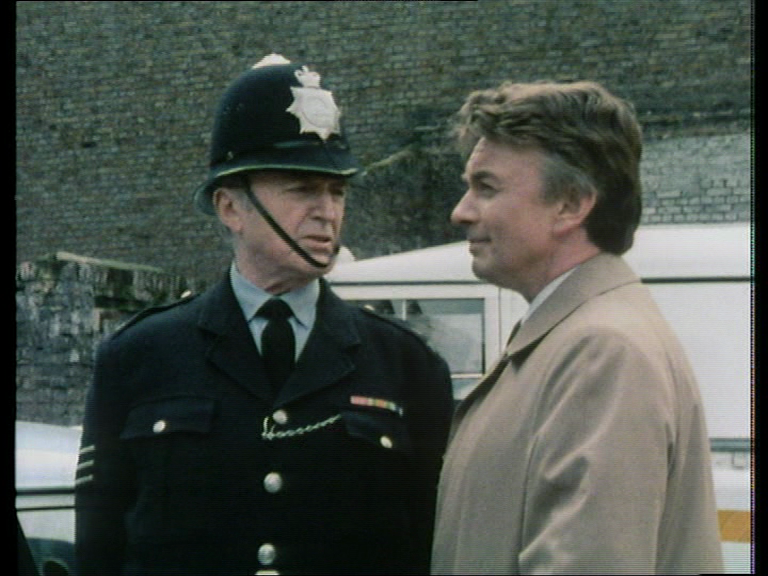
<p>The opinion that <em>Dixon of Dock Green</em> (BBC, 1955-76) was a cosy anachronism throughout its existence, and in particular in the 1970s, remains pervasive. Lez Cooke&#8217;s excellent study of British television drama fairly summarises the common view that <em>Dixon</em> “gained a reputation as a ‘cosy’ representation of the police and their relationship with the public in the mid-late 1950s”, a representation which was “superseded” in the 1960s and 1970s “by more hard-hitting and up-to-date representations of both the police and the criminal underworld”.<sup id="rf1-2843"><a href="#fn1-2843" title="Lez Cooke, &lt;em&gt;British Television Drama: A History&lt;/em&gt; (London: British Film Institute, 2003), p. 49." rel="footnote">1</a></sup> Dylan Cave goes further in <em>Ealing Revisited</em>, arguing that <em>Dixon</em>&#8216;s long run &#8220;wasn&#8217;t due to innovation, but to its dogged refusal to acknowledge the pace of a changing Britain, as depicted in the far tougher police series <em>Z Cars</em> and <em>The Sweeney</em>. It was cherished as a reassuring reminder of apparently simpler, gentler times&#8221;.<sup id="rf2-2843"><a href="#fn2-2843" title="Dylan Cave, &#8216;The Legacy of Ealing&#8217;, in Mark Duguid, Lee Freeman, Keith M. Johnston and Melanie Williams (editors), &lt;em&gt;Ealing Revisited&lt;/em&gt; (London: British Film Institute/Palgrave Macmillan, 2012), p. 222. The directness of this statement is slightly surprising since &lt;em&gt;Ealing Revisited&lt;/em&gt; is derived from a 2006 conference of the same name at which I presented a paper which problematised this opinion. An extended version of that paper, on &lt;em&gt;Dixon&lt;/em&gt;&#8216;s revisiting of Ealing&#8217;s &lt;em&gt;The Blue Lamp&lt;/em&gt; and its own revisiting by &lt;em&gt;The Black and Blue Lamp&lt;/em&gt;, is available on this site, with a link elsewhere on this page." rel="footnote">2</a></sup> There is room to question the pervasive generalisation that 1970s <em>Dixon</em> was a cosy anachronism that was smashed up by the arrival of <em>The Sweeney</em> (ITV, 1974-78). As I’ve argued in my previous writing on police drama,<sup id="rf3-2843"><a href="#fn3-2843" title="David Rolinson, &lt;a href=&quot;http://www.britishtelevisiondrama.org.uk/?p=1429&quot; target=&quot;_self&quot; rel=&quot;noopener&quot;&gt; ‘From &lt;em&gt;The Blue Lamp&lt;/em&gt; to &lt;em&gt;The Black and Blue Lamp&lt;/em&gt;: the police in TV drama’&lt;/a&gt;. Posted on this site in February 2011, but drawing from previous talks and publications since 2002." rel="footnote">3</a></sup> this generalisation needs to be put under more scrutiny, either by putting <em>The Sweeney</em> in the context of the detailed study of other police and action series of the period (Cooke wisely uses the plural “representations”), or looking into the apparent anomaly that <em>Dixon</em> survived – indeed, was still hugely successful – well into the 1970s. <em>Dixon</em> makes its own use of the changing language of police drama – with its “shooters”, &#8220;birds&#8221; and “blags” and the prioritisation of the CID while former beat copper Dixon takes a back seat – and reflects the changing practices of, and attitudes towards, the police. Acorn Media’s welcome DVD release of six colour episodes gives me a chance to look more closely at 1970s <em>Dixon</em> to add this article as a supplement to <a href="http://www.britishtelevisiondrama.org.uk/?p=1429" target="_self" rel="noopener">this much longer and more detailed piece on <em>Dixon</em>’s place in the history of police drama</a>.</p>

<hr class="footnotes"><ol class="footnotes" style="list-style-type:decimal"><li id="fn1-2843"><p >Lez Cooke, <em>British Television Drama: A History</em> (London: British Film Institute, 2003), p. 49.&nbsp;<a href="#rf1-2843" class="backlink" title="Return to footnote 1.">&#8617;</a></p></li><li id="fn2-2843"><p >Dylan Cave, &#8216;The Legacy of Ealing&#8217;, in Mark Duguid, Lee Freeman, Keith M. Johnston and Melanie Williams (editors), <em>Ealing Revisited</em> (London: British Film Institute/Palgrave Macmillan, 2012), p. 222. The directness of this statement is slightly surprising since <em>Ealing Revisited</em> is derived from a 2006 conference of the same name at which I presented a paper which problematised this opinion. An extended version of that paper, on <em>Dixon</em>&#8216;s revisiting of Ealing&#8217;s <em>The Blue Lamp</em> and its own revisiting by <em>The Black and Blue Lamp</em>, is available on this site, with a link elsewhere on this page.&nbsp;<a href="#rf2-2843" class="backlink" title="Return to footnote 2.">&#8617;</a></p></li><li id="fn3-2843"><p >David Rolinson, <a href="http://www.britishtelevisiondrama.org.uk/?p=1429" target="_self" rel="noopener"> ‘From <em>The Blue Lamp</em> to <em>The Black and Blue Lamp</em>: the police in TV drama’</a>. Posted on this site in February 2011, but drawing from previous talks and publications since 2002.&nbsp;<a href="#rf3-2843" class="backlink" title="Return to footnote 3.">&#8617;</a></p></li></ol></hr>{"id":2843,"date":"2012-08-31T11:44:26","date_gmt":"2012-08-31T10:44:26","guid":{"rendered":"http:\/\/www.britishtelevisiondrama.org.uk\/?p=2843"},"modified":"2024-08-30T11:41:18","modified_gmt":"2024-08-30T10:41:18","slug":"dixon-of-dock-green-in-the-1970s","status":"publish","type":"post","link":"http:\/\/www.britishtelevisiondrama.org.uk\/?p=2843","title":{"rendered":"<em>Dixon of Dock Green<\/em> in the 1970s"},"content":{"rendered":"<h4>by DAVID ROLINSON<\/h4>\n<p><a href=\"http:\/\/www.britishtelevisiondrama.org.uk\/wp-content\/uploads\/2012\/08\/Dixon05_Sounds_DixonCrawford.png\"><img loading=\"lazy\" decoding=\"async\" src=\"http:\/\/www.britishtelevisiondrama.org.uk\/wp-content\/uploads\/2012\/08\/Dixon05_Sounds_DixonCrawford-300x225.png\" alt=\"\" title=\"Dixon05_Sounds_DixonCrawford\" width=\"300\" height=\"225\" class=\"alignleft size-medium wp-image-2871\" srcset=\"http:\/\/www.britishtelevisiondrama.org.uk\/wp-content\/uploads\/2012\/08\/Dixon05_Sounds_DixonCrawford-300x225.png 300w, http:\/\/www.britishtelevisiondrama.org.uk\/wp-content\/uploads\/2012\/08\/Dixon05_Sounds_DixonCrawford.png 768w\" sizes=\"auto, (max-width: 300px) 100vw, 300px\" \/><\/a><\/p>\n<p>The opinion that <em>Dixon of Dock Green<\/em> (BBC, 1955-76) was a cosy anachronism throughout its existence, and in particular in the 1970s, remains pervasive. Lez Cooke&#8217;s excellent study of British television drama fairly summarises the common view that <em>Dixon<\/em> \u201cgained a reputation as a \u2018cosy\u2019 representation of the police and their relationship with the public in the mid-late 1950s\u201d, a representation which was \u201csuperseded\u201d in the 1960s and 1970s \u201cby more hard-hitting and up-to-date representations of both the police and the criminal underworld\u201d.<sup id=\"rf1-2843\"><a href=\"#fn1-2843\" title=\"Lez Cooke, &lt;em&gt;British Television Drama: A History&lt;\/em&gt; (London: British Film Institute, 2003), p. 49.\" rel=\"footnote\">1<\/a><\/sup> Dylan Cave goes further in <em>Ealing Revisited<\/em>, arguing that <em>Dixon<\/em>&#8216;s long run &#8220;wasn&#8217;t due to innovation, but to its dogged refusal to acknowledge the pace of a changing Britain, as depicted in the far tougher police series <em>Z Cars<\/em> and <em>The Sweeney<\/em>. It was cherished as a reassuring reminder of apparently simpler, gentler times&#8221;.<sup id=\"rf2-2843\"><a href=\"#fn2-2843\" title=\"Dylan Cave, &#8216;The Legacy of Ealing&#8217;, in Mark Duguid, Lee Freeman, Keith M. Johnston and Melanie Williams (editors), &lt;em&gt;Ealing Revisited&lt;\/em&gt; (London: British Film Institute\/Palgrave Macmillan, 2012), p. 222. The directness of this statement is slightly surprising since &lt;em&gt;Ealing Revisited&lt;\/em&gt; is derived from a 2006 conference of the same name at which I presented a paper which problematised this opinion. An extended version of that paper, on &lt;em&gt;Dixon&lt;\/em&gt;&#8216;s revisiting of Ealing&#8217;s &lt;em&gt;The Blue Lamp&lt;\/em&gt; and its own revisiting by &lt;em&gt;The Black and Blue Lamp&lt;\/em&gt;, is available on this site, with a link elsewhere on this page.\" rel=\"footnote\">2<\/a><\/sup> There is room to question the pervasive generalisation that 1970s <em>Dixon<\/em> was a cosy anachronism that was smashed up by the arrival of <em>The Sweeney<\/em> (ITV, 1974-78). As I\u2019ve argued in my previous writing on police drama,<sup id=\"rf3-2843\"><a href=\"#fn3-2843\" title=\"David Rolinson, &lt;a href=&quot;http:\/\/www.britishtelevisiondrama.org.uk\/?p=1429&quot; target=&quot;_self&quot; rel=&quot;noopener&quot;&gt; \u2018From &lt;em&gt;The Blue Lamp&lt;\/em&gt; to &lt;em&gt;The Black and Blue Lamp&lt;\/em&gt;: the police in TV drama\u2019&lt;\/a&gt;. Posted on this site in February 2011, but drawing from previous talks and publications since 2002.\" rel=\"footnote\">3<\/a><\/sup> this generalisation needs to be put under more scrutiny, either by putting <em>The Sweeney<\/em> in the context of the detailed study of other police and action series of the period (Cooke wisely uses the plural \u201crepresentations\u201d), or looking into the apparent anomaly that <em>Dixon<\/em> survived \u2013 indeed, was still hugely successful \u2013 well into the 1970s. <em>Dixon<\/em> makes its own use of the changing language of police drama \u2013 with its \u201cshooters\u201d, &#8220;birds&#8221; and \u201cblags\u201d and the prioritisation of the CID while former beat copper Dixon takes a back seat \u2013 and reflects the changing practices of, and attitudes towards, the police. Acorn Media\u2019s welcome DVD release of six colour episodes gives me a chance to look more closely at 1970s <em>Dixon<\/em> to add this article as a supplement to <a href=\"http:\/\/www.britishtelevisiondrama.org.uk\/?p=1429\" target=\"_self\" rel=\"noopener\">this much longer and more detailed piece on <em>Dixon<\/em>\u2019s place in the history of police drama<\/a>.<\/p>\n<p><!--more--><\/p>\n<p>There\u2019s plenty of evidence to support Cooke\u2019s point from the start of this article. <em>Dixon of Dock Green<\/em>\u2019s creator, Ted Willis, summarised its changing critical reception in a piece in the <em>TV Times<\/em> in 1983:<\/p>\n<blockquote><p>In the first years, the critics were almost unanimous in their acclaim for <em>Dock Green<\/em>, hailing it as a breakthrough, praising its realism. But slowly, the view began to change. We were accused of being too cosy and the good word was reserved for series like <em>No Hiding Place<\/em>, <em>Z Cars<\/em> and <em>Softly, Softly<\/em>. These, in turn, were superseded by the violent, all-action type of police drama like <em>The Sweeney<\/em>, [\u2026] <em>Strangers<\/em> and <em>Killer<\/em>.<sup id=\"rf4-2843\"><a href=\"#fn4-2843\" title=\"Ted Willis, \u2018Is Pc Dixon on the way back?\u2019, &lt;em&gt;TV Times&lt;\/em&gt;, 26 November \u2013 2 December 1983, p. 16.\" rel=\"footnote\">4<\/a><\/sup> <\/p><\/blockquote>\n<p>As Cooke notes, in 1955 <em>Dixon<\/em> was distinctive in resisting \u201cidealised\u201d detectives in favour of \u201can ordinary, working-class policeman on the beat\u201d,<sup id=\"rf5-2843\"><a href=\"#fn5-2843\" title=\"Cooke, p. 49.\" rel=\"footnote\">5<\/a><\/sup> with Willis seeking to \u201cconcentrate on the smaller everyday type of crime, and put the emphasis on people rather than problems.\u201d<sup id=\"rf6-2843\"><a href=\"#fn6-2843\" title=\"Ted Willis, \u2018Dock Green through the Years\u2019, &lt;em&gt;Radio Times&lt;\/em&gt;, 17 September 1964, p. 7, quoted in Cooke, p. 50.\" rel=\"footnote\">6<\/a><\/sup> As I noted in my previous article, Willis talked in 1957 about seeking \u201cto break away from the accepted formula for police and crime stories [\u2026] The average policeman might go through a life-time of service without being involved in one murder-case. His life is one of routine [\u2026] Would [viewers] take simple, human stories about a simple ordinary copper and the people he meets?\u201d<sup id=\"rf7-2843\"><a href=\"#fn7-2843\" title=\"Ted Willis, \u2018George Dixon of Dock Green is Back\u2019, &lt;em&gt;Radio Times&lt;\/em&gt;, 4 January 1957, p. 5. See \u2018From &lt;em&gt;The Blue Lamp&lt;\/em&gt;\u2019.\" rel=\"footnote\">7<\/a><\/sup> Although Willis no longer wrote for the series in the 1970s, most of the episodes in this DVD release reflect this procedural emphasis \u2013 as Willis put it in 1983, \u201cEighty per cent of police work is ordinary and unsensational\u201d \u2013 albeit in a format driven more by the CID and a larger cast of characters in a setting that is closer to the markers of &#8220;toughness&#8221; in action-driven police series of the period. Without claiming to be the sole creator of Dixon or author of <em>The Blue Lamp<\/em> (1949) &#8211; due attention must be paid to Jan Read, and Willis quickly reminds us in this piece that the film&#8217;s final screenplay was written by T.E.B. Clarke &#8211; Willis was reflecting upon his research for the film, in particular Inspector Mott of Leman Street police station, who \u201cbuilt up a special relationship with the people he served\u201d. \u201cI admit that <em>Dixon of Dock Green<\/em> was sometimes too good to be true,\u201d reflected Willis, \u201cbut, by the same token, many of the TV police characters who followed him have been too bad to be true.\u201d<sup id=\"rf8-2843\"><a href=\"#fn8-2843\" title=\"Ibid.\" rel=\"footnote\">8<\/a><\/sup> <\/p>\n<p>My previous article contains some critics\u2019 and viewers\u2019 responses to the series. However, by adding a couple of extra pieces of press coverage from 1974 \u2013 the latest year represented in these DVD episodes \u2013 we can see that its reputation was not quite set in stone. In his side job as television critic, Dennis Potter, savaging a \u201cpathetic\u201d episode of <em>Barlow<\/em> as \u201cthe ultimate degeneration\u201d of the <em>Z Cars<\/em> lineage which had previously brought \u201csome of the best writing to British television\u201d, noted that the early <em>Z Cars<\/em> episodes under Troy Kennedy Martin, Allan Prior and John McGrath had been successful in part because of \u201cthe startling contrast they made with <em>Dixon of Dock Green<\/em>, a cotton-wool-and-humbug series which belonged to a much earlier layer of television\u201d. Describing George Dixon\u2019s remarks to viewers at the end of each episode as \u201ca uniformed imitation of a Wayside Pulpit\u201d, Potter found it \u201ca small miracle that his programme survived the critical disdain which came whenever comparisons with the newcomer were made.\u201d<sup id=\"rf9-2843\"><a href=\"#fn9-2843\" title=\"Dennis Potter, \u2018Death Rattles\u2019, &lt;em&gt;New Statesman&lt;\/em&gt;, 1 February 1974, p. 183.\" rel=\"footnote\">9<\/a><\/sup> Potter watched an episode of <em>Dixon<\/em> to \u201csee if the roles had been reversed, with Dock Green the scene of street-level realism and Barlow the anserine confection\u201d, but thought that <em>Dixon<\/em> was \u201cjust the same as ever.\u201d<sup id=\"rf10-2843\"><a href=\"#fn10-2843\" title=\"The most recent episode broadcast was \u2018The Unwanted\u2019, tx. 26 January 1974, written by former policeman and specialist in tough, modern &lt;em&gt;Doctor Who&lt;\/em&gt; stories, Robert Holmes, and directed by Mary Ridge. Whether this is the episode being discussed by Potter is something I\u2019m looking into and will update later, although the recording is missing from the archive.\" rel=\"footnote\">10<\/a><\/sup> To be fair, Potter disliked the casual use of violence in formula series, and he wrote a negative review of the postmodern, socially-concerned <em>Gangsters<\/em>, so he\u2019s not simply critical of <em>Dixon<\/em> on the grounds of stereotypical quaintness. <\/p>\n<p>By contrast, more favourable comments regarding <em>Dixon<\/em> can be found in a 1974 opinion piece by James Scott, which briefly charts police drama as part of its discussion of whether television drama was descending into \u201c\u2018play safe\u2019 attitudes\u201d. (Incidentally, Scott begins his piece with the discontented comments of a television writer depicted in Potter\u2019s play <em>Only Make Believe<\/em>.)<sup id=\"rf11-2843\"><a href=\"#fn11-2843\" title=\"&lt;em&gt;Play for Today&lt;\/em&gt;: \u2018Only Make Believe\u2019, tx. BBC1, 12 February 1973.\" rel=\"footnote\">11<\/a><\/sup> Scott noted that <em>Dixon<\/em> \u201chas been mauled by the critics who find it smug and unreal\u201d, but whilst the early years of <em>Z Cars<\/em> (1962-78) \u201chad a directness and honesty which has never been equalled far less surpassed in any police show since\u201d, <em>Z Cars<\/em> \u201chas declined badly over the years and now looks rather tired\u201d. By contrast, \u201cMany of the [<em>Dixon<\/em>] scripts have been excellent and have contained sharp and pertinent social comment.\u201d<sup id=\"rf12-2843\"><a href=\"#fn12-2843\" title=\"James Scott, \u2018Is drama suffering from \u201cplay safe\u201d attitudes?\u2019, &lt;em&gt;The Stage and Television Today&lt;\/em&gt;, 29 August 1974.\" rel=\"footnote\">12<\/a><\/sup> Similarly, director Michael E. Briant spoke highly of his time directing <em>Dixon<\/em> in the 1970s, finding it &#8220;one of the most underrated police series&#8221;, produced by the &#8220;very shrewd and talented&#8221; Joe Waters. For Briant, <em>Dixon<\/em> was &#8220;actually very modern and compelling compared to the boring and trite <em>Z Cars<\/em> scripts of those days.&#8221;<sup id=\"rf13-2843\"><a href=\"#fn13-2843\" title=\"Michael E. Briant, &lt;em&gt;Who on Earth is Michael E. Briant?&lt;\/em&gt; (Cambridge: Classic TV Press, 2012), p. 86.\" rel=\"footnote\">13<\/a><\/sup> Indeed, Briant&#8217;s experience of directing <em>Z Cars<\/em> in the 1970s was that the scripts were &#8220;never very inspirational but very workmanlike&#8221; and that &#8220;creativity&#8221; on the part of directors was &#8220;positively discouraged&#8221;, unlike on other shows he directed such as <em>The Newcomers<\/em> and <em>Doctor Who<\/em>.<sup id=\"rf14-2843\"><a href=\"#fn14-2843\" title=\"Ibid, p. 32.\" rel=\"footnote\">14<\/a><\/sup> (I recently stumbled upon a <em>Radio Times<\/em> letters page in which this same producer said &#8220;Mea culpa&#8221;, and not much more, when a former policewoman criticised <em>Z Cars<\/em> for a poor sense of protocol in the questioning of female suspects and argued that the part of women police, &#8220;a working part of every section of the police forces today&#8221;, is &#8220;very underplayed&#8221; in this and other series.)<sup id=\"rf15-2843\"><a href=\"#fn15-2843\" title=\"Briant doesn&#8217;t name names at any point, but he has a run-in with the mystifying behaviour of the same producer on a later project.\" rel=\"footnote\">15<\/a><\/sup> Scott and Briant\u2019s comments may surprise viewers who are more familiar with the idea of <em>Dixon<\/em> as a cosy anachronism. <\/p>\n<p><a href=\"http:\/\/www.britishtelevisiondrama.org.uk\/wp-content\/uploads\/2012\/08\/Dixon06_titles.png\"><img loading=\"lazy\" decoding=\"async\" src=\"http:\/\/www.britishtelevisiondrama.org.uk\/wp-content\/uploads\/2012\/08\/Dixon06_titles-300x225.png\" alt=\"\" title=\"Dixon06_titles\" width=\"300\" height=\"225\" class=\"alignleft size-medium wp-image-2889\" srcset=\"http:\/\/www.britishtelevisiondrama.org.uk\/wp-content\/uploads\/2012\/08\/Dixon06_titles-300x225.png 300w, http:\/\/www.britishtelevisiondrama.org.uk\/wp-content\/uploads\/2012\/08\/Dixon06_titles.png 768w\" sizes=\"auto, (max-width: 300px) 100vw, 300px\" \/><\/a><\/p>\n<p>Scott&#8217;s comments on &#8220;pertinent social comment&#8221; are borne out by some (though admittedly not all) of the episodes on the DVD set. The episodes are scattered across several years \u2013 1970 through to 1974 \u2013 but this is not a random selection. These are the six earliest available episodes from the colour era, rare survivors of the wiping of episodes which hit <em>Dixon of Dock Green<\/em> particularly badly. \u2018Waste Land\u2019 (written by Eric Paice) opened the seventeenth series in late 1970, and \u2018Jig-Saw\u2019 (also by Paice) opened the eighteenth series in late 1971. The other four episodes come from the twentieth series: the opening episode from late 1973, \u2018Eye Witness\u2019 (written by Derek Ingrey), and three episodes first broadcast in 1974, \u2018Harry\u2019s Back\u2019 (written by N. J. Crisp), \u2018Sounds\u2019 (by Paice again) and \u2018Firearms Were Issued\u2019 (by Crisp again).<sup id=\"rf16-2843\"><a href=\"#fn16-2843\" title=\"&lt;em&gt;Dixon of Dock Green&lt;\/em&gt;: \u2018Waste Land\u2019, tx. BBC1, 14 November 1970; \u2018Jig-Saw\u2019, tx. BBC1, 18 November 1971; \u2018Eye Witness\u2019, tx. BBC1, 29 December 1973; \u2018Harry\u2019s Back\u2019, tx. BBC1, 12 January 1974;  \u2018Sounds\u2019, tx. BBC1, 13 April 1974; \u2018Firearms Were Issued\u2019, tx. BBC1, 20 April 1974.\" rel=\"footnote\">16<\/a><\/sup> My previous article looks into several half-hour 1950s episodes which, as Cooke persuasively notes, were almost \u201ca hybrid\u201d of recent BBC successes <em>The Grove Family<\/em> and <em>Fabian of Scotland Yard<\/em>, presenting \u201ca comforting, reassuring image of the police\u201d.<sup id=\"rf17-2843\"><a href=\"#fn17-2843\" title=\"Cooke, p. 49.\" rel=\"footnote\">17<\/a><\/sup> Episodes moved to forty-five minutes in 1960, and the 1970s episodes are all in colour, some shot entirely on film and others mixing film location work with videotaped studio interiors.<\/p>\n<p>All episodes feature one of the series\u2019 most famous devices (referenced on the DVD cover): \u201cDixon\u2019s personal address to camera at the beginning and end of each episode\u201d which Cooke noted of the 1950s episodes, and whilst Cooke justifiably observes that these speeches \u201cwere designed to reinforce\u201d the reassuring image of the police, we will see that their use in the 1970s episodes is sometimes less straightforward than the paternalistic reassurance we might expect.<sup id=\"rf18-2843\"><a href=\"#fn18-2843\" title=\"Cooke, p. 49.\" rel=\"footnote\">18<\/a><\/sup> This is particularly the case in \u2018Waste Land\u2019, which opens with Dixon reflecting on how \u201cmost of us remain ignorant of one another\u201d, and closes with Dixon\u2019s tactful acknowledgement that the official version of events might not allow for human complexity. <\/p>\n<p>Indeed, \u2018Waste Land\u2019 is the most striking episode on the set. Its pre-credit sequence is notably disorienting: a hand-held point-of-view sequence with heavy breathing, abrupt movement and an eye for urban decay and absurdity, such as an abandoned doorframe swinging incongruously on waste ground. Voice-over dialogue heightens the sense of dislocation with its description of a state between dreaming and waking, \u201clooking in a mirror at a mirror\u201d. Dixon\u2019s voice plays over a police radio, but the way that his call to \u201creport your position\u201d is shot makes it unsettling and we realise that the request might not be easy to answer. The episode details the search for a missing policeman, and the point-of-view opening and concern with the distance between people recall peak <em>Softly, Softly<\/em> episodes written by Alan Plater, in particular \u2018Sleeping Dogs\u2019 (1966) and \u2018Going Quietly\u2019 (1968), and whilst the episode is not in their class, it\u2019s worthy of that flattering association.<sup id=\"rf19-2843\"><a href=\"#fn19-2843\" title=\"&lt;em&gt;Softly, Softly&lt;\/em&gt;: \u2018Sleeping Dogs\u2019, tx. BBC1, 30 November 1966. &lt;em&gt;Softly, Softly&lt;\/em&gt;: \u2018Going Quietly\u2019, tx. BBC1, 19 December 1968.\" rel=\"footnote\">19<\/a><\/sup> <\/p>\n<p>As discussed in my other piece, by this stage the series\u2019 focus is on Andy Crawford (Peter Byrne) \u2013 in these 1970 episodes, a Detective Sergeant \u2013 who had been in the show since the start, when he was assimilated into the paternalistic police family through marrying Dixon\u2019s daughter Mary (who gets just a fleeting dialogue mention during these episodes). Now a more recognisable 1970s drama CID type, Crawford is tougher, occasionally cynical and aloof. His team of suited investigators includes Detective Constable Lauderdale (Geoffrey Adams), who I last saw in the 1960 episode \u2018The Hot Seat\u2019 on its BBC4 repeat, and who has come a long way from the elaborately-moustached posh-fish-out-of-water figure of fun he was there.<sup id=\"rf20-2843\"><a href=\"#fn20-2843\" title=\"&lt;em&gt;Dixon of Dock Green&lt;\/em&gt;: \u2018The Hot Seat\u2019, tx. BBC, 15 October 1960. Repeat broadcast, tx. BBC4, 12 August 2008.\" rel=\"footnote\">20<\/a><\/sup> Dixon \u2013 a Sergeant since the mid-1960s but listed in the credits simply as \u2018George Dixon\u2019 \u2013 is increasingly bound to the station, but in this episode covers a lot of ground as the investigation sets up base in the area of the disappearance.<\/p>\n<p><a href=\"http:\/\/www.britishtelevisiondrama.org.uk\/wp-content\/uploads\/2012\/08\/Dixon01_WasteLand_walk.png\"><img loading=\"lazy\" decoding=\"async\" src=\"http:\/\/www.britishtelevisiondrama.org.uk\/wp-content\/uploads\/2012\/08\/Dixon01_WasteLand_walk-300x225.png\" alt=\"\" title=\"Dixon01_WasteLand_walk\" width=\"300\" height=\"225\" class=\"alignleft size-medium wp-image-2855\" srcset=\"http:\/\/www.britishtelevisiondrama.org.uk\/wp-content\/uploads\/2012\/08\/Dixon01_WasteLand_walk-300x225.png 300w, http:\/\/www.britishtelevisiondrama.org.uk\/wp-content\/uploads\/2012\/08\/Dixon01_WasteLand_walk.png 768w\" sizes=\"auto, (max-width: 300px) 100vw, 300px\" \/><\/a><\/p>\n<p>Empty docklands, overgrown waste ground, disused spaces: in the iconography of police series these are often the sites of punch-ups and shoot-outs, but here they mark forms of isolation, the distance between people and the scepticism expressed by some locals regarding the kind of community that this series is so often seen to embody. The location work records areas that have been subsequently developed \u2013 as <em>Guardian<\/em> reviewer Tim Dowling noted, \u201cthe show seemed to sense it was part of a fast-vanishing world. Abandoned industry formed its backdrop \u2013 everything is overgrown and crumbling\u201d.<sup id=\"rf21-2843\"><a href=\"#fn21-2843\" title=\"Tim Dowling, \u2018Your next box set: Dixon of Dock Green\u2019, The Guardian, 19 July 2012, &lt;a href=&quot;http:\/\/www.guardian.co.uk\/tv-and-radio\/2012\/jul\/19\/dixon-of-dock-green-boxset&quot; target=&quot;_self&quot; rel=&quot;noopener&quot;&gt;available here&lt;\/a&gt;.\" rel=\"footnote\">21<\/a><\/sup> The same might be said of various other plays and series from this period, but the effect is worth noting: if these spaces are more unsettling than nostalgic, Dixon\u2019s walking of these spaces plays two forms of growing obsolescence alongside each other in ways that are surprisingly troubling. As in various plays in the period, we are witnessing the end of the walkable, \u201cknowable community\u201d,<sup id=\"rf22-2843\"><a href=\"#fn22-2843\" title=\"See for instance Jane Jacobs\u2019 &lt;em&gt;The Death and Life of Great American Cities&lt;\/em&gt;, via &lt;a href=&quot;http:\/\/www.britishtelevisiondrama.org.uk\/?p=921&quot; target=&quot;_self&quot; rel=&quot;noopener&quot;&gt;Alan Plater\u2019s &lt;em&gt;Land of Green Ginger&lt;\/em&gt; on enforced relocation of Hull communities&lt;\/a&gt;.\" rel=\"footnote\">22<\/a><\/sup> even when Dixon isn\u2019t helpfully framed in the same shot as a disused vehicle prominently but redundantly promising a \u2018Warm Home\u2019.<\/p>\n<p>\u2018Jig-Saw\u2019 may resolve its story of mysterious attacks on women in a way that resembles the simpler characterisations of early episodes, but even here there is a grubby, cloying desperation at work. Its repetitive scenes of a form of (in this case, entrapping) reconstruction brings to mind John Hopkins\u2019s later <em>Play for Today<\/em> \u2018A Story to Frighten the Children\u2019, itself a police procedural of genuine interest to anyone documenting the supposed irrelevance of the <em>Dixon<\/em> \u201ctype\u201d in the face of the likes of <em>The Sweeney<\/em> and <em>Target<\/em> (BBC, 1977-78), although <em>A Story to Frighten the Children<\/em>\u2019s devastating opening section would be strong stuff for those series, let alone <em>Dixon<\/em>.<sup id=\"rf23-2843\"><a href=\"#fn23-2843\" title=\"&lt;em&gt;Play for Today&lt;\/em&gt;: \u2018A Story to Frighten the Children\u2019, tx. BBC1, 3 February 1976.\" rel=\"footnote\">23<\/a><\/sup><\/p>\n<p><a href=\"http:\/\/www.britishtelevisiondrama.org.uk\/wp-content\/uploads\/2012\/08\/Dixon02_Jig-Saw_gas.png\"><img loading=\"lazy\" decoding=\"async\" src=\"http:\/\/www.britishtelevisiondrama.org.uk\/wp-content\/uploads\/2012\/08\/Dixon02_Jig-Saw_gas-300x225.png\" alt=\"\" title=\"Dixon02_Jig-Saw_gas\" width=\"300\" height=\"225\" class=\"alignleft size-medium wp-image-2869\" srcset=\"http:\/\/www.britishtelevisiondrama.org.uk\/wp-content\/uploads\/2012\/08\/Dixon02_Jig-Saw_gas-300x225.png 300w, http:\/\/www.britishtelevisiondrama.org.uk\/wp-content\/uploads\/2012\/08\/Dixon02_Jig-Saw_gas.png 768w\" sizes=\"auto, (max-width: 300px) 100vw, 300px\" \/><\/a><\/p>\n<p>Shot entirely on film, \u2018Waste Land\u2019 and \u2018Jig-Saw\u2019 showcase the work of film cameraman Phil Meheux, early in a varied and distinguished career that would include collaboration with John Mackenzie (<em>Apaches<\/em>, Dennis Potter\u2019s <em>Double Dare<\/em>, <em>The Long Good Friday<\/em>), Alan Clarke (the film remake of <em>Scum<\/em>) and Martin Campbell, and provide a welcome link between <em>The Killing Fields<\/em>, <em>Casino Royale<\/em>, <em>Beverley Hills Chihuahua<\/em> and <em>The Smurfs<\/em>. Meheux\u2019s photography is one of the highlights of this set. As well as capturing the more expressionistic point-of-view moments of \u2018Waste Land\u2019, Meheux provides shadowy interiors, and camerawork that is mobile, sometimes hand-held, combining the social realist capturing of landscape with a poetic isolation of detail, and a combination of movement and framing that isolates buildings, and sometimes people, in space. These techniques emphasise the sense of people in the community getting lost or struggling to connect.<\/p>\n<p>These questions of connection also map onto the programme\u2019s relationship with developments in policing. Some potential witnesses display degrees of self-protection and cynicism, and policing has moved on from the old single-handed Dixon model, adopting technology whilst trying to retain vital personal contact, while acknowledging the limits of their reach. <em>Dixon<\/em> has been described as providing positive PR for the police \u2013 see my previous article \u2013 and strangely enough these moments of apparent weakness and the awareness of isolation might be serving a similar function, if we compare these 1970 and 1971 episodes with Central Office of Information shorts from the period, such as <em>Unit Beat Policing<\/em> (1968), in which we are told that:<\/p>\n<blockquote><p>The British policeman has always been the trusted guardian of law and order. This trust has been rooted in the feeling that a constable belongs to his neighbourhood and that he is a friend of everyone that lives there. They know him and help him [\u2026] In most modern towns, this relationship between public and police is less close [\u2026] the town policeman finds it difficult to know many of his people [\u2026] Much of what he has to do has little effect in the war against crime. So those natural partners, police and public, have become estranged [\u2026] without public help, effective police work in Britain is almost impossible [\u2026] conventional police work and equipment need looking at.\u201d<sup id=\"rf24-2843\"><a href=\"#fn24-2843\" title=\"&lt;em&gt;Unit Beat Policing&lt;\/em&gt;, in &lt;em&gt;The COI Collection Volume One: Police and Thieves&lt;\/em&gt; (BFI DVD).\" rel=\"footnote\">24<\/a><\/sup> <\/p><\/blockquote>\n<p><div id=\"attachment_2877\" style=\"width: 310px\" class=\"wp-caption alignleft\"><a href=\"http:\/\/www.britishtelevisiondrama.org.uk\/wp-content\/uploads\/2012\/08\/Dixon_COI_unitbeat.png\"><img loading=\"lazy\" decoding=\"async\" aria-describedby=\"caption-attachment-2877\" src=\"http:\/\/www.britishtelevisiondrama.org.uk\/wp-content\/uploads\/2012\/08\/Dixon_COI_unitbeat-300x225.png\" alt=\"\" title=\"Dixon_COI_unitbeat\" width=\"300\" height=\"225\" class=\"size-medium wp-image-2877\" srcset=\"http:\/\/www.britishtelevisiondrama.org.uk\/wp-content\/uploads\/2012\/08\/Dixon_COI_unitbeat-300x225.png 300w, http:\/\/www.britishtelevisiondrama.org.uk\/wp-content\/uploads\/2012\/08\/Dixon_COI_unitbeat.png 768w\" sizes=\"auto, (max-width: 300px) 100vw, 300px\" \/><\/a><p id=\"caption-attachment-2877\" class=\"wp-caption-text\"><em>Unit Beat Policing<\/em> (1968)<\/p><\/div><br \/>\nThe solution proposed by the Director of Police Research and Development Branch in the film, indeed the cause which the film is pushing, is the system of Unit Beat Policing, with patches patrolled by a unit of fewer officers, a Detective Constable and modern communication equipment. The development of this system can be seen in various police dramas, as I mentioned in <a href=\"http:\/\/tachyon-tv.co.uk\/2012\/04\/the-%e2%80%98appening\/\" target=\"_self\" rel=\"noopener\">this piece on Yorkshire TV series <em>Parkin\u2019s Patch<\/em> (ITV, 1969-70)<\/a> which has been released on DVD by Network. While I\u2019m reviewing DVDs that aren\u2019t the one that I\u2019m meant to be reviewing, the short <em>Unit Beat Policing<\/em> is on the BFI\u2019s <em>Police and Thieves<\/em> collection of COI shorts, which include some fictionalised pieces of possible interest to this site\u2019s readers, for instance <em>Anything Can Happen<\/em> (1973), a police recruitment film scripted by Gerry Davis and starring Simon Rouse and Jeremy Bulloch.<\/p>\n<p>\u2018Eye Witness\u2019 and \u2018Harry\u2019s Back\u2019 share surface elements with the world of <em>The Sweeney<\/em>: intimidation with shooters, a moll-accompanied heavy issuing orders from a swimming pool and Crawford leaning on snouts. \u2018Eye Witness\u2019 is fairly unsophisticated and quite endearing in its na\u00efve rural relocation in the name of witness protection, while \u2018Harry\u2019s Back\u2019 is a pleasing character piece about a charming villain whose popularity on his home turf appals Crawford, whose hounding of Harry puts him closer to <em>The Sweeney<\/em>\u2019s Regan than Dixon. Crawford even suffers pointed comments about his lack of promotion, always a thorny topic for critics of the plausibility of <em>Dixon<\/em>\u2019s leads (Crawford is a Detective Inspector by the time of the set\u2019s later episodes).<\/p>\n<p><a href=\"http:\/\/www.britishtelevisiondrama.org.uk\/wp-content\/uploads\/2012\/08\/Dixon05_Sounds_Dixondesk.png\"><img loading=\"lazy\" decoding=\"async\" src=\"http:\/\/www.britishtelevisiondrama.org.uk\/wp-content\/uploads\/2012\/08\/Dixon05_Sounds_Dixondesk-300x225.png\" alt=\"\" title=\"Dixon05_Sounds_Dixondesk\" width=\"300\" height=\"225\" class=\"alignleft size-medium wp-image-2870\" srcset=\"http:\/\/www.britishtelevisiondrama.org.uk\/wp-content\/uploads\/2012\/08\/Dixon05_Sounds_Dixondesk-300x225.png 300w, http:\/\/www.britishtelevisiondrama.org.uk\/wp-content\/uploads\/2012\/08\/Dixon05_Sounds_Dixondesk.png 768w\" sizes=\"auto, (max-width: 300px) 100vw, 300px\" \/><\/a><\/p>\n<p>\u2018Sounds\u2019 and \u2018Firearms Were Issued\u2019 have the more familiar piebald look of filmed exteriors and studio interiors, with Dixon behind the desk of a more settled Dock Green nick.<sup id=\"rf25-2843\"><a href=\"#fn25-2843\" title=\"A phrase that trips off the tongue, unless you\u2019re Victor Maddern.\" rel=\"footnote\">25<\/a><\/sup> In \u2018Sounds\u2019, the police are faced with having to trace a child who telephones after her mother is attacked, and their response proves most of the points made by the Director of Police Research and Development Branch in <em>Unit Beat Policing<\/em>, as their mobility, modern communications and attempt to engage the public help their search when allied to their local knowledge and membership of the community. However, there are twists to come.<sup id=\"rf26-2843\"><a href=\"#fn26-2843\" title=\"In a bizarre coda, very soon after the release of this DVD, a similar telephone call prompted public appeals and national news coverage, though it turned out to be a hoax. Whether &lt;em&gt;Dixon&lt;\/em&gt; is compulsive viewing for the prankster community, we can only speculate.\" rel=\"footnote\">26<\/a><\/sup> Where the episode falls more into the series\u2019 primetime LE scope is the broad characterisation of the musical expert \u2013 a colourfully-outfitted and unreliably monickered<sup id=\"rf27-2843\"><a href=\"#fn27-2843\" title=\"He\u2019s called Dave.\" rel=\"footnote\">27<\/a><\/sup> hi-fi \u201ctechnical jargon\u201d type \u2013 called in to improve their analysis of the call. I\u2019m a keen follower of British television drama\u2019s incorporation of elements from Francis Ford Coppola\u2019s <em>The Conversation<\/em> \u2013 for instance, in a pivotal sequence in Potter\u2019s <em>Double Dare<\/em> \u2013 but perhaps this one&#8217;s a bit of a reach.<\/p>\n<p><a href=\"http:\/\/www.britishtelevisiondrama.org.uk\/wp-content\/uploads\/2012\/08\/Dixon06_Firearms_raid.png\"><img loading=\"lazy\" decoding=\"async\" src=\"http:\/\/www.britishtelevisiondrama.org.uk\/wp-content\/uploads\/2012\/08\/Dixon06_Firearms_raid-300x225.png\" alt=\"\" title=\"Dixon06_Firearms_raid\" width=\"300\" height=\"225\" class=\"alignleft size-medium wp-image-2887\" srcset=\"http:\/\/www.britishtelevisiondrama.org.uk\/wp-content\/uploads\/2012\/08\/Dixon06_Firearms_raid-300x225.png 300w, http:\/\/www.britishtelevisiondrama.org.uk\/wp-content\/uploads\/2012\/08\/Dixon06_Firearms_raid.png 768w\" sizes=\"auto, (max-width: 300px) 100vw, 300px\" \/><\/a><\/p>\n<p>\u2018Firearms Were Issued\u2019 again steps into the territory of the period\u2019s more action-driven police series, as Crawford leads an armed raid on suspected armed robbers. However, process is still uppermost \u2013 Dixon logs out the weapons by the book in solemn detail \u2013 and when things do not go according to plan, Crawford and his colleagues find themselves under investigation. Dixon may be more often chained to his desk by this stage, but he\u2019s serving an interesting role in the drama: Crawford\u2019s apparent pragmatism appears to include a willingness to bend the rules, which pushes him against the straight if sympathetic Dixon. There is no escaping Jack Warner\u2019s advancing years, the plausibility issues that are raised by his continued presence, and the contribution that his persona and undoubted appeal to older viewers made to readings (sometimes misreadings) of the series in terms of nostalgia. Indeed, <em>Dixon<\/em>\u2019s last series was promoted in the <em>Radio Times<\/em> in terms of 72-year-old admirer May Pamment, who &#8220;collects Jack Warner press cuttings and signed photographs of Dixon [&#8230; and] several records, including a monologue of road safety advice for drivers and a 78 record of one of Warner&#8217;s wartime Cockney comedy acts in the BBC Radio Show <em>Garrison Theatre<\/em> &#8220;, though she admitted preferring his more &#8220;refined&#8221; speech in the modern series to the way that Warner, Byrne and Arthur Rigby (Sergeant Flint in earlier episodes) &#8220;had the ring of Bow Bells&#8221;.<sup id=\"rf28-2843\"><a href=\"#fn28-2843\" title=\"Madeleine Kingsley, &#8216;George Dixon, my hero, and me&#8217;, &lt;em&gt;Radio Times&lt;\/em&gt;, 1974. Date to be added.\" rel=\"footnote\">28<\/a><\/sup> This <em>Radio Times<\/em> piece notes that Warner, now 80, &#8220;has been getting bee-sting treatment for an arthritic hip&#8221; but will &#8220;carry on resolutely, as long, he says, &#8216;as I can stand and talk, and people want to see me&#8217;.&#8221;<sup id=\"rf29-2843\"><a href=\"#fn29-2843\" title=\"Ibid.\" rel=\"footnote\">29<\/a><\/sup> Warner&#8217;s age was certainly an issue at the time, but seems to be more so now than in a media landscape which was not yet obsessed with youth: from James Bond to <em>Doctor Who<\/em>, <em>Carry On<\/em> to action series like <em>The Sweeney<\/em> and others in the wake of <em>The French Connection<\/em> and Gene Hackman\u2019s success, leading men (sadly mainly men) were often middle-aged or older. That defence is perhaps tenuous &#8211; as we&#8217;ve just seen, Warner was playing Dixon at 80 \u2013 but Dixon\u2019s part in the series has changed by the 1970s, and his persona has its own value in episodes like \u2018Firearms Were Issued\u2019. <\/p>\n<p>In the episodes on this DVD set at least, he has adapted to social change more readily than the homily-spouting, change-resistant Dixon of the 1950s who informs critics\u2019 perceptions of the series. When \u2018Sounds\u2019 moves into the darker area of domestic violence, the attitudes of Dixon and the programme have clearly moved on from earlier days.<sup id=\"rf30-2843\"><a href=\"#fn30-2843\" title=\"As discussed in the previous article, in the 1956 episode \u2018Pound of Flesh\u2019, Dixon jovially observes that \u201cif I arrested every bloke in Dock Green who clocked his wife, I\u2019d be working overtime\u201d.\" rel=\"footnote\">30<\/a><\/sup> The resolution of \u2018Firearms Were Issued\u2019 veers towards my and Cooke\u2019s comments regarding the ideological sewing-up of situations, as Dixon briskly informs us that he would have done the same as the officers in similar circumstances. Whilst there have been some interesting tensions amongst the police and between them and their investigator, and the acknowledgement of potential fallibility, there is indeed something quaint in the episode\u2019s handling of a potentially incendiary topic \u2013 the shooting of an unarmed man \u2013 in the language of wounded naivety and chalkboard diagrams. However, the sense of Dixon&#8217;s closing speech being pat is far from the norm. Dixon\u2019s speech to end \u2018Sounds\u2019 is bleak in its implications and appropriate to the episode\u2019s tone. Viewers expecting a nostalgic trip back into a warm Saturday night primetime family drama might be surprised by such bleaker moments. That&#8217;s not to say that there won&#8217;t be plenty of nostalgic triggers, and plenty of enjoyable archive television faces: James Grout, Anna Karen, Victor Maddern, Windsor Davies, Glynn Edwards, Gwyneth Powell, Stephen Greif, John Salthouse, Lee Montague, Michael Sheard and of course Cyril Shaps. Those bleaker moments don\u2019t prevent <em>Dixon of Dock Green<\/em> from being overall a lighter show which lacks some of the edges of dramas around it, and there are indeed some creaky moments in its plotting and the depiction of hardened criminals in a pre-watershed family show (although Willis\u2019s selective list adds to the wrong impression that crime drama meant a choice between <em>Dixon<\/em> and action series, thereby omitting for instance the numerous police shows which were broadly in the <em>Dixon<\/em> register and, for that matter, shows that weren&#8217;t in either camp, such as the magisterial detective-based drama <em>Public Eye<\/em>, which got huge ratings for many years with its alliance of inventiveness, character focus, an unconventional lead and sometimes minimalist narrative). <\/p>\n<p>Recalling the show\u2019s final years, Willis noted that it continued \u201cto hold a huge audience\u201d, and (in keeping with Cave&#8217;s point at the start of this article) wondered whether \u201cpeople tuned in to seek reassurance.\u201d<sup id=\"rf31-2843\"><a href=\"#fn31-2843\" title=\"Willis, 1983.\" rel=\"footnote\">31<\/a><\/sup> It was, according to Mary Whitehouse&#8217;s National Viewers and Listeners Association, the nemesis of several other programmes discussed on this site, &#8220;the most suitable programme for a family audience&#8221;.<sup id=\"rf32-2843\"><a href=\"#fn32-2843\" title=\"Kingsley, &#8216;George Dixon, my hero, and me&#8217;.\" rel=\"footnote\">32<\/a><\/sup> Willis acknowledged that this was a different world \u2013 \u201cWords like \u2018fuzz\u2019 and \u2018pigs\u2019 were being used to describe the police\u201d \u2013 but \u201cDixon was a kind of proof that the old \u2018bobby\u2019 was not dead.\u201d<sup id=\"rf33-2843\"><a href=\"#fn33-2843\" title=\"Willis, 1983.\" rel=\"footnote\">33<\/a><\/sup> <em>Radio Times<\/em> letters pages in the 1970s support and oppose perceptions of the decline of <em>Z Cars<\/em> &#8211; in 1973, one reader dismisses a reviewer&#8217;s belief in the superiority of <em>Softly, Softly<\/em> by calling it &#8220;a series of fairy stories with an overloaded whitewash brush for its heroes, and a surfeit of crudity substituting for realism&#8221;, and gives guarded compliments to <em>Z Cars<\/em> for not trying to &#8220;romanticise&#8221; its &#8220;heroes&#8221;.<sup id=\"rf34-2843\"><a href=\"#fn34-2843\" title=\"Louis Gillain, letter, &lt;em&gt;Radio Times&lt;\/em&gt;, 19-26 December 1974, p. 114. Its backhanded compliment: &#8220;I won&#8217;t go so far as to say that &lt;em&gt;Z Cars&lt;\/em&gt; is the best television series that &lt;em&gt;could&lt;\/em&gt; be produced, but it certainly is the best that is being produced.&#8221; In response to the attack on his review, Jonathan Raban stated that &#8220;Responses like &#8216;loved it!&#8217; or &#8216;loathed it!&#8217; just aren&#8217;t good enough&#8221; in &#8220;writing about TV programmes&#8221; &#8211; a point lost to Alison Graham&#8217;s 21st-century &lt;em&gt;Radio Times&lt;\/em&gt; work.\" rel=\"footnote\">34<\/a><\/sup> Another letter writer thought the Kingsley Amis episode of <em>Softly, Softly<\/em> under discussion was &#8220;a disaster&#8221;, adding that &#8220;We do <em>not<\/em> want the series to degenerate into third-rate social psychology pieces written by would-be egghead writers to &#8216;explore&#8217; society.&#8221;<sup id=\"rf35-2843\"><a href=\"#fn35-2843\" title=\"D. Clark, letters, &lt;em&gt;Radio Times&lt;\/em&gt;, ibid. &lt;em&gt;Softly, Softly&lt;\/em&gt;: &#8216;See What You&#8217;ve Done&#8217;, tx. BBC1, 13 November 1974. Presumably the subtlety with which Alan Plater&#8217;s often magnificent scripts for the series handled such concerns protected them against this viewer&#8217;s unhappiness.\" rel=\"footnote\">35<\/a><\/sup> It would be difficult to take this as the representative view of the entire audience or a statement about the conservatism of the genre &#8211; the counter-attack reply by the reviewer these letters were criticising suggests that they aren&#8217;t &#8211; but it sheds different light on some of the issues covered in this essay.<\/p>\n<p>But we could actually take Willis\u2019s previous point further: condemning <em>Dixon of Dock Green<\/em> for being outdated carries its own problems. James Piers Taylor has noted that a COI research report into the recruitment short <em>Challenge for a Lifetime<\/em> argued that it \u201cconcentrated too much on the exciting elements of the job and excluded the routine elements which would have provided a rounded impression\u201d. The extent to which this sort of film needed to be \u201cpersuasive propaganda\u201d was therefore an issue.<sup id=\"rf36-2843\"><a href=\"#fn36-2843\" title=\"James Piers Taylor, \u2018&lt;em&gt;Challenge for a Lifetime&lt;\/em&gt;, &lt;em&gt;The COI Collection Volume One: Police and Thieves&lt;\/em&gt; accompanying booklet, p. 22.\" rel=\"footnote\">36<\/a><\/sup> The idea of <em>Dixon of Dock Green<\/em> as propaganda was an old one \u2013 see my previous article \u2013 and Arthur Ellis, the writer of the excellent satirical play <em>The Black and Blue Lamp<\/em> which interrogates the Dixon persona, noted that <em>The Sweeney<\/em> was just as much a PR exercise, with the novelty that it \u201cromanticised screen violence, which gave the Met a nice tough little image that invariably helped them employ it\u201d.<sup id=\"rf37-2843\"><a href=\"#fn37-2843\" title=\"Arthur Ellis, in &lt;a href=&quot;http:\/\/www.britishtelevisiondrama.org.uk\/?p=1429&quot; target=&quot;_self&quot; rel=&quot;noopener&quot;&gt;my previous article&lt;\/a&gt;.\" rel=\"footnote\">37<\/a><\/sup> As Ellis put it, Regan \u201csupplanted\u201d the \u201cidea of a decent beat copper\u201d, but Willis\u2019s observation usefully demonstrates that, in fact and fiction, the Regan rather than the Dixon stereotype was to be underplayed by the police as they sought to restore their place in modern communities. There\u2019s more detail on this in my other piece \u2013 in particular the thesis-antithesis-synthesis model \u2013 but there\u2019s more than enough evidence in this DVD release that the accepted story of the violent <em>Sweeney<\/em> overturning the cosy <em>Dixon<\/em> can be problematic. Certainly Alan Plater, who was as great at police drama as he was in many other areas of drama, argued in police publication <em>Context<\/em> in 1976 that &#8220;It is just as irresponsible to portray the Police as always chasing murderers and big-time criminals as it is to show them as boy scouts like George Dixon. <em>The Sweeney<\/em> is ridiculous. It&#8217;s James Cagney and the Sundance Kid rolled into one and given an English background.&#8221;<sup id=\"rf38-2843\"><a href=\"#fn38-2843\" title=\"Alan Plater, in &#8216;T.V. Gives False Impression of Police Work &#8211; But I Don&#8217;t&#8217;, &lt;em&gt;Context&lt;\/em&gt;, August 1976, p. 5. Originally accessed from the Alan Plater archive at Hull History Centre.\" rel=\"footnote\">38<\/a><\/sup> <em>Dixon<\/em>&#8216;s continued focus on process and the everyday made it particularly relevant in the 1970s and 1980s: indeed, in 1983 Willis found in <em>The Gentle Touch<\/em> and <em>Juliet Bravo<\/em> distinct similarities to the earliest episodes of <em>Dixon of Dock Green<\/em>, and noted that \u201cThe police are making great efforts to re-establish their position in the community, more men are going back on the beat.\u201d For all its flaws, <em>Dixon<\/em> continued, and continues, to play an interesting part in depictions and perceptions of policing.<\/p>\n<div id=\"attachment_2880\" style=\"width: 221px\" class=\"wp-caption alignleft\"><a href=\"http:\/\/www.britishtelevisiondrama.org.uk\/wp-content\/uploads\/2012\/08\/Dixon_DVDcover.jpg\"><img loading=\"lazy\" decoding=\"async\" aria-describedby=\"caption-attachment-2880\" src=\"http:\/\/www.britishtelevisiondrama.org.uk\/wp-content\/uploads\/2012\/08\/Dixon_DVDcover-211x300.jpg\" alt=\"\" title=\"Dixon_DVDcover\" width=\"211\" height=\"300\" class=\"size-medium wp-image-2880\" srcset=\"http:\/\/www.britishtelevisiondrama.org.uk\/wp-content\/uploads\/2012\/08\/Dixon_DVDcover-211x300.jpg 211w, http:\/\/www.britishtelevisiondrama.org.uk\/wp-content\/uploads\/2012\/08\/Dixon_DVDcover.jpg 300w\" sizes=\"auto, (max-width: 211px) 100vw, 211px\" \/><\/a><p id=\"caption-attachment-2880\" class=\"wp-caption-text\"><em>Dixon of Dock Green<\/em> is available now on DVD (Acorn Media). Other titles mentioned in this piece are also available: <em>The COI Collection Volume One: Police and Thieves<\/em> (British Film Institute), <em>Public Eye<\/em>, <em>The Sweeney<\/em> and <em>Parkin&#8217;s Patch<\/em> (all Network DVD).<\/p><\/div>\n<p><em>Thanks to John Williams, Ian Greaves and Jim Smith.<\/em><\/p>\n<p><em>Originally posted: 31 August 2012.<br \/>\nUpdates:<br \/>\n5 September 2012: minor corrections and added further <em>Radio Times<\/em> quotations.<br \/>\n28 September 2012: added Plater quotation from <em>Context<\/em>.<br \/>\n8 December 2012: added Cave and Briant quotations and material from three more <em>Radio Times<\/em> letters (on women police, Softly and Amis), reworked opening paragraph. <\/em><br \/>\n<br \/>\n<\/br><\/p>\n<p><body><!-- Start of StatCounter Code --><br \/>\n<script type=\"text\/javascript\">\nvar sc_project=5750652; \nvar sc_invisible=1; \nvar sc_partition=68; \nvar sc_click_stat=1; \nvar sc_security=\"6dd1aa39\"; \n<\/script><\/p>\n<p><script type=\"text\/javascript\"\nsrc=\"http:\/\/www.statcounter.com\/counter\/counter.js\"><\/script><noscript>\n<div<br \/>\nclass=&#8221;statcounter&#8221;><a title=\"wordpress stats \"<br \/>\nhref=&#8221;http:\/\/www.statcounter.com\/wordpress.org\/&#8221;<br \/>\ntarget=&#8221;_blank&#8221;><img class=\"statcounter\"<br \/>\nsrc=&#8221;http:\/\/c.statcounter.com\/5750652\/0\/6dd1aa39\/1\/&#8221;<br \/>\nalt=&#8221;wordpress stats &#8221; ><\/a><\/div>\n<p><\/noscript><br \/>\n<!-- End of StatCounter Code --><\/body><\/p>\n<hr class=\"footnotes\"><ol class=\"footnotes\" style=\"list-style-type:decimal\"><li id=\"fn1-2843\"><p >Lez Cooke, <em>British Television Drama: A History<\/em> (London: British Film Institute, 2003), p. 49.&nbsp;<a href=\"#rf1-2843\" class=\"backlink\" title=\"Return to footnote 1.\">&#8617;<\/a><\/p><\/li><li id=\"fn2-2843\"><p >Dylan Cave, &#8216;The Legacy of Ealing&#8217;, in Mark Duguid, Lee Freeman, Keith M. Johnston and Melanie Williams (editors), <em>Ealing Revisited<\/em> (London: British Film Institute\/Palgrave Macmillan, 2012), p. 222. The directness of this statement is slightly surprising since <em>Ealing Revisited<\/em> is derived from a 2006 conference of the same name at which I presented a paper which problematised this opinion. An extended version of that paper, on <em>Dixon<\/em>&#8216;s revisiting of Ealing&#8217;s <em>The Blue Lamp<\/em> and its own revisiting by <em>The Black and Blue Lamp<\/em>, is available on this site, with a link elsewhere on this page.&nbsp;<a href=\"#rf2-2843\" class=\"backlink\" title=\"Return to footnote 2.\">&#8617;<\/a><\/p><\/li><li id=\"fn3-2843\"><p >David Rolinson, <a href=\"http:\/\/www.britishtelevisiondrama.org.uk\/?p=1429\" target=\"_self\" rel=\"noopener\"> \u2018From <em>The Blue Lamp<\/em> to <em>The Black and Blue Lamp<\/em>: the police in TV drama\u2019<\/a>. Posted on this site in February 2011, but drawing from previous talks and publications since 2002.&nbsp;<a href=\"#rf3-2843\" class=\"backlink\" title=\"Return to footnote 3.\">&#8617;<\/a><\/p><\/li><li id=\"fn4-2843\"><p >Ted Willis, \u2018Is Pc Dixon on the way back?\u2019, <em>TV Times<\/em>, 26 November \u2013 2 December 1983, p. 16.&nbsp;<a href=\"#rf4-2843\" class=\"backlink\" title=\"Return to footnote 4.\">&#8617;<\/a><\/p><\/li><li id=\"fn5-2843\"><p >Cooke, p. 49.&nbsp;<a href=\"#rf5-2843\" class=\"backlink\" title=\"Return to footnote 5.\">&#8617;<\/a><\/p><\/li><li id=\"fn6-2843\"><p >Ted Willis, \u2018Dock Green through the Years\u2019, <em>Radio Times<\/em>, 17 September 1964, p. 7, quoted in Cooke, p. 50.&nbsp;<a href=\"#rf6-2843\" class=\"backlink\" title=\"Return to footnote 6.\">&#8617;<\/a><\/p><\/li><li id=\"fn7-2843\"><p >Ted Willis, \u2018George Dixon of Dock Green is Back\u2019, <em>Radio Times<\/em>, 4 January 1957, p. 5. See \u2018From <em>The Blue Lamp<\/em>\u2019.&nbsp;<a href=\"#rf7-2843\" class=\"backlink\" title=\"Return to footnote 7.\">&#8617;<\/a><\/p><\/li><li id=\"fn8-2843\"><p >Ibid.&nbsp;<a href=\"#rf8-2843\" class=\"backlink\" title=\"Return to footnote 8.\">&#8617;<\/a><\/p><\/li><li id=\"fn9-2843\"><p >Dennis Potter, \u2018Death Rattles\u2019, <em>New Statesman<\/em>, 1 February 1974, p. 183.&nbsp;<a href=\"#rf9-2843\" class=\"backlink\" title=\"Return to footnote 9.\">&#8617;<\/a><\/p><\/li><li id=\"fn10-2843\"><p >The most recent episode broadcast was \u2018The Unwanted\u2019, tx. 26 January 1974, written by former policeman and specialist in tough, modern <em>Doctor Who<\/em> stories, Robert Holmes, and directed by Mary Ridge. Whether this is the episode being discussed by Potter is something I\u2019m looking into and will update later, although the recording is missing from the archive.&nbsp;<a href=\"#rf10-2843\" class=\"backlink\" title=\"Return to footnote 10.\">&#8617;<\/a><\/p><\/li><li id=\"fn11-2843\"><p ><em>Play for Today<\/em>: \u2018Only Make Believe\u2019, tx. BBC1, 12 February 1973.&nbsp;<a href=\"#rf11-2843\" class=\"backlink\" title=\"Return to footnote 11.\">&#8617;<\/a><\/p><\/li><li id=\"fn12-2843\"><p >James Scott, \u2018Is drama suffering from \u201cplay safe\u201d attitudes?\u2019, <em>The Stage and Television Today<\/em>, 29 August 1974.&nbsp;<a href=\"#rf12-2843\" class=\"backlink\" title=\"Return to footnote 12.\">&#8617;<\/a><\/p><\/li><li id=\"fn13-2843\"><p >Michael E. Briant, <em>Who on Earth is Michael E. Briant?<\/em> (Cambridge: Classic TV Press, 2012), p. 86.&nbsp;<a href=\"#rf13-2843\" class=\"backlink\" title=\"Return to footnote 13.\">&#8617;<\/a><\/p><\/li><li id=\"fn14-2843\"><p >Ibid, p. 32.&nbsp;<a href=\"#rf14-2843\" class=\"backlink\" title=\"Return to footnote 14.\">&#8617;<\/a><\/p><\/li><li id=\"fn15-2843\"><p >Briant doesn&#8217;t name names at any point, but he has a run-in with the mystifying behaviour of the same producer on a later project.&nbsp;<a href=\"#rf15-2843\" class=\"backlink\" title=\"Return to footnote 15.\">&#8617;<\/a><\/p><\/li><li id=\"fn16-2843\"><p ><em>Dixon of Dock Green<\/em>: \u2018Waste Land\u2019, tx. BBC1, 14 November 1970; \u2018Jig-Saw\u2019, tx. BBC1, 18 November 1971; \u2018Eye Witness\u2019, tx. BBC1, 29 December 1973; \u2018Harry\u2019s Back\u2019, tx. BBC1, 12 January 1974;  \u2018Sounds\u2019, tx. BBC1, 13 April 1974; \u2018Firearms Were Issued\u2019, tx. BBC1, 20 April 1974.&nbsp;<a href=\"#rf16-2843\" class=\"backlink\" title=\"Return to footnote 16.\">&#8617;<\/a><\/p><\/li><li id=\"fn17-2843\"><p >Cooke, p. 49.&nbsp;<a href=\"#rf17-2843\" class=\"backlink\" title=\"Return to footnote 17.\">&#8617;<\/a><\/p><\/li><li id=\"fn18-2843\"><p >Cooke, p. 49.&nbsp;<a href=\"#rf18-2843\" class=\"backlink\" title=\"Return to footnote 18.\">&#8617;<\/a><\/p><\/li><li id=\"fn19-2843\"><p ><em>Softly, Softly<\/em>: \u2018Sleeping Dogs\u2019, tx. BBC1, 30 November 1966. <em>Softly, Softly<\/em>: \u2018Going Quietly\u2019, tx. BBC1, 19 December 1968.&nbsp;<a href=\"#rf19-2843\" class=\"backlink\" title=\"Return to footnote 19.\">&#8617;<\/a><\/p><\/li><li id=\"fn20-2843\"><p ><em>Dixon of Dock Green<\/em>: \u2018The Hot Seat\u2019, tx. BBC, 15 October 1960. Repeat broadcast, tx. BBC4, 12 August 2008.&nbsp;<a href=\"#rf20-2843\" class=\"backlink\" title=\"Return to footnote 20.\">&#8617;<\/a><\/p><\/li><li id=\"fn21-2843\"><p >Tim Dowling, \u2018Your next box set: Dixon of Dock Green\u2019, The Guardian, 19 July 2012, <a href=\"http:\/\/www.guardian.co.uk\/tv-and-radio\/2012\/jul\/19\/dixon-of-dock-green-boxset\" target=\"_self\" rel=\"noopener\">available here<\/a>.&nbsp;<a href=\"#rf21-2843\" class=\"backlink\" title=\"Return to footnote 21.\">&#8617;<\/a><\/p><\/li><li id=\"fn22-2843\"><p >See for instance Jane Jacobs\u2019 <em>The Death and Life of Great American Cities<\/em>, via <a href=\"http:\/\/www.britishtelevisiondrama.org.uk\/?p=921\" target=\"_self\" rel=\"noopener\">Alan Plater\u2019s <em>Land of Green Ginger<\/em> on enforced relocation of Hull communities<\/a>.&nbsp;<a href=\"#rf22-2843\" class=\"backlink\" title=\"Return to footnote 22.\">&#8617;<\/a><\/p><\/li><li id=\"fn23-2843\"><p ><em>Play for Today<\/em>: \u2018A Story to Frighten the Children\u2019, tx. BBC1, 3 February 1976.&nbsp;<a href=\"#rf23-2843\" class=\"backlink\" title=\"Return to footnote 23.\">&#8617;<\/a><\/p><\/li><li id=\"fn24-2843\"><p ><em>Unit Beat Policing<\/em>, in <em>The COI Collection Volume One: Police and Thieves<\/em> (BFI DVD).&nbsp;<a href=\"#rf24-2843\" class=\"backlink\" title=\"Return to footnote 24.\">&#8617;<\/a><\/p><\/li><li id=\"fn25-2843\"><p >A phrase that trips off the tongue, unless you\u2019re Victor Maddern.&nbsp;<a href=\"#rf25-2843\" class=\"backlink\" title=\"Return to footnote 25.\">&#8617;<\/a><\/p><\/li><li id=\"fn26-2843\"><p >In a bizarre coda, very soon after the release of this DVD, a similar telephone call prompted public appeals and national news coverage, though it turned out to be a hoax. Whether <em>Dixon<\/em> is compulsive viewing for the prankster community, we can only speculate.&nbsp;<a href=\"#rf26-2843\" class=\"backlink\" title=\"Return to footnote 26.\">&#8617;<\/a><\/p><\/li><li id=\"fn27-2843\"><p >He\u2019s called Dave.&nbsp;<a href=\"#rf27-2843\" class=\"backlink\" title=\"Return to footnote 27.\">&#8617;<\/a><\/p><\/li><li id=\"fn28-2843\"><p >Madeleine Kingsley, &#8216;George Dixon, my hero, and me&#8217;, <em>Radio Times<\/em>, 1974. Date to be added.&nbsp;<a href=\"#rf28-2843\" class=\"backlink\" title=\"Return to footnote 28.\">&#8617;<\/a><\/p><\/li><li id=\"fn29-2843\"><p >Ibid.&nbsp;<a href=\"#rf29-2843\" class=\"backlink\" title=\"Return to footnote 29.\">&#8617;<\/a><\/p><\/li><li id=\"fn30-2843\"><p >As discussed in the previous article, in the 1956 episode \u2018Pound of Flesh\u2019, Dixon jovially observes that \u201cif I arrested every bloke in Dock Green who clocked his wife, I\u2019d be working overtime\u201d.&nbsp;<a href=\"#rf30-2843\" class=\"backlink\" title=\"Return to footnote 30.\">&#8617;<\/a><\/p><\/li><li id=\"fn31-2843\"><p >Willis, 1983.&nbsp;<a href=\"#rf31-2843\" class=\"backlink\" title=\"Return to footnote 31.\">&#8617;<\/a><\/p><\/li><li id=\"fn32-2843\"><p >Kingsley, &#8216;George Dixon, my hero, and me&#8217;.&nbsp;<a href=\"#rf32-2843\" class=\"backlink\" title=\"Return to footnote 32.\">&#8617;<\/a><\/p><\/li><li id=\"fn33-2843\"><p >Willis, 1983.&nbsp;<a href=\"#rf33-2843\" class=\"backlink\" title=\"Return to footnote 33.\">&#8617;<\/a><\/p><\/li><li id=\"fn34-2843\"><p >Louis Gillain, letter, <em>Radio Times<\/em>, 19-26 December 1974, p. 114. Its backhanded compliment: &#8220;I won&#8217;t go so far as to say that <em>Z Cars<\/em> is the best television series that <em>could<\/em> be produced, but it certainly is the best that is being produced.&#8221; In response to the attack on his review, Jonathan Raban stated that &#8220;Responses like &#8216;loved it!&#8217; or &#8216;loathed it!&#8217; just aren&#8217;t good enough&#8221; in &#8220;writing about TV programmes&#8221; &#8211; a point lost to Alison Graham&#8217;s 21st-century <em>Radio Times<\/em> work.&nbsp;<a href=\"#rf34-2843\" class=\"backlink\" title=\"Return to footnote 34.\">&#8617;<\/a><\/p><\/li><li id=\"fn35-2843\"><p >D. Clark, letters, <em>Radio Times<\/em>, ibid. <em>Softly, Softly<\/em>: &#8216;See What You&#8217;ve Done&#8217;, tx. BBC1, 13 November 1974. Presumably the subtlety with which Alan Plater&#8217;s often magnificent scripts for the series handled such concerns protected them against this viewer&#8217;s unhappiness.&nbsp;<a href=\"#rf35-2843\" class=\"backlink\" title=\"Return to footnote 35.\">&#8617;<\/a><\/p><\/li><li id=\"fn36-2843\"><p >James Piers Taylor, \u2018<em>Challenge for a Lifetime<\/em>, <em>The COI Collection Volume One: Police and Thieves<\/em> accompanying booklet, p. 22.&nbsp;<a href=\"#rf36-2843\" class=\"backlink\" title=\"Return to footnote 36.\">&#8617;<\/a><\/p><\/li><li id=\"fn37-2843\"><p >Arthur Ellis, in <a href=\"http:\/\/www.britishtelevisiondrama.org.uk\/?p=1429\" target=\"_self\" rel=\"noopener\">my previous article<\/a>.&nbsp;<a href=\"#rf37-2843\" class=\"backlink\" title=\"Return to footnote 37.\">&#8617;<\/a><\/p><\/li><li id=\"fn38-2843\"><p >Alan Plater, in &#8216;T.V. Gives False Impression of Police Work &#8211; But I Don&#8217;t&#8217;, <em>Context<\/em>, August 1976, p. 5. Originally accessed from the Alan Plater archive at Hull History Centre.&nbsp;<a href=\"#rf38-2843\" class=\"backlink\" title=\"Return to footnote 38.\">&#8617;<\/p><\/li><\/p><\/ol><\/hr>","protected":false},"excerpt":{"rendered":null,"protected":false},"author":1,"featured_media":0,"comment_status":"open","ping_status":"open","sticky":false,"template":"","format":"standard","meta":{"footnotes":""},"categories":[140,306,137],"tags":[33,34,154,58,322,355,324,321,16,95,354,323,353,155],"class_list":["post-2843","post","type-post","status-publish","format-standard","hentry","category-david-rolinson","category-dvd-reviews","category-essays","tag-alan-plater","tag-dennis-potter","tag-dixon-of-dock-green","tag-doctor-who","tag-eric-paice","tag-joe-waters","tag-john-hopkins","tag-nj-crisp","tag-play-for-today","tag-police-drama","tag-softly-softly","tag-the-black-and-blue-lamp","tag-the-newcomers","tag-the-sweeney"],"_links":{"self":[{"href":"http:\/\/www.britishtelevisiondrama.org.uk\/index.php?rest_route=\/wp\/v2\/posts\/2843","targetHints":{"allow":["GET"]}}],"collection":[{"href":"http:\/\/www.britishtelevisiondrama.org.uk\/index.php?rest_route=\/wp\/v2\/posts"}],"about":[{"href":"http:\/\/www.britishtelevisiondrama.org.uk\/index.php?rest_route=\/wp\/v2\/types\/post"}],"author":[{"embeddable":true,"href":"http:\/\/www.britishtelevisiondrama.org.uk\/index.php?rest_route=\/wp\/v2\/users\/1"}],"replies":[{"embeddable":true,"href":"http:\/\/www.britishtelevisiondrama.org.uk\/index.php?rest_route=%2Fwp%2Fv2%2Fcomments&post=2843"}],"version-history":[{"count":83,"href":"http:\/\/www.britishtelevisiondrama.org.uk\/index.php?rest_route=\/wp\/v2\/posts\/2843\/revisions"}],"predecessor-version":[{"id":8288,"href":"http:\/\/www.britishtelevisiondrama.org.uk\/index.php?rest_route=\/wp\/v2\/posts\/2843\/revisions\/8288"}],"wp:attachment":[{"href":"http:\/\/www.britishtelevisiondrama.org.uk\/index.php?rest_route=%2Fwp%2Fv2%2Fmedia&parent=2843"}],"wp:term":[{"taxonomy":"category","embeddable":true,"href":"http:\/\/www.britishtelevisiondrama.org.uk\/index.php?rest_route=%2Fwp%2Fv2%2Fcategories&post=2843"},{"taxonomy":"post_tag","embeddable":true,"href":"http:\/\/www.britishtelevisiondrama.org.uk\/index.php?rest_route=%2Fwp%2Fv2%2Ftags&post=2843"}],"curies":[{"name":"wp","href":"https:\/\/api.w.org\/{rel}","templated":true}]}}