<h4>by DAVID ROLINSON</h4>
<p><em>Screen Two</em>; <strong>Writer:</strong> AFN Clarke; <strong>Director</strong>: Alan Clarke; <strong>Producer:</strong> Terry Coles<br />
<a href="http://www.britishtelevisiondrama.org.uk/wp-content/uploads/2012/11/BTVD_Contact_00.png"><img loading="lazy" decoding="async" class="alignleft size-medium wp-image-3125" title="BTVD_Contact_00" src="http://www.britishtelevisiondrama.org.uk/wp-content/uploads/2012/11/BTVD_Contact_00-300x225.png" alt="" width="300" height="225" srcset="http://www.britishtelevisiondrama.org.uk/wp-content/uploads/2012/11/BTVD_Contact_00-300x225.png 300w, http://www.britishtelevisiondrama.org.uk/wp-content/uploads/2012/11/BTVD_Contact_00.png 768w" sizes="auto, (max-width: 300px) 100vw, 300px" /></a><br />
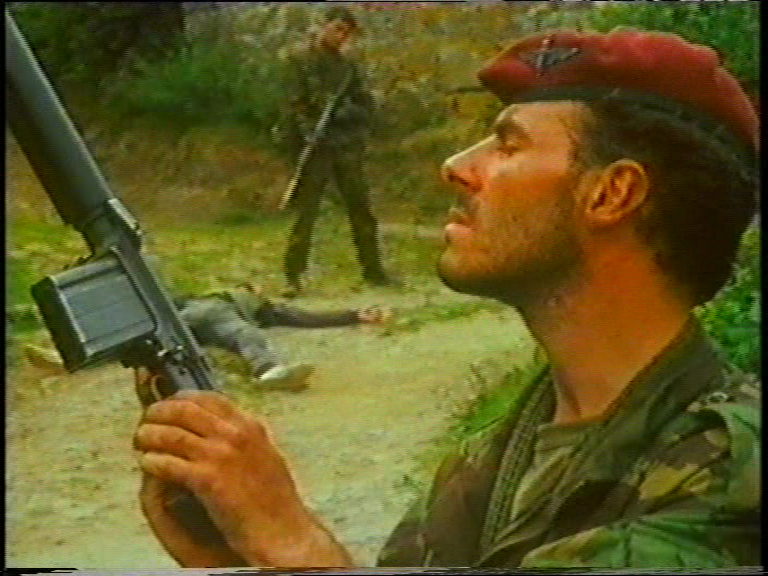
The first production to be shown in the <em>Screen Two</em> strand, <em>Contact</em> was broadcast on BBC2 at 10.10pm on Sunday 6 January 1985.<sup id="rf1-2931"><a href="#fn1-2931" title="This article builds upon one sub-section of Chapter 3 of Dave Rolinson, &lt;em&gt;Alan Clarke&lt;/em&gt; (Manchester: Manchester University Press, 2005), which was reissued in paperback in 2011. It was a shame that the paperback was just a straight reprint because most of it was written in the restrictive logistical circumstances of my Ph.D. (October 2000-Summer 2004) and I think the &lt;em&gt;Contact&lt;/em&gt; chapter in particular would benefit from updating and revising with the facilities and information that I now have. This article marks the start of that process of revision." rel="footnote">1</a></sup> An account of British Army patrols around the border in South Armagh, <em>Contact</em> was an appropriate start for <em>Screen Two</em> given its contemporary concerns, politically sensitive subject matter and distinctive style. Filmed between 6 and 29 August 1984, <em>Contact</em> was directed by Alan Clarke.<sup id="rf2-2931"><a href="#fn2-2931" title="Filming dates taken from &lt;em&gt;Contact&lt;/em&gt;’s BBC Programme-as-Broadcast file, viewed at the BBC Written Archives Centre." rel="footnote">2</a></sup> It is one of the highlights of Clarke’s astonishing body of work. Jim Naughton&#8217;s review of <em>Contact</em> is largely characteristic of the critical acclaim that it received: &#8220;a crisp, tight, elegant piece of work, wonderfully shot […] by Philip Bonham Carter and making brilliant use of sound&#8221;, the film &#8220;found a new angle on Northern Ireland, which is more than can be said for most programmes about that […] province&#8221;.<sup id="rf3-2931"><a href="#fn3-2931" title="Jim Naughton, ‘The good spies come back’, &lt;em&gt;The Listener&lt;/em&gt;, 10 January 1985, p. 33." rel="footnote">3</a></sup> Typically for a Clarke piece it achieved more acclaim abroad, winning the Golden Leopard&#8217;s Eye at the Locarno International Film Festival, where the jury praised the &#8220;intelligence and precision with which the camera describes the story of a British patrol in Northern Ireland while leaving the spectator free to judge&#8221;.<sup id="rf4-2931"><a href="#fn4-2931" title="Jury quoted in Paul Johnson, &#8216;BBC says film on informers was not delayed&#8217;, &lt;em&gt;The Guardian&lt;/em&gt;, 15 August 1985. Interestingly given some of the reviewer comments quoted later in this essay, the &lt;em&gt;Guardian&lt;/em&gt; piece describes &lt;em&gt;Contact&lt;/em&gt; as &#8220;A BBC documentary on Northern Ireland&#8221;. The &lt;em&gt;Contact&lt;/em&gt; news is at the bottom of a piece about the BBC denying alleged censorship of a programme about informers in Northern Ireland, &lt;em&gt;On the Word of a Supergrass&lt;/em&gt;." rel="footnote">4</a></sup> Clarke described the win as a &#8220;high spot&#8221; of his career, &#8220;absolutely great&#8221;.<sup id="rf5-2931"><a href="#fn5-2931" title="&lt;em&gt;Billy the Kid and the Green Baize Vampire&lt;/em&gt; publicity material, viewed at British Film Institute library." rel="footnote">5</a></sup> However, there was another Clarke at work on <em>Contact</em> whose own contribution has been underexplored: its writer, AFN Clarke&#8230;</p>

<hr class="footnotes"><ol class="footnotes" style="list-style-type:decimal"><li id="fn1-2931"><p >This article builds upon one sub-section of Chapter 3 of Dave Rolinson, <em>Alan Clarke</em> (Manchester: Manchester University Press, 2005), which was reissued in paperback in 2011. It was a shame that the paperback was just a straight reprint because most of it was written in the restrictive logistical circumstances of my Ph.D. (October 2000-Summer 2004) and I think the <em>Contact</em> chapter in particular would benefit from updating and revising with the facilities and information that I now have. This article marks the start of that process of revision.&nbsp;<a href="#rf1-2931" class="backlink" title="Return to footnote 1.">&#8617;</a></p></li><li id="fn2-2931"><p >Filming dates taken from <em>Contact</em>’s BBC Programme-as-Broadcast file, viewed at the BBC Written Archives Centre.&nbsp;<a href="#rf2-2931" class="backlink" title="Return to footnote 2.">&#8617;</a></p></li><li id="fn3-2931"><p >Jim Naughton, ‘The good spies come back’, <em>The Listener</em>, 10 January 1985, p. 33.&nbsp;<a href="#rf3-2931" class="backlink" title="Return to footnote 3.">&#8617;</a></p></li><li id="fn4-2931"><p >Jury quoted in Paul Johnson, &#8216;BBC says film on informers was not delayed&#8217;, <em>The Guardian</em>, 15 August 1985. Interestingly given some of the reviewer comments quoted later in this essay, the <em>Guardian</em> piece describes <em>Contact</em> as &#8220;A BBC documentary on Northern Ireland&#8221;. The <em>Contact</em> news is at the bottom of a piece about the BBC denying alleged censorship of a programme about informers in Northern Ireland, <em>On the Word of a Supergrass</em>.&nbsp;<a href="#rf4-2931" class="backlink" title="Return to footnote 4.">&#8617;</a></p></li><li id="fn5-2931"><p ><em>Billy the Kid and the Green Baize Vampire</em> publicity material, viewed at British Film Institute library.&nbsp;<a href="#rf5-2931" class="backlink" title="Return to footnote 5.">&#8617;</a></p></li></ol></hr>{"id":2931,"date":"2012-12-01T00:49:45","date_gmt":"2012-12-01T00:49:45","guid":{"rendered":"http:\/\/www.britishtelevisiondrama.org.uk\/?p=2931"},"modified":"2024-08-30T11:40:39","modified_gmt":"2024-08-30T10:40:39","slug":"making-contact-with-contact-from-afn-clarke-to-alan-clarke","status":"publish","type":"post","link":"http:\/\/www.britishtelevisiondrama.org.uk\/?p=2931","title":{"rendered":"Making Contact with <em>Contact<\/em>: From AFN Clarke to Alan Clarke"},"content":{"rendered":"<h4>by DAVID ROLINSON<\/h4>\n<p><em>Screen Two<\/em>; <strong>Writer:<\/strong> AFN Clarke; <strong>Director<\/strong>: Alan Clarke; <strong>Producer:<\/strong> Terry Coles<br \/>\n<a href=\"http:\/\/www.britishtelevisiondrama.org.uk\/wp-content\/uploads\/2012\/11\/BTVD_Contact_00.png\"><img loading=\"lazy\" decoding=\"async\" class=\"alignleft size-medium wp-image-3125\" title=\"BTVD_Contact_00\" src=\"http:\/\/www.britishtelevisiondrama.org.uk\/wp-content\/uploads\/2012\/11\/BTVD_Contact_00-300x225.png\" alt=\"\" width=\"300\" height=\"225\" srcset=\"http:\/\/www.britishtelevisiondrama.org.uk\/wp-content\/uploads\/2012\/11\/BTVD_Contact_00-300x225.png 300w, http:\/\/www.britishtelevisiondrama.org.uk\/wp-content\/uploads\/2012\/11\/BTVD_Contact_00.png 768w\" sizes=\"auto, (max-width: 300px) 100vw, 300px\" \/><\/a><br \/>\nThe first production to be shown in the <em>Screen Two<\/em> strand, <em>Contact<\/em> was broadcast on BBC2 at 10.10pm on Sunday 6 January 1985.<sup id=\"rf1-2931\"><a href=\"#fn1-2931\" title=\"This article builds upon one sub-section of Chapter 3 of Dave Rolinson, &lt;em&gt;Alan Clarke&lt;\/em&gt; (Manchester: Manchester University Press, 2005), which was reissued in paperback in 2011. It was a shame that the paperback was just a straight reprint because most of it was written in the restrictive logistical circumstances of my Ph.D. (October 2000-Summer 2004) and I think the &lt;em&gt;Contact&lt;\/em&gt; chapter in particular would benefit from updating and revising with the facilities and information that I now have. This article marks the start of that process of revision.\" rel=\"footnote\">1<\/a><\/sup> An account of British Army patrols around the border in South Armagh, <em>Contact<\/em> was an appropriate start for <em>Screen Two<\/em> given its contemporary concerns, politically sensitive subject matter and distinctive style. Filmed between 6 and 29 August 1984, <em>Contact<\/em> was directed by Alan Clarke.<sup id=\"rf2-2931\"><a href=\"#fn2-2931\" title=\"Filming dates taken from &lt;em&gt;Contact&lt;\/em&gt;\u2019s BBC Programme-as-Broadcast file, viewed at the BBC Written Archives Centre.\" rel=\"footnote\">2<\/a><\/sup> It is one of the highlights of Clarke\u2019s astonishing body of work. Jim Naughton&#8217;s review of <em>Contact<\/em> is largely characteristic of the critical acclaim that it received: &#8220;a crisp, tight, elegant piece of work, wonderfully shot [\u2026] by Philip Bonham Carter and making brilliant use of sound&#8221;, the film &#8220;found a new angle on Northern Ireland, which is more than can be said for most programmes about that [\u2026] province&#8221;.<sup id=\"rf3-2931\"><a href=\"#fn3-2931\" title=\"Jim Naughton, \u2018The good spies come back\u2019, &lt;em&gt;The Listener&lt;\/em&gt;, 10 January 1985, p. 33.\" rel=\"footnote\">3<\/a><\/sup> Typically for a Clarke piece it achieved more acclaim abroad, winning the Golden Leopard&#8217;s Eye at the Locarno International Film Festival, where the jury praised the &#8220;intelligence and precision with which the camera describes the story of a British patrol in Northern Ireland while leaving the spectator free to judge&#8221;.<sup id=\"rf4-2931\"><a href=\"#fn4-2931\" title=\"Jury quoted in Paul Johnson, &#8216;BBC says film on informers was not delayed&#8217;, &lt;em&gt;The Guardian&lt;\/em&gt;, 15 August 1985. Interestingly given some of the reviewer comments quoted later in this essay, the &lt;em&gt;Guardian&lt;\/em&gt; piece describes &lt;em&gt;Contact&lt;\/em&gt; as &#8220;A BBC documentary on Northern Ireland&#8221;. The &lt;em&gt;Contact&lt;\/em&gt; news is at the bottom of a piece about the BBC denying alleged censorship of a programme about informers in Northern Ireland, &lt;em&gt;On the Word of a Supergrass&lt;\/em&gt;.\" rel=\"footnote\">4<\/a><\/sup> Clarke described the win as a &#8220;high spot&#8221; of his career, &#8220;absolutely great&#8221;.<sup id=\"rf5-2931\"><a href=\"#fn5-2931\" title=\"&lt;em&gt;Billy the Kid and the Green Baize Vampire&lt;\/em&gt; publicity material, viewed at British Film Institute library.\" rel=\"footnote\">5<\/a><\/sup> However, there was another Clarke at work on <em>Contact<\/em> whose own contribution has been underexplored: its writer, AFN Clarke&#8230;<\/p>\n<p><!--more--><\/p>\n<p>Contrary to the claims of some critics, AFN Clarke is not Alan Clarke,<sup id=\"rf6-2931\"><a href=\"#fn6-2931\" title=\"Brian McIlroy, &#8216;The Repression of Communities: Visual Representations of Northern Ireland during the Thatcher Years&#8217;, in Lester D. Friedman, &lt;em&gt;Fires Were Started: British Cinema and Thatcherism&lt;\/em&gt; Second Edition (London: Wallflower Press, 2006). However, the view from my high horse is obscured by the fact that my own book is stupidly unable to name the correct source book\u2026 despite it having the same name as the film\u2026\" rel=\"footnote\">6<\/a><\/sup> nor is he a relation &#8211; he is Anthony (Tony) Clarke, though I will continue to use &#8216;AFN&#8217; in this article for consistency. He is not one of the many collaborators interviewed for Richard Kelly&#8217;s <em>Alan Clarke<\/em>, and his contribution is underexplored in my own book <em>Alan Clarke<\/em>. Instead, I placed <em>Contact<\/em> alongside <em>Psy-Warriors<\/em> and <em>Elephant<\/em>, pieces by different writers, to talk about discourses relating to terrorism within my overall concern with this <em>director<\/em>&#8216;s body of work and the thesis&#8217;s theoretical concepts such as ideology. So, reasons of structure, argument and space were mostly responsible for my lack of coverage of the relationship between Alan Clarke&#8217;s <em>Contact<\/em> and its source book, AFN Clarke&#8217;s <em>Contact<\/em>. This omission risks skewing the critical discussion, at least until <em>Contact<\/em> gets the number and depth of studies that this great television drama deserves. Therefore, this article returns to <em>Contact<\/em>, reproducing much of my book&#8217;s analysis but also revising it with new material including, most importantly, reference to the source book, which I&#8217;ve incorporated when teaching the film on my University of Stirling module Terrorism in the Media since 2010. This article makes no claim to being definitive &#8211; indeed, I hope to return to <em>Contact<\/em> later as part of a wider research project on terrorism in British television drama &#8211; and there is much left for further scholars to say.<\/p>\n<p><a href=\"http:\/\/www.britishtelevisiondrama.org.uk\/wp-content\/uploads\/2012\/12\/BTVD_Contact_bookcover.jpg\"><img loading=\"lazy\" decoding=\"async\" src=\"http:\/\/www.britishtelevisiondrama.org.uk\/wp-content\/uploads\/2012\/12\/BTVD_Contact_bookcover.jpg\" alt=\"\" title=\"BTVD_Contact_bookcover\" width=\"181\" height=\"280\" class=\"alignleft size-full wp-image-3180\" \/><\/a><br \/>\nThe book <em>Contact<\/em> is AFN Clarke\u2019s first-person memoir of tours in Northern Ireland with the Parachute Regiment: half of the book details his time in Belfast (not covered in the film version), while the second half details his border patrols near Crossmaglen in South Armagh.<sup id=\"rf7-2931\"><a href=\"#fn7-2931\" title=\"AFN Clarke, &lt;em&gt;Contact&lt;\/em&gt; (London: Secker &#038; Warburg, 1983). For more information and ebook ordering details, see the entry on &lt;em&gt;Contact&lt;\/em&gt; on &lt;a href=&quot;http:\/\/www.afnclarke.com\/Contact_CGT6.html&quot; target=&quot;_self&quot; rel=&quot;noopener&quot;&gt;AFN Clarke&#8217;s website afnclarke.com&lt;\/a&gt;.\" rel=\"footnote\">7<\/a><\/sup> In an initially close collaboration \u2013 detailed in Richard Kelly\u2019s interview collection <em>Alan Clarke<\/em> \u2013 AFN Clarke developed a detailed and semi-autobiographical script around the breakdown of a Platoon Commander.<sup id=\"rf8-2931\"><a href=\"#fn8-2931\" title=\"Richard Kelly (editor), &lt;em&gt;Alan Clarke&lt;\/em&gt; (London: Faber and Faber, 1998).\" rel=\"footnote\">8<\/a><\/sup> As was typical of much of the director&#8217;s work in the 1980s, the script was pared down. Lead actor Sean Chapman told Kelly that &#8220;Alan was respectful of writers and writing. He wasn&#8217;t one for letting actors change whatever line they liked [&#8230;] There was no &#8216;make it up as you go&#8217; feel, ever. But the time I saw him remake a script was <em>Contact<\/em>&#8220;, with the removal of plot exposition and much dialogue, until <em>Contact<\/em> became a \u201cset of sequences, describing army operations\u201d.<sup id=\"rf9-2931\"><a href=\"#fn9-2931\" title=\"Kelly, p. 152. As an example of this paring-down, Chapman describes meeting AFN Clarke and hearing about his &#8220;complete and massive breakdown&#8221;, a &#8220;nightmarish &lt;em&gt;Hearts of Darkness&lt;\/em&gt; experience as a young officer in charge of much younger men in South Armagh&#8221;, but Chapman argues that the script &#8220;doesn&#8217;t delineate that story at all&#8221; &#8211; Kelly, p. 153. AFN Clarke recalls a conversation about the film based on &lt;em&gt;Hearts of Darkness&lt;\/em&gt;, &lt;em&gt;Apocalypse Now&lt;\/em&gt;, relating to &#8220;the anger and rage that builds up inside a warrior when they are not engaged but just waiting to go into action&#8221;, an &#8220;anger that sits beneath the surface many years later. It is in everyone and Alan and I would talk about having a &#8220;rubber room&#8221; in which &#8216;we could go and &#8216;bounce off the walls&#8217; when the frustration got too much, before returning back to our jobs&#8221;. However, AFN Clarke disputes the suggestion from the Chapman quotation from Kelly that he &#8220;had a mental breakdown&#8221; &#8211; he suffered internal bleeding which consequently led to the loss of &#8220;my entire large bowel and half my small bowel&#8221;, and eventually received a War Disability pension. AFN Clarke, correspondence with author, 1 July 2013 and 30 June 2013.\" rel=\"footnote\">9<\/a><\/sup> In the final programme, there is often a refusal to provide motivational detail, and I&#8217;ve analysed the effects of that refusal in my book and will do so again in this article. In a problematically auteurist maneouvre (albeit one tied to a theoretical reading of ideology), I\u2019ve tried to interpret this refusal of context by looking at the director&#8217;s earlier <em>Psy-Warriors<\/em> and later <em>Elephant<\/em>.<sup id=\"rf10-2931\"><a href=\"#fn10-2931\" title=\"For more on those plays, again, see Rolinson, &lt;em&gt;Alan Clarke&lt;\/em&gt;.\" rel=\"footnote\">10<\/a><\/sup> Taking their lead, I read <em>Contact<\/em>\u2019s treatment of these operations in terms of the discourses of British rule, colonialism and ideology.<\/p>\n<p>However, interpreting the film in this way should not involve neglecting AFN Clarke&#8217;s contribution &#8211; although Clarke&#8217;s paring-down of scripts caused problems in later dramas, <em>Contact<\/em> remained a collaboration. Corin Campbell Hill, <em>Contact<\/em>&#8216;s production manager, told Richard Kelly that AFN Clarke &#8220;was on the set pretty much throughout&#8221;.<sup id=\"rf11-2931\"><a href=\"#fn11-2931\" title=\"Kelly, p. 154. &#8220;But I don&#8217;t remember any brooding discussions about &#8216;Have we got this shot?&#8217; or &#8216;Did we do that line?&#8217; [&#8230;] It was &#8216;Is the essence of that scene there?&#8217; (In the same book, Stuart Griffiths recalls seeing Clarke editing &lt;em&gt;Contact&lt;\/em&gt;: &#8220;of course, he liked to pare things down to an absolute minimum&#8221;, including near the end of the film &#8220;removing certain shots which would probably have extended the suspense more overtly&#8221; &#8211; Kelly, p. 156.) \" rel=\"footnote\">11<\/a><\/sup> Indeed, the collaboration went deeper than this, as AFN Clarke has explained: &#8216;In fact I was not only onset all the time, I also chose all the locations, trained the actors and myself and stunt coordinator Terry Forrestal blocked all the scenes with the actors over five days, with none of the production team present including Alan Clarke. I also was present throughout the entire editing process and working alone with the sound editor dubbing the correct sound effects related to the weapons being used.&#8221;<sup id=\"rf12-2931\"><a href=\"#fn12-2931\" title=\"AFN Clarke, correspondence with author, 30 June 2013.\" rel=\"footnote\">12<\/a><\/sup> But my focus will be on the impact of the original book. For instance, the repetition of scenes (in particular walking scenes) might well resemble numerous other Alan Clarke films \u2013 <em>Made in Britain<\/em>, <em>Christine <\/em>and <em>Elephant<\/em> in particular \u2013 or be productively compared with the discussion of circularity in <em>Psy-Warriors<\/em>, but it is also a feature of AFN Clarke&#8217;s book: &#8220;The hours drag on and eventually the rota becomes the only way of knowing which day it is. Day succeeds night succeeds day in a monotonous cycle enriched with the cold wind and the rain&#8221;.<sup id=\"rf13-2931\"><a href=\"#fn13-2931\" title=\"AFN Clarke, &lt;em&gt;Contact&lt;\/em&gt;, p. 119.\" rel=\"footnote\">13<\/a><\/sup> The refusal of motivational detail in the film is also the result of Alan Clarke developing a style which emulates in film terms the numbing routines that are described in the book. Having said that, the book does provide much more factual and emotional information than the film, and so thinking about what has been lost does give us a way into the film&#8217;s strategies. The book is told from a first-person point-of-view rather than from the outside, and the military perspective makes it an essential reference point on my terrorism module, which features a number of competing terror, counter-terror and academic perspectives. The book is also vital because it provides a clearer sense of motivation which the film often (though not always) omits, and a view of the conflict that sits distinctively within the module\u2019s numerous representations from broadcast fiction and non-fiction, journalism and other sources. Examples of the information and opinion that the book provides but which the film does not make explicit: the statement that distrust or hatred towards the British Army occurs within the Loyalist community and groups as well as the Nationalist community and groups; we are told why the soldiers need to travel by helicopter, how the bases run; what the threats usually are; where those threats come from; and (as we shall see) why the soldiers do certain things.<\/p>\n<p>The significance of the location is stressed less by the film than by the book and various studies. AFN Clarke&#8217;s book describes the base at Crossmaglen as a &#8220;tactical farce [&#8230;] in a pocket of the North surrounded on three sides by the border with the Republic, and the entire population of the district, with the exception of a couple of Prots, are Catholic, anti-British, pro-I.R.A. and a law unto themselves. Bandit country, the media have called it and it\u2019s not a bad label.&#8221;<sup id=\"rf14-2931\"><a href=\"#fn14-2931\" title=\"AFN Clarke, &lt;em&gt;Contact&lt;\/em&gt;, p. 104.\" rel=\"footnote\">14<\/a><\/sup><em> <\/em>As Toby Harnden discusses in his history of the IRA in South Armagh, the description &#8220;Bandit Country&#8221; was applied in 1975 by Merlyn Rees, then-Northern Ireland Secretary, because of how \u2018dangerous\u2019 it was for British soldiers, and so it remained.<sup id=\"rf15-2931\"><a href=\"#fn15-2931\" title=\"Harnden, pp. 14-15. He states that &#8220;no other part of the world has been as dangerous for someone wearing the uniform of the British Army. Some 123 soldiers have been killed in the South Armagh area since August 1971, around a fifth of all military casualties in Northern Ireland, along with 42 Royal Ulster Constabulary officers and 75 civilians. According to RUC statistics, the area within a 10-mile radius of the heart of South Armagh has seen 1, 255 bomb attacks and 1, 158 shooting incidents since the Troubles began.&#8221;\" rel=\"footnote\">15<\/a><\/sup> (Harnden notes that a senior Army officer &#8220;added that the term &#8216;Bandit Country&#8217; had been entirely counter-productive for it had fuelled the South Armagh Brigade\u2019s sense of inevitability and planted fear in every soldier\u2019s mind&#8221;.<sup id=\"rf16-2931\"><a href=\"#fn16-2931\" title=\"Ibid, p. 465.\" rel=\"footnote\">16<\/a><\/sup> ) Crossmaglen in particular &#8220;is a place of hostility, isolation and the constant threat of death. Before going out on patrol, troops are briefed that every gorse bush, stone wall or ditch, every cowshed, milk churn or bale of hay could hide a bomb; if a sniper decided to strike, the victim would probably never even hear the crack of the bullet being fired.&#8221;<sup id=\"rf17-2931\"><a href=\"#fn17-2931\" title=\"Ibid, p. 15. Harnden also stated that &#8220;History and landscape are rooted deep in the psyche of the people of South Armagh&#8221;, a statement which could support some of the ideological analyses of landscape in the film that this chapter touches upon.\" rel=\"footnote\">17<\/a><\/sup> These are among the sensations evoked by the film.<\/p>\n<p><a href=\"http:\/\/www.britishtelevisiondrama.org.uk\/wp-content\/uploads\/2012\/11\/BTVD_Contact_01.png\"><img loading=\"lazy\" decoding=\"async\" src=\"http:\/\/www.britishtelevisiondrama.org.uk\/wp-content\/uploads\/2012\/11\/BTVD_Contact_01-300x225.png\" alt=\"\" title=\"BTVD_Contact_01\" width=\"300\" height=\"225\" class=\"alignleft size-medium wp-image-3126\" srcset=\"http:\/\/www.britishtelevisiondrama.org.uk\/wp-content\/uploads\/2012\/11\/BTVD_Contact_01-300x225.png 300w, http:\/\/www.britishtelevisiondrama.org.uk\/wp-content\/uploads\/2012\/11\/BTVD_Contact_01.png 768w\" sizes=\"auto, (max-width: 300px) 100vw, 300px\" \/><\/a><br \/>\nIn my book, after providing a history of censored or banned programmes on Northern Ireland and analysing <em>Psy-Warriors<\/em>, my analysis of <em>Contact<\/em> begins with the opening scene. <em>Contact<\/em> opens with an establishing shot &#8211; held for a fair few seconds &#8211; of a country road. The road&#8217;s framing in the foreground acts to mediate the lush greens of rural Ireland in the background,<sup id=\"rf18-2931\"><a href=\"#fn18-2931\" title=\"It was shot in Wales.\" rel=\"footnote\">18<\/a><\/sup> a shot which demonstrates an incursion by urban space. What I didn\u2019t add was that the source book also uses intrusion imagery \u2013 for instance, \u2018the base looking like an obscene sculpture on the green landscape\u2019.<sup id=\"rf19-2931\"><a href=\"#fn19-2931\" title=\"AFN Clarke, &lt;em&gt;Contact&lt;\/em&gt;, p. 120.\" rel=\"footnote\">19<\/a><\/sup> <\/p>\n<p><a href=\"http:\/\/www.britishtelevisiondrama.org.uk\/wp-content\/uploads\/2012\/11\/BTVD_Contact_02.png\"><img loading=\"lazy\" decoding=\"async\" src=\"http:\/\/www.britishtelevisiondrama.org.uk\/wp-content\/uploads\/2012\/11\/BTVD_Contact_02-300x225.png\" alt=\"\" title=\"BTVD_Contact_02\" width=\"300\" height=\"225\" class=\"alignleft size-medium wp-image-3127\" srcset=\"http:\/\/www.britishtelevisiondrama.org.uk\/wp-content\/uploads\/2012\/11\/BTVD_Contact_02-300x225.png 300w, http:\/\/www.britishtelevisiondrama.org.uk\/wp-content\/uploads\/2012\/11\/BTVD_Contact_02.png 768w\" sizes=\"auto, (max-width: 300px) 100vw, 300px\" \/><\/a><\/p>\n<p>Eventually, a car speeds into view. Several British soldiers emerge from outside the frame and block the road. This opening image establishes a contrast between the natural green of the countryside, a pure green with connotations of Ireland and Irish nationalism, and the camouflage uniforms of the soldiers, here first seen against the grey of the road. There\u2019s a similar contrast between their uniforms and the organic greens and browns worn by locals they interrogate. These shots reinforce the idea that the soldiers cannot assimilate themselves fully into their surroundings. I\u2019m still content with this observation of mise-en-sc\u00e8ne, in that the clash of organic and non-organic colours and textures is a clear visual thread throughout the film. However, I do think that I leap too quickly into interpreting that, in a baldly-stated way, before I\u2019ve provided enough evidence. If the locals seem innocent, then that\u2019s perhaps an ambiguity left by the film: the source book gives us a more detailed sense of the possibility of threat, the tactics that groups use and why soldiers might be particularly on edge at given moments. Toby Harnden details the use of \u2018scout cars\u2019 to check that roads are clear of soldiers. However, as the scene develops, our first view of \u2018contact\u2019 between the soldiers and the Irish is based upon the British exercising their power. One man is shot dead, the other lies on the ground while the unspeaking Commander pushes a gun into his face. Throughout this scene, and for most of <em>Contact<\/em>, the Irish are silent. Described simply as \u201cgun-runners\u201d, they represent an administrative problem for British rule, which is deaf to, or actively silences, the subaltern culture of the indigenous people. This kind of colonial reading is reinforced by the description of Northern Ireland in <em>Psy-Warriors<\/em> as Britain\u2019s \u201clast colonial battlefield[\u2026] the rear end of the cruelty and exploitation of over thirty colonial wars\u201d. The Interrogator, using an image which we might see as anticipating the circularity of <em>Elephant<\/em>, compares the situation to \u201ca dog devouring its own tail\u201d.<\/p>\n<p><a href=\"http:\/\/www.britishtelevisiondrama.org.uk\/wp-content\/uploads\/2012\/11\/BTVD_Contact_12.png\"><img loading=\"lazy\" decoding=\"async\" src=\"http:\/\/www.britishtelevisiondrama.org.uk\/wp-content\/uploads\/2012\/11\/BTVD_Contact_12-300x225.png\" alt=\"\" title=\"BTVD_Contact_12\" width=\"300\" height=\"225\" class=\"alignleft size-medium wp-image-3137\" srcset=\"http:\/\/www.britishtelevisiondrama.org.uk\/wp-content\/uploads\/2012\/11\/BTVD_Contact_12-300x225.png 300w, http:\/\/www.britishtelevisiondrama.org.uk\/wp-content\/uploads\/2012\/11\/BTVD_Contact_12.png 768w\" sizes=\"auto, (max-width: 300px) 100vw, 300px\" \/><\/a><br \/>\nIf we\u2019re to read this scene from <em>Contact<\/em> in ideological terms, it\u2019s partly because of its virtual replication later, when the soldiers shoot gun-runners and the Commander forces his gun into the mouth of a captive.<sup id=\"rf20-2931\"><a href=\"#fn20-2931\" title=\"Of that later scene, Chapman noted: &#8220;Neither Alan or I knew what came next in the scene. We knew this was a position of complete power for my character, complete revenge and potentially a complete release of this tension. And I said to him, &#8216;I can hold this look with him for ever, I&#8217;m getting off on being in charge here.&#8217; He said, &#8216;So hold it.&#8217; [&#8230;] he&#8217;s broken the procedure, now he has to make his own rules, and at a cost to himself. That&#8217;s the moral crux&#8221; &#8211; Kelly, p. 155.\" rel=\"footnote\">20<\/a><\/sup> Reflecting the Interrogator\u2019s \u201csymbiotic\u201d rhetoric, the guns are being transported to locals to fight the British soldiers, so the repetitious skirmishes continue because the soldiers remain present; their first appearance blocks both the frame and the road, obstructing the movement of the Irish and our view of them. Drama stems from the soldiers\u2019 misreading of signs. In a way that comes from the book, which tells us: \u201cThe closer we get the more alert we get, stopping at the slightest sound, listening for long minutes, eyes trying to pierce the darkness and interpret the shapes. Buildings take on a sinister presence [\u2026]\u201d.<sup id=\"rf21-2931\"><a href=\"#fn21-2931\" title=\"&lt;em&gt;Contact&lt;\/em&gt;, p. 118.\" rel=\"footnote\">21<\/a><\/sup><\/p>\n<p><a href=\"http:\/\/www.britishtelevisiondrama.org.uk\/wp-content\/uploads\/2012\/11\/BTVD_Contact_07.png\"><img loading=\"lazy\" decoding=\"async\" src=\"http:\/\/www.britishtelevisiondrama.org.uk\/wp-content\/uploads\/2012\/11\/BTVD_Contact_07-300x225.png\" alt=\"\" title=\"BTVD_Contact_07\" width=\"300\" height=\"225\" class=\"alignleft size-medium wp-image-3132\" srcset=\"http:\/\/www.britishtelevisiondrama.org.uk\/wp-content\/uploads\/2012\/11\/BTVD_Contact_07-300x225.png 300w, http:\/\/www.britishtelevisiondrama.org.uk\/wp-content\/uploads\/2012\/11\/BTVD_Contact_07.png 768w\" sizes=\"auto, (max-width: 300px) 100vw, 300px\" \/><\/a><br \/>\nAs in the source book, they find danger in gun magazines left on the grass and a couple emerging from a derelict building (who in the book are more clearly described as being extremely poor and dirty). The crisis point is always, as the title implies, at the point of contact between the soldiers and the Irish. Toby Harnden also discusses soldiers\u2019 difficulties in reading signs. He quotes Jim McAllister\u2019s argument that \u201cIf they come here for six months at a time, they are never going to really learn the area like people who were born and reared here. They might be watching everything and see Farmer Joe go by with his tractor loaded with hay three days of the week but one day it\u2019s not Farmer Joe but IRA man Joe and he\u2019s got something extra underneath his hay. They don\u2019t know that and that\u2019s why they\u2019ll never win this territory. It\u2019s to do with community, it\u2019s to do with history\u201d.<sup id=\"rf22-2931\"><a href=\"#fn22-2931\" title=\"Harnden, pp. 87-88.\" rel=\"footnote\">22<\/a><\/sup> As in <em>Psy-Warriors<\/em>, elements of Clarke\u2019s style reflect the limited view of the soldiers, in the process exposing the power inscribed in the act of looking, a Foucauldian theme that I develop in different parts of the book. Largely, Clarke uses a hand-held camera to react to events with an \u201cunmediated\u201d rhetoric reminiscent of documentary. In the 1980s, Clarke often used Steadicam to walk \u201cwith\u201d characters, but this is not the signature device of <em>Contact<\/em>. The effect is to link the observational camera with the distanced state. In the soldiers\u2019 operations in what they describe as \u201cbandit country\u201d, the Irish are the unelaborated \u201cOther\u201d, a mostly unseen presence of which we only become aware when British soldiers come under attack. At those points the camera reacts, lurching and zooming in a vain search for the gunmen. That is also an impressive feature of <em>Full Metal Jacket<\/em> (1987), whose director Stanley Kubrick apparently saw and admired <em>Contact<\/em>.<sup id=\"rf23-2931\"><a href=\"#fn23-2931\" title=\"I\u2019m told that he congratulated the BBC about it, but I have not seen the note. This is not the time to develop this, but there are surprising correlations between the stylistic development of Kubrick and Clarke in the 1970s and 1980s. &lt;em&gt;Full Metal Jacket&lt;\/em&gt; also features the camerawork of John Ward, Clarke\u2019s DP on &lt;em&gt;Road&lt;\/em&gt; (in part), &lt;em&gt;Elephant&lt;\/em&gt; and &lt;em&gt;The Firm&lt;\/em&gt;.\" rel=\"footnote\">23<\/a><\/sup><\/p>\n<p><a href=\"http:\/\/www.britishtelevisiondrama.org.uk\/wp-content\/uploads\/2012\/11\/BTVD_Contact_04.png\"><img loading=\"lazy\" decoding=\"async\" src=\"http:\/\/www.britishtelevisiondrama.org.uk\/wp-content\/uploads\/2012\/11\/BTVD_Contact_04-300x225.png\" alt=\"\" title=\"BTVD_Contact_04\" width=\"300\" height=\"225\" class=\"alignleft size-medium wp-image-3129\" srcset=\"http:\/\/www.britishtelevisiondrama.org.uk\/wp-content\/uploads\/2012\/11\/BTVD_Contact_04-300x225.png 300w, http:\/\/www.britishtelevisiondrama.org.uk\/wp-content\/uploads\/2012\/11\/BTVD_Contact_04.png 768w\" sizes=\"auto, (max-width: 300px) 100vw, 300px\" \/><\/a><br \/>\nIn addition to the two shades of green mentioned earlier, in the night sequences Clarke gains a night-vision effect. In the book I lazily call this &#8220;infra-red&#8221; (confusing the process with the effect), admittedly reinforced by Tim Roth when he described the call he received from Alan Clarke to play the lead in <em>Contact<\/em>: &#8220;I&#8217;ve got this great part for you, it&#8217;s all night shoots; we&#8217;re gonna do infra-red night vision, handheld camera&#8221;.<sup id=\"rf24-2931\"><a href=\"#fn24-2931\" title=\"Kelly, p. 153.\" rel=\"footnote\">24<\/a><\/sup> Actually, the view was achieved by adapting military sights, as AFN Clarke recalls (in a discussion of his contribution to the collaboration): &#8220;It was also my idea to use the Image Intensifying sight and I worked with Phillip Bonham-Carter to get the right equipment and carry out the camera tests.&#8221;<sup id=\"rf25-2931\"><a href=\"#fn25-2931\" title=\"AFN Clarke, correspondence with author, 30 June 2013. This follows previous correspondence on this topic before 2010.\" rel=\"footnote\">25<\/a><\/sup> Brian McIlroy noted from these shots that we are seeing &#8220;a society predicated upon clandestine surveillance&#8221;.<sup id=\"rf26-2931\"><a href=\"#fn26-2931\" title=\"Brian McIlroy, &lt;em&gt;Shooting to Kill: Filmmaking and the \u201cTroubles\u201d in Northern Ireland&lt;\/em&gt; (Richmond: Steveston Press, 2001), p. 127.\" rel=\"footnote\">26<\/a><\/sup> Furthermore, the night camera has the disorienting effect of filling the screen with overwhelming greens. Again, we can note that this reflects the source book: \u201cLooking at the ghostly greeny countryside through the image-intensifying sight gives me the feeling of unreality\u201d.<sup id=\"rf27-2931\"><a href=\"#fn27-2931\" title=\"AFN Clarke, &lt;em&gt;Contact&lt;\/em&gt;, p. 119.\" rel=\"footnote\">27<\/a><\/sup> Nancy Banks-Smith observed that the platoon is \u2018bathed in a thin, liquid green light like aliens\u2019.<sup id=\"rf28-2931\"><a href=\"#fn28-2931\" title=\"Nancy Banks-Smith, \u2018Silent night, holding tight\u2019, &lt;em&gt;The Guardian&lt;\/em&gt;, 7 January 1985, p. 11.\" rel=\"footnote\">28<\/a><\/sup> The title <em>Contact<\/em> reinforces this notion of the platoon trespassing in an alien landscape. Furthermore, as Howard Schuman proposed, it could turn \u201cus into alien observers; the viewer is therefore both comrade and enemy, victim and aggressor\u201d.<sup id=\"rf29-2931\"><a href=\"#fn29-2931\" title=\"Schuman, \u2018In it for life\u2019, p. 20.\" rel=\"footnote\">29<\/a><\/sup><\/p>\n<p>As he often did, Clarke resists the editorialising use of music and non-diegetic sound, leaving only distant bird call or the rustling of trees. According to Banks-Smith, because of the way in which the soldiers &#8220;prowled in\u2026 such silence&#8221;, the viewer\u2019s ears \u201cgrow points and prick forward with the aching acuteness of the hunter and the hunted&#8221;.<sup id=\"rf30-2931\"><a href=\"#fn30-2931\" title=\"Banks-Smith, p. 11.\" rel=\"footnote\">30<\/a><\/sup> The rural soundtrack is displaced when we move to scenes in Army quarters underscored by the unnatural humming of a power source. The sounds of the countryside are replicated by artificial echoes, like the showers which clean the soldiers after wading through rivers, or blocked out altogether by the personal stereos with which the young troops relax on their bunks. The base, therefore, becomes a limbo in which the British are further distanced from their surroundings. This is reflected in the camera\u2019s own distance from the Commander, which makes it appear, as Jim Hiley observed, \u201cas if the camera approaches him with extreme wariness\u201d,<sup id=\"rf31-2931\"><a href=\"#fn31-2931\" title=\"Jim Hiley, \u2018Other Highlights\u2019, &lt;em&gt;The Listener&lt;\/em&gt;, 3 January 1985, p. 31.\" rel=\"footnote\">31<\/a><\/sup> and in army psychology, as the Corporal tells the Commander, \u201cDon\u2019t get involved, boss. It\u2019s bad for the brain\u201d. Again, I could have related this to an equivalent scene in the source book: \u201cI don\u2019t want to know you, because to me you will be just another number when I shovel what\u2019s left of it into a body bag\u201d, translated as \u201cI don\u2019t want to get involved because I don\u2019t want to get hurt.\u201d<sup id=\"rf32-2931\"><a href=\"#fn32-2931\" title=\"&lt;em&gt;Contact&lt;\/em&gt;, p. 38.\" rel=\"footnote\">32<\/a><\/sup> The close-ups were shot on long lenses, to the extent that Chapman was often unaware that he was in close-up,<sup id=\"rf33-2931\"><a href=\"#fn33-2931\" title=\"&#8220;Almost all of &lt;em&gt;Contact&lt;\/em&gt; was shot on these incredibly long lenses. For a lot of the time I didn&#8217;t know where the camera crew were [&#8230;] I wasn&#8217;t really aware that Alan was starting to concentrate on the close-ups of my face [&#8230;] I just knew I had the freedom to hold a look for as long as I wanted to, or as briefly.&#8221; &#8211; Kelly, p. 155.\" rel=\"footnote\">33<\/a><\/sup> with the effect of making Ireland a hazy and indistinct background, as Clarke according to Richard Kelly \u201cframed these soldiers as figures in a landscape where they have no mission, no prayer and no place\u201d<sup id=\"rf34-2931\"><a href=\"#fn34-2931\" title=\"Kelly, p. xix.\" rel=\"footnote\">34<\/a><\/sup>. <em>Contact<\/em>, therefore, becomes a post-colonial war film, in which Clarke\u2019s strategies both demonstrate the landscape\u2019s refusal to be easily defined and locate the act of looking within the discursive frameworks of colonialism.<\/p>\n<p><a href=\"http:\/\/www.britishtelevisiondrama.org.uk\/wp-content\/uploads\/2012\/11\/BTVD_Contact_03.png\"><img loading=\"lazy\" decoding=\"async\" src=\"http:\/\/www.britishtelevisiondrama.org.uk\/wp-content\/uploads\/2012\/11\/BTVD_Contact_03-300x225.png\" alt=\"\" title=\"BTVD_Contact_03\" width=\"300\" height=\"225\" class=\"alignleft size-medium wp-image-3128\" srcset=\"http:\/\/www.britishtelevisiondrama.org.uk\/wp-content\/uploads\/2012\/11\/BTVD_Contact_03-300x225.png 300w, http:\/\/www.britishtelevisiondrama.org.uk\/wp-content\/uploads\/2012\/11\/BTVD_Contact_03.png 768w\" sizes=\"auto, (max-width: 300px) 100vw, 300px\" \/><\/a><br \/>\nThis is reflected in its minimalist narrative. Although the film contains a small number of understated briefing scenes at which tactics (and, to answer my earlier point, locations) are discussed, there is overall no clear statement for us of defined mission aims or understanding on the part of the British \u2013 there is instead a number of repetitive searches and seemingly pointless deaths. Up to a point, <em>Contact<\/em> is operating within the modes of the \u201ctour of duty\u201d war film, but, contrary to our expectations of that genre, and potentially contrary to the source book, we are not led to empathise with the soldiers. Through its sparse characterisation, <em>Contact<\/em>, according to David Leland, \u201cbreaks the mould of the soldiers-at-war film. There\u2019s no chirpy Cockney or dour Scot and nobody takes the piss out of a character called Taff\u201d.<sup id=\"rf35-2931\"><a href=\"#fn35-2931\" title=\"David Leland, introduction to tribute repeat broadcast of &lt;em&gt;Contact&lt;\/em&gt;, tx. BBC2, 20 July 1991.\" rel=\"footnote\">35<\/a><\/sup> This is generally true, although the last point is slightly undercut by one soldier\u2019s speculation on another soldier\u2019s night life after hearing the sound of off-screen sheep. Contrary to the iconography of the war film, there is no narrative causality or resolution. As a non-discursive war film focusing on the problems of leadership, <em>Contact<\/em> has some correlations with the films of Samuel Fuller, who according to Phil Hardy often \u201cexcludes as much as possible in the way of context and films the internal pressures\u201d on an unsympathetic leader and the men he leads, who do not know why they are fighting.<sup id=\"rf36-2931\"><a href=\"#fn36-2931\" title=\"Phil Hardy, Samuel Fuller (London: Studio Vista, 1970), p. 48.\" rel=\"footnote\">36<\/a><\/sup> <em>The Steel Helmet<\/em> (1951) follows a patrol behind enemy lines, whose protagonists are deceived and confused by the native land, and \u201center a limbo of their own. In a slow pan across their faces, Fuller shows them staring blankly ahead\u201d as madness is \u201cthe only form of impassivity\u2026 available to men at war\u201d.<sup id=\"rf37-2931\"><a href=\"#fn37-2931\" title=\"Ibid, p. 104.\" rel=\"footnote\">37<\/a><\/sup> Fuller also made use of a walking motif. As another leader says in <em>Merrill\u2019s Marauders<\/em> (1962), \u201cWhen you come to the end of your rope, all you have to do is put one foot in front of the other, just take the next step \u2013 that\u2019s all there is to it.\u201d To place <em>Contact<\/em> in the context of the British war film, Robert Murphy, commenting on the way in which <em>The Long and the Short and the Tall<\/em> (1961) was celebrated for \u201cits boldness in concentrating on a unit of squabbling, foul-mouthed and distinctly unheroic soldiers\u201d, argued that \u201cThe film it most resembles is Alan Clarke\u2019s <em>Contact<\/em>\u2019.<sup id=\"rf38-2931\"><a href=\"#fn38-2931\" title=\"Robert Murphy, &lt;em&gt;British Cinema and the Second World War&lt;\/em&gt; (London: Continuum, 2000), pp. 247, 268n.\" rel=\"footnote\">38<\/a><\/sup> David Thomson compared <em>Contact<\/em> with Anthony Mann\u2019s \u201cabstract study of an infantry patrol lost in Korea\u201d, <em>Men in War<\/em> (1957). Mann \u201chas never had an equal at the depiction of landscape, immensely extended spatial relationships, and the dramatics of distance\u201d. Though \u201cClarke\u2019s style is not as classical as Mann\u2019s\u201d, <em>Contact<\/em>\u2019s strategies also employ physical movement to convey \u201cthe animal in people\u2026 dwarfed by eternity and the tranquility of the land\u201d.<sup id=\"rf39-2931\"><a href=\"#fn39-2931\" title=\"David Thomson, \u2018Walkers in the world: Alan Clarke\u2019, &lt;em&gt;Film Comment&lt;\/em&gt;, Volume 29, Number 3, May\/June 1993, pp. 80-81.\" rel=\"footnote\">39<\/a><\/sup> Clarke\u2019s avoidance of conventional narrative strategies made <em>Contact<\/em>, in Amy Taubin\u2019s phrase, \u201ca rare thing \u2013 a truly antiwar movie\u201d.<sup id=\"rf40-2931\"><a href=\"#fn40-2931\" title=\"Taubin, Amy, \u2018Small Screen Giant\u2019, Village Voice, 20 September 1994, pp. 60-62.\" rel=\"footnote\">40<\/a><\/sup> According to V. F. Perkins, the effect of such conventional strategies on David Lean\u2019s <em>The Bridge on the River Kwai<\/em> (1957) was to undermine its proclamation of \u201cthe futility of war\u201d, with \u201cemotional dynamics\u201d which \u201cinvited us to share in the excitements, tensions and triumphs offered by the action\u201d. Therefore, in Lean\u2019s film, \u201cWar was said to be futile and experienced as glorious, victory was said to be empty and felt magnificent\u201d.<sup id=\"rf41-2931\"><a href=\"#fn41-2931\" title=\"V.F. Perkins, &lt;em&gt;Film as Film: Understanding and Judging Movies&lt;\/em&gt; (London: Pelican, 1972), p. 149.\" rel=\"footnote\">41<\/a><\/sup> This is in stark contrast to <em>Contact<\/em>&#8216;s qualities as described by Dennis Hackett, as \u201cClarke\u2019s taut, atmospheric direction\u2026 brought the sick tension of it all through strongly\u201d. Actor Sean Chapman observed in comparable terms: &#8220;It seems more and more pointless, the more vehicle checks you do, the more silly gunfights in a field, where nobody seems to win anything. In that sense it&#8217;s an anti-war film without ever talking about the pointlessness of its project, it&#8217;s interwoven in the shot choices and so on.&#8221;<sup id=\"rf42-2931\"><a href=\"#fn42-2931\" title=\"Kelly, p. 156.\" rel=\"footnote\">42<\/a><\/sup> Hackett added of the pared-down script that \u201cIt is unlikely that any play this year will have fewer words\u201d but \u201cA more fulsome script would\u2026 have been inappropriate\u201d.<sup id=\"rf43-2931\"><a href=\"#fn43-2931\" title=\"Dennis Hackett, \u2018Beyond words\u2019, &lt;em&gt;The Guardian&lt;\/em&gt;, 7 January 1985, p. 10.\" rel=\"footnote\">43<\/a><\/sup><\/p>\n<p><a href=\"http:\/\/www.britishtelevisiondrama.org.uk\/wp-content\/uploads\/2012\/11\/BTVD_Contact_11.png\"><img loading=\"lazy\" decoding=\"async\" src=\"http:\/\/www.britishtelevisiondrama.org.uk\/wp-content\/uploads\/2012\/11\/BTVD_Contact_11-300x225.png\" alt=\"\" title=\"BTVD_Contact_11\" width=\"300\" height=\"225\" class=\"alignleft size-medium wp-image-3136\" srcset=\"http:\/\/www.britishtelevisiondrama.org.uk\/wp-content\/uploads\/2012\/11\/BTVD_Contact_11-300x225.png 300w, http:\/\/www.britishtelevisiondrama.org.uk\/wp-content\/uploads\/2012\/11\/BTVD_Contact_11.png 768w\" sizes=\"auto, (max-width: 300px) 100vw, 300px\" \/><\/a><br \/>\n<em>Contact<\/em>\u2019s soldiers resemble <em>Scum<\/em>\u2019s trainees, which I\u2019d be tempted to see as a deliberate paralleling of institutionalised youth, given that <em>Scum<\/em> was intended as part of a trilogy including a play about youths entering the army. In the regimented, imprisoning headquarters, the young men, led by <em>Scum<\/em>\u2019s \u201cdaddy\u201d John Blundell, eat and wash communally before retiring to their cell-like rooms.<sup id=\"rf44-2931\"><a href=\"#fn44-2931\" title=\"This kind of auteurist connection means missing out ones that don\u2019t fit, for instance the appearance of Blundell as a British soldier in a very different Northern Ireland piece, a &lt;em&gt;Play for Today&lt;\/em&gt; called &lt;em&gt;Shadows on our Skin&lt;\/em&gt; (tx. BBC1, 20 March 1980).\" rel=\"footnote\">44<\/a><\/sup> The soldiers\u2019 youthful vulnerability is emphasised by a scene in which they discover a group of children out camping. The Commander seems troubled by one child staring up in fear at the platoon, a reflection of the mysterious armed confrontations suffered by his own young charges, and a foreshadowing of his own guilt. Again, these are ideas described in the source book: \u201cIt\u2019s a bit like playing hide and seek [\u2026] Grown-ups playing children\u2019s games with death the only winner.\u201d<sup id=\"rf45-2931\"><a href=\"#fn45-2931\" title=\"&lt;em&gt;Contact&lt;\/em&gt;, p. 137.\" rel=\"footnote\">45<\/a><\/sup><\/p>\n<p>In such sequences we see, as Brian McIlroy observed, the \u201ctension\u201d implicit in the position of the soldier who \u201cfollows orders and tries not to get killed in the process\u201d, as Clarke depicts routine \u201cwith his almost mathematical precision\u201d.<sup id=\"rf46-2931\"><a href=\"#fn46-2931\" title=\"McIlroy, p. 128.\" rel=\"footnote\">46<\/a><\/sup> But if we turn to the source book to think about what the soldiers are thinking and feeling, we find opinions that make my book\u2019s ideological analysis of what the film is doing seem a little too neat at times. For instance, the film contains no direct equivalent of this observation from the source book:<\/p>\n<blockquote><p>We must be the only Army in the world that has to account for every minute of time, every action taken. Guilty until proven innocent, my Lord. Yellow cards with instructions on when to open fire. White cards on arrest procedures. Another white card on the use of P.V.C. baton rounds, and yet another on how M. 79 grenade launchers can be used. Will you please stop the battle, I have to consult my yellow and white cards.<sup id=\"rf47-2931\"><a href=\"#fn47-2931\" title=\"AFN Clarke, &lt;em&gt;Contact&lt;\/em&gt;, pp. 37-38.\" rel=\"footnote\">47<\/a><\/sup><\/p><\/blockquote>\n<p>In their 1983 book <em>Televising Terrorism<\/em>,<em> <\/em>Philip Schlesinger, Graham Murdock and Philip Elliott discuss the film <em>Who Dares Wins<\/em> (1982) and its associated novel <em>The Tiptoe Boys<\/em> in terms of tensions in the official perspective between maintaining order and maintaining the rule of law, finding in <em>The Tiptoe Boys<\/em> &#8220;reactionary populist sentiments&#8221; regarding serving in Northern Ireland:<\/p>\n<blockquote><p>&#8230;those cringing wankers at Westminster put me and my mates in there to clean up their shit. But are we allowed to fight as soldiers are trained to fight? Christ, no. We\u2019ve got to ride round like fucking human targets and be shot at first. Then we\u2019re allowed to shoot back if we\u2019re still alive, but we mustn\u2019t use too many rounds and there\u2019s fucking hell to pay if we do. You reckon the Provos do that? Do they hell. They\u2019re laughing at us\u2026<sup id=\"rf48-2931\"><a href=\"#fn48-2931\" title=\"James Follett, &lt;em&gt;The Tiptoe Boys&lt;\/em&gt;, quoted in Philip Schlesinger, Graham Murdock and Philip Elliott, &lt;em&gt;Televising Terrorism &lt;\/em&gt;(London: Comedia, 1983), p. 75.\" rel=\"footnote\">48<\/a><\/sup><\/p><\/blockquote>\n<p>Using the <em>Televising Terrorism<\/em> methodology, we might wonder whether the above quotations make both <em>Contact<\/em> and <em>Who Dares Wins<\/em> examples of the official perspective, with <em>Who Dares Wins<\/em> moving most clearly into the harder-line populist category. However, <em>Contact<\/em> is a very different film from <em>Who Dares Wins<\/em>, and in the context of my reading of the film within Alan Clarke&#8217;s Northern Ireland pieces as a whole, the finished version might be placed within the terms of the alternative perspective (perhaps even the oppositional, if we take some of the discussions in <em>Psy-Warriors<\/em> as a cue to read its depiction of silence, absence and circularity). I won&#8217;t go into those perspective distinctions too much here because these are questions for students of terrorism in the media to tackle.<\/p>\n<p>However, the two quotations above do valuably complicate attempts to categorise either version of <em>Contact<\/em>. The film mostly loses the kind of <em>overt<\/em> expression of soldiers&#8217; thoughts and feelings that we see above, but that doesn&#8217;t necessarily mean that they are excluded \u2013 and I&#8217;ve often worried about whether to take at face value the director&#8217;s statement to Chapman that \u201cI\u2019m not fuckin\u2019 interested in the army, it\u2019s full of idiots\u201d.<sup id=\"rf49-2931\"><a href=\"#fn49-2931\" title=\"Kelly, p. 154. The context of the statement is Clarke telling Chapman: &#8220;I want &lt;em&gt;you&lt;\/em&gt; to be the officer in this situation [&#8230;] how would you handle it?&#8221;\" rel=\"footnote\">49<\/a><\/sup><\/p>\n<p><a href=\"http:\/\/www.britishtelevisiondrama.org.uk\/wp-content\/uploads\/2012\/11\/BTVD_Contact_13.png\"><img loading=\"lazy\" decoding=\"async\" src=\"http:\/\/www.britishtelevisiondrama.org.uk\/wp-content\/uploads\/2012\/11\/BTVD_Contact_13-300x225.png\" alt=\"\" title=\"BTVD_Contact_13\" width=\"300\" height=\"225\" class=\"alignleft size-medium wp-image-3138\" srcset=\"http:\/\/www.britishtelevisiondrama.org.uk\/wp-content\/uploads\/2012\/11\/BTVD_Contact_13-300x225.png 300w, http:\/\/www.britishtelevisiondrama.org.uk\/wp-content\/uploads\/2012\/11\/BTVD_Contact_13.png 768w\" sizes=\"auto, (max-width: 300px) 100vw, 300px\" \/><\/a><br \/>\nAlthough <em>Contact<\/em> resists overt signposting, it often captures Chapman\u2019s character in what Richard Kelly calls \u201cquite terrifying moments of mental absence\u201d which demonstrate an analysis of \u201cillegitimate authority\u201d.<sup id=\"rf50-2931\"><a href=\"#fn50-2931\" title=\"Kelly, p. xix.\" rel=\"footnote\">50<\/a><\/sup> Jim Hiley wrote that \u201c<em>Contact<\/em> is completely engrossing \u2013 not because we identify with the soldiers, but because of what we learn about them. Even their excesses show a sort of logic\u2026 the logic of an intolerable situation\u201d. Amy Taubin noted that \u201cWatching, we identify not with specific individuals nor with one side or another, but with the terror and absurdity of being there\u201d.<sup id=\"rf51-2931\"><a href=\"#fn51-2931\" title=\"Taubin, p. 60.\" rel=\"footnote\">51<\/a><\/sup> In the source book, AFN Clarke sees his own \u201clost expression\u201d as a \u201cpallid spectre\u201d.<sup id=\"rf52-2931\"><a href=\"#fn52-2931\" title=\"&lt;em&gt;Contact&lt;\/em&gt;, p. 121.\" rel=\"footnote\">52<\/a><\/sup> What are we left with? According to Brian McIlroy, the film \u201cposes a series of veiled questions which Clarke\u2019s unremitting observational style of fictional filmmaking avoids answering directly \u2013 Who are they fighting against? Why are they there? What do they think about their job?\u201d<sup id=\"rf53-2931\"><a href=\"#fn53-2931\" title=\"McIlroy, p. 126.\" rel=\"footnote\">53<\/a><\/sup> Once we get into wider questions, we are into areas of interpretation that might sound more provocative than they do in my book, where <em>Contact<\/em> is placed in the context of a body of work and a clearly-stated methodology, not that this means viewers and other critics can\u2019t disagree with me. Instead I\u2019ll quote Howard Schuman, who thinks that we are left with the \u201cunstated question \u2013 why are the English in Ireland?\u2026 to which there is no clear answer, only a lament for wasted lives\u201d.<sup id=\"rf54-2931\"><a href=\"#fn54-2931\" title=\"Schuman, p. 20.\" rel=\"footnote\">54<\/a><\/sup> The source book may or may not share that interpretation, but the phrasing of Schuman\u2019s point is surprisingly similar to the last two lines of the following statement:<\/p>\n<blockquote><p>Dead at eighteen. Not an accident or natural catastrophe, but publicly murdered, snuffed out before he has the chance to even know what all this is about, before he has known what life is. That makes two now, because the other guy who was blown up, in Sgt. Donne\u2019s patrol, died after a week. What did they die for? The recurring question that defies answer.<sup id=\"rf55-2931\"><a href=\"#fn55-2931\" title=\"&lt;em&gt;Contact&lt;\/em&gt;, p. 152.\" rel=\"footnote\">55<\/a><\/sup><\/p><\/blockquote>\n<p><a href=\"http:\/\/www.britishtelevisiondrama.org.uk\/wp-content\/uploads\/2012\/11\/BTVD_Contact_14.png\"><img loading=\"lazy\" decoding=\"async\" src=\"http:\/\/www.britishtelevisiondrama.org.uk\/wp-content\/uploads\/2012\/11\/BTVD_Contact_14-300x225.png\" alt=\"\" title=\"BTVD_Contact_14\" width=\"300\" height=\"225\" class=\"alignleft size-medium wp-image-3139\" srcset=\"http:\/\/www.britishtelevisiondrama.org.uk\/wp-content\/uploads\/2012\/11\/BTVD_Contact_14-300x225.png 300w, http:\/\/www.britishtelevisiondrama.org.uk\/wp-content\/uploads\/2012\/11\/BTVD_Contact_14.png 768w\" sizes=\"auto, (max-width: 300px) 100vw, 300px\" \/><\/a><br \/>\nRecurring questions that defy answers are important throughout these two versions of <em>Contact<\/em>. Clarke refuses to flesh out the Commander&#8217;s character, to the extent that his actions toward the end of the film seem baffling.<sup id=\"rf56-2931\"><a href=\"#fn56-2931\" title=\"I&#8217;m trying to avoid spoilers. Chapman, responding to criticisms that &#8220;No British Army officer would do&#8221; the thing that happens near the end, said &#8220;it&#8217;s not Army procedure at all. That&#8217;s the point &#8211; he&#8217;s lost the plot. [&#8230;] It&#8217;s like a moment in &lt;em&gt;Platoon&lt;\/em&gt; where the grunts have spent so long in this foxhole that they break out and go crazy&#8221;. Kelly, p. 156.\" rel=\"footnote\">56<\/a><\/sup> The source book does give us a sense of a surface performance at work, even at times when they are operating in areas in which they are usually fired upon: &#8220;Outwardly I\u2019m calm and unconcerned, as I casually negotiate a ditch and scramble up the other side. Inside I\u2019m coming apart at the seams, fighting the rising fear and the temptation to find a hole and crawl into it. [&#8230;] Just to lend a bit of authenticity to my play-acting, I stroll slowly across the road, in full view of any potential sniper positions.&#8221;<sup id=\"rf57-2931\"><a href=\"#fn57-2931\" title=\"AFN Clarke, &lt;em&gt;Contact&lt;\/em&gt;, pp. 125-126.\" rel=\"footnote\">57<\/a><\/sup><\/p>\n<p><a href=\"http:\/\/www.britishtelevisiondrama.org.uk\/wp-content\/uploads\/2012\/11\/BTVD_Contact_15.png\"><img loading=\"lazy\" decoding=\"async\" src=\"http:\/\/www.britishtelevisiondrama.org.uk\/wp-content\/uploads\/2012\/11\/BTVD_Contact_15-300x225.png\" alt=\"\" title=\"BTVD_Contact_15\" width=\"300\" height=\"225\" class=\"alignleft size-medium wp-image-3140\" srcset=\"http:\/\/www.britishtelevisiondrama.org.uk\/wp-content\/uploads\/2012\/11\/BTVD_Contact_15-300x225.png 300w, http:\/\/www.britishtelevisiondrama.org.uk\/wp-content\/uploads\/2012\/11\/BTVD_Contact_15.png 768w\" sizes=\"auto, (max-width: 300px) 100vw, 300px\" \/><\/a><br \/>\nThe film&#8217;s refusal to flesh out the Commander\u2019s character supports its rhetoric of absence, and his breakdown, though never made entirely explicit, forms an existential distanciation that we can map onto some of the earlier critical points about the wider situation being depicted. <em>Contact<\/em> ends with the Commander looking broken (or, to follow my earlier point, without an answer), in a mid-shot against a brick wall. This shot is a variation on the ending of <em>Made in Britain<\/em>, connecting the two. Indeed, Tim Roth was at one stage signed up to play the lead.<sup id=\"rf58-2931\"><a href=\"#fn58-2931\" title=\"Roth accepted the part, with Sean Chapman cast as the Corporal, but this fell through owing to the imminent birth of Roth&#8217;s child. Kelly, p. 153.\" rel=\"footnote\">58<\/a><\/sup> Clarke&#8217;s subsequent move from the rural spaces of <em>Contact<\/em> to the urban spaces of <em>Elephant<\/em> partly supports the observation by Michael Walsh that films tend to feature a &#8220;polarisation of images of Ulster&#8221; of &#8220;city centre versus country, especially border country&#8221;. On one level, Clarke operates in the &#8220;same binary&#8221;, because the countryside of <em>Contact<\/em>, whether a wilderness imbued with \u2018Otherness\u2019 or a historical Ireland resisting its colonisers, contrasts with the urban space as controlled area of production captured in the machine-like structure of <em>Elephant<\/em>.<sup id=\"rf59-2931\"><a href=\"#fn59-2931\" title=\"Michael Walsh, \u2018Thinking the unthinkable: coming to terms with Northern Ireland in the 1980s and 1990s\u2019, in Justine Ashby and Andrew Higson (editors), &lt;em&gt;British Cinema, Past and Present&lt;\/em&gt; (London: Routledge, 2000), p. 294.\" rel=\"footnote\">59<\/a><\/sup> This rural\/urban binary &#8211; which could have been explored within <em>Contact<\/em> had the whole source book been attempted &#8211; soon seems to collapse, because <em>Elephant<\/em> seems to make clear that these spaces are ontological rather than geographical, not so much Irish views as views <em>of<\/em> Ireland.<\/p>\n<p>There are still issues with my analysis here. The resistance of direct comment in <em>Contact<\/em> might also be related to Clarke&#8217;s respectful awareness of his own status as an outsider. While defending <em>Elephant<\/em> on <em>Open Air<\/em> in 1989, Clarke said that he and its producer (Clarke and Danny Boyle co-devised its concept) had been wary of the original project because they risked being &#8220;a couple of Englishmen visiting Ireland, doing a kind of pseudo-important drama and getting out of there&#8221;.<sup id=\"rf60-2931\"><a href=\"#fn60-2931\" title=\"&lt;em&gt;Open Air&lt;\/em&gt;, tx. BBC1, 21 January 1989.\" rel=\"footnote\">60<\/a><\/sup> He often made comments like this. In relation to <em>Rita, Sue and Bob Too<\/em> (1987), he said that &#8220;What I can\u2019t stand is the kind of film-maker who scoots up North, shoots a film about how depressed things are as quickly as possible and encourages &#8216;the natives&#8217; with banalities like &#8216;Great! I like it! Keep things bad! Make them worse! I\u2019ll be back next year!'&#8221;<sup id=\"rf61-2931\"><a href=\"#fn61-2931\" title=\"Mike Hutchinson, &#8216;Grim and gritty reflections of life&#8217;s estate&#8217;, &lt;em&gt;Hampstead and Highgate Express&lt;\/em&gt;, 28 August 1987, p, 20.\" rel=\"footnote\">61<\/a><\/sup> Reading <em>Contact<\/em>&#8216;s spaces as ontological does depend on a completely different text (<em>Elephant<\/em>), devised under different circumstances. Also, as we&#8217;ve seen, there&#8217;s a lot more work to be done regarding <em>Contact<\/em>, in particular as an adaptation of a fascinating and quite different source book.<\/p>\n<p>Its appearance at the very beginning of the <em>Screen Two<\/em> strand makes it even more significant. Writing in <em>The Listener<\/em> a few weeks after <em>Contact<\/em> was broadcast, Mike Campbell noted that &#8220;the traditional studio &#8216;play'&#8221; was being replaced by Film on Four and &#8220;its BBC2 rival <em>Screen Two<\/em>&#8220;.<sup id=\"rf62-2931\"><a href=\"#fn62-2931\" title=\"Mike Campbell, &#8216;The art of the hybrid&#8217;, &lt;em&gt;The Listener&lt;\/em&gt;, 21 February 1985, p. 30.\" rel=\"footnote\">62<\/a><\/sup> Elsewhere in my book I talk about the institutional noises in defence of the television studio as a space for radical, distinctive work &#8211; Clarke&#8217;s <em>Psy-Warriors<\/em> is held up by the BBC as an example &#8211; so I mention Campbell&#8217;s piece not to unproblematically accept the narrative of cinema replacing studio drama in the 1980s but to note his observation that &#8220;the semantics&#8221; of words like play and film &#8220;didn&#8217;t matter much&#8221; in the days of <em>Cathy Come Home<\/em> which &#8220;clearly belonged neither to the cinema nor to the theatre&#8221; but the rise of <em>Screen Two<\/em> and <em>Screen One<\/em> (even their names) meant &#8220;new definitions seem to be called for&#8221;.<sup id=\"rf63-2931\"><a href=\"#fn63-2931\" title=\"Ibid.\" rel=\"footnote\">63<\/a><\/sup> Given that I&#8217;ve used the word &#8220;film&#8221; throughout this essay, this is a point I have to make room for. Films made for television were &#8220;a distinctive art-form in their own right&#8221;, but that television was increasingly &#8220;reluctant to accept that it can be an autonomous medium, influenced by but not dependent upon others&#8221;.<sup id=\"rf64-2931\"><a href=\"#fn64-2931\" title=\"Ibid. See also Dave Rolinson, &#8216;The last studio system&#8217;, in Paul Newland (editor), &lt;em&gt;Don&#8217;t Look Now: British Cinema in the 1970s&lt;\/em&gt; (Bristol: Intellect, 2010).\" rel=\"footnote\">64<\/a><\/sup> These are issues for another day, but I raise them because of Campbell&#8217;s choice of examples: &#8220;The two outstanding contributions so far &#8211; Alan Clarke&#8217;s <em>Contact<\/em> and Mike Leigh&#8217;s <em>Four Days in July<\/em> &#8211; significantly both drew on television&#8217;s strengths in order to extend its range.&#8221;<sup id=\"rf65-2931\"><a href=\"#fn65-2931\" title=\"Ibid. The point is slightly compromised by Campbell&#8217;s haziness about the film itself, describing its depiction of &#8220;SAS surveillance&#8221; and stating that its &#8220;grainy exploration&#8221; of this &#8220;murky world [&#8230;] exploited the atmospheric potential of video as it has rarely been exploited before in mainstream output&#8221;. Perhaps this refers to the specific effect of the night-vision sequences? &lt;em&gt;Contact&lt;\/em&gt; is clearly on film rather than video, and there are numerous Clarke pieces on video, both studio and OB, that show its potential. Clearly television and film alike would become dominated by video, albeit digital.\" rel=\"footnote\">65<\/a><\/sup> At a time when &#8220;television&#8217;s new commitment to film is essentially a hybrid form&#8221; &#8211; a &#8220;compromise&#8221; between cinema and television &#8211; works like <em>Contact<\/em> and David Pirie&#8217;s <em>Rainy Day Women<\/em> suggested to Campbell that cinema, as well as television, could benefit from television remembering its &#8220;televisuality&#8221;.<sup id=\"rf66-2931\"><a href=\"#fn66-2931\" title=\"Ibid.\" rel=\"footnote\">66<\/a><\/sup><\/p>\n<p><em>Thanks to AFN Clarke.<\/em><\/p>\n<p><em>Contact<\/em> was released on DVD and blu-ray by the BFI in 2016, both within their excellent <a href=\"http:\/\/shop.bfi.org.uk\/dissent-disruption-the-complete-alan-clarke-at-the-bbc-limited-edition-blu-ray-box-set.html#.WJcnbPmLSM8\" target=\"_self\" rel=\"noopener\">Alan Clarke collection<\/a> and, on blu-ray, <a href=\"http:\/\/shop.bfi.org.uk\/directors\/alan-clarke\/contact.html#.WJcoffmLSM8\" target=\"_self\" rel=\"noopener\">on its own<\/a>.<\/em><\/p>\n<p><em>Originally posted: 30 November 2012<br \/>\n[This piece first appeared as a small section of my book Alan Clarke in 2005 (which was republished unchanged in paperback in 2011). It is presented here with substantial revisions, including a lot of new material.]<br \/>\nUpdates:<br \/>\n3 December 2012: Minor corrections and the addition of extra quotations from Chapman, Campbell Hill and Roth.<br \/>\n4 December 2012: Minor additions including Campbell quotations.<br \/>\n5 July 2013: Addition of comments from AFN Clarke, and consequent amendments to surrounding text, including bringing some material from endnotes into the main body of text.<br \/>\n25 August 2014: Clarified prize won at Locarno and added jury quotation.<br \/>\n31 October 2015: Minor correction: removed two duplicated sentences.<br \/>\n5 February 2017: Added link to BFI releases.<\/em><br \/>\n<br \/>\n<\/br><\/p>\n<p><body><!-- Start of StatCounter Code --><br \/>\n<script type=\"text\/javascript\">\nvar sc_project=5750652; \nvar sc_invisible=1; \nvar sc_partition=68; \nvar sc_click_stat=1; \nvar sc_security=\"6dd1aa39\"; \n<\/script><\/p>\n<p><script type=\"text\/javascript\"\nsrc=\"http:\/\/www.statcounter.com\/counter\/counter.js\"><\/script><noscript>\n<div<br \/>\nclass=&#8221;statcounter&#8221;><a title=\"wordpress stats \"<br \/>\nhref=&#8221;http:\/\/www.statcounter.com\/wordpress.org\/&#8221;<br \/>\ntarget=&#8221;_blank&#8221;><img class=\"statcounter\"<br \/>\nsrc=&#8221;http:\/\/c.statcounter.com\/5750652\/0\/6dd1aa39\/1\/&#8221;<br \/>\nalt=&#8221;wordpress stats &#8221; ><\/a><\/div>\n<p><\/noscript><br \/>\n<!-- End of StatCounter Code --><\/body><\/p>\n<hr class=\"footnotes\"><ol class=\"footnotes\" style=\"list-style-type:decimal\"><li id=\"fn1-2931\"><p >This article builds upon one sub-section of Chapter 3 of Dave Rolinson, <em>Alan Clarke<\/em> (Manchester: Manchester University Press, 2005), which was reissued in paperback in 2011. It was a shame that the paperback was just a straight reprint because most of it was written in the restrictive logistical circumstances of my Ph.D. (October 2000-Summer 2004) and I think the <em>Contact<\/em> chapter in particular would benefit from updating and revising with the facilities and information that I now have. This article marks the start of that process of revision.&nbsp;<a href=\"#rf1-2931\" class=\"backlink\" title=\"Return to footnote 1.\">&#8617;<\/a><\/p><\/li><li id=\"fn2-2931\"><p >Filming dates taken from <em>Contact<\/em>\u2019s BBC Programme-as-Broadcast file, viewed at the BBC Written Archives Centre.&nbsp;<a href=\"#rf2-2931\" class=\"backlink\" title=\"Return to footnote 2.\">&#8617;<\/a><\/p><\/li><li id=\"fn3-2931\"><p >Jim Naughton, \u2018The good spies come back\u2019, <em>The Listener<\/em>, 10 January 1985, p. 33.&nbsp;<a href=\"#rf3-2931\" class=\"backlink\" title=\"Return to footnote 3.\">&#8617;<\/a><\/p><\/li><li id=\"fn4-2931\"><p >Jury quoted in Paul Johnson, &#8216;BBC says film on informers was not delayed&#8217;, <em>The Guardian<\/em>, 15 August 1985. Interestingly given some of the reviewer comments quoted later in this essay, the <em>Guardian<\/em> piece describes <em>Contact<\/em> as &#8220;A BBC documentary on Northern Ireland&#8221;. The <em>Contact<\/em> news is at the bottom of a piece about the BBC denying alleged censorship of a programme about informers in Northern Ireland, <em>On the Word of a Supergrass<\/em>.&nbsp;<a href=\"#rf4-2931\" class=\"backlink\" title=\"Return to footnote 4.\">&#8617;<\/a><\/p><\/li><li id=\"fn5-2931\"><p ><em>Billy the Kid and the Green Baize Vampire<\/em> publicity material, viewed at British Film Institute library.&nbsp;<a href=\"#rf5-2931\" class=\"backlink\" title=\"Return to footnote 5.\">&#8617;<\/a><\/p><\/li><li id=\"fn6-2931\"><p >Brian McIlroy, &#8216;The Repression of Communities: Visual Representations of Northern Ireland during the Thatcher Years&#8217;, in Lester D. Friedman, <em>Fires Were Started: British Cinema and Thatcherism<\/em> Second Edition (London: Wallflower Press, 2006). However, the view from my high horse is obscured by the fact that my own book is stupidly unable to name the correct source book\u2026 despite it having the same name as the film\u2026&nbsp;<a href=\"#rf6-2931\" class=\"backlink\" title=\"Return to footnote 6.\">&#8617;<\/a><\/p><\/li><li id=\"fn7-2931\"><p >AFN Clarke, <em>Contact<\/em> (London: Secker &#038; Warburg, 1983). For more information and ebook ordering details, see the entry on <em>Contact<\/em> on <a href=\"http:\/\/www.afnclarke.com\/Contact_CGT6.html\" target=\"_self\" rel=\"noopener\">AFN Clarke&#8217;s website afnclarke.com<\/a>.&nbsp;<a href=\"#rf7-2931\" class=\"backlink\" title=\"Return to footnote 7.\">&#8617;<\/a><\/p><\/li><li id=\"fn8-2931\"><p >Richard Kelly (editor), <em>Alan Clarke<\/em> (London: Faber and Faber, 1998).&nbsp;<a href=\"#rf8-2931\" class=\"backlink\" title=\"Return to footnote 8.\">&#8617;<\/a><\/p><\/li><li id=\"fn9-2931\"><p >Kelly, p. 152. As an example of this paring-down, Chapman describes meeting AFN Clarke and hearing about his &#8220;complete and massive breakdown&#8221;, a &#8220;nightmarish <em>Hearts of Darkness<\/em> experience as a young officer in charge of much younger men in South Armagh&#8221;, but Chapman argues that the script &#8220;doesn&#8217;t delineate that story at all&#8221; &#8211; Kelly, p. 153. AFN Clarke recalls a conversation about the film based on <em>Hearts of Darkness<\/em>, <em>Apocalypse Now<\/em>, relating to &#8220;the anger and rage that builds up inside a warrior when they are not engaged but just waiting to go into action&#8221;, an &#8220;anger that sits beneath the surface many years later. It is in everyone and Alan and I would talk about having a &#8220;rubber room&#8221; in which &#8216;we could go and &#8216;bounce off the walls&#8217; when the frustration got too much, before returning back to our jobs&#8221;. However, AFN Clarke disputes the suggestion from the Chapman quotation from Kelly that he &#8220;had a mental breakdown&#8221; &#8211; he suffered internal bleeding which consequently led to the loss of &#8220;my entire large bowel and half my small bowel&#8221;, and eventually received a War Disability pension. AFN Clarke, correspondence with author, 1 July 2013 and 30 June 2013.&nbsp;<a href=\"#rf9-2931\" class=\"backlink\" title=\"Return to footnote 9.\">&#8617;<\/a><\/p><\/li><li id=\"fn10-2931\"><p >For more on those plays, again, see Rolinson, <em>Alan Clarke<\/em>.&nbsp;<a href=\"#rf10-2931\" class=\"backlink\" title=\"Return to footnote 10.\">&#8617;<\/a><\/p><\/li><li id=\"fn11-2931\"><p >Kelly, p. 154. &#8220;But I don&#8217;t remember any brooding discussions about &#8216;Have we got this shot?&#8217; or &#8216;Did we do that line?&#8217; [&#8230;] It was &#8216;Is the essence of that scene there?&#8217; (In the same book, Stuart Griffiths recalls seeing Clarke editing <em>Contact<\/em>: &#8220;of course, he liked to pare things down to an absolute minimum&#8221;, including near the end of the film &#8220;removing certain shots which would probably have extended the suspense more overtly&#8221; &#8211; Kelly, p. 156.) &nbsp;<a href=\"#rf11-2931\" class=\"backlink\" title=\"Return to footnote 11.\">&#8617;<\/a><\/p><\/li><li id=\"fn12-2931\"><p >AFN Clarke, correspondence with author, 30 June 2013.&nbsp;<a href=\"#rf12-2931\" class=\"backlink\" title=\"Return to footnote 12.\">&#8617;<\/a><\/p><\/li><li id=\"fn13-2931\"><p >AFN Clarke, <em>Contact<\/em>, p. 119.&nbsp;<a href=\"#rf13-2931\" class=\"backlink\" title=\"Return to footnote 13.\">&#8617;<\/a><\/p><\/li><li id=\"fn14-2931\"><p >AFN Clarke, <em>Contact<\/em>, p. 104.&nbsp;<a href=\"#rf14-2931\" class=\"backlink\" title=\"Return to footnote 14.\">&#8617;<\/a><\/p><\/li><li id=\"fn15-2931\"><p >Harnden, pp. 14-15. He states that &#8220;no other part of the world has been as dangerous for someone wearing the uniform of the British Army. Some 123 soldiers have been killed in the South Armagh area since August 1971, around a fifth of all military casualties in Northern Ireland, along with 42 Royal Ulster Constabulary officers and 75 civilians. According to RUC statistics, the area within a 10-mile radius of the heart of South Armagh has seen 1, 255 bomb attacks and 1, 158 shooting incidents since the Troubles began.&#8221;&nbsp;<a href=\"#rf15-2931\" class=\"backlink\" title=\"Return to footnote 15.\">&#8617;<\/a><\/p><\/li><li id=\"fn16-2931\"><p >Ibid, p. 465.&nbsp;<a href=\"#rf16-2931\" class=\"backlink\" title=\"Return to footnote 16.\">&#8617;<\/a><\/p><\/li><li id=\"fn17-2931\"><p >Ibid, p. 15. Harnden also stated that &#8220;History and landscape are rooted deep in the psyche of the people of South Armagh&#8221;, a statement which could support some of the ideological analyses of landscape in the film that this chapter touches upon.&nbsp;<a href=\"#rf17-2931\" class=\"backlink\" title=\"Return to footnote 17.\">&#8617;<\/a><\/p><\/li><li id=\"fn18-2931\"><p >It was shot in Wales.&nbsp;<a href=\"#rf18-2931\" class=\"backlink\" title=\"Return to footnote 18.\">&#8617;<\/a><\/p><\/li><li id=\"fn19-2931\"><p >AFN Clarke, <em>Contact<\/em>, p. 120.&nbsp;<a href=\"#rf19-2931\" class=\"backlink\" title=\"Return to footnote 19.\">&#8617;<\/a><\/p><\/li><li id=\"fn20-2931\"><p >Of that later scene, Chapman noted: &#8220;Neither Alan or I knew what came next in the scene. We knew this was a position of complete power for my character, complete revenge and potentially a complete release of this tension. And I said to him, &#8216;I can hold this look with him for ever, I&#8217;m getting off on being in charge here.&#8217; He said, &#8216;So hold it.&#8217; [&#8230;] he&#8217;s broken the procedure, now he has to make his own rules, and at a cost to himself. That&#8217;s the moral crux&#8221; &#8211; Kelly, p. 155.&nbsp;<a href=\"#rf20-2931\" class=\"backlink\" title=\"Return to footnote 20.\">&#8617;<\/a><\/p><\/li><li id=\"fn21-2931\"><p ><em>Contact<\/em>, p. 118.&nbsp;<a href=\"#rf21-2931\" class=\"backlink\" title=\"Return to footnote 21.\">&#8617;<\/a><\/p><\/li><li id=\"fn22-2931\"><p >Harnden, pp. 87-88.&nbsp;<a href=\"#rf22-2931\" class=\"backlink\" title=\"Return to footnote 22.\">&#8617;<\/a><\/p><\/li><li id=\"fn23-2931\"><p >I\u2019m told that he congratulated the BBC about it, but I have not seen the note. This is not the time to develop this, but there are surprising correlations between the stylistic development of Kubrick and Clarke in the 1970s and 1980s. <em>Full Metal Jacket<\/em> also features the camerawork of John Ward, Clarke\u2019s DP on <em>Road<\/em> (in part), <em>Elephant<\/em> and <em>The Firm<\/em>.&nbsp;<a href=\"#rf23-2931\" class=\"backlink\" title=\"Return to footnote 23.\">&#8617;<\/a><\/p><\/li><li id=\"fn24-2931\"><p >Kelly, p. 153.&nbsp;<a href=\"#rf24-2931\" class=\"backlink\" title=\"Return to footnote 24.\">&#8617;<\/a><\/p><\/li><li id=\"fn25-2931\"><p >AFN Clarke, correspondence with author, 30 June 2013. This follows previous correspondence on this topic before 2010.&nbsp;<a href=\"#rf25-2931\" class=\"backlink\" title=\"Return to footnote 25.\">&#8617;<\/a><\/p><\/li><li id=\"fn26-2931\"><p >Brian McIlroy, <em>Shooting to Kill: Filmmaking and the \u201cTroubles\u201d in Northern Ireland<\/em> (Richmond: Steveston Press, 2001), p. 127.&nbsp;<a href=\"#rf26-2931\" class=\"backlink\" title=\"Return to footnote 26.\">&#8617;<\/a><\/p><\/li><li id=\"fn27-2931\"><p >AFN Clarke, <em>Contact<\/em>, p. 119.&nbsp;<a href=\"#rf27-2931\" class=\"backlink\" title=\"Return to footnote 27.\">&#8617;<\/a><\/p><\/li><li id=\"fn28-2931\"><p >Nancy Banks-Smith, \u2018Silent night, holding tight\u2019, <em>The Guardian<\/em>, 7 January 1985, p. 11.&nbsp;<a href=\"#rf28-2931\" class=\"backlink\" title=\"Return to footnote 28.\">&#8617;<\/a><\/p><\/li><li id=\"fn29-2931\"><p >Schuman, \u2018In it for life\u2019, p. 20.&nbsp;<a href=\"#rf29-2931\" class=\"backlink\" title=\"Return to footnote 29.\">&#8617;<\/a><\/p><\/li><li id=\"fn30-2931\"><p >Banks-Smith, p. 11.&nbsp;<a href=\"#rf30-2931\" class=\"backlink\" title=\"Return to footnote 30.\">&#8617;<\/a><\/p><\/li><li id=\"fn31-2931\"><p >Jim Hiley, \u2018Other Highlights\u2019, <em>The Listener<\/em>, 3 January 1985, p. 31.&nbsp;<a href=\"#rf31-2931\" class=\"backlink\" title=\"Return to footnote 31.\">&#8617;<\/a><\/p><\/li><li id=\"fn32-2931\"><p ><em>Contact<\/em>, p. 38.&nbsp;<a href=\"#rf32-2931\" class=\"backlink\" title=\"Return to footnote 32.\">&#8617;<\/a><\/p><\/li><li id=\"fn33-2931\"><p >&#8220;Almost all of <em>Contact<\/em> was shot on these incredibly long lenses. For a lot of the time I didn&#8217;t know where the camera crew were [&#8230;] I wasn&#8217;t really aware that Alan was starting to concentrate on the close-ups of my face [&#8230;] I just knew I had the freedom to hold a look for as long as I wanted to, or as briefly.&#8221; &#8211; Kelly, p. 155.&nbsp;<a href=\"#rf33-2931\" class=\"backlink\" title=\"Return to footnote 33.\">&#8617;<\/a><\/p><\/li><li id=\"fn34-2931\"><p >Kelly, p. xix.&nbsp;<a href=\"#rf34-2931\" class=\"backlink\" title=\"Return to footnote 34.\">&#8617;<\/a><\/p><\/li><li id=\"fn35-2931\"><p >David Leland, introduction to tribute repeat broadcast of <em>Contact<\/em>, tx. BBC2, 20 July 1991.&nbsp;<a href=\"#rf35-2931\" class=\"backlink\" title=\"Return to footnote 35.\">&#8617;<\/a><\/p><\/li><li id=\"fn36-2931\"><p >Phil Hardy, Samuel Fuller (London: Studio Vista, 1970), p. 48.&nbsp;<a href=\"#rf36-2931\" class=\"backlink\" title=\"Return to footnote 36.\">&#8617;<\/a><\/p><\/li><li id=\"fn37-2931\"><p >Ibid, p. 104.&nbsp;<a href=\"#rf37-2931\" class=\"backlink\" title=\"Return to footnote 37.\">&#8617;<\/a><\/p><\/li><li id=\"fn38-2931\"><p >Robert Murphy, <em>British Cinema and the Second World War<\/em> (London: Continuum, 2000), pp. 247, 268n.&nbsp;<a href=\"#rf38-2931\" class=\"backlink\" title=\"Return to footnote 38.\">&#8617;<\/a><\/p><\/li><li id=\"fn39-2931\"><p >David Thomson, \u2018Walkers in the world: Alan Clarke\u2019, <em>Film Comment<\/em>, Volume 29, Number 3, May\/June 1993, pp. 80-81.&nbsp;<a href=\"#rf39-2931\" class=\"backlink\" title=\"Return to footnote 39.\">&#8617;<\/a><\/p><\/li><li id=\"fn40-2931\"><p >Taubin, Amy, \u2018Small Screen Giant\u2019, Village Voice, 20 September 1994, pp. 60-62.&nbsp;<a href=\"#rf40-2931\" class=\"backlink\" title=\"Return to footnote 40.\">&#8617;<\/a><\/p><\/li><li id=\"fn41-2931\"><p >V.F. Perkins, <em>Film as Film: Understanding and Judging Movies<\/em> (London: Pelican, 1972), p. 149.&nbsp;<a href=\"#rf41-2931\" class=\"backlink\" title=\"Return to footnote 41.\">&#8617;<\/a><\/p><\/li><li id=\"fn42-2931\"><p >Kelly, p. 156.&nbsp;<a href=\"#rf42-2931\" class=\"backlink\" title=\"Return to footnote 42.\">&#8617;<\/a><\/p><\/li><li id=\"fn43-2931\"><p >Dennis Hackett, \u2018Beyond words\u2019, <em>The Guardian<\/em>, 7 January 1985, p. 10.&nbsp;<a href=\"#rf43-2931\" class=\"backlink\" title=\"Return to footnote 43.\">&#8617;<\/a><\/p><\/li><li id=\"fn44-2931\"><p >This kind of auteurist connection means missing out ones that don\u2019t fit, for instance the appearance of Blundell as a British soldier in a very different Northern Ireland piece, a <em>Play for Today<\/em> called <em>Shadows on our Skin<\/em> (tx. BBC1, 20 March 1980).&nbsp;<a href=\"#rf44-2931\" class=\"backlink\" title=\"Return to footnote 44.\">&#8617;<\/a><\/p><\/li><li id=\"fn45-2931\"><p ><em>Contact<\/em>, p. 137.&nbsp;<a href=\"#rf45-2931\" class=\"backlink\" title=\"Return to footnote 45.\">&#8617;<\/a><\/p><\/li><li id=\"fn46-2931\"><p >McIlroy, p. 128.&nbsp;<a href=\"#rf46-2931\" class=\"backlink\" title=\"Return to footnote 46.\">&#8617;<\/a><\/p><\/li><li id=\"fn47-2931\"><p >AFN Clarke, <em>Contact<\/em>, pp. 37-38.&nbsp;<a href=\"#rf47-2931\" class=\"backlink\" title=\"Return to footnote 47.\">&#8617;<\/a><\/p><\/li><li id=\"fn48-2931\"><p >James Follett, <em>The Tiptoe Boys<\/em>, quoted in Philip Schlesinger, Graham Murdock and Philip Elliott, <em>Televising Terrorism <\/em>(London: Comedia, 1983), p. 75.&nbsp;<a href=\"#rf48-2931\" class=\"backlink\" title=\"Return to footnote 48.\">&#8617;<\/a><\/p><\/li><li id=\"fn49-2931\"><p >Kelly, p. 154. The context of the statement is Clarke telling Chapman: &#8220;I want <em>you<\/em> to be the officer in this situation [&#8230;] how would you handle it?&#8221;&nbsp;<a href=\"#rf49-2931\" class=\"backlink\" title=\"Return to footnote 49.\">&#8617;<\/a><\/p><\/li><li id=\"fn50-2931\"><p >Kelly, p. xix.&nbsp;<a href=\"#rf50-2931\" class=\"backlink\" title=\"Return to footnote 50.\">&#8617;<\/a><\/p><\/li><li id=\"fn51-2931\"><p >Taubin, p. 60.&nbsp;<a href=\"#rf51-2931\" class=\"backlink\" title=\"Return to footnote 51.\">&#8617;<\/a><\/p><\/li><li id=\"fn52-2931\"><p ><em>Contact<\/em>, p. 121.&nbsp;<a href=\"#rf52-2931\" class=\"backlink\" title=\"Return to footnote 52.\">&#8617;<\/a><\/p><\/li><li id=\"fn53-2931\"><p >McIlroy, p. 126.&nbsp;<a href=\"#rf53-2931\" class=\"backlink\" title=\"Return to footnote 53.\">&#8617;<\/a><\/p><\/li><li id=\"fn54-2931\"><p >Schuman, p. 20.&nbsp;<a href=\"#rf54-2931\" class=\"backlink\" title=\"Return to footnote 54.\">&#8617;<\/a><\/p><\/li><li id=\"fn55-2931\"><p ><em>Contact<\/em>, p. 152.&nbsp;<a href=\"#rf55-2931\" class=\"backlink\" title=\"Return to footnote 55.\">&#8617;<\/a><\/p><\/li><li id=\"fn56-2931\"><p >I&#8217;m trying to avoid spoilers. Chapman, responding to criticisms that &#8220;No British Army officer would do&#8221; the thing that happens near the end, said &#8220;it&#8217;s not Army procedure at all. That&#8217;s the point &#8211; he&#8217;s lost the plot. [&#8230;] It&#8217;s like a moment in <em>Platoon<\/em> where the grunts have spent so long in this foxhole that they break out and go crazy&#8221;. Kelly, p. 156.&nbsp;<a href=\"#rf56-2931\" class=\"backlink\" title=\"Return to footnote 56.\">&#8617;<\/a><\/p><\/li><li id=\"fn57-2931\"><p >AFN Clarke, <em>Contact<\/em>, pp. 125-126.&nbsp;<a href=\"#rf57-2931\" class=\"backlink\" title=\"Return to footnote 57.\">&#8617;<\/a><\/p><\/li><li id=\"fn58-2931\"><p >Roth accepted the part, with Sean Chapman cast as the Corporal, but this fell through owing to the imminent birth of Roth&#8217;s child. Kelly, p. 153.&nbsp;<a href=\"#rf58-2931\" class=\"backlink\" title=\"Return to footnote 58.\">&#8617;<\/a><\/p><\/li><li id=\"fn59-2931\"><p >Michael Walsh, \u2018Thinking the unthinkable: coming to terms with Northern Ireland in the 1980s and 1990s\u2019, in Justine Ashby and Andrew Higson (editors), <em>British Cinema, Past and Present<\/em> (London: Routledge, 2000), p. 294.&nbsp;<a href=\"#rf59-2931\" class=\"backlink\" title=\"Return to footnote 59.\">&#8617;<\/a><\/p><\/li><li id=\"fn60-2931\"><p ><em>Open Air<\/em>, tx. BBC1, 21 January 1989.&nbsp;<a href=\"#rf60-2931\" class=\"backlink\" title=\"Return to footnote 60.\">&#8617;<\/a><\/p><\/li><li id=\"fn61-2931\"><p >Mike Hutchinson, &#8216;Grim and gritty reflections of life&#8217;s estate&#8217;, <em>Hampstead and Highgate Express<\/em>, 28 August 1987, p, 20.&nbsp;<a href=\"#rf61-2931\" class=\"backlink\" title=\"Return to footnote 61.\">&#8617;<\/a><\/p><\/li><li id=\"fn62-2931\"><p >Mike Campbell, &#8216;The art of the hybrid&#8217;, <em>The Listener<\/em>, 21 February 1985, p. 30.&nbsp;<a href=\"#rf62-2931\" class=\"backlink\" title=\"Return to footnote 62.\">&#8617;<\/a><\/p><\/li><li id=\"fn63-2931\"><p >Ibid.&nbsp;<a href=\"#rf63-2931\" class=\"backlink\" title=\"Return to footnote 63.\">&#8617;<\/a><\/p><\/li><li id=\"fn64-2931\"><p >Ibid. See also Dave Rolinson, &#8216;The last studio system&#8217;, in Paul Newland (editor), <em>Don&#8217;t Look Now: British Cinema in the 1970s<\/em> (Bristol: Intellect, 2010).&nbsp;<a href=\"#rf64-2931\" class=\"backlink\" title=\"Return to footnote 64.\">&#8617;<\/a><\/p><\/li><li id=\"fn65-2931\"><p >Ibid. The point is slightly compromised by Campbell&#8217;s haziness about the film itself, describing its depiction of &#8220;SAS surveillance&#8221; and stating that its &#8220;grainy exploration&#8221; of this &#8220;murky world [&#8230;] exploited the atmospheric potential of video as it has rarely been exploited before in mainstream output&#8221;. Perhaps this refers to the specific effect of the night-vision sequences? <em>Contact<\/em> is clearly on film rather than video, and there are numerous Clarke pieces on video, both studio and OB, that show its potential. Clearly television and film alike would become dominated by video, albeit digital.&nbsp;<a href=\"#rf65-2931\" class=\"backlink\" title=\"Return to footnote 65.\">&#8617;<\/a><\/p><\/li><li id=\"fn66-2931\"><p >Ibid.&nbsp;<a href=\"#rf66-2931\" class=\"backlink\" title=\"Return to footnote 66.\">&#8617;<\/p><\/li><\/p><\/ol><\/hr>","protected":false},"excerpt":{"rendered":null,"protected":false},"author":1,"featured_media":0,"comment_status":"open","ping_status":"open","sticky":false,"template":"","format":"standard","meta":{"footnotes":""},"categories":[140,137],"tags":[15,330,35,348,350,349,351,332,16,352,347,122,346,345,331,344],"class_list":["post-2931","post","type-post","status-publish","format-standard","hentry","category-david-rolinson","category-essays","tag-adaptation","tag-afn-clarke","tag-alan-clarke","tag-anthony-mann","tag-danny-boyle","tag-david-lean","tag-elephant","tag-philip-bonham-carter","tag-play-for-today","tag-psy-warriors","tag-samuel-fuller","tag-screen-two","tag-scum","tag-shadows-on-our-skin","tag-terry-coles","tag-who-dares-wins"],"_links":{"self":[{"href":"http:\/\/www.britishtelevisiondrama.org.uk\/index.php?rest_route=\/wp\/v2\/posts\/2931","targetHints":{"allow":["GET"]}}],"collection":[{"href":"http:\/\/www.britishtelevisiondrama.org.uk\/index.php?rest_route=\/wp\/v2\/posts"}],"about":[{"href":"http:\/\/www.britishtelevisiondrama.org.uk\/index.php?rest_route=\/wp\/v2\/types\/post"}],"author":[{"embeddable":true,"href":"http:\/\/www.britishtelevisiondrama.org.uk\/index.php?rest_route=\/wp\/v2\/users\/1"}],"replies":[{"embeddable":true,"href":"http:\/\/www.britishtelevisiondrama.org.uk\/index.php?rest_route=%2Fwp%2Fv2%2Fcomments&post=2931"}],"version-history":[{"count":110,"href":"http:\/\/www.britishtelevisiondrama.org.uk\/index.php?rest_route=\/wp\/v2\/posts\/2931\/revisions"}],"predecessor-version":[{"id":8285,"href":"http:\/\/www.britishtelevisiondrama.org.uk\/index.php?rest_route=\/wp\/v2\/posts\/2931\/revisions\/8285"}],"wp:attachment":[{"href":"http:\/\/www.britishtelevisiondrama.org.uk\/index.php?rest_route=%2Fwp%2Fv2%2Fmedia&parent=2931"}],"wp:term":[{"taxonomy":"category","embeddable":true,"href":"http:\/\/www.britishtelevisiondrama.org.uk\/index.php?rest_route=%2Fwp%2Fv2%2Fcategories&post=2931"},{"taxonomy":"post_tag","embeddable":true,"href":"http:\/\/www.britishtelevisiondrama.org.uk\/index.php?rest_route=%2Fwp%2Fv2%2Ftags&post=2931"}],"curies":[{"name":"wp","href":"https:\/\/api.w.org\/{rel}","templated":true}]}}