<h4>by DAVID ROLINSON</h4>
<p>Nine parts. <strong>Writer:</strong> Alan Plater; <strong>Adapted from (novel):</strong> J.B. Priestley; <strong>Music by:</strong> David Fanshawe; <strong>Producer:</strong> Leonard Lewis; <strong>Directors</strong>: Bill Hays, Leonard Lewis</p>
<p><img loading="lazy" decoding="async" class="alignleft size-medium wp-image-2948" title="BTVD_composing" src="http://www.britishtelevisiondrama.org.uk/wp-content/uploads/2012/09/BTVD_composing1-300x225.png" alt="" width="300" height="225" srcset="http://www.britishtelevisiondrama.org.uk/wp-content/uploads/2012/09/BTVD_composing1-300x225.png 300w, http://www.britishtelevisiondrama.org.uk/wp-content/uploads/2012/09/BTVD_composing1.png 768w" sizes="auto, (max-width: 300px) 100vw, 300px" /><br />
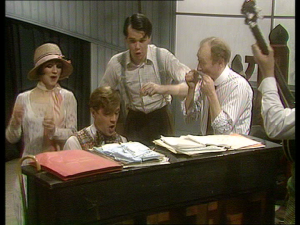
A “tuneful tonic of merriment and mirth”, <em>The Good Companions</em> is a nine-part Yorkshire Television serial about a touring concert party adapted from J. B. Priestley’s famous 1929 novel.<sup id="rf1-2934"><a href="#fn1-2934" title="&lt;em&gt;The Good Companions&lt;/em&gt;, tx. ITV, 14 November 1980-16 January 1981. Now available on DVD from &lt;a href=&quot;http://www.networkdvd.net/product_info.php?products_id=1408&quot; target=&quot;_self&quot; rel=&quot;noopener&quot;&gt;Network DVD&lt;/a&gt;." rel="footnote">1</a></sup> It was adapted by Alan Plater, who described the serial as one of his happiest working experiences, but added that it was “interesting but flawed, and didn&#8217;t really catch on”.<sup id="rf2-2934"><a href="#fn2-2934" title="Alan Plater, &lt;em&gt;Doggin&#8217; Around&lt;/em&gt; (Northway, 2006), p. 99." rel="footnote">2</a></sup> That&#8217;s a fair assessment, but the serial is certainly more interesting than flawed. Like the two previous film adaptations, the serial risked being written off as undemanding, suffering in part because of the reputation of the source novel. Writing about the 1933 film version, Charles Barr observed that the novel “never had much currency in academic circles”, with supportive opinions outweighed by the impact of “the vinegary attacks on the book and the novelists by the two Leavises”.<sup id="rf3-2934"><a href="#fn3-2934" title="Charles Barr, ‘&lt;em&gt;The Good Companions&lt;/em&gt;’, in Brian McFarlane (editor), &lt;em&gt;The Cinema of Britain and Ireland&lt;/em&gt; (London: Wallflower Press, 2005), p. 31." rel="footnote">3</a></sup> Priestley himself argued that &#8220;[s]ome severe critics dislike&#8221; stories in the <em>picaresque</em> tradition of &#8220;huge wandering tales&#8221; as these are &#8220;too rambling and easy for them&#8221;.<sup id="rf4-2934"><a href="#fn4-2934" title="J.B. Priestley, in Priestley and O.B. Davis, &lt;em&gt;Four English Novels&lt;/em&gt; (Harcourt Brace, 1960), p. 262." rel="footnote">4</a></sup> However, the serial’s ability to parallel the book’s feel-good, episodic qualities is also one of its main strengths. With composer David Fanshawe setting Plater’s lyrics to a variety of song styles, and a lively ensemble cast relishing on-stage music hall scenes and off-stage full production numbers, this is a witty and unashamedly fun serial. The Network DVD release also comes with the 1980 tie-in documentary <em>On the Road</em>, in which Plater interviews Priestley, compares the serial with previous film versions and provides behind-the-scenes footage.<sup id="rf5-2934"><a href="#fn5-2934" title="According to production files relating to &lt;em&gt;On the Road&lt;/em&gt;, which are available in the Alan Plater archive in the &lt;a href=&quot;http://www.hullhistorycentre.org.uk/&quot;&gt;Hull History Centre&lt;/a&gt;, the documentary’s location visits happened in the last week of July 1979." rel="footnote">5</a></sup></p>

<hr class="footnotes"><ol class="footnotes" style="list-style-type:decimal"><li id="fn1-2934"><p ><em>The Good Companions</em>, tx. ITV, 14 November 1980-16 January 1981. Now available on DVD from <a href="http://www.networkdvd.net/product_info.php?products_id=1408" target="_self" rel="noopener">Network DVD</a>.&nbsp;<a href="#rf1-2934" class="backlink" title="Return to footnote 1.">&#8617;</a></p></li><li id="fn2-2934"><p >Alan Plater, <em>Doggin&#8217; Around</em> (Northway, 2006), p. 99.&nbsp;<a href="#rf2-2934" class="backlink" title="Return to footnote 2.">&#8617;</a></p></li><li id="fn3-2934"><p >Charles Barr, ‘<em>The Good Companions</em>’, in Brian McFarlane (editor), <em>The Cinema of Britain and Ireland</em> (London: Wallflower Press, 2005), p. 31.&nbsp;<a href="#rf3-2934" class="backlink" title="Return to footnote 3.">&#8617;</a></p></li><li id="fn4-2934"><p >J.B. Priestley, in Priestley and O.B. Davis, <em>Four English Novels</em> (Harcourt Brace, 1960), p. 262.&nbsp;<a href="#rf4-2934" class="backlink" title="Return to footnote 4.">&#8617;</a></p></li><li id="fn5-2934"><p >According to production files relating to <em>On the Road</em>, which are available in the Alan Plater archive in the <a href="http://www.hullhistorycentre.org.uk/">Hull History Centre</a>, the documentary’s location visits happened in the last week of July 1979.&nbsp;<a href="#rf5-2934" class="backlink" title="Return to footnote 5.">&#8617;</a></p></li></ol></hr>{"id":2934,"date":"2012-09-30T09:00:32","date_gmt":"2012-09-30T08:00:32","guid":{"rendered":"http:\/\/www.britishtelevisiondrama.org.uk\/?p=2934"},"modified":"2024-08-30T11:41:06","modified_gmt":"2024-08-30T10:41:06","slug":"the-good-companions-1980-81","status":"publish","type":"post","link":"http:\/\/www.britishtelevisiondrama.org.uk\/?p=2934","title":{"rendered":"<em>The Good Companions<\/em> (1980-81)"},"content":{"rendered":"<h4>by DAVID ROLINSON<\/h4>\n<p>Nine parts. <strong>Writer:<\/strong> Alan Plater; <strong>Adapted from (novel):<\/strong> J.B. Priestley; <strong>Music by:<\/strong> David Fanshawe; <strong>Producer:<\/strong> Leonard Lewis; <strong>Directors<\/strong>: Bill Hays, Leonard Lewis<\/p>\n<p><img loading=\"lazy\" decoding=\"async\" class=\"alignleft size-medium wp-image-2948\" title=\"BTVD_composing\" src=\"http:\/\/www.britishtelevisiondrama.org.uk\/wp-content\/uploads\/2012\/09\/BTVD_composing1-300x225.png\" alt=\"\" width=\"300\" height=\"225\" srcset=\"http:\/\/www.britishtelevisiondrama.org.uk\/wp-content\/uploads\/2012\/09\/BTVD_composing1-300x225.png 300w, http:\/\/www.britishtelevisiondrama.org.uk\/wp-content\/uploads\/2012\/09\/BTVD_composing1.png 768w\" sizes=\"auto, (max-width: 300px) 100vw, 300px\" \/><br \/>\nA \u201ctuneful tonic of merriment and mirth\u201d, <em>The Good Companions<\/em> is a nine-part Yorkshire Television serial about a touring concert party adapted from J. B. Priestley\u2019s famous 1929 novel.<sup id=\"rf1-2934\"><a href=\"#fn1-2934\" title=\"&lt;em&gt;The Good Companions&lt;\/em&gt;, tx. ITV, 14 November 1980-16 January 1981. Now available on DVD from &lt;a href=&quot;http:\/\/www.networkdvd.net\/product_info.php?products_id=1408&quot; target=&quot;_self&quot; rel=&quot;noopener&quot;&gt;Network DVD&lt;\/a&gt;.\" rel=\"footnote\">1<\/a><\/sup> It was adapted by Alan Plater, who described the serial as one of his happiest working experiences, but added that it was \u201cinteresting but flawed, and didn&#8217;t really catch on\u201d.<sup id=\"rf2-2934\"><a href=\"#fn2-2934\" title=\"Alan Plater, &lt;em&gt;Doggin&#8217; Around&lt;\/em&gt; (Northway, 2006), p. 99.\" rel=\"footnote\">2<\/a><\/sup> That&#8217;s a fair assessment, but the serial is certainly more interesting than flawed. Like the two previous film adaptations, the serial risked being written off as undemanding, suffering in part because of the reputation of the source novel. Writing about the 1933 film version, Charles Barr observed that the novel \u201cnever had much currency in academic circles\u201d, with supportive opinions outweighed by the impact of \u201cthe vinegary attacks on the book and the novelists by the two Leavises\u201d.<sup id=\"rf3-2934\"><a href=\"#fn3-2934\" title=\"Charles Barr, \u2018&lt;em&gt;The Good Companions&lt;\/em&gt;\u2019, in Brian McFarlane (editor), &lt;em&gt;The Cinema of Britain and Ireland&lt;\/em&gt; (London: Wallflower Press, 2005), p. 31.\" rel=\"footnote\">3<\/a><\/sup> Priestley himself argued that &#8220;[s]ome severe critics dislike&#8221; stories in the <em>picaresque<\/em> tradition of &#8220;huge wandering tales&#8221; as these are &#8220;too rambling and easy for them&#8221;.<sup id=\"rf4-2934\"><a href=\"#fn4-2934\" title=\"J.B. Priestley, in Priestley and O.B. Davis, &lt;em&gt;Four English Novels&lt;\/em&gt; (Harcourt Brace, 1960), p. 262.\" rel=\"footnote\">4<\/a><\/sup> However, the serial\u2019s ability to parallel the book\u2019s feel-good, episodic qualities is also one of its main strengths. With composer David Fanshawe setting Plater\u2019s lyrics to a variety of song styles, and a lively ensemble cast relishing on-stage music hall scenes and off-stage full production numbers, this is a witty and unashamedly fun serial. The Network DVD release also comes with the 1980 tie-in documentary <em>On the Road<\/em>, in which Plater interviews Priestley, compares the serial with previous film versions and provides behind-the-scenes footage.<sup id=\"rf5-2934\"><a href=\"#fn5-2934\" title=\"According to production files relating to &lt;em&gt;On the Road&lt;\/em&gt;, which are available in the Alan Plater archive in the &lt;a href=&quot;http:\/\/www.hullhistorycentre.org.uk\/&quot;&gt;Hull History Centre&lt;\/a&gt;, the documentary\u2019s location visits happened in the last week of July 1979.\" rel=\"footnote\">5<\/a><\/sup><\/p>\n<p><!--more--><\/p>\n<p><a href=\"http:\/\/www.britishtelevisiondrama.org.uk\/wp-content\/uploads\/2012\/09\/BTVD_GoodComp_heading.png\"><img loading=\"lazy\" decoding=\"async\" class=\"alignleft size-medium wp-image-2990\" title=\"BTVD_GoodComp_heading\" src=\"http:\/\/www.britishtelevisiondrama.org.uk\/wp-content\/uploads\/2012\/09\/BTVD_GoodComp_heading-300x225.png\" alt=\"\" width=\"300\" height=\"225\" srcset=\"http:\/\/www.britishtelevisiondrama.org.uk\/wp-content\/uploads\/2012\/09\/BTVD_GoodComp_heading-300x225.png 300w, http:\/\/www.britishtelevisiondrama.org.uk\/wp-content\/uploads\/2012\/09\/BTVD_GoodComp_heading.png 768w\" sizes=\"auto, (max-width: 300px) 100vw, 300px\" \/><\/a><\/p>\n<p>First shown on ITV between November 1980 and January 1981, <em>The Good Companions<\/em> was shot on video, in studio and on Outside Broadcast at locations including Scarborough, Llandudno, Bradford and the Cotswolds. Each episode moves the story along chronologically, but also jumps back in time to give the background of characters, who take turns dominating episodes. Throughout the serial, Leslie Sands\u2019 voice-over gives the flavour of Priestley\u2019s prose, interceding now and again with thoughts on life, time and storytelling (\u201ccoincidence is a potent influence on the affairs of mankind\u201d) or telling us that we\u2019ll return to an event or character later. (Although the serial lacks the 1933 version\u2019s device of primary characters replying to the narrator upon their introduction, there are other integrative devices including on-screen captions as types of chapter heading.) In the first episode, Jess meets Miss Trant, and both meet the troubled Dinky Doos, whom Miss Trant will of course save. But then we flashback to how Jess got here, losing his job and running away from Bruddersford \u2013 that \u201camalgam of Huddersfield and Priestley\u2019s own city of Bradford\u201d<sup id=\"rf6-2934\"><a href=\"#fn6-2934\" title=\"Barr, p. 32.\" rel=\"footnote\">6<\/a><\/sup> \u2013 in misadventures which include guest turns by Alfred Lynch (who returns later) and John Savident. The troupe isn\u2019t cemented until the third episode (when the Dinky Doos and newcomers become the Good Companions), and this might explain why the first episode is the most difficult to engage with. However, there is an immediate sense of where the troupe are heading \u2013 the rehearsal script notes that the titles are \u201cin effect a quotation from a later episode [\u2026] when the Good Companions have their greatest triumph\u201d \u2013 also, that \u201cThe song is jolly, boisterous and maybe a little silly but who cares?\u201d<sup id=\"rf7-2934\"><a href=\"#fn7-2934\" title=\"Episode one rehearsal script, accessed in the Alan Plater archive in the &lt;a href=&quot;http:\/\/www.hullhistorycentre.org.uk\/&quot;&gt;Hull History Centre&lt;\/a&gt;. Rehearsals were scheduled for the Oval Rehearsal Rooms on Brixton Road in London and, the script notes, \u201cLeeds TBA\u201d.\" rel=\"footnote\">7<\/a><\/sup><br \/>\n<iframe loading=\"lazy\"  id=\"_ytid_78388\"  width=\"584\" height=\"329\"  data-origwidth=\"584\" data-origheight=\"329\" src=\"https:\/\/www.youtube.com\/embed\/R5dy2rjaCEE?enablejsapi=1&#038;autoplay=0&#038;cc_load_policy=0&#038;cc_lang_pref=&#038;iv_load_policy=1&#038;loop=0&#038;rel=1&#038;fs=1&#038;playsinline=0&#038;autohide=2&#038;theme=dark&#038;color=red&#038;controls=1&#038;disablekb=0&#038;\" class=\"__youtube_prefs__  epyt-is-override  no-lazyload\" title=\"YouTube player\"  allow=\"fullscreen; accelerometer; autoplay; clipboard-write; encrypted-media; gyroscope; picture-in-picture; web-share\" referrerpolicy=\"strict-origin-when-cross-origin\" allowfullscreen data-no-lazy=\"1\" data-skipgform_ajax_framebjll=\"\"><\/iframe><br \/>\n<a href=\"http:\/\/www.britishtelevisiondrama.org.uk\/wp-content\/uploads\/2012\/09\/BTVD_GoodComp_group01.png\"><img loading=\"lazy\" decoding=\"async\" class=\"alignleft size-medium wp-image-2955\" title=\"BTVD_GoodComp_group01\" src=\"http:\/\/www.britishtelevisiondrama.org.uk\/wp-content\/uploads\/2012\/09\/BTVD_GoodComp_group01-300x225.png\" alt=\"\" width=\"300\" height=\"225\" srcset=\"http:\/\/www.britishtelevisiondrama.org.uk\/wp-content\/uploads\/2012\/09\/BTVD_GoodComp_group01-300x225.png 300w, http:\/\/www.britishtelevisiondrama.org.uk\/wp-content\/uploads\/2012\/09\/BTVD_GoodComp_group01.png 768w\" sizes=\"auto, (max-width: 300px) 100vw, 300px\" \/><\/a>It is therefore unsurprising that situation, tone and pace are more engaging in subsequent episodes as the troupe gets together. Characters get variations on the theme \u2018On the Road\u2019 as we are given more backstory: the search for independence by Miss Trant in the second episode (guest starring Nigel Hawthorne), and Inigo Jollifant (a winning Jeremy Nicholas) rejecting the prune-plagued tyranny of teaching at a minor public school in the third episode (guest starring Nigel Stock). He also meets \u201cfour-times-round-the-world\u201d Morton Mitcham, played by Bryan Pringle with such endearing fruitiness that the DVD release might just count towards your 5-a-day. Judy Cornwell is fabulous throughout, communicating Miss Trant\u2019s naive enthusiasm with lip-biting sparkle &#8211; as Peter Fiddick wrote in <em>The Guardian<\/em>, &#8220;She never steps outside the character for a second, yet fills it with fun, song, dance, timidity, steel, and a certain longing&#8221;<sup id=\"rf8-2934\"><a href=\"#fn8-2934\" title=\"Peter Fiddick, &#8216;North stars: Peter Fiddick revels in the warmth of &lt;em&gt;The Good Companions&lt;\/em&gt;&#8216;, &lt;em&gt;The Guardian&lt;\/em&gt;, 3 January 1981, p. 11.\" rel=\"footnote\">8<\/a><\/sup> &#8211; while Jan Francis is an energetic and engaging Susie Dean. There are many individuals worthy of praise \u2013 John Stratton brings pathos to Jess Oakroyd, a part that could easily descend into stereotype \u2013 but one of the serial\u2019s joys is the way the ensemble sparks off each other. As Fiddick argued, the serial is &#8220;full to the brim with the sort of character acting (and being just slightly aware of the techniques at work is half the fun) that gives British television much of its richness.&#8221;<sup id=\"rf9-2934\"><a href=\"#fn9-2934\" title=\"Fiddick, &#8216;North stars&#8217;.\" rel=\"footnote\">9<\/a><\/sup><\/p>\n<p>If there <em>is <\/em>any lack of cohesion in the early moments \u2013 or more likely a desire to get on with the troupe\u2019s story \u2013 then that is appropriate to the material. As Charles Barr argued, Jess, Susie and Inigo \u201chave escaped from a parody of community\u201d and will find \u201c[m]ore genuine versions of community and companionship\u201d with the Good Companions.<sup id=\"rf10-2934\"><a href=\"#fn10-2934\" title=\"Barr, p. 34.\" rel=\"footnote\">10<\/a><\/sup> Indeed, this \u201crepresents a typical Priestley structure\u201d according to Barr, a structure that he finds also in Priestley\u2019s <em>Benighted<\/em> (1927, filmed as <em>The Old Dark House<\/em> (1932)) and explained by Priestley himself on-camera in the Ealing film version of <em>They Came to a City<\/em>: \u201cLet\u2019s suppose we took a cross-section of our people\u2026 let\u2019s imagine these people suddenly find themselves out of their ordinary surroundings\u201d. In this way, characters are, in Barr\u2019s description, transferred, \u201cto their bewilderment, from their everyday lives into a new space where they are forced to interact, in a sort of workshop for constructing a good society\u201d.<sup id=\"rf11-2934\"><a href=\"#fn11-2934\" title=\"Ibid, p. 35.\" rel=\"footnote\">11<\/a><\/sup> It is therefore perhaps appropriate to share a sense of frustration or disconnectedness in the serial\u2019s opening sections.<\/p>\n<p>&nbsp;<\/p>\n<p><a href=\"http:\/\/www.britishtelevisiondrama.org.uk\/wp-content\/uploads\/2012\/09\/BTVD_change03.png\"><img loading=\"lazy\" decoding=\"async\" class=\"alignleft size-medium wp-image-2946\" title=\"BTVD_change03\" src=\"http:\/\/www.britishtelevisiondrama.org.uk\/wp-content\/uploads\/2012\/09\/BTVD_change03-300x225.png\" alt=\"\" width=\"300\" height=\"225\" srcset=\"http:\/\/www.britishtelevisiondrama.org.uk\/wp-content\/uploads\/2012\/09\/BTVD_change03-300x225.png 300w, http:\/\/www.britishtelevisiondrama.org.uk\/wp-content\/uploads\/2012\/09\/BTVD_change03.png 768w\" sizes=\"auto, (max-width: 300px) 100vw, 300px\" \/><\/a>A more prosaic reason for the sense of the serial starting slowly is that episodes two and three bring welcome variations in light and shade, from the startling expressionism of Static Three\u2019s avant-garde manifesto, to the flesh-consumed-in-fire Second Resurrectionists. But things really get going in the fourth episode, with rehearsals, the adorable designer Miss Thong and the troupe\u2019s riot at Sandybay, while Miss Trant faces her family\u2019s disapproval, which prompts her to lead a massive song-and-dance number on the pier. The fifth episode takes us back to see the composition of their songs, turns a mundane train journey into a jolly production number (\u2018Change at Hicklefield\u2019) and sets up a key love story (of sorts). A sentimental character is described as having a \u201cmind like a cheap Christmas card\u201d, but in case you\u2019re unfairly thinking that about the serial itself, the last four episodes hit top gear. Episode six is particularly strong, with light, shade and tension. Jess confronts his past, and the troupe endures a terrible run playing deteriorating shows (\u201cI\u2019ve had more fun watching a hen sit\u201d) to tiny audiences (\u201cMr and Mrs Crabtree\u201d), in a depression-marked small town, as tensions undermine their friendliness and loyalty. Episode seven sees the \u201ctatty\u201d troupe under threat from Bill Dean\u2019s jealous cinema owner, marriage, ambition and veiled warnings. Episode eight has guest roles for Roy Kinnear and Barry Jackson, and features an apocalyptic performance and a memorable punch-up (\u201ccaught up in the bewildering mechanisms of life\u201d). Episode nine (guest starring Harold Innocent) wraps up individual stories, culminating in a long epilogue in which every regular sings a variation on \u2018My Dream of Life\u2019, and the deliberately artificial renderings of these and a woozy effects-laden curtain call (indeed a dream of life) take us closer to <em>Pennies from Heaven<\/em> than <em>Glee<\/em>. Priestley himself gets to read the final lines. It did take me a while to get into the serial on first watch, and perfection is not to be found \u2013 situation and tone don\u2019t immediately gel and the class types are inevitably broad \u2013 but I was sad to get to the end: as always, Alan Plater writes characters with such warmth and nuance that you enjoy spending time with them.<\/p>\n<p>The joy of the serial and of Priestley\u2019s original (as in Charles Dickens\u2019s <em>The Pickwick Papers<\/em>, which inevitably springs to mind at times), is in the characters we meet, and in seemingly incidental details and prose. As Barr indicated earlier, critics expected more weight from the novel \u2013 Richard Church once wrote that Priestley lacked the social and economic analysis of Thomas Holcroft\u2019s <em>Alwyn<\/em>, which had the same basic idea in 1870 \u2013 and Plater\u2019s apparent lightness often conceals more steel.<sup id=\"rf12-2934\"><a href=\"#fn12-2934\" title=\"Richard Church, &lt;em&gt;The Growth of the English Novel&lt;\/em&gt; (Methuen, 1961), p. 101.\" rel=\"footnote\">12<\/a><\/sup> But lightness and warmth are often underestimated by critics: reviewing Priestley&#8217;s <em>Instead of the Trees<\/em> in 1977, Anthony Burgess wrote that Priestley&#8217;s &#8220;critics have not taken him seriously enough. Let them make this book a pretext for a revaluation which avoids [&#8230;] condescension&#8221;. Disagreeing with Priestley&#8217;s own opinion that he had written far too much, Burgess stated that he had &#8220;hardly written a word too many&#8221; and that his &#8220;<em>oeuvre<\/em> coheres into a unity marked by a strong and inimitable personality.&#8221;<sup id=\"rf13-2934\"><a href=\"#fn13-2934\" title=\"Anthony Burgess, &lt;em&gt;Observer&lt;\/em&gt;, 20 March 1977.\" rel=\"footnote\">13<\/a><\/sup> If <em>The Good Companions<\/em> feels escapist, then that is hardly surprising: Priestley had endured a decade of personal tragedy, and as he says in <em>On the Road<\/em>, he had a \u201cfeeling of something coming loose\u201d when writing the book.<sup id=\"rf14-2934\"><a href=\"#fn14-2934\" title=\"&lt;em&gt;On the Road&lt;\/em&gt;, Yorkshire TV, 1980. Director: Mervyn Cumming. Producer: Leonard Lewis. Executive Producer: David Cunliffe.\" rel=\"footnote\">14<\/a><\/sup> Published in 1929 in a wall-bracket-troubling 250,000 words, the book was a huge seller, propelling Priestley to the high profile he\u2019d keep for life.\u00a0The reviewer who thought it would be \u201cforgotten in six months\u201d is currently 83 years out and counting.<sup id=\"rf15-2934\"><a href=\"#fn15-2934\" title=\"Review quoted in Susan Cooper, &#8216;That\u2019s J.B. Priestley for you\u2019 A 75&lt;sup&gt;th&lt;\/sup&gt; birthday portrait by Susan Cooper. Cutting in Plater archive.\" rel=\"footnote\">15<\/a><\/sup>\u00a0As Keith Waterhouse wrote in 1973, critics have \u201calways been wary of Priestley\u201d, who for Waterhouse was \u201cthe last of a great line of authors who knew how to teach their readers\u201d, like Wells, Chesterton and Bennett. Writers now \u201cdon\u2019t even try to reach the ordinary man. They write about problems of identity for people who can afford to worry about such matters\u201d.<sup id=\"rf16-2934\"><a href=\"#fn16-2934\" title=\"Keith Waterhouse, \u2018Waterhouse on Monday: The good companion\u2019, &lt;em&gt;Daily Mirror&lt;\/em&gt;, 10 September 1973.\" rel=\"footnote\">16<\/a><\/sup> Waterhouse\u2019s thoughts are in keeping with Priestley\u2019s opinion that critics, \u201cthe Eng. Lit. boys\u201d, based their standards on \u201cthe highbrow-lowbrow structure that intellectuals erected as a defence when they saw the mass media beginning to spread\u201d.<sup id=\"rf17-2934\"><a href=\"#fn17-2934\" title=\"Priestley, in Cooper.\" rel=\"footnote\">17<\/a><\/sup><\/p>\n<p>Those last few quotations come from Alan Plater\u2019s own research files on Priestley, which are available in the Alan Plater archive in the <a href=\"http:\/\/www.hullhistorycentre.org.uk\/\">Hull History Centre<\/a>. Like the adaptation, those quotations are interesting for the further reason that Plater too had a prodigious, varied and accessible body of work. I\u2019m not going to apply Priestley\u2019s point to television because so many television writers are neglected, whether writing in \u201cdifficult\u201d forms or the Plater\/Jack Rosenthal model of complexity treated with accessibility, warmth and humour. (The comparison would also be complicated by the fact that Priestley wrote for television. See, for instance, his <em>Armchair Theatre<\/em> piece \u2018Now Let Him Go\u2019 on Network DVD\u2019s <em>Armchair Theatre<\/em> Volume Three.) To borrow Waterhouse\u2019s words about Priestley, Plater \u201ccan make you look at old things in a new way, and what is perhaps more important, he can force you to look at new things in the old way.\u201d<sup id=\"rf18-2934\"><a href=\"#fn18-2934\" title=\"Waterhouse.\" rel=\"footnote\">18<\/a><\/sup> The DVD\u2019s release in 2011 was well-timed: Priestley\u2019s reputation has rightly moved on and <em>The Good Companions<\/em> had recently returned to the stage and to radio, in an adaptation by Eric Pringle, the previous year.<\/p>\n<p>&nbsp;<\/p>\n<p><a href=\"http:\/\/www.britishtelevisiondrama.org.uk\/wp-content\/uploads\/2012\/09\/BTVD_GoodComp_StaticThree01.png\"><img loading=\"lazy\" decoding=\"async\" class=\"alignleft size-medium wp-image-2953\" title=\"BTVD_GoodComp_StaticThree01\" src=\"http:\/\/www.britishtelevisiondrama.org.uk\/wp-content\/uploads\/2012\/09\/BTVD_GoodComp_StaticThree01-300x225.png\" alt=\"\" width=\"300\" height=\"225\" srcset=\"http:\/\/www.britishtelevisiondrama.org.uk\/wp-content\/uploads\/2012\/09\/BTVD_GoodComp_StaticThree01-300x225.png 300w, http:\/\/www.britishtelevisiondrama.org.uk\/wp-content\/uploads\/2012\/09\/BTVD_GoodComp_StaticThree01.png 768w\" sizes=\"auto, (max-width: 300px) 100vw, 300px\" \/><\/a>Plater worried whether \u201cwe all became intoxicated by our own cleverness\u201d, particularly his own lyrics, as he thought he\u2019d \u201cfallen in love with convoluted triple-rhyming schemes\u201d resulting in \u201cToo many words\u201d.<sup id=\"rf19-2934\"><a href=\"#fn19-2934\" title=\"Plater, &lt;em&gt;Doggin&#8217; Around&lt;\/em&gt;, p. 99.\" rel=\"footnote\">19<\/a><\/sup> He had a point about the wordy lyrics: in the published sheet music, David Fanshawe said that Plater\u2019s \u201cdeceptively simple lyrics have been a joy to set \u2013 or should I say a puzzle to get!\u201d<sup id=\"rf20-2934\"><a href=\"#fn20-2934\" title=\"David Fanshawe, introduction to &lt;em&gt;The Good Companions: Songs and Music from the Yorkshire Television Serial&lt;\/em&gt;. Copy accessed in the Alan Plater archive in the &lt;a href=&quot;http:\/\/www.hullhistorycentre.org.uk\/&quot;&gt;Hull History Centre&lt;\/a&gt;, with Plater\u2019s annotations of best wishes and an apology for a misprint. The file also has the original hand-written score of the title song. The archive contains other &lt;em&gt;Good Companions&lt;\/em&gt; material including scripts, stills, notes and a promotional scrapbook.\" rel=\"footnote\">20<\/a><\/sup>. However, they usually feel organic. Fanshawe relished the \u201copportunity to write featured songs, dances, choruses, duets, quartets, solos for banjo, piano to full orchestrations\u201d. Some of the actors \u201chad never sung in public before\u201d, and their \u201cvoices became the discipline of the music\u201d.<sup id=\"rf21-2934\"><a href=\"#fn21-2934\" title=\"Ibid. Fanshawe thanks Martin Goldstein for teaching the cast and dealing with last-minute changes.\" rel=\"footnote\">21<\/a><\/sup> This feels appropriate for the characters too. Similarly, the rehearsal script notes that the opening song contains \u201ca simple dance routine, geared to the ability of the least able dancers\u201d, a reference presumably to the characters but possibly also\u00a0applicable to the cast.<sup id=\"rf22-2934\"><a href=\"#fn22-2934\" title=\"Episode one rehearsal script, accessed in the Alan Plater archive in the &lt;a href=&quot;http:\/\/www.hullhistorycentre.org.uk\/&quot;&gt;Hull History Centre&lt;\/a&gt;.\" rel=\"footnote\">22<\/a><\/sup> Plater noted that the nearest they got to jazz was in the first episode, on \u2018The Original Bruddersford Dixieland Ragtime Band\u2019 (a song that Adler &#8220;really hated&#8221;), featuring trumpet by Kenny Baker.<sup id=\"rf23-2934\"><a href=\"#fn23-2934\" title=\"Ibid, p. 100.\" rel=\"footnote\">23<\/a><\/sup> True, the accompanying soundtrack album \u201cdidn\u2019t exactly sell in millions\u201d, to the \u201cchagrin\u201d of YTV; as Plater put it, \u201cParodies of early Benjamin Britten were never likely to make the charts\u201d.<sup id=\"rf24-2934\"><a href=\"#fn24-2934\" title=\"Ibid.\" rel=\"footnote\">24<\/a><\/sup><\/p>\n<p>Comparisons with earlier adaptations of Priestley\u2019s novel are useful to an extent. Helpfully, the documentary <em>On the Road<\/em> uses extracts to compare the handling of key scenes from this version with their handling in two previous film adaptations &#8211; for instance, visiting the 1933 film, Plater\u00a0seemed pleased to identify\u00a0(according to the production files)\u00a0&#8220;Key scenes that seem to run in parallel&#8221; with his serial.<sup id=\"rf25-2934\"><a href=\"#fn25-2934\" title=\"&lt;em&gt;On the Road&lt;\/em&gt; production files,\u00a0Alan Plater archive, Hull History Centre.\" rel=\"footnote\">25<\/a><\/sup>\u00a0Victor Saville\u2019s 1933 version, described by Brian McFarlane as \u201ca fine, unmannered adaptation\u201d,<sup id=\"rf26-2934\"><a href=\"#fn26-2934\" title=\"Brian McFarlane, &lt;em&gt;An Autobiography of British Cinema&lt;\/em&gt; (London: Methuen, 1997), p. 396.\" rel=\"footnote\">26<\/a><\/sup> starred John Gielgud and Jessie Matthews: the latter became a big star and said at the time that she had \u201cenjoyed making this more than any other film\u201d.<sup id=\"rf27-2934\"><a href=\"#fn27-2934\" title=\"Doris Mackie, \u2018Jessie Matthews talks about herself\u2019, &lt;em&gt;Film Weekly&lt;\/em&gt;, 19 May 1933, p. 12, quoted in Ibid.\" rel=\"footnote\">27<\/a><\/sup> Charles Barr felt the 1933 version \u201coverdue for rescuing for obscurity\u201d, and his choice if \u201cone had to nominate a single film to represent 1930s British cinema\u201d.<sup id=\"rf28-2934\"><a href=\"#fn28-2934\" title=\"Barr, pp. 31, 39.\" rel=\"footnote\">28<\/a><\/sup> As with many adaptations, there is as much interest in what each version reveals about its own time as there is in its fidelity to the source. Barr persuasively relates the 1933 film\u2019s sense of teamwork and its integration of people from different walks of life across the country into a form of community (discussed above) to the film\u2019s own teamwork, since personnel involved with the film would go on to be key players in the subsequent Second World War propaganda effort: Priestley of course, but also the Crown Film Unit (via Ian Dalrymple here) and Ealing (via Michael Balcon here) \u2013 the latter two groups making wartime propaganda featuring \u201ccelebrations of teamwork in action, of people coming together from diverse backgrounds to serve a common cause\u201d.<sup id=\"rf29-2934\"><a href=\"#fn29-2934\" title=\"Ibid, p. 31.\" rel=\"footnote\">29<\/a><\/sup><\/p>\n<p>As Steve Chibnall noted, the 1930s version happened when musicals were \u201ca familiar and popular part of British film culture\u201d, but by the time of the 1957 version (directed by J. Lee Thompson and featuring Celia Johnson and Eric Portman amongst its cast), musicals were a \u201crarity\u201d.<sup id=\"rf30-2934\"><a href=\"#fn30-2934\" title=\"Steve Chibnall, &lt;em&gt;J. Lee Thompson&lt;\/em&gt; (Manchester: Manchester University Press, 2000), p. 127.\" rel=\"footnote\">30<\/a><\/sup> Thompson had not been keen on making the film until his studio head reminded him that Thompson&#8217;s superb <em>Yield to the Night<\/em> (1956) had lost them money. For Chibnall, it was a \u201cmistake\u201d to try \u201cto spruce up J.B. Priestley&#8217;s tired old nag and turn it into a joy ride for teenagers\u201d in the period of <em>Rebel Without A Cause<\/em> (1955), <em>The Blackboard Jungle<\/em> (1955) and <em>Rock Around the Clock<\/em> (1956).<sup id=\"rf31-2934\"><a href=\"#fn31-2934\" title=\"Ibid, p. 129.\" rel=\"footnote\">31<\/a><\/sup> Although the film \u201ctells the story of two young people&#8217;s attempts to break out of a mundane and oppressive environment\u201d, this version&#8217;s title song \u2013 \u201cGood Companions, That&#8217;s What People Out to Be\u201d \u2013 &#8220;effaces all suggestion of a generation gap\u201d. Therefore, as Chibnall puts it, its \u201cvalues, like its style, remain more rocking-chair than rock and roll.\u201d<sup id=\"rf32-2934\"><a href=\"#fn32-2934\" title=\"Ibid, p. 130.\" rel=\"footnote\">32<\/a><\/sup> Like Chibnall, John Mundy notes the high production values, effective choreography, Technicolour and Cinemascope, but finds that \u201cthe film mixes its messages\u201d because of \u201ctrying to update the original concept and centring it on Susie Dean\u2019s (Janette Scott) attempts to escape from the outmoded variety circuit towards more contemporary stardom and affluence\u201d.<sup id=\"rf33-2934\"><a href=\"#fn33-2934\" title=\"John Mundy, &lt;em&gt;The British Musical Film&lt;\/em&gt; (Manchester: Manchester University Press, 2007), p. 171.\" rel=\"footnote\">33<\/a><\/sup> The <em>Evening Standard<\/em>&#8216;s reviewer argued in 1957 that Thompson \u201cput his players in a no-man&#8217;s-land\u201d by \u201cbringing the action up to date\u201d.<sup id=\"rf34-2934\"><a href=\"#fn34-2934\" title=\"Philip Oakes, &lt;em&gt;Evening Standard&lt;\/em&gt;, 7 March 1957, quoted in Chibnall, p. 131.\" rel=\"footnote\">34<\/a><\/sup> Chibnall stressed that Thompson was \u201ca great admirer of Priestley&#8217;s work\u201d, and so wanted \u201cto retain some of the romanticising of theatrical life, even the lives of mediocre performers in unglamorous venues\u201d, but this had to be somehow balanced with \u201cSusie&#8217;s desire to break away\u201d, and the attempt to bring the events into the then-present day whilst failing to engender \u201cdrama and pathos\u201d when confronted by, in Chibnall\u2019s view, \u201ca narrative which is hackneyed and characterisations which are half-hearted\u201d.<sup id=\"rf35-2934\"><a href=\"#fn35-2934\" title=\"Ibid, pp. 132-133.\" rel=\"footnote\">35<\/a><\/sup><\/p>\n<p>Clearly Plater&#8217;s version, which avoids attempting to bring the action up to date, should be vulnerable to these sorts of concerns at the end of the 1970s and start of the 1980s: for rock \u2018n\u2019 roll read post-punk, for the sense of looking back criticised by Chibnall see the political climate of the 1980s which fed, or fed from, cultural representations of nostalgia and heritage. However, just as this connection can sometimes be essentialised \u2013 critics are keen to stress the sometimes neglected critical qualities of <em>Chariots of Fire<\/em> (1981) \u2013 so the timing of <em>The Good Companions<\/em> is less anachronistic than it may appear. (This is even without attempting a political reading of the story\u2019s interest in amateurs\/communities coming up against profiteers, a time-specific reading which would need a lot of work to avoid glibness, given the \u2018noise\u2019 at work in the presence of layers of the book and previous versions.) Hollywood musicals in the period also show a play of nostalgia in films such as <em>New York, New York<\/em> (1977) and <em>Grease<\/em> (1978), although here the past becomes a genre and nostalgia an imagined or constructed state, as musicals were a problematic frontline in Hollywood\u2019s engagement with cinema\u2019s changing demographics (but then, 1970s Hollywood was full of reference to, and unpicking of, classical genres in a way that might itself seem to be as backward-looking as the features that Chibnall and other critics found in the 1950s <em>Good Companions<\/em>). Of more relevance to us (my polite way of saying that I don&#8217;t know much about the study of film musicals) is the fact that <em>The Good Companions<\/em> comes at the end of a cycle of television musicals, from Howard Schuman\u2019s <em>Rock Follies<\/em><sup id=\"rf36-2934\"><a href=\"#fn36-2934\" title=\"&lt;em&gt;Rock Follies&lt;\/em&gt; \/ &lt;em&gt;Rock Follies of 77&lt;\/em&gt;, tx. ITV, 24 February 1976-8 June 1977.\" rel=\"footnote\">36<\/a><\/sup> to Dennis Potter\u2019s <em>Pennies from Heaven<\/em>.<sup id=\"rf37-2934\"><a href=\"#fn37-2934\" title=\"&lt;em&gt;Pennies from Heaven&lt;\/em&gt;, tx. BBC1, 7 March 1978-11 April 1978.\" rel=\"footnote\">37<\/a><\/sup> Those pieces are clearly less conventional and comparisons are fraught with enough complications to put me off, but there are connections: Bill Hays, one of the directors of <em>The Good Companions<\/em>, was one of the directors of the Schuman serial.<sup id=\"rf38-2934\"><a href=\"#fn38-2934\" title=\"The other directors credited on the Schuman serial were Jon Scoffield and Brian Farnham.\" rel=\"footnote\">38<\/a><\/sup> Like producer and fellow director Leonard Lewis, Hays had worked with Plater on previous dramas, including the superb <em>Softly Softly<\/em> episode \u2018Going Quietly\u2019 and the one-off <em>Party of the First Part<\/em>, which shared actors with <em>The Good Companions<\/em> including Jan Francis. (Indeed, familiar faces abound: Bryan Pringle, for instance, was a veteran of <em>Close the Coalhouse Door<\/em>.) In <a href=\"http:\/\/www.britishtelevisiondrama.org.uk\/wp-admin\/\u201chttp:\/www.guardian.co.uk\/news\/2006\/mar\/14\/guardianobituaries.media\u201d\">his obituary for Hays in 2006<\/a> , Plater described this former miner\u2019s son as a \u201crenaissance man\u201d and \u201cone of the brightest, most versatile and certainly most cavalier\u201d of that generation, and the OB-unit-doing-MGM ambition of this serial is some achievement.<\/p>\n<p><a href=\"http:\/\/www.britishtelevisiondrama.org.uk\/wp-content\/uploads\/2012\/09\/BTVD_GoodComp_Ontheroad_Priestleylocation.png\"><img loading=\"lazy\" decoding=\"async\" class=\"alignleft size-medium wp-image-2952\" title=\"BTVD_GoodComp_Ontheroad_Priestleylocation\" src=\"http:\/\/www.britishtelevisiondrama.org.uk\/wp-content\/uploads\/2012\/09\/BTVD_GoodComp_Ontheroad_Priestleylocation-300x225.png\" alt=\"\" width=\"300\" height=\"225\" srcset=\"http:\/\/www.britishtelevisiondrama.org.uk\/wp-content\/uploads\/2012\/09\/BTVD_GoodComp_Ontheroad_Priestleylocation-300x225.png 300w, http:\/\/www.britishtelevisiondrama.org.uk\/wp-content\/uploads\/2012\/09\/BTVD_GoodComp_Ontheroad_Priestleylocation.png 768w\" sizes=\"auto, (max-width: 300px) 100vw, 300px\" \/><\/a><br \/>\nThe <em>On the Road<\/em> documentary is therefore more than entitled to draw comparisons\u00a0between (or, in its more fitting language, take &#8220;an affectionate look back at&#8221;) different screen versions of <em>The Good Companions<\/em>, and its engagement with the strengths and dangers of adapting Priestley\u2019s novel adds to the sense of this as a thoughtful accompaniment to the serial. In fact, the production files for <em>On the Road<\/em> show that the documentary\u2019s concept and structure were Plater\u2019s, and although he said he wanted to avoid \u201cthe full Bragg bit\u201d, he appears on-screen interviewing Priestley.<sup id=\"rf39-2934\"><a href=\"#fn39-2934\" title=\"&lt;em&gt;On the Road&lt;\/em&gt; production files, accessed in the Alan Plater archive in the &lt;a href=&quot;http:\/\/www.hullhistorycentre.org.uk\/&quot;&gt;Hull History Centre&lt;\/a&gt;.\" rel=\"footnote\">39<\/a><\/sup> Priestley also visits the cast on location, which was again Plater\u2019s idea. Unlike the serial, the documentary (directed by Mervyn Cumming) is made on film. The documentary is a welcome and impressive addition to the DVD set, though the picture quality is variable, because it\u2019s from an off-air video recording (the only copy ITV have in their archive). The serial itself has no such problems, and the ad caps are present and correct, which matters particularly when the episode\u2019s music runs into them.<\/p>\n<p>Of course, the use of music can be seen in another context: the body of work of Alan Plater. As Peter Fiddick argued, &#8220;for all the literary paternity and nostalgia&#8221; in the serial, it was &#8220;very much a thing of its own&#8221;, which he mentioned alongside, despite its &#8220;very different voice&#8221;, Plater&#8217;s <em>Trinity Tales<\/em>.<sup id=\"rf40-2934\"><a href=\"#fn40-2934\" title=\"Fiddick, &#8216;North stars&#8217;.\" rel=\"footnote\">40<\/a><\/sup> Plater often uses music to investigate situation and character, from jazz as metaphor in <em>Misterioso<\/em> (1991) and expression in the <em>Beiderbecke<\/em> series, to the Watersons&#8217; folk music in <em>Land of Green Ginger<\/em>, which as Plater argued, &#8220;not only reflected the action, it helped to generate and inspire the action&#8221;. Plater contrasted this with the way that &#8220;most music in film and television tends to be called [accurately]&#8230; &#8216;incidental&#8217;. It underlines the moments &#8211; scary bits, sad bits, look-behind-you bits. It tells the watchers what they should be thinking and [&#8230;] feeling [&#8230;] on the assumption that they&#8217;re too stupid to work it out for themselves.&#8221;<sup id=\"rf41-2934\"><a href=\"#fn41-2934\" title=\"Plater, &lt;em&gt;Doggin&#8217; Around&lt;\/em&gt;, pp. 82-83.\" rel=\"footnote\">41<\/a><\/sup> As I&#8217;ve argued of <em>Land of Green Ginger<\/em>, the use of music in the movement between particular scenes works in a politicised space, connecting region, history and community: though a very different type of production from <em>The Good Companions<\/em>, it was described by Nancy Banks-Smith as &#8220;not so much a play, more a local musical: plaiting script, songs and scenery in about equal amounts&#8221;.<sup id=\"rf42-2934\"><a href=\"#fn42-2934\" title=\"Nancy Banks-Smith, &#8216;Green Ginger&#8217;, &lt;em&gt;The Guardian&lt;\/em&gt;, 16 January 1973. Elements of this paragraph are reworked from Dave Rolinson, &#8216;The Surprise of a Large Town: Depicting Regional Space in Alan Plater&#8217;s &lt;em&gt;Land of Green Ginger&lt;\/em&gt;, &lt;em&gt;Journal of British Cinema and Television&lt;\/em&gt;, Volume 4, Number 2, 2007, p. 298.&lt;\/a&gt;\" rel=\"footnote\">42<\/a><\/sup> <em>On the Road<\/em> also gives another insight into the combination of lyricism and naturalism in Plater&#8217;s work &#8211; making him a &#8220;gritty Northern surrealist&#8221;, a phrase he reminded me of in interview<sup id=\"rf43-2934\"><a href=\"#fn43-2934\" title=\"For this quote, and more information about &lt;em&gt;Land of Green Ginger&lt;\/em&gt;, &lt;a href=&quot;http:\/\/www.britishtelevisiondrama.org.uk\/?p=921&quot; target=&quot;_self&quot; rel=&quot;noopener&quot;&gt;see my interview with Alan Plater about this play. &lt;\/a&gt;\" rel=\"footnote\">43<\/a><\/sup> &#8211; as he questions Priestley on the novel&#8217;s &#8220;stumbling chronicles of a dream of life&#8221;, reality and fairytale. Priestley&#8217;s reply: \u201ca man may offer you the real world and not try and move out of it, and yet the same time his mind may work in such a way that the real world becomes also a fairytale world. Dickens is a very good example of that&#8221;.<sup id=\"rf44-2934\"><a href=\"#fn44-2934\" title=\"&lt;em&gt;On the Road&lt;\/em&gt;.\" rel=\"footnote\">44<\/a><\/sup><\/p>\n<p><img loading=\"lazy\" decoding=\"async\" src=\"http:\/\/www.britishtelevisiondrama.org.uk\/wp-content\/uploads\/2015\/11\/BTVD_Good-Companions_Did-You-See-e1447624504883.png\" alt=\"BTVD_Good Companions_Did You See\" width=\"250\" height=\"201\" class=\"alignleft size-full wp-image-5651\" \/><br \/>\nAlthough Plater acknowledged the serial&#8217;s failings, he fought back against its harshest critics. The first episode was savaged on the review programme <em>Did You See\u2026?<\/em> by panellists Michael Hastings, Larry Adler and Christopher Hitchens.<sup id=\"rf45-2934\"><a href=\"#fn45-2934\" title=\"&lt;em&gt;Did You See&#8230;?&lt;\/em&gt;, tx. BBC2, 29 November 1980. This is not available on the DVD.\" rel=\"footnote\">45<\/a><\/sup> Playwright Hastings, for whom all of Priestley&#8217;s dramatisations were &#8220;eminently resistible&#8221; with their &#8220;curiously sentimental&#8221; and &#8220;nostalgic&#8221; content, thought that &#8220;the director has sat back and gone to sleep&#8221;. Furthermore, he thought that there was &#8220;a quality which is unconscious in the writing and in the dramatisation which seems to put the blame on the women&#8221;. Hitchens found it &#8220;very tough to watch&#8221;, thought that &#8220;Yorkshire sentimentality is to sentimentality what Yorkshire pudding is to pudding&#8221; and described Priestley as &#8220;one of the great bores of the century&#8221;. Adler argued in the third person that &#8220;it was the BBC&#8217;s revenge against Larry Adler [&#8230;] to make me sit through it. I thought it was awful&#8221;. As a musician, he thought the songs &#8220;corny, dreadful numbers&#8221;. Although Hitchens thought that Nigel Stock was &#8220;the only actor of any merit in the thing&#8221;, Hastings and presenter Ludovic Kennedy advanced the case for Bryan Pringle, though his lack of skill with a banjo annoyed Adler. In response, Plater sent them &#8220;exceedingly angry&#8221; letters,<sup id=\"rf46-2934\"><a href=\"#fn46-2934\" title=\"Plater, &lt;em&gt;Doggin&#8217; Around&lt;\/em&gt;, p. 99.\" rel=\"footnote\">46<\/a><\/sup> though noted that he and Adler became &#8220;lifelong friends&#8221; as a result of their correspondence.<sup id=\"rf47-2934\"><a href=\"#fn47-2934\" title=\"Ibid., p. 100.\" rel=\"footnote\">47<\/a><\/sup><\/p>\n<p><a href=\"http:\/\/www.britishtelevisiondrama.org.uk\/wp-content\/uploads\/2012\/09\/BTVD_GoodComp_Ontheroad_intro.png\"><img loading=\"lazy\" decoding=\"async\" class=\"alignleft size-medium wp-image-2954\" title=\"BTVD_GoodComp_Ontheroad_intro\" src=\"http:\/\/www.britishtelevisiondrama.org.uk\/wp-content\/uploads\/2012\/09\/BTVD_GoodComp_Ontheroad_intro-300x225.png\" alt=\"\" width=\"300\" height=\"225\" srcset=\"http:\/\/www.britishtelevisiondrama.org.uk\/wp-content\/uploads\/2012\/09\/BTVD_GoodComp_Ontheroad_intro-300x225.png 300w, http:\/\/www.britishtelevisiondrama.org.uk\/wp-content\/uploads\/2012\/09\/BTVD_GoodComp_Ontheroad_intro.png 768w\" sizes=\"auto, (max-width: 300px) 100vw, 300px\" \/><\/a><br \/>\nThis savage criticism was not universally shared. Later in the run, Peter Fiddick found it \u201cnot merely charming but skilfully crafted\u201d, benefiting from \u201ca characteristically economical Plater script, never using two words where a nod and a wink will do, and David Fanshawe\u2019s music, which for me hits just the right note of affectionate pastiche.\u201d<sup id=\"rf48-2934\"><a href=\"#fn48-2934\" title=\"Fiddick, &#8216;North stars&#8217;.\" rel=\"footnote\">48<\/a><\/sup> Overall, the serial is lots of fun, and it\u2019s obvious that it was a creative, enjoyable collaboration. Plater\u2019s archival holdings on the serial contain many treats, including Plater\u2019s lovely gift to colleagues, a hand-drawn <em>Good Companions<\/em> Colouring Book, inscribed as \u201cAn Alan Plater Thank You Production with Love\u201d.<sup id=\"rf49-2934\"><a href=\"#fn49-2934\" title=\"Alan Plater archive, Hull History Centre.\" rel=\"footnote\">49<\/a><\/sup> In <em>On the Road<\/em>, Plater tells Priestley that writing the adaptation gave him \u201cone of the most joyous years\u201d of his career.<sup id=\"rf50-2934\"><a href=\"#fn50-2934\" title=\"&lt;em&gt;On the Road&lt;\/em&gt;.\" rel=\"footnote\">50<\/a><\/sup> Therefore, it\u2019s surprising to see Plater in his memoirs asking: \u201cWhat went wrong?\u201d He wondered whether \u201cwe all had too good a time\u201d, that whilst work should be fun, the audience should have fun too, and \u201cWe sing the song but don\u2019t invite the audience to join in the chorus\u201d.<sup id=\"rf51-2934\"><a href=\"#fn51-2934\" title=\"Plater, &lt;em&gt;Doggin\u2019 Around&lt;\/em&gt;, p. 99.\" rel=\"footnote\">51<\/a><\/sup> It\u2019s interesting that <em>Pennies from Heaven<\/em>, for all its anti-naturalistic devices, feels more confident in playing its musical pastiches to the viewer rather than others in the scene. <\/p>\n<p>There is one final reason to cherish <em>The Good Companions<\/em>: without it, we might not have got the  <em>Beiderbecke<\/em> serials. Yorkshire TV\u2019s David Cunliffe, Executive Producer of the serial, thought that <em>The Good Companions<\/em> would last thirteen episodes, but Plater thought he could adapt it in nine, and to fill the other four weeks, proposed what became <em>Get Lost!<\/em>, the first <em>Beiderbecke<\/em> in all but name. As Plater put it in <em>Doggin\u2019 Around<\/em>, \u201cthey were innocent days\u201d.<sup id=\"rf52-2934\"><a href=\"#fn52-2934\" title=\"Plater, &lt;em&gt;Doggin&#8217; Around&lt;\/em&gt;, p. 100.\" rel=\"footnote\">52<\/a><\/sup> YTV let the Dormouse label do the <em>Beiderbecke<\/em> soundtrack album (which became a hit), probably because \u201cthey still had a warehouse stacked high with unsold LPs of The Good Companions music\u201d.<sup id=\"rf53-2934\"><a href=\"#fn53-2934\" title=\"Ibid, p. 112.\" rel=\"footnote\">53<\/a><\/sup> I hope the DVDs don\u2019t face the same fate, because you\u2019d be missing a treat.<\/p>\n<p><em>Originally posted: 30 September 2012<br \/>\n[This piece first appeared on the Tachyon TV website in September 2011. It is presented here with substantial revisions, including new material and endnotes.]<br \/>\nUpdates:<br \/>\n1 October 2012: corrected minor typos, added missing page numbers, added two endnotes and moved one image.<br \/>\n15 November 2015: added a new paragraph on Did You See (which included a sentence moved from the start of the essay and from an endnote). Added an image from Did You See. Broke up comments on the serial&#8217;s critical reception (moving most of this material to the paragraph following the paragraph on Did You See).<\/em><\/p>\n<p><body><!-- Start of StatCounter Code --><br \/>\n<script type=\"text\/javascript\">\nvar sc_project=5750652; \nvar sc_invisible=1; \nvar sc_partition=68; \nvar sc_click_stat=1; \nvar sc_security=\"6dd1aa39\"; \n<\/script><\/p>\n<p><script type=\"text\/javascript\"\nsrc=\"http:\/\/www.statcounter.com\/counter\/counter.js\"><\/script><noscript>\n<div<br \/>\nclass=&#8221;statcounter&#8221;><a title=\"wordpress stats \"<br \/>\nhref=&#8221;http:\/\/www.statcounter.com\/wordpress.org\/&#8221;<br \/>\ntarget=&#8221;_blank&#8221;><img class=\"statcounter\"<br \/>\nsrc=&#8221;http:\/\/c.statcounter.com\/5750652\/0\/6dd1aa39\/1\/&#8221;<br \/>\nalt=&#8221;wordpress stats &#8221; ><\/a><\/div>\n<p><\/noscript><br \/>\n<!-- End of StatCounter Code --><\/body><\/p>\n<hr class=\"footnotes\"><ol class=\"footnotes\" style=\"list-style-type:decimal\"><li id=\"fn1-2934\"><p ><em>The Good Companions<\/em>, tx. ITV, 14 November 1980-16 January 1981. Now available on DVD from <a href=\"http:\/\/www.networkdvd.net\/product_info.php?products_id=1408\" target=\"_self\" rel=\"noopener\">Network DVD<\/a>.&nbsp;<a href=\"#rf1-2934\" class=\"backlink\" title=\"Return to footnote 1.\">&#8617;<\/a><\/p><\/li><li id=\"fn2-2934\"><p >Alan Plater, <em>Doggin&#8217; Around<\/em> (Northway, 2006), p. 99.&nbsp;<a href=\"#rf2-2934\" class=\"backlink\" title=\"Return to footnote 2.\">&#8617;<\/a><\/p><\/li><li id=\"fn3-2934\"><p >Charles Barr, \u2018<em>The Good Companions<\/em>\u2019, in Brian McFarlane (editor), <em>The Cinema of Britain and Ireland<\/em> (London: Wallflower Press, 2005), p. 31.&nbsp;<a href=\"#rf3-2934\" class=\"backlink\" title=\"Return to footnote 3.\">&#8617;<\/a><\/p><\/li><li id=\"fn4-2934\"><p >J.B. Priestley, in Priestley and O.B. Davis, <em>Four English Novels<\/em> (Harcourt Brace, 1960), p. 262.&nbsp;<a href=\"#rf4-2934\" class=\"backlink\" title=\"Return to footnote 4.\">&#8617;<\/a><\/p><\/li><li id=\"fn5-2934\"><p >According to production files relating to <em>On the Road<\/em>, which are available in the Alan Plater archive in the <a href=\"http:\/\/www.hullhistorycentre.org.uk\/\">Hull History Centre<\/a>, the documentary\u2019s location visits happened in the last week of July 1979.&nbsp;<a href=\"#rf5-2934\" class=\"backlink\" title=\"Return to footnote 5.\">&#8617;<\/a><\/p><\/li><li id=\"fn6-2934\"><p >Barr, p. 32.&nbsp;<a href=\"#rf6-2934\" class=\"backlink\" title=\"Return to footnote 6.\">&#8617;<\/a><\/p><\/li><li id=\"fn7-2934\"><p >Episode one rehearsal script, accessed in the Alan Plater archive in the <a href=\"http:\/\/www.hullhistorycentre.org.uk\/\">Hull History Centre<\/a>. Rehearsals were scheduled for the Oval Rehearsal Rooms on Brixton Road in London and, the script notes, \u201cLeeds TBA\u201d.&nbsp;<a href=\"#rf7-2934\" class=\"backlink\" title=\"Return to footnote 7.\">&#8617;<\/a><\/p><\/li><li id=\"fn8-2934\"><p >Peter Fiddick, &#8216;North stars: Peter Fiddick revels in the warmth of <em>The Good Companions<\/em>&#8216;, <em>The Guardian<\/em>, 3 January 1981, p. 11.&nbsp;<a href=\"#rf8-2934\" class=\"backlink\" title=\"Return to footnote 8.\">&#8617;<\/a><\/p><\/li><li id=\"fn9-2934\"><p >Fiddick, &#8216;North stars&#8217;.&nbsp;<a href=\"#rf9-2934\" class=\"backlink\" title=\"Return to footnote 9.\">&#8617;<\/a><\/p><\/li><li id=\"fn10-2934\"><p >Barr, p. 34.&nbsp;<a href=\"#rf10-2934\" class=\"backlink\" title=\"Return to footnote 10.\">&#8617;<\/a><\/p><\/li><li id=\"fn11-2934\"><p >Ibid, p. 35.&nbsp;<a href=\"#rf11-2934\" class=\"backlink\" title=\"Return to footnote 11.\">&#8617;<\/a><\/p><\/li><li id=\"fn12-2934\"><p >Richard Church, <em>The Growth of the English Novel<\/em> (Methuen, 1961), p. 101.&nbsp;<a href=\"#rf12-2934\" class=\"backlink\" title=\"Return to footnote 12.\">&#8617;<\/a><\/p><\/li><li id=\"fn13-2934\"><p >Anthony Burgess, <em>Observer<\/em>, 20 March 1977.&nbsp;<a href=\"#rf13-2934\" class=\"backlink\" title=\"Return to footnote 13.\">&#8617;<\/a><\/p><\/li><li id=\"fn14-2934\"><p ><em>On the Road<\/em>, Yorkshire TV, 1980. Director: Mervyn Cumming. Producer: Leonard Lewis. Executive Producer: David Cunliffe.&nbsp;<a href=\"#rf14-2934\" class=\"backlink\" title=\"Return to footnote 14.\">&#8617;<\/a><\/p><\/li><li id=\"fn15-2934\"><p >Review quoted in Susan Cooper, &#8216;That\u2019s J.B. Priestley for you\u2019 A 75<sup>th<\/sup> birthday portrait by Susan Cooper. Cutting in Plater archive.&nbsp;<a href=\"#rf15-2934\" class=\"backlink\" title=\"Return to footnote 15.\">&#8617;<\/a><\/p><\/li><li id=\"fn16-2934\"><p >Keith Waterhouse, \u2018Waterhouse on Monday: The good companion\u2019, <em>Daily Mirror<\/em>, 10 September 1973.&nbsp;<a href=\"#rf16-2934\" class=\"backlink\" title=\"Return to footnote 16.\">&#8617;<\/a><\/p><\/li><li id=\"fn17-2934\"><p >Priestley, in Cooper.&nbsp;<a href=\"#rf17-2934\" class=\"backlink\" title=\"Return to footnote 17.\">&#8617;<\/a><\/p><\/li><li id=\"fn18-2934\"><p >Waterhouse.&nbsp;<a href=\"#rf18-2934\" class=\"backlink\" title=\"Return to footnote 18.\">&#8617;<\/a><\/p><\/li><li id=\"fn19-2934\"><p >Plater, <em>Doggin&#8217; Around<\/em>, p. 99.&nbsp;<a href=\"#rf19-2934\" class=\"backlink\" title=\"Return to footnote 19.\">&#8617;<\/a><\/p><\/li><li id=\"fn20-2934\"><p >David Fanshawe, introduction to <em>The Good Companions: Songs and Music from the Yorkshire Television Serial<\/em>. Copy accessed in the Alan Plater archive in the <a href=\"http:\/\/www.hullhistorycentre.org.uk\/\">Hull History Centre<\/a>, with Plater\u2019s annotations of best wishes and an apology for a misprint. The file also has the original hand-written score of the title song. The archive contains other <em>Good Companions<\/em> material including scripts, stills, notes and a promotional scrapbook.&nbsp;<a href=\"#rf20-2934\" class=\"backlink\" title=\"Return to footnote 20.\">&#8617;<\/a><\/p><\/li><li id=\"fn21-2934\"><p >Ibid. Fanshawe thanks Martin Goldstein for teaching the cast and dealing with last-minute changes.&nbsp;<a href=\"#rf21-2934\" class=\"backlink\" title=\"Return to footnote 21.\">&#8617;<\/a><\/p><\/li><li id=\"fn22-2934\"><p >Episode one rehearsal script, accessed in the Alan Plater archive in the <a href=\"http:\/\/www.hullhistorycentre.org.uk\/\">Hull History Centre<\/a>.&nbsp;<a href=\"#rf22-2934\" class=\"backlink\" title=\"Return to footnote 22.\">&#8617;<\/a><\/p><\/li><li id=\"fn23-2934\"><p >Ibid, p. 100.&nbsp;<a href=\"#rf23-2934\" class=\"backlink\" title=\"Return to footnote 23.\">&#8617;<\/a><\/p><\/li><li id=\"fn24-2934\"><p >Ibid.&nbsp;<a href=\"#rf24-2934\" class=\"backlink\" title=\"Return to footnote 24.\">&#8617;<\/a><\/p><\/li><li id=\"fn25-2934\"><p ><em>On the Road<\/em> production files,\u00a0Alan Plater archive, Hull History Centre.&nbsp;<a href=\"#rf25-2934\" class=\"backlink\" title=\"Return to footnote 25.\">&#8617;<\/a><\/p><\/li><li id=\"fn26-2934\"><p >Brian McFarlane, <em>An Autobiography of British Cinema<\/em> (London: Methuen, 1997), p. 396.&nbsp;<a href=\"#rf26-2934\" class=\"backlink\" title=\"Return to footnote 26.\">&#8617;<\/a><\/p><\/li><li id=\"fn27-2934\"><p >Doris Mackie, \u2018Jessie Matthews talks about herself\u2019, <em>Film Weekly<\/em>, 19 May 1933, p. 12, quoted in Ibid.&nbsp;<a href=\"#rf27-2934\" class=\"backlink\" title=\"Return to footnote 27.\">&#8617;<\/a><\/p><\/li><li id=\"fn28-2934\"><p >Barr, pp. 31, 39.&nbsp;<a href=\"#rf28-2934\" class=\"backlink\" title=\"Return to footnote 28.\">&#8617;<\/a><\/p><\/li><li id=\"fn29-2934\"><p >Ibid, p. 31.&nbsp;<a href=\"#rf29-2934\" class=\"backlink\" title=\"Return to footnote 29.\">&#8617;<\/a><\/p><\/li><li id=\"fn30-2934\"><p >Steve Chibnall, <em>J. Lee Thompson<\/em> (Manchester: Manchester University Press, 2000), p. 127.&nbsp;<a href=\"#rf30-2934\" class=\"backlink\" title=\"Return to footnote 30.\">&#8617;<\/a><\/p><\/li><li id=\"fn31-2934\"><p >Ibid, p. 129.&nbsp;<a href=\"#rf31-2934\" class=\"backlink\" title=\"Return to footnote 31.\">&#8617;<\/a><\/p><\/li><li id=\"fn32-2934\"><p >Ibid, p. 130.&nbsp;<a href=\"#rf32-2934\" class=\"backlink\" title=\"Return to footnote 32.\">&#8617;<\/a><\/p><\/li><li id=\"fn33-2934\"><p >John Mundy, <em>The British Musical Film<\/em> (Manchester: Manchester University Press, 2007), p. 171.&nbsp;<a href=\"#rf33-2934\" class=\"backlink\" title=\"Return to footnote 33.\">&#8617;<\/a><\/p><\/li><li id=\"fn34-2934\"><p >Philip Oakes, <em>Evening Standard<\/em>, 7 March 1957, quoted in Chibnall, p. 131.&nbsp;<a href=\"#rf34-2934\" class=\"backlink\" title=\"Return to footnote 34.\">&#8617;<\/a><\/p><\/li><li id=\"fn35-2934\"><p >Ibid, pp. 132-133.&nbsp;<a href=\"#rf35-2934\" class=\"backlink\" title=\"Return to footnote 35.\">&#8617;<\/a><\/p><\/li><li id=\"fn36-2934\"><p ><em>Rock Follies<\/em> \/ <em>Rock Follies of 77<\/em>, tx. ITV, 24 February 1976-8 June 1977.&nbsp;<a href=\"#rf36-2934\" class=\"backlink\" title=\"Return to footnote 36.\">&#8617;<\/a><\/p><\/li><li id=\"fn37-2934\"><p ><em>Pennies from Heaven<\/em>, tx. BBC1, 7 March 1978-11 April 1978.&nbsp;<a href=\"#rf37-2934\" class=\"backlink\" title=\"Return to footnote 37.\">&#8617;<\/a><\/p><\/li><li id=\"fn38-2934\"><p >The other directors credited on the Schuman serial were Jon Scoffield and Brian Farnham.&nbsp;<a href=\"#rf38-2934\" class=\"backlink\" title=\"Return to footnote 38.\">&#8617;<\/a><\/p><\/li><li id=\"fn39-2934\"><p ><em>On the Road<\/em> production files, accessed in the Alan Plater archive in the <a href=\"http:\/\/www.hullhistorycentre.org.uk\/\">Hull History Centre<\/a>.&nbsp;<a href=\"#rf39-2934\" class=\"backlink\" title=\"Return to footnote 39.\">&#8617;<\/a><\/p><\/li><li id=\"fn40-2934\"><p >Fiddick, &#8216;North stars&#8217;.&nbsp;<a href=\"#rf40-2934\" class=\"backlink\" title=\"Return to footnote 40.\">&#8617;<\/a><\/p><\/li><li id=\"fn41-2934\"><p >Plater, <em>Doggin&#8217; Around<\/em>, pp. 82-83.&nbsp;<a href=\"#rf41-2934\" class=\"backlink\" title=\"Return to footnote 41.\">&#8617;<\/a><\/p><\/li><li id=\"fn42-2934\"><p >Nancy Banks-Smith, &#8216;Green Ginger&#8217;, <em>The Guardian<\/em>, 16 January 1973. Elements of this paragraph are reworked from Dave Rolinson, &#8216;The Surprise of a Large Town: Depicting Regional Space in Alan Plater&#8217;s <em>Land of Green Ginger<\/em>, <em>Journal of British Cinema and Television<\/em>, Volume 4, Number 2, 2007, p. 298.<\/a>&nbsp;<a href=\"#rf42-2934\" class=\"backlink\" title=\"Return to footnote 42.\">&#8617;<\/a><\/p><\/li><li id=\"fn43-2934\"><p >For this quote, and more information about <em>Land of Green Ginger<\/em>, <a href=\"http:\/\/www.britishtelevisiondrama.org.uk\/?p=921\" target=\"_self\" rel=\"noopener\">see my interview with Alan Plater about this play. <\/a>&nbsp;<a href=\"#rf43-2934\" class=\"backlink\" title=\"Return to footnote 43.\">&#8617;<\/a><\/p><\/li><li id=\"fn44-2934\"><p ><em>On the Road<\/em>.&nbsp;<a href=\"#rf44-2934\" class=\"backlink\" title=\"Return to footnote 44.\">&#8617;<\/a><\/p><\/li><li id=\"fn45-2934\"><p ><em>Did You See&#8230;?<\/em>, tx. BBC2, 29 November 1980. This is not available on the DVD.&nbsp;<a href=\"#rf45-2934\" class=\"backlink\" title=\"Return to footnote 45.\">&#8617;<\/a><\/p><\/li><li id=\"fn46-2934\"><p >Plater, <em>Doggin&#8217; Around<\/em>, p. 99.&nbsp;<a href=\"#rf46-2934\" class=\"backlink\" title=\"Return to footnote 46.\">&#8617;<\/a><\/p><\/li><li id=\"fn47-2934\"><p >Ibid., p. 100.&nbsp;<a href=\"#rf47-2934\" class=\"backlink\" title=\"Return to footnote 47.\">&#8617;<\/a><\/p><\/li><li id=\"fn48-2934\"><p >Fiddick, &#8216;North stars&#8217;.&nbsp;<a href=\"#rf48-2934\" class=\"backlink\" title=\"Return to footnote 48.\">&#8617;<\/a><\/p><\/li><li id=\"fn49-2934\"><p >Alan Plater archive, Hull History Centre.&nbsp;<a href=\"#rf49-2934\" class=\"backlink\" title=\"Return to footnote 49.\">&#8617;<\/a><\/p><\/li><li id=\"fn50-2934\"><p ><em>On the Road<\/em>.&nbsp;<a href=\"#rf50-2934\" class=\"backlink\" title=\"Return to footnote 50.\">&#8617;<\/a><\/p><\/li><li id=\"fn51-2934\"><p >Plater, <em>Doggin\u2019 Around<\/em>, p. 99.&nbsp;<a href=\"#rf51-2934\" class=\"backlink\" title=\"Return to footnote 51.\">&#8617;<\/a><\/p><\/li><li id=\"fn52-2934\"><p >Plater, <em>Doggin&#8217; Around<\/em>, p. 100.&nbsp;<a href=\"#rf52-2934\" class=\"backlink\" title=\"Return to footnote 52.\">&#8617;<\/a><\/p><\/li><li id=\"fn53-2934\"><p >Ibid, p. 112.&nbsp;<a href=\"#rf53-2934\" class=\"backlink\" title=\"Return to footnote 53.\">&#8617;<\/p><\/li><\/p><\/ol><\/hr>","protected":false},"excerpt":{"rendered":null,"protected":false},"author":1,"featured_media":0,"comment_status":"open","ping_status":"open","sticky":false,"template":"","format":"standard","meta":{"footnotes":""},"categories":[140,306,137],"tags":[33,335,34,152,339,336,340,337,334,333,338],"class_list":["post-2934","post","type-post","status-publish","format-standard","hentry","category-david-rolinson","category-dvd-reviews","category-essays","tag-alan-plater","tag-bill-hays","tag-dennis-potter","tag-ealing","tag-get-lost","tag-howard-schuman","tag-jb-priestley","tag-leonard-lewis","tag-pennies-from-heaven","tag-rock-follies","tag-the-beiderbecke-affair"],"_links":{"self":[{"href":"http:\/\/www.britishtelevisiondrama.org.uk\/index.php?rest_route=\/wp\/v2\/posts\/2934","targetHints":{"allow":["GET"]}}],"collection":[{"href":"http:\/\/www.britishtelevisiondrama.org.uk\/index.php?rest_route=\/wp\/v2\/posts"}],"about":[{"href":"http:\/\/www.britishtelevisiondrama.org.uk\/index.php?rest_route=\/wp\/v2\/types\/post"}],"author":[{"embeddable":true,"href":"http:\/\/www.britishtelevisiondrama.org.uk\/index.php?rest_route=\/wp\/v2\/users\/1"}],"replies":[{"embeddable":true,"href":"http:\/\/www.britishtelevisiondrama.org.uk\/index.php?rest_route=%2Fwp%2Fv2%2Fcomments&post=2934"}],"version-history":[{"count":141,"href":"http:\/\/www.britishtelevisiondrama.org.uk\/index.php?rest_route=\/wp\/v2\/posts\/2934\/revisions"}],"predecessor-version":[{"id":8287,"href":"http:\/\/www.britishtelevisiondrama.org.uk\/index.php?rest_route=\/wp\/v2\/posts\/2934\/revisions\/8287"}],"wp:attachment":[{"href":"http:\/\/www.britishtelevisiondrama.org.uk\/index.php?rest_route=%2Fwp%2Fv2%2Fmedia&parent=2934"}],"wp:term":[{"taxonomy":"category","embeddable":true,"href":"http:\/\/www.britishtelevisiondrama.org.uk\/index.php?rest_route=%2Fwp%2Fv2%2Fcategories&post=2934"},{"taxonomy":"post_tag","embeddable":true,"href":"http:\/\/www.britishtelevisiondrama.org.uk\/index.php?rest_route=%2Fwp%2Fv2%2Ftags&post=2934"}],"curies":[{"name":"wp","href":"https:\/\/api.w.org\/{rel}","templated":true}]}}