<h4>by DAVID ROLINSON</h4>
<p><em>Play for Today</em> <strong>Writer:</strong> Roy Minton; <strong>Producer</strong>: Mark Shivas; <strong>Director</strong>: Alan Clarke</p>
<blockquote><p><em>&#8220;This place gets more like a bleeding madhouse every day&#8230;&#8221;</em></p></blockquote>
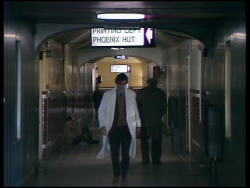
<p><img loading="lazy" decoding="async" src="http://www.britishtelevisiondrama.org.uk/wp-content/uploads/2016/07/BTVD_Funny-Farm_1-2016-e1468942845291.png" alt="BTVD_Funny Farm_1 2016" width="250" height="188" class="alignleft size-full wp-image-6414" /><em>Funny Farm</em> depicts a night shift by nurse Alan Welbeck (Tim Preece) on a psychiatric ward. As reviewer James Scott put it, the play comments on &#8220;conditions in our mental hospitals &#8211; understaffing, overwork, bad pay, old inadequate buildings&#8221; and unsatisfactory &#8220;patient treatment and cure&#8221;, points which are heightened by the play&#8217;s &#8220;understatement&#8221; and rejection of &#8220;sensationalism and sentimentality&#8221;.<sup id="rf1-3570"><a href="#fn1-3570" title="James Scott, &#8216;Writer swipes hard at our crazy values&#8217;, &lt;em&gt;The Stage and Television Today&lt;/em&gt;, 6 March 1975, p. 19." rel="footnote">1</a></sup> Dennis Potter praised this &#8220;gentle and observant drama&#8221; as &#8220;Beautifully acted, compassionately written and intelligently directed&#8221;.<sup id="rf2-3570"><a href="#fn2-3570" title="Dennis Potter, &#8216;Switch Back&#8217;, &lt;em&gt;New Statesman&lt;/em&gt;, 7 March 1975, p. 319." rel="footnote">2</a></sup> The play also dramatises writer Roy Minton&#8217;s contention that &#8220;Psychiatric therapy is fundamentally an agent for the state&#8221;,<sup id="rf3-3570"><a href="#fn3-3570" title="Minton, quoted in Shiva Naipaul, &#8216;Madness and their methods&#8217;, &lt;em&gt;Radio Times&lt;/em&gt;, 20 February 1975, p. 14." rel="footnote">3</a></sup> and provides an example of Minton&#8217;s productive collaboration with director <a href="http://www.britishtelevisiondrama.org.uk/?p=862" target="_self" rel="noopener">Alan Clarke</a>. My book <em>Alan Clarke</em> didn&#8217;t have a chapter on <em>Funny Farm</em> in its own right &#8211; I discussed it only in relation to other collaborations and tendencies across Clarke&#8217;s work. This essay aims to correct that omission, and features some new research findings.</p>

<hr class="footnotes"><ol class="footnotes" style="list-style-type:decimal"><li id="fn1-3570"><p >James Scott, &#8216;Writer swipes hard at our crazy values&#8217;, <em>The Stage and Television Today</em>, 6 March 1975, p. 19.&nbsp;<a href="#rf1-3570" class="backlink" title="Return to footnote 1.">&#8617;</a></p></li><li id="fn2-3570"><p >Dennis Potter, &#8216;Switch Back&#8217;, <em>New Statesman</em>, 7 March 1975, p. 319.&nbsp;<a href="#rf2-3570" class="backlink" title="Return to footnote 2.">&#8617;</a></p></li><li id="fn3-3570"><p >Minton, quoted in Shiva Naipaul, &#8216;Madness and their methods&#8217;, <em>Radio Times</em>, 20 February 1975, p. 14.&nbsp;<a href="#rf3-3570" class="backlink" title="Return to footnote 3.">&#8617;</a></p></li></ol></hr>{"id":3570,"date":"2013-03-31T23:50:12","date_gmt":"2013-03-31T22:50:12","guid":{"rendered":"http:\/\/www.britishtelevisiondrama.org.uk\/?p=3570"},"modified":"2024-08-30T11:39:53","modified_gmt":"2024-08-30T10:39:53","slug":"funny-farm-1975","status":"publish","type":"post","link":"http:\/\/www.britishtelevisiondrama.org.uk\/?p=3570","title":{"rendered":"<em>Funny Farm<\/em> (1975)"},"content":{"rendered":"<h4>by DAVID ROLINSON<\/h4>\n<p><em>Play for Today<\/em> <strong>Writer:<\/strong> Roy Minton; <strong>Producer<\/strong>: Mark Shivas; <strong>Director<\/strong>: Alan Clarke<\/p>\n<blockquote><p><em>&#8220;This place gets more like a bleeding madhouse every day&#8230;&#8221;<\/em><\/p><\/blockquote>\n<p><img loading=\"lazy\" decoding=\"async\" src=\"http:\/\/www.britishtelevisiondrama.org.uk\/wp-content\/uploads\/2016\/07\/BTVD_Funny-Farm_1-2016-e1468942845291.png\" alt=\"BTVD_Funny Farm_1 2016\" width=\"250\" height=\"188\" class=\"alignleft size-full wp-image-6414\" \/><em>Funny Farm<\/em> depicts a night shift by nurse Alan Welbeck (Tim Preece) on a psychiatric ward. As reviewer James Scott put it, the play comments on &#8220;conditions in our mental hospitals &#8211; understaffing, overwork, bad pay, old inadequate buildings&#8221; and unsatisfactory &#8220;patient treatment and cure&#8221;, points which are heightened by the play&#8217;s &#8220;understatement&#8221; and rejection of &#8220;sensationalism and sentimentality&#8221;.<sup id=\"rf1-3570\"><a href=\"#fn1-3570\" title=\"James Scott, &#8216;Writer swipes hard at our crazy values&#8217;, &lt;em&gt;The Stage and Television Today&lt;\/em&gt;, 6 March 1975, p. 19.\" rel=\"footnote\">1<\/a><\/sup> Dennis Potter praised this &#8220;gentle and observant drama&#8221; as &#8220;Beautifully acted, compassionately written and intelligently directed&#8221;.<sup id=\"rf2-3570\"><a href=\"#fn2-3570\" title=\"Dennis Potter, &#8216;Switch Back&#8217;, &lt;em&gt;New Statesman&lt;\/em&gt;, 7 March 1975, p. 319.\" rel=\"footnote\">2<\/a><\/sup> The play also dramatises writer Roy Minton&#8217;s contention that &#8220;Psychiatric therapy is fundamentally an agent for the state&#8221;,<sup id=\"rf3-3570\"><a href=\"#fn3-3570\" title=\"Minton, quoted in Shiva Naipaul, &#8216;Madness and their methods&#8217;, &lt;em&gt;Radio Times&lt;\/em&gt;, 20 February 1975, p. 14.\" rel=\"footnote\">3<\/a><\/sup> and provides an example of Minton&#8217;s productive collaboration with director <a href=\"http:\/\/www.britishtelevisiondrama.org.uk\/?p=862\" target=\"_self\" rel=\"noopener\">Alan Clarke<\/a>. My book <em>Alan Clarke<\/em> didn&#8217;t have a chapter on <em>Funny Farm<\/em> in its own right &#8211; I discussed it only in relation to other collaborations and tendencies across Clarke&#8217;s work. This essay aims to correct that omission, and features some new research findings.<\/p>\n<p><!--more--><\/p>\n<p>The play was officially commissioned as a <em>Play for Today<\/em> by producer Mark Shivas on 31 May 1974, as a 75-minute drama (a fact that would later become problematic). Minton signed his contract on 13 June; the target delivery date was 31 July; it was delivered on 27 August and accepted on 16 September.<sup id=\"rf4-3570\"><a href=\"#fn4-3570\" title=\"Various copyright registry documents, BBC Written Archive Centre. File information available upon request.\" rel=\"footnote\">4<\/a><\/sup> On 13 November, Shivas requested an additional payment for Minton (okayed on 19 November) on the basis that he &#8220;will be attending rehearsals and recording&#8221; from 23 November to 19 December, although when the request was okayed the end date was given as 11 December.<sup id=\"rf5-3570\"><a href=\"#fn5-3570\" title=\"Various documents and correspondence, BBC Written Archives Centre. File information available upon request.\" rel=\"footnote\">5<\/a><\/sup> Shivas stressed that Minton&#8217;s &#8220;presence is quite necessary&#8221;, an indication of the work required or of the collaborative process that Minton enjoyed with Clarke, who was still at this stage very much a writer&#8217;s director. The relevance of this close collaboration will become apparent. The play was ultimately transmitted on 27 February 1975.<\/p>\n<p>Like Minton&#8217;s <em>Scum<\/em> &#8211; or, indeed, <em>Scrubbers<\/em>, a film to which he was just one, unhappy, contributor &#8211; <em>Funny Farm<\/em> has a title that is unsettlingly direct, confronting perceptions. &#8220;In two words Roy Minton sums up most people&#8217;s views of the mental hospital&#8221;, argued Scott. &#8220;Madness scares the hell out of us, so we feel compelled to make bad jokes about &#8220;the looney bin&#8221;, &#8220;the laughing academy&#8221; or, &#8216;the funny farm&#8217;.&#8221;<sup id=\"rf6-3570\"><a href=\"#fn6-3570\" title=\"Scott, p. 19.\" rel=\"footnote\">6<\/a><\/sup> Patients use gallow humour themselves in the play, as in Arthur&#8217;s observation &#8211; and variations on it &#8211; that &#8220;This place gets more like a bleeding madhouse every day&#8221;. The title also predicts the strain of humour in the play, in dialogue, interactions and grim repetitions of unsettled behaviour, as Welbeck experiences &#8211; in Minton&#8217;s words &#8211; &#8220;the tears, the vacancies, the obsessions&#8221; of his patients.<sup id=\"rf7-3570\"><a href=\"#fn7-3570\" title=\"Minton, quoted in Naipaul, p. 14.\" rel=\"footnote\">7<\/a><\/sup><\/p>\n<p>The setting &#8211; as so many medical dramas know &#8211; affords the placing together of various personalities from various backgrounds, but in this play their specific psychiatric conditions are not the pretext for diagnosis. They have meetings with a specialist, but we are not privy to them &#8211; instead, we follow nurse Welbeck and his routine on the ward, and experience their varied behaviour during his visits or in their own conversations. The characters include Les, who claims that his nerves were damaged in military service, and who is now dedicated to exercise: &#8220;You&#8217;ve got to be perfect&#8221;. Jack&#8217;s promotion to suited office work seemed to trigger a collapse (&#8220;I don&#8217;t know what happened to me&#8221;), while serious teenage illness seemed to have a lasting mental impact on Walter, whose overt generosity and helpfulness gives way to a hysterical bid for freedom. There is the aged Mr Scully, experiencing advancing dementia; and Sidney, who never recovered from dismissal from his gardening job and cottage after requesting more pay from a boss whose inherited wealth means that he, Sidney stresses, had never worked a day in his life. Others include Mr Chadd, who constantly bursts into song and asks others to moderate their language; Jonathan the self-challenging artist; Graham the chess obsessive; and Jeff the Elvis fanatic who, in Arthur&#8217;s words, is often &#8220;giving it some fist in the wanking pit&#8221;. Listing characters like this, and noting that their differences will produce interplay, might bring to mind the likes of <em>One Flew Over the Cuckoo&#8217;s Nest<\/em> (released later in 1975), Dennis Potter&#8217;s <em>Emergency Ward 9<\/em> engagement with hospital soaps, or even the sitcom <em>Only When I Laugh<\/em> (1979-82). Its state-of-the-nation concerns evoke the concept, though not the execution, of <em>Britannia Hospital<\/em> (1982). However, let&#8217;s stop this list now while it still resembles context: <em>Funny Farm<\/em> is a very different piece, with a sparseness and concern with institutionalisation that is characteristic of the work of Minton and Clarke in this period, separately and in collaboration. Its subject matter makes it clearly a <em>Play for Today<\/em> and a play for <em>today<\/em>.<\/p>\n<p><img loading=\"lazy\" decoding=\"async\" src=\"http:\/\/www.britishtelevisiondrama.org.uk\/wp-content\/uploads\/2016\/07\/BTVD_Funny-Farm_2-2016-e1468942853725.png\" alt=\"BTVD_Funny Farm_2 2016\" width=\"250\" height=\"188\" class=\"alignleft size-full wp-image-6415\" \/>Arthur is the most complex of all the patients. He seems to be an identification figure, providing sardonic insights, but we realise that he is an alcoholic, who is at (or beyond) his last chance, and anxious about his prospects when he is potentially allowed to leave: &#8220;What the hell&#8217;s gonna happen?&#8221; Although he is aware of the impact of his condition on his wife and others, and tactful when other patients offer bland advice unaware of the nature of the condition (&#8220;What about a hobby?&#8221; &#8220;I&#8217;ve got one&#8221;), he is fatalistic about the lack of a cure for his liver and, possibly, his mind. He gets an unwelcome reminder when the ward is invaded by bullying recidivist James, who arrives drunk and demanding special treatment on the basis that he can pay. Friends and colleagues of Minton have connected the depiction of these issues with Minton\u2019s initial trigger for writing the play. In Richard Kelly\u2019s interview book <em>Alan Clarke<\/em>, Paul Knight recalled that in &#8220;about 1969&#8221; he and Minton\u2019s then-wife committed Minton, who was experiencing alcoholism and gambling issues, to a mental home &#8220;because that was the only course \u2013 he was in a terrible state&#8221;. They put him in an &#8220;enormous and incredibly grim fortress-like Victorian building&#8221;, until Minton rang, at four that morning, to say: &#8220;Get me the fuck out of here.&#8221; Knight argues that, since Minton\u2019s writing was often &#8220;based on his life&#8221;, &#8220;I suppose there was a bit of that episode in <em>Funny Farm<\/em>.&#8221;<sup id=\"rf8-3570\"><a href=\"#fn8-3570\" title=\"Knight, quoted in Richard Kelly (ed.), Alan Clarke (London: Faber, 1998), p. 86.\" rel=\"footnote\">8<\/a><\/sup><\/p>\n<p>Whether or not the play echoes Minton\u2019s life, its themes certainly echo other Minton dramas. For example, <em>Funny Farm<\/em> draws correlations between the ward, the military and society, in keeping with the concern with institutionalisation that runs through a lot of Minton\u2019s work. For instance, <em>Scum<\/em> is said to have developed as part of an unrealised trilogy of plays about institutionalisation in the police, the army and Borstal.<sup id=\"rf9-3570\"><a href=\"#fn9-3570\" title=\"Kelly, p. 92.\" rel=\"footnote\">9<\/a><\/sup> Ted describes life in this institution as being &#8220;Just like the forces. Good mates, comradeship.&#8221; Arthur invokes the army in a vitriolic response to Mr Chadd\u2019s reminiscence about his lost friends in the trenches in the First World War. Mr Chadd misreads Arthur\u2019s statement &#8220;then you\u2019re one of the stalwarts who helped to make us the nation we are today&#8221; as friendly interest, but Arthur\u2019s explanatory follow-up is brutal: &#8220;you\u2019re one of the bastards to blame for the mess we\u2019re in [\u2026] How dare you go winning wars [\u2026] You sit there canting bullshit about flags, orders and death [\u2026] yet there is not one solitary opinion about your boring cadaverous person. They should not have died.&#8221; Today\u2019s youth, Arthur believes, &#8220;won\u2019t go hurling themselves on rusty bayonets for any half-baked reason&#8221; like Mr Chadd and his &#8220;brainwashed mates&#8221;. Meanwhile, Les says that his &#8220;nerve went&#8221; during his time in military service, and he is now constantly moving as if movement is a displacement activity, physical activity that will occupy his mind.<\/p>\n<p><img loading=\"lazy\" decoding=\"async\" src=\"http:\/\/www.britishtelevisiondrama.org.uk\/wp-content\/uploads\/2013\/04\/BTVD_FunnyFarm_Standbyyourscreen-e1364812649711.png\" alt=\"BTVD_FunnyFarm_Standbyyourscreen\" width=\"250\" height=\"190\" class=\"alignleft size-full wp-image-3615\" \/>These ideas echo an earlier Minton play also directed by Clarke, the playful <em>Stand by Your Screen<\/em>.<sup id=\"rf10-3570\"><a href=\"#fn10-3570\" title=\"&lt;em&gt;Company of Five&lt;\/em&gt;: &lt;em&gt;Stand by Your Screen&lt;\/em&gt;, tx. ITV, 7 December 1968 in some regions, but there were variations across other regions.\" rel=\"footnote\">10<\/a><\/sup> In that play, Christopher Gritter (John Neville) is at home, not a hospital, but he is arguably still in an institution because his family has internalised social attitudes and pressures.<sup id=\"rf11-3570\"><a href=\"#fn11-3570\" title=\"See Dave Rolinson, &lt;em&gt;Alan Clarke&lt;\/em&gt; (Manchester: Manchester University Press, 2005), pp. 26-28.\" rel=\"footnote\">11<\/a><\/sup> Gritter hides behind screens in the living room, rejects traditional lifestyles and makes the class-conscious statement to-camera that &#8220;If you\u2019re poor, you\u2019re mad; if you\u2019re rich, you\u2019re eccentric.&#8221; Gritter\u2019s prior breakdown is connected with institutionalisation, through his National Service, in which he was taught to kill without understanding why: &#8220;I am told not to think, but to do.&#8221; If his movement \u2013 ending the play running on the spot, in suit and slippers \u2013 anticipates Les\u2019s later activity in <em>Funny Farm<\/em>, Gritter\u2019s statement to his mother directly anticipates the later play: &#8220;Mummy, Mummy, where is the womb? The security and comfort, the inside better than the outside of the womb? Mother, why did you let me go? Why did you spew me out with that enormous shudder of pain and ecstasy into this temple of darkness?&#8221; Minton used the same imagery while promoting <em>Funny Farm<\/em>: &#8220;Hospitals provide a womb for a while. But the end result is debilitating. The recidivism is enormous.&#8221;<sup id=\"rf12-3570\"><a href=\"#fn12-3570\" title=\"Minton, quoted in Naipaul, p. 14.\" rel=\"footnote\">12<\/a><\/sup> The inevitability of recidivism is a feature in <em>Funny Farm<\/em> \u2013 from James\u2019s belligerence to Arthur\u2019s doubt \u2013 and for the trainees in <em>Scum<\/em>, but it is also a feature in Clarke\u2019s work without Minton, such as Clarke\u2019s previous <em>Play for Today<\/em>, <em>A Follower for Emily<\/em> written by Brian Clark.<sup id=\"rf13-3570\"><a href=\"#fn13-3570\" title=\"&lt;em&gt;Play for Today&lt;\/em&gt;: &lt;em&gt;A Follower for Emily&lt;\/em&gt;, tx. BBC1, 4 July 1974.\" rel=\"footnote\">13<\/a><\/sup> There, residents of an old people\u2019s home return early from honeymoon to be in that safe environment. <\/p>\n<p><img loading=\"lazy\" decoding=\"async\" src=\"http:\/\/www.britishtelevisiondrama.org.uk\/wp-content\/uploads\/2016\/07\/BTVD_Funny-Farm_3-2016-e1468942862605.png\" alt=\"BTVD_Funny Farm_3 2016\" width=\"250\" height=\"188\" class=\"alignright size-full wp-image-6416\" \/>Arthur\u2019s fears of recidivism are particularly important to the play\u2019s concerns because they are tellingly exposed in a conversation with Welbeck. It is as though patient and nurse alike fear their ability, and desire, to leave the institution. Indeed, Welbeck, for all his hard work and clear dedication \u2013 he says that he likes the job, he enjoys helping people \u2013 has written a resignation letter. His reasons for leaving bring to our attention the problems with the profession that James Scott itemised in the first paragraph of this essay.<\/p>\n<p><img loading=\"lazy\" decoding=\"async\" src=\"http:\/\/www.britishtelevisiondrama.org.uk\/wp-content\/uploads\/2016\/07\/BTVD_Funny-Farm_4-2016-e1468942881733.png\" alt=\"BTVD_Funny Farm_4 2016\" width=\"250\" height=\"188\" class=\"alignleft size-full wp-image-6418\" \/>During his shift, Welbeck is asked to help on a geriatric ward \u2013 which he does, uncomplainingly attending to a patient\u2019s basic, increasingly intimate needs \u2013 but makes it clear that his ward is already understaffed (with only two of its supposed five staff), which he says is not &#8220;fair either to us or the patients \u2013 they\u2019re supposed to be under observation&#8221;. The sardonic reply to his question &#8220;What would you tell an inquiry?&#8221; is, &#8220;Which one?&#8221; Understaffing and overwork are key issues, as Shiva Naipaul summarised in his <em>Radio Times<\/em> preview of the play: &#8220;One patient has to be dressed, another to be spoon-fed, another to be cleaned, another to be comforted, another to be entertained, another to be rebuked&#8221; \u2013 but the nurse is the &#8220;bridge between the patient and his possible &#8216;cure'&#8221;, and consultants &#8220;often entirely dependent on&#8221; their information.<sup id=\"rf14-3570\"><a href=\"#fn14-3570\" title=\"Naipaul, p. 14.\" rel=\"footnote\">14<\/a><\/sup> Patients compete for Welbeck\u2019s time in various scenes, attempt to help each other, or sit in boredom in the sitting room not watching the television. A female patient, Joyce, wanders in disruptively from another ward. Interviewed by Naipaul, Minton observed that &#8220;There are only the briefest of confrontations between him and the patient. He is always aware of the queue.&#8221;<sup id=\"rf15-3570\"><a href=\"#fn15-3570\" title=\"Minton, quoted in Naipaul, p. 14.\" rel=\"footnote\">15<\/a><\/sup> Alan Clarke added, &#8220;There should be the possibility of friendship \u2013 genuine friendship \u2013 between nurse and patient. Of course, that happens now \u2013 but not to the extent that it should. There ought to be a one-to-one ratio. One patient to one nurse. It is impossible for anyone to cope with <em>all<\/em> that distress.&#8221;<sup id=\"rf16-3570\"><a href=\"#fn16-3570\" title=\"Clarke, quoted in Naipaul, p. 14.\" rel=\"footnote\">16<\/a><\/sup> This is one of the areas covered by the captions shown at the end of the play, which tell us that in cases of non-psychiatric illness &#8220;There are 121 nurses for 100 patients&#8221; but in cases of psychiatric illness &#8220;There are 36 nurses for 100 patients&#8221;. The <em>Radio Times<\/em> preview repeats this information and adds that the ratio between consultants and patients is 1 per 31 patients and 1 per 154 patients respectively. The preview adds other contextual information, including the fact that 65% of &#8220;British mental hospitals were built before 1891.&#8221;<sup id=\"rf17-3570\"><a href=\"#fn17-3570\" title=\"Boxout accompanying Naipaul, p. 14.\" rel=\"footnote\">17<\/a><\/sup><\/p>\n<p><img loading=\"lazy\" decoding=\"async\" src=\"http:\/\/www.britishtelevisiondrama.org.uk\/wp-content\/uploads\/2016\/07\/BTVD_Funny-Farm_5-2016-e1468942891923.png\" alt=\"BTVD_Funny Farm_5 2016\" width=\"250\" height=\"188\" class=\"alignright size-full wp-image-6419\" \/><br \/>\nAnother reason given by Alan Welbeck for his resignation is his pay: Alan Clarke told Naipaul that &#8220;The pay of the nurses is awful. Really terrible&#8221;.<sup id=\"rf18-3570\"><a href=\"#fn18-3570\" title=\"Naipaul estimated that Welbeck\u2019s pay would have been \u00a31,200 a year. Naipaul, p. 14.\" rel=\"footnote\">18<\/a><\/sup> Welbeck bikes to work because he can\u2019t afford a car or the bus fare, and worries about being able to provide for his wife and two children, concerns that are unpleasantly emphasised by James waving money at him \u2013 his claim that &#8220;I can buy you any time&#8221; is timed particularly badly for Welbeck \u2013 and Joyce shouting &#8220;tight-fisted bastard!&#8221; after him, although that is one of her universal accusations. Welbeck feels the need to leave a job that he enjoys \u2013 and there is a brutal irony in his intended alternative. He has discovered that he can earn twice as much working in a factory, but as his colleague observes, many of the workers from this &#8220;sweatshop&#8221; end up as patients in this ward. Reviewer James Scott thought that this choice of &#8220;mind-destroying monotony&#8221; was a &#8220;shrewd swipe&#8221; by Minton at &#8220;our crazy system of job valuation and payment&#8221;.<sup id=\"rf19-3570\"><a href=\"#fn19-3570\" title=\"Scott, p. 19.\" rel=\"footnote\">19<\/a><\/sup><\/p>\n<p><img loading=\"lazy\" decoding=\"async\" src=\"http:\/\/www.britishtelevisiondrama.org.uk\/wp-content\/uploads\/2016\/07\/BTVD_Funny-Farm_6-2016-e1468942901553.png\" alt=\"BTVD_Funny Farm_6 2016\" width=\"250\" height=\"188\" class=\"alignleft size-full wp-image-6420\" \/>However, Welbeck\u2019s disquiet is also motivated by a pressing ethical issue that relates to the play\u2019s social analysis. Patients wait for their turn to see the doctor, wondering whether he will suggest that they be released or whether he will recommend ECT (electroconvulsive therapy). When patients ask Welbeck for advice, he professionally defers to the doctor\u2019s expertise \u2013 however, in private he expresses his doubts: he fears that their methods merely leave patients &#8220;dependent on artificially-induced epileptic fits&#8221;, knowing that they will inevitably need more of the same, whether in six months or two years. Welbeck wonders whether a crowbar to the head would have comparable results, but notes that the system would not countenance this because its damage would be visible. He says: &#8220;I have never seen a really disturbed person &#8216;normalised&#8217;, whatever that means [\u2026] we know nothing but the short-term effect of chemicals on the brain \u2013 we can only subdue, shovel pills in by the ton&#8221;. His colleague contests this, arguing that the profession uses the knowledge that they <em>do<\/em> have &#8220;in all good faith&#8221;, but Welbeck\u2019s analysis would seem to be supported by the programme makers: Clarke told Naipaul that &#8220;Our knowledge of mental illness is very limited. We\u2019re like Christopher Columbus at the beginning of his voyage. We\u2019ve only just started to cross an unexplored ocean\u2026&#8221;<sup id=\"rf20-3570\"><a href=\"#fn20-3570\" title=\"Clarke, quoted in Naipaul, p. 15.\" rel=\"footnote\">20<\/a><\/sup> The results of this treatment \u2013 indeed, the results of various practices depicted during the play, even down to the loss of individual identity that Walter feels could be addressed if only he were allowed his own clothes \u2013 are recidivism and dependency. This supports the idea of the &#8220;womb&#8221; that was raised earlier in this essay or, to give a further meaning to the play\u2019s title, a &#8220;farm&#8221; in which this dependence is grown. Naipaul summarises Minton\u2019s position: &#8220;Every society hammers home its own particular definition of the normal and abnormal, subjecting its individual members to a barrage of propaganda.&#8221;<sup id=\"rf21-3570\"><a href=\"#fn21-3570\" title=\"Naipaul, p. 14.\" rel=\"footnote\">21<\/a><\/sup> Minton and Clarke put the play in its social context in comments in the Naipaul piece, which I\u2019ve selected from here:<\/p>\n<blockquote><p>Minton: Sanity is a problematical concept. Most of what passes for sanity out there just does not appeal to me. Walking around London is not much different from walking around a hospital. You see so many people visibly in distress [\u2026] Psychiatric therapy is fundamentally an agent for the state that exists as represented by the Church, marriage [\u2026] People are induced to accept rather than reject. Nobody is ever told to get the hell out of any situation that is causing him distress.<\/p>\n<p>Clarke: It\u2019s always &#8220;Go back! Go back!&#8221; People are never encouraged to go forward, to make a break\u2026<\/p>\n<p>Minton: Most people are encouraged to believe that they have responsibilities to all sorts of things. But one\u2019s first responsibility is to oneself. The most important thing to know is what you <em>don\u2019t<\/em> want to do.<\/p>\n<p>Clarke: Go on! Sit down and have a depression! It\u2019s nothing to be ashamed of. That depression is telling you something. It can be a very fundamental warning and emotional experience. We have got to get away from this guilt thing.<sup id=\"rf22-3570\"><a href=\"#fn22-3570\" title=\"Various quotations from Minton and Clarke, quoted in Naipaul, p. 14.\" rel=\"footnote\">22<\/a><\/sup> <\/p><\/blockquote>\n<p>Naipaul observes that Clarke and Minton &#8220;are an articulate duet&#8221;.<sup id=\"rf23-3570\"><a href=\"#fn23-3570\" title=\"Naipaul, p. 19.\" rel=\"footnote\">23<\/a><\/sup> Their comments also anticipate Archer\u2019s thoughts on institutionalism in <em>Scum<\/em>, in particular his distinction between life inside Borstal (where &#8220;you act, you\u2019re punished, you\u2019re free&#8221;) and outside Borstal (where &#8220;you act, you\u2019re punished by your own guilt complexes, and are never free&#8221;). My book on Clarke connects <em>Scum<\/em> with <em>Stand by Your Screen<\/em>, which &#8220;demonstrated the internalisation of the dominant ideology into the family unit, in line with Antonio Gramsci\u2019s reading of consensus in his prison notebooks as &#8216;the &#8220;spontaneous&#8221; consent given by the great masses of the population to the general direction imposed on social life by the dominant fundamental group'&#8221;.<sup id=\"rf24-3570\"><a href=\"#fn24-3570\" title=\"Rolinson, pp. 76-77. I also draw on Foucault, Althusser and other theorists whose work echoes the position here and in other plays.\" rel=\"footnote\">24<\/a><\/sup> <\/p>\n<p><img loading=\"lazy\" decoding=\"async\" src=\"http:\/\/www.britishtelevisiondrama.org.uk\/wp-content\/uploads\/2016\/07\/BTVD_Funny-Farm_7-2016-e1468942910317.png\" alt=\"BTVD_Funny Farm_7 2016\" width=\"250\" height=\"188\" class=\"alignleft size-full wp-image-6421\" \/>This &#8220;duet&#8221; includes the ways in which Clarke\u2019s techniques reinforce Minton\u2019s themes. Dennis Potter noted that &#8220;<em>Funny Farm<\/em> placed its damaged characters and underpaid male nurses in a shrinking world of endless passages, pale windows, distant scrabbles of voices, swishing doors and subterranean green colours.&#8221;<sup id=\"rf25-3570\"><a href=\"#fn25-3570\" title=\"Potter, p. 319.\" rel=\"footnote\">25<\/a><\/sup> Scott noted that these spaces were evoked by &#8220;some splendidly nightmarish camera shots of very long, narrow corridors, emphasising the inconvenience of the nineteenth century building and showing the incredible amount of sheer foot-slogging a nurse has to do in such a place&#8221;.<sup id=\"rf26-3570\"><a href=\"#fn26-3570\" title=\"Scott, p. 19.\" rel=\"footnote\">26<\/a><\/sup> Producer Mark Shivas suspected that &#8220;This was the start of Alan\u2019s penchant for people walking down corridors&#8221; as Welbeck made &#8220;his lonely way about the building with the camera at his shoulder. This may have been assisted by the newer lightweight cameras, which made Alan a bit more flexible in getting about.&#8221;<sup id=\"rf27-3570\"><a href=\"#fn27-3570\" title=\"Shivas, quoted in Kelly, pp. 86-87.\" rel=\"footnote\">27<\/a><\/sup> It is true that there are some walking shots that anticipate the signature device of Clarke\u2019s 1980s work, in particular near the end, as the camera at speed accompanies Welbeck walking toward or away from the camera, pursued through bleak corridors of institutions like something out of <em>Made in Britain<\/em> or <em>Elephant<\/em>. Clarke develops this emergent motif, but that point should be qualified. The movement is not quite a hand-held camera perched at the character\u2019s shoulder as in earlier Clarke pieces like <a href=\"http:\/\/www.britishtelevisiondrama.org.uk\/?p=967\" target=\"_self\" rel=\"noopener\"><em>The Hallelujah Handshake<\/em><\/a> in 1970, or the Steadicam that would arrive to facilitate vibrant attachment to protagonists in his 80s work. The movement is nearer to a dolly, with a necessarily more distanced position. Also, these moving shots are quite sparse in <em>Funny Farm<\/em>. Usually, Welbeck\u2019s walks are composed in static frames, or frames that are static as Welbeck approaches us, until he reaches a corner, when a pan follows him before the shot becomes static to observe the rest of his walk down another corridor. Static frames, in which characters move from background to foreground or vice versa (or, in the panning example just mentioned, both) are more characteristic of Clarke\u2019s 1970s style, in particular in filmed pieces with the often-noted influence of Robert Bresson such as <em>Diane<\/em>.<\/p>\n<p><em>Funny Farm<\/em> was shot entirely on video, at a time when the potential for Outside Broadcast for drama was becoming more widely accepted, although its merits were the subject of debate. Programme makers debated its financial benefits (increasing the amount of material that could be shot in one day, assuming a multi-camera set-up facilitated by a Lightweight Manual Control Room), and aesthetic strengths (matching the grain of studio interiors in order to reduce the jolt between location film and studio video) or weaknesses (Stephen Poliakoff spoke for many in seeing OB as &#8220;a real danger to drama&#8221;, a &#8220;poor relation to film&#8221; that resulted in a loss of &#8220;atmosphere and depth&#8221;).<sup id=\"rf28-3570\"><a href=\"#fn28-3570\" title=\"This sentence garbles material from Rolinson, p. 72.\" rel=\"footnote\">28<\/a><\/sup> Indeed, Margaret Matheson, promoting the series of <em>Play for Today<\/em> that included <em>Scum<\/em>, stated that electronic cameras were not yet good enough for location shooting.<sup id=\"rf29-3570\"><a href=\"#fn29-3570\" title=\"&#8216;Tackling public subjects in plays that stand alone&#8217;, &lt;em&gt;The Stage and Television Today&lt;\/em&gt;, 1 September 1977, p. 14.\" rel=\"footnote\">29<\/a><\/sup> <\/p>\n<p><img loading=\"lazy\" decoding=\"async\" src=\"http:\/\/www.britishtelevisiondrama.org.uk\/wp-content\/uploads\/2016\/07\/BTVD_Funny-Farm_9-2016-e1468942927141.png\" alt=\"BTVD_Funny Farm_9 2016\" width=\"250\" height=\"188\" class=\"alignleft size-full wp-image-6424\" \/><img loading=\"lazy\" decoding=\"async\" src=\"http:\/\/www.britishtelevisiondrama.org.uk\/wp-content\/uploads\/2016\/07\/BTVD_Funny-Farm_10-2016-e1468942934725.png\" alt=\"BTVD_Funny Farm_10 2016\" width=\"250\" height=\"188\" class=\"alignright size-full wp-image-6425\" \/><img loading=\"lazy\" decoding=\"async\" src=\"http:\/\/www.britishtelevisiondrama.org.uk\/wp-content\/uploads\/2016\/07\/BTVD_Funny-Farm_11-2016-e1468942941482.png\" alt=\"BTVD_Funny Farm_11 2016\" width=\"250\" height=\"188\" class=\"alignleft size-full wp-image-6426\" \/><img loading=\"lazy\" decoding=\"async\" src=\"http:\/\/www.britishtelevisiondrama.org.uk\/wp-content\/uploads\/2016\/07\/BTVD_Funny-Farm_8-2016-e1468942919537.png\" alt=\"BTVD_Funny Farm_8 2016\" width=\"250\" height=\"188\" class=\"alignright size-full wp-image-6423\" \/><br \/>\nClarke moulded his signatures to location video. As in his <em>Play of the Month<\/em> production of <em>The Love-Girl and the Innocent<\/em> or his production of Minton\u2019s <em>Fast Hands<\/em> for <em>Plays for Britain<\/em>, the static frames of <em>Funny Farm<\/em> sometimes constrain characters even when the shot size leaves them freedom to walk: like Lyuba in a key scene from <em>The Love-Girl and the Innocent<\/em>, Welbeck\u2019s long walk at the end can only be stopped by going through a door and resolving a difficult decision. <em>Funny Farm<\/em> lacks the experimentation with lenses that distinguishes <em>The Love-Girl and the Innocent<\/em>, but builds upon <em>A Follower for Emily<\/em>, with which it shares framing strategies, sparse but expressive mise-en-sc\u00e8ne (including imprisoning characters in door or window frames, placing characters in inflexible lines or using highly formal side-on shots) and visual repetition in the service of the study of institutionalisation.<sup id=\"rf30-3570\"><a href=\"#fn30-3570\" title=\"See my book for more detail on Clarke\u2019s use of video, and a very different experience on &lt;em&gt;Love for Lydia&lt;\/em&gt;, from which he was fired.\" rel=\"footnote\">30<\/a><\/sup> <\/p>\n<p><img loading=\"lazy\" decoding=\"async\" src=\"http:\/\/www.britishtelevisiondrama.org.uk\/wp-content\/uploads\/2016\/07\/BTVD_Funny-Farm_13-2016-e1468942949237.png\" alt=\"BTVD_Funny Farm_13 2016\" width=\"250\" height=\"188\" class=\"alignleft size-full wp-image-6428\" \/>The visual treatment of the play\u2019s opening and closing scenes further reflects theme. These are the only moments in which we leave the hospital, but the style is no more liberated outside than inside. In both scenes, Alan leaves a building and bikes away, either from home to the hospital or from the hospital to his home (though we don&#8217;t see the end of the journey on the latter occasion). Their visual treatment is similar: at first the route to his destination was on the left of the building, and when he bikes away he moves from foreground to background along the road: the two shots resemble each other but the vertical strip of road also resembles the framing of corridors throughout the play. There is a characteristically Clarke-like repetition created by the similarity between the beginning and the ending, but it also hints at the wider social themes discussed by Clarke and Minton earlier in the essay, problematising the distinction between institution and society, insane and sane, inside and outside \u2013 the concern with &#8220;the deadly virtues of state-sponsored sanity&#8221; that Naipaul saw in their statements.<sup id=\"rf31-3570\"><a href=\"#fn31-3570\" title=\"Naipaul, p. 14.\" rel=\"footnote\">31<\/a><\/sup> The idea that the programme has covered issues that affect us all is underlined by other captions at the end of the programme \u2013 &#8220;Every 3 hours a baby is born that will require continuous specialised psychiatric care for the whole of its life&#8221;; &#8220;1 person in 9 will enter mental hospital for treatment&#8221;. Again, the <em>Radio Times<\/em> provided supporting information: &#8220;patients suffering from mental disorder\u2019 occupy 47% of hospital beds, and \u2018Every fifth family has an intimate connection with mental illness.&#8221;<sup id=\"rf32-3570\"><a href=\"#fn32-3570\" title=\"Boxout accompanying Naipaul, p. 14.\" rel=\"footnote\">32<\/a><\/sup> These captions play over the shot of Welbeck starting his journey, just as the title caption <em>Funny Farm<\/em> played over a shot of a &#8220;normal&#8221; street, not the hospital.<\/p>\n<p><img loading=\"lazy\" decoding=\"async\" src=\"http:\/\/www.britishtelevisiondrama.org.uk\/wp-content\/uploads\/2016\/07\/BTVD_Funny-Farm_12-2016-e1468942871294.png\" alt=\"BTVD_Funny Farm_12 2016\" width=\"250\" height=\"188\" class=\"alignright size-full wp-image-6417\" \/>If the style, themes and &#8220;articulate duet&#8221; of writer and director bring to mind Clarke and Minton\u2019s previous and subsequent work, in particular the problems that they would face with <em>Scum<\/em>, then so do responses to <em>Funny Farm<\/em>. In both pieces, the play was drawn from wide research. Michael Jackley recalled that &#8220;Roy had done a lot of research for the script, then Alan did a bit himself by going and working in the hospital for a bit; he got his little white jacket on and did a few stints. I think Tim Preece did too&#8221;.<sup id=\"rf33-3570\"><a href=\"#fn33-3570\" title=\"Jackley, quoted in Kelly, p. 86.\" rel=\"footnote\">33<\/a><\/sup> Unlike the feedback that the BBC gathered in the politicised climate of the banning of <em>Scum<\/em>, the feedback that the <em>Radio Times<\/em> gathered saw <em>Funny Farm<\/em> praised for its accuracy. Barbara Rudgley, a Senior Nursing Officer and experienced psychiatric nurse, said that <em>Funny Farm<\/em> &#8220;could almost be used as a training film. It was so absolutely accurate&#8221;. She noted that &#8220;Psychiatric nursing has very few rewards. You rarely ever see anyone get better. Most of the time you\u2019re dealing with very sad, very under-motivated people who just don\u2019t like life. That\u2019s depressing.&#8221;<sup id=\"rf34-3570\"><a href=\"#fn34-3570\" title=\"Rudgley, quoted in Naipaul, p. 15.\" rel=\"footnote\">34<\/a><\/sup> Dennis Powell, a Nursing Officer, noted that &#8220;Nurses like [Welbeck] are definitely exploited&#8221;, although he thought that English people were now less likely to want to enter the profession and noted that he started out wanting to &#8220;do something worthwhile&#8221; but perhaps lacked that &#8220;sense of vocation&#8221; now.<sup id=\"rf35-3570\"><a href=\"#fn35-3570\" title=\"Powell, quoted in Naipaul, p. 15.\" rel=\"footnote\">35<\/a><\/sup> Rudgley stated that &#8220;The question is whether we ought to give patients an asylum where they can be themselves or whether we ought to pressurise them to return to society.&#8221;<sup id=\"rf36-3570\"><a href=\"#fn36-3570\" title=\"Rudgley, quoted in Naipaul, p. 15.\" rel=\"footnote\">36<\/a><\/sup> Jackley\u2019s response to the recording demonstrated that the play raised similar ideas: &#8220;We had real patients coming in and out on that shoot. Your blood turned to ice when you went in. Obviously, I don\u2019t agree with care in the community now, because it plainly doesn\u2019t work, but you could see the arguments for closing places like this \u2013 mile-long corridors.&#8221;<sup id=\"rf37-3570\"><a href=\"#fn37-3570\" title=\"Jackley, quoted in Kelly, p. 86.\" rel=\"footnote\">37<\/a><\/sup><\/p>\n<p>However, for all the detailed research, Clarke was keen to stress that <em>Funny Farm<\/em> was not a documentary: &#8220;It\u2019s a play. It was <em>written<\/em> as a play. Nor is it just about nursing. It\u2019s about people.&#8221;<sup id=\"rf38-3570\"><a href=\"#fn38-3570\" title=\"Clarke, quoted in Naipaul, p. 15.\" rel=\"footnote\">38<\/a><\/sup> He would respond even more robustly when the banned <em>Scum<\/em> was subject to debates on drama documentary\u2019s supposed mangling of drama and documentary techniques: <em>Scum<\/em>, he said, &#8220;<em>is<\/em> a play, it\u2019s not a documentary, there\u2019s been such a lot of I think rubbish talked about what\u2019s a drama, what\u2019s a drama documentary&#8221;.<sup id=\"rf39-3570\"><a href=\"#fn39-3570\" title=\"Clarke, in &lt;em&gt;Arena&lt;\/em&gt;: \u2018When Is a Play Not a Play?\u2019 \" rel=\"footnote\">39<\/a><\/sup> For Scott, <em>Funny Farm<\/em> was &#8220;definitely a play, not a documentary&#8221; but still carried &#8220;far more conviction than many a &#8216;factual&#8217; programme on the same subject.&#8221;<sup id=\"rf40-3570\"><a href=\"#fn40-3570\" title=\"Scott, p. 19.\" rel=\"footnote\">40<\/a><\/sup> Scott was also comfortable with its dramatic compression \u2013 &#8220;While not all mental hospitals are as bad as the one in the play, some are undeniably worse&#8221;<sup id=\"rf41-3570\"><a href=\"#fn41-3570\" title=\"Scott, p. 19.\" rel=\"footnote\">41<\/a><\/sup> \u2013 although the idea of a drama as compendium of researched incidents would be challenged by the BBC executives who withheld <em>Scum<\/em>. Minton and Clarke <em>did<\/em> have a spat with the BBC over <em>Funny Farm<\/em>, but whether it related to similar issues of interference depended on your point of view. Christopher Morahan, the then-Head of Plays, noted that &#8220;It was commissioned as a seventy-five-minute play and it came out at one hundred and five. For me this was like working on a newspaper \u2013 we were working in fictional journalism if you like \u2013 and if you write a thousand words when your editor asked for five hundred, he has to spike half the article. This was during the three-day week, and we had to be off the air by eleven o\u2019 clock at night. There was no way it could be broadcast at that length.&#8221;<sup id=\"rf42-3570\"><a href=\"#fn42-3570\" title=\"Morahan, quoted in Kelly, p. 87.\" rel=\"footnote\">42<\/a><\/sup> He observed that Clarke, faced with having to cut the play, &#8220;got very angry and petitioned the plays department against me \u2013 stood at the gates of the BBC and handed out pamphlets. It got pretty rough, and people said I had been censorious.&#8221; Clarke asked to remove his credit but Morahan replied, &#8220;Don\u2019t be so silly, it\u2019s very good and it\u2019s improved for being a bit shorter. It\u2019s your work and you should sign it&#8221;.<sup id=\"rf43-3570\"><a href=\"#fn43-3570\" title=\"Morahan, in Kelly, p. 88.\" rel=\"footnote\">43<\/a><\/sup> Internal correspondence reveals resistance from other areas of the BBC to the idea of Clarke or Minton removing their names, finding that request unreasonable in line with the overrun from the agreed programme length.<sup id=\"rf44-3570\"><a href=\"#fn44-3570\" title=\"Correspondence, BBC Written Archives Centre. File location available upon request.\" rel=\"footnote\">44<\/a><\/sup> Ultimately, the play had a ninety-minute timeslot \u2013 9.25 to 10.55, followed by Midweek, the Weather and Regional News before the scheduled closedown of 11.30.<sup id=\"rf45-3570\"><a href=\"#fn45-3570\" title=\"Programmes for 27 February, &lt;em&gt;Radio Times&lt;\/em&gt;, 20 February 1975.\" rel=\"footnote\">45<\/a><\/sup> Minton was paid a fee to reflect the fact that the play was 92 minutes and 50 seconds long, constituting 18 extra minutes.<sup id=\"rf46-3570\"><a href=\"#fn46-3570\" title=\"Correspondence, BBC Written Archives Centre. File location available upon request.\" rel=\"footnote\">46<\/a><\/sup> Interestingly, Dennis Potter\u2019s review\u2019s only real quibble with the play was that it was &#8220;Too long, with too many uninterrupted monologues&#8221;.<sup id=\"rf47-3570\"><a href=\"#fn47-3570\" title=\"Potter, p. 319.\" rel=\"footnote\">47<\/a><\/sup> <\/p>\n<p>Minton, meanwhile, had a few plays and series commissioned by the BBC but not used, in the period just before and after <em>Funny Farm<\/em> \u2013 I won\u2019t dwell on this since unused scripts were quite normal for writers, but a few of them are worth raising in relation to <em>Funny Farm<\/em>. Minton was looking to revisit a quite different piece that touched on issues of psychiatric care, <em>Horace<\/em>, a 1972 play that Clarke directed and Shivas produced. <sup id=\"rf48-3570\"><a href=\"#fn48-3570\" title=\"&lt;em&gt;Horace&lt;\/em&gt;, tx. BBC2, 21 March 1972.\" rel=\"footnote\">48<\/a><\/sup> The series \u2013 titled in commissioning documents as <em>Horace Lives!<\/em> \u2013 was commissioned by David Rose (its separate episodes commissioned across late 1976 and early 1977) but quite heated correspondence arose and the series didn\u2019t ultimately appear until April 1982, as <em>Horace<\/em> for Yorkshire TV.<sup id=\"rf49-3570\"><a href=\"#fn49-3570\" title=\"Various documents and correspondence, BBC Written Archives Centre.\" rel=\"footnote\">49<\/a><\/sup> It\u2019s also interesting that various pieces involved Shivas collaborating with Minton \u2013 an episode of <em>The Edwardians<\/em> that was ultimately rejected, and then the commissioning of <em>Scum<\/em>. Indeed, contrary to Sian Barber\u2019s recent claim that <em>Scum<\/em> was commissioned in 1976,<sup id=\"rf50-3570\"><a href=\"#fn50-3570\" title=\"Sian Barber, \u2018Scum: Institutional Control and Patriarchy\u2019, in The British Film Industry in the 1970s: Capital, Culture and Creativity (Palgrave, 2013). To be fair, Barber is mainly writing about the cinema remake.\" rel=\"footnote\">50<\/a><\/sup> <em>Scum<\/em> was actually commissioned by Mark Shivas in a document dated 8 January 1975. (Indeed, Minton said in 1978 that &#8220;The BBC commissioned <em>Scum<\/em> in 1975&#8243;.<sup id=\"rf51-3570\"><a href=\"#fn51-3570\" title=\"Roy Minton, &#8216;The Billy Cotton Banned Show&#8217; press release, 13 January 1978.\" rel=\"footnote\">51<\/a><\/sup> ) It was delivered in April 1975 \u2013 documents indicate that it was intended as a BBC2 <em>Playhouse<\/em>, but there are precedents for transfer \u2013 but it didn\u2019t happen in that form. Minton told Kelly that Shivas &#8220;turned it down \u2013 said it was too biased&#8221;.<sup id=\"rf52-3570\"><a href=\"#fn52-3570\" title=\"Minton, in Kelly, p. 93.\" rel=\"footnote\">52<\/a><\/sup> Shivas told Kelly that &#8220;I don\u2019t remember why I turned down <em>Scum<\/em>. I don\u2019t think I\u2019d had enough of Roy Minton. Whether they\u2019d had enough of Mark Shivas \u2013 it\u2019s possible.&#8221;<sup id=\"rf53-3570\"><a href=\"#fn53-3570\" title=\"Shivas, quoted in Kelly, p. 93.\" rel=\"footnote\">53<\/a><\/sup> In 1978, Minton had said that the BBC &#8220;rejected the script because of overlong running time&#8221;,<sup id=\"rf54-3570\"><a href=\"#fn54-3570\" title=\"Minton, &#8216;The Billy Cotton Banned Show&#8217;.\" rel=\"footnote\">54<\/a><\/sup> and this is corroborated by internal BBC paperwork.<sup id=\"rf55-3570\"><a href=\"#fn55-3570\" title=\"BBC Written Archives Centre. File information available upon request.\" rel=\"footnote\">55<\/a><\/sup> <em>Scum<\/em> was then commissioned by Margaret Matheson as a <em>Play for Today<\/em> \u2013 in effect, the paperwork states, a re-write of a first draft \u2013 and delivered and accepted, in September 1976. (Filmed over March and April 1977, the completed <em>Scum<\/em> would be withdrawn before its intended November 1977 transmission.) Clarke had worked with Shivas before on several pieces, and would do so again in the late 1980s (when Shivas, as Head of Drama, faced controversies over <em>Elephant<\/em> and <em>The Firm<\/em>). Obviously I aim to return to <em>Scum<\/em> some day with all the extra information that I either couldn&#8217;t find space for in the book or have discovered since.<\/p>\n<p><img loading=\"lazy\" decoding=\"async\" src=\"http:\/\/www.britishtelevisiondrama.org.uk\/wp-content\/uploads\/2016\/07\/BTVD_Funny-Farm_14-2016-e1468942957309.png\" alt=\"BTVD_Funny Farm_14 2016\" width=\"250\" height=\"188\" class=\"alignright size-full wp-image-6429\" \/>If I\u2019m dwelling on some of the behind-the-scenes incidents on the periphery of <em>Funny Farm<\/em>, it\u2019s because of one last idea raised by the play. Actually, it\u2019s an idea raised by Dennis Potter in his review: the play, he said, &#8220;was notably successful in catching the pace and moods of any institution for the unwell, such as a crowded ward, an army billet or the Television Centre at Wood Lane.&#8221; (The connection appeals to Potter after a spell in hospital, where, he records, an invitation to watch the television coincided with an episode of <em>Churchill\u2019s People<\/em>, which he feared &#8220;would set my recovery back by several weeks&#8221;.) Earlier, I quoted Potter on the play\u2019s &#8220;shrinking world of endless passages&#8221;, voices, doors and &#8220;subterranean colours&#8221; \u2013 clearly those details had another resonance, which he built upon: &#8220;The patients didn\u2019t seem to watch much television, another disturbing similarity to the inmates whose doors open onto a long corridor that goes round and round the Television Centre and never quite makes it out into the real world. Except in plays as good as this.&#8221;<sup id=\"rf56-3570\"><a href=\"#fn56-3570\" title=\"Potter, p. 319.\" rel=\"footnote\">56<\/a><\/sup> Minton had already connected institutionalisation with television in the descriptions of television and the presence of &#8220;screens&#8221; in <em>Stand by Your Screen<\/em>, but Potter\u2019s quotation tempted me, in my book, to read <em>Scum<\/em>\u2019s three bloodied protagonists after a riot \u2013 dragged through the corridors of an institution \u2013 in relation to the pressures facing Clarke, Minton and Matheson over <em>Scum<\/em>. Soon, all would be facing questions about their futures in a beleaguered institution, and television&#8217;s ability or willingness to interrogate institutions (and state attitudes to the public sector) would be open to question.<\/p>\n<p>Credits (sources: the programme, and the BBC&#8217;s Programme-as-Broadcast file)<\/p>\n<p>&#8220;Telerecorded on 18.12.1974 &#8211; VTC\/6HT\/96540\/ED\/ED &#8211; from Napsbury Hospital, Shenley Lane, Napsbury&#8221;<sup id=\"rf57-3570\"><a href=\"#fn57-3570\" title=\"Programme-as-Broadcast file, BBC Written Archives Centre.\" rel=\"footnote\">57<\/a><\/sup><\/p>\n<p>Alan Welbeck (Tim Preece), Bill Spence (Chris Sanders), Graham (Francis Mortimer), Jack (Gordon Christie), Sidney Charlton (Michael Bilton), Arthur Rothwell (Allan Surtees), Ted Spinner (Bernard Severn), Jeff West (John Locke), Les Dewhurst (Anthony Langdon), Mr. Chadd (Wally Thomas), Jonathan (Kenneth Scott), Mr. Scully (Donald Bisset), Miss Taylor (Patricia Moore), Joyce (Helena McCarthy), Walter (Terence Davies), John (Michael Percival), James Ball (Arnold Diamond), Edna Ball (Dorothy Frere), Elsie (Gillian Wray), Baby (Ben Preece), Child (Joel Edwards), Patients (John Cross, Vic Hooper, John Dolan), Extras\/Walk-ons (Floralyn Wardell, Sharon Sande, Paul Howlett, Julian Hudson, Eileen Brady, Donald Hoath, Ernest Jennings, Stanley Jacomb, Andre Ducane, Peter Kodak, Kelvin Sue-a-quan, Elaine Banham, Jacky Blackmore, Simon Ricco, Donat Joseph, Hal Collins, George Lowdell, Richard Hurgon, George Richardson, John Tucker, Alec Morton, Roy Seeley, Bill McNichol, Edmund Bailey, Andy Devine, Nancy Gabriel).<\/p>\n<p>Costumes: Dorinda Rea; Make-up: Judy Neame; Lighting: Harry Thomas; Sound: Chris Holcombe; V.T. Editor: Howard Dell; Written by: Roy Minton; Script Editor: Richard Broke; Designer: Richard Henry; Producer: Mark Shivas; Directed by: Alan Clarke.<\/p>\n<p><em>Since this piece was written, <em>Funny Farm<\/em> has been released by the BFI in their excellent 2016 <a href=\"http:\/\/shop.bfi.org.uk\/dissent-disruption-the-complete-alan-clarke-at-the-bbc-limited-edition-blu-ray-box-set.html#.WJcnbPmLSM8\" target=\"_self\" rel=\"noopener\">Alan Clarke collection<\/a>.<\/em><\/p>\n<p><em>Originally posted: 31 March 2013.<br \/>\nUpdates:<br \/>\n1 April 2013: added images; added credits; minor edits to footnotes and text.<br \/>\n19 April 2016: replaced 2013 images with non-timecoded images.<br \/>\n5 February 2017: added update regarding BFI release.<\/em><\/p>\n<p><body><!-- Start of StatCounter Code --><br \/>\n<script type=\"text\/javascript\">\nvar sc_project=5750652; \nvar sc_invisible=1; \nvar sc_partition=68; \nvar sc_click_stat=1; \nvar sc_security=\"6dd1aa39\"; \n<\/script><\/p>\n<p><script type=\"text\/javascript\"\nsrc=\"http:\/\/www.statcounter.com\/counter\/counter.js\"><\/script><noscript>\n<div<br \/>\nclass=&#8221;statcounter&#8221;><a title=\"wordpress stats \"<br \/>\nhref=&#8221;http:\/\/www.statcounter.com\/wordpress.org\/&#8221;<br \/>\ntarget=&#8221;_blank&#8221;><img class=\"statcounter\"<br \/>\nsrc=&#8221;http:\/\/c.statcounter.com\/5750652\/0\/6dd1aa39\/1\/&#8221;<br \/>\nalt=&#8221;wordpress stats &#8221; ><\/a><\/div>\n<p><\/noscript><br \/>\n<!-- End of StatCounter Code --><\/body><\/p>\n<hr class=\"footnotes\"><ol class=\"footnotes\" style=\"list-style-type:decimal\"><li id=\"fn1-3570\"><p >James Scott, &#8216;Writer swipes hard at our crazy values&#8217;, <em>The Stage and Television Today<\/em>, 6 March 1975, p. 19.&nbsp;<a href=\"#rf1-3570\" class=\"backlink\" title=\"Return to footnote 1.\">&#8617;<\/a><\/p><\/li><li id=\"fn2-3570\"><p >Dennis Potter, &#8216;Switch Back&#8217;, <em>New Statesman<\/em>, 7 March 1975, p. 319.&nbsp;<a href=\"#rf2-3570\" class=\"backlink\" title=\"Return to footnote 2.\">&#8617;<\/a><\/p><\/li><li id=\"fn3-3570\"><p >Minton, quoted in Shiva Naipaul, &#8216;Madness and their methods&#8217;, <em>Radio Times<\/em>, 20 February 1975, p. 14.&nbsp;<a href=\"#rf3-3570\" class=\"backlink\" title=\"Return to footnote 3.\">&#8617;<\/a><\/p><\/li><li id=\"fn4-3570\"><p >Various copyright registry documents, BBC Written Archive Centre. File information available upon request.&nbsp;<a href=\"#rf4-3570\" class=\"backlink\" title=\"Return to footnote 4.\">&#8617;<\/a><\/p><\/li><li id=\"fn5-3570\"><p >Various documents and correspondence, BBC Written Archives Centre. File information available upon request.&nbsp;<a href=\"#rf5-3570\" class=\"backlink\" title=\"Return to footnote 5.\">&#8617;<\/a><\/p><\/li><li id=\"fn6-3570\"><p >Scott, p. 19.&nbsp;<a href=\"#rf6-3570\" class=\"backlink\" title=\"Return to footnote 6.\">&#8617;<\/a><\/p><\/li><li id=\"fn7-3570\"><p >Minton, quoted in Naipaul, p. 14.&nbsp;<a href=\"#rf7-3570\" class=\"backlink\" title=\"Return to footnote 7.\">&#8617;<\/a><\/p><\/li><li id=\"fn8-3570\"><p >Knight, quoted in Richard Kelly (ed.), Alan Clarke (London: Faber, 1998), p. 86.&nbsp;<a href=\"#rf8-3570\" class=\"backlink\" title=\"Return to footnote 8.\">&#8617;<\/a><\/p><\/li><li id=\"fn9-3570\"><p >Kelly, p. 92.&nbsp;<a href=\"#rf9-3570\" class=\"backlink\" title=\"Return to footnote 9.\">&#8617;<\/a><\/p><\/li><li id=\"fn10-3570\"><p ><em>Company of Five<\/em>: <em>Stand by Your Screen<\/em>, tx. ITV, 7 December 1968 in some regions, but there were variations across other regions.&nbsp;<a href=\"#rf10-3570\" class=\"backlink\" title=\"Return to footnote 10.\">&#8617;<\/a><\/p><\/li><li id=\"fn11-3570\"><p >See Dave Rolinson, <em>Alan Clarke<\/em> (Manchester: Manchester University Press, 2005), pp. 26-28.&nbsp;<a href=\"#rf11-3570\" class=\"backlink\" title=\"Return to footnote 11.\">&#8617;<\/a><\/p><\/li><li id=\"fn12-3570\"><p >Minton, quoted in Naipaul, p. 14.&nbsp;<a href=\"#rf12-3570\" class=\"backlink\" title=\"Return to footnote 12.\">&#8617;<\/a><\/p><\/li><li id=\"fn13-3570\"><p ><em>Play for Today<\/em>: <em>A Follower for Emily<\/em>, tx. BBC1, 4 July 1974.&nbsp;<a href=\"#rf13-3570\" class=\"backlink\" title=\"Return to footnote 13.\">&#8617;<\/a><\/p><\/li><li id=\"fn14-3570\"><p >Naipaul, p. 14.&nbsp;<a href=\"#rf14-3570\" class=\"backlink\" title=\"Return to footnote 14.\">&#8617;<\/a><\/p><\/li><li id=\"fn15-3570\"><p >Minton, quoted in Naipaul, p. 14.&nbsp;<a href=\"#rf15-3570\" class=\"backlink\" title=\"Return to footnote 15.\">&#8617;<\/a><\/p><\/li><li id=\"fn16-3570\"><p >Clarke, quoted in Naipaul, p. 14.&nbsp;<a href=\"#rf16-3570\" class=\"backlink\" title=\"Return to footnote 16.\">&#8617;<\/a><\/p><\/li><li id=\"fn17-3570\"><p >Boxout accompanying Naipaul, p. 14.&nbsp;<a href=\"#rf17-3570\" class=\"backlink\" title=\"Return to footnote 17.\">&#8617;<\/a><\/p><\/li><li id=\"fn18-3570\"><p >Naipaul estimated that Welbeck\u2019s pay would have been \u00a31,200 a year. Naipaul, p. 14.&nbsp;<a href=\"#rf18-3570\" class=\"backlink\" title=\"Return to footnote 18.\">&#8617;<\/a><\/p><\/li><li id=\"fn19-3570\"><p >Scott, p. 19.&nbsp;<a href=\"#rf19-3570\" class=\"backlink\" title=\"Return to footnote 19.\">&#8617;<\/a><\/p><\/li><li id=\"fn20-3570\"><p >Clarke, quoted in Naipaul, p. 15.&nbsp;<a href=\"#rf20-3570\" class=\"backlink\" title=\"Return to footnote 20.\">&#8617;<\/a><\/p><\/li><li id=\"fn21-3570\"><p >Naipaul, p. 14.&nbsp;<a href=\"#rf21-3570\" class=\"backlink\" title=\"Return to footnote 21.\">&#8617;<\/a><\/p><\/li><li id=\"fn22-3570\"><p >Various quotations from Minton and Clarke, quoted in Naipaul, p. 14.&nbsp;<a href=\"#rf22-3570\" class=\"backlink\" title=\"Return to footnote 22.\">&#8617;<\/a><\/p><\/li><li id=\"fn23-3570\"><p >Naipaul, p. 19.&nbsp;<a href=\"#rf23-3570\" class=\"backlink\" title=\"Return to footnote 23.\">&#8617;<\/a><\/p><\/li><li id=\"fn24-3570\"><p >Rolinson, pp. 76-77. I also draw on Foucault, Althusser and other theorists whose work echoes the position here and in other plays.&nbsp;<a href=\"#rf24-3570\" class=\"backlink\" title=\"Return to footnote 24.\">&#8617;<\/a><\/p><\/li><li id=\"fn25-3570\"><p >Potter, p. 319.&nbsp;<a href=\"#rf25-3570\" class=\"backlink\" title=\"Return to footnote 25.\">&#8617;<\/a><\/p><\/li><li id=\"fn26-3570\"><p >Scott, p. 19.&nbsp;<a href=\"#rf26-3570\" class=\"backlink\" title=\"Return to footnote 26.\">&#8617;<\/a><\/p><\/li><li id=\"fn27-3570\"><p >Shivas, quoted in Kelly, pp. 86-87.&nbsp;<a href=\"#rf27-3570\" class=\"backlink\" title=\"Return to footnote 27.\">&#8617;<\/a><\/p><\/li><li id=\"fn28-3570\"><p >This sentence garbles material from Rolinson, p. 72.&nbsp;<a href=\"#rf28-3570\" class=\"backlink\" title=\"Return to footnote 28.\">&#8617;<\/a><\/p><\/li><li id=\"fn29-3570\"><p >&#8216;Tackling public subjects in plays that stand alone&#8217;, <em>The Stage and Television Today<\/em>, 1 September 1977, p. 14.&nbsp;<a href=\"#rf29-3570\" class=\"backlink\" title=\"Return to footnote 29.\">&#8617;<\/a><\/p><\/li><li id=\"fn30-3570\"><p >See my book for more detail on Clarke\u2019s use of video, and a very different experience on <em>Love for Lydia<\/em>, from which he was fired.&nbsp;<a href=\"#rf30-3570\" class=\"backlink\" title=\"Return to footnote 30.\">&#8617;<\/a><\/p><\/li><li id=\"fn31-3570\"><p >Naipaul, p. 14.&nbsp;<a href=\"#rf31-3570\" class=\"backlink\" title=\"Return to footnote 31.\">&#8617;<\/a><\/p><\/li><li id=\"fn32-3570\"><p >Boxout accompanying Naipaul, p. 14.&nbsp;<a href=\"#rf32-3570\" class=\"backlink\" title=\"Return to footnote 32.\">&#8617;<\/a><\/p><\/li><li id=\"fn33-3570\"><p >Jackley, quoted in Kelly, p. 86.&nbsp;<a href=\"#rf33-3570\" class=\"backlink\" title=\"Return to footnote 33.\">&#8617;<\/a><\/p><\/li><li id=\"fn34-3570\"><p >Rudgley, quoted in Naipaul, p. 15.&nbsp;<a href=\"#rf34-3570\" class=\"backlink\" title=\"Return to footnote 34.\">&#8617;<\/a><\/p><\/li><li id=\"fn35-3570\"><p >Powell, quoted in Naipaul, p. 15.&nbsp;<a href=\"#rf35-3570\" class=\"backlink\" title=\"Return to footnote 35.\">&#8617;<\/a><\/p><\/li><li id=\"fn36-3570\"><p >Rudgley, quoted in Naipaul, p. 15.&nbsp;<a href=\"#rf36-3570\" class=\"backlink\" title=\"Return to footnote 36.\">&#8617;<\/a><\/p><\/li><li id=\"fn37-3570\"><p >Jackley, quoted in Kelly, p. 86.&nbsp;<a href=\"#rf37-3570\" class=\"backlink\" title=\"Return to footnote 37.\">&#8617;<\/a><\/p><\/li><li id=\"fn38-3570\"><p >Clarke, quoted in Naipaul, p. 15.&nbsp;<a href=\"#rf38-3570\" class=\"backlink\" title=\"Return to footnote 38.\">&#8617;<\/a><\/p><\/li><li id=\"fn39-3570\"><p >Clarke, in <em>Arena<\/em>: \u2018When Is a Play Not a Play?\u2019 &nbsp;<a href=\"#rf39-3570\" class=\"backlink\" title=\"Return to footnote 39.\">&#8617;<\/a><\/p><\/li><li id=\"fn40-3570\"><p >Scott, p. 19.&nbsp;<a href=\"#rf40-3570\" class=\"backlink\" title=\"Return to footnote 40.\">&#8617;<\/a><\/p><\/li><li id=\"fn41-3570\"><p >Scott, p. 19.&nbsp;<a href=\"#rf41-3570\" class=\"backlink\" title=\"Return to footnote 41.\">&#8617;<\/a><\/p><\/li><li id=\"fn42-3570\"><p >Morahan, quoted in Kelly, p. 87.&nbsp;<a href=\"#rf42-3570\" class=\"backlink\" title=\"Return to footnote 42.\">&#8617;<\/a><\/p><\/li><li id=\"fn43-3570\"><p >Morahan, in Kelly, p. 88.&nbsp;<a href=\"#rf43-3570\" class=\"backlink\" title=\"Return to footnote 43.\">&#8617;<\/a><\/p><\/li><li id=\"fn44-3570\"><p >Correspondence, BBC Written Archives Centre. File location available upon request.&nbsp;<a href=\"#rf44-3570\" class=\"backlink\" title=\"Return to footnote 44.\">&#8617;<\/a><\/p><\/li><li id=\"fn45-3570\"><p >Programmes for 27 February, <em>Radio Times<\/em>, 20 February 1975.&nbsp;<a href=\"#rf45-3570\" class=\"backlink\" title=\"Return to footnote 45.\">&#8617;<\/a><\/p><\/li><li id=\"fn46-3570\"><p >Correspondence, BBC Written Archives Centre. File location available upon request.&nbsp;<a href=\"#rf46-3570\" class=\"backlink\" title=\"Return to footnote 46.\">&#8617;<\/a><\/p><\/li><li id=\"fn47-3570\"><p >Potter, p. 319.&nbsp;<a href=\"#rf47-3570\" class=\"backlink\" title=\"Return to footnote 47.\">&#8617;<\/a><\/p><\/li><li id=\"fn48-3570\"><p ><em>Horace<\/em>, tx. BBC2, 21 March 1972.&nbsp;<a href=\"#rf48-3570\" class=\"backlink\" title=\"Return to footnote 48.\">&#8617;<\/a><\/p><\/li><li id=\"fn49-3570\"><p >Various documents and correspondence, BBC Written Archives Centre.&nbsp;<a href=\"#rf49-3570\" class=\"backlink\" title=\"Return to footnote 49.\">&#8617;<\/a><\/p><\/li><li id=\"fn50-3570\"><p >Sian Barber, \u2018Scum: Institutional Control and Patriarchy\u2019, in The British Film Industry in the 1970s: Capital, Culture and Creativity (Palgrave, 2013). To be fair, Barber is mainly writing about the cinema remake.&nbsp;<a href=\"#rf50-3570\" class=\"backlink\" title=\"Return to footnote 50.\">&#8617;<\/a><\/p><\/li><li id=\"fn51-3570\"><p >Roy Minton, &#8216;The Billy Cotton Banned Show&#8217; press release, 13 January 1978.&nbsp;<a href=\"#rf51-3570\" class=\"backlink\" title=\"Return to footnote 51.\">&#8617;<\/a><\/p><\/li><li id=\"fn52-3570\"><p >Minton, in Kelly, p. 93.&nbsp;<a href=\"#rf52-3570\" class=\"backlink\" title=\"Return to footnote 52.\">&#8617;<\/a><\/p><\/li><li id=\"fn53-3570\"><p >Shivas, quoted in Kelly, p. 93.&nbsp;<a href=\"#rf53-3570\" class=\"backlink\" title=\"Return to footnote 53.\">&#8617;<\/a><\/p><\/li><li id=\"fn54-3570\"><p >Minton, &#8216;The Billy Cotton Banned Show&#8217;.&nbsp;<a href=\"#rf54-3570\" class=\"backlink\" title=\"Return to footnote 54.\">&#8617;<\/a><\/p><\/li><li id=\"fn55-3570\"><p >BBC Written Archives Centre. File information available upon request.&nbsp;<a href=\"#rf55-3570\" class=\"backlink\" title=\"Return to footnote 55.\">&#8617;<\/a><\/p><\/li><li id=\"fn56-3570\"><p >Potter, p. 319.&nbsp;<a href=\"#rf56-3570\" class=\"backlink\" title=\"Return to footnote 56.\">&#8617;<\/a><\/p><\/li><li id=\"fn57-3570\"><p >Programme-as-Broadcast file, BBC Written Archives Centre.&nbsp;<a href=\"#rf57-3570\" class=\"backlink\" title=\"Return to footnote 57.\">&#8617;<\/p><\/li><\/p><\/ol><\/hr>","protected":false},"excerpt":{"rendered":null,"protected":false},"author":1,"featured_media":0,"comment_status":"open","ping_status":"open","sticky":false,"template":"","format":"standard","meta":{"footnotes":""},"categories":[140,137],"tags":[35,34,375,380,71,16,376,346],"class_list":["post-3570","post","type-post","status-publish","format-standard","hentry","category-david-rolinson","category-essays","tag-alan-clarke","tag-dennis-potter","tag-funny-farm","tag-horace","tag-mark-shivas","tag-play-for-today","tag-roy-minton","tag-scum"],"_links":{"self":[{"href":"http:\/\/www.britishtelevisiondrama.org.uk\/index.php?rest_route=\/wp\/v2\/posts\/3570","targetHints":{"allow":["GET"]}}],"collection":[{"href":"http:\/\/www.britishtelevisiondrama.org.uk\/index.php?rest_route=\/wp\/v2\/posts"}],"about":[{"href":"http:\/\/www.britishtelevisiondrama.org.uk\/index.php?rest_route=\/wp\/v2\/types\/post"}],"author":[{"embeddable":true,"href":"http:\/\/www.britishtelevisiondrama.org.uk\/index.php?rest_route=\/wp\/v2\/users\/1"}],"replies":[{"embeddable":true,"href":"http:\/\/www.britishtelevisiondrama.org.uk\/index.php?rest_route=%2Fwp%2Fv2%2Fcomments&post=3570"}],"version-history":[{"count":58,"href":"http:\/\/www.britishtelevisiondrama.org.uk\/index.php?rest_route=\/wp\/v2\/posts\/3570\/revisions"}],"predecessor-version":[{"id":8281,"href":"http:\/\/www.britishtelevisiondrama.org.uk\/index.php?rest_route=\/wp\/v2\/posts\/3570\/revisions\/8281"}],"wp:attachment":[{"href":"http:\/\/www.britishtelevisiondrama.org.uk\/index.php?rest_route=%2Fwp%2Fv2%2Fmedia&parent=3570"}],"wp:term":[{"taxonomy":"category","embeddable":true,"href":"http:\/\/www.britishtelevisiondrama.org.uk\/index.php?rest_route=%2Fwp%2Fv2%2Fcategories&post=3570"},{"taxonomy":"post_tag","embeddable":true,"href":"http:\/\/www.britishtelevisiondrama.org.uk\/index.php?rest_route=%2Fwp%2Fv2%2Ftags&post=3570"}],"curies":[{"name":"wp","href":"https:\/\/api.w.org\/{rel}","templated":true}]}}