<h4>by DAVID ROLINSON</h4>
<p><em>Play for Today</em> <strong>Writer:</strong> Colin Welland; <strong>Producer:</strong> Kenith Trodd; <strong>Director:</strong> Roy Battersby</p>
<p><em>“When a woman looks at her wages and thinks of the hours she works and the conditions, she knows she is a slave…”</em></p>
<p><img loading="lazy" decoding="async" src="http://www.britishtelevisiondrama.org.uk/wp-content/uploads/2013/11/BTVD_LeedsUnited_1-e1383674061546.png" alt="BTVD_LeedsUnited_1" width="250" height="141" class="alignleft size-full wp-image-4185" /><br />
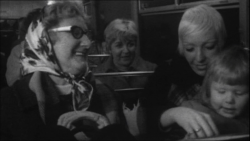
<em>Leeds United!</em> dramatises the 1970 dispute in which over 25,000 clothing workers, the majority of them women, went on strike across Leeds, other parts of Yorkshire and the North East.<sup id="rf1-4110"><a href="#fn1-4110" title="&lt;em&gt;Play for Today&lt;/em&gt;: &lt;em&gt;Leeds United!&lt;/em&gt;, tx. BBC1, 31 October 1974." rel="footnote">1</a></sup> Katrina Honeyman, in her history of the Leeds clothing industry, argued that the strike symbolised “the response of women workers to several decades of oppression by both employers and the male union hierarchy” and showed the “talent of women for political organization, [which is] so often overlooked in labour history”.<sup id="rf2-4110"><a href="#fn2-4110" title="Katrina Honeyman, &lt;em&gt;Well Suited: A History of the Leeds Clothing Industry, 1850-1990&lt;/em&gt; (Oxford: Oxford University Press, 2000), p. 209." rel="footnote">2</a></sup> <em>Leeds United!</em> reflects this talent in its methods of retelling, and reconstructing, the strike. According to director Roy Battersby in 2009, the play’s “ambition was to try to understand” how their “courageous” action took them to “the verge of winning” and how “within a few days that was turned into […] a miserable, heartbreaking compromise”.<sup id="rf3-4110"><a href="#fn3-4110" title="Roy Battersby, in Q&#038;A with John Hill and Kenith Trodd at BFI Southbank on 25 November 2009, in the Radical Television Drama season. Available to view &lt;a href=&quot;http://www.bfi.org.uk/live/video/255&quot; target=&quot;_self&quot; rel=&quot;noopener&quot;&gt;here&lt;/a&gt;." rel="footnote">3</a></sup> </p>

<hr class="footnotes"><ol class="footnotes" style="list-style-type:decimal"><li id="fn1-4110"><p ><em>Play for Today</em>: <em>Leeds United!</em>, tx. BBC1, 31 October 1974.&nbsp;<a href="#rf1-4110" class="backlink" title="Return to footnote 1.">&#8617;</a></p></li><li id="fn2-4110"><p >Katrina Honeyman, <em>Well Suited: A History of the Leeds Clothing Industry, 1850-1990</em> (Oxford: Oxford University Press, 2000), p. 209.&nbsp;<a href="#rf2-4110" class="backlink" title="Return to footnote 2.">&#8617;</a></p></li><li id="fn3-4110"><p >Roy Battersby, in Q&#038;A with John Hill and Kenith Trodd at BFI Southbank on 25 November 2009, in the Radical Television Drama season. Available to view <a href="http://www.bfi.org.uk/live/video/255" target="_self" rel="noopener">here</a>.&nbsp;<a href="#rf3-4110" class="backlink" title="Return to footnote 3.">&#8617;</a></p></li></ol></hr>{"id":4110,"date":"2014-02-28T06:00:23","date_gmt":"2014-02-28T06:00:23","guid":{"rendered":"http:\/\/www.britishtelevisiondrama.org.uk\/?p=4110"},"modified":"2024-08-30T11:38:14","modified_gmt":"2024-08-30T10:38:14","slug":"women-and-work-leeds-united-1974-part-1","status":"publish","type":"post","link":"http:\/\/www.britishtelevisiondrama.org.uk\/?p=4110","title":{"rendered":"Women and Work: <em>Leeds United!<\/em> (1974) Part 1 of 3"},"content":{"rendered":"<h4>by DAVID ROLINSON<\/h4>\n<p><em>Play for Today<\/em> <strong>Writer:<\/strong> Colin Welland; <strong>Producer:<\/strong> Kenith Trodd; <strong>Director:<\/strong> Roy Battersby<\/p>\n<p><em>\u201cWhen a woman looks at her wages and thinks of the hours she works and the conditions, she knows she is a slave\u2026\u201d<\/em><\/p>\n<p><img loading=\"lazy\" decoding=\"async\" src=\"http:\/\/www.britishtelevisiondrama.org.uk\/wp-content\/uploads\/2013\/11\/BTVD_LeedsUnited_1-e1383674061546.png\" alt=\"BTVD_LeedsUnited_1\" width=\"250\" height=\"141\" class=\"alignleft size-full wp-image-4185\" \/><br \/>\n<em>Leeds United!<\/em> dramatises the 1970 dispute in which over 25,000 clothing workers, the majority of them women, went on strike across Leeds, other parts of Yorkshire and the North East.<sup id=\"rf1-4110\"><a href=\"#fn1-4110\" title=\"&lt;em&gt;Play for Today&lt;\/em&gt;: &lt;em&gt;Leeds United!&lt;\/em&gt;, tx. BBC1, 31 October 1974.\" rel=\"footnote\">1<\/a><\/sup> Katrina Honeyman, in her history of the Leeds clothing industry, argued that the strike symbolised \u201cthe response of women workers to several decades of oppression by both employers and the male union hierarchy\u201d and showed the \u201ctalent of women for political organization, [which is] so often overlooked in labour history\u201d.<sup id=\"rf2-4110\"><a href=\"#fn2-4110\" title=\"Katrina Honeyman, &lt;em&gt;Well Suited: A History of the Leeds Clothing Industry, 1850-1990&lt;\/em&gt; (Oxford: Oxford University Press, 2000), p. 209.\" rel=\"footnote\">2<\/a><\/sup> <em>Leeds United!<\/em> reflects this talent in its methods of retelling, and reconstructing, the strike. According to director Roy Battersby in 2009, the play\u2019s \u201cambition was to try to understand\u201d how their \u201ccourageous\u201d action took them to \u201cthe verge of winning\u201d and how \u201cwithin a few days that was turned into [\u2026] a miserable, heartbreaking compromise\u201d.<sup id=\"rf3-4110\"><a href=\"#fn3-4110\" title=\"Roy Battersby, in Q&#038;A with John Hill and Kenith Trodd at BFI Southbank on 25 November 2009, in the Radical Television Drama season. Available to view &lt;a href=&quot;http:\/\/www.bfi.org.uk\/live\/video\/255&quot; target=&quot;_self&quot; rel=&quot;noopener&quot;&gt;here&lt;\/a&gt;.\" rel=\"footnote\">3<\/a><\/sup> <\/p>\n<p><!--more--><\/p>\n<p><em>Play for Today<\/em>\u2019s concern with contemporary Britain made the discussion of industrial disputes inevitable in this period, and made the strand a natural home for <em>Leeds United!<\/em> However, the play had been initially planned for Granada, and though the BBC accepted it they had reservations. Therefore, when <em>Leeds United!<\/em> featured in a recent academic journal issue on &#8216;Radical Television Drama&#8217;,<sup id=\"rf4-4110\"><a href=\"#fn4-4110\" title=\"&#8216;Radical Television Drama&#8217;, edited by John Hill, &lt;em&gt;Journal of British Cinema and Television&lt;\/em&gt;, Volume 10, Number 1, 2013, pp. 106-255. This includes a Lez Cooke interview with John McGrath and pieces by Billy Smart on &lt;em&gt;The Life of Galileo&lt;\/em&gt;, Leah Panos on Trevor Griffiths\u2019 &lt;em&gt;Absolute Beginners&lt;\/em&gt;, Derek Paget on docudramas by Peter Kosminsky and Stephen Frears, Sarita Malik on &lt;em&gt;Shoot the Messenger&lt;\/em&gt;, Stephen Harper on Peter Bowker\u2019s &lt;em&gt;Occupation&lt;\/em&gt; and Stephen Baker on &lt;em&gt;Early Doors&lt;\/em&gt;. &#8216;Radical Television Drama&#8217; shares Volume 10 Number 1 with the special issue &#8216;Cinema, Television and the Cold War&#8217;.\" rel=\"footnote\">4<\/a><\/sup> John Hill discussed the BBC\u2019s objections to <em>Leeds United!<\/em> and other Battersby dramas in order to assess the \u201cideological and institutional\u201d constraints \u201cweighing upon \u2018radical\u2019 political expression\u201d. Hill demonstrated that, despite the understandable view that programme makers in this period \u201cenjoyed substantial creative freedom to make work that challenged the status quo\u201d, we must note that such work \u201cwas far from the norm\u201d and was often fiercely contested.<sup id=\"rf5-4110\"><a href=\"#fn5-4110\" title=\"John Hill, \u2018From &lt;em&gt;Five Women&lt;\/em&gt; to &lt;em&gt;Leeds United!&lt;\/em&gt;: Roy Battersby and the Politics of \u201cRadical\u201d Television Drama\u2019, &lt;em&gt;Journal of British Cinema and Television&lt;\/em&gt;, Volume 10, Number 1, 2013, p. 132.\" rel=\"footnote\">5<\/a><\/sup> Therefore, although my essay attends to the play\u2019s creative methods of showing the experience of women workers, I am also mindful of Hill\u2019s warning that radical drama\u2019s \u201cpossibilities [\u2026] cannot be understood in terms of textual features alone but must also be accounted for in relation to the political and institutional contexts in which they are both produced and received\u201d.<sup id=\"rf6-4110\"><a href=\"#fn6-4110\" title=\"Hill, \u2018Introduction\u2019, &lt;em&gt;Journal of British Cinema and Television&lt;\/em&gt;, Volume 10, Number 1, p. 110.\" rel=\"footnote\">6<\/a><\/sup> This essay therefore uses various sources to build an account of the development of <em>Leeds United!<\/em> and responses to it within and outwith the BBC, building on my own previous research into the ways in which women workers responded to their depiction.<sup id=\"rf7-4110\"><a href=\"#fn7-4110\" title=\"Much of this essay is new but I\u2019m returning to the programme after discussing it in &lt;a href=&quot;http:\/\/www.screenonline.org.uk\/tv\/id\/1373817\/&quot; target=&quot;_self&quot; rel=&quot;noopener&quot;&gt;a Screenonline essay from 2009&lt;\/a&gt;, my article \u2018Small Screens and Big Voices: Televisual Social Realism and the Popular\u2019 in David Tucker (editor), &lt;em&gt;British Social Realism in the Arts since 1940&lt;\/em&gt; (Basingstoke: Palgrave Macmillan, 2011) and my paper \u2018\u201cDid you recognize yourself\u201d? Women workers &lt;em&gt;In Vision&lt;\/em&gt;\u2019 at the conference &lt;em&gt;Television for Women&lt;\/em&gt; at the University of Warwick in May 2013. The latter comes from my ongoing research into audience feedback programmes, as Part 3 of this current essay explains.\" rel=\"footnote\">7<\/a><\/sup> <\/p>\n<p><strong>Background<\/strong><\/p>\n<p><em>Leeds United!<\/em> depicts the strike\u2019s origins, motives, organisation and eventual breakdown; for <a href=\"http:\/\/www.screenonline.org.uk\/tv\/id\/1373817\/synopsis.html\" target=\"_self\" rel=\"noopener\">my synopsis of the plot, see here<\/a>. The play views the strike as a consequence of the controversial National Agreement which was implemented in 1970 after the union, without its members&#8217; approval, had negotiated it in 1969. This Agreement gave a pay rise of 5d per hour to men and 4d per hour to women,<sup id=\"rf8-4110\"><a href=\"#fn8-4110\" title=\"For more on the specifics of the National Agreement, see Honeyman and the pieces that she draws from, such as a piece by Jim Roche (Publicity Officer for the strike committee), \u2018The Leeds Clothing Strike\u2019, in T. Topham and M. Barratt Brown (editors), &lt;em&gt;Trade Union Register&lt;\/em&gt; (London, 1970).\" rel=\"footnote\">8<\/a><\/sup> a move that was described as a \u201cmiserably nominal increase in long-scandalous wages\u201d that maintained the industry\u2019s low pay,<sup id=\"rf9-4110\"><a href=\"#fn9-4110\" title=\"Leonard Buckley, \u2018Leeds \u2013 United!\u2019, &lt;em&gt;The Times&lt;\/em&gt;, 1 November 1974.\" rel=\"footnote\">9<\/a><\/sup> poor conditions, limited rights and gender inequality.<sup id=\"rf10-4110\"><a href=\"#fn10-4110\" title=\"As Honeyman documents, wages were one issue \u2013 they had fallen behind those of other workers and whilst the Agreement took place \u201cin the context of a 3.5% limit\u201d, it \u201chad not been altered once the ceiling had been raised\u201d. However, other issues \u201cbecame apparent\u201d during the strike, including \u201cpoor conditions of work, the chasm between the workers and the union, and the resentment of the female labour force over their long-term oppression by employers and the union.\u201d \u2013 Honeyman, p. 216; n.33.\" rel=\"footnote\">10<\/a><\/sup> In February 1970, workers struck for a shilling-per-hour increase \u2013 the \u201cbob an hour\u201d \u2013 which was to be equal: \u201call round, men and women, equal pay\u201d.<sup id=\"rf11-4110\"><a href=\"#fn11-4110\" title=\"Geoffrey Sheridan, \u2018Tailor made for drama\u2019, &lt;em&gt;The Guardian&lt;\/em&gt;, 31 October 1974. Sheridan details the situation: \u201cSchool leavers were on 2s 9d an hour. Women went home after a week\u2019s work with barely \u00a35 in their purses.\u201d\" rel=\"footnote\">11<\/a><\/sup> Discussing the programme in <em>The Sun<\/em>, Chris Greenwood observed that this strike, the first undertaken by these workers in over 36 years, \u201cshook the Yorkshire capital of the British clothing industry\u201d.<sup id=\"rf12-4110\"><a href=\"#fn12-4110\" title=\"Chris Greenwood, \u2018Angry women who shook a city\u2019, &lt;em&gt;The Sun&lt;\/em&gt;, 31 October 1974.\" rel=\"footnote\">12<\/a><\/sup> However, other previewers and reviews questioned the importance of the original events: in <em>The Guardian<\/em>, Nancy Banks-Smith asked \u201cHeard about the clothing workers\u2019 strike in Leeds in 1970, which debagged the nation for five weeks?\u201d and presumed a widespread negative response by answering \u201cNor me\u201d.<sup id=\"rf13-4110\"><a href=\"#fn13-4110\" title=\"Nancy Banks-Smith, \u2018Leeds \u2013 United!\u2019, &lt;em&gt;The Guardian&lt;\/em&gt;, 1 November 1974.\" rel=\"footnote\">13<\/a><\/sup> The difference between these two statements might indicate the events&#8217; relative regional and national impact, though <em>Play for Today<\/em> often provided a space for the national primetime transmission of dramas about different regions, and Greenwood&#8217;s more positive piece situates the Leeds events in their national context (and in this industry, Leeds is the &#8220;capital&#8221;). Greenwood&#8217;s statement that \u201cThe women of Leeds are about to become television stars\u201d<sup id=\"rf14-4110\"><a href=\"#fn14-4110\" title=\"Greenwood, &#8216;Angry women who shook a city&#8217;.\" rel=\"footnote\">14<\/a><\/sup> supports my view in this essay that the events and the play both position women workers as actors. They were social actors in the original events and became performers in helping the play to reconstruct those events. Thousands of people who were involved in the strike participated in the play\u2019s ambitious reconstructions of large-scale events during the strike, such as marches across Leeds and mass meetings. <\/p>\n<p><img loading=\"lazy\" decoding=\"async\" src=\"http:\/\/www.britishtelevisiondrama.org.uk\/wp-content\/uploads\/2013\/11\/BTVD_LeedsUnited_2-e1383674080360.png\" alt=\"BTVD_LeedsUnited_2\" width=\"250\" height=\"141\" class=\"alignleft size-full wp-image-4186\" \/><br \/>\nGreenwood\u2019s piece gave a sense, shared by a lot of the press coverage, that some of the play\u2019s strengths could be attributed to the personal involvement, regional background and professional identity of its writer. Greenwood described Colin Welland as \u201cone of the city\u2019s favourite sons\u201d who had been working on <em>Leeds United!<\/em> for \u201ca large part of the last four years\u201d.<sup id=\"rf15-4110\"><a href=\"#fn15-4110\" title=\"Ibid.\" rel=\"footnote\">15<\/a><\/sup> Observing that \u201cWelland first heard about the strike while he was enjoying a pint in his Leeds local, The Cavalier\u201d, Greenwood noted that the same pub had \u201cinspired him to write\u201d his earlier play <em>Slattery\u2019s Mounted Foot<\/em>.<sup id=\"rf16-4110\"><a href=\"#fn16-4110\" title=\"&lt;em&gt;Saturday Night Theatre&lt;\/em&gt;: &lt;em&gt;Slattery\u2019s Mounted Foot&lt;\/em&gt;, [LWT] ITV, tx. 20 June 1970, directed by Michael Apted. Similarly, Geoffrey Sheridan\u2019s preview in &lt;em&gt;The Guardian&lt;\/em&gt; noted that \u201cWelland was in a pub in Leeds during the strike when the idea for the film came to him.\u201d Sheridan, \u2018Tailor made for drama\u2019.\" rel=\"footnote\">16<\/a><\/sup> Welland had told the <em>Daily Telegraph<\/em> that \u201cI became personally involved because my mother-in-law was one of the strikers\u201d.<sup id=\"rf17-4110\"><a href=\"#fn17-4110\" title=\"Richard Last, \u2018BBC screens strike play ITV refused\u2019, &lt;em&gt;Daily Telegraph&lt;\/em&gt;, 11 October 1973.\" rel=\"footnote\">17<\/a><\/sup> In a much later interview with Paul Sutton, Welland recalled that his mother-in-law was <\/p>\n<blockquote><p>a little forty-eight year old Irish woman working in a clothing factory in Leeds. All her life, she, and these women, her fellow workers had never said \u201cBoo\u201d to a goose. And all of a sudden, when they asked for a rise and are offered 5p an hour more, they regard it as an insult and go on unofficial strike. They closed the city of Leeds down. They produced their own newspaper. It was a wonderful display of natural power, workers\u2019 power.<sup id=\"rf18-4110\"><a href=\"#fn18-4110\" title=\"Colin Welland, interviewed by Paul Sutton, previously available online at &lt;em&gt;Camera Journal&lt;\/em&gt; but presently offline. Quotation from Hill, \u2018From &lt;em&gt;Five Women&lt;\/em&gt; to &lt;em&gt;Leeds United&lt;\/em&gt;!, p. 140.\" rel=\"footnote\">18<\/a><\/sup> <\/p><\/blockquote>\n<p>However, personal involvement also had potential implications which Welland was keen to resist: for instance, he followed his above comment to the <em>Daily Telegraph<\/em> with the qualification: \u201cBut I have tried to look at the situation dispassionately. There are no villains \u2013 only victims.\u201d<sup id=\"rf19-4110\"><a href=\"#fn19-4110\" title=\"Last, \u2018BBC screens strike play ITV refused\u2019.\" rel=\"footnote\">19<\/a><\/sup> Some of the previews and critical responses that\u2019ll we\u2019ll see later in this essay take place along this axis of personal involvement\/professional distance. <\/p>\n<p>Similarly, the distinction between the personal and the political was negotiated by the programme makers in their depiction and analysis of events. Welland recalled of his inspirational moment in The Cavalier: \u201cSuddenly the women all round me were talking angrily about their rough deal, and singing anti-boss songs they had made up. I vividly remember one woman waving her \u00a38.75 wages around, and saying that was all she got for sweating her guts out all week at a sewing machine.\u201d  Welland paid tribute to how the women \u201crocked their union, rocked the management, rocked the very establishment of Leeds\u201d and \u201cleft their mark on history\u201d, although one of the ways in which he stressed their achievement at the time was by rooting their identity in the domestic \u2013 \u201cmostly mothers and housewives\u201d.<sup id=\"rf20-4110\"><a href=\"#fn20-4110\" title=\"Greenwood, \u2018Angry women who shook a city\u2019.\" rel=\"footnote\">20<\/a><\/sup> Of course he also stressed the political in other interviews, particularly later (\u201cworkers\u2019 power\u201d, as we have seen), and was quick to pay tribute to how \u201cWomen played a leading role\u201d, but their political involvement was at times described as something new to them: \u201cwomen who had never been to a union meeting in their lives; women who kept a picture of Mr Heath above their beds; women workers untrammelled by the tramlines of union procedure and bureaucracy [\u2026] these people who weren\u2019t at all political [\u2026but had] this tremendous <em>esprit de corps<\/em>\u201d.<sup id=\"rf21-4110\"><a href=\"#fn21-4110\" title=\"Sheridan, \u2018Tailor made for drama\u2019.\" rel=\"footnote\">21<\/a><\/sup> The William Ivory-scripted <em>Faith<\/em> (2005) and <em>Made in Dagenham <\/em>(2010) similarly foreground women who find solidarity and a means of expression in campaigning situations that were new to them, as \u2013 to quote Clive James on <em>Leeds United!<\/em> \u2013 \u201cSome of the women found themselves, some of them lost themselves, as the strike dragged on.\u201d<sup id=\"rf22-4110\"><a href=\"#fn22-4110\" title=\"Clive James, &lt;em&gt;The Observer&lt;\/em&gt;, 3 November 1974.\" rel=\"footnote\">22<\/a><\/sup> However, women who already held firm political principles before the strike were key participants in the original dispute &#8211; and they do play some part in Ivory\u2019s and Welland\u2019s dramas. Therefore, when Welland stated that the workers \u201cwere sold down the river\u201d,<sup id=\"rf23-4110\"><a href=\"#fn23-4110\" title=\"Greenwood, \u2018Angry women who shook a city\u2019.\" rel=\"footnote\">23<\/a><\/sup> and \u201cthe women I asked had no idea why\u201d they were back at work within three weeks, the statement is less an indication that the women lacked political insight and more a claim for the play\u2019s researched insight into the mechanics of their betrayal, part of which involved this failure of communication with the workers.<sup id=\"rf24-4110\"><a href=\"#fn24-4110\" title=\"Sheridan, \u2018Tailor made for drama\u2019.\" rel=\"footnote\">24<\/a><\/sup> <\/p>\n<p>Although Welland stressed to <em>The Guardian<\/em> that \u201che still doesn\u2019t know what the answer to the strike is\u201d, he felt that \u201cthe strikers\u2019 leadership was completely inadequate\u201d, so \u201cI want to say: \u2018Look around and find yourself some new leaders.\u2019\u201d<sup id=\"rf25-4110\"><a href=\"#fn25-4110\" title=\"Ibid.\" rel=\"footnote\">25<\/a><\/sup> Peter Fiddick described <em>Leeds United!<\/em> in <em>The Guardian<\/em> as \u201ca powerfully political play\u201d that showed \u201chow unions and bosses living too cosily together can leave the workers sweating on the bread-line\u201d.<sup id=\"rf26-4110\"><a href=\"#fn26-4110\" title=\"Peter Fiddick, \u2018Filming strife\u2019, &lt;em&gt;The &lt;\/em&gt;Guardian, 26 March 1974.\" rel=\"footnote\">26<\/a><\/sup> James Thomas used interestingly loaded language in describing the play\u2019s \u201caccount of a rowdy, desperate near-riot as these formidable battalions of angry women left their machines defying their union A.S.C.A.T&#8221; (the Association of Seamstresses Cutters and Tailors), but Thomas\u2019s statement that we were \u201cleft in no doubt about where Mr. Welland stood\u201d<sup id=\"rf27-4110\"><a href=\"#fn27-4110\" title=\"James Thomas, \u2018Sadness at the end of this battle for a bob\u2019, &lt;em&gt;Daily Express&lt;\/em&gt;, 1 November 1974.\" rel=\"footnote\">27<\/a><\/sup> would be typical of some of the doubts about the play in the press and within the BBC itself, as we shall see.<\/p>\n<p><strong>Development, from Granada to the BBC<\/strong><\/p>\n<p>The play was commissioned by ITV company Granada. While collaborating on <em>Roll on Four O\u2019 Clock<\/em>, Welland, Trodd and Battersby discussed their next project, and Welland suggested a piece on the strike.<sup id=\"rf28-4110\"><a href=\"#fn28-4110\" title=\"Granada \u201cwere very interested and commissioned the play\u201d \u2013 BBC Head of Plays Christopher Morahan, \u2018Leeds \u2013 United!!\u2019 memo, 12 May 1972, p. 1. Copyright registry file on Colin Welland, BBC WAC RCONT 21, BBC Written Archives Centre.\" rel=\"footnote\">28<\/a><\/sup> According to press interviews and reports, Welland spent \u201csix months [in Leeds] researching the situation, talking to the workers, the factory bosses, the union men\u201d,<sup id=\"rf29-4110\"><a href=\"#fn29-4110\" title=\"Fiddick, \u2018Filming strife\u2019.\" rel=\"footnote\">29<\/a><\/sup> then \u201cthree weeks tucked away in Ireland writing the script\u201d.<sup id=\"rf30-4110\"><a href=\"#fn30-4110\" title=\"Sheridan, \u2018Tailor made for drama\u2019.\" rel=\"footnote\">30<\/a><\/sup> Trodd felt that it would \u201cput our collaboration with Granada up several notches\u201d: this \u201creal and very recent\u201d story \u201chad everything \u2013 northern setting, heart-tearing and pyrrhic struggle by little people against mighty bosses\u201d.<sup id=\"rf31-4110\"><a href=\"#fn31-4110\" title=\"Kenith Trodd, \u2018The bear hug\u2019, in John Finch (editor), &lt;em&gt;Granada Television: The First Generation&lt;\/em&gt; (Manchester: Manchester University Press, 2003), p. 130.\" rel=\"footnote\">31<\/a><\/sup> However, the script sat with Granada \u201cfor six months\u201d,<sup id=\"rf32-4110\"><a href=\"#fn32-4110\" title=\"Sheridan, \u2018Tailor made for drama\u2019.\" rel=\"footnote\">32<\/a><\/sup> as \u2013 in Trodd\u2019s phrase \u2013 \u201cmysteriously the project did not thrive\u201d.<sup id=\"rf33-4110\"><a href=\"#fn33-4110\" title=\"Trodd, \u2018The bear hug\u2019, p. 130. Trodd characterised discussions about &lt;em&gt;Leeds \u2013 United!&lt;\/em&gt; as follows: \u201cYes, they thought it was a great idea but \u2026 Why didn\u2019t I offer Colin a 3-play deal and renew my own, with Roy in tow? We asked, couldn\u2019t we do Leeds first though? We were already on a roll with it. Maybe, but I have to run now and I\u2019ll catch up with you later for a jar\u201d.\" rel=\"footnote\">33<\/a><\/sup> Given that Welland, Trodd and Battersby were \u201cfirming up contracts with sweatshops and back-to-backs\u201d and \u201cMost of Leeds was already making the film with us\u201d, it was worrying that \u201cin Manchester its future was beginning to look indefinite\u201d. Eventually pinning down the Head of Drama (Peter Eckersley), they discovered that \u201cthough they loved us, they loved <em>Leeds United<\/em> less, though they could not explain why (they never did)\u201d.<\/p>\n<p>Trodd later told Colin MacCabe that \u201cGranada bottled out, so we took it to the BBC\u201d.<sup id=\"rf34-4110\"><a href=\"#fn34-4110\" title=\"Kenith Trodd, interviewed by Colin MacCabe, \u2018An Interview with Kenith Trodd\u2019, &lt;em&gt;Simon Gray&lt;\/em&gt; website, &lt;a href=&quot;http:\/\/simongray.org.uk\/blog\/?p=348&quot; target=&quot;_self&quot; rel=&quot;noopener&quot;&gt;available here&lt;\/a&gt;.\" rel=\"footnote\">34<\/a><\/sup> Granada\u2019s decision was described as a response to the expensive nature of the production: the <em>Daily Express<\/em> reported that \u201cGranada were interested but were put off by the scale of the operation [\u2026] It was easy to see why producers flinched [\u2026]: Welland had presented them with a formidable challenge.\u201d<sup id=\"rf35-4110\"><a href=\"#fn35-4110\" title=\"Thomas, \u2018Sadness at the end of this battle for a bob\u2019.\" rel=\"footnote\">35<\/a><\/sup> However, as Trodd\u2019s comment about bottling out shows, others saw it as a political issue. Lez Cooke has compared the fate of the \u201cpolitical\u201d <em>Leeds United!<\/em> with Granada\u2019s support for more \u201cpersonal\u201d Welland\/Trodd\/Battersby pieces like <em>Roll on Four O\u2019 Clock<\/em> to suggest \u201ca fundamental difference between Granada and the BBC as \u2018public service\u2019 broadcasters at the time\u201d.<sup id=\"rf36-4110\"><a href=\"#fn36-4110\" title=\"&lt;em&gt;Saturday Night Theatre&lt;\/em&gt;: &lt;em&gt;Roll on Four o\u2019 Clock&lt;\/em&gt;, [Granada] ITV, tx. 19 December 1970.\" rel=\"footnote\">36<\/a><\/sup> Therefore, although \u201cGranada saw itself as a liberal company\u201d, the decision \u201cindicates where Granada felt it needed to draw the line\u201d given the \u201ctension between [its] public service ambitions and its commercial obligations\u201d. Granada had a strong reputation for investigative, \u201cpolitical\u201d docudramas, but in Cooke\u2019s view the political scope of <em>Leeds United!<\/em> made it more problematic for Granada than the \u201cinternational\u201d address of <em>I Know What I Meant<\/em> (1974) and <em>Invasion<\/em> (1980), because <em>Leeds United!<\/em> was \u201ca play about contemporary class politics in Britain\u201d.<sup id=\"rf37-4110\"><a href=\"#fn37-4110\" title=\"Lez Cooke, &lt;em&gt;A Sense of Place: Regional British Television Drama, 1956-82&lt;\/em&gt; (Manchester: Manchester University Press, 2012), p. 98.\" rel=\"footnote\">37<\/a><\/sup> <\/p>\n<p><em>Leeds United!<\/em> was offered to the BBC. In a memo dated 12 May 1972, Head of Plays Christopher Morahan recommended purchasing it, finding it \u201ca splendid script for a filmed <em>Play for Today<\/em>\u201d.<sup id=\"rf38-4110\"><a href=\"#fn38-4110\" title=\"Morahan, \u2018Leeds \u2013 United!!\u2019 memo, p. 1.\" rel=\"footnote\">38<\/a><\/sup> Morahan recounted the origins of the play, stressing Welland\u2019s family circumstances and local knowledge: how Morahan had met Welland\u2019s mother-in-law and had sat in The Cavalier listening to the women\u2019s songs.<sup id=\"rf39-4110\"><a href=\"#fn39-4110\" title=\"Morahan collaborated with Welland on a stage version of &lt;em&gt;Slattery\u2019s Mounted Foot&lt;\/em&gt;.\" rel=\"footnote\">39<\/a><\/sup> Morahan argued that the play was committed to \u201cthe humanity and strength of the women of Leeds\u201d, but explained that \u201cI\u2019m stressing this human commitment of Colin\u2019s and his absence of political guile because [\u2026] this subject, at first sight, is contentious.\u201d Morahan paid tribute to \u201cColin\u2019s care in his research and his desire to tell the truth as he sees it\u201d but was aware that those qualities could lead to difficulties. <\/p>\n<p>Morahan noted that the words attributed to people such as the Union secretary were accurate: therefore the negotiation of docudramatic space here depended in part on the visibility of evidence, a direct indexical relationship between dramatized statements and the reality such statements dramatize. Therefore, the programme makers constantly stressed that the piece was drawn from many interviews and much investigation \u2013 as producer Kenith Trodd put it, \u201cColin, as he did with everything, researched it thoroughly\u201d.<sup id=\"rf40-4110\"><a href=\"#fn40-4110\" title=\"Trodd, interviewed by MacCabe, &lt;em&gt;Simon Gray&lt;\/em&gt;.\" rel=\"footnote\">40<\/a><\/sup> However, this negotiation of space also depended on the visibility of drama\/fiction. Certain names and details were changed, as was noted by <em>Daily Express<\/em> reviewer James Thomas and <em>Guardian<\/em> previewer Geoffrey Sheridan respectively: \u201cthe names of official and bosses were fictitious\u201d<sup id=\"rf41-4110\"><a href=\"#fn41-4110\" title=\"Thomas, \u2018Sadness at the end of this battle for a bob\u2019.\" rel=\"footnote\">41<\/a><\/sup> and the \u201cmultiple tailors\u201d whose association kept wages \u201cin line\u201d were \u201chousehold names, although they\u2019ve been changed in the film.\u201d<sup id=\"rf42-4110\"><a href=\"#fn42-4110\" title=\"Sheridan, &#8216;Tailor made for drama.\" rel=\"footnote\">42<\/a><\/sup> Morahan wondered whether it might be necessary to disguise the names of manufacturers and Union representatives even further than Welland had already done (to which Welland was amenable) and thought about the challenges of filming in Leeds when one factory was so recognisable locally that its use \u201cmight jeopardise the fiction that we\u2019ve attempted\u201d. Therefore the specificity of the local is also a feature of this docudramatic negotiation, the drama\u2019s success depending on the ability to convincingly reproduce events in the regional space \u2013 Morahan explained how the programme makers\u2019 contacts and research could help to gain access to premises and large crowds \u2013 whilst also partly disavowing some of the details.<sup id=\"rf43-4110\"><a href=\"#fn43-4110\" title=\"Morahan, \u2018Leeds \u2013 United!!\u2019 memo, p. 1.\" rel=\"footnote\">43<\/a><\/sup> These negotiations of space arguably turned on questions of advocacy \u2013 the importance of \u201cthe absence of political guile\u201d in the representation of political events and debate. These questions were the subject of serious concern elsewhere within the BBC, as we shall see later.<\/p>\n<p>Morahan noted that Granada owned the script, but Welland \u201chas their spoken agreement to release it\u201d. Morahan recommended purchasing it, but needed to agree a budget, which could be drawn up by Trodd if the BBC hired him.<sup id=\"rf44-4110\"><a href=\"#fn44-4110\" title=\"Trodd, nearing the end of his Granada contract, was to be hired by the BBC initially on a weekly contract but with a view to him becoming a regular Play for Today producer. Trodd\u2019s future role is beyond the scope of this essay, but is discussed in memos by Morahan and, briefly, Gerald Savory, in the copyright registry file on Colin Welland. BBC WAC RCONT 21, BBC Written Archives Centre.\" rel=\"footnote\">44<\/a><\/sup> Morahan\u2019s suggested schedule involved agreeing this budget by July, hiring Battersby as director in August, starting shooting in September and finishing by November. It was already established that the play would, unusually, be shot in black and white.<sup id=\"rf45-4110\"><a href=\"#fn45-4110\" title=\"Morahan, \u2018Leeds \u2013 United!!\u2019 memo, p. 2.\" rel=\"footnote\">45<\/a><\/sup> On 26 May the Head of Copyright was briefed to purchase the script with the intention that a revised version would form a 90-minute <em>Play for Today<\/em>, as per Morahan\u2019s memo, though the play\u2019s eventual running time would be much longer. The purchase would be treated as a commission \u2013 paying the fee in two halves \u2013 and an enhanced fee was recommended to reflect Welland\u2019s \u201cextensive research beyond that normally expected from an author\u201d.<sup id=\"rf46-4110\"><a href=\"#fn46-4110\" title=\"Brian Batchelor (Chief Assistant (General) Drama Group Television), \u2018Leeds United\u2019, memo to H. Cop., 26 May 1972. BBC WAC. The note observed the executives who had agreed the purchase. Copyright registry file on Colin Welland, BBC WAC RCONT 21, BBC Written Archives Centre.\" rel=\"footnote\">46<\/a><\/sup> (Welland\u2019s fee was mentioned in later press coverage: according to <em>The Guardian<\/em>\u2019s Geoffrey Sheridan, Welland \u201cestimates that his [\u2026] fee represents a return of approximately 0.5p an hour for the time he spent. \u2018I was just delighted that the BBC would do it.\u2019 Granada held the script for six months and didn\u2019t.\u201d<sup id=\"rf47-4110\"><a href=\"#fn47-4110\" title=\"Sheridan, \u2018Tailor made for drama\u2019. Sheridan gives Welland\u2019s fee as \u00a31,000, though this doesn\u2019t quite match the figure quoted in BBC documentation.\" rel=\"footnote\">47<\/a><\/sup> ) On 31 May, an agreement was sent to Welland\u2019s agent, noting that the revised script had a delivery date of 14 July and asking for Welland\u2019s attention to be drawn to the clause pertaining to defamation and the fact that acceptance might depend on vetting by the BBC Solicitor\u2019s Department.<sup id=\"rf48-4110\"><a href=\"#fn48-4110\" title=\"Ben Travers, Assistant Head of Copyright, \u2018Leeds United \u2013 90\u2019 original television play by Colin Welland\u2019, 01\/CT\/BT, Memo to various, 31 May 1972. Copyright registry file on Colin Welland, BBC WAC RCONT 21, BBC Written Archives Centre.\" rel=\"footnote\">48<\/a><\/sup><\/p>\n<p>The length of the play was a challenge for programme makers and broadcasters alike. Welland recalled coming out of the research process with \u201ca long script that in the end the BBC costed at \u00a3300,000. So then Trodd, Battersby, and I went through it again. I cut it, re-wrote it, fought for the bits I really felt important, and in the end we still had a big, two-hour, very detailed script. It still costs \u00a3150,000.\u201d<sup id=\"rf49-4110\"><a href=\"#fn49-4110\" title=\"Fiddick, \u2018Filming strife\u2019.\" rel=\"footnote\">49<\/a><\/sup> The budget was a constant reference point for previewers and reviewers: the <em>Daily Mail<\/em> called it \u201cthe BBC\u2019s most expensive drama production\u201d.<sup id=\"rf50-4110\"><a href=\"#fn50-4110\" title=\"Martin Jackson, &lt;em&gt;Daily Mail&lt;\/em&gt;, 22 June 1974. The piece claimed that the budget was \u00a3100,000.\" rel=\"footnote\">50<\/a><\/sup> In October 1973, the <em>Daily Telegraph<\/em> reported that \u201cThe BBC is to spend up to \u00a3150,000 producing a television play about a strike in a Northern clothing factory which the ITV channel rejected as too controversial.\u201d<sup id=\"rf51-4110\"><a href=\"#fn51-4110\" title=\"Last, \u2018BBC screens strike play ITV refused\u2019.\" rel=\"footnote\">51<\/a><\/sup> John Hill recently noted that the play\u2019s budget would have been \u201crelatively modest\u201d for a British cinema film at the time, but that it was \u201cthree times the cost of the average <em>Play for Today<\/em> and almost double the cost of <em>The Operation<\/em>\u201d, a Roger Smith-scripted <em>Play for Today<\/em> produced by Trodd and directed by Battersby.<sup id=\"rf52-4110\"><a href=\"#fn52-4110\" title=\"Hill, \u2018From &lt;em&gt;Five Women&lt;\/em&gt;\u2019, p. 141. &lt;em&gt;Play for Today&lt;\/em&gt;: &lt;em&gt;The Operation&lt;\/em&gt;, tx. BBC1, 26 February 1973.\" rel=\"footnote\">52<\/a><\/sup> Hill quoted the \u201cwaspish\u201d reaction of Alasdair Milne to the Board of Governors in 1974: the \u201cwhole production had been rather like Concorde [\u2026] it would have cost as much to stop as it would to go on to the end\u201d.<sup id=\"rf53-4110\"><a href=\"#fn53-4110\" title=\"Meeting of the Board of Governors, 21 November 1974, BBCWAC R1\/42\/2, BBC Written Archives Centre. Quoted in Hill, \u2018From &lt;em&gt;Five Women&lt;\/em&gt;\u2019, p. 141.\" rel=\"footnote\">53<\/a><\/sup> <\/p>\n<p><strong>Post-production dispute: television workers<\/strong><\/p>\n<p>In October 1973, the <em>Daily Telegraph<\/em> mentioned <em>Leeds United!<\/em> in advance promotion of a new batch of 26 <em>Play for Today<\/em> productions, with the strand about to be restored to Thursday nights after its move to Mondays had resulted in lower ratings.<sup id=\"rf54-4110\"><a href=\"#fn54-4110\" title=\"Last, \u2018BBC screens strike play ITV refused\u2019.\" rel=\"footnote\">54<\/a><\/sup> However, the completion and broadcast of <em>Leeds United!<\/em> were delayed. In <em>The Guardian<\/em> in March 1974, Peter Fiddick reported that the play \u201cwas filmed on location in Leeds last October running into November\u201d and \u201cneeds now just to be edited\u201d, but it has been \u201cstuck all these months, because two departments within the BBC cannot agree\u201d about who the editor should be.<sup id=\"rf55-4110\"><a href=\"#fn55-4110\" title=\"Fiddick, \u2018Filming strife\u2019. The later piece \u2018\u201cWho edits\u201d row finally settled\u2019 says that the play \u201ctook seven weeks to film\u201d \u2013 see endnote 56.\" rel=\"footnote\">55<\/a><\/sup> Welland stated that Battersby \u201cwants to do it with someone he\u2019s worked with before\u201d,<sup id=\"rf56-4110\"><a href=\"#fn56-4110\" title=\"Fiddick, &#8216;Filming strife&#8217;.\" rel=\"footnote\">56<\/a><\/sup> and Trodd was later reported as having been \u201cvery anxious that everyone on the production team should have had previous experience of working with Roy Battersby and there were no staff editors in the BBC who fulfilled that condition.\u201d<sup id=\"rf57-4110\"><a href=\"#fn57-4110\" title=\"Anonymous, \u2018\u201cWho edits\u201d row finally settled\u2019, &lt;em&gt;CinemaTV Today&lt;\/em&gt;, 29 June 1974, p. 14. Journal research by Ian Greaves.\" rel=\"footnote\">57<\/a><\/sup> Battersby wanted to use the freelance Tom Scott-Robson.<sup id=\"rf58-4110\"><a href=\"#fn58-4110\" title=\"Fiddick, &#8216;Filming strife&#8217;.\" rel=\"footnote\">58<\/a><\/sup> However, as Fiddick noted, \u201cThe BBC\u2019s own film department, based at Ealing Studios, which controls and allocates the corporation\u2019s own army of staff cameramen, editors, and other technicians, says the production must be handled by one of their own editors; no outsiders.\u201d<sup id=\"rf59-4110\"><a href=\"#fn59-4110\" title=\"Ibid. Fiddick notes that Battersby himself is a freelance, but the drama department\u2019s staff men\u201d including Trodd and Morahan \u201chave supported his view.\u201d\" rel=\"footnote\">59<\/a><\/sup> For Fiddick, the situation reflected \u201cstrains not only between \u2018creative workers\u2019 and \u2018craftsmen\u2019 but between the staff men and the freelances\u201d at a time when the industry was moving from permanent staff to short-term and medium-term contracts \u201cfor specific jobs\u201d, with costs being cut and \u201cthe concept of independent producers [becoming] fashionable\u201d. (In May 1974, <em>Film and Television Technician<\/em> reported that the <em>Leeds United!<\/em> case had involved \u201ctensions not only between [the unions] ABS [the Association of Broadcasting Staff \u2013 renamed the Association of Broadcasting and Allied Staffs in 1974 \u2013 representing technicians in the BBC] and ACTT [the Association of Cinematograph Television and Allied Technicians, representing technicians in cinema and ITV] but also between ACTT freelances and the BBC staff members.\u201d<sup id=\"rf60-4110\"><a href=\"#fn60-4110\" title=\"D. Penderyn, \u2018BBC Column\u2019, &lt;em&gt;Film and Television Technician&lt;\/em&gt;, May 1974, p. 24. The column begins with ACTT solidarity with an ABS strike that resulted from the suspension of engineers as part of a dispute regarding their payment for working on regional programmes in colour. Journal research by Ian Greaves.\" rel=\"footnote\">60<\/a><\/sup> ) Describing the pros and cons of staff and freelance work, Fiddick noted that full-time crew moved between productions as required \u2013 \u201ca 90-minute star-laden drama one week, and a ten-minute trip round a museum the next\u201d \u2013 and enjoyed \u201csecurity\u201d while freelances preferred \u201cworking on things that interest them\u201d, \u201cbeing reliant on their reputations for their work\u201d, and benefited in terms of wages and different tax arrangements when working. However, it would be problematic if \u201cstaff men feel the plum jobs are going too much to the freelances\u201d, rather than their bosses \u201cguaranteeing them interesting work\u201d.<sup id=\"rf61-4110\"><a href=\"#fn61-4110\" title=\"Ibid.\" rel=\"footnote\">61<\/a><\/sup> Trodd later noted a similar situation when Granada refused him and Battersby the use of freelance cameraman Tony Imi on a project, with Denis Forman telling him: \u201cYou two are birds of passage [\u2026] you\u2019ll be flying onwards. We have to look after 700 people who are with us for good\u201d.<sup id=\"rf62-4110\"><a href=\"#fn62-4110\" title=\"Trodd, \u2018The bear hug\u2019, p. 130.\" rel=\"footnote\">62<\/a><\/sup> However, as Fiddick noted, allowing people to \u201c[choose] their technicians just as they would choose actors\u201d was one way to \u201ckeep room for the creative spark\u201d by \u201cletting the creators work the way they work best\u201d.<sup id=\"rf63-4110\"><a href=\"#fn63-4110\" title=\"Fiddick, \u2018Filming strife\u2019.\" rel=\"footnote\">63<\/a><\/sup><\/p>\n<p>\u201cWhy should <em>Leeds United<\/em> suddenly become the problem?\u201d, asked Welland,<sup id=\"rf64-4110\"><a href=\"#fn64-4110\" title=\"Ibid.\" rel=\"footnote\">64<\/a><\/sup> who gave his own <em>Kisses At Fifty<\/em>,<sup id=\"rf65-4110\"><a href=\"#fn65-4110\" title=\"&lt;em&gt;Play for Today&lt;\/em&gt;: &lt;em&gt;Kisses At Fifty&lt;\/em&gt;, tx. BBC1, 22 January 1973. (Written by Colin Welland; Produced by Graeme McDonald; Directed by Michael Apted.) \" rel=\"footnote\">65<\/a><\/sup> and the Brian Clark-scripted <em>Easy Go<\/em>,<sup id=\"rf66-4110\"><a href=\"#fn66-4110\" title=\"&lt;em&gt;Play for Today&lt;\/em&gt;: &lt;em&gt;Easy Go&lt;\/em&gt;, tx. BBC1, 7 March 1974. (Written by Brian Clarke; Produced by Graeme McDonald; Directed by Michael Tuchner.) This play was also postponed, from 7 February, but for a different reason: &lt;em&gt;Midweek&lt;\/em&gt; \u201cwas \u2018promoted\u2019 to BBC 1 [from BBC 2] because of the forthcoming General Election in late February\u201d \u2013 Simon Coward, Richard Down and Chris Perry, &lt;em&gt;The Kaleidoscope BBC Television Drama Research Guide 1936-2011&lt;\/em&gt; (Dudley: Kaleidoscope, 2011, digital edition), p. 1906.\" rel=\"footnote\">66<\/a><\/sup> as examples of how <em>Play for Today <\/em>regularly used freelance editors.<sup id=\"rf67-4110\"><a href=\"#fn67-4110\" title=\"Fiddick put it more strongly: \u201cthe majority of filmed &lt;em&gt;Plays for Today&lt;\/em&gt; are cut outside.\u201d Fiddick, \u2018Filming strife\u2019.\" rel=\"footnote\">67<\/a><\/sup> Fiddick reported that the dispute was \u201creferred up\u201d to director of programmes Alasdair Milne at the start of 1974. There were brief discussions of whether to have a junior staff editor working alongside Scott-Robson, or whether Scott-Robson \u201cmight come back onto the staff\u201d despite him having worked freelance on other BBC programmes.<sup id=\"rf68-4110\"><a href=\"#fn68-4110\" title=\"The former idea \u201clasted one morning\u201d, the latter idea \u201cwas a none-starter.\u201d Ibid.\" rel=\"footnote\">68<\/a><\/sup> Don Fairservice, who was on secondment to the National Film School, seemed to be the solution, but at first he too was blocked.<sup id=\"rf69-4110\"><a href=\"#fn69-4110\" title=\"\u201cOn March 6, the BBC staff union \u2013 the ABS \u2013 wrote to the management asking for \u2018clarification.\u2019 There has been no reply.\u201d Ibid.\" rel=\"footnote\">69<\/a><\/sup> Tony Hearn, general secretary of the union, the Association of Broadcasting Staff, told Fiddick that \u201cIf the management offered serious talks on the general problem, a single programme would not be the issue, and the blacking could be lifted.\u201d This follows Fiddick\u2019s concern that \u201cmanagers and unions\u201d needed \u201cto face up to the new realities with rather more urgency.\u201d<sup id=\"rf70-4110\"><a href=\"#fn70-4110\" title=\"Ibid.\" rel=\"footnote\">70<\/a><\/sup>  <\/p>\n<p>In May 1974, <em>Film and Television Technician<\/em> reported that the BBC Joint Shops Committee, having \u201cfirmly stated that they will not have [\u2026<em>Leeds United!<\/em>] cut by an outside editor\u201d, rapped \u201cthe knuckles of the freelance producer and director\u201d, having been \u201cannoyed by the attempt to push this and other issues in the press.\u201d But equally, \u201cBBC-elected representatives are not happy about a trade union pressing the management to refuse a producer and director a say in which staff editor should cut their film.\u201d The Committee urgently requested a meeting with the Freelance Shop \u201cto discuss a policy on non-BBC personnel.\u201d<sup id=\"rf71-4110\"><a href=\"#fn71-4110\" title=\"Penderyn, \u2018BBC Column\u2019. Journal research by Ian Greaves. The description of Trodd as a \u201cfreelance\u201d producer is complicated by the contract situation mentioned earlier in this essay; indeed, Fiddick described Trodd as a staff man in endnote 57, above.\" rel=\"footnote\">71<\/a><\/sup><\/p>\n<p>In June 1974, the <em>Daily Mail<\/em> reported that the \u201cwho-does-what row\u201d had been settled as \u201cAgreement has now been reached on a BBC editor, Don Fairservice, and the play will be in the BBC-1 schedule, taking over most of an evening viewing, later this autumn.\u201d<sup id=\"rf72-4110\"><a href=\"#fn72-4110\" title=\"Martin Jackson, &lt;em&gt;Daily Mail&lt;\/em&gt;, 22 June 1974.\" rel=\"footnote\">72<\/a><\/sup> Later that month, <em>CinemaTV Today<\/em> reported that the row \u201chas ended with a climb-down\u201d by Trodd and Battersby. Although Fiddick called Fairservice \u201cthe one other BBC editor Battersby had worked with\u201d,<sup id=\"rf73-4110\"><a href=\"#fn73-4110\" title=\"Fiddick, &#8216;Filming strife&#8217;.\" rel=\"footnote\">73<\/a><\/sup> Trodd is quoted here as saying that, \u201cAlthough Roy hasn\u2019t worked with Don before, he knows him personally. He was on a year\u2019s attachment to the National Film School but we persuaded the film school to let him go and the BBC to recall him. It is a compromise solution but we are very satisfied.\u201d<sup id=\"rf74-4110\"><a href=\"#fn74-4110\" title=\"Anonymous, \u2018\u201cWho edits\u201d row finally settled\u2019.\" rel=\"footnote\">74<\/a><\/sup> The piece expresses Trodd\u2019s hope that <em>Leeds United!<\/em> will be shown \u201cin early November [\u2026] according to a novel transmission plan \u2013 the first half before the 9 o\u2019 clock news and the second half afterwards\u201d. It would ultimately be shown on BBC1 on 31 October 1974 between 9.25pm and 11.20pm.<\/p>\n<p>This essay continues in <a href=\"http:\/\/www.britishtelevisiondrama.org.uk\/?p=4429\" target=\"_self\" rel=\"noopener\">Part 2<\/a>: the play and Part 3: the debate.<\/p>\n<p><em>Originally posted (Part 1): 28 February 2014.<\/em><br \/>\nUpdates:<br \/>\n24 June 2015: Small number of minor changes to expression in main body; in endnotes, minor typographical corrections and additional Greenwood citation to clarify a stray &#8216;Ibid&#8217;.<\/em><\/p>\n<p><body><!-- Start of StatCounter Code --><br \/>\n<script type=\"text\/javascript\">\nvar sc_project=5750652; \nvar sc_invisible=1; \nvar sc_partition=68; \nvar sc_click_stat=1; \nvar sc_security=\"6dd1aa39\"; \n<\/script><\/p>\n<p><script type=\"text\/javascript\"\nsrc=\"http:\/\/www.statcounter.com\/counter\/counter.js\"><\/script><noscript>\n<div<br \/>\nclass=&#8221;statcounter&#8221;><a title=\"wordpress stats \"<br \/>\nhref=&#8221;http:\/\/www.statcounter.com\/wordpress.org\/&#8221;<br \/>\ntarget=&#8221;_blank&#8221;><img class=\"statcounter\"<br \/>\nsrc=&#8221;http:\/\/c.statcounter.com\/5750652\/0\/6dd1aa39\/1\/&#8221;<br \/>\nalt=&#8221;wordpress stats &#8221; ><\/a><\/div>\n<p><\/noscript><br \/>\n<!-- End of StatCounter Code --><\/body><\/p>\n<hr class=\"footnotes\"><ol class=\"footnotes\" style=\"list-style-type:decimal\"><li id=\"fn1-4110\"><p ><em>Play for Today<\/em>: <em>Leeds United!<\/em>, tx. BBC1, 31 October 1974.&nbsp;<a href=\"#rf1-4110\" class=\"backlink\" title=\"Return to footnote 1.\">&#8617;<\/a><\/p><\/li><li id=\"fn2-4110\"><p >Katrina Honeyman, <em>Well Suited: A History of the Leeds Clothing Industry, 1850-1990<\/em> (Oxford: Oxford University Press, 2000), p. 209.&nbsp;<a href=\"#rf2-4110\" class=\"backlink\" title=\"Return to footnote 2.\">&#8617;<\/a><\/p><\/li><li id=\"fn3-4110\"><p >Roy Battersby, in Q&#038;A with John Hill and Kenith Trodd at BFI Southbank on 25 November 2009, in the Radical Television Drama season. Available to view <a href=\"http:\/\/www.bfi.org.uk\/live\/video\/255\" target=\"_self\" rel=\"noopener\">here<\/a>.&nbsp;<a href=\"#rf3-4110\" class=\"backlink\" title=\"Return to footnote 3.\">&#8617;<\/a><\/p><\/li><li id=\"fn4-4110\"><p >&#8216;Radical Television Drama&#8217;, edited by John Hill, <em>Journal of British Cinema and Television<\/em>, Volume 10, Number 1, 2013, pp. 106-255. This includes a Lez Cooke interview with John McGrath and pieces by Billy Smart on <em>The Life of Galileo<\/em>, Leah Panos on Trevor Griffiths\u2019 <em>Absolute Beginners<\/em>, Derek Paget on docudramas by Peter Kosminsky and Stephen Frears, Sarita Malik on <em>Shoot the Messenger<\/em>, Stephen Harper on Peter Bowker\u2019s <em>Occupation<\/em> and Stephen Baker on <em>Early Doors<\/em>. &#8216;Radical Television Drama&#8217; shares Volume 10 Number 1 with the special issue &#8216;Cinema, Television and the Cold War&#8217;.&nbsp;<a href=\"#rf4-4110\" class=\"backlink\" title=\"Return to footnote 4.\">&#8617;<\/a><\/p><\/li><li id=\"fn5-4110\"><p >John Hill, \u2018From <em>Five Women<\/em> to <em>Leeds United!<\/em>: Roy Battersby and the Politics of \u201cRadical\u201d Television Drama\u2019, <em>Journal of British Cinema and Television<\/em>, Volume 10, Number 1, 2013, p. 132.&nbsp;<a href=\"#rf5-4110\" class=\"backlink\" title=\"Return to footnote 5.\">&#8617;<\/a><\/p><\/li><li id=\"fn6-4110\"><p >Hill, \u2018Introduction\u2019, <em>Journal of British Cinema and Television<\/em>, Volume 10, Number 1, p. 110.&nbsp;<a href=\"#rf6-4110\" class=\"backlink\" title=\"Return to footnote 6.\">&#8617;<\/a><\/p><\/li><li id=\"fn7-4110\"><p >Much of this essay is new but I\u2019m returning to the programme after discussing it in <a href=\"http:\/\/www.screenonline.org.uk\/tv\/id\/1373817\/\" target=\"_self\" rel=\"noopener\">a Screenonline essay from 2009<\/a>, my article \u2018Small Screens and Big Voices: Televisual Social Realism and the Popular\u2019 in David Tucker (editor), <em>British Social Realism in the Arts since 1940<\/em> (Basingstoke: Palgrave Macmillan, 2011) and my paper \u2018\u201cDid you recognize yourself\u201d? Women workers <em>In Vision<\/em>\u2019 at the conference <em>Television for Women<\/em> at the University of Warwick in May 2013. The latter comes from my ongoing research into audience feedback programmes, as Part 3 of this current essay explains.&nbsp;<a href=\"#rf7-4110\" class=\"backlink\" title=\"Return to footnote 7.\">&#8617;<\/a><\/p><\/li><li id=\"fn8-4110\"><p >For more on the specifics of the National Agreement, see Honeyman and the pieces that she draws from, such as a piece by Jim Roche (Publicity Officer for the strike committee), \u2018The Leeds Clothing Strike\u2019, in T. Topham and M. Barratt Brown (editors), <em>Trade Union Register<\/em> (London, 1970).&nbsp;<a href=\"#rf8-4110\" class=\"backlink\" title=\"Return to footnote 8.\">&#8617;<\/a><\/p><\/li><li id=\"fn9-4110\"><p >Leonard Buckley, \u2018Leeds \u2013 United!\u2019, <em>The Times<\/em>, 1 November 1974.&nbsp;<a href=\"#rf9-4110\" class=\"backlink\" title=\"Return to footnote 9.\">&#8617;<\/a><\/p><\/li><li id=\"fn10-4110\"><p >As Honeyman documents, wages were one issue \u2013 they had fallen behind those of other workers and whilst the Agreement took place \u201cin the context of a 3.5% limit\u201d, it \u201chad not been altered once the ceiling had been raised\u201d. However, other issues \u201cbecame apparent\u201d during the strike, including \u201cpoor conditions of work, the chasm between the workers and the union, and the resentment of the female labour force over their long-term oppression by employers and the union.\u201d \u2013 Honeyman, p. 216; n.33.&nbsp;<a href=\"#rf10-4110\" class=\"backlink\" title=\"Return to footnote 10.\">&#8617;<\/a><\/p><\/li><li id=\"fn11-4110\"><p >Geoffrey Sheridan, \u2018Tailor made for drama\u2019, <em>The Guardian<\/em>, 31 October 1974. Sheridan details the situation: \u201cSchool leavers were on 2s 9d an hour. Women went home after a week\u2019s work with barely \u00a35 in their purses.\u201d&nbsp;<a href=\"#rf11-4110\" class=\"backlink\" title=\"Return to footnote 11.\">&#8617;<\/a><\/p><\/li><li id=\"fn12-4110\"><p >Chris Greenwood, \u2018Angry women who shook a city\u2019, <em>The Sun<\/em>, 31 October 1974.&nbsp;<a href=\"#rf12-4110\" class=\"backlink\" title=\"Return to footnote 12.\">&#8617;<\/a><\/p><\/li><li id=\"fn13-4110\"><p >Nancy Banks-Smith, \u2018Leeds \u2013 United!\u2019, <em>The Guardian<\/em>, 1 November 1974.&nbsp;<a href=\"#rf13-4110\" class=\"backlink\" title=\"Return to footnote 13.\">&#8617;<\/a><\/p><\/li><li id=\"fn14-4110\"><p >Greenwood, &#8216;Angry women who shook a city&#8217;.&nbsp;<a href=\"#rf14-4110\" class=\"backlink\" title=\"Return to footnote 14.\">&#8617;<\/a><\/p><\/li><li id=\"fn15-4110\"><p >Ibid.&nbsp;<a href=\"#rf15-4110\" class=\"backlink\" title=\"Return to footnote 15.\">&#8617;<\/a><\/p><\/li><li id=\"fn16-4110\"><p ><em>Saturday Night Theatre<\/em>: <em>Slattery\u2019s Mounted Foot<\/em>, [LWT] ITV, tx. 20 June 1970, directed by Michael Apted. Similarly, Geoffrey Sheridan\u2019s preview in <em>The Guardian<\/em> noted that \u201cWelland was in a pub in Leeds during the strike when the idea for the film came to him.\u201d Sheridan, \u2018Tailor made for drama\u2019.&nbsp;<a href=\"#rf16-4110\" class=\"backlink\" title=\"Return to footnote 16.\">&#8617;<\/a><\/p><\/li><li id=\"fn17-4110\"><p >Richard Last, \u2018BBC screens strike play ITV refused\u2019, <em>Daily Telegraph<\/em>, 11 October 1973.&nbsp;<a href=\"#rf17-4110\" class=\"backlink\" title=\"Return to footnote 17.\">&#8617;<\/a><\/p><\/li><li id=\"fn18-4110\"><p >Colin Welland, interviewed by Paul Sutton, previously available online at <em>Camera Journal<\/em> but presently offline. Quotation from Hill, \u2018From <em>Five Women<\/em> to <em>Leeds United<\/em>!, p. 140.&nbsp;<a href=\"#rf18-4110\" class=\"backlink\" title=\"Return to footnote 18.\">&#8617;<\/a><\/p><\/li><li id=\"fn19-4110\"><p >Last, \u2018BBC screens strike play ITV refused\u2019.&nbsp;<a href=\"#rf19-4110\" class=\"backlink\" title=\"Return to footnote 19.\">&#8617;<\/a><\/p><\/li><li id=\"fn20-4110\"><p >Greenwood, \u2018Angry women who shook a city\u2019.&nbsp;<a href=\"#rf20-4110\" class=\"backlink\" title=\"Return to footnote 20.\">&#8617;<\/a><\/p><\/li><li id=\"fn21-4110\"><p >Sheridan, \u2018Tailor made for drama\u2019.&nbsp;<a href=\"#rf21-4110\" class=\"backlink\" title=\"Return to footnote 21.\">&#8617;<\/a><\/p><\/li><li id=\"fn22-4110\"><p >Clive James, <em>The Observer<\/em>, 3 November 1974.&nbsp;<a href=\"#rf22-4110\" class=\"backlink\" title=\"Return to footnote 22.\">&#8617;<\/a><\/p><\/li><li id=\"fn23-4110\"><p >Greenwood, \u2018Angry women who shook a city\u2019.&nbsp;<a href=\"#rf23-4110\" class=\"backlink\" title=\"Return to footnote 23.\">&#8617;<\/a><\/p><\/li><li id=\"fn24-4110\"><p >Sheridan, \u2018Tailor made for drama\u2019.&nbsp;<a href=\"#rf24-4110\" class=\"backlink\" title=\"Return to footnote 24.\">&#8617;<\/a><\/p><\/li><li id=\"fn25-4110\"><p >Ibid.&nbsp;<a href=\"#rf25-4110\" class=\"backlink\" title=\"Return to footnote 25.\">&#8617;<\/a><\/p><\/li><li id=\"fn26-4110\"><p >Peter Fiddick, \u2018Filming strife\u2019, <em>The <\/em>Guardian, 26 March 1974.&nbsp;<a href=\"#rf26-4110\" class=\"backlink\" title=\"Return to footnote 26.\">&#8617;<\/a><\/p><\/li><li id=\"fn27-4110\"><p >James Thomas, \u2018Sadness at the end of this battle for a bob\u2019, <em>Daily Express<\/em>, 1 November 1974.&nbsp;<a href=\"#rf27-4110\" class=\"backlink\" title=\"Return to footnote 27.\">&#8617;<\/a><\/p><\/li><li id=\"fn28-4110\"><p >Granada \u201cwere very interested and commissioned the play\u201d \u2013 BBC Head of Plays Christopher Morahan, \u2018Leeds \u2013 United!!\u2019 memo, 12 May 1972, p. 1. Copyright registry file on Colin Welland, BBC WAC RCONT 21, BBC Written Archives Centre.&nbsp;<a href=\"#rf28-4110\" class=\"backlink\" title=\"Return to footnote 28.\">&#8617;<\/a><\/p><\/li><li id=\"fn29-4110\"><p >Fiddick, \u2018Filming strife\u2019.&nbsp;<a href=\"#rf29-4110\" class=\"backlink\" title=\"Return to footnote 29.\">&#8617;<\/a><\/p><\/li><li id=\"fn30-4110\"><p >Sheridan, \u2018Tailor made for drama\u2019.&nbsp;<a href=\"#rf30-4110\" class=\"backlink\" title=\"Return to footnote 30.\">&#8617;<\/a><\/p><\/li><li id=\"fn31-4110\"><p >Kenith Trodd, \u2018The bear hug\u2019, in John Finch (editor), <em>Granada Television: The First Generation<\/em> (Manchester: Manchester University Press, 2003), p. 130.&nbsp;<a href=\"#rf31-4110\" class=\"backlink\" title=\"Return to footnote 31.\">&#8617;<\/a><\/p><\/li><li id=\"fn32-4110\"><p >Sheridan, \u2018Tailor made for drama\u2019.&nbsp;<a href=\"#rf32-4110\" class=\"backlink\" title=\"Return to footnote 32.\">&#8617;<\/a><\/p><\/li><li id=\"fn33-4110\"><p >Trodd, \u2018The bear hug\u2019, p. 130. Trodd characterised discussions about <em>Leeds \u2013 United!<\/em> as follows: \u201cYes, they thought it was a great idea but \u2026 Why didn\u2019t I offer Colin a 3-play deal and renew my own, with Roy in tow? We asked, couldn\u2019t we do Leeds first though? We were already on a roll with it. Maybe, but I have to run now and I\u2019ll catch up with you later for a jar\u201d.&nbsp;<a href=\"#rf33-4110\" class=\"backlink\" title=\"Return to footnote 33.\">&#8617;<\/a><\/p><\/li><li id=\"fn34-4110\"><p >Kenith Trodd, interviewed by Colin MacCabe, \u2018An Interview with Kenith Trodd\u2019, <em>Simon Gray<\/em> website, <a href=\"http:\/\/simongray.org.uk\/blog\/?p=348\" target=\"_self\" rel=\"noopener\">available here<\/a>.&nbsp;<a href=\"#rf34-4110\" class=\"backlink\" title=\"Return to footnote 34.\">&#8617;<\/a><\/p><\/li><li id=\"fn35-4110\"><p >Thomas, \u2018Sadness at the end of this battle for a bob\u2019.&nbsp;<a href=\"#rf35-4110\" class=\"backlink\" title=\"Return to footnote 35.\">&#8617;<\/a><\/p><\/li><li id=\"fn36-4110\"><p ><em>Saturday Night Theatre<\/em>: <em>Roll on Four o\u2019 Clock<\/em>, [Granada] ITV, tx. 19 December 1970.&nbsp;<a href=\"#rf36-4110\" class=\"backlink\" title=\"Return to footnote 36.\">&#8617;<\/a><\/p><\/li><li id=\"fn37-4110\"><p >Lez Cooke, <em>A Sense of Place: Regional British Television Drama, 1956-82<\/em> (Manchester: Manchester University Press, 2012), p. 98.&nbsp;<a href=\"#rf37-4110\" class=\"backlink\" title=\"Return to footnote 37.\">&#8617;<\/a><\/p><\/li><li id=\"fn38-4110\"><p >Morahan, \u2018Leeds \u2013 United!!\u2019 memo, p. 1.&nbsp;<a href=\"#rf38-4110\" class=\"backlink\" title=\"Return to footnote 38.\">&#8617;<\/a><\/p><\/li><li id=\"fn39-4110\"><p >Morahan collaborated with Welland on a stage version of <em>Slattery\u2019s Mounted Foot<\/em>.&nbsp;<a href=\"#rf39-4110\" class=\"backlink\" title=\"Return to footnote 39.\">&#8617;<\/a><\/p><\/li><li id=\"fn40-4110\"><p >Trodd, interviewed by MacCabe, <em>Simon Gray<\/em>.&nbsp;<a href=\"#rf40-4110\" class=\"backlink\" title=\"Return to footnote 40.\">&#8617;<\/a><\/p><\/li><li id=\"fn41-4110\"><p >Thomas, \u2018Sadness at the end of this battle for a bob\u2019.&nbsp;<a href=\"#rf41-4110\" class=\"backlink\" title=\"Return to footnote 41.\">&#8617;<\/a><\/p><\/li><li id=\"fn42-4110\"><p >Sheridan, &#8216;Tailor made for drama.&nbsp;<a href=\"#rf42-4110\" class=\"backlink\" title=\"Return to footnote 42.\">&#8617;<\/a><\/p><\/li><li id=\"fn43-4110\"><p >Morahan, \u2018Leeds \u2013 United!!\u2019 memo, p. 1.&nbsp;<a href=\"#rf43-4110\" class=\"backlink\" title=\"Return to footnote 43.\">&#8617;<\/a><\/p><\/li><li id=\"fn44-4110\"><p >Trodd, nearing the end of his Granada contract, was to be hired by the BBC initially on a weekly contract but with a view to him becoming a regular Play for Today producer. Trodd\u2019s future role is beyond the scope of this essay, but is discussed in memos by Morahan and, briefly, Gerald Savory, in the copyright registry file on Colin Welland. BBC WAC RCONT 21, BBC Written Archives Centre.&nbsp;<a href=\"#rf44-4110\" class=\"backlink\" title=\"Return to footnote 44.\">&#8617;<\/a><\/p><\/li><li id=\"fn45-4110\"><p >Morahan, \u2018Leeds \u2013 United!!\u2019 memo, p. 2.&nbsp;<a href=\"#rf45-4110\" class=\"backlink\" title=\"Return to footnote 45.\">&#8617;<\/a><\/p><\/li><li id=\"fn46-4110\"><p >Brian Batchelor (Chief Assistant (General) Drama Group Television), \u2018Leeds United\u2019, memo to H. Cop., 26 May 1972. BBC WAC. The note observed the executives who had agreed the purchase. Copyright registry file on Colin Welland, BBC WAC RCONT 21, BBC Written Archives Centre.&nbsp;<a href=\"#rf46-4110\" class=\"backlink\" title=\"Return to footnote 46.\">&#8617;<\/a><\/p><\/li><li id=\"fn47-4110\"><p >Sheridan, \u2018Tailor made for drama\u2019. Sheridan gives Welland\u2019s fee as \u00a31,000, though this doesn\u2019t quite match the figure quoted in BBC documentation.&nbsp;<a href=\"#rf47-4110\" class=\"backlink\" title=\"Return to footnote 47.\">&#8617;<\/a><\/p><\/li><li id=\"fn48-4110\"><p >Ben Travers, Assistant Head of Copyright, \u2018Leeds United \u2013 90\u2019 original television play by Colin Welland\u2019, 01\/CT\/BT, Memo to various, 31 May 1972. Copyright registry file on Colin Welland, BBC WAC RCONT 21, BBC Written Archives Centre.&nbsp;<a href=\"#rf48-4110\" class=\"backlink\" title=\"Return to footnote 48.\">&#8617;<\/a><\/p><\/li><li id=\"fn49-4110\"><p >Fiddick, \u2018Filming strife\u2019.&nbsp;<a href=\"#rf49-4110\" class=\"backlink\" title=\"Return to footnote 49.\">&#8617;<\/a><\/p><\/li><li id=\"fn50-4110\"><p >Martin Jackson, <em>Daily Mail<\/em>, 22 June 1974. The piece claimed that the budget was \u00a3100,000.&nbsp;<a href=\"#rf50-4110\" class=\"backlink\" title=\"Return to footnote 50.\">&#8617;<\/a><\/p><\/li><li id=\"fn51-4110\"><p >Last, \u2018BBC screens strike play ITV refused\u2019.&nbsp;<a href=\"#rf51-4110\" class=\"backlink\" title=\"Return to footnote 51.\">&#8617;<\/a><\/p><\/li><li id=\"fn52-4110\"><p >Hill, \u2018From <em>Five Women<\/em>\u2019, p. 141. <em>Play for Today<\/em>: <em>The Operation<\/em>, tx. BBC1, 26 February 1973.&nbsp;<a href=\"#rf52-4110\" class=\"backlink\" title=\"Return to footnote 52.\">&#8617;<\/a><\/p><\/li><li id=\"fn53-4110\"><p >Meeting of the Board of Governors, 21 November 1974, BBCWAC R1\/42\/2, BBC Written Archives Centre. Quoted in Hill, \u2018From <em>Five Women<\/em>\u2019, p. 141.&nbsp;<a href=\"#rf53-4110\" class=\"backlink\" title=\"Return to footnote 53.\">&#8617;<\/a><\/p><\/li><li id=\"fn54-4110\"><p >Last, \u2018BBC screens strike play ITV refused\u2019.&nbsp;<a href=\"#rf54-4110\" class=\"backlink\" title=\"Return to footnote 54.\">&#8617;<\/a><\/p><\/li><li id=\"fn55-4110\"><p >Fiddick, \u2018Filming strife\u2019. The later piece \u2018\u201cWho edits\u201d row finally settled\u2019 says that the play \u201ctook seven weeks to film\u201d \u2013 see endnote 56.&nbsp;<a href=\"#rf55-4110\" class=\"backlink\" title=\"Return to footnote 55.\">&#8617;<\/a><\/p><\/li><li id=\"fn56-4110\"><p >Fiddick, &#8216;Filming strife&#8217;.&nbsp;<a href=\"#rf56-4110\" class=\"backlink\" title=\"Return to footnote 56.\">&#8617;<\/a><\/p><\/li><li id=\"fn57-4110\"><p >Anonymous, \u2018\u201cWho edits\u201d row finally settled\u2019, <em>CinemaTV Today<\/em>, 29 June 1974, p. 14. Journal research by Ian Greaves.&nbsp;<a href=\"#rf57-4110\" class=\"backlink\" title=\"Return to footnote 57.\">&#8617;<\/a><\/p><\/li><li id=\"fn58-4110\"><p >Fiddick, &#8216;Filming strife&#8217;.&nbsp;<a href=\"#rf58-4110\" class=\"backlink\" title=\"Return to footnote 58.\">&#8617;<\/a><\/p><\/li><li id=\"fn59-4110\"><p >Ibid. Fiddick notes that Battersby himself is a freelance, but the drama department\u2019s staff men\u201d including Trodd and Morahan \u201chave supported his view.\u201d&nbsp;<a href=\"#rf59-4110\" class=\"backlink\" title=\"Return to footnote 59.\">&#8617;<\/a><\/p><\/li><li id=\"fn60-4110\"><p >D. Penderyn, \u2018BBC Column\u2019, <em>Film and Television Technician<\/em>, May 1974, p. 24. The column begins with ACTT solidarity with an ABS strike that resulted from the suspension of engineers as part of a dispute regarding their payment for working on regional programmes in colour. Journal research by Ian Greaves.&nbsp;<a href=\"#rf60-4110\" class=\"backlink\" title=\"Return to footnote 60.\">&#8617;<\/a><\/p><\/li><li id=\"fn61-4110\"><p >Ibid.&nbsp;<a href=\"#rf61-4110\" class=\"backlink\" title=\"Return to footnote 61.\">&#8617;<\/a><\/p><\/li><li id=\"fn62-4110\"><p >Trodd, \u2018The bear hug\u2019, p. 130.&nbsp;<a href=\"#rf62-4110\" class=\"backlink\" title=\"Return to footnote 62.\">&#8617;<\/a><\/p><\/li><li id=\"fn63-4110\"><p >Fiddick, \u2018Filming strife\u2019.&nbsp;<a href=\"#rf63-4110\" class=\"backlink\" title=\"Return to footnote 63.\">&#8617;<\/a><\/p><\/li><li id=\"fn64-4110\"><p >Ibid.&nbsp;<a href=\"#rf64-4110\" class=\"backlink\" title=\"Return to footnote 64.\">&#8617;<\/a><\/p><\/li><li id=\"fn65-4110\"><p ><em>Play for Today<\/em>: <em>Kisses At Fifty<\/em>, tx. BBC1, 22 January 1973. (Written by Colin Welland; Produced by Graeme McDonald; Directed by Michael Apted.) &nbsp;<a href=\"#rf65-4110\" class=\"backlink\" title=\"Return to footnote 65.\">&#8617;<\/a><\/p><\/li><li id=\"fn66-4110\"><p ><em>Play for Today<\/em>: <em>Easy Go<\/em>, tx. BBC1, 7 March 1974. (Written by Brian Clarke; Produced by Graeme McDonald; Directed by Michael Tuchner.) This play was also postponed, from 7 February, but for a different reason: <em>Midweek<\/em> \u201cwas \u2018promoted\u2019 to BBC 1 [from BBC 2] because of the forthcoming General Election in late February\u201d \u2013 Simon Coward, Richard Down and Chris Perry, <em>The Kaleidoscope BBC Television Drama Research Guide 1936-2011<\/em> (Dudley: Kaleidoscope, 2011, digital edition), p. 1906.&nbsp;<a href=\"#rf66-4110\" class=\"backlink\" title=\"Return to footnote 66.\">&#8617;<\/a><\/p><\/li><li id=\"fn67-4110\"><p >Fiddick put it more strongly: \u201cthe majority of filmed <em>Plays for Today<\/em> are cut outside.\u201d Fiddick, \u2018Filming strife\u2019.&nbsp;<a href=\"#rf67-4110\" class=\"backlink\" title=\"Return to footnote 67.\">&#8617;<\/a><\/p><\/li><li id=\"fn68-4110\"><p >The former idea \u201clasted one morning\u201d, the latter idea \u201cwas a none-starter.\u201d Ibid.&nbsp;<a href=\"#rf68-4110\" class=\"backlink\" title=\"Return to footnote 68.\">&#8617;<\/a><\/p><\/li><li id=\"fn69-4110\"><p >\u201cOn March 6, the BBC staff union \u2013 the ABS \u2013 wrote to the management asking for \u2018clarification.\u2019 There has been no reply.\u201d Ibid.&nbsp;<a href=\"#rf69-4110\" class=\"backlink\" title=\"Return to footnote 69.\">&#8617;<\/a><\/p><\/li><li id=\"fn70-4110\"><p >Ibid.&nbsp;<a href=\"#rf70-4110\" class=\"backlink\" title=\"Return to footnote 70.\">&#8617;<\/a><\/p><\/li><li id=\"fn71-4110\"><p >Penderyn, \u2018BBC Column\u2019. Journal research by Ian Greaves. The description of Trodd as a \u201cfreelance\u201d producer is complicated by the contract situation mentioned earlier in this essay; indeed, Fiddick described Trodd as a staff man in endnote 57, above.&nbsp;<a href=\"#rf71-4110\" class=\"backlink\" title=\"Return to footnote 71.\">&#8617;<\/a><\/p><\/li><li id=\"fn72-4110\"><p >Martin Jackson, <em>Daily Mail<\/em>, 22 June 1974.&nbsp;<a href=\"#rf72-4110\" class=\"backlink\" title=\"Return to footnote 72.\">&#8617;<\/a><\/p><\/li><li id=\"fn73-4110\"><p >Fiddick, &#8216;Filming strife&#8217;.&nbsp;<a href=\"#rf73-4110\" class=\"backlink\" title=\"Return to footnote 73.\">&#8617;<\/a><\/p><\/li><li id=\"fn74-4110\"><p >Anonymous, \u2018\u201cWho edits\u201d row finally settled\u2019.&nbsp;<a href=\"#rf74-4110\" class=\"backlink\" title=\"Return to footnote 74.\">&#8617;<\/p><\/li><\/p><\/ol><\/hr>","protected":false},"excerpt":{"rendered":null,"protected":false},"author":1,"featured_media":0,"comment_status":"open","ping_status":"open","sticky":false,"template":"","format":"standard","meta":{"footnotes":""},"categories":[140,137],"tags":[64,452,434,76,16,84],"class_list":["post-4110","post","type-post","status-publish","format-standard","hentry","category-david-rolinson","category-essays","tag-colin-welland","tag-docudrama","tag-granada","tag-kenith-trodd","tag-play-for-today","tag-roy-battersby"],"_links":{"self":[{"href":"http:\/\/www.britishtelevisiondrama.org.uk\/index.php?rest_route=\/wp\/v2\/posts\/4110","targetHints":{"allow":["GET"]}}],"collection":[{"href":"http:\/\/www.britishtelevisiondrama.org.uk\/index.php?rest_route=\/wp\/v2\/posts"}],"about":[{"href":"http:\/\/www.britishtelevisiondrama.org.uk\/index.php?rest_route=\/wp\/v2\/types\/post"}],"author":[{"embeddable":true,"href":"http:\/\/www.britishtelevisiondrama.org.uk\/index.php?rest_route=\/wp\/v2\/users\/1"}],"replies":[{"embeddable":true,"href":"http:\/\/www.britishtelevisiondrama.org.uk\/index.php?rest_route=%2Fwp%2Fv2%2Fcomments&post=4110"}],"version-history":[{"count":70,"href":"http:\/\/www.britishtelevisiondrama.org.uk\/index.php?rest_route=\/wp\/v2\/posts\/4110\/revisions"}],"predecessor-version":[{"id":8272,"href":"http:\/\/www.britishtelevisiondrama.org.uk\/index.php?rest_route=\/wp\/v2\/posts\/4110\/revisions\/8272"}],"wp:attachment":[{"href":"http:\/\/www.britishtelevisiondrama.org.uk\/index.php?rest_route=%2Fwp%2Fv2%2Fmedia&parent=4110"}],"wp:term":[{"taxonomy":"category","embeddable":true,"href":"http:\/\/www.britishtelevisiondrama.org.uk\/index.php?rest_route=%2Fwp%2Fv2%2Fcategories&post=4110"},{"taxonomy":"post_tag","embeddable":true,"href":"http:\/\/www.britishtelevisiondrama.org.uk\/index.php?rest_route=%2Fwp%2Fv2%2Ftags&post=4110"}],"curies":[{"name":"wp","href":"https:\/\/api.w.org\/{rel}","templated":true}]}}