<h4>by OLIVER WAKE</h4>
<p><em>Armchair Theatre</em> <strong>Writer:</strong> James Forsyth; <strong>Adapted from (novel):</strong> Harold Rein; <strong>Producer</strong> Sydney Newman; <strong>Director</strong>: William Kotcheff</p>
<p><em>This piece was substantially revised and updated in 2018.</em></p>
<p>When people talk about live television drama, and in particular the disasters that can befall live productions, actors forgetting their lines and technical faults loom large. Sometimes mention will be made of the incident in which a leading actor died during a performance. It sounds like it could be a dark joke or an industry myth, but it’s true. It’s a morbid story but a fascinating one.</p>
<p><img loading="lazy" decoding="async" src="http://www.britishtelevisiondrama.org.uk/wp-content/uploads/2019/11/BTVD_Underground-book-cover-e1573553487653-192x300.jpg" alt="" width="192" height="300" class="alignleft size-medium wp-image-7543" srcset="http://www.britishtelevisiondrama.org.uk/wp-content/uploads/2019/11/BTVD_Underground-book-cover-e1573553487653-192x300.jpg 192w, http://www.britishtelevisiondrama.org.uk/wp-content/uploads/2019/11/BTVD_Underground-book-cover-e1573553487653-654x1024.jpg 654w, http://www.britishtelevisiondrama.org.uk/wp-content/uploads/2019/11/BTVD_Underground-book-cover-e1573553487653-69x108.jpg 69w, http://www.britishtelevisiondrama.org.uk/wp-content/uploads/2019/11/BTVD_Underground-book-cover-e1573553487653.jpg 734w" sizes="auto, (max-width: 192px) 100vw, 192px" /></p>
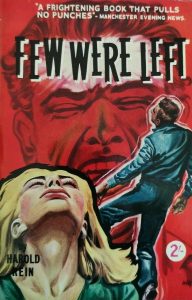
<p>The production in question was <em>Underground</em>, transmitted on Sunday 30 November 1958 as part of ITV company ABC’s popular <em>Armchair Theatre</em> drama anthology. It was directed by William (known as Ted) Kotcheff, one of ABC’s regular directors, then aged only 27, and produced by Sydney Newman, the company’s drama supervisor. The play was a television dramatisation by James Forsyth of Harold Rein’s 1955 novel <em>Few Were Left</em>. No recording of the play exists, so this account is based on various interviews and media reports about the play. There are several accounts of what happened which, though largely consistent on the main events, differ notably on the smaller details. In this essay I’ll try to separate the reality from the myth and distortion as far as is possible at this remove from the event itself.</p>{"id":4313,"date":"2013-12-18T06:00:49","date_gmt":"2013-12-18T06:00:49","guid":{"rendered":"http:\/\/www.britishtelevisiondrama.org.uk\/?p=4313"},"modified":"2024-08-30T11:38:32","modified_gmt":"2024-08-30T10:38:32","slug":"underground-1958-2","status":"publish","type":"post","link":"http:\/\/www.britishtelevisiondrama.org.uk\/?p=4313","title":{"rendered":"<em>Underground<\/em> (1958)"},"content":{"rendered":"<h4>by OLIVER WAKE<\/h4>\n<p><em>Armchair Theatre<\/em> <strong>Writer:<\/strong> James Forsyth; <strong>Adapted from (novel):<\/strong> Harold Rein; <strong>Producer<\/strong> Sydney Newman; <strong>Director<\/strong>: William Kotcheff<\/strong><\/p>\n<p><em>This piece was substantially revised and updated in 2018.<\/em><\/p>\n<p>When people talk about live television drama, and in particular the disasters that can befall live productions, actors forgetting their lines and technical faults loom large. Sometimes mention will be made of the incident in which a leading actor died during a performance. It sounds like it could be a dark joke or an industry myth, but it\u2019s true. It\u2019s a morbid story but a fascinating one.<\/p>\n<p><img loading=\"lazy\" decoding=\"async\" src=\"http:\/\/www.britishtelevisiondrama.org.uk\/wp-content\/uploads\/2019\/11\/BTVD_Underground-book-cover-e1573553487653-192x300.jpg\" alt=\"\" width=\"192\" height=\"300\" class=\"alignleft size-medium wp-image-7543\" srcset=\"http:\/\/www.britishtelevisiondrama.org.uk\/wp-content\/uploads\/2019\/11\/BTVD_Underground-book-cover-e1573553487653-192x300.jpg 192w, http:\/\/www.britishtelevisiondrama.org.uk\/wp-content\/uploads\/2019\/11\/BTVD_Underground-book-cover-e1573553487653-654x1024.jpg 654w, http:\/\/www.britishtelevisiondrama.org.uk\/wp-content\/uploads\/2019\/11\/BTVD_Underground-book-cover-e1573553487653-69x108.jpg 69w, http:\/\/www.britishtelevisiondrama.org.uk\/wp-content\/uploads\/2019\/11\/BTVD_Underground-book-cover-e1573553487653.jpg 734w\" sizes=\"auto, (max-width: 192px) 100vw, 192px\" \/><\/p>\n<p>The production in question was <em>Underground<\/em>, transmitted on Sunday 30 November 1958 as part of ITV company ABC\u2019s popular <em>Armchair Theatre<\/em> drama anthology. It was directed by William (known as Ted) Kotcheff, one of ABC\u2019s regular directors, then aged only 27, and produced by Sydney Newman, the company\u2019s drama supervisor. The play was a television dramatisation by James Forsyth of Harold Rein\u2019s 1955 novel <em>Few Were Left<\/em>. No recording of the play exists, so this account is based on various interviews and media reports about the play. There are several accounts of what happened which, though largely consistent on the main events, differ notably on the smaller details. In this essay I\u2019ll try to separate the reality from the myth and distortion as far as is possible at this remove from the event itself.<\/p>\n<p><!--more--><\/p>\n<p>The ill-fated actor was Gareth Jones, from Lampeter in Wales. Accounts differ as to his age. Newspapers variously reported he was 34 or 35. However, fellow actors Peter Bowles (who appeared in <em>Underground<\/em>) and Richard Huggett put him in his twenties.<sup id=\"rf1-4313\"><a href=\"#fn1-4313\" title=\"Peter Bowles in Kate Dunn, &lt;em&gt;Do Not Adjust Your Set&lt;\/em&gt; (London: John Murray, 2003), p. 120; Richard Huggett, \u2018Excuse me, I need my flask of brandy \u2013 it\u2019s for my heart\u2019, &lt;em&gt;The Stage and Television Today&lt;\/em&gt;, 10 July 1986, p. 18. See endnote 7 below for a discussion of Huggett\u2019s reliability.\" rel=\"footnote\">1<\/a><\/sup> Kotcheff has at different times reported Jones was 32 and 33, although both occasions were long after the events in question so his memory may not have been exact.<sup id=\"rf2-4313\"><a href=\"#fn2-4313\" title=\"Kotcheff in James Cathcart, \u2018Talking with veteran director Ted Kotcheff\u2026\u2019, from &lt;em&gt;nashvillescene.com&lt;\/em&gt;, posted 8 November 2012. Available &lt;a href=&quot;http:\/\/www.nashvillescene.com\/nashville\/talking-with-veteran-director-ted-kotcheff-whose-rediscovered-classic-wake-in-fright-is-the-movie-of-the-moment\/Content?oid=3072701&quot; target=&quot;_self&quot; rel=&quot;noopener noreferrer&quot;&gt;here&lt;\/a&gt; [accessed 22 December 2013]; and Ted Kotcheff and Josh Young, &lt;em&gt;Director\u2019s Cut: My Life in Film&lt;\/em&gt; (Toronto: ECW Press, 2017), p. 143.\" rel=\"footnote\">2<\/a><\/sup> In their obituary, <em>The Stage<\/em> newspaper called Jones \u201cA good actor, a hard worker, a real \u2018pro\u2019 and a man of great personal charm\u201d.<sup id=\"rf3-4313\"><a href=\"#fn3-4313\" title=\"Anonymous, \u2018Obituary\u2019, &lt;em&gt;The Stage&lt;\/em&gt;, 4 December 1958, p. 17.\" rel=\"footnote\">3<\/a><\/sup> Decades later, Huggett, who reported he had been Jones\u2019s friend and contemporary at drama school, recalled him as \u201ca fat, flabby, lazy, likable, oversexed, boozy, moderately talented actor\u201d.<sup id=\"rf4-4313\"><a href=\"#fn4-4313\" title=\"Huggett, \u2018Excuse me, I need my flask of brandy \u2013 it\u2019s for my heart\u2019.\" rel=\"footnote\">4<\/a><\/sup> Jones\u2019s agent, Joan Reddish, claimed he had been \u201call set to become a star\u201d when he died.<sup id=\"rf5-4313\"><a href=\"#fn5-4313\" title=\"Joan Reddish in Brendon Mulholland, \u2018Actor Dies On TV\u2019, &lt;em&gt;Daily Herald&lt;\/em&gt;, 1 December 1958, p. 1.\" rel=\"footnote\">5<\/a><\/sup> This may not be just an agent\u2019s hyperbole, with leading television director Philip Saville, who had directed Jones in two earlier <em>Armchair Theatre<\/em> plays, recalling him as \u201ca very exciting actor\u201d.<sup id=\"rf6-4313\"><a href=\"#fn6-4313\" title=\"Saville in Richard Marson, &lt;em&gt;Drama and Delight: The Life of Verity Lambert&lt;\/em&gt; (Tadworth: Miwk Publishing, 2015), p. 41.\" rel=\"footnote\">6<\/a><\/sup> Saville felt Jones was \u201clike a young Charles Laughton or Simon Russell Beale. He could have had an amazing career.\u201d<\/p>\n<p>According to Huggett, Jones had graduated from the Central School of Dramatic Art in the summer of 1953 and, apparently without much effort, was rapidly able to join a West End company formed by theatre impresario \u2018Binkie\u2019 Beaumont.<sup id=\"rf7-4313\"><a href=\"#fn7-4313\" title=\"Huggett, \u2018Excuse me, I need my flask of brandy \u2013 it\u2019s for my heart\u2019. In the previous versions of this essay, Huggett\u2019s article was cited more frequently as a source than it is in this November 2018 version. His account regards &lt;em&gt;Underground&lt;\/em&gt; and Jones\u2019s death is frequently at odds with more authoritative accounts, or with verifiable fact (e.g. dates and &lt;em&gt;Armchair Theatre&lt;\/em&gt;\u2019s network status), and these discrepancies have been further emphasised by the new sources incorporated into this revision. Whereas some other sources (e.g. Ted Kotcheff, Sydney Newman and Peter Bowles) were part of the production of &lt;em&gt;Underground&lt;\/em&gt;, we have no knowledge that Huggett had any connection with the production (and it seems reasonable to assume that he would have recorded any such connection in his account if he had had one), or what sources he relied upon in compiling his account. Huggett passed away in 2000 so it has not been possible to clarify this with him. With all other sources being broadly consistent, and with a lack of supporting evidence for Huggett\u2019s account where it differs from others, it has been decided that Huggett\u2019s account is unlikely to be reliable and it has therefore largely been removed from this essay. Although we are doubtful about the reliability of Huggett\u2019s account of &lt;em&gt;Underground&lt;\/em&gt; and the exact circumstances of Jones\u2019s death, we have no reason to doubt that Huggett was, as he claimed, a friend of Jones\u2019s from drama school (which may also explain how he came to write his article), so the details he gives of Jones\u2019s personal background and his own impression of Jones have been retained. Needless to say, Richard Huggett should not be confused with the much younger actor currently working under the same name.\" rel=\"footnote\">7<\/a><\/sup> He played Marcellus in <em>Hamlet<\/em> and, when this production was staged in Moscow in 1955, he reportedly became the first &#8220;English&#8221; actor to speak on a Russian stage since the 1917 revolution.<sup id=\"rf8-4313\"><a href=\"#fn8-4313\" title=\"Anonymous, \u2018Actor Dies on Set in TV Play\u2019, &lt;em&gt;Daily Express&lt;\/em&gt;, 1 December 1958, p. 2. The quotation marks around English here, like the word &#8220;reportedly&#8221;, indicate that the press report calls Jones English &#8211; it is their error not ours.\" rel=\"footnote\">8<\/a><\/sup> Jones subsequently appeared in a number of roles at theatres across Britain and on television, including playing in Dylan Thomas\u2019s <em>Under Milk Wood<\/em> on both stage and television.<sup id=\"rf9-4313\"><a href=\"#fn9-4313\" title=\"&lt;em&gt;Under Milk Wood&lt;\/em&gt;, BBC, tx. 9 May 1957. Jones also previously appeared in extracts of the play televised from the Lyceum Theatre, Edinburgh (BBC, tx. 28 August 1956).\" rel=\"footnote\">9<\/a><\/sup> Of his television work, <em>The Stage<\/em> reported that he was \u201calways in constant demand and he loved working in the medium although he thought it was very hectic and terrifying.\u201d<sup id=\"rf10-4313\"><a href=\"#fn10-4313\" title=\"Anonymous, \u2018In Vision\u2019, &lt;em&gt;The Stage&lt;\/em&gt;, 4 December 1958, p. 6.\" rel=\"footnote\">10<\/a><\/sup> His television roles included parts in three other <em>Armchair Theatre<\/em> plays earlier in 1958.<\/p>\n<p><em>Underground<\/em> follows a group of people who are waiting for a train at a London Underground station when a huge explosion on the surface collapses some of the tunnels, enclosing the railway network. The main characters were Art (played by Donald Houston), a music critic who, when the disaster occurred, had been about to throw himself in front of a train in despair at humanity\u2019s self-destructive urge; Bob (Ian Curry), an injured and scared American serviceman; and Cassie (Patricia Jessel), a quick-witted nurse. The \u2018villain\u2019 is the ruthless Thornton (Andrew Cruickshank), who plans to install himself as dictator of what\u2019s left of the world above. Jones played businessman Carl Norman, who, in the final act, was to betray his fellow survivors, becoming a sycophantic supporter of Thornton. According to several press reports, Jones\u2019s character suffered a weak heart in what would prove a tragic example of life imitating art.<\/p>\n<p>Equipped with only one hurricane lamp, salvaged from a maintenance store, Art, Bob and Cassie make their way down the railway tunnel from their station, digging their way through collapsed sections, to the next station. There their party is swelled by two further survivors. It\u2019s not clear who these characters were; the <em>TV Times<\/em> lists four other characters \u2013 Stan (Warren Mitchell), Elliot (Edward Dentith), Simpson (Peter Bowles) and one simply called \u201cOld man\u201d (Laurence Maraschal) \u2013 but it seems likely one of the pair was Jones\u2019s character as he is widely reported to have been one of those involved in crawling through tunnels.<sup id=\"rf11-4313\"><a href=\"#fn11-4313\" title=\"&lt;em&gt;Underground&lt;\/em&gt; listing, &lt;em&gt;TV Times&lt;\/em&gt;, No. 161, 28 November 1949, p. 25.\" rel=\"footnote\">11<\/a><\/sup> Sustained only by the sweets and nuts they find in station vending machines, they make their way down further tunnels, eventually arriving, exhausted, days later, at the next station, where they find a group of nearly 100 survivors gathered under Thornton\u2019s self-imposed leadership. Having had the decision to kill himself taken away from him at the start of the play, Art regains the will to survive and ultimately leads the survivors to revolt, becoming the new leader.<\/p>\n<p>Forsyth\u2019s dramatisation changed a number of elements from Rein\u2019s novel. Most obviously, the story was relocated from New York\u2019s subway system to the London Underground. In the novel, the cause of the disaster on the surface remains unspecified. For the play, it seems the cause was strongly implied to be the use of an atomic bomb, as a number of reviews and interviews in relation to the play refer to this cause, although the <em>TV Times<\/em>\u2019s publicity article noted that the entombed survivors could only speculate as to the cause of the catastrophe above.<sup id=\"rf12-4313\"><a href=\"#fn12-4313\" title=\"Sarah Snow, \u2018Play Bill\u2019, &lt;em&gt;TV Times&lt;\/em&gt;, No. 161, 28 November 1958, p. 17.\" rel=\"footnote\">12<\/a><\/sup><\/p>\n<p>The shattered London Underground setting was unusual for <em>Armchair Theatre<\/em>, whose designers were more accustomed to domestic, historical or industrial settings. By all accounts set designer George Haslam surpassed himself, filling ABC\u2019s Manchester studio with smashed tunnels, railway lines and platforms.<sup id=\"rf13-4313\"><a href=\"#fn13-4313\" title=\"In his recent memoir Kotcheff states that the designer was Timothy O\u2019Brien, but contemporaneous sources name Haslam and these seem the more reliable. Kotcheff and Young, &lt;em&gt;Director\u2019s Cut&lt;\/em&gt;, p. 143.\" rel=\"footnote\">13<\/a><\/sup> As set photographs indicate, he made good use of forced perspective backdrops, giving the impression that the sets extended much further than they really did.<sup id=\"rf14-4313\"><a href=\"#fn14-4313\" title=\"These photographs were published in Anonymous (credited only to ABC Television), &lt;em&gt;The Armchair Theatre&lt;\/em&gt; (London: Weidenfeld and Nicholson, 1959).\" rel=\"footnote\">14<\/a><\/sup> A pre-broadcast press report suggested the production\u2019s opening scenes would involve five tonnes of debris falling onto the set.<sup id=\"rf15-4313\"><a href=\"#fn15-4313\" title=\"Philip Phillips, \u2018It\u2019s Horror by Tube\u2019, &lt;em&gt;Daily Herald&lt;\/em&gt;, 29 November 1958, p. 2.\" rel=\"footnote\">15<\/a><\/sup> The same report claims that London Transport, who run London\u2019s underground railway, had refused to cooperate with the production. London Transport were reportedly concerned that showing a cave-in of the \u2018tube\u2019 system would frighten its real-world users, and that depicting Art\u2019s attempted suicide would lead to copycat acts. They declined to allow ABC to film in their stations, lobbied for the attempted suicide to be omitted and refused permission for their distinctive \u2018roundel\u2019 logo to be reproduced on set, leading to ABC substituting it with a triangular variant.<\/p>\n<p>It wasn\u2019t just London Transport who proved troublesome to the production. Sydney Newman recalled years later that the play was \u201cill-fated from the start. While [story editor] Peter Luke and I were satisfied with Forsyth\u2019s dramatization, Ted [Kotcheff] hated the script. It was necessary for me to force him to do it, which led to his being a brutal sonofabitch to the author during rehearsals.\u201d<sup id=\"rf16-4313\"><a href=\"#fn16-4313\" title=\"Sydney Newman, &lt;em&gt;Head of Drama: The Memoirs of Sydney Newman&lt;\/em&gt; (Toronto: ECW Press, 2017), p. 309.\" rel=\"footnote\">16<\/a><\/sup> This is likely the reason for a report in the industry press that the <em>Underground<\/em> script was \u201cconstantly being changed\u201d during rehearsal.<sup id=\"rf17-4313\"><a href=\"#fn17-4313\" title=\"Anonymous, \u2018In Vision\u2019.\" rel=\"footnote\">17<\/a><\/sup> <\/p>\n<p>After rehearsals in London, the cast travelled to the ABC studios in Didsbury, Manchester, late on Friday 28 November. This gave them the whole of Saturday and most of Sunday, the day of transmission, for technical rehearsals in studio. The play was then broadcast live on Sunday at 10:05pm. An unnamed actor later told the <em>Daily Express<\/em> that Jones \u201cdid not look well before we began. He was quiet, but I thought he was concentrating on his part.\u201d<sup id=\"rf18-4313\"><a href=\"#fn18-4313\" title=\"Anonymous, \u2018Actor Dies on Set in TV Play\u2019.\" rel=\"footnote\">18<\/a><\/sup> The <em>Daily Mail<\/em> reported that during rehearsals Jones had \u201ccomplained of feeling unwell, but was determined to carry on.\u201d<sup id=\"rf19-4313\"><a href=\"#fn19-4313\" title=\"Anonymous, \u2018TV actor dies in heart attack play\u2019, &lt;em&gt;Daily Mail&lt;\/em&gt;, 1 December 1959, p. 1.\" rel=\"footnote\">19<\/a><\/sup> The play began as planned and progressed well into the second of its three acts. According to Sydney Newman:<\/p>\n<blockquote><p>Part of the action centres on these people crawling through the rubble to get out, and we had to illustrate them crawling for a period of three days. <\/p>\n<\/blockquote>\n<blockquote><p>The way we did it was to photograph three people crawling, then had the camera move in for a two-shot whilst the third actor went off and someone put \u2018dirt\u2019 on his face. He then crawled back in and the camera resumed on a three-shot. You then did a two-shot again whilst another actor went off and got all dirtied up. This was all done within a period of forty seconds. <\/p>\n<\/blockquote>\n<blockquote><p>Gareth took his turn to be made-up, and whilst the girl was slapping on the make-up, he said that he felt sick.<sup id=\"rf20-4313\"><a href=\"#fn20-4313\" title=\"Sydney Newman in \u2018Back to Basics\u2019, &lt;em&gt;Doctor Who Magazine&lt;\/em&gt;, issue 141, October 1988, pp. 15-16.\" rel=\"footnote\">20<\/a><\/sup> <\/p>\n<\/blockquote>\n<p>According to the <em>Daily Mail<\/em>, Jones \u201ctook a sip of brandy from a flask and told the make-up girl Miss Lee Halls: \u2018I don\u2019t feel well. Perhaps it\u2019s just nerves.\u2019 Then he collapsed in the chair.\u201d<sup id=\"rf21-4313\"><a href=\"#fn21-4313\" title=\"Anonymous, \u2018TV actor dies in heart attack play\u2019.\" rel=\"footnote\">21<\/a><\/sup> Kotcheff picks up the story:<\/p>\n<blockquote><p>Halfway through act 2, in the background of one of the sets, I saw a body being carried by two men. I cried out to the assistant director to clear the set. The make-up girl came running into our control room where I was, crying out to me that while she was applying black smudges to Gareth Jones\u2019s face, he had fainted and fallen face forward onto her makeup tray. He had been taken backstage, and a doctor was coming.<\/p><\/blockquote>\n<blockquote><p>We were still live on the air. On camera, the five other survivors arrived at the mouth of a subway tunnel expecting to meet up with Gareth. Not finding him there and having no idea of what had occurred, there was a tense moment of indecision. Then the lead actor quick-wittedly ad-libbed as a cue to me: \u201cLet\u2019s go down this tunnel. Carl must be waiting for us further down.\u201d <\/p><\/blockquote>\n<blockquote><p>I rushed a camera, fortunately nearby, to the far end of the tunnel and photographed them as they made their way down it. They finally arrived at another large subway station, filled with survivors, where a dictatorial fanatic was organizing them into a neo-fascist society. Somehow, we stumbled to the end of act 2. <\/p><\/blockquote>\n<blockquote><p>As we were fading to black, I yelled at the floor manager, \u201cGet all the actors together!\u201d The make-up girl rushed into the control room. \u201cIt\u2019s Gareth \u2026 The doctor declared him dead \u2026 heart attack,\u201d she whispered.<sup id=\"rf22-4313\"><a href=\"#fn22-4313\" title=\"Kotcheff and Young, &lt;em&gt;Director\u2019s Cut&lt;\/em&gt;, pp. 143-144.\" rel=\"footnote\">22<\/a><\/sup><\/p><\/blockquote>\n<p>Kotcheff\u2019s account suggests Jones was attended by a doctor almost impossibly rapidly. This is explained by a contemporaneous report that a \u201cDr. Southam had been asked to stand by in the studio in case of accidents.\u201d<sup id=\"rf23-4313\"><a href=\"#fn23-4313\" title=\"Anonymous, &#8216;TV death: Fiancee hurries to N.-W.&#8217;, &lt;em&gt;Manchester Evening News&lt;\/em&gt;, 1 December 1958, p. 9.\" rel=\"footnote\">23<\/a><\/sup> Peter Bowles later recalled that a doctor and nurse were present because of the potential for the rubble strewn across the studio as part of the set to lead to accidents.<sup id=\"rf24-4313\"><a href=\"#fn24-4313\" title=\"Bowles in Dunn, &lt;em&gt;Do Not Adjust Your Set&lt;\/em&gt;, p. 120.\" rel=\"footnote\">24<\/a><\/sup> Another contemporaneous account reported that other precautions included special insurance taken out by ABC against injury caused by falling rubble in the explosion scene.<sup id=\"rf25-4313\"><a href=\"#fn25-4313\" title=\"Anonymous, \u2018The Early Years of Elizabeth Tudor\u2019, &lt;em&gt;Coventry Evening Telegraph&lt;\/em&gt;, 29 November 1958, p. 2.\" rel=\"footnote\">25<\/a><\/sup> <\/p>\n<p>Although make-up would normally be applied in a dedicated make-up department, in this case that would not have been possible, with the brevity of Jones\u2019s planned absence from screen necessitating this being done to the side of the set, or on an adjacent piece of set, for speed. Bowles recalled witnessing Jones\u2019s collapse from the set itself: \u201cDuring transmission a little group of us was talking on camera while awaiting the arrival of Gareth Jones\u2019s character, who had some information for us. We could see him coming up towards us and he was going to arrive on cue, but we saw him drop, we saw him fall\u2026 We could see people tending to him.\u201d<sup id=\"rf26-4313\"><a href=\"#fn26-4313\" title=\"Ibid., p. 121.\" rel=\"footnote\">26<\/a><\/sup><\/p>\n<p>Bowles is the only one to suggest Jones was actually on his way back to the set when he collapsed, with all other accounts reporting that this occurred during the application of the make-up itself, although none of those making the latter assertion were direct witnesses, leaving room for inexactness with such details as this. On the other hand, Bowles could simply have misremembered slightly; his account was provided over four decades after the event and the fallibility of memory is illustrated by his substitution of Birmingham for Manchester elsewhere in his recollection.<sup id=\"rf27-4313\"><a href=\"#fn27-4313\" title=\"Ibid., p. 120.\" rel=\"footnote\">27<\/a><\/sup> <\/p>\n<p>All reports concur that Jones died within a very few minutes of his collapse. <em>The Times<\/em> reported that Jones died in his dressing room, which is presumably where he was taken immediately after his collapse to be tended by a doctor.<sup id=\"rf28-4313\"><a href=\"#fn28-4313\" title=\"Anonymous, \u2018Actor Dies During Television Play\u2019, &lt;em&gt;The Times&lt;\/em&gt;, 1 December 1958, p. 10.\" rel=\"footnote\">28<\/a><\/sup> This suggestion is also consistent with <em>The Manchester Guardian<\/em>\u2019s report that Jones had a lay down before then dying.<sup id=\"rf29-4313\"><a href=\"#fn29-4313\" title=\"Anonymous, \u2018Death During TV Play\u2019, &lt;em&gt;The Manchester Guardian&lt;\/em&gt;, 1 December 1958, p. 1.\" rel=\"footnote\">29<\/a><\/sup> <\/p>\n<p>The play filled a 65-minute slot and was divided by advertising breaks into three acts of approximately 19 minutes each. Jones collapsed during the second act. Newman recalled: <\/p>\n<blockquote><p>I was in an office about two doors away, watching the show as it was going out on the air. Suddenly I was aware that something had gone wrong. Gareth was not there and the action was not the way it had been planned. The moment the Act ended, I got up and ran into the control room. Before I could say anything, Ted Kotcheff, the director, said, \u2018Sydney, Gareth\u2019s dead! He\u2019s died \u2013 what do I do?\u2019 And I said something stupid like, \u2018Shoot it like a football game \u2013 just follow the actors.\u2019<sup id=\"rf30-4313\"><a href=\"#fn30-4313\" title=\"Newman in \u2018Back to Basics\u2019.\" rel=\"footnote\">30<\/a><\/sup> <\/p><\/blockquote>\n<p>Despite this disaster, the production team followed the traditional theatrical imperative that \u2018the show must go on\u2019. Newman did consider whether to cancel the show but, he recalled later, \u201chearing Ted firing out instructions to the actors, I decided to go ahead.\u201d<sup id=\"rf31-4313\"><a href=\"#fn31-4313\" title=\"Newman, &lt;em&gt;Head of Drama&lt;\/em&gt;, p. 308.\" rel=\"footnote\">31<\/a><\/sup> Verity Lambert, the production assistant, recalled: \u201cIt was one of these things where nobody knew what to do. Nobody could prepare for it. You had to think on your feet. I don\u2019t know, rightly or wrongly, we just ploughed on with it.\u201d<sup id=\"rf32-4313\"><a href=\"#fn32-4313\" title=\"Lambert in Marson, &lt;em&gt;Drama and Delight&lt;\/em&gt;, p. 42.\" rel=\"footnote\">32<\/a><\/sup><\/p>\n<p>Kotcheff kept the news of Jones\u2019s death from the other actors until after the play, telling them during the break: \u201cGareth is ill and I\u2019m afraid he\u2019s incapable of carrying on, and we\u2019ll have to somehow manage without him.\u201d<sup id=\"rf33-4313\"><a href=\"#fn33-4313\" title=\"Kotcheff in Cathcart, \u2018Talking with veteran director Ted Kotcheff\u2026\u2019.\" rel=\"footnote\">33<\/a><\/sup> Even so, he instructed transmission control to \u201chave a Charlie Chaplin two-reeler standing by\u201d, in case the production ground to halt.<sup id=\"rf34-4313\"><a href=\"#fn34-4313\" title=\"Ted Kotcheff in &lt;em&gt;And Now for Your Sunday Night Dramatic Entertainment\u2026&lt;\/em&gt;, Channel 4, tx. 8 February 1987.\" rel=\"footnote\">34<\/a><\/sup> Bowles later suggested that had Houston, a close friend of Jones, been informed during that second commercial break that Jones had died, he \u201cwould not have been able to continue\u201d, with Houston in a \u201cterrible state\u201d when he later learnt of his death.<sup id=\"rf35-4313\"><a href=\"#fn35-4313\" title=\"Bowles in Dunn, &lt;em&gt;Do Not Adjust Your Set&lt;\/em&gt;, p. 121.\" rel=\"footnote\">35<\/a><\/sup><\/p>\n<p>During the break, Kotcheff hastily modified the play\u2019s dialogue. He later recalled how he \u201chad to re-assign his [Jones\u2019s] character and all his many lines to one of the other actors \u2013 in just three minutes.\u201d<sup id=\"rf36-4313\"><a href=\"#fn36-4313\" title=\"Kotcheff and Young, &lt;em&gt;Director\u2019s Cut&lt;\/em&gt;, p. 144.\" rel=\"footnote\">36<\/a><\/sup> Presumably only the most essential dialogue was retained and reassigned, with some being omitted altogether. The camera script \u2013 which, in conjunction with dialogue and stage directions, detailed individual camera shots, technical requirements, etc \u2013 was discarded. Kotcheff left the gallery, from where the studio output was controlled, and went down onto the studio floor to organise the movements of the four cameras \u2018on the fly\u2019 (although the various accounts we have are unclear on whether he remained there throughout the third act or returned to the gallery). Lambert remained in the gallery to vision mix (ie switch from one camera shot to another for the broadcast output) as best she could. Vision mixing was usually a precise art based on a detailed camera script and thorough technical rehearsal, but Lambert had to improvise, choosing whatever shots Kotcheff could arrange.<\/p>\n<p>Each camera trailed a thick, heavy cable behind it, restricting its movement around sets and potentially blocking other cameras\u2019 movements, which must have been particularly troublesome in this case given the amount of rubble on set. At one point, Kotcheff ordered a camera to zoom in to an extreme close-up on its subject, so that their face filled the whole shot, to enable another camera to pass behind the actor to reach its position in time for the next shot without being seen on air.<sup id=\"rf37-4313\"><a href=\"#fn37-4313\" title=\"Kotcheff in &lt;em&gt;And Now for Your Sunday Night Dramatic Entertainment\u2026&lt;\/em&gt;\" rel=\"footnote\">37<\/a><\/sup> He recalled: \u201cI had cameras hiding behind piles of rubble that would come out, take a shot, then go back to hiding because the next shot would be on that same pile of rubble.\u201d<sup id=\"rf38-4313\"><a href=\"#fn38-4313\" title=\"Kotcheff in Cathcart, \u2018Talking with veteran director Ted Kotcheff\u2026\u2019.\" rel=\"footnote\">38<\/a><\/sup> <\/p>\n<p>Dialogue also had to be improvised to cover the omission of Jones\u2019s character. Newman reports one example of how this was done:<\/p>\n<blockquote><p>The actors were incredible, especially Andrew Cruickshank, who played the dictator. His main speech to the survivors depended upon leading questions thrown at him by the now absent actor such as, \u201cHow are you going to lead us?\u201d Cruickshank, paraphrasing Gareth\u2019s question, ad-libbed, \u201cNow, you might ask, how am I going to lead you?\u201d and then followed it with his own set speech.<sup id=\"rf39-4313\"><a href=\"#fn39-4313\" title=\"Newman, &lt;em&gt;Head of Drama&lt;\/em&gt;, p. 308.\" rel=\"footnote\">39<\/a><\/sup><\/p><\/blockquote>\n<p>\u201cThe whole thing was a feverish dream with me yelling at the cameras as they improvised shot after shot, as the actors improvised line after line\u201d, recalled Kotcheff.<sup id=\"rf40-4313\"><a href=\"#fn40-4313\" title=\"Kotcheff and Young, &lt;em&gt;Director\u2019s Cut&lt;\/em&gt;, p. 145.\" rel=\"footnote\">40<\/a><\/sup> In this manner, the play was completed. It was touch-and-go, with Kotcheff later reporting that \u201cwe could easily have ground to a halt. [Jones] was the antagonist; it\u2019s like having \u2018The Last Supper\u2019 without Judas.\u201d <sup id=\"rf41-4313\"><a href=\"#fn41-4313\" title=\"Kotcheff in &lt;em&gt;And Now for Your Sunday Night Dramatic Entertainment\u2026&lt;\/em&gt;\" rel=\"footnote\">41<\/a><\/sup> However, it\u2019s unclear how important Jones\u2019s role was actually supposed to be in the second half of the play. The fact that it was possible to complete the play at all without his character could be taken as suggestive of his role not being major. In the <em>TV Times<\/em>\u2019s article about the play, several cast members and their characters were referred to, but not Jones and his.<sup id=\"rf42-4313\"><a href=\"#fn42-4313\" title=\"Snow, \u2018Play Bill\u2019.\" rel=\"footnote\">42<\/a><\/sup> However, perhaps paradoxically, another piece of advanced publicity billed Jones above actors Mitchell and Currey, with the rest of the cast omitted.<sup id=\"rf43-4313\"><a href=\"#fn43-4313\" title=\"Anonymous, \u2018ITV Play Diary\u2019, &lt;em&gt;The Stage&lt;\/em&gt;, 13 November 1958, p. 5.\" rel=\"footnote\">43<\/a><\/sup> <\/p>\n<p>With the actors now learning of Jones\u2019s death, the studio at the conclusion of the performance was a sombre, still place, rather than the usual hubbub of activity. \u201cIt was total silence\u201d, recalled Kotcheff, \u201cbroken only by the deep, gasping sobs coming from the star of the show, Donald Houston, who was Gareth\u2019s dear friend. The other actors stood immobile, disbelieving.\u201d<sup id=\"rf44-4313\"><a href=\"#fn44-4313\" title=\"Kotcheff and Young, &lt;em&gt;Director\u2019s Cut&lt;\/em&gt;, p. 145.\" rel=\"footnote\">44<\/a><\/sup> Houston told the <em>Daily Mail<\/em> that night: \u201cI\u2019m simply stunned. I can hardly believe it.\u201d<sup id=\"rf45-4313\"><a href=\"#fn45-4313\" title=\"Anonymous, \u2018TV actor dies in heart attack play\u2019.\" rel=\"footnote\">45<\/a><\/sup> Kotcheff learned that Jones had a fianc\u00e9e in London and it fell to him to make the devastating telephone call to give her the terrible news. Several news reports commented on this human side of the tragic story, with Jones\u2019s fianc\u00e9e reported to have been surprised by his disappearance from the drama, which she watched at home. The cast had earlier bought a crate of beer to enliven their train journey back to London. In the event, the journey was wake-like and Jones\u2019s share of the beer was left untouched.<sup id=\"rf46-4313\"><a href=\"#fn46-4313\" title=\"The beer anecdote is related in Marson, &lt;em&gt;Drama and Delight&lt;\/em&gt;, p. 43, and presumably derives from the author\u2019s interview with Peter Bowles.\" rel=\"footnote\">46<\/a><\/sup> <\/p>\n<p>Newspapers carried the story of Jones\u2019s death the following day, some reporting that the audience had noticed nothing amiss. \u201cThe viewers never guessed what had happened\u201d, said an ABC official quoted by the <em>Daily Mirror<\/em>, \u201cWe haven\u2019t had a single enquiry from them.\u201d<sup id=\"rf47-4313\"><a href=\"#fn47-4313\" title=\"Anonymous, \u2018TV Actor Dies During Play\u2019.\" rel=\"footnote\">47<\/a><\/sup> Even Jones\u2019s agent reported failing to spot that anything was wrong while watching the play.<sup id=\"rf48-4313\"><a href=\"#fn48-4313\" title=\"Joan Reddish in ibid.\" rel=\"footnote\">48<\/a><\/sup> It was a measure of the production team\u2019s success that the drama critics, unaware of the news at the time of writing their reviews, also failed to notice anything significantly unusual about the production\u2019s later scenes. Looking back on it, Kotcheff wondered wryly whether this could be taken as a comment on the quality of the work they usually managed.<sup id=\"rf49-4313\"><a href=\"#fn49-4313\" title=\"Kotcheff in &lt;em&gt;And Now for Your Sunday Night Dramatic Entertainment\u2026&lt;\/em&gt;\" rel=\"footnote\">49<\/a><\/sup> Conversely, Newman suggested it was \u201ceither a testimonial to Kotcheff\u2019s genius or it is a reflection on popular criticism.\u201d<sup id=\"rf50-4313\"><a href=\"#fn50-4313\" title=\"Newman, &lt;em&gt;Head of Drama&lt;\/em&gt;, p. 309.\" rel=\"footnote\">50<\/a><\/sup> <\/p>\n<p><em>The Stage<\/em>\u2019s television critic took exception to the quality of the play and its grim tone. In an article entitled \u2018Morbid! Depressing! Pointless!\u2019, Derek Hoddinott called it a \u201cplay without hope. It has nothing new to say about war, tyrants, peace or humanity.\u201d<sup id=\"rf51-4313\"><a href=\"#fn51-4313\" title=\"Derek Hoddinott, \u2018Morbid! Depressing! Pointless!\u2019, &lt;em&gt;The Stage&lt;\/em&gt;, 4 December 1958, p. 7.\" rel=\"footnote\">51<\/a><\/sup> He also found the conclusion lacking in reassurance following Art\u2019s deposing of Thornton, asking: \u201chow are we to know that Art will not turn into exactly the same kind of man through sheer necessity?\u201d He went on to lambast the \u201cshallow\u201d script, which, in the only sign that he had noticed anything amiss during the broadcast, he felt was \u201cobviously messed about with\u201d. However, the latter comment may not necessarily be attributable to the <em>ad hoc<\/em> changes made after Jones died in view of the report quoted earlier of last-minute script changes during rehearsals.<\/p>\n<p>Hoddinott thought the play \u201cneither convinced or interested. It was dull, shapeless and lifeless.\u201d<sup id=\"rf52-4313\"><a href=\"#fn52-4313\" title=\"Hoddinott, \u2018Morbid! Depressing! Pointless!\u2019.\" rel=\"footnote\">52<\/a><\/sup> He did however praise the \u201cbrilliant production of Ted Kotcheff which fortunately overpowered the script. His panning and tracking cameras tried desperately to give life to the characters.\u201d He was also full of praise for Haslam\u2019s set design. The critic of <em>The Daily Telegraph and Morning Post<\/em> found <em>Underground<\/em> \u201ca gloomy little hour\u201d, with the climactic conflict between Thornton and Art coming too late.<sup id=\"rf53-4313\"><a href=\"#fn53-4313\" title=\"L. L., \u2018Actress Shines as Elizabeth I\u2019, &lt;em&gt;The Daily Telegraph and Morning Post&lt;\/em&gt;, 1 December 1958, p. 12.\" rel=\"footnote\">53<\/a><\/sup> However, they felt: \u201cthe production was in fact a triumph for producer, cameramen and scenic designer\u201d. Philip Purser, writing in the <em>News Chronicle and Daily Dispatch<\/em>, found the play \u201cuneasy in execution.\u201d<sup id=\"rf54-4313\"><a href=\"#fn54-4313\" title=\"Philip Purser, \u2018The anonymous uncomical comic\u2019, &lt;em&gt;News Chronicle and Daily Dispatch&lt;\/em&gt; [Manchester edition consulted], 1 December 1958, p. 3.\" rel=\"footnote\">54<\/a><\/sup> He thought Cruickshank was \u201csplendid\u201d but that following \u201ca generally exciting climax, the ending was off-hand to the point of rudeness.\u201d<\/p>\n<p>The <em>Evening Chronicle<\/em>\u2019s William Hornby did suggest Jones\u2019s death had marred the production but it\u2019s possible he was allowing hindsight to play a part in his review, particularly as he suggested the cast were visibly affected by the news, whereas we know they were not made aware of Jones\u2019s death until the performance was over (though Jones\u2019s sudden absence in itself would surely have unsettled them at least).<sup id=\"rf55-4313\"><a href=\"#fn55-4313\" title=\"William Hornby in \u2018Your TV and Radio\u2019, &lt;em&gt;Evening Chronicle&lt;\/em&gt;, 1 December 1958, p. 2.\" rel=\"footnote\">55<\/a><\/sup> Hornby wrote:<\/p>\n<blockquote><p>Nevertheless, warmest congratulations must be extended to them and to the producers for the excellence of their work.<\/p><\/blockquote>\n<blockquote><p>They escaped from the studio atmosphere and gave us one of the most gripping hours in following the fortunes of a group of survivors trapped in a London tube after \u201cThe Bomb.\u201d <\/p><\/blockquote>\n<blockquote><p>True, the ingredients of success in Donald Houston, Patricia Jessell and Andrew Cruickshank were there, but the greatest triumphs were achieved by the effects and camera teams.<\/p><\/blockquote>\n<blockquote><p>They produced the \u201cexplosion,\u201d crashing wreckage and some rather macabre scenes with startling success.<\/p><\/blockquote>\n<p>Noting Jones\u2019s death, the critic of the <em>Manchester Evening News<\/em> felt the play \u201cwas, nevertheless, excellent television with vivid shots of wreckage.\u201d<sup id=\"rf56-4313\"><a href=\"#fn56-4313\" title=\"P.D. in \u2018Our Two Televiews\u2019, Manchester Evening News, 1 December 1959, p. 2.\" rel=\"footnote\">56<\/a><\/sup> The <em>Daily Express<\/em> suggested an audience of eight to 12 million had watched <em>Underground<\/em>, with <em>The Daily Telegraph and Morning Post<\/em> specifying nine million.<sup id=\"rf57-4313\"><a href=\"#fn57-4313\" title=\"Anonymous, \u2018Actor Dies on Set in TV Play\u2019. Anonymous, \u2018TV Actor In \u2018Weak Heart\u2019 Role Dies\u2019, &lt;em&gt;The Daily Telegraph and Morning Post&lt;\/em&gt;, 1 December 1958, p. 1.\" rel=\"footnote\">57<\/a><\/sup> <\/p><\/blockquote>\n<p>One viewer who claims to have recognised the disruption to the production while watching at home was director Christopher Morahan, who recalled: \u201cEvery time someone went to a door, there was a camera there. So I said, \u2018I think we\u2019re watching a live disaster!\u2019\u201d<sup id=\"rf58-4313\"><a href=\"#fn58-4313\" title=\"Christopher Morahan in Marson, &lt;em&gt;Drama and Delight&lt;\/em&gt;, p. 42.\" rel=\"footnote\">58<\/a><\/sup> However, minor on-air mishaps such as a camera briefly appearing in shot weren\u2019t uncommon on <em>Armchair Theatr<\/em>e in this period even when productions were proceeding as planned, so other viewers may not have taken such blunders in <em>Underground<\/em> as anything unusual.<\/p>\n<p><p>Since the tragic event, some of its details have become obscured, distorted or exaggerated. Some retellings, for example, can be read as suggesting Jones died while acting on air, through the omission of details, though we know Jones was certainly spared this indignity. Contrary to one myth, the incident had no bearing on the move to prerecording for television drama.<sup id=\"rf59-4313\"><a href=\"#fn59-4313\" title=\"This myth was being repeated as recently as December 2013 in &lt;em&gt;The Telegraph&lt;\/em&gt; newspaper by the usually well-informed critic Matthew Sweet. See: &lt;a href=&quot;http:\/\/www.telegraph.co.uk\/culture\/tvandradio\/10492487\/Searching-for-televisions-missing-gems-Doctor-Who-Woody-Allen-Ridley-Scott-and-Dennis-Potter.html&quot; target=&quot;_self&quot; rel=&quot;noopener noreferrer&quot;&gt;here&lt;\/a&gt; [accessed 15 December 2013].\" rel=\"footnote\">59<\/a><\/sup> This only occurred wholesale in the British television industry over the next five years or so, with plenty of examples of live drama continuing many years beyond that. Any correlation between ITV\u2019s early videotaping and Jones\u2019s death are coincidental only, as it was around that time that the earliest practical form of videotape became available. In fact, there was still a ten month gap between <em>Underground<\/em> and the introduction of videotaping for <em>Armchair Theatre<\/em>, with a further 40 live plays being transmitted in that series alone. Even if the videotape facility was not yet available, ABC could have immediately transferred to pre-recording drama production via the method of telerecording the studio output to film (much as they recorded live broadcasts, including at least some <em>Armchair Theatre<\/em> productions since 1957, from transmission), and the fact that they did not do so also suggests no change in policy as a result of Jones\u2019s death. In reality, the low probability of a repetition of such a calamity surely meant that no new (and expensive) procedures were felt necessary, and indeed there has been no recurrence since in live drama, although similar scenarios have occurred in other genres.<\/p>\n<p> It\u2019s not known for sure if <em>Underground<\/em> was one of the <em>Armchair Theatre<\/em> plays recorded from transmission but, if so, it has not been retained in any archive. Whilst it would undoubtedly be a rather macabre record, a recording would also have been a fascinating document of live television drama pressing on against great adversity. Although we\u2019ll never be able to evaluate for ourselves quite how well the production team managed, all accounts indicate they did an excellent job given the terrible circumstances.<\/p>\n<p>\u00a9 Oliver Wake, 2018<\/p>\n<p><em>Originally posted: 18 December 2013.<br \/>\nUpdates:<br \/>\n22 December 2013: added new material including Cathcart quotations.<br \/>\n25 August 2014: added two new paragraphs (&#8220;We must bear in mind&#8221; and &#8220;Another area of ambiguity&#8221;); added Manchester Guardian quotations; minor corrections.<br \/>\n25 November 2018: replaced post with a revised version with additional material, and amendments to existing material, as a result of new findings from recent and contemporaneous material. Substantially reduced the coverage from one source, whose reliability is commented upon in a new endnote. A few hours after posting, further changes were made to correct the editor&#8217;s coding errors and thereby reinstate a paragraph, reinstate two endnotes, restore a section inadvertently moved to endnote and tidy blockquote spacing.<br \/>\n12 November 2019: added image of the cover of the novel Few Were Left.<br \/>\n11 March 2022: added material from Manchester Evening News and Coventry Evening Telegraph and accompanying endnotes; removed comments from Evening Chronicle and Daily Mail speculating on the reasons for the presence of the doctor; removed endnotes accompanying those points; reworded Bowles sentence.<br \/>\n19 March 2022: amended Transport for London and TfL to London Transport as it appeared in the press at the time rather than standardising to modern usage.<br \/>\n28 April 2022: clarified that the description of Jones as English is an error in the press report quoted by this article, not an error by this article.<\/p>\n<p>This is a heavily updated and revised version of an article which originally appeared at the <a href=\"http:\/\/www.thiswayupzine.blogspot.co.uk\" target=\"_self\" rel=\"noopener noreferrer\">This Way Up<\/a> blog.<\/em><\/p>\n<p><body><!-- Start of StatCounter Code --><br \/>\n<script type=\"text\/javascript\">\nvar sc_project=5750652; \nvar sc_invisible=1; \nvar sc_partition=68; \nvar sc_click_stat=1; \nvar sc_security=\"6dd1aa39\"; \n<\/script><\/p>\n<p><script type=\"text\/javascript\"\nsrc=\"http:\/\/www.statcounter.com\/counter\/counter.js\"><\/script><noscript>\n<div<br \/>\nclass=&#8221;statcounter&#8221;><a title=\"wordpress stats \"<br \/>\nhref=&#8221;http:\/\/www.statcounter.com\/wordpress.org\/&#8221;<br \/>\ntarget=&#8221;_blank&#8221;><img class=\"statcounter\"<br \/>\nsrc=&#8221;http:\/\/c.statcounter.com\/5750652\/0\/6dd1aa39\/1\/&#8221;<br \/>\nalt=&#8221;wordpress stats &#8221; ><\/a><\/div>\n<p><\/noscript><br \/>\n<!-- End of StatCounter Code --><\/body><\/p>\n<hr class=\"footnotes\"><ol class=\"footnotes\" style=\"list-style-type:decimal\"><li id=\"fn1-4313\"><p >Peter Bowles in Kate Dunn, <em>Do Not Adjust Your Set<\/em> (London: John Murray, 2003), p. 120; Richard Huggett, \u2018Excuse me, I need my flask of brandy \u2013 it\u2019s for my heart\u2019, <em>The Stage and Television Today<\/em>, 10 July 1986, p. 18. See endnote 7 below for a discussion of Huggett\u2019s reliability.&nbsp;<a href=\"#rf1-4313\" class=\"backlink\" title=\"Return to footnote 1.\">&#8617;<\/a><\/p><\/li><li id=\"fn2-4313\"><p >Kotcheff in James Cathcart, \u2018Talking with veteran director Ted Kotcheff\u2026\u2019, from <em>nashvillescene.com<\/em>, posted 8 November 2012. Available <a href=\"http:\/\/www.nashvillescene.com\/nashville\/talking-with-veteran-director-ted-kotcheff-whose-rediscovered-classic-wake-in-fright-is-the-movie-of-the-moment\/Content?oid=3072701\" target=\"_self\" rel=\"noopener noreferrer\">here<\/a> [accessed 22 December 2013]; and Ted Kotcheff and Josh Young, <em>Director\u2019s Cut: My Life in Film<\/em> (Toronto: ECW Press, 2017), p. 143.&nbsp;<a href=\"#rf2-4313\" class=\"backlink\" title=\"Return to footnote 2.\">&#8617;<\/a><\/p><\/li><li id=\"fn3-4313\"><p >Anonymous, \u2018Obituary\u2019, <em>The Stage<\/em>, 4 December 1958, p. 17.&nbsp;<a href=\"#rf3-4313\" class=\"backlink\" title=\"Return to footnote 3.\">&#8617;<\/a><\/p><\/li><li id=\"fn4-4313\"><p >Huggett, \u2018Excuse me, I need my flask of brandy \u2013 it\u2019s for my heart\u2019.&nbsp;<a href=\"#rf4-4313\" class=\"backlink\" title=\"Return to footnote 4.\">&#8617;<\/a><\/p><\/li><li id=\"fn5-4313\"><p >Joan Reddish in Brendon Mulholland, \u2018Actor Dies On TV\u2019, <em>Daily Herald<\/em>, 1 December 1958, p. 1.&nbsp;<a href=\"#rf5-4313\" class=\"backlink\" title=\"Return to footnote 5.\">&#8617;<\/a><\/p><\/li><li id=\"fn6-4313\"><p >Saville in Richard Marson, <em>Drama and Delight: The Life of Verity Lambert<\/em> (Tadworth: Miwk Publishing, 2015), p. 41.&nbsp;<a href=\"#rf6-4313\" class=\"backlink\" title=\"Return to footnote 6.\">&#8617;<\/a><\/p><\/li><li id=\"fn7-4313\"><p >Huggett, \u2018Excuse me, I need my flask of brandy \u2013 it\u2019s for my heart\u2019. In the previous versions of this essay, Huggett\u2019s article was cited more frequently as a source than it is in this November 2018 version. His account regards <em>Underground<\/em> and Jones\u2019s death is frequently at odds with more authoritative accounts, or with verifiable fact (e.g. dates and <em>Armchair Theatre<\/em>\u2019s network status), and these discrepancies have been further emphasised by the new sources incorporated into this revision. Whereas some other sources (e.g. Ted Kotcheff, Sydney Newman and Peter Bowles) were part of the production of <em>Underground<\/em>, we have no knowledge that Huggett had any connection with the production (and it seems reasonable to assume that he would have recorded any such connection in his account if he had had one), or what sources he relied upon in compiling his account. Huggett passed away in 2000 so it has not been possible to clarify this with him. With all other sources being broadly consistent, and with a lack of supporting evidence for Huggett\u2019s account where it differs from others, it has been decided that Huggett\u2019s account is unlikely to be reliable and it has therefore largely been removed from this essay. Although we are doubtful about the reliability of Huggett\u2019s account of <em>Underground<\/em> and the exact circumstances of Jones\u2019s death, we have no reason to doubt that Huggett was, as he claimed, a friend of Jones\u2019s from drama school (which may also explain how he came to write his article), so the details he gives of Jones\u2019s personal background and his own impression of Jones have been retained. Needless to say, Richard Huggett should not be confused with the much younger actor currently working under the same name.&nbsp;<a href=\"#rf7-4313\" class=\"backlink\" title=\"Return to footnote 7.\">&#8617;<\/a><\/p><\/li><li id=\"fn8-4313\"><p >Anonymous, \u2018Actor Dies on Set in TV Play\u2019, <em>Daily Express<\/em>, 1 December 1958, p. 2. The quotation marks around English here, like the word &#8220;reportedly&#8221;, indicate that the press report calls Jones English &#8211; it is their error not ours.&nbsp;<a href=\"#rf8-4313\" class=\"backlink\" title=\"Return to footnote 8.\">&#8617;<\/a><\/p><\/li><li id=\"fn9-4313\"><p ><em>Under Milk Wood<\/em>, BBC, tx. 9 May 1957. Jones also previously appeared in extracts of the play televised from the Lyceum Theatre, Edinburgh (BBC, tx. 28 August 1956).&nbsp;<a href=\"#rf9-4313\" class=\"backlink\" title=\"Return to footnote 9.\">&#8617;<\/a><\/p><\/li><li id=\"fn10-4313\"><p >Anonymous, \u2018In Vision\u2019, <em>The Stage<\/em>, 4 December 1958, p. 6.&nbsp;<a href=\"#rf10-4313\" class=\"backlink\" title=\"Return to footnote 10.\">&#8617;<\/a><\/p><\/li><li id=\"fn11-4313\"><p ><em>Underground<\/em> listing, <em>TV Times<\/em>, No. 161, 28 November 1949, p. 25.&nbsp;<a href=\"#rf11-4313\" class=\"backlink\" title=\"Return to footnote 11.\">&#8617;<\/a><\/p><\/li><li id=\"fn12-4313\"><p >Sarah Snow, \u2018Play Bill\u2019, <em>TV Times<\/em>, No. 161, 28 November 1958, p. 17.&nbsp;<a href=\"#rf12-4313\" class=\"backlink\" title=\"Return to footnote 12.\">&#8617;<\/a><\/p><\/li><li id=\"fn13-4313\"><p >In his recent memoir Kotcheff states that the designer was Timothy O\u2019Brien, but contemporaneous sources name Haslam and these seem the more reliable. Kotcheff and Young, <em>Director\u2019s Cut<\/em>, p. 143.&nbsp;<a href=\"#rf13-4313\" class=\"backlink\" title=\"Return to footnote 13.\">&#8617;<\/a><\/p><\/li><li id=\"fn14-4313\"><p >These photographs were published in Anonymous (credited only to ABC Television), <em>The Armchair Theatre<\/em> (London: Weidenfeld and Nicholson, 1959).&nbsp;<a href=\"#rf14-4313\" class=\"backlink\" title=\"Return to footnote 14.\">&#8617;<\/a><\/p><\/li><li id=\"fn15-4313\"><p >Philip Phillips, \u2018It\u2019s Horror by Tube\u2019, <em>Daily Herald<\/em>, 29 November 1958, p. 2.&nbsp;<a href=\"#rf15-4313\" class=\"backlink\" title=\"Return to footnote 15.\">&#8617;<\/a><\/p><\/li><li id=\"fn16-4313\"><p >Sydney Newman, <em>Head of Drama: The Memoirs of Sydney Newman<\/em> (Toronto: ECW Press, 2017), p. 309.&nbsp;<a href=\"#rf16-4313\" class=\"backlink\" title=\"Return to footnote 16.\">&#8617;<\/a><\/p><\/li><li id=\"fn17-4313\"><p >Anonymous, \u2018In Vision\u2019.&nbsp;<a href=\"#rf17-4313\" class=\"backlink\" title=\"Return to footnote 17.\">&#8617;<\/a><\/p><\/li><li id=\"fn18-4313\"><p >Anonymous, \u2018Actor Dies on Set in TV Play\u2019.&nbsp;<a href=\"#rf18-4313\" class=\"backlink\" title=\"Return to footnote 18.\">&#8617;<\/a><\/p><\/li><li id=\"fn19-4313\"><p >Anonymous, \u2018TV actor dies in heart attack play\u2019, <em>Daily Mail<\/em>, 1 December 1959, p. 1.&nbsp;<a href=\"#rf19-4313\" class=\"backlink\" title=\"Return to footnote 19.\">&#8617;<\/a><\/p><\/li><li id=\"fn20-4313\"><p >Sydney Newman in \u2018Back to Basics\u2019, <em>Doctor Who Magazine<\/em>, issue 141, October 1988, pp. 15-16.&nbsp;<a href=\"#rf20-4313\" class=\"backlink\" title=\"Return to footnote 20.\">&#8617;<\/a><\/p><\/li><li id=\"fn21-4313\"><p >Anonymous, \u2018TV actor dies in heart attack play\u2019.&nbsp;<a href=\"#rf21-4313\" class=\"backlink\" title=\"Return to footnote 21.\">&#8617;<\/a><\/p><\/li><li id=\"fn22-4313\"><p >Kotcheff and Young, <em>Director\u2019s Cut<\/em>, pp. 143-144.&nbsp;<a href=\"#rf22-4313\" class=\"backlink\" title=\"Return to footnote 22.\">&#8617;<\/a><\/p><\/li><li id=\"fn23-4313\"><p >Anonymous, &#8216;TV death: Fiancee hurries to N.-W.&#8217;, <em>Manchester Evening News<\/em>, 1 December 1958, p. 9.&nbsp;<a href=\"#rf23-4313\" class=\"backlink\" title=\"Return to footnote 23.\">&#8617;<\/a><\/p><\/li><li id=\"fn24-4313\"><p >Bowles in Dunn, <em>Do Not Adjust Your Set<\/em>, p. 120.&nbsp;<a href=\"#rf24-4313\" class=\"backlink\" title=\"Return to footnote 24.\">&#8617;<\/a><\/p><\/li><li id=\"fn25-4313\"><p >Anonymous, \u2018The Early Years of Elizabeth Tudor\u2019, <em>Coventry Evening Telegraph<\/em>, 29 November 1958, p. 2.&nbsp;<a href=\"#rf25-4313\" class=\"backlink\" title=\"Return to footnote 25.\">&#8617;<\/a><\/p><\/li><li id=\"fn26-4313\"><p >Ibid., p. 121.&nbsp;<a href=\"#rf26-4313\" class=\"backlink\" title=\"Return to footnote 26.\">&#8617;<\/a><\/p><\/li><li id=\"fn27-4313\"><p >Ibid., p. 120.&nbsp;<a href=\"#rf27-4313\" class=\"backlink\" title=\"Return to footnote 27.\">&#8617;<\/a><\/p><\/li><li id=\"fn28-4313\"><p >Anonymous, \u2018Actor Dies During Television Play\u2019, <em>The Times<\/em>, 1 December 1958, p. 10.&nbsp;<a href=\"#rf28-4313\" class=\"backlink\" title=\"Return to footnote 28.\">&#8617;<\/a><\/p><\/li><li id=\"fn29-4313\"><p >Anonymous, \u2018Death During TV Play\u2019, <em>The Manchester Guardian<\/em>, 1 December 1958, p. 1.&nbsp;<a href=\"#rf29-4313\" class=\"backlink\" title=\"Return to footnote 29.\">&#8617;<\/a><\/p><\/li><li id=\"fn30-4313\"><p >Newman in \u2018Back to Basics\u2019.&nbsp;<a href=\"#rf30-4313\" class=\"backlink\" title=\"Return to footnote 30.\">&#8617;<\/a><\/p><\/li><li id=\"fn31-4313\"><p >Newman, <em>Head of Drama<\/em>, p. 308.&nbsp;<a href=\"#rf31-4313\" class=\"backlink\" title=\"Return to footnote 31.\">&#8617;<\/a><\/p><\/li><li id=\"fn32-4313\"><p >Lambert in Marson, <em>Drama and Delight<\/em>, p. 42.&nbsp;<a href=\"#rf32-4313\" class=\"backlink\" title=\"Return to footnote 32.\">&#8617;<\/a><\/p><\/li><li id=\"fn33-4313\"><p >Kotcheff in Cathcart, \u2018Talking with veteran director Ted Kotcheff\u2026\u2019.&nbsp;<a href=\"#rf33-4313\" class=\"backlink\" title=\"Return to footnote 33.\">&#8617;<\/a><\/p><\/li><li id=\"fn34-4313\"><p >Ted Kotcheff in <em>And Now for Your Sunday Night Dramatic Entertainment\u2026<\/em>, Channel 4, tx. 8 February 1987.&nbsp;<a href=\"#rf34-4313\" class=\"backlink\" title=\"Return to footnote 34.\">&#8617;<\/a><\/p><\/li><li id=\"fn35-4313\"><p >Bowles in Dunn, <em>Do Not Adjust Your Set<\/em>, p. 121.&nbsp;<a href=\"#rf35-4313\" class=\"backlink\" title=\"Return to footnote 35.\">&#8617;<\/a><\/p><\/li><li id=\"fn36-4313\"><p >Kotcheff and Young, <em>Director\u2019s Cut<\/em>, p. 144.&nbsp;<a href=\"#rf36-4313\" class=\"backlink\" title=\"Return to footnote 36.\">&#8617;<\/a><\/p><\/li><li id=\"fn37-4313\"><p >Kotcheff in <em>And Now for Your Sunday Night Dramatic Entertainment\u2026<\/em>&nbsp;<a href=\"#rf37-4313\" class=\"backlink\" title=\"Return to footnote 37.\">&#8617;<\/a><\/p><\/li><li id=\"fn38-4313\"><p >Kotcheff in Cathcart, \u2018Talking with veteran director Ted Kotcheff\u2026\u2019.&nbsp;<a href=\"#rf38-4313\" class=\"backlink\" title=\"Return to footnote 38.\">&#8617;<\/a><\/p><\/li><li id=\"fn39-4313\"><p >Newman, <em>Head of Drama<\/em>, p. 308.&nbsp;<a href=\"#rf39-4313\" class=\"backlink\" title=\"Return to footnote 39.\">&#8617;<\/a><\/p><\/li><li id=\"fn40-4313\"><p >Kotcheff and Young, <em>Director\u2019s Cut<\/em>, p. 145.&nbsp;<a href=\"#rf40-4313\" class=\"backlink\" title=\"Return to footnote 40.\">&#8617;<\/a><\/p><\/li><li id=\"fn41-4313\"><p >Kotcheff in <em>And Now for Your Sunday Night Dramatic Entertainment\u2026<\/em>&nbsp;<a href=\"#rf41-4313\" class=\"backlink\" title=\"Return to footnote 41.\">&#8617;<\/a><\/p><\/li><li id=\"fn42-4313\"><p >Snow, \u2018Play Bill\u2019.&nbsp;<a href=\"#rf42-4313\" class=\"backlink\" title=\"Return to footnote 42.\">&#8617;<\/a><\/p><\/li><li id=\"fn43-4313\"><p >Anonymous, \u2018ITV Play Diary\u2019, <em>The Stage<\/em>, 13 November 1958, p. 5.&nbsp;<a href=\"#rf43-4313\" class=\"backlink\" title=\"Return to footnote 43.\">&#8617;<\/a><\/p><\/li><li id=\"fn44-4313\"><p >Kotcheff and Young, <em>Director\u2019s Cut<\/em>, p. 145.&nbsp;<a href=\"#rf44-4313\" class=\"backlink\" title=\"Return to footnote 44.\">&#8617;<\/a><\/p><\/li><li id=\"fn45-4313\"><p >Anonymous, \u2018TV actor dies in heart attack play\u2019.&nbsp;<a href=\"#rf45-4313\" class=\"backlink\" title=\"Return to footnote 45.\">&#8617;<\/a><\/p><\/li><li id=\"fn46-4313\"><p >The beer anecdote is related in Marson, <em>Drama and Delight<\/em>, p. 43, and presumably derives from the author\u2019s interview with Peter Bowles.&nbsp;<a href=\"#rf46-4313\" class=\"backlink\" title=\"Return to footnote 46.\">&#8617;<\/a><\/p><\/li><li id=\"fn47-4313\"><p >Anonymous, \u2018TV Actor Dies During Play\u2019.&nbsp;<a href=\"#rf47-4313\" class=\"backlink\" title=\"Return to footnote 47.\">&#8617;<\/a><\/p><\/li><li id=\"fn48-4313\"><p >Joan Reddish in ibid.&nbsp;<a href=\"#rf48-4313\" class=\"backlink\" title=\"Return to footnote 48.\">&#8617;<\/a><\/p><\/li><li id=\"fn49-4313\"><p >Kotcheff in <em>And Now for Your Sunday Night Dramatic Entertainment\u2026<\/em>&nbsp;<a href=\"#rf49-4313\" class=\"backlink\" title=\"Return to footnote 49.\">&#8617;<\/a><\/p><\/li><li id=\"fn50-4313\"><p >Newman, <em>Head of Drama<\/em>, p. 309.&nbsp;<a href=\"#rf50-4313\" class=\"backlink\" title=\"Return to footnote 50.\">&#8617;<\/a><\/p><\/li><li id=\"fn51-4313\"><p >Derek Hoddinott, \u2018Morbid! Depressing! Pointless!\u2019, <em>The Stage<\/em>, 4 December 1958, p. 7.&nbsp;<a href=\"#rf51-4313\" class=\"backlink\" title=\"Return to footnote 51.\">&#8617;<\/a><\/p><\/li><li id=\"fn52-4313\"><p >Hoddinott, \u2018Morbid! Depressing! Pointless!\u2019.&nbsp;<a href=\"#rf52-4313\" class=\"backlink\" title=\"Return to footnote 52.\">&#8617;<\/a><\/p><\/li><li id=\"fn53-4313\"><p >L. L., \u2018Actress Shines as Elizabeth I\u2019, <em>The Daily Telegraph and Morning Post<\/em>, 1 December 1958, p. 12.&nbsp;<a href=\"#rf53-4313\" class=\"backlink\" title=\"Return to footnote 53.\">&#8617;<\/a><\/p><\/li><li id=\"fn54-4313\"><p >Philip Purser, \u2018The anonymous uncomical comic\u2019, <em>News Chronicle and Daily Dispatch<\/em> [Manchester edition consulted], 1 December 1958, p. 3.&nbsp;<a href=\"#rf54-4313\" class=\"backlink\" title=\"Return to footnote 54.\">&#8617;<\/a><\/p><\/li><li id=\"fn55-4313\"><p >William Hornby in \u2018Your TV and Radio\u2019, <em>Evening Chronicle<\/em>, 1 December 1958, p. 2.&nbsp;<a href=\"#rf55-4313\" class=\"backlink\" title=\"Return to footnote 55.\">&#8617;<\/a><\/p><\/li><li id=\"fn56-4313\"><p >P.D. in \u2018Our Two Televiews\u2019, Manchester Evening News, 1 December 1959, p. 2.&nbsp;<a href=\"#rf56-4313\" class=\"backlink\" title=\"Return to footnote 56.\">&#8617;<\/a><\/p><\/li><li id=\"fn57-4313\"><p >Anonymous, \u2018Actor Dies on Set in TV Play\u2019. Anonymous, \u2018TV Actor In \u2018Weak Heart\u2019 Role Dies\u2019, <em>The Daily Telegraph and Morning Post<\/em>, 1 December 1958, p. 1.&nbsp;<a href=\"#rf57-4313\" class=\"backlink\" title=\"Return to footnote 57.\">&#8617;<\/a><\/p><\/li><li id=\"fn58-4313\"><p >Christopher Morahan in Marson, <em>Drama and Delight<\/em>, p. 42.&nbsp;<a href=\"#rf58-4313\" class=\"backlink\" title=\"Return to footnote 58.\">&#8617;<\/a><\/p><\/li><li id=\"fn59-4313\"><p >This myth was being repeated as recently as December 2013 in <em>The Telegraph<\/em> newspaper by the usually well-informed critic Matthew Sweet. See: <a href=\"http:\/\/www.telegraph.co.uk\/culture\/tvandradio\/10492487\/Searching-for-televisions-missing-gems-Doctor-Who-Woody-Allen-Ridley-Scott-and-Dennis-Potter.html\" target=\"_self\" rel=\"noopener noreferrer\">here<\/a> [accessed 15 December 2013].&nbsp;<a href=\"#rf59-4313\" class=\"backlink\" title=\"Return to footnote 59.\">&#8617;<\/p><\/li><\/p><\/p><\/ol><\/hr>","protected":false},"excerpt":{"rendered":null,"protected":false},"author":1,"featured_media":0,"comment_status":"open","ping_status":"open","sticky":false,"template":"","format":"standard","meta":{"footnotes":""},"categories":[137,139],"tags":[78,401,77,448,56,449],"class_list":["post-4313","post","type-post","status-publish","format-standard","hentry","category-essays","category-oliver-wake","tag-armchair-theatre","tag-live-drama","tag-sydney-newman","tag-underground","tag-verity-lambert","tag-william-kotcheff"],"_links":{"self":[{"href":"http:\/\/www.britishtelevisiondrama.org.uk\/index.php?rest_route=\/wp\/v2\/posts\/4313","targetHints":{"allow":["GET"]}}],"collection":[{"href":"http:\/\/www.britishtelevisiondrama.org.uk\/index.php?rest_route=\/wp\/v2\/posts"}],"about":[{"href":"http:\/\/www.britishtelevisiondrama.org.uk\/index.php?rest_route=\/wp\/v2\/types\/post"}],"author":[{"embeddable":true,"href":"http:\/\/www.britishtelevisiondrama.org.uk\/index.php?rest_route=\/wp\/v2\/users\/1"}],"replies":[{"embeddable":true,"href":"http:\/\/www.britishtelevisiondrama.org.uk\/index.php?rest_route=%2Fwp%2Fv2%2Fcomments&post=4313"}],"version-history":[{"count":40,"href":"http:\/\/www.britishtelevisiondrama.org.uk\/index.php?rest_route=\/wp\/v2\/posts\/4313\/revisions"}],"predecessor-version":[{"id":8274,"href":"http:\/\/www.britishtelevisiondrama.org.uk\/index.php?rest_route=\/wp\/v2\/posts\/4313\/revisions\/8274"}],"wp:attachment":[{"href":"http:\/\/www.britishtelevisiondrama.org.uk\/index.php?rest_route=%2Fwp%2Fv2%2Fmedia&parent=4313"}],"wp:term":[{"taxonomy":"category","embeddable":true,"href":"http:\/\/www.britishtelevisiondrama.org.uk\/index.php?rest_route=%2Fwp%2Fv2%2Fcategories&post=4313"},{"taxonomy":"post_tag","embeddable":true,"href":"http:\/\/www.britishtelevisiondrama.org.uk\/index.php?rest_route=%2Fwp%2Fv2%2Ftags&post=4313"}],"curies":[{"name":"wp","href":"https:\/\/api.w.org\/{rel}","templated":true}]}}