<h4>by DAVID ROLINSON</h4>
<p><em>Play for Today</em> <strong>Writer:</strong> Colin Welland; <strong>Producer:</strong> Kenith Trodd; <strong>Director:</strong> Roy Battersby</p>
<p><em>This essay continues from <a href="http://www.britishtelevisiondrama.org.uk/?p=4110" target="_self" rel="noopener noreferrer">Part 1</a>.</em></p>
<p><strong>The play</strong></p>
<p><img loading="lazy" decoding="async" src="http://www.britishtelevisiondrama.org.uk/wp-content/uploads/2013/11/BTVD_LeedsUnited_9-e1383674190290.png" alt="BTVD_LeedsUnited_9" width="250" height="141" class="alignleft size-full wp-image-4193" /><br />
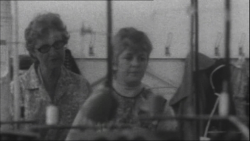
Early in <em>Leeds United!</em>, Annie (Teresa Anne Keegan, played by Josie Lane) walks along early morning streets, picking up a friend and arriving at the bus stop on her journey to work. An ambitious crane shot accompanies her walk, leaves her in order to reverse across a street and rises above outhouses to find her further on. As she walks, we hear a male voice-over set out her new contract, the terms of which have reduced her rights. This sequence &#8220;set the tone&#8221;, according to Clive James:</p>
<blockquote><p>ably combining the humanist touch with the analytical glance. [&#8230;] their company contracts were read out in plummy tones on voice-over. ‘The company has no contractual pension arrangements covering your employment.’ Which meant that you work for half a century and they scrap you.<sup id="rf1-4429"><a href="#fn1-4429" title="James, &lt;em&gt;The Observer&lt;/em&gt;." rel="footnote">1</a></sup> </p></blockquote>
<p> This practice was so common that Welland heard about another example just a few weeks before the play was broadcast: “a 61-year-old seamstress who works in the same clothing factory as Colin Welland’s mother-in-law in Leeds was made redundant. She had worked in the same place for 25 years but because she was over retiring age she was not entitled to any redundancy pay.” Welland’s response: “Bastards, they are”.<sup id="rf2-4429"><a href="#fn2-4429" title="Sheridan, &#8216;Tailor made for drama&#8217;." rel="footnote">2</a></sup></p>

<hr class="footnotes"><ol class="footnotes" style="list-style-type:decimal"><li id="fn1-4429"><p >James, <em>The Observer</em>.&nbsp;<a href="#rf1-4429" class="backlink" title="Return to footnote 1.">&#8617;</a></p></li><li id="fn2-4429"><p >Sheridan, &#8216;Tailor made for drama&#8217;.&nbsp;<a href="#rf2-4429" class="backlink" title="Return to footnote 2.">&#8617;</a></p></li></ol></hr>{"id":4429,"date":"2014-03-31T06:00:34","date_gmt":"2014-03-31T05:00:34","guid":{"rendered":"http:\/\/www.britishtelevisiondrama.org.uk\/?p=4429"},"modified":"2024-08-30T11:38:05","modified_gmt":"2024-08-30T10:38:05","slug":"women-and-work-leeds-united-1974-part-2","status":"publish","type":"post","link":"http:\/\/www.britishtelevisiondrama.org.uk\/?p=4429","title":{"rendered":"Women and Work: <em>Leeds United!<\/em> (1974) Part 2 of 3"},"content":{"rendered":"<h4>by DAVID ROLINSON<\/h4>\n<p><em>Play for Today<\/em> <strong>Writer:<\/strong> Colin Welland; <strong>Producer:<\/strong> Kenith Trodd; <strong>Director:<\/strong> Roy Battersby<\/p>\n<p><em>This essay continues from <a href=\"http:\/\/www.britishtelevisiondrama.org.uk\/?p=4110\" target=\"_self\" rel=\"noopener noreferrer\">Part 1<\/a>.<\/em><\/p>\n<p><strong>The play<\/strong><\/p>\n<p><img loading=\"lazy\" decoding=\"async\" src=\"http:\/\/www.britishtelevisiondrama.org.uk\/wp-content\/uploads\/2013\/11\/BTVD_LeedsUnited_9-e1383674190290.png\" alt=\"BTVD_LeedsUnited_9\" width=\"250\" height=\"141\" class=\"alignleft size-full wp-image-4193\" \/><br \/>\nEarly in <em>Leeds United!<\/em>, Annie (Teresa Anne Keegan, played by Josie Lane) walks along early morning streets, picking up a friend and arriving at the bus stop on her journey to work. An ambitious crane shot accompanies her walk, leaves her in order to reverse across a street and rises above outhouses to find her further on. As she walks, we hear a male voice-over set out her new contract, the terms of which have reduced her rights. This sequence &#8220;set the tone&#8221;, according to Clive James:<\/p>\n<blockquote><p>ably combining the humanist touch with the analytical glance. [&#8230;] their company contracts were read out in plummy tones on voice-over. \u2018The company has no contractual pension arrangements covering your employment.\u2019 Which meant that you work for half a century and they scrap you.<sup id=\"rf1-4429\"><a href=\"#fn1-4429\" title=\"James, &lt;em&gt;The Observer&lt;\/em&gt;.\" rel=\"footnote\">1<\/a><\/sup> <\/p><\/blockquote>\n<p> This practice was so common that Welland heard about another example just a few weeks before the play was broadcast: \u201ca 61-year-old seamstress who works in the same clothing factory as Colin Welland\u2019s mother-in-law in Leeds was made redundant. She had worked in the same place for 25 years but because she was over retiring age she was not entitled to any redundancy pay.\u201d Welland\u2019s response: \u201cBastards, they are\u201d.<sup id=\"rf2-4429\"><a href=\"#fn2-4429\" title=\"Sheridan, &#8216;Tailor made for drama&#8217;.\" rel=\"footnote\">2<\/a><\/sup><\/p>\n<p><!--more--><\/p>\n<p>The combination of \u201cthe humanist touch with the analytical glance\u201d that James identified is partly achieved through docudrama devices. When the women get to the factory, we again hear Company rules and the results of the recent National Agreement, while again following Annie; and as work begins we cut away to the Northern Regional Secretary of the Association of Seamstresses Cutters and Tailors who, talking to camera, describes the Agreement as a \u201cmilestone\u201d, and thinks that anyone who expected more was \u201ca super-optimist\u201d. (This must include Annie and other workers from John Black\u2019s who are returning to work after a week\u2019s strike.) As if in response, the play now shows several women \u2013 some are lead characters, some are unidentified \u2013 working in various clothing factory jobs, with close shots of their labour and long shots composed as if to &#8220;observe&#8221; or \u201cdiscover\u201d them at work, accompanied by their testimony either to-camera or in voice-over. One young worker speaks happily about gaining a skill for life, and her words guide the storytelling in the sense that her words \u201con time\u201d cue a shot of her piecework observer, the camera moving down to find his stopwatch. Communist shop steward Harry Gridley (Bert Gaunt) tells us that the women \u201cbloody well deserve\u201d equal pay.<\/p>\n<p>The testimony of another woman worker confirms this, as she takes pride in her skills as a final presser (she can turn a bundle of rags into \u201ca suit fit to get wed in\u201d) who has been in the trade for 35 years. Again, close visual details of her work are accompanied by spoken testimony: <\/p>\n<blockquote><p>See these lads around me? I taught half of them their jobs, and they\u2019re taking home two quid a week more than me. Just because they\u2019re wearing trousers.<\/p><\/blockquote>\n<p>John Hill recently observed docudrama elements in <em>Leeds United!<\/em>, such as \u201cthe use of stills and unspecified voice-overs\u201d and \u201cdirect address to camera (as if the character is responding to an unseen interviewer\u2019s questions)\u201d.<sup id=\"rf3-4429\"><a href=\"#fn3-4429\" title=\"Hill, &#8216;From &lt;em&gt;Five Women&lt;\/em&gt;&#8216;, p. 152.\" rel=\"footnote\">3<\/a><\/sup> Indeed, the interaction of audio testimony and shots of processes brings to mind John Corner\u2019s description of the \u201cmixed aesthetic\u201d of <em>Cathy Come Home<\/em>,<sup id=\"rf4-4429\"><a href=\"#fn4-4429\" title=\"&lt;em&gt;The Wednesday Play&lt;\/em&gt;: &lt;em&gt;Cathy Come Home&lt;\/em&gt;, BBC1, tx. 16 November 1966. Written by Jeremy Sandford, directed by Ken Loach.\" rel=\"footnote\">4<\/a><\/sup> which \u201cdevelops both as \u2018story\u2019 and \u2018report\u2019, the latter being produced through the use of images and speech which generate a documentary referentiality around the main line of action, thereby connecting this to contemporary reality in a way which differs from conventional drama\u201d.<sup id=\"rf5-4429\"><a href=\"#fn5-4429\" title=\"John Corner, &lt;em&gt;The Art of Record: A Critical Introduction to Documentary&lt;\/em&gt; (Manchester: Manchester University Press, 1996), p. 92.\" rel=\"footnote\">5<\/a><\/sup> Both scenes also remind me of the start of <em>Saturday Night and Sunday Morning<\/em>,<sup id=\"rf6-4429\"><a href=\"#fn6-4429\" title=\"&lt;em&gt;Saturday Night and Sunday Morning&lt;\/em&gt; (1960), written by Alan Sillitoe from his novel, directed by Karel Reisz.\" rel=\"footnote\">6<\/a><\/sup> which signposts the subjectivity of Arthur Seaton through an internal monologue that motivates camerawork and editing. When Arthur says \u201clook at Robbo\u201d, <em>Saturday Night and Sunday Morning<\/em> cuts to a shot of Robbo \u2013 but in <em>Leeds United!<\/em> the speaker\u2019s urge to \u201csee these lads around me\u201d doesn\u2019t cue a look at them. However, the play is clearly interested in subjectivity, as she adds \u201cthat\u2019s what [the] row\u2019s all about as far as I\u2019m concerned\u201d. The point here is not a gendered reading of the gaze \u2013 men give testimony in this form too \u2013 but the play\u2019s stress on the centrality of female experience in this situation and this form.<\/p>\n<p><img loading=\"lazy\" decoding=\"async\" src=\"http:\/\/www.britishtelevisiondrama.org.uk\/wp-content\/uploads\/2013\/11\/BTVD_LeedsUnited_3-e1383674095909.png\" alt=\"BTVD_LeedsUnited_3\" width=\"250\" height=\"141\" class=\"alignleft size-full wp-image-4187\" \/><br \/>\nThese strategies returned to mind recently at Tate Britain, when I saw the <em>Women and Work<\/em> exhibition of Margaret Harrison and Kay Hunt\u2019s study of women workers at a metal box factory in Bermondsey between 1973 and 1975. Black-and-white photographs and films of working processes are similarly placed with documentation such as pay slips, productivity agreements, medical reports and lists of gender differences in job definition, skills and status. (Similarly, Battersby was aware when directing <em>Leeds United!<\/em> that the 30,000 women \u201cwere the second-raters in the industry \u2013 it was the cutters, the men, who earnt the money such as it was\u201d.<sup id=\"rf7-4429\"><a href=\"#fn7-4429\" title=\"Battersby, Q&#038;A with Hill and Trodd.\" rel=\"footnote\">7<\/a><\/sup> ) In <em>Women and Work<\/em>, the \u201cuse of sociological method as a conceptual strategy is emphasised by the minimalist look of the work itself\u201d.<sup id=\"rf8-4429\"><a href=\"#fn8-4429\" title=\"&lt;em&gt;BP Spotlight: Women and Work&lt;\/em&gt; exhibition text; also &lt;a href=&quot;http:\/\/www.tate.org.uk\/whats-on\/tate-britain\/display\/bp-spotlight-women-and-work&quot; target=&quot;_self&quot; rel=&quot;noopener noreferrer&quot;&gt;available here&lt;\/a&gt;.\" rel=\"footnote\">8<\/a><\/sup> <em>Women and Work<\/em> is described as \u201cone of the earliest projects to tackle political and industrial issues from an overtly feminist perspective\u201d, in which \u201cObjective and subjective points of view coexist\u201d and key themes include \u201cpoints of contact between the personal and the political, the public and the private\u201d, as portraits \u201cput human faces to the facts and figures and invite the viewer to engage with the issues on more personal terms.\u201d <em>Leeds United!<\/em> achieves comparable effects with its docudrama approach.<\/p>\n<p>Gridley reminds Black\u2019s workers of the union conference that rejected their request for a shilling (\u201cbob\u201d)-per-hour increase, and workers vote to strike, in opposition not only to employers but also to their union. Black\u2019s workers march across Leeds, singing for a bob an hour, calling colleagues from other firms out on strike. Their march reveals bad conditions in sweatshops, as in the real events in Leeds in 1970, when strikers were so \u201cshocked and appalled at the working environment especially of the back-street clothing workshops\u201d that they \u201cdecided to press for the appointment of worker inspectors in the factories.\u201d<sup id=\"rf9-4429\"><a href=\"#fn9-4429\" title=\"&lt;em&gt;Morning Chronicle&lt;\/em&gt;, 27 February 1970, quoted in Honeyman, &lt;em&gt;Well Suited&lt;\/em&gt;, n34, p. 216.\" rel=\"footnote\">9<\/a><\/sup> In turn, sweatshop workers are cynical about joining the strike because they believe it is only going to benefit workers from Black&#8217;s, until they realise that the campaign is seeking a deal for all workers. Echoes of the mainstream social realism of the British New Wave can be found in the combination of documenting conditions and moving through public spaces \u2013 from workplaces to pubs to streets \u2013 in scenes of solidarity in campaigning marching, which recall the earlier scenes of observation and testimony: indeed, we glimpse in the crowd the young woman from earlier, and hear her words from earlier, except her phrases such as \u201cI\u2019m learning summat\u201d are now acquiring a different meaning.<\/p>\n<p>To describe <em>Leeds United!<\/em> as a docudrama is not to claim it as solely a project of documentation \u2013 the docudrama label raised issues that were, as we shall see, of concern to the BBC \u2013 but to appreciate the potential range that docudrama affords and the play\u2019s specific range of generic and stylistic approaches and influences. The early combination of walking and voice-over documentation is not reductively a combination of \u201cfact\u201d and \u201cfiction\u201d but \u2013 if we borrow from the description of <em>Women and Work<\/em> \u2013 is a combination of objectivity and subjectivity, public and private. The camera\u2019s fluid movement across and above houses and wet streets, which glisten in black-and-white photography, signposts a more expansive, even excessive style than stereotypes of social realism would expect. The style of this sequence may recall the British New Wave but it\u2019s nearer to the opening of Orson Welles\u2019s <em>Touch of Evil<\/em>.<sup id=\"rf10-4429\"><a href=\"#fn10-4429\" title=\"&lt;em&gt;Touch of Evil&lt;\/em&gt; (1959), written by Orson Welles from a novel by Whit Masterson, directed by Orson Welles.\" rel=\"footnote\">10<\/a><\/sup> The significance of this visual scope lays in its association with the women, who will play the leading role in a struggle that is marked by style as epic, heroic and even timeless. It is tempting to see the early crane shot as a demarcation of space. As the strike develops and hundreds take to the streets, and as political betrayal develops, the story unfolds in visual and narrative forms that traditionally had predominantly male authors and male social actors, including the British New Wave, political cinema and in particular the large-scale industrial-themed radical docudramas of Jim Allen and Ken Loach such as <em>The Big Flame<\/em>.<sup id=\"rf11-4429\"><a href=\"#fn11-4429\" title=\"&lt;em&gt;The Wednesday Play&lt;\/em&gt;: &lt;em&gt;The Big Flame&lt;\/em&gt;, BBC1, tx. 19 February 1969. Written by Jim Allen, directed by Ken Loach.\" rel=\"footnote\">11<\/a><\/sup><\/p>\n<p>I will return to the play\u2019s style in these terms, and the way in which programme makers debated the influence of political cinema and its appropriateness to the subject. But there are clearly other genres at work when Mollie (Lynne Perrie) marches into various workplaces encouraging others to join the strike, and the largely female workforce gathers in buses, pubs and other locations. Regional drama and soap opera are brought to mind by the dialogue and the cast, as Kenith Trodd observed: despite the play\u2019s move to the BBC, it \u201cstill feels like a Granada programme, not just because its stars include Lynne Perrie, Liz Dawn and half of the future cast of <em>Coronation Street<\/em>.\u201d<sup id=\"rf12-4429\"><a href=\"#fn12-4429\" title=\"Trodd, &#8216;The bear hug&#8217;, pp. 130-131.\" rel=\"footnote\">12<\/a><\/sup> It is understandable that the study of women&#8217;s television has spent much more time on soap opera than on industrial-themed single dramas but these &#8211; and more fundamentally, single drama strands in general &#8211; should not be neglected. <em>Leeds &#8211; United!<\/em> sheds a different light on some of the issues that ran through the study of television in this period. Some of the aspects of Richard Hoggart\u2019s <em>The Uses of Literacy<\/em> that Richard Dyer felt \u201cdefined [<em>Coronation Street<\/em>\u2019s] fictional world\u201d were \u201cthe absence of work and politics, the stress on women and the strength of women\u201d.<sup id=\"rf13-4429\"><a href=\"#fn13-4429\" title=\"Richard Dyer, \u2018Introduction\u2019 in Richard Dyer, Christine Geraghty, Marion Jordan, Terry Lovell, Richard Paterson, J Stewart, &lt;em&gt;Television Monograph 13: Coronation Street&lt;\/em&gt; (London: British Film Institute, 1981), p. 4.\" rel=\"footnote\">13<\/a><\/sup> Social realist plays and docudramas often foreground the presence of \u201cwork and politics\u201d. <\/p>\n<p>Such spaces are also explored in other genres, as I\u2019ve noted elsewhere,<sup id=\"rf14-4429\"><a href=\"#fn14-4429\" title=\"The next few sentences, up to \u201cbetrayal\u201d, reproduce, but revise and extend, a section from Dave Rolinson, \u2018Small Screens and Big Voices\u2019.\" rel=\"footnote\">14<\/a><\/sup> including situation comedies like Ronald Wolfe and Ronald Chesney\u2019s <em>The Rag Trade<\/em>.<sup id=\"rf15-4429\"><a href=\"#fn15-4429\" title=\"&lt;em&gt;The Rag Trade&lt;\/em&gt;, BBC, tx. 1963-65; ITV, tx. 1977.\" rel=\"footnote\">15<\/a><\/sup> Stephen Wagg discussed <em>The Rag Trade<\/em> as one example of how 1960s situation comedies sought to represent working-class life. Here, \u201cthe action takes place on the shop floor and revolves around the powerful advocacy of the workers\u2019 interests by Miriam Karlin\u2019s shop steward\u201d. This is \u201can essentially sympathetic portrayal of unionised factory life\u201d in that \u201cKarlin\u2019s character is militant on behalf of her class, rather than herself\u201d, generating such \u201cpublic affection\u201d that \u201cher frequent injunction [\u2026], \u2018Everybody out!\u2019, became a popular catchphrase.\u201d<sup id=\"rf16-4429\"><a href=\"#fn16-4429\" title=\"Stephen Wagg, \u2018Social Class and the Situation Comedy in British Television\u2019, in Stephen Wagg (editor), &lt;em&gt;Because I tell a joke or two: Comedy, Politics and Social Difference&lt;\/em&gt; (Abingdon: Routledge, 1998), p. 9.\" rel=\"footnote\">16<\/a><\/sup> <em>The Rag Trade<\/em>\u2019s sitcom format provided a (playful) restoration of the status quo, whereas <em>Leeds United!<\/em>, despite Welland\u2019s wit and depiction of hope, provided damning closure in its depiction of alleged betrayal. But some reviewers had this sitcom in mind as an intertext; for instance, Leonard Buckley wrote in <em>The Times<\/em>: \u201cEverybody out! The sardonic cry that Miriam Karlin used to utter in a comedy series about the rag trade became an impassioned roar last night\u201d.<sup id=\"rf17-4429\"><a href=\"#fn17-4429\" title=\"Buckley, &#8216;Leeds &#8211; United!&#8217;\" rel=\"footnote\">17<\/a><\/sup> But the presence of other potential markers of comedy were entirely consistent with radical docudrama\u2019s use of comedy performers (such casting is, for instance, a common feature across Ken Loach&#8217;s work). Therefore, as Greenwood observed, Joe Pike was played by \u201ccomedian Stan Stennett making his acting debut\u201d, a boss was played by \u201cTerence Frisby, who wrote the hit play, <em>There\u2019s A Girl In My Soup<\/em>\u201d, and Gridley was played by \u201cBert Gaunt, of the Gaunt Brothers music hall act\u201d.<sup id=\"rf18-4429\"><a href=\"#fn18-4429\" title=\"Greenwood, &#8216;Angry women who shook a city&#8217;.\" rel=\"footnote\">18<\/a><\/sup> Elements of comedy and character drama stood out for critics who were concerned with potential didacticism or identification; for instance, according to Buckley: <\/p>\n<blockquote><p>It was the strikers who gripped us. Their leaders harangued them. They chivvied each other. A woman stood firm while her mother died. They marched and massed and sang [\u2026] And through it all ran Mr Welland\u2019s dialogue, vulgar and funny, sad, savage and sincere.<sup id=\"rf19-4429\"><a href=\"#fn19-4429\" title=\"Buckley, &#8216;Leeds &#8211; United!&#8217;\" rel=\"footnote\">19<\/a><\/sup><\/p><\/blockquote>\n<p>But as we\u2019ve already seen, the centrality of the women was itself seen as political, as in the coverage of the original dispute: \u201cLeft-wing militants have been blamed both by union and management. But there is no doubt that the strike is inspired and led by the women members, with whom the local officials appear hopelessly out of touch.\u201d<sup id=\"rf20-4429\"><a href=\"#fn20-4429\" title=\"Vincent Hannah, &lt;em&gt;Sunday Times&lt;\/em&gt;, 22 February 1970, quoted by Honeyman, p. 216.\" rel=\"footnote\">20<\/a><\/sup><\/p>\n<p><img loading=\"lazy\" decoding=\"async\" src=\"http:\/\/www.britishtelevisiondrama.org.uk\/wp-content\/uploads\/2013\/11\/BTVD_LeedsUnited_4-e1383674112258.png\" alt=\"BTVD_LeedsUnited_4\" width=\"250\" height=\"141\" class=\"alignleft size-full wp-image-4188\" \/><\/p>\n<p>Representing the strike\u2019s scale and spontaneity made <em>Leeds United!<\/em> a large-scale production built upon the reconstruction of mass marches and huge meetings: as Mary Malone stated in the <em>Daily Mirror<\/em>, this was a \u201cmarathon epic\u201d with seemingly a \u201ccast of thousands\u201d that was \u201cquite literally stunning [\u2026] never mind the quality feel the width\u201d.<sup id=\"rf21-4429\"><a href=\"#fn21-4429\" title=\"Mary Malone, \u2018Putting Wembley in the shade\u2026\u2019, &lt;em&gt;Daily Mirror&lt;\/em&gt;, 1 November 1974.\" rel=\"footnote\">21<\/a><\/sup> It drew its extras from hundreds of people who were involved in the original events, as national newspaper coverage was keen to note. The <em>Daily Express<\/em> noted how \u201cthe workers who came out unofficially for an extra bob an hour joined enthusiastically in the making of the film, cluttering the Leeds streets again for the film crews, singing their \u2018war songs,\u2019 storming the factory barricades.\u201d<sup id=\"rf22-4429\"><a href=\"#fn22-4429\" title=\"Thomas, &#8216;Sadness at the end of this battle for the bob&#8217;.\" rel=\"footnote\">22<\/a><\/sup> The <em>Daily Mail<\/em>\u2019s Shaun Usher reflected that \u201cI can\u2019t recall large groups of players and extras being presented to greater effect\u201d, and felt that \u201cBattersby\u2019s direction capitalised on the stirring call to the blood when masses march behind banners \u2013 \u2018Smite The Infidel\u2019 or \u2018Sod The Bosses,\u2019 still the scalp tingles.\u201d<sup id=\"rf23-4429\"><a href=\"#fn23-4429\" title=\"Shaun Usher, \u2018When the scalp tingles and the blood runs hot\u2019, &lt;em&gt;Daily Mail&lt;\/em&gt;, 1 November 1974.\" rel=\"footnote\">23<\/a><\/sup> Indeed, Roy Battersby\u2019s production was praised by many, for the way that \u2013 according to Buckley \u2013 it undertook \u201ca gigantic undertaking with ingenuity and skill. For besides the crowds and the complex strands of action it brought us all the dingy clatter of the sweatshops and their silence when the machines were still.\u201d<sup id=\"rf24-4429\"><a href=\"#fn24-4429\" title=\"Buckley, &#8216;Leeds &#8211; United!&#8217;\" rel=\"footnote\">24<\/a><\/sup> Dennis Potter admired Battersby for keeping:<\/p>\n<blockquote><p>a breathtakingly adept control of what could have been (visually) a clich\u00e9-ridden sprawl. His long, steady pans and elaborate tracks took on not so much the rhythm of exhortation as the subtler and more moving texture of deep emotional commitment.<sup id=\"rf25-4429\"><a href=\"#fn25-4429\" title=\"Dennis Potter, &#8216;Twisting Time&#8217;, &lt;em&gt;New Statesman&lt;\/em&gt;, 8 November 1974, p. 671.\" rel=\"footnote\">25<\/a><\/sup> <\/p><\/blockquote>\n<p>For Chris Dunkley in the <em>Financial Times<\/em>, this reconstruction element made it an \u201cexhilarating chunk of electronic street theatre\u201d.<sup id=\"rf26-4429\"><a href=\"#fn26-4429\" title=\"Chris Dunkley, \u2018Getting better\u2019, &lt;em&gt;Financial Times&lt;\/em&gt;, 6 November 1974.\" rel=\"footnote\">26<\/a><\/sup> Not everyone was quite as impressed \u2013 although the <em>Daily Telegraph<\/em>\u2019s reviewer felt that the crowd scenes were \u201cbrilliantly directed by Roy Battersby with an army of extras who appeared to be as fiercely committed to the cause as the original strikers\u201d, he described the \u201cresulting mob rule\u201d as \u201can ugly and repetitive spectacle and doubtless intended to be so.\u201d<sup id=\"rf27-4429\"><a href=\"#fn27-4429\" title=\"Sean Day-Lewis, \u2018Brilliant picture of mob rule in strike\u2019, &lt;em&gt;Daily Telegraph&lt;\/em&gt;, 1 November 1974.\" rel=\"footnote\">27<\/a><\/sup><\/p>\n<p>Before moving on to the ultimate example of the crowd work \u2013 the Leeds Town Hall sequence \u2013 it is worth noting the impact of shooting such scenes in black and white. It was very unusual to shoot in black and white by this time, and this is reflected in the attention that critics paid to that decision, discussing its potential reasons and effects. They argued that the play was \u201cshot in black and white for Dickensian veracity\u201d,<sup id=\"rf28-4429\"><a href=\"#fn28-4429\" title=\"Malone, &#8216;Putting Wembley in the shade&#8217;.\" rel=\"footnote\">28<\/a><\/sup> \u201cso that nothing should be prettified by colour\u201d,<sup id=\"rf29-4429\"><a href=\"#fn29-4429\" title=\"Buckley, &#8216;Leeds &#8211; United!&#8217;\" rel=\"footnote\">29<\/a><\/sup> making it \u201ca story told against a grey, industrial background.\u201d<sup id=\"rf30-4429\"><a href=\"#fn30-4429\" title=\"Thomas, &#8216;Sadness at the end of this battle for the bob&#8217;.\" rel=\"footnote\">30<\/a><\/sup> The \u201cabsence of the cosmetic of colour played a vital part in [its] success\u201d,   as it gained \u201cthe flat, inelegant, haphazard taste of realism; as if [then-recent &#8220;fly-on-the-wall&#8221; documentary series] <em>The Family<\/em> was covering a whole city.\u201d<sup id=\"rf31-4429\"><a href=\"#fn31-4429\" title=\"&lt;em&gt;The Family&lt;\/em&gt;, BBC1, tx. 3 April &#8211; 26 June 1974.\" rel=\"footnote\">31<\/a><\/sup> However, the choice helped the programme makers with their aim, as Battersby put it:<\/p>\n<blockquote><p>to say: this is a film, it\u2019s not a documentary. This is an enormously important social, human drama, and we want to understand it. We don\u2019t just want to rehearse the events. We want to illuminate \u2013 what is the physiognomy of this process, how does it take place?\u201d<sup id=\"rf32-4429\"><a href=\"#fn32-4429\" title=\"Battersby, in Q&#038;A with Hill and Trodd.\" rel=\"footnote\">32<\/a><\/sup> <\/p><\/blockquote>\n<p>Filmmakers like Pontecorvo were a direct influence \u2013 Welland recalled that he \u201chad just seen <em>Battle of Algiers<\/em>, and was \u2018knocked out\u2019 by it\u201d.<sup id=\"rf33-4429\"><a href=\"#fn33-4429\" title=\"Sheridan, &#8216;Tailor made for drama&#8217;.\" rel=\"footnote\">33<\/a><\/sup> Chris Dunkley observed that it \u201cinevitably recalled the early products of the Russian and Italian schools of film realism\u201d and related it to the way that television stopped covering Vietnam after its \u201cimaginary peace\u201d.<sup id=\"rf34-4429\"><a href=\"#fn34-4429\" title=\"Chris Dunkley, \u2018Getting better\u2019. Dunkley compared it with &lt;em&gt;Peshmerga: Those Who Face Death&lt;\/em&gt;, photographed by Chris Menges and directed by Chris Goddard, after TV had \u201ccut dead its coverage of Vietnam when the Americans declared an imaginary peace [\u2026] Welland did me a similar favour in regard to the 1970 strike [\u2026] although this was supposedly a drama while Goddard\u2019s programme was a documentary.\u201d\" rel=\"footnote\">34<\/a><\/sup> For Clive James, <em>Leeds United!<\/em> \u201chad the elemental force of first-generation political dramas like <em>October<\/em> or <em>Kameradschaft<\/em>\u201d.<sup id=\"rf35-4429\"><a href=\"#fn35-4429\" title=\"James, &lt;em&gt;The Observer&lt;\/em&gt;.\" rel=\"footnote\">35<\/a><\/sup> (James added that \u201cthere was no way of being distracted from it\u201d, which was an important point given that the preview screening was so troubled by technical faults that Welland \u201csank into his seat, with his hands over his eyes\u201d.) These respected antecedents seemed to heighten Nancy Banks-Smith\u2019s sense that the original events were hardly worth the treatment given to them by the production: she argued that Welland, Trodd and Battersby \u201chave given the little strike the chest measurement of a revolution\u201d as if they were \u201csons determined to make their father\u2019s obscure life mean more, matter more\u201d. It \u201chas the feel of a film\u201d but Banks-Smith \u2013 wondering whether Welland \u201chas some memory of <em>Sing As We Go<\/em>, with Gracie Fields toodle-ooing out of a train window on her way to right some cotton town wrong\u201d \u2013 described it as the BBC\u2019s \u201cbiggest play\u201d but \u201cNot their best.\u201d<sup id=\"rf36-4429\"><a href=\"#fn36-4429\" title=\"Banks-Smith, &#8216;Leeds &#8211; United!&#8217;\" rel=\"footnote\">36<\/a><\/sup> The choices of black-and-white and docudrama methods were debated after the programme\u2019s broadcast, as we shall see.<\/p>\n<p><img loading=\"lazy\" decoding=\"async\" src=\"http:\/\/www.britishtelevisiondrama.org.uk\/wp-content\/uploads\/2013\/11\/BTVD_LeedsUnited_5-e1383674126221.png\" alt=\"BTVD_LeedsUnited_5\" width=\"250\" height=\"141\" class=\"alignleft size-full wp-image-4189\" \/><br \/>\nThe Town Hall sequence is the ultimate example of the play\u2019s large-scale techniques. By this stage of the play, the strike has spread across many firms in Leeds and the North East, despite the union\u2019s claim that the strike is specific to Black\u2019s. The union has called for a return to work, but the strike holds firm despite welfare concerns, family bereavement and threatened victimisation. At a meeting in Leeds Town Hall, 2,000 workers passionately reject the calls of their union \u2013 and, surprisingly, Gridley \u2013 to return to work. Workplace politics have been central to <em>Leeds United!<\/em>\u2019s characters, through an emotive focus. Gridley will argue that \u201cEmotion must make way for reason\u201d, but such politically loaded statements are undermined in the Town Hall by the personalised testimony of female workers, who talk about their experiences. Union leaders calling for a return to work are drowned out by songs of solidarity. This sequence\u2019s centrality to the play was reflected in previews and reviews. In October 1973, before the scene was shot, the <em>Daily Telegraph<\/em> noted that this scene \u201cre-creates a meeting in Leeds Town Hall and calls for 500 \u2018extras\u2019, reinforced by 1,500 of the factory workers who were actually involved.\u201d<sup id=\"rf37-4429\"><a href=\"#fn37-4429\" title=\"Last, \u2018BBC screens strike play ITV refused\u2019. At the time of publication the scene was due to be shot &#8220;next Sunday&#8221;.\" rel=\"footnote\">37<\/a><\/sup> For the <em>Daily Mail<\/em>, the Town Hall sequence \u201cought to have failed miserably\u201d but \u201cthey brought off [this] extraordinary section\u201d as \u201cstriker after striker called for solidarity and resolve, in a steadily mounting, sustained chain of emotional peaks.\u201d<sup id=\"rf38-4429\"><a href=\"#fn38-4429\" title=\"Usher, &#8216;When the scalp tingles and the blood runs hot&#8217;.\" rel=\"footnote\">38<\/a><\/sup> Dennis Potter thought that the Town Hall sequence &#8220;was masterfully orchestrated, protest breaking against the platform in wave upon wave of thunderous indignation.&#8221;<sup id=\"rf39-4429\"><a href=\"#fn39-4429\" title=\"Potter, &#8216;Twisting Time&#8217;, p. 671.\" rel=\"footnote\">39<\/a><\/sup> Even Nancy Banks-Smith, who as we have seen was no great fan of the play, picked out the Town Hall scene as evidence of how <em>Leeds \u2013 United!<\/em> &#8220;is a team endeavour about groups, marches, meetings, large lumps of people. It is conducted and sung like a performance of Messiah. The silence of the workshop and, on the dot, the sudden rev and roar of sewing machines. The wave on wave of singing in the Town Hall scene and the cut to the concussed silence of the bosses meeting.\u201d<sup id=\"rf40-4429\"><a href=\"#fn40-4429\" title=\"Banks-Smith, &#8216;Leeds &#8211; United!&#8217;\" rel=\"footnote\">40<\/a><\/sup> One way in which research into <em>Leeds United!<\/em> could be developed is to dig more deeply into the way extras are used, with testimony from people involved in the original events and their reconstruction \u2013 as Charlotte Brunsdon has suggested, this could add to studies of, for instance, the 1984 \u2018Battle of Orgreave\u2019 reconstructed in 2001 by artist Jeremy Deller and the subject of a documentary in 2002.<sup id=\"rf41-4429\"><a href=\"#fn41-4429\" title=\"&lt;em&gt;The Battle of Orgreave&lt;\/em&gt;, Channel 4, tx. 20 October 2002. Brunsdon suggestion in conversation.\" rel=\"footnote\">41<\/a><\/sup><\/p>\n<p>But the women\u2019s disruptive performance in the Town Hall also suggests that we can add to the aforementioned political, social realist, sitcom and soap traditions mentioned earlier. For instance, 1974 was also the year of the suffragette drama <em>Shoulder to Shoulder<\/em>,<sup id=\"rf42-4429\"><a href=\"#fn42-4429\" title=\"&lt;em&gt;Shoulder to Shoulder&lt;\/em&gt;, 6 episodes, BBC2, tx. 3 April 1974 to 8 May 1974. Written by Douglas Livingstone, Alan Plater, Ken Taylor, Hugh Whitemore, produced by Verity Lambert, directed by Waris Hussein and Moira Armstrong.\" rel=\"footnote\">42<\/a><\/sup> which Vicky Ball gave as an example of how some types of \u201cfemale ensemble drama\u201d served to comment on \u201cmarginalized aspects of women\u2019s history\u201d.<sup id=\"rf43-4429\"><a href=\"#fn43-4429\" title=\"Vicky Ball, \u2018Forgotten sisters: the British female ensemble drama\u2019, &lt;em&gt;Screen&lt;\/em&gt;, Volume 54, Number 2, Summer 2013, p. 246.\" rel=\"footnote\">43<\/a><\/sup> We have already seen, from my opening quotation from Katrina Honeyman, that <em>Leeds United!<\/em> partly corrects one specific area of marginalized history. <em>Leeds United!<\/em> is very much focused on the \u201cworking-class communities of women\u201d and \u201cthe \u2018backstage\u2019 or mundane aspects of women\u2019s work in factories\u201d that Ball mentions among the different ways in which the female ensemble drama since the 1960s has served to demonstrate \u201ctelevision\u2019s attempt to construct and address a more pluralized sense of female identity\u201d.<sup id=\"rf44-4429\"><a href=\"#fn44-4429\" title=\"Ibid. Ball\u2019s examples include &lt;em&gt;Tenko&lt;\/em&gt; (1981-82, 1984-85), &lt;em&gt;Band of Gold&lt;\/em&gt; (1995-98) and &lt;em&gt;Rock Follies&lt;\/em&gt; (1976-77) but also comedies including &lt;em&gt;Dinnerladies&lt;\/em&gt; (1998-2000) and, of most relevance to this essay, &lt;em&gt;The Rag Trade&lt;\/em&gt;.\" rel=\"footnote\">44<\/a><\/sup> <\/p>\n<p><strong>The betrayal<\/strong><\/p>\n<p><img loading=\"lazy\" decoding=\"async\" src=\"http:\/\/www.britishtelevisiondrama.org.uk\/wp-content\/uploads\/2013\/11\/BTVD_LeedsUnited_6-e1383674143715.png\" alt=\"BTVD_LeedsUnited_6\" width=\"250\" height=\"141\" class=\"alignleft size-full wp-image-4190\" \/><br \/>\nThe showdown at the Town Hall demonstrates worker solidarity but also foreshadows the betrayal to come. Mollie&#8217;s accusatory renaming of ASCAT &#8211; &#8220;the Association of Scabs, Arse-lickers and bleeding Traitors&#8221; &#8211; leaves us in no doubt that the biggest threat will come from the workers\u2019 own representatives rather than the employers. However, the depiction of the employers was a point of contention for some critics. At first, some of the employers are relatively amenable to the requests made by the strikers \u2013 they need the support of the union to help push through planned job losses and are aware that employers were favoured by the recent Agreement. However, the boss of Black\u2019s takes a more hard-line approach and pushes for a united statement refusing concessions and claiming that the strike is the work of a few left-wing anarchists leading a mindless rabble \u2013 a common tactic that the programme has partly disproven by showing not only the scepticism of workers to Communist shop steward Gridley but also, more fundamentally, by presenting the women as active agents in events. Soon, they will be pushing to continue the strike, in opposition to Gridley\u2019s moves to end it. I say \u201cpartly disproven\u201d because, as Shaun Usher noted, the makers of <em>Leeds \u2013 United!<\/em>, although not \u201cboss\u2019s men\u201d, were \u201cclear-eyed and fair enough about worker vulnerability to con-tricks and double-shuffles by their own leaders.\u201d <\/p>\n<p>However, Usher also noted that the play\u2019s \u201cromantic bias towards the underdog\u201d had infuriated the worthy clothes manufacturers of Leeds\u201d.<sup id=\"rf45-4429\"><a href=\"#fn45-4429\" title=\"Usher, &#8216;When the scalp tingles and the blood runs hot&#8217;.\" rel=\"footnote\">45<\/a><\/sup> Not everyone agreed that the play had such romantic bias &#8211; Geoffrey Sheridan stressed that &#8220;has nothing whatever to do with romanticism&#8221;<sup id=\"rf46-4429\"><a href=\"#fn46-4429\" title=\"Sheridan, &#8216;Tailor made for drama&#8217;.\" rel=\"footnote\">46<\/a><\/sup> &#8211; but Leonard Buckley\u2019s argument that \u201cIt was the strikers who gripped us\u201d was made in contrast with his belief that \u201cThere was no doubt where our sympathies were meant to lie. The employers, prissy, devious or bovine, were largely shown as men who went on playing their golf. The union officials were all bluster and procedure.\u201d<sup id=\"rf47-4429\"><a href=\"#fn47-4429\" title=\"Buckley, &#8216;Leeds &#8211; United!&#8217;\" rel=\"footnote\">47<\/a><\/sup> For Nancy Banks-Smith, the depiction of the employers was a problem:<\/p>\n<blockquote><p>The bosses even when they were excessively fat were excessively flat. Such cartoon characters that at first I thought Welland must be pulling my leg. For all I know all bosses may be bastards but I\u2019ve not seen them wear their birth certificates so jauntily in their hatbands before. Take the farcical fellow on the golf course and his line of chat. \u2018They\u2019ll be scuttling back like rabbits in a couple of days.\u2019 The dialogue had too many lines like that [&#8230;]<sup id=\"rf48-4429\"><a href=\"#fn48-4429\" title=\"Banks-Smith, &#8216;Leeds &#8211; United!&#8217;\" rel=\"footnote\">48<\/a><\/sup> <\/p><\/blockquote>\n<p>This concern was shared by other critics, even those who were more positive about the play than Banks-Smith. Clive James noted that \u201cThe masters gathered on the golf course for some Hooray-Henry dialogue on the subject of cheating the swine back to work.\u201d<sup id=\"rf49-4429\"><a href=\"#fn49-4429\" title=\"James, &lt;em&gt;The Observer&lt;\/em&gt;.\" rel=\"footnote\">49<\/a><\/sup> Sean Day-Lewis felt that the employers \u201cwere drawn to present obvious types and attitudes rather than people.\u201d<sup id=\"rf50-4429\"><a href=\"#fn50-4429\" title=\"Day-Lewis, &#8216;Brilliant picture of mob rule in strike&#8217;.\" rel=\"footnote\">50<\/a><\/sup> Usher thought it a \u201cmajor flaw\u201d that the bosses looked and sounded \u201cstereotyped, with jut-jawed, frowning Bernard Archard as the most reactionary in a collection of crypto-twits, sharks, and pantomime fat men.\u201d<sup id=\"rf51-4429\"><a href=\"#fn51-4429\" title=\"Usher, &#8216;When the scalp tingles and the blood runs hot&#8217;.\" rel=\"footnote\">51<\/a><\/sup> Complaints from employers \u2013 such as a Clothing Manufacturers\u2019 Federation spokesman calling it \u201cinept, inaccurate and insolent\u201d and &#8220;a clumsy beginner&#8217;s manual on how to organise an unofficial strike and terrorise women into joining it&#8221;<sup id=\"rf52-4429\"><a href=\"#fn52-4429\" title=\"Thomas, &#8216;Sadness at the end of this battle for the bob&#8217;.\" rel=\"footnote\">52<\/a><\/sup> \u2013 prompted Welland&#8217;s response:<\/p>\n<blockquote><p>If the bosses had enjoyed the play I would have been worried. This is exactly the reaction I expected. They are behaving like a wounded animal at bay. Every event described in my play is a matter of record. I portrayed the events as they happened. The people of Leeds will be the true judge of what I have written.<sup id=\"rf53-4429\"><a href=\"#fn53-4429\" title=\"Martin Jackson, \u2018Bosses attack the BBC for \u201cinsolent\u201d strike play\u2019, &lt;em&gt;Daily Mail&lt;\/em&gt;, 1 November 1974.\" rel=\"footnote\">53<\/a><\/sup> <\/p><\/blockquote>\n<p>(Some of &#8220;the people of Leeds&#8221; would soon appear in the media in order to &#8220;judge&#8221; Welland&#8217;s play, as we shall see.) The employers, despite their scheming, are left to bleakly consider new national pay negotiations and the strikers seem to be on the brink of victory. However, outside the Town Hall meeting, the strike committee chairman Fred Packer (Peter Wallis) tells a reporter that, although his mandate is a shilling, they are open to offers. Packer and Gridley meet individual bosses then telegram the Association to offer a return to work for an interim reward plus negotiations. The employers celebrate victory. Therefore, despite complaints from employers about their depiction, Chris Dunkley observed that \u201cthe main villains in this play were the all too real gutless trade union leaders and perfidious Communist agitator. The employers by contrast were shown as Punch and Judy figures.\u201d<sup id=\"rf54-4429\"><a href=\"#fn54-4429\" title=\"Furthermore, \u201cAnyone capable of reading party political sympathies [\u2026] would presumably expect Tories to react quite differently from Socialists on discovering a baby rabbit caught in a steel trap\u201d. Dunkley, &#8216;Getting better&#8217;.\" rel=\"footnote\">54<\/a><\/sup> As Geoffrey Sheridan argued, the play shows the strike being betrayed by \u201cthe elected leader of the unofficial strike committee prepared to wheeler-deal with bosses in a council flat, behind the backs not only of the strikers, but the rest of the committee, the Machiavellian manoeuvres of the Communist Party member on the union district committee.\u201d<sup id=\"rf55-4429\"><a href=\"#fn55-4429\" title=\"Sheridan, &#8216;Tailor made for drama&#8217;.\" rel=\"footnote\">55<\/a><\/sup> <\/p>\n<p>The betrayal is brought home to Maggie (Elizabeth Spriggs) in a sequence which underlines the centrality of female agency and silenced voices. When Gridley starts to talk to the small meeting of the strike committee, we hold on a shot of Maggie. Earlier in the play, contextualising voice-overs played over footage of women at work \u2013 either male voices giving the employer\u2019s line on contracts or female voices charting their own experiences. Now, we look at Maggie while Gridley starts to speak &#8211; and his words are drowned out by Maggie\u2019s words as the sound from another sequence is played over her shot, as she remembers addressing a mass meeting on Woodhouse Moor. The combination of sound and image cues a subjective narrative movement as we see Maggie\u2019s speech: \u201cWhen a woman looks at her wages and thinks of the hours she works and the conditions, she knows she is a slave.\u201d She adds that \u201cif the employers and the unions cannot put the house in order, then we the women will do it for them\u201d.<sup id=\"rf56-4429\"><a href=\"#fn56-4429\" title=\"This domestic analogy has a long history in political discourse and now seems to anticipate the phrasing of Margaret Thatcher in her criticism of the BBC\u2019s reporting of terrorism: \u201cboth the Home Secretary and I think it is about time they put their house in order\u201d. Liz Curtis, &lt;em&gt;Ireland: The propaganda war \u2013 the British media and the \u2018battle for hearts and minds\u2019&lt;\/em&gt; (Belfast: S\u00e1sta, 1998), p. 167. Originally published in 1984 by Pluto Press.\" rel=\"footnote\">56<\/a><\/sup> Editing juxtaposes the two sequences in order to draw a contrast between two resolutions: the rank-and-file workers\u2019 vote to continue the strike and the strike committee\u2019s vote to give up. The committee stated that people were returning to work and the strike was crumbling \u2013 James Thomas argued that the play showed \u201chow wild enthusiasm can slide, sadly but inevitably, into desperation: the drift back to work of the \u2018mindless rabble\u2019 as one of the masters called them, the realisation that the system cannot be beaten, was movingly illustrated.\u201d<sup id=\"rf57-4429\"><a href=\"#fn57-4429\" title=\"Thomas, &#8216;Sadness at the end of this battle for a bob&#8217;.\" rel=\"footnote\">57<\/a><\/sup> However, the Town Hall and Moor sequences have shown collective solidarity. The docudrama reconstruction of real events \u2013 the Moor sequence \u2013 may imply documentary objectivity but it is also subjective, as it rejects Gridley\u2019s political discourse. Shaun Usher picked out this sequence as a \u201cvivid, intentionally confusing, sequence\u201d which put across the confusion of workers, achieved by \u201cWelland and Battersby and film editor Don Fairservice [\u2026] cross-cutting between a mass meeting baying for the strike to continue, and [\u2026] the strike committee, the following day. Somehow, despite the apparent \u2018No surrender\u2019 climate, the thing was settled. None of the rank and file knew why.\u201d<sup id=\"rf58-4429\"><a href=\"#fn58-4429\" title=\"Usher, &#8216;When the scalp tingles and the blood runs hot&#8217;.\" rel=\"footnote\">58<\/a><\/sup> Later, Mollie rejects similar discourse more emphatically when she slaps Joe in the face for saying that \u201cPolitics is the art of the attainable\u201d. It is the slap of docudrama\u2019s affective discourse.<\/p>\n<p>The betrayal of the rank and file by union leadership is a common theme across several pieces in this period, including Ken Loach and Jim Allen\u2019s <a href=\"http:\/\/www.britishtelevisiondrama.org.uk\/?p=954\" target=\"_self\" rel=\"noopener noreferrer\"><em>The Rank and File<\/em><\/a> and <em>Days of Hope<\/em>. For critics like Peter Lennon in the <em>Sunday Times<\/em>, the play did not describe \u201cthe role of the union\u201d as satisfactorily as it did the \u201cimpersonal ruthlessness of the employers\u201d \u2013 therefore, \u201cinvestigating the hidden official motivation of the union would have powerfully strengthened this film\u201d.<sup id=\"rf59-4429\"><a href=\"#fn59-4429\" title=\"Peter Lennon, \u2018Faces in the crowd\u2019, &lt;em&gt;Sunday Times&lt;\/em&gt;, 3 November 1974.\" rel=\"footnote\">59<\/a><\/sup> There were more specific concerns from some quarters regarding the Communist Gridley, who \u2013 as Sheridan put it \u2013 \u201cled the workers out, then ratted on them \u2013 he was interested in an abstract revolution in the future, not a concrete one here and now.\u201d<sup id=\"rf60-4429\"><a href=\"#fn60-4429\" title=\"Sheridan, &#8216;Tailor made for drama&#8217;.\" rel=\"footnote\">60<\/a><\/sup> John Hill recently noted that <em>Leeds \u2013 United!<\/em> \u201cdoes clearly concur with the WRP&#8217;s analysis of a \u2018crisis of leadership\u2019 within the Labour movement\u201d.<sup id=\"rf61-4429\"><a href=\"#fn61-4429\" title=\"Hill, &#8216;From &lt;em&gt;Five Women&lt;\/em&gt;&#8216;, p. 148, n. 30.\" rel=\"footnote\">61<\/a><\/sup> The <em>Workers Press<\/em>, the publication associated with the Trotskyist Workers&#8217; Revolutionary Party, welcomed the play&#8217;s attack on Stalinism.<sup id=\"rf62-4429\"><a href=\"#fn62-4429\" title=\"Stewart Lane summarised the &lt;em&gt;Workers Press&lt;\/em&gt; response as, in part, seeing the play as \u201ca vindication of its own political position back in 1970\u201d. Stewart Lane, &#8216;Welland&#8217;s despairing anti-Communism&#8217;, &lt;em&gt;Morning Star&lt;\/em&gt;, 2 November 1974.\" rel=\"footnote\">62<\/a><\/sup> Speaking to MacCabe, Trodd accepted that \u201cthere\u2019s no doubt it was informed a little by the insights of the WRP \u2013 the only trace of it in the film is the voice-over at the end, spoken by one of the women, which says, the next time we have a fight, we\u2019ll trust ourselves to those who won\u2019t let us down. There\u2019s a kind of message there, but it didn\u2019t offend it dramatically.\u201d<sup id=\"rf63-4429\"><a href=\"#fn63-4429\" title=\"MacCabe, &lt;em&gt;Simon Gray&lt;\/em&gt;.\" rel=\"footnote\">63<\/a><\/sup> However, Hill felt that \u201cits \u2018anti-Stalinist\u2019 polemics against the Communist Party does seem to strike an unnecessarily sectarian note\u201d.<sup id=\"rf64-4429\"><a href=\"#fn64-4429\" title=\"Hill, &#8216;From &lt;em&gt;Five Women&lt;\/em&gt;&#8216;, p. 148, n. 30.\" rel=\"footnote\">64<\/a><\/sup> Indeed, the <em>Morning Star<\/em>, Stewart Lane criticised the play\u2019s treatment of the Communist shop steward as \u201ca snide distortion\u201d, and compared \u201cWelland\u2019s version\u201d with \u201cthe facts\u201d.<sup id=\"rf65-4429\"><a href=\"#fn65-4429\" title=\"Lane, \u2018Welland\u2019s despairing anti-Communism\u2019.\" rel=\"footnote\">65<\/a><\/sup> Lane pointed out that the strike \u201cwon the biggest wage increase ever paid in the industry, revitalised organisation and increased union membership\u201d, and that the real Communist shop steward was sacked, \u201calong with 39 other cutters, which included other members of the shop committee\u201d, in August 1970. In another <em>Morning Star<\/em> piece, Lane challenged the view that the strike was a failure. He interviewed Benny Mattison, treasurer of the real 1970 strike committee, who said that, although the strike was \u201cnot a spectacular victory in the immediate sense, [\u2026] the workers did get an increase, and it was the only year in which union membership went up.\u201d Lane noted that \u201cCommunists played an active role in the leadership of the strike\u201d and summarised Mattison\u2019s belief that \u201cThere was never [\u2026] any betrayal\u201d.<sup id=\"rf66-4429\"><a href=\"#fn66-4429\" title=\"Stewart Lane, \u2018\u201cCharacters\u201d in BBC play hit back at author\u2019, &lt;em&gt;Morning Star&lt;\/em&gt;, 4 November 1974.\" rel=\"footnote\">66<\/a><\/sup><\/p>\n<p>To look more fully into responses from those who were featured in the play, the third part of this essay will move us onto a feedback discussion programme that was broadcast on BBC2 the night after the play was broadcast on BBC1.<\/p>\n<p><em>This essay continues in <a href=\"http:\/\/\/www.britishtelevisiondrama.org.uk\/?p=4597\" target=\"_self\" rel=\"noopener noreferrer\">Part 3<\/a>.<\/em><\/p>\n<p><em>Originally posted: 31 March 2014 (Part 2)<\/em><\/p>\n<p><body><!-- Start of StatCounter Code --><br \/>\n<script type=\"text\/javascript\">\nvar sc_project=5750652; \nvar sc_invisible=1; \nvar sc_partition=68; \nvar sc_click_stat=1; \nvar sc_security=\"6dd1aa39\"; \n<\/script><\/p>\n<p><script type=\"text\/javascript\"\nsrc=\"http:\/\/www.statcounter.com\/counter\/counter.js\"><\/script><noscript>\n<div<br \/>\nclass=&#8221;statcounter&#8221;><a title=\"wordpress stats \"<br \/>\nhref=&#8221;http:\/\/www.statcounter.com\/wordpress.org\/&#8221;<br \/>\ntarget=&#8221;_blank&#8221;><img class=\"statcounter\"<br \/>\nsrc=&#8221;http:\/\/c.statcounter.com\/5750652\/0\/6dd1aa39\/1\/&#8221;<br \/>\nalt=&#8221;wordpress stats &#8221; ><\/a><\/div>\n<p><\/noscript><br \/>\n<!-- End of StatCounter Code --><\/body><\/p>\n<hr class=\"footnotes\"><ol class=\"footnotes\" style=\"list-style-type:decimal\"><li id=\"fn1-4429\"><p >James, <em>The Observer<\/em>.&nbsp;<a href=\"#rf1-4429\" class=\"backlink\" title=\"Return to footnote 1.\">&#8617;<\/a><\/p><\/li><li id=\"fn2-4429\"><p >Sheridan, &#8216;Tailor made for drama&#8217;.&nbsp;<a href=\"#rf2-4429\" class=\"backlink\" title=\"Return to footnote 2.\">&#8617;<\/a><\/p><\/li><li id=\"fn3-4429\"><p >Hill, &#8216;From <em>Five Women<\/em>&#8216;, p. 152.&nbsp;<a href=\"#rf3-4429\" class=\"backlink\" title=\"Return to footnote 3.\">&#8617;<\/a><\/p><\/li><li id=\"fn4-4429\"><p ><em>The Wednesday Play<\/em>: <em>Cathy Come Home<\/em>, BBC1, tx. 16 November 1966. Written by Jeremy Sandford, directed by Ken Loach.&nbsp;<a href=\"#rf4-4429\" class=\"backlink\" title=\"Return to footnote 4.\">&#8617;<\/a><\/p><\/li><li id=\"fn5-4429\"><p >John Corner, <em>The Art of Record: A Critical Introduction to Documentary<\/em> (Manchester: Manchester University Press, 1996), p. 92.&nbsp;<a href=\"#rf5-4429\" class=\"backlink\" title=\"Return to footnote 5.\">&#8617;<\/a><\/p><\/li><li id=\"fn6-4429\"><p ><em>Saturday Night and Sunday Morning<\/em> (1960), written by Alan Sillitoe from his novel, directed by Karel Reisz.&nbsp;<a href=\"#rf6-4429\" class=\"backlink\" title=\"Return to footnote 6.\">&#8617;<\/a><\/p><\/li><li id=\"fn7-4429\"><p >Battersby, Q&#038;A with Hill and Trodd.&nbsp;<a href=\"#rf7-4429\" class=\"backlink\" title=\"Return to footnote 7.\">&#8617;<\/a><\/p><\/li><li id=\"fn8-4429\"><p ><em>BP Spotlight: Women and Work<\/em> exhibition text; also <a href=\"http:\/\/www.tate.org.uk\/whats-on\/tate-britain\/display\/bp-spotlight-women-and-work\" target=\"_self\" rel=\"noopener noreferrer\">available here<\/a>.&nbsp;<a href=\"#rf8-4429\" class=\"backlink\" title=\"Return to footnote 8.\">&#8617;<\/a><\/p><\/li><li id=\"fn9-4429\"><p ><em>Morning Chronicle<\/em>, 27 February 1970, quoted in Honeyman, <em>Well Suited<\/em>, n34, p. 216.&nbsp;<a href=\"#rf9-4429\" class=\"backlink\" title=\"Return to footnote 9.\">&#8617;<\/a><\/p><\/li><li id=\"fn10-4429\"><p ><em>Touch of Evil<\/em> (1959), written by Orson Welles from a novel by Whit Masterson, directed by Orson Welles.&nbsp;<a href=\"#rf10-4429\" class=\"backlink\" title=\"Return to footnote 10.\">&#8617;<\/a><\/p><\/li><li id=\"fn11-4429\"><p ><em>The Wednesday Play<\/em>: <em>The Big Flame<\/em>, BBC1, tx. 19 February 1969. Written by Jim Allen, directed by Ken Loach.&nbsp;<a href=\"#rf11-4429\" class=\"backlink\" title=\"Return to footnote 11.\">&#8617;<\/a><\/p><\/li><li id=\"fn12-4429\"><p >Trodd, &#8216;The bear hug&#8217;, pp. 130-131.&nbsp;<a href=\"#rf12-4429\" class=\"backlink\" title=\"Return to footnote 12.\">&#8617;<\/a><\/p><\/li><li id=\"fn13-4429\"><p >Richard Dyer, \u2018Introduction\u2019 in Richard Dyer, Christine Geraghty, Marion Jordan, Terry Lovell, Richard Paterson, J Stewart, <em>Television Monograph 13: Coronation Street<\/em> (London: British Film Institute, 1981), p. 4.&nbsp;<a href=\"#rf13-4429\" class=\"backlink\" title=\"Return to footnote 13.\">&#8617;<\/a><\/p><\/li><li id=\"fn14-4429\"><p >The next few sentences, up to \u201cbetrayal\u201d, reproduce, but revise and extend, a section from Dave Rolinson, \u2018Small Screens and Big Voices\u2019.&nbsp;<a href=\"#rf14-4429\" class=\"backlink\" title=\"Return to footnote 14.\">&#8617;<\/a><\/p><\/li><li id=\"fn15-4429\"><p ><em>The Rag Trade<\/em>, BBC, tx. 1963-65; ITV, tx. 1977.&nbsp;<a href=\"#rf15-4429\" class=\"backlink\" title=\"Return to footnote 15.\">&#8617;<\/a><\/p><\/li><li id=\"fn16-4429\"><p >Stephen Wagg, \u2018Social Class and the Situation Comedy in British Television\u2019, in Stephen Wagg (editor), <em>Because I tell a joke or two: Comedy, Politics and Social Difference<\/em> (Abingdon: Routledge, 1998), p. 9.&nbsp;<a href=\"#rf16-4429\" class=\"backlink\" title=\"Return to footnote 16.\">&#8617;<\/a><\/p><\/li><li id=\"fn17-4429\"><p >Buckley, &#8216;Leeds &#8211; United!&#8217;&nbsp;<a href=\"#rf17-4429\" class=\"backlink\" title=\"Return to footnote 17.\">&#8617;<\/a><\/p><\/li><li id=\"fn18-4429\"><p >Greenwood, &#8216;Angry women who shook a city&#8217;.&nbsp;<a href=\"#rf18-4429\" class=\"backlink\" title=\"Return to footnote 18.\">&#8617;<\/a><\/p><\/li><li id=\"fn19-4429\"><p >Buckley, &#8216;Leeds &#8211; United!&#8217;&nbsp;<a href=\"#rf19-4429\" class=\"backlink\" title=\"Return to footnote 19.\">&#8617;<\/a><\/p><\/li><li id=\"fn20-4429\"><p >Vincent Hannah, <em>Sunday Times<\/em>, 22 February 1970, quoted by Honeyman, p. 216.&nbsp;<a href=\"#rf20-4429\" class=\"backlink\" title=\"Return to footnote 20.\">&#8617;<\/a><\/p><\/li><li id=\"fn21-4429\"><p >Mary Malone, \u2018Putting Wembley in the shade\u2026\u2019, <em>Daily Mirror<\/em>, 1 November 1974.&nbsp;<a href=\"#rf21-4429\" class=\"backlink\" title=\"Return to footnote 21.\">&#8617;<\/a><\/p><\/li><li id=\"fn22-4429\"><p >Thomas, &#8216;Sadness at the end of this battle for the bob&#8217;.&nbsp;<a href=\"#rf22-4429\" class=\"backlink\" title=\"Return to footnote 22.\">&#8617;<\/a><\/p><\/li><li id=\"fn23-4429\"><p >Shaun Usher, \u2018When the scalp tingles and the blood runs hot\u2019, <em>Daily Mail<\/em>, 1 November 1974.&nbsp;<a href=\"#rf23-4429\" class=\"backlink\" title=\"Return to footnote 23.\">&#8617;<\/a><\/p><\/li><li id=\"fn24-4429\"><p >Buckley, &#8216;Leeds &#8211; United!&#8217;&nbsp;<a href=\"#rf24-4429\" class=\"backlink\" title=\"Return to footnote 24.\">&#8617;<\/a><\/p><\/li><li id=\"fn25-4429\"><p >Dennis Potter, &#8216;Twisting Time&#8217;, <em>New Statesman<\/em>, 8 November 1974, p. 671.&nbsp;<a href=\"#rf25-4429\" class=\"backlink\" title=\"Return to footnote 25.\">&#8617;<\/a><\/p><\/li><li id=\"fn26-4429\"><p >Chris Dunkley, \u2018Getting better\u2019, <em>Financial Times<\/em>, 6 November 1974.&nbsp;<a href=\"#rf26-4429\" class=\"backlink\" title=\"Return to footnote 26.\">&#8617;<\/a><\/p><\/li><li id=\"fn27-4429\"><p >Sean Day-Lewis, \u2018Brilliant picture of mob rule in strike\u2019, <em>Daily Telegraph<\/em>, 1 November 1974.&nbsp;<a href=\"#rf27-4429\" class=\"backlink\" title=\"Return to footnote 27.\">&#8617;<\/a><\/p><\/li><li id=\"fn28-4429\"><p >Malone, &#8216;Putting Wembley in the shade&#8217;.&nbsp;<a href=\"#rf28-4429\" class=\"backlink\" title=\"Return to footnote 28.\">&#8617;<\/a><\/p><\/li><li id=\"fn29-4429\"><p >Buckley, &#8216;Leeds &#8211; United!&#8217;&nbsp;<a href=\"#rf29-4429\" class=\"backlink\" title=\"Return to footnote 29.\">&#8617;<\/a><\/p><\/li><li id=\"fn30-4429\"><p >Thomas, &#8216;Sadness at the end of this battle for the bob&#8217;.&nbsp;<a href=\"#rf30-4429\" class=\"backlink\" title=\"Return to footnote 30.\">&#8617;<\/a><\/p><\/li><li id=\"fn31-4429\"><p ><em>The Family<\/em>, BBC1, tx. 3 April &#8211; 26 June 1974.&nbsp;<a href=\"#rf31-4429\" class=\"backlink\" title=\"Return to footnote 31.\">&#8617;<\/a><\/p><\/li><li id=\"fn32-4429\"><p >Battersby, in Q&#038;A with Hill and Trodd.&nbsp;<a href=\"#rf32-4429\" class=\"backlink\" title=\"Return to footnote 32.\">&#8617;<\/a><\/p><\/li><li id=\"fn33-4429\"><p >Sheridan, &#8216;Tailor made for drama&#8217;.&nbsp;<a href=\"#rf33-4429\" class=\"backlink\" title=\"Return to footnote 33.\">&#8617;<\/a><\/p><\/li><li id=\"fn34-4429\"><p >Chris Dunkley, \u2018Getting better\u2019. Dunkley compared it with <em>Peshmerga: Those Who Face Death<\/em>, photographed by Chris Menges and directed by Chris Goddard, after TV had \u201ccut dead its coverage of Vietnam when the Americans declared an imaginary peace [\u2026] Welland did me a similar favour in regard to the 1970 strike [\u2026] although this was supposedly a drama while Goddard\u2019s programme was a documentary.\u201d&nbsp;<a href=\"#rf34-4429\" class=\"backlink\" title=\"Return to footnote 34.\">&#8617;<\/a><\/p><\/li><li id=\"fn35-4429\"><p >James, <em>The Observer<\/em>.&nbsp;<a href=\"#rf35-4429\" class=\"backlink\" title=\"Return to footnote 35.\">&#8617;<\/a><\/p><\/li><li id=\"fn36-4429\"><p >Banks-Smith, &#8216;Leeds &#8211; United!&#8217;&nbsp;<a href=\"#rf36-4429\" class=\"backlink\" title=\"Return to footnote 36.\">&#8617;<\/a><\/p><\/li><li id=\"fn37-4429\"><p >Last, \u2018BBC screens strike play ITV refused\u2019. At the time of publication the scene was due to be shot &#8220;next Sunday&#8221;.&nbsp;<a href=\"#rf37-4429\" class=\"backlink\" title=\"Return to footnote 37.\">&#8617;<\/a><\/p><\/li><li id=\"fn38-4429\"><p >Usher, &#8216;When the scalp tingles and the blood runs hot&#8217;.&nbsp;<a href=\"#rf38-4429\" class=\"backlink\" title=\"Return to footnote 38.\">&#8617;<\/a><\/p><\/li><li id=\"fn39-4429\"><p >Potter, &#8216;Twisting Time&#8217;, p. 671.&nbsp;<a href=\"#rf39-4429\" class=\"backlink\" title=\"Return to footnote 39.\">&#8617;<\/a><\/p><\/li><li id=\"fn40-4429\"><p >Banks-Smith, &#8216;Leeds &#8211; United!&#8217;&nbsp;<a href=\"#rf40-4429\" class=\"backlink\" title=\"Return to footnote 40.\">&#8617;<\/a><\/p><\/li><li id=\"fn41-4429\"><p ><em>The Battle of Orgreave<\/em>, Channel 4, tx. 20 October 2002. Brunsdon suggestion in conversation.&nbsp;<a href=\"#rf41-4429\" class=\"backlink\" title=\"Return to footnote 41.\">&#8617;<\/a><\/p><\/li><li id=\"fn42-4429\"><p ><em>Shoulder to Shoulder<\/em>, 6 episodes, BBC2, tx. 3 April 1974 to 8 May 1974. Written by Douglas Livingstone, Alan Plater, Ken Taylor, Hugh Whitemore, produced by Verity Lambert, directed by Waris Hussein and Moira Armstrong.&nbsp;<a href=\"#rf42-4429\" class=\"backlink\" title=\"Return to footnote 42.\">&#8617;<\/a><\/p><\/li><li id=\"fn43-4429\"><p >Vicky Ball, \u2018Forgotten sisters: the British female ensemble drama\u2019, <em>Screen<\/em>, Volume 54, Number 2, Summer 2013, p. 246.&nbsp;<a href=\"#rf43-4429\" class=\"backlink\" title=\"Return to footnote 43.\">&#8617;<\/a><\/p><\/li><li id=\"fn44-4429\"><p >Ibid. Ball\u2019s examples include <em>Tenko<\/em> (1981-82, 1984-85), <em>Band of Gold<\/em> (1995-98) and <em>Rock Follies<\/em> (1976-77) but also comedies including <em>Dinnerladies<\/em> (1998-2000) and, of most relevance to this essay, <em>The Rag Trade<\/em>.&nbsp;<a href=\"#rf44-4429\" class=\"backlink\" title=\"Return to footnote 44.\">&#8617;<\/a><\/p><\/li><li id=\"fn45-4429\"><p >Usher, &#8216;When the scalp tingles and the blood runs hot&#8217;.&nbsp;<a href=\"#rf45-4429\" class=\"backlink\" title=\"Return to footnote 45.\">&#8617;<\/a><\/p><\/li><li id=\"fn46-4429\"><p >Sheridan, &#8216;Tailor made for drama&#8217;.&nbsp;<a href=\"#rf46-4429\" class=\"backlink\" title=\"Return to footnote 46.\">&#8617;<\/a><\/p><\/li><li id=\"fn47-4429\"><p >Buckley, &#8216;Leeds &#8211; United!&#8217;&nbsp;<a href=\"#rf47-4429\" class=\"backlink\" title=\"Return to footnote 47.\">&#8617;<\/a><\/p><\/li><li id=\"fn48-4429\"><p >Banks-Smith, &#8216;Leeds &#8211; United!&#8217;&nbsp;<a href=\"#rf48-4429\" class=\"backlink\" title=\"Return to footnote 48.\">&#8617;<\/a><\/p><\/li><li id=\"fn49-4429\"><p >James, <em>The Observer<\/em>.&nbsp;<a href=\"#rf49-4429\" class=\"backlink\" title=\"Return to footnote 49.\">&#8617;<\/a><\/p><\/li><li id=\"fn50-4429\"><p >Day-Lewis, &#8216;Brilliant picture of mob rule in strike&#8217;.&nbsp;<a href=\"#rf50-4429\" class=\"backlink\" title=\"Return to footnote 50.\">&#8617;<\/a><\/p><\/li><li id=\"fn51-4429\"><p >Usher, &#8216;When the scalp tingles and the blood runs hot&#8217;.&nbsp;<a href=\"#rf51-4429\" class=\"backlink\" title=\"Return to footnote 51.\">&#8617;<\/a><\/p><\/li><li id=\"fn52-4429\"><p >Thomas, &#8216;Sadness at the end of this battle for the bob&#8217;.&nbsp;<a href=\"#rf52-4429\" class=\"backlink\" title=\"Return to footnote 52.\">&#8617;<\/a><\/p><\/li><li id=\"fn53-4429\"><p >Martin Jackson, \u2018Bosses attack the BBC for \u201cinsolent\u201d strike play\u2019, <em>Daily Mail<\/em>, 1 November 1974.&nbsp;<a href=\"#rf53-4429\" class=\"backlink\" title=\"Return to footnote 53.\">&#8617;<\/a><\/p><\/li><li id=\"fn54-4429\"><p >Furthermore, \u201cAnyone capable of reading party political sympathies [\u2026] would presumably expect Tories to react quite differently from Socialists on discovering a baby rabbit caught in a steel trap\u201d. Dunkley, &#8216;Getting better&#8217;.&nbsp;<a href=\"#rf54-4429\" class=\"backlink\" title=\"Return to footnote 54.\">&#8617;<\/a><\/p><\/li><li id=\"fn55-4429\"><p >Sheridan, &#8216;Tailor made for drama&#8217;.&nbsp;<a href=\"#rf55-4429\" class=\"backlink\" title=\"Return to footnote 55.\">&#8617;<\/a><\/p><\/li><li id=\"fn56-4429\"><p >This domestic analogy has a long history in political discourse and now seems to anticipate the phrasing of Margaret Thatcher in her criticism of the BBC\u2019s reporting of terrorism: \u201cboth the Home Secretary and I think it is about time they put their house in order\u201d. Liz Curtis, <em>Ireland: The propaganda war \u2013 the British media and the \u2018battle for hearts and minds\u2019<\/em> (Belfast: S\u00e1sta, 1998), p. 167. Originally published in 1984 by Pluto Press.&nbsp;<a href=\"#rf56-4429\" class=\"backlink\" title=\"Return to footnote 56.\">&#8617;<\/a><\/p><\/li><li id=\"fn57-4429\"><p >Thomas, &#8216;Sadness at the end of this battle for a bob&#8217;.&nbsp;<a href=\"#rf57-4429\" class=\"backlink\" title=\"Return to footnote 57.\">&#8617;<\/a><\/p><\/li><li id=\"fn58-4429\"><p >Usher, &#8216;When the scalp tingles and the blood runs hot&#8217;.&nbsp;<a href=\"#rf58-4429\" class=\"backlink\" title=\"Return to footnote 58.\">&#8617;<\/a><\/p><\/li><li id=\"fn59-4429\"><p >Peter Lennon, \u2018Faces in the crowd\u2019, <em>Sunday Times<\/em>, 3 November 1974.&nbsp;<a href=\"#rf59-4429\" class=\"backlink\" title=\"Return to footnote 59.\">&#8617;<\/a><\/p><\/li><li id=\"fn60-4429\"><p >Sheridan, &#8216;Tailor made for drama&#8217;.&nbsp;<a href=\"#rf60-4429\" class=\"backlink\" title=\"Return to footnote 60.\">&#8617;<\/a><\/p><\/li><li id=\"fn61-4429\"><p >Hill, &#8216;From <em>Five Women<\/em>&#8216;, p. 148, n. 30.&nbsp;<a href=\"#rf61-4429\" class=\"backlink\" title=\"Return to footnote 61.\">&#8617;<\/a><\/p><\/li><li id=\"fn62-4429\"><p >Stewart Lane summarised the <em>Workers Press<\/em> response as, in part, seeing the play as \u201ca vindication of its own political position back in 1970\u201d. Stewart Lane, &#8216;Welland&#8217;s despairing anti-Communism&#8217;, <em>Morning Star<\/em>, 2 November 1974.&nbsp;<a href=\"#rf62-4429\" class=\"backlink\" title=\"Return to footnote 62.\">&#8617;<\/a><\/p><\/li><li id=\"fn63-4429\"><p >MacCabe, <em>Simon Gray<\/em>.&nbsp;<a href=\"#rf63-4429\" class=\"backlink\" title=\"Return to footnote 63.\">&#8617;<\/a><\/p><\/li><li id=\"fn64-4429\"><p >Hill, &#8216;From <em>Five Women<\/em>&#8216;, p. 148, n. 30.&nbsp;<a href=\"#rf64-4429\" class=\"backlink\" title=\"Return to footnote 64.\">&#8617;<\/a><\/p><\/li><li id=\"fn65-4429\"><p >Lane, \u2018Welland\u2019s despairing anti-Communism\u2019.&nbsp;<a href=\"#rf65-4429\" class=\"backlink\" title=\"Return to footnote 65.\">&#8617;<\/a><\/p><\/li><li id=\"fn66-4429\"><p >Stewart Lane, \u2018\u201cCharacters\u201d in BBC play hit back at author\u2019, <em>Morning Star<\/em>, 4 November 1974.&nbsp;<a href=\"#rf66-4429\" class=\"backlink\" title=\"Return to footnote 66.\">&#8617;<\/p><\/li><\/p><\/ol><\/hr>","protected":false},"excerpt":{"rendered":null,"protected":false},"author":1,"featured_media":0,"comment_status":"open","ping_status":"open","sticky":false,"template":"","format":"standard","meta":{"footnotes":""},"categories":[140,137],"tags":[64,512,452,76,16,84],"class_list":["post-4429","post","type-post","status-publish","format-standard","hentry","category-david-rolinson","category-essays","tag-colin-welland","tag-directors","tag-docudrama","tag-kenith-trodd","tag-play-for-today","tag-roy-battersby"],"_links":{"self":[{"href":"http:\/\/www.britishtelevisiondrama.org.uk\/index.php?rest_route=\/wp\/v2\/posts\/4429","targetHints":{"allow":["GET"]}}],"collection":[{"href":"http:\/\/www.britishtelevisiondrama.org.uk\/index.php?rest_route=\/wp\/v2\/posts"}],"about":[{"href":"http:\/\/www.britishtelevisiondrama.org.uk\/index.php?rest_route=\/wp\/v2\/types\/post"}],"author":[{"embeddable":true,"href":"http:\/\/www.britishtelevisiondrama.org.uk\/index.php?rest_route=\/wp\/v2\/users\/1"}],"replies":[{"embeddable":true,"href":"http:\/\/www.britishtelevisiondrama.org.uk\/index.php?rest_route=%2Fwp%2Fv2%2Fcomments&post=4429"}],"version-history":[{"count":128,"href":"http:\/\/www.britishtelevisiondrama.org.uk\/index.php?rest_route=\/wp\/v2\/posts\/4429\/revisions"}],"predecessor-version":[{"id":8271,"href":"http:\/\/www.britishtelevisiondrama.org.uk\/index.php?rest_route=\/wp\/v2\/posts\/4429\/revisions\/8271"}],"wp:attachment":[{"href":"http:\/\/www.britishtelevisiondrama.org.uk\/index.php?rest_route=%2Fwp%2Fv2%2Fmedia&parent=4429"}],"wp:term":[{"taxonomy":"category","embeddable":true,"href":"http:\/\/www.britishtelevisiondrama.org.uk\/index.php?rest_route=%2Fwp%2Fv2%2Fcategories&post=4429"},{"taxonomy":"post_tag","embeddable":true,"href":"http:\/\/www.britishtelevisiondrama.org.uk\/index.php?rest_route=%2Fwp%2Fv2%2Ftags&post=4429"}],"curies":[{"name":"wp","href":"https:\/\/api.w.org\/{rel}","templated":true}]}}