<h4>by DAVID ROLINSON</h4>
<p><em>Play for Today</em> <strong>Writer:</strong> Colin Welland; <strong>Producer:</strong> Kenith Trodd; <strong>Director:</strong> Roy Battersby</p>
<p><em>This essay continues from <a href="http://www.britishtelevisiondrama.org.uk/?p=4429" target="_self" rel="noopener">Part 2</a> and <a href="http://www.britishtelevisiondrama.org.uk/?p=4110" target="_self" rel="noopener">Part 1</a>.</em></p>
<p><b>The debate</b></p>
<p><img loading="lazy" decoding="async" src="http://www.britishtelevisiondrama.org.uk/wp-content/uploads/2013/11/BTVD_LeedsUnited_7-e1383674163923.png" alt="BTVD_LeedsUnited_7" width="250" height="141" class="alignleft size-full wp-image-4191" /><br />
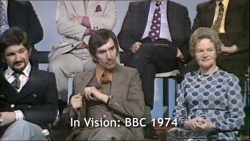
Producer Kenith Trodd faced criticism and praise from local workers, employers and critics in an edition of the discussion programme series <em>In Vision</em> (1974-75) that was dedicated to <em>Leeds – United!</em><sup id="rf1-4597"><a href="#fn1-4597" title="&lt;em&gt;In Vision&lt;/em&gt;, BBC2, tx. 1 November 1974." rel="footnote">1</a></sup> The play had a largely female cast who were positioned as participants: its lead actors and its extras were social actors, as mass crowds reconstructed their real-life participation in the 1970 events. The guests on <em>In Vision</em> include women workers who respond to the techniques by which their experiences were depicted by that male-authored text. There is a revealing tension between the play and the discussion programme. Women are addressed variously as subjects, participants and audiences, and this problematic movement is one with which the women workers are partly complicit, as we shall see. Women are the minority – 3 out of 10 guests – and are addressed in part as audience members, albeit in order to comment on the textual representation of their social participation. The programme opens up gendered discourse relating to the workplace and drama, or even contributes to that discourse. Of course, <em>In Vision</em> is a different type of text, with its own codes and conventions as well as its own guidelines on issues such as balance.</p>

<hr class="footnotes"><ol class="footnotes" style="list-style-type:decimal"><li id="fn1-4597"><p ><em>In Vision</em>, BBC2, tx. 1 November 1974.&nbsp;<a href="#rf1-4597" class="backlink" title="Return to footnote 1.">&#8617;</a></p></li></ol></hr>{"id":4597,"date":"2014-04-01T06:00:45","date_gmt":"2014-04-01T05:00:45","guid":{"rendered":"http:\/\/www.britishtelevisiondrama.org.uk\/?p=4597"},"modified":"2024-08-30T11:37:57","modified_gmt":"2024-08-30T10:37:57","slug":"women-and-work-leeds-united-part-3-of-3","status":"publish","type":"post","link":"http:\/\/www.britishtelevisiondrama.org.uk\/?p=4597","title":{"rendered":"Women and Work: <em>Leeds United!<\/em> (1974) Part 3 of 3"},"content":{"rendered":"<h4>by DAVID ROLINSON<\/h4>\n<p><em>Play for Today<\/em> <strong>Writer:<\/strong> Colin Welland; <strong>Producer:<\/strong> Kenith Trodd; <strong>Director:<\/strong> Roy Battersby<\/p>\n<p><em>This essay continues from <a href=\"http:\/\/www.britishtelevisiondrama.org.uk\/?p=4429\" target=\"_self\" rel=\"noopener\">Part 2<\/a> and <a href=\"http:\/\/www.britishtelevisiondrama.org.uk\/?p=4110\" target=\"_self\" rel=\"noopener\">Part 1<\/a>.<\/em><\/p>\n<p><b>The debate<\/b><\/p>\n<p><img loading=\"lazy\" decoding=\"async\" src=\"http:\/\/www.britishtelevisiondrama.org.uk\/wp-content\/uploads\/2013\/11\/BTVD_LeedsUnited_7-e1383674163923.png\" alt=\"BTVD_LeedsUnited_7\" width=\"250\" height=\"141\" class=\"alignleft size-full wp-image-4191\" \/><br \/>\nProducer Kenith Trodd faced criticism and praise from local workers, employers and critics in an edition of the discussion programme series <em>In Vision<\/em> (1974-75) that was dedicated to <em>Leeds \u2013 United!<\/em><sup id=\"rf1-4597\"><a href=\"#fn1-4597\" title=\"&lt;em&gt;In Vision&lt;\/em&gt;, BBC2, tx. 1 November 1974.\" rel=\"footnote\">1<\/a><\/sup> The play had a largely female cast who were positioned as participants: its lead actors and its extras were social actors, as mass crowds reconstructed their real-life participation in the 1970 events. The guests on <em>In Vision<\/em> include women workers who respond to the techniques by which their experiences were depicted by that male-authored text. There is a revealing tension between the play and the discussion programme. Women are addressed variously as subjects, participants and audiences, and this problematic movement is one with which the women workers are partly complicit, as we shall see. Women are the minority \u2013 3 out of 10 guests \u2013 and are addressed in part as audience members, albeit in order to comment on the textual representation of their social participation. The programme opens up gendered discourse relating to the workplace and drama, or even contributes to that discourse. Of course, <em>In Vision<\/em> is a different type of text, with its own codes and conventions as well as its own guidelines on issues such as balance.<\/p>\n<p><!--more--><\/p>\n<p><em>In Vision<\/em> is part of my ongoing wider research into feedback discussion programmes. Feedback programmes are an underexplored part of the history and critical analysis of television drama: they have intervened in key debates on areas such as authorship, form and genre and have provided a space for institutional narratives on commissioning, production, censorship and broadcasting regulation and, at times, the interrogation of those narratives. My main interest is in feedback programmes made in response to docudramas. These programmes discuss or mediate the discussion of docudrama methods, their content, and even their banning. They are often made alongside those docudramas or are deal-breakers in the making and scheduling of them. Broadcasters are required to observe \u201cdue impartiality\u201d, as the Ofcom Broadcasting Code states, \u201cwithin a programme or series of programmes\u201d &#8211; for example, by accepting that a drama may have a partial point of view but that this can be balanced by \u201ca debate about [that] drama\u201d.<sup id=\"rf2-4597\"><a href=\"#fn2-4597\" title=\"Ofcom Broadcasting Code rule 5.5. Derek Paget, &lt;em&gt;No Other Way To Tell It: Docudrama on Film and Television&lt;\/em&gt; (Manchester: Manchester University Press, 2011). Second Edition.\" rel=\"footnote\">2<\/a><\/sup> The regulations and guidelines on the subject are beyond my scope in this current essay, so I will let Alan Plater give a typically elegant summary, from his response to the BBC&#8217;s request for extra material during the difficulties faced by his <em>Horizon<\/em> docudrama <em>The Black Pool<\/em>: an &#8220;after the- programme studio discussion&#8221; was for Plater evidence of &#8220;the age-old BBC premise that you can get away with most things if you discuss them afterwards in a &#8216;balanced&#8217; way.&#8221;<sup id=\"rf3-4597\"><a href=\"#fn3-4597\" title=\"Alan Plater, draft piece for &lt;em&gt;The New Statesman&lt;\/em&gt; on &lt;em&gt;The Black Pool&lt;\/em&gt;\u2019s withdrawal by the BBC, 1980, accessed at Hull History Centre. From my forthcoming work on &lt;em&gt;The Black Pool&lt;\/em&gt;.\" rel=\"footnote\">3<\/a><\/sup> The fact that <em>Leeds United!<\/em> was allocated such a discussion is hardly surprising given the BBC&#8217;s strong reservations about its perceived political partiality, as we shall see.<\/p>\n<p>Feedback programmes take several forms, including one-offs responding to individual programmes and branded as off-shoots of them, such as <em>Dirty War: Your Questions Answered<\/em> and <em>Shoot to Kill: The Issues<\/em>. They also include series, such as Channel 4&#8217;s <em>Right to Reply<\/em> and <em>The TV Show<\/em>, and sections of arts\/discussion programmes. <em>In Vision<\/em> was a BBC2 discussion programme that ran between 1974 and 1975. It covered, according to one BBC document, \u201ca broad spectrum of broadcasting, from individual programme criticism\u201d \u2013 which is obviously my focus here \u2013 to author profiles and interviews.<sup id=\"rf4-4597\"><a href=\"#fn4-4597\" title=\"File labelled &lt;em&gt;In Vision Special International Report&lt;\/em&gt;, BBC Written Archives.\" rel=\"footnote\">4<\/a><\/sup>  Topics covered included audience research, broadcasting in Northern Ireland, the televising of a Cup Final, documentary, the police in television drama and American Television; and programmes featured \u2013 often with their cast and makers in the studio \u2013 included <em>Z Cars<\/em>, <em>Barlow<\/em>, <em>Gangsters<\/em> and <em>Monty Python<\/em>. <\/p>\n<p>Presented by William Hardcastle, the <em>Leeds United!<\/em> episode featured the following guests, reading screen left to screen right: along the back row, John Elliott (<em>Financial Times<\/em> industrial editor), Martin Frankel (MD of Montague Burton Manufacturing), Harry Yates (National Union of Tailors and Garment Workers), Roland Hebden (clothing worker) and Mildred Crossley (clothing worker); along the front row, Barrie Farnill (<em>Yorkshire Post<\/em>), Russell Davies (<em>The Observer<\/em>), Kenith Trodd (producer), Alice Knowles (clothing worker) and Gertie Roche (clothing worker). I mentioned earlier that only 3 out of 10 guests were women, but they are the majority in terms of the clothing worker guests &#8211; 3 out of 4 \u2013 collected on the (screen) right. The three journalists are collected on the left, and Trodd is central, as the programme\u2019s only representative. (John Hill has demonstrated that the BBC did not want Roy Battersby involved in the programme.<sup id=\"rf5-4597\"><a href=\"#fn5-4597\" title=\"Hill, \u2018From &lt;em&gt;Five Women&lt;\/em&gt;\u2019, p. 142\" rel=\"footnote\">5<\/a><\/sup> ) There is no Communist Party guest to reply to criticisms made in the play, as Stewart Lane noted in the <em>Morning Star<\/em>: \u201cDespite the Communist Party requesting that one of the Communist leaders in the [\u2026strike\u2026] be invited to the discussion\u201d. Lane argued that this \u201comission\u201d was \u201cparticularly blatant\u201d and that, given the statistics on Communist involvement mentioned earlier, such a guest \u201cwould have injected factual reality\u201d.<sup id=\"rf6-4597\"><a href=\"#fn6-4597\" title=\"Lane, \u2018\u201cCharacters\u201d in BBC play hit back at author\u2019.\" rel=\"footnote\">6<\/a><\/sup> <\/p>\n<p>The fact that the employer and the union representative sit side-by-side seems loaded given that political context, the play\u2019s analysis. Indeed, they form a line with the industrial editor of the <em>Financial Times<\/em> who presents a dominant official view of strikes. As I say this, I realise that I&#8217;m in danger of reading studio space reductively in baldly ideological terms. After all, the positioning of guests in this episode is partly the result of the code that it shares with many feedback programmes, addressing answers and comments to the mediating questioner &#8211; but <em>In Vision<\/em>&#8216;s blocking makes for an awkward use of space. One common arrangement for such discussions can be seen in <em>Shoot to Kill: The Issues<\/em>, a 1990 discussion programme following <em>Shoot to Kill<\/em>, Peter Kosminsky\u2019s docudrama about the killings of \u2018terrorist\u2019 suspects in Northern Ireland.<sup id=\"rf7-4597\"><a href=\"#fn7-4597\" title=\"&lt;em&gt;Shoot to Kill: The Issues&lt;\/em&gt;, Yorkshire for ITV, tx. 4 June 1990.\" rel=\"footnote\">7<\/a><\/sup> There, the form is more clearly adversarial: two panels of guests in ideological and visual opposition. Filmmaker Kosminsky is on the same side as an Amnesty representative and the Republican Seamus Mallin from the SDLP. They are positioned at a desk on the (screen) left. Meanwhile, at a separate desk on the right sit a Conservative MP and the Unionist MP David Trimble of the UUP. Presenter Olivia O\u2019 Leary is in the centre, the fulcrum to whom questions, answers and statements about others in the studio are addressed. There are of course practical reasons for this use of studio space \u2013 as with comedy panel shows, the visual grammar supports the use of a small number of cameras to get group and single shots for each \u201cside\u201d, shots which camera operators can find while the fulcrum presenter speaks to, and motivates a throw to, a specific guest. It might be crass to make a party-political reading of the guests\u2019 positioning on the \u201cleft\u201d and \u201cright\u201d, but the assumed sympathies between and against specific groups are clearly marked. Awkwardly, the <em>In Vision<\/em> guests are all positioned frontally in rows of seats, looking out at us and across to the presenter on the right. We shouldn\u2019t essentialise studio space in either of the examples I\u2019ve discussed, even though Trodd is positioned centrally and the discussion flows from his actions while the women are relatively marginalised at the end. But the questions, and their organisation, do offer support for that sort of reading.<\/p>\n<p>Just as <em>Shoot to Kill: the Issues<\/em> opens with a question not about its allegations but about the appropriateness of docudrama, so this <em>In Vision<\/em> discussion ends on docudrama and starts with questions about the cinematic qualities of <em>Leeds United!<\/em> and how we define terms like film, play, big screen and small screen. Hardcastle presents his personal, taste-laden, praise for the achievement. Trodd explains why they fought to shoot the play in black and white and, in keeping with the references presented earlier in this essay, mentions as influences Portecorvo, Pabst and Eisenstein. Docudrama and cinematic influences were two active frames for discussion within the BBC and in press coverage; Sean Day-Lewis wondered whether they acted in opposition: \u201cThe snowball effect of the strike, workers constantly leaving their benches to join the passing marchers, looked a good deal more filmic than realistic.\u201d<sup id=\"rf8-4597\"><a href=\"#fn8-4597\" title=\"Day-Lewis, &#8216;Brilliant picture of mob rule in strike&#8217;.\" rel=\"footnote\">8<\/a><\/sup> If they acted in opposition, it might seem strange that the BBC&#8217;s Board of Governors were concerned about the play&#8217;s supposed documentary rhetoric, as John Hill noted: &#8220;it does not attempt to maintain a consistent simulation of documentary style but employs a range of film-making techniques. Indeed, [&#8230;it] signal[s] its departure from documentary from the very outset&#8221; in the opening sequence&#8217;s &#8220;homage to Pabst&#8221;.<sup id=\"rf9-4597\"><a href=\"#fn9-4597\" title=\"Hill, &#8216;From &lt;em&gt;Five Women&lt;\/em&gt;, p. 142.\" rel=\"footnote\">9<\/a><\/sup> As we shall see, a mixture of styles created other objections. But if the opening of <em>Leeds United!<\/em> uses those cinematic influences to prioritise female experience and agency, the start of <em>In Vision<\/em> does not.<\/p>\n<p>It is 13 minutes before <em>In Vision<\/em> asks a question of a female guest. The three women mostly speak about their horror at the play\u2019s depiction of women workers swearing. Given that Gertie Roche was publicly associated with the real-life strike, it is striking that she is encouraged to address swearing rather than the political aspects of the depiction. Roche was the subject of profiles, for instance in the <em>Daily Mirror<\/em> (another source called her the \u201cquiet leader of the rag trade wildcats\u201d<sup id=\"rf10-4597\"><a href=\"#fn10-4597\" title=\"Profile in &lt;em&gt;History Workshop Journal&lt;\/em&gt; &#8211; an extract, unless you have access to the journal, is available &lt;a href=&quot;http:\/\/hwj.oxfordjournals.org\/content\/1998\/45\/313.extract&quot; target=&quot;_self&quot; rel=&quot;noopener&quot;&gt;here&lt;\/a&gt;.\" rel=\"footnote\">10<\/a><\/sup> ), and commented in public, for instance in a letter published in the <em>Yorkshire Evening Post<\/em> explaining that \u201cThe revolt is due, not to a handful of left wingers, but to something far deeper \u2013 20 years of neglect by the employers.\u201d<sup id=\"rf11-4597\"><a href=\"#fn11-4597\" title=\"Letter from Gertie Roche published in &lt;em&gt;Yorkshire Evening Post&lt;\/em&gt;, 26 February 1970, in Honeyman, p. 216.\" rel=\"footnote\">11<\/a><\/sup> (It seems appropriate therefore that the play was praised by Shaun Usher as \u201cskilful, uncondescending, and [\u2026] probably quite valuable\u201d because it leaves \u201cno excuse for innocents who believe that workers really go on strike over a cup of tea or a rude word.\u201d<sup id=\"rf12-4597\"><a href=\"#fn12-4597\" title=\"Usher, &#8216;When the scalp tingles and the blood runs hot&#8217;.\" rel=\"footnote\">12<\/a><\/sup> ) Roche, according to Katrina Honeyman, \u201cplayed a critical role\u201d, raising the \u201clack of communication between bosses and workers and between the workers themselves\u201d and the observation that \u201cthere is a tremendous revolt against the NUTGW\u201d. Roche \u201choped to see a new-deal charter for the industry upon the settlement of the strike.\u201d<sup id=\"rf13-4597\"><a href=\"#fn13-4597\" title=\"&lt;em&gt;Daily Mirror&lt;\/em&gt;, 26 February 1970, quoted in Honeyman, p. 216.\" rel=\"footnote\">13<\/a><\/sup> <\/p>\n<p>On <em>In Vision<\/em>, Roche praises <em>Leeds United!<\/em> \u2013 \u201cI thought the play was absolutely terrific, and depicted what really happened\u201d. Although she is critical of the play&#8217;s use of swearing, she intriguingly discusses it in comparison with <em>Serpico<\/em> in order to see the swearing as a creative device that helps to evoke &#8220;the frustrations and fury that the women felt at the time&#8221;. This is a lovely reversal from <em>Leeds United!<\/em> &#8211; now the worker is empathising with the filmmaker&#8217;s experience. Gertie later interrupts debates on swearing to reconnect it to content: although a lot has been said \u201con the obscene language that was used\u201d, \u201cwhat\u2019s failed to be realised is the obscenity of people having to work in these awful sweatshops.\u201d Like Gertie, Dennis Potter found it \u201cinsulting\u201d that <em>In Vision<\/em> \u201cspent most of its time discussing not the relevance, not the discoveries, not the insights of the play but its mere documentary \u2018accuracy\u2019.\u201d Potter related this to the statement of a \u201cwasteland orator\u201d during the play: \u201cThe trouble is, you\u2019re trying to ride two \u2018orses with one arse\u201d.<sup id=\"rf14-4597\"><a href=\"#fn14-4597\" title=\"Dennis Potter, \u2018Twisting Time\u2019, &lt;em&gt;New Statesman&lt;\/em&gt;, 8 November 1974, p. 671.\" rel=\"footnote\">14<\/a><\/sup> The question of whether <em>Leeds United!<\/em> was \u201ctrue\u201d is asked in various ways in the programme: for example, Hardcastle presents two comparisons between news coverage from the real events and the reconstructions shown in the play. Some of the press coverage had similar concerns: \u201cHow far the reconstruction was exactly true you could not tell. The collapse of one factory into the strike was disappointingly skimped after all the confidence of its boss that he could keep it into production. And in times when two marchers usually bring three policemen the Law was oddly absent, save in one incident with scabs at a gate.&#8221;<sup id=\"rf15-4597\"><a href=\"#fn15-4597\" title=\"Buckley, &#8216;Leeds &#8211; United!&#8217;\" rel=\"footnote\">15<\/a><\/sup><\/p>\n<p>The discussion programme does get onto substantive issues. The women reject the employer\u2019s assurance that sweatshops have gone, and Trodd takes up their position and states it more forcefully. They also discuss the view, as represented by the <em>Morning Star<\/em> earlier in this essay, that the strike, despite its overall failure, led to improved conditions. But the women and their politics are not the focal point of the discussion. Indeed, Elliott says that he wanted to know what the women strikers\u2019 husbands thought during the events shown in the play. It is striking that <em>Leeds United!<\/em>, as John Hill noted, \u201ckeeps the number of domestic scenes to a minimum in order to highlight actions in the public sphere\u201d.<sup id=\"rf16-4597\"><a href=\"#fn16-4597\" title=\"Hill, &#8216;From &lt;em&gt;Five Women&lt;\/em&gt;&#8216;, p. 149, n.30.\" rel=\"footnote\">16<\/a><\/sup> During <em>In Vision<\/em>, Trodd points out that domestic scenes were planned but, during the process of paring down the script, those scenes were removed. This prioritisation of workplaces over domestic spaces is interesting in terms of the foregrounding of work and politics discussed earlier in this essay. One of the play\u2019s few movements into the domestic space operates as a critique: noting the \u201cstruggles to invest the CP shop steward\u2019s treachery with political and psychological plausibility\u201d, Hill argues that the play\u2019s \u201canalysis of the strike\u2019s collapse depends [\u2026] on the insertion of a dramatically unconvincing scene at the official\u2019s home in which he denounces the women strikers as \u2018animals\u2019 to his wife.\u201d<sup id=\"rf17-4597\"><a href=\"#fn17-4597\" title=\"Ibid.\" rel=\"footnote\">17<\/a><\/sup> For Potter, the domestic could have enhanced the political: \u201cas march dissolved into march, meeting into meeting, I longed all the more for a domestic sequence where the hope and then the demoralisation and sense of betrayal could really come home to roost\u201d.<sup id=\"rf18-4597\"><a href=\"#fn18-4597\" title=\"Potter, &#8216;Twisting Time&#8217;.\" rel=\"footnote\">18<\/a><\/sup> Therefore, although Elliott\u2019s point about the women\u2019s husbands risked a problematic gendered shifting of agency, the play between public and private spaces was, for critics before and since, central to the play\u2019s effectiveness.<\/p>\n<p><img loading=\"lazy\" decoding=\"async\" src=\"http:\/\/www.britishtelevisiondrama.org.uk\/wp-content\/uploads\/2013\/11\/BTVD_LeedsUnited_8-e1383674178518.png\" alt=\"BTVD_LeedsUnited_8\" width=\"250\" height=\"141\" class=\"alignleft size-full wp-image-4192\" \/><br \/>\nWhen <em>In Vision<\/em> asks the question \u201cDid you recognize yourself?\u201d, it is addressed not to the women but to Yates. There is a point during the discussion at which Hardcastle stops Frankel with the exhortation to \u201clet the lady speak\u201d, but this is something that <em>Leeds United!<\/em> does not need to say. Parallels suggest themselves between the ways in which the women workers are positioned: by their bosses (within and outwith the play), by the male authors representing them, and by <em>In Vision<\/em>\u2019s viewer-response address. However, this is problematised by the ways in which women position *themselves* in terms of social performance. <em>In Vision<\/em>\u2019s long discussion of swearing is justifiable in that it reflects the complaints made by women workers in the local and national press coverage of the play. The swearing was seized upon by the play\u2019s opponents \u2013 the Clothing Manufacturers\u2019 Federation spokesman pointed out that \u201cThere will be thousands of angry women at this portrayal of them as foul-mouthed harridans.\u201d<sup id=\"rf19-4597\"><a href=\"#fn19-4597\" title=\"Thomas, &#8216;Sadness at the end of this battle for the bob&#8217;.\" rel=\"footnote\">19<\/a><\/sup> Such &#8220;angry women&#8221; feature in press pieces referenced by <em>In Vision<\/em>, and in a <em>Daily Mail<\/em> piece that this essay will use as an indicative example: \u2018We\u2019re <u>ladies<\/u> in Leeds and the BBC better believe it!\u2019 The story reported a petition at Larlo\u2019s factory, which stated: \u201cWe were misrepresented. We are normal, respectable hard-working women.\u201d One woman presser stressed that \u201cthe language is no worse in the rag trade than in any other factory. It\u2019s not right that the girls should be degraded. They are a nice bunch of proud, clean women.\u201d Other speakers stated that \u201cI don\u2019t swear \u2013 ever. We are not crude\u201d and that \u201cWhen we have a works outing we never allow a man to come along. I drink tonic water in a hotel.\u201d The female worker who organised the petition stated that \u201cwe were bugged. We didn\u2019t know we were being taped for the first 20 minutes. It was wrong.\u201d A male factory manager alleged that \u201cWe were told to lay the language on, to make it tougher than normal.\u201d The use of recording equipment sheds light on one of the play\u2019s docudrama devices and the verification of documentation. Rejecting the accusations, Welland stated that<\/p>\n<blockquote><p>We hung a big microphone over the workbenches because I wanted to pick up the quality of the intonation of the speech in the factory. It was no secret. Within minutes everyone knew the microphone was there. The language in the play was an accurate portrayal of the way ordinary people speak.<sup id=\"rf20-4597\"><a href=\"#fn20-4597\" title=\"Daily Mail Reporter, \u2018We\u2019re &lt;b&gt;ladies&lt;\/b&gt; in Leeds and the BBC better believe it!\u2019, &lt;em&gt;Daily Mail&lt;\/em&gt;, 2 November 1974.\" rel=\"footnote\">20<\/a><\/sup> <\/p><\/blockquote>\n<p>Given such accusations and denials, it is understandable that <em>In Vision<\/em> asks Trodd such a direct question about swearing as &#8220;Is it true?&#8221; In 2006, Roy Battersby tried to reconcile women workers\u2019 complaints about misrepresentation with his experience of walking across a factory floor: \u201cthe first voice I heard was a woman on a machine saying, \u2018by \u2018eck, I wouldn\u2019t mind his balls banging against me bum\u201d and fifty variations on the same which left him a sweating wreck. He was therefore puzzled by newspaper comments from workers including women they knew from making the play, and so he went to see them: according to Battersby they said that those comments had been \u201cjust for the old man\u201d, in that they didn&#8217;t want their husbands to know what they were like at work.<sup id=\"rf21-4597\"><a href=\"#fn21-4597\" title=\"&lt;em&gt;Time Shift&lt;\/em&gt;: \u2018Left of Frame: the Rise and Fall of the Radical TV Play\u2019, BBC4 tx. 7 February 2006; BBC2 tx. 31 July 2006.\" rel=\"footnote\">21<\/a><\/sup> (I must stress that this was not said directly about the people quoted in the <em>Daily Mail<\/em> piece above!) Clearly complaints about swearing have wider issues of representation and identity at stake: as one worker told the <em>Daily Mail<\/em>, \u201cMy husband was annoyed. It is the association of the use of bad language with loose morals. In our case this couldn\u2019t be further from the truth.\u201d<sup id=\"rf22-4597\"><a href=\"#fn22-4597\" title=\"Daily Mail Reporter, &#8216;We&#8217;re &lt;b&gt;ladies&lt;\/b&gt; in Leeds and the BBC better believe it!&#8217;\" rel=\"footnote\">22<\/a><\/sup> Models of feminine conduct, already loaded in terms of gendered discourse and popular representations of second wave feminism, are invoked in relation to political action, as we saw with Gridley\u2019s dismissal of women workers as \u201canimals\u201d earlier. <\/p>\n<p>However, and without wanting to downplay those concerns, or to give the impression that the male director&#8217;s reading of the attitudes of his subjects is definitive, an attractive if messy idea emerges: that the women were playing with social performance even while criticising the play&#8217;s performance of their earlier social performance. I&#8217;m reminded of Stella Bruzzi&#8217;s work on documentary performativity, some filmmakers&#8217; emphasis on often hidden aspects of performance. For Bruzzi, Dineen\u2019s work such as <em>Geri<\/em> (about Geri Halliwell) shows how the personal, individual woman&#8217;s voice has traditionally been marked as &#8216;other&#8217; in a discourse whose voice (voice-over and the \u201cvoice\u201d of documentary) is often male. In <em>Geri<\/em>, Dineen \u201cperforms an archetypal femininity\u201d according to Bruzzi;<sup id=\"rf23-4597\"><a href=\"#fn23-4597\" title=\"Stella Bruzzi, &lt;em&gt;New Documentary: A Critical Introduction&lt;\/em&gt; Second Edition (Abingdon: Routledge, 2006), p. 203.\" rel=\"footnote\">23<\/a><\/sup> for John Ellis, his students\u2019 scepticism about Halliwell\u2019s sincerity raise questions about how we read performance: \u201canother identity which lies, inaccessibly, behind the performance [\u2026] performance as exactly the essence of her identity\u201d.<sup id=\"rf24-4597\"><a href=\"#fn24-4597\" title=\"John Ellis, &lt;em&gt;Documentary: Witness and Self-Revelation&lt;\/em&gt; (Abingdon: Routledge, 2012), p. 149.\" rel=\"footnote\">24<\/a><\/sup> If <em>Geri<\/em> questions whether it can find the real person under the celebrity performance, it also shows that documentary itself is subject to modes of performance. Bruzzi observes the visibility of codes and negotiation in <em>Geri<\/em>, which sheds light on the ethical issues raised by the filmmaker-participant relationship. Geri performs, but Dineen also performs as a documentarian. A comparison can be made with <em>Leeds United!<\/em>, if we view the complaints reported in the press as the factory workers performing to gender roles that the play attempts not to restrict them to. <em>In Vision<\/em> gives no sense of this performative exchange between subjects, filmmakers and audiences, until viewed alongside the play. During <em>Leeds United!<\/em>, strikers pose for photographs, which are taken by a man. They copy his order to say &#8220;cheese&#8221;, with comic excess. They critique representations &#8211; earlier, one factory&#8217;s workers walked out when the radio news said that factory wouldn&#8217;t strike. But in this photograph they are performing, playing, conspiring &#8211; in different ways they might just be doing this across this play&#8217;s intermedial presence.<\/p>\n<p>Far from being surprised by complaints about the swearing, Trodd had predicted them. In October 1973, he was reported as being \u201cworried\u201d that the \u201cearlier timing\u201d of the play (when it was still being discussed as starting at 8pm) \u201cmay cause difficulties because of some frank language in the script.\u201d Trodd clarified that the play\u2019s language was \u201cnot obscenity \u2013 there are no four letter words. But if we try to restrict them to the second half, after 9 p.m., it will sound very artificial.\u201d<sup id=\"rf25-4597\"><a href=\"#fn25-4597\" title=\"Last, &#8216;BBC screens strike play ITV refused&#8217;.\" rel=\"footnote\">25<\/a><\/sup> However, the programme makers and critics were mindful of what seemed like more pressing opposition \u2013 some of which would come from within the BBC itself.<\/p>\n<p><strong>Radical drama?<\/strong><\/p>\n<p>In March 1974, Peter Fiddick observed that this \u201cpowerfully political play\u201d was likely to cause problems since it would \u201cevoke a high degree of commitment from Trodd and Battersby, two of the industry\u2019s better-known political radicals.\u201d<sup id=\"rf26-4597\"><a href=\"#fn26-4597\" title=\"Fiddick, &#8216;Filming strife&#8217;.\" rel=\"footnote\">26<\/a><\/sup> As we saw earlier, the perceived personal involvement and sense of advocacy were an issue for a few reviewers. Peter Lennon saw it as a \u201cweakness\u201d that \u201cthe film-makers seemed to share the, no doubt justified, feeling of betrayal of the strikers\u201d because the latter \u201cwas not convincingly demonstrated.\u201d<sup id=\"rf27-4597\"><a href=\"#fn27-4597\" title=\"Lennon, &#8216;Faces in the crowd&#8217;.\" rel=\"footnote\">27<\/a><\/sup> After transmission, Chris Dunkley speculated that \u201cNo doubt there are those who will point to \u2013 probably already have pointed to \u2013 this play as clear evidence of the BBC\u2019s pinko-commie bias\u201d as it showed \u201cthe \u2018anti-social hours\u2019 of the rag trade workers and the tedium of their jobs, quoted their appalling wages and filmed their unofficial strike meetings and marches in a way that gave them a certain glory.\u201d<sup id=\"rf28-4597\"><a href=\"#fn28-4597\" title=\"Dunkley, &#8216;Getting better&#8217;.\" rel=\"footnote\">28<\/a><\/sup> Clive James speculated that the delay in finding a slot may have been connected with the timing of an election, since \u201cthe Tories would have screamed blue murder\u201d.<sup id=\"rf29-4597\"><a href=\"#fn29-4597\" title=\"James, &lt;em&gt;The Observer&lt;\/em&gt;.\" rel=\"footnote\">29<\/a><\/sup> <\/p>\n<p>John Hill has recently discussed the tensions within the BBC over <em>Leeds United!<\/em> in the context of the time and the nature of radical television drama. Radical dramas tended to involve not merely critiquing the establishment but \u2018canvassing [\u2026] social and political alternatives to it\u2019, with concomitant debates on content and form, \u201cdebates about the specific artistic forms that \u2018radicalism\u2019 might assume\u201d.<sup id=\"rf30-4597\"><a href=\"#fn30-4597\" title=\"Hill, &#8216;Introduction&#8217;, pp. 107, 108.\" rel=\"footnote\">30<\/a><\/sup> Hill explains that definitions of radicalism, and of radical television drama\u2019s strategies, are \u201cnot fixed but subject to historical change\u201d, noting for example the shifting meaning of such terms pre- and post-Thatcher.<sup id=\"rf31-4597\"><a href=\"#fn31-4597\" title=\"Ibid, p. 110.\" rel=\"footnote\">31<\/a><\/sup> The BBC supported pieces like <em>Leeds United!<\/em> mindful that \u201cthe bulk of television drama [is] conservative\u201d in that it \u201cmaintained support for prevailing institutions and provided a form of \u2018social cement\u2019\u201d.<sup id=\"rf32-4597\"><a href=\"#fn32-4597\" title=\"Ibid, p. 108.\" rel=\"footnote\">32<\/a><\/sup> Even in this period such directly political plays were rare \u2013 Alasdair Milne, Director of Television Programmes, stated in 1975 that only a dozen plays out of 150 could be viewed as political \u2013 but were \u201csome of the most expensive and prestigious dramas produced by the BBC [\u2026] capable of attracting a disproportionate amount of attention\u201d.<sup id=\"rf33-4597\"><a href=\"#fn33-4597\" title=\"Hill, &#8216;From &lt;em&gt;Five Women&lt;\/em&gt;, p. 131.\" rel=\"footnote\">33<\/a><\/sup> But, to return to the start of this essay, <em>Leeds United!<\/em> is an example of how radical drama was \u201coften made, and shown, in the face of considerable opposition.\u201d<sup id=\"rf34-4597\"><a href=\"#fn34-4597\" title=\"Ibid, p. 132.\" rel=\"footnote\">34<\/a><\/sup> <\/p>\n<p>Hill valuably places <em>Leeds United!<\/em> in the context of other radical dramas made in the 1970s and in the challenges faced by Roy Battersby on <em>Five Women<\/em>\/<em>Some Women<\/em>, which prompted exchanges about docudrama\u2019s mixing of fact and fiction, and science programme <em>Hit Suddenly Hit<\/em>, the dispute over which prompted Head of Features Aubrey Singer to remind Battersby that \u201cbalance and impartiality\u201d had to be observed and that \u201cemployment at the BBC did not constitute \u2018an act of patronage giving freedom of the air\u2019\u201d.<sup id=\"rf35-4597\"><a href=\"#fn35-4597\" title=\"Letter, 9 September 1968, quoted in Hill, \u2018From &lt;em&gt;Five Women&lt;\/em&gt;\u2019, p. 138. For this reference and all subsequent references of this type, see Hill for full quotation and BBC Written Archives reference.\" rel=\"footnote\">35<\/a><\/sup> Such issues recurred when the BBC\u2019s Board of Governors discussed <em>Leeds United!<\/em>, asking: \u201cdid the play\u2026 make it sufficiently clear that it was fiction and not documentary?\u201d and \u201cwas it legitimate for playwrights to write loaded plays?\u201d Huw Wheldon felt that there was \u201cno deceit\u201d and stated that he had forbidden \u201cthe use of real persons\u2019 voices [\u2026even] when the people on the screen were acting their parts\u201d.<sup id=\"rf36-4597\"><a href=\"#fn36-4597\" title=\"Meeting, 7 November 1974, quoted in Hill, \u2018From &lt;em&gt;Five Women&lt;\/em&gt;\u2019, pp. 142-143.\" rel=\"footnote\">36<\/a><\/sup> These comments explain the institutional logic underpinning the issues covered by <em>In Vision<\/em> and demonstrate that the combination of observed footage and voice-overs took place in a climate in which such techniques were under close institutional scrutiny after a number of controversies. For BBC figures quoted by Hill, the combination of fact and fiction challenged the BBC\u2019s ability to enforce its \u201cobligation to balance\u201d: as the incoming Director-General, Charles Curran, argued, the sort of \u201cpolitical advocacy\u201d that would be forbidden in factual programming could sneak through in drama because such programming \u201cfalls under a different technical classification in television\u201d, something that Curran thought the BBC should no longer \u201cassume without question\u201d.<sup id=\"rf37-4597\"><a href=\"#fn37-4597\" title=\"Memo, 21 February 1969, quoted in Hill, \u2018From &lt;em&gt;Five Women&lt;\/em&gt;\u2019, p. 143.\" rel=\"footnote\">37<\/a><\/sup> This challenges the programme makers\u2019 position that \u201c\u2018balance\u2019 did not operate within an individual programme but across the schedule and that left-wing plays could, therefore, be seen to \u2018balance\u2019 the overwhelmingly conservative character of the majority of TV programmes.\u201d  Hill quotes discussions about the BBC\u2019s responsibilities to avoid exacerbating tensions at a time of industrial tensions \u2013 delays meant that the play was broadcast after 1974\u2019s two elections, the first of which saw a confrontation with the NUM in effect bring down a Conservative government. This need not involve banning such a programme but there is a sense in the discussion that such pieces should be made less frequently. Discussing \u201cdramatic work of a politically or socially tendentious nature\u201d, Milne felt that the BBC should provide space for \u201cpeople of genuine talent\u201d like Ken Loach and Tony Garnett, whom he distinguished from \u201cless talented but more obstreperous\u201d people. Hill comments that this \u201cappeared to include the makers of <em>Leeds United!<\/em>\u201d, on which, according to Milne, \u201cthe editorial arguments and niceties got out of hand\u201d.<sup id=\"rf38-4597\"><a href=\"#fn38-4597\" title=\"Note by Milne, 17 October 1975, quoted in Hill, \u2018From &lt;em&gt;Five Women&lt;\/em&gt;\u2019, pp. 142-143. \" rel=\"footnote\">38<\/a><\/sup> There would arguably be consequences in terms of the provision of radical drama and the \u201cpurge\u201d of left-wing staff that is alleged to have followed.<sup id=\"rf39-4597\"><a href=\"#fn39-4597\" title=\"See Mark Hollingsworth and Richard Norton-Taylor, &lt;em&gt;Blacklist: The Inside Story of Political Vetting&lt;\/em&gt; (London: Hogarth Press, 1988).\" rel=\"footnote\">39<\/a><\/sup> Later, Trodd, who described <em>Leeds United!<\/em> as \u201cprobably the most radical piece I was associated with\u201d, put it in context:<\/p>\n<blockquote><p>\u2026we\u2019re dealing here with a period when there was a Labour government [\u2026] who were increasingly uneasy about the BBC, or certain elements in the BBC. That perennial thing, that the BBC is endemically lefty \u2013 I\u2019ve never been able to make up my mind about that really. I certainly didn\u2019t feel that the antagonisms I was involved in at the BBC were political on that narrow basis. But nevertheless there was that perception. And around 1976 \u2013 2 or 3 years after <em>Leeds United!<\/em> \u2013 they tried a purge.<sup id=\"rf40-4597\"><a href=\"#fn40-4597\" title=\"Trodd to MacCabe, &lt;em&gt;Simon Gray&lt;\/em&gt;.\" rel=\"footnote\">40<\/a><\/sup> <\/p><\/blockquote>\n<p>Alleged concerns about the active WRP member Roy Battersby \u2013 such as the allegation that MI5 objected to Battersby\u2019s use on plays like <em>Leeds United!<\/em> \u2013 help to explain his absence for the next decade.<sup id=\"rf41-4597\"><a href=\"#fn41-4597\" title=\"As Hill points out, Battersby directed &lt;em&gt;Post Mortem&lt;\/em&gt; (BBC2, tx. 6 March 1975) but subsequently got little work \u2013 instead working for the WRP \u2013 and didn\u2019t work for the BBC again until King of the Ghetto (BBC2, May 1986) and that only after \u201cresistance within the BBC to his employment\u201d. Hill, &#8216;From &lt;em&gt;Five Women&lt;\/em&gt;&#8216;, p. 145. Hill also draws from Hollingsworth and Norton-Taylor, &lt;em&gt;Blacklist&lt;\/em&gt;.\" rel=\"footnote\">41<\/a><\/sup><\/p>\n<p>Such institutional debates are particularly striking given reviewer Clive James\u2019s claim that \u201cwhile it retains the capacity to commission and screen a play as serious as this, the BBC is in a solid moral position, and would be justified in asking for the licence fee to be doubled.\u201d<sup id=\"rf42-4597\"><a href=\"#fn42-4597\" title=\"James, &lt;em&gt;The Observer&lt;\/em&gt;.\" rel=\"footnote\">42<\/a><\/sup> Although my essay has shown that there was some critical dissent, there were also many tributes. Despite reservations expressed elsewhere, Peter Lennon said it was \u201cexpertly filmed by Peter Bartlett, intelligently and sensitively cut by Don Fairservice, and with masterly direction of crowds by Roy Battersby was, in both an aesthetic and a social sense, a bold and exhilarating use of the box.\u201d<sup id=\"rf43-4597\"><a href=\"#fn43-4597\" title=\"Lennon, &#8216;Faces in the Crowd&#8217;.\" rel=\"footnote\">43<\/a><\/sup> Although Shaun Usher felt that it was \u201cNot a masterwork\u201d, he thought it \u201ca surging yet disciplined, earthy and engaged shot at the article\u201d which blended \u201ceverything from broad humour to polemical anger and moments suspiciously close to blank verse.\u201d<sup id=\"rf44-4597\"><a href=\"#fn44-4597\" title=\"Usher, &#8216;When the scalp tingles and the blood runs hot&#8217;.\" rel=\"footnote\">44<\/a><\/sup> Colin Welland received much praise from critics who were used to expecting high quality \u2013 <em>The Times<\/em> stated that \u201cOnce more this vigorous writer brought us a <em>Play for Today<\/em> that took us by the throat\u201d.<sup id=\"rf45-4597\"><a href=\"#fn45-4597\" title=\"Buckley, &#8216;Leeds &#8211; United!&#8217;\" rel=\"footnote\">45<\/a><\/sup> Critics were particularly impressed by Welland\u2019s ability to combine the political and the personal. <em>Leeds United!<\/em> was therefore praised as \u201ctelevision with emotion [\u2026that] cut through the union jargon and the political cant that have left us these days apathetic to a fundamental human grievance.\u201d<sup id=\"rf46-4597\"><a href=\"#fn46-4597\" title=\"Ibid.\" rel=\"footnote\">46<\/a><\/sup> \u201cWelland\u2019s great merit\u201d, argued Clive James in <em>The Observer<\/em>, \u201cis that he can work with precision in poster colours, sacrificing subtlety while retaining delicacy: his people can talk slogans at one another and still sound human.\u201d<sup id=\"rf47-4597\"><a href=\"#fn47-4597\" title=\"James, &lt;em&gt;The Observer&lt;\/em&gt;.\" rel=\"footnote\">47<\/a><\/sup> <em>The Guardian<\/em> put it more directly: \u201cWelland proves that it\u2019s possible to bring drama into political analysis and make you cry.\u201d<sup id=\"rf48-4597\"><a href=\"#fn48-4597\" title=\"Sheridan, &#8216;Tailor made for drama&#8217;.\" rel=\"footnote\">48<\/a><\/sup> <em>The Daily Telegraph<\/em>\u2019s praise was more back-handed: \u201cAny drama which holds the viewer gripped and emotionally involved for two hours, despite the depressingly familiar theme of industrial unrest and filming in grainy monochrome [\u2026to emphasise] the gloom of dank and crumbling backgrounds, cannot be all bad.\u201d<sup id=\"rf49-4597\"><a href=\"#fn49-4597\" title=\"Day-Lewis, &#8216;Brilliant picture of mob rule in strike&#8217;.\" rel=\"footnote\">49<\/a><\/sup> Peter Fiddick had observed at the script stage \u201cthe warmth and pace that has made Welland one of our most popular serious television writers.\u201d<sup id=\"rf50-4597\"><a href=\"#fn50-4597\" title=\"Fiddick, &#8216;Filming strife&#8217;.\" rel=\"footnote\">50<\/a><\/sup><\/p>\n<p>Dennis Potter\u2019s praise for Welland is worth quoting at length because it also attempts to add to as-yet inadequate \u201cdiscussion of the claims and potentialities of TV drama\u201d. Potter felt that Welland\u2019s \u201ctalents are seen at their best\u201d not in docudrama but when internal \u201ccontrary emotions, tangled yearnings, bruised expectations and comic dislocations\u201d are \u201cteased out in the domestic dialogue, public bar confrontations, inebriated sing-songs and slow, hesitant asides which fall between people\u201d. This relates to Potter\u2019s ongoing case for non-naturalistic form, which might be seen as an alternative reading of institutional resistance given his belief that \u201cthe future of the threatened single play lies not in simulated \u2018drama documentary\u2019, not in film, not in overtly \u2018public issues tackled in a way that seeks deliberately to breach the wavering line between reportage and the often greater truths of \u2018fiction\u2019\u201d. Several <em>Play for Today<\/em> pieces would be censored or banned outright in the next few years, but these included not just public-issue docudramas like <em>Scum<\/em> but also Potter&#8217;s formally very different <a href=\"http:\/\/www.britishtelevisiondrama.org.uk\/?p=882\" target=\"_self\" rel=\"noopener\"><em>Brimstone and Treacle<\/em><\/a>). There was still institutional support &#8211; in 1980, Trodd observed that the &#8220;politically innocent&#8221; but potentially controversial Northern Ireland play <em>Shadows on our Skin<\/em> could only have been made with &#8220;the institutional force of the BBC behind us, against all the political forces ranged against us&#8221;<sup id=\"rf51-4597\"><a href=\"#fn51-4597\" title=\"Quoted in Janet Morgan, &lt;em&gt;Report of the seminar The Television Play and Contemporary Society&lt;\/em&gt; (University of Goldsmiths&#8217; College: 1980), p. 11. The seminar was held on 20 November 1980.\" rel=\"footnote\">51<\/a><\/sup> &#8211; but Hill has shown, drama would operate under enhanced scrutiny. <\/p>\n<p>For all his reservations about <em>Leeds United!<\/em>&#8216;s docudrama approach, Potter accepted that it was \u201ca brilliant piece of work\u201d. It also seemed to exemplify the qualities of Welland\u2019s work as described by Potter:<\/p>\n<blockquote><p>There is no one writing in any medium today who can so successfully use simplicity as the mask for complex truths or who demonstrates such instantly recognisable warmth and affection for his characters without squelching haplessly into those ever waiting bogs of sentimentality. [\u2026] A lively and rewarding dramatist.<sup id=\"rf52-4597\"><a href=\"#fn52-4597\" title=\"Potter, &#8216;Twisting Time&#8217;, pp. 670-671.\" rel=\"footnote\">52<\/a><\/sup> <\/p><\/blockquote>\n<p><em>Leeds United!<\/em>, described by its producer Kenith Trodd as \u201cthe film I am most proud of\u201d,<sup id=\"rf53-4597\"><a href=\"#fn53-4597\" title=\"Trodd, &#8216;The bear hug&#8217;.\" rel=\"footnote\">53<\/a><\/sup> must rank as one of the greatest <em>Play for Today<\/em> pieces. It is simultaneously a testament to the television culture that produced it and a warning of the changes that were to come within that culture.<\/p>\n<p><em>Thanks to: the BBC Written Archives Centre for access to documents; Ian Greaves for additional periodical research for Part 1; and the British Film Institute. Part 3 of this essay returns to my paper \u2018\u201cDid you recognize yourself\u201d? Women workers <em>In Vision<\/em>\u2019 given at the conference <em>Television for Women<\/em> at the University of Warwick in May 2013.<\/em><\/p>\n<p><em>Originally posted: 1 April 2014 (Part 3).<\/em><\/p>\n<p>Images taken from &#8216;Left of Frame&#8217;.<\/em><sup id=\"rf54-4597\"><a href=\"#fn54-4597\" title=\"&lt;em&gt;Time Shift&lt;\/em&gt;: \u2018Left of Frame: the Rise and Fall of the Radical TV Play\u2019, BBC2 tx. 31 July 2006.\" rel=\"footnote\">54<\/a><\/sup><\/p>\n<p><body><!-- Start of StatCounter Code --><br \/>\n<script type=\"text\/javascript\">\nvar sc_project=5750652; \nvar sc_invisible=1; \nvar sc_partition=68; \nvar sc_click_stat=1; \nvar sc_security=\"6dd1aa39\"; \n<\/script><\/p>\n<p><script type=\"text\/javascript\"\nsrc=\"http:\/\/www.statcounter.com\/counter\/counter.js\"><\/script><noscript>\n<div<br \/>\nclass=&#8221;statcounter&#8221;><a title=\"wordpress stats \"<br \/>\nhref=&#8221;http:\/\/www.statcounter.com\/wordpress.org\/&#8221;<br \/>\ntarget=&#8221;_blank&#8221;><img class=\"statcounter\"<br \/>\nsrc=&#8221;http:\/\/c.statcounter.com\/5750652\/0\/6dd1aa39\/1\/&#8221;<br \/>\nalt=&#8221;wordpress stats &#8221; ><\/a><\/div>\n<p><\/noscript><br \/>\n<!-- End of StatCounter Code --><\/body><\/p>\n<hr class=\"footnotes\"><ol class=\"footnotes\" style=\"list-style-type:decimal\"><li id=\"fn1-4597\"><p ><em>In Vision<\/em>, BBC2, tx. 1 November 1974.&nbsp;<a href=\"#rf1-4597\" class=\"backlink\" title=\"Return to footnote 1.\">&#8617;<\/a><\/p><\/li><li id=\"fn2-4597\"><p >Ofcom Broadcasting Code rule 5.5. Derek Paget, <em>No Other Way To Tell It: Docudrama on Film and Television<\/em> (Manchester: Manchester University Press, 2011). Second Edition.&nbsp;<a href=\"#rf2-4597\" class=\"backlink\" title=\"Return to footnote 2.\">&#8617;<\/a><\/p><\/li><li id=\"fn3-4597\"><p >Alan Plater, draft piece for <em>The New Statesman<\/em> on <em>The Black Pool<\/em>\u2019s withdrawal by the BBC, 1980, accessed at Hull History Centre. From my forthcoming work on <em>The Black Pool<\/em>.&nbsp;<a href=\"#rf3-4597\" class=\"backlink\" title=\"Return to footnote 3.\">&#8617;<\/a><\/p><\/li><li id=\"fn4-4597\"><p >File labelled <em>In Vision Special International Report<\/em>, BBC Written Archives.&nbsp;<a href=\"#rf4-4597\" class=\"backlink\" title=\"Return to footnote 4.\">&#8617;<\/a><\/p><\/li><li id=\"fn5-4597\"><p >Hill, \u2018From <em>Five Women<\/em>\u2019, p. 142&nbsp;<a href=\"#rf5-4597\" class=\"backlink\" title=\"Return to footnote 5.\">&#8617;<\/a><\/p><\/li><li id=\"fn6-4597\"><p >Lane, \u2018\u201cCharacters\u201d in BBC play hit back at author\u2019.&nbsp;<a href=\"#rf6-4597\" class=\"backlink\" title=\"Return to footnote 6.\">&#8617;<\/a><\/p><\/li><li id=\"fn7-4597\"><p ><em>Shoot to Kill: The Issues<\/em>, Yorkshire for ITV, tx. 4 June 1990.&nbsp;<a href=\"#rf7-4597\" class=\"backlink\" title=\"Return to footnote 7.\">&#8617;<\/a><\/p><\/li><li id=\"fn8-4597\"><p >Day-Lewis, &#8216;Brilliant picture of mob rule in strike&#8217;.&nbsp;<a href=\"#rf8-4597\" class=\"backlink\" title=\"Return to footnote 8.\">&#8617;<\/a><\/p><\/li><li id=\"fn9-4597\"><p >Hill, &#8216;From <em>Five Women<\/em>, p. 142.&nbsp;<a href=\"#rf9-4597\" class=\"backlink\" title=\"Return to footnote 9.\">&#8617;<\/a><\/p><\/li><li id=\"fn10-4597\"><p >Profile in <em>History Workshop Journal<\/em> &#8211; an extract, unless you have access to the journal, is available <a href=\"http:\/\/hwj.oxfordjournals.org\/content\/1998\/45\/313.extract\" target=\"_self\" rel=\"noopener\">here<\/a>.&nbsp;<a href=\"#rf10-4597\" class=\"backlink\" title=\"Return to footnote 10.\">&#8617;<\/a><\/p><\/li><li id=\"fn11-4597\"><p >Letter from Gertie Roche published in <em>Yorkshire Evening Post<\/em>, 26 February 1970, in Honeyman, p. 216.&nbsp;<a href=\"#rf11-4597\" class=\"backlink\" title=\"Return to footnote 11.\">&#8617;<\/a><\/p><\/li><li id=\"fn12-4597\"><p >Usher, &#8216;When the scalp tingles and the blood runs hot&#8217;.&nbsp;<a href=\"#rf12-4597\" class=\"backlink\" title=\"Return to footnote 12.\">&#8617;<\/a><\/p><\/li><li id=\"fn13-4597\"><p ><em>Daily Mirror<\/em>, 26 February 1970, quoted in Honeyman, p. 216.&nbsp;<a href=\"#rf13-4597\" class=\"backlink\" title=\"Return to footnote 13.\">&#8617;<\/a><\/p><\/li><li id=\"fn14-4597\"><p >Dennis Potter, \u2018Twisting Time\u2019, <em>New Statesman<\/em>, 8 November 1974, p. 671.&nbsp;<a href=\"#rf14-4597\" class=\"backlink\" title=\"Return to footnote 14.\">&#8617;<\/a><\/p><\/li><li id=\"fn15-4597\"><p >Buckley, &#8216;Leeds &#8211; United!&#8217;&nbsp;<a href=\"#rf15-4597\" class=\"backlink\" title=\"Return to footnote 15.\">&#8617;<\/a><\/p><\/li><li id=\"fn16-4597\"><p >Hill, &#8216;From <em>Five Women<\/em>&#8216;, p. 149, n.30.&nbsp;<a href=\"#rf16-4597\" class=\"backlink\" title=\"Return to footnote 16.\">&#8617;<\/a><\/p><\/li><li id=\"fn17-4597\"><p >Ibid.&nbsp;<a href=\"#rf17-4597\" class=\"backlink\" title=\"Return to footnote 17.\">&#8617;<\/a><\/p><\/li><li id=\"fn18-4597\"><p >Potter, &#8216;Twisting Time&#8217;.&nbsp;<a href=\"#rf18-4597\" class=\"backlink\" title=\"Return to footnote 18.\">&#8617;<\/a><\/p><\/li><li id=\"fn19-4597\"><p >Thomas, &#8216;Sadness at the end of this battle for the bob&#8217;.&nbsp;<a href=\"#rf19-4597\" class=\"backlink\" title=\"Return to footnote 19.\">&#8617;<\/a><\/p><\/li><li id=\"fn20-4597\"><p >Daily Mail Reporter, \u2018We\u2019re <b>ladies<\/b> in Leeds and the BBC better believe it!\u2019, <em>Daily Mail<\/em>, 2 November 1974.&nbsp;<a href=\"#rf20-4597\" class=\"backlink\" title=\"Return to footnote 20.\">&#8617;<\/a><\/p><\/li><li id=\"fn21-4597\"><p ><em>Time Shift<\/em>: \u2018Left of Frame: the Rise and Fall of the Radical TV Play\u2019, BBC4 tx. 7 February 2006; BBC2 tx. 31 July 2006.&nbsp;<a href=\"#rf21-4597\" class=\"backlink\" title=\"Return to footnote 21.\">&#8617;<\/a><\/p><\/li><li id=\"fn22-4597\"><p >Daily Mail Reporter, &#8216;We&#8217;re <b>ladies<\/b> in Leeds and the BBC better believe it!&#8217;&nbsp;<a href=\"#rf22-4597\" class=\"backlink\" title=\"Return to footnote 22.\">&#8617;<\/a><\/p><\/li><li id=\"fn23-4597\"><p >Stella Bruzzi, <em>New Documentary: A Critical Introduction<\/em> Second Edition (Abingdon: Routledge, 2006), p. 203.&nbsp;<a href=\"#rf23-4597\" class=\"backlink\" title=\"Return to footnote 23.\">&#8617;<\/a><\/p><\/li><li id=\"fn24-4597\"><p >John Ellis, <em>Documentary: Witness and Self-Revelation<\/em> (Abingdon: Routledge, 2012), p. 149.&nbsp;<a href=\"#rf24-4597\" class=\"backlink\" title=\"Return to footnote 24.\">&#8617;<\/a><\/p><\/li><li id=\"fn25-4597\"><p >Last, &#8216;BBC screens strike play ITV refused&#8217;.&nbsp;<a href=\"#rf25-4597\" class=\"backlink\" title=\"Return to footnote 25.\">&#8617;<\/a><\/p><\/li><li id=\"fn26-4597\"><p >Fiddick, &#8216;Filming strife&#8217;.&nbsp;<a href=\"#rf26-4597\" class=\"backlink\" title=\"Return to footnote 26.\">&#8617;<\/a><\/p><\/li><li id=\"fn27-4597\"><p >Lennon, &#8216;Faces in the crowd&#8217;.&nbsp;<a href=\"#rf27-4597\" class=\"backlink\" title=\"Return to footnote 27.\">&#8617;<\/a><\/p><\/li><li id=\"fn28-4597\"><p >Dunkley, &#8216;Getting better&#8217;.&nbsp;<a href=\"#rf28-4597\" class=\"backlink\" title=\"Return to footnote 28.\">&#8617;<\/a><\/p><\/li><li id=\"fn29-4597\"><p >James, <em>The Observer<\/em>.&nbsp;<a href=\"#rf29-4597\" class=\"backlink\" title=\"Return to footnote 29.\">&#8617;<\/a><\/p><\/li><li id=\"fn30-4597\"><p >Hill, &#8216;Introduction&#8217;, pp. 107, 108.&nbsp;<a href=\"#rf30-4597\" class=\"backlink\" title=\"Return to footnote 30.\">&#8617;<\/a><\/p><\/li><li id=\"fn31-4597\"><p >Ibid, p. 110.&nbsp;<a href=\"#rf31-4597\" class=\"backlink\" title=\"Return to footnote 31.\">&#8617;<\/a><\/p><\/li><li id=\"fn32-4597\"><p >Ibid, p. 108.&nbsp;<a href=\"#rf32-4597\" class=\"backlink\" title=\"Return to footnote 32.\">&#8617;<\/a><\/p><\/li><li id=\"fn33-4597\"><p >Hill, &#8216;From <em>Five Women<\/em>, p. 131.&nbsp;<a href=\"#rf33-4597\" class=\"backlink\" title=\"Return to footnote 33.\">&#8617;<\/a><\/p><\/li><li id=\"fn34-4597\"><p >Ibid, p. 132.&nbsp;<a href=\"#rf34-4597\" class=\"backlink\" title=\"Return to footnote 34.\">&#8617;<\/a><\/p><\/li><li id=\"fn35-4597\"><p >Letter, 9 September 1968, quoted in Hill, \u2018From <em>Five Women<\/em>\u2019, p. 138. For this reference and all subsequent references of this type, see Hill for full quotation and BBC Written Archives reference.&nbsp;<a href=\"#rf35-4597\" class=\"backlink\" title=\"Return to footnote 35.\">&#8617;<\/a><\/p><\/li><li id=\"fn36-4597\"><p >Meeting, 7 November 1974, quoted in Hill, \u2018From <em>Five Women<\/em>\u2019, pp. 142-143.&nbsp;<a href=\"#rf36-4597\" class=\"backlink\" title=\"Return to footnote 36.\">&#8617;<\/a><\/p><\/li><li id=\"fn37-4597\"><p >Memo, 21 February 1969, quoted in Hill, \u2018From <em>Five Women<\/em>\u2019, p. 143.&nbsp;<a href=\"#rf37-4597\" class=\"backlink\" title=\"Return to footnote 37.\">&#8617;<\/a><\/p><\/li><li id=\"fn38-4597\"><p >Note by Milne, 17 October 1975, quoted in Hill, \u2018From <em>Five Women<\/em>\u2019, pp. 142-143. &nbsp;<a href=\"#rf38-4597\" class=\"backlink\" title=\"Return to footnote 38.\">&#8617;<\/a><\/p><\/li><li id=\"fn39-4597\"><p >See Mark Hollingsworth and Richard Norton-Taylor, <em>Blacklist: The Inside Story of Political Vetting<\/em> (London: Hogarth Press, 1988).&nbsp;<a href=\"#rf39-4597\" class=\"backlink\" title=\"Return to footnote 39.\">&#8617;<\/a><\/p><\/li><li id=\"fn40-4597\"><p >Trodd to MacCabe, <em>Simon Gray<\/em>.&nbsp;<a href=\"#rf40-4597\" class=\"backlink\" title=\"Return to footnote 40.\">&#8617;<\/a><\/p><\/li><li id=\"fn41-4597\"><p >As Hill points out, Battersby directed <em>Post Mortem<\/em> (BBC2, tx. 6 March 1975) but subsequently got little work \u2013 instead working for the WRP \u2013 and didn\u2019t work for the BBC again until King of the Ghetto (BBC2, May 1986) and that only after \u201cresistance within the BBC to his employment\u201d. Hill, &#8216;From <em>Five Women<\/em>&#8216;, p. 145. Hill also draws from Hollingsworth and Norton-Taylor, <em>Blacklist<\/em>.&nbsp;<a href=\"#rf41-4597\" class=\"backlink\" title=\"Return to footnote 41.\">&#8617;<\/a><\/p><\/li><li id=\"fn42-4597\"><p >James, <em>The Observer<\/em>.&nbsp;<a href=\"#rf42-4597\" class=\"backlink\" title=\"Return to footnote 42.\">&#8617;<\/a><\/p><\/li><li id=\"fn43-4597\"><p >Lennon, &#8216;Faces in the Crowd&#8217;.&nbsp;<a href=\"#rf43-4597\" class=\"backlink\" title=\"Return to footnote 43.\">&#8617;<\/a><\/p><\/li><li id=\"fn44-4597\"><p >Usher, &#8216;When the scalp tingles and the blood runs hot&#8217;.&nbsp;<a href=\"#rf44-4597\" class=\"backlink\" title=\"Return to footnote 44.\">&#8617;<\/a><\/p><\/li><li id=\"fn45-4597\"><p >Buckley, &#8216;Leeds &#8211; United!&#8217;&nbsp;<a href=\"#rf45-4597\" class=\"backlink\" title=\"Return to footnote 45.\">&#8617;<\/a><\/p><\/li><li id=\"fn46-4597\"><p >Ibid.&nbsp;<a href=\"#rf46-4597\" class=\"backlink\" title=\"Return to footnote 46.\">&#8617;<\/a><\/p><\/li><li id=\"fn47-4597\"><p >James, <em>The Observer<\/em>.&nbsp;<a href=\"#rf47-4597\" class=\"backlink\" title=\"Return to footnote 47.\">&#8617;<\/a><\/p><\/li><li id=\"fn48-4597\"><p >Sheridan, &#8216;Tailor made for drama&#8217;.&nbsp;<a href=\"#rf48-4597\" class=\"backlink\" title=\"Return to footnote 48.\">&#8617;<\/a><\/p><\/li><li id=\"fn49-4597\"><p >Day-Lewis, &#8216;Brilliant picture of mob rule in strike&#8217;.&nbsp;<a href=\"#rf49-4597\" class=\"backlink\" title=\"Return to footnote 49.\">&#8617;<\/a><\/p><\/li><li id=\"fn50-4597\"><p >Fiddick, &#8216;Filming strife&#8217;.&nbsp;<a href=\"#rf50-4597\" class=\"backlink\" title=\"Return to footnote 50.\">&#8617;<\/a><\/p><\/li><li id=\"fn51-4597\"><p >Quoted in Janet Morgan, <em>Report of the seminar The Television Play and Contemporary Society<\/em> (University of Goldsmiths&#8217; College: 1980), p. 11. The seminar was held on 20 November 1980.&nbsp;<a href=\"#rf51-4597\" class=\"backlink\" title=\"Return to footnote 51.\">&#8617;<\/a><\/p><\/li><li id=\"fn52-4597\"><p >Potter, &#8216;Twisting Time&#8217;, pp. 670-671.&nbsp;<a href=\"#rf52-4597\" class=\"backlink\" title=\"Return to footnote 52.\">&#8617;<\/a><\/p><\/li><li id=\"fn53-4597\"><p >Trodd, &#8216;The bear hug&#8217;.&nbsp;<a href=\"#rf53-4597\" class=\"backlink\" title=\"Return to footnote 53.\">&#8617;<\/a><\/p><\/li><li id=\"fn54-4597\"><p ><em>Time Shift<\/em>: \u2018Left of Frame: the Rise and Fall of the Radical TV Play\u2019, BBC2 tx. 31 July 2006.&nbsp;<a href=\"#rf54-4597\" class=\"backlink\" title=\"Return to footnote 54.\">&#8617;<\/p><\/li><\/p><\/ol><\/hr>","protected":false},"excerpt":{"rendered":null,"protected":false},"author":1,"featured_media":0,"comment_status":"open","ping_status":"open","sticky":false,"template":"","format":"standard","meta":{"footnotes":""},"categories":[140,137],"tags":[64,34,452,76,16,84],"class_list":["post-4597","post","type-post","status-publish","format-standard","hentry","category-david-rolinson","category-essays","tag-colin-welland","tag-dennis-potter","tag-docudrama","tag-kenith-trodd","tag-play-for-today","tag-roy-battersby"],"_links":{"self":[{"href":"http:\/\/www.britishtelevisiondrama.org.uk\/index.php?rest_route=\/wp\/v2\/posts\/4597","targetHints":{"allow":["GET"]}}],"collection":[{"href":"http:\/\/www.britishtelevisiondrama.org.uk\/index.php?rest_route=\/wp\/v2\/posts"}],"about":[{"href":"http:\/\/www.britishtelevisiondrama.org.uk\/index.php?rest_route=\/wp\/v2\/types\/post"}],"author":[{"embeddable":true,"href":"http:\/\/www.britishtelevisiondrama.org.uk\/index.php?rest_route=\/wp\/v2\/users\/1"}],"replies":[{"embeddable":true,"href":"http:\/\/www.britishtelevisiondrama.org.uk\/index.php?rest_route=%2Fwp%2Fv2%2Fcomments&post=4597"}],"version-history":[{"count":56,"href":"http:\/\/www.britishtelevisiondrama.org.uk\/index.php?rest_route=\/wp\/v2\/posts\/4597\/revisions"}],"predecessor-version":[{"id":8270,"href":"http:\/\/www.britishtelevisiondrama.org.uk\/index.php?rest_route=\/wp\/v2\/posts\/4597\/revisions\/8270"}],"wp:attachment":[{"href":"http:\/\/www.britishtelevisiondrama.org.uk\/index.php?rest_route=%2Fwp%2Fv2%2Fmedia&parent=4597"}],"wp:term":[{"taxonomy":"category","embeddable":true,"href":"http:\/\/www.britishtelevisiondrama.org.uk\/index.php?rest_route=%2Fwp%2Fv2%2Fcategories&post=4597"},{"taxonomy":"post_tag","embeddable":true,"href":"http:\/\/www.britishtelevisiondrama.org.uk\/index.php?rest_route=%2Fwp%2Fv2%2Ftags&post=4597"}],"curies":[{"name":"wp","href":"https:\/\/api.w.org\/{rel}","templated":true}]}}