<h4>by DAVID ROLINSON</h4>
<p><img loading="lazy" decoding="async" src="http://www.britishtelevisiondrama.org.uk/wp-content/uploads/2014/09/BTVD_Docudrama1_Castles-e1411923665166.jpg" alt="BTVD_Docudrama1_Castles" width="320" height="156" class="alignleft size-full wp-image-4853" /><br />
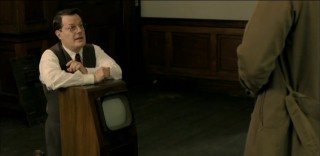
Near the end of <em>Castles in the Sky</em> (2014), the docudrama about the invention of Radar broadcast on BBC Two earlier this month, Robert Watson-Watt (Eddie Izzard) shows his colleagues a television set.<sup id="rf1-4855"><a href="#fn1-4855" title="&lt;em&gt;Castles in the Sky&lt;/em&gt;, wr. Ian Kershaw, dr. Gillies McKinnon, tx. BBC Two, 4 September 2014. More information on this &#8220;factual drama&#8221; from Hero Film and Television &#8211; with BBC Scotland, BBC Worldwide, Creative Scotland, the Robert Watson-Watt Trust and Brechin Civic Trust &#8211; can be found in &lt;a href=&quot;http://www.bbc.co.uk/mediacentre/latestnews/2014/castles-in-the-sky-vid&quot; target=&quot;_self&quot; rel=&quot;noopener&quot;&gt;the BBC Media Centre press release here&lt;/a&gt;." rel="footnote">1</a></sup> This produces another of the little scientific breakthroughs that form the core of this quietly endearing piece. The set is at once modern and archaic: in the programme&#8217;s 1930s setting this gleaming new object is a technological marvel, proposing a solution to a challenge on which the defence of the nation rests, but in the visual rhetoric of the 2014 drama it appears almost comic. This reminded me of some of the tensions that sometimes result when television technology appears in docudramas, either in terms of sets or studios. This article runs through a few such moments in pieces including <em>The Fools on the Hill</em> (1986), <em>The Road to Coronation Street</em> (2010) and <em>An Adventure in Space and Time</em> (2013).</p>

<hr class="footnotes"><ol class="footnotes" style="list-style-type:decimal"><li id="fn1-4855"><p ><em>Castles in the Sky</em>, wr. Ian Kershaw, dr. Gillies McKinnon, tx. BBC Two, 4 September 2014. More information on this &#8220;factual drama&#8221; from Hero Film and Television &#8211; with BBC Scotland, BBC Worldwide, Creative Scotland, the Robert Watson-Watt Trust and Brechin Civic Trust &#8211; can be found in <a href="http://www.bbc.co.uk/mediacentre/latestnews/2014/castles-in-the-sky-vid" target="_self" rel="noopener">the BBC Media Centre press release here</a>.&nbsp;<a href="#rf1-4855" class="backlink" title="Return to footnote 1.">&#8617;</a></p></li></ol></hr>{"id":4855,"date":"2014-09-30T06:00:45","date_gmt":"2014-09-30T05:00:45","guid":{"rendered":"http:\/\/www.britishtelevisiondrama.org.uk\/?p=4855"},"modified":"2024-08-30T11:37:36","modified_gmt":"2024-08-30T10:37:36","slug":"notes-on-docudrama-1-tv-sets","status":"publish","type":"post","link":"http:\/\/www.britishtelevisiondrama.org.uk\/?p=4855","title":{"rendered":"Docudrama &#8211; Notes #1: TV sets &#038; TV Centre"},"content":{"rendered":"<h4>by DAVID ROLINSON<\/h4>\n<p><img loading=\"lazy\" decoding=\"async\" src=\"http:\/\/www.britishtelevisiondrama.org.uk\/wp-content\/uploads\/2014\/09\/BTVD_Docudrama1_Castles-e1411923665166.jpg\" alt=\"BTVD_Docudrama1_Castles\" width=\"320\" height=\"156\" class=\"alignleft size-full wp-image-4853\" \/><br \/>\nNear the end of <em>Castles in the Sky<\/em> (2014), the docudrama about the invention of Radar broadcast on BBC Two earlier this month, Robert Watson-Watt (Eddie Izzard) shows his colleagues a television set.<sup id=\"rf1-4855\"><a href=\"#fn1-4855\" title=\"&lt;em&gt;Castles in the Sky&lt;\/em&gt;, wr. Ian Kershaw, dr. Gillies McKinnon, tx. BBC Two, 4 September 2014. More information on this &#8220;factual drama&#8221; from Hero Film and Television &#8211; with BBC Scotland, BBC Worldwide, Creative Scotland, the Robert Watson-Watt Trust and Brechin Civic Trust &#8211; can be found in &lt;a href=&quot;http:\/\/www.bbc.co.uk\/mediacentre\/latestnews\/2014\/castles-in-the-sky-vid&quot; target=&quot;_self&quot; rel=&quot;noopener&quot;&gt;the BBC Media Centre press release here&lt;\/a&gt;.\" rel=\"footnote\">1<\/a><\/sup> This produces another of the little scientific breakthroughs that form the core of this quietly endearing piece. The set is at once modern and archaic: in the programme&#8217;s 1930s setting this gleaming new object is a technological marvel, proposing a solution to a challenge on which the defence of the nation rests, but in the visual rhetoric of the 2014 drama it appears almost comic. This reminded me of some of the tensions that sometimes result when television technology appears in docudramas, either in terms of sets or studios. This article runs through a few such moments in pieces including <em>The Fools on the Hill<\/em> (1986), <em>The Road to Coronation Street<\/em> (2010) and <em>An Adventure in Space and Time<\/em> (2013).<\/p>\n<p><!--more--><\/p>\n<p><em>Castles in the Sky<\/em> ends with a brief depiction of the Battle of Britain whose outcome is partly attributed to Watson-Watt&#8217;s team&#8217;s achievements, but the programme&#8217;s emphasis is on the incremental steps made by the team in their attempts to innovate despite working with insufficient resources and class-coded institutional scepticism. This makes it sound like it&#8217;s somewhere between an Ealing comedy &#8211; though not <em>The Man in the White Suit<\/em> &#8211; and <em>The Sound Barrier<\/em>,<sup id=\"rf2-4855\"><a href=\"#fn2-4855\" title=\"Producer Simon Wheeler touched upon a similar contrast in his argument that &#8220;if anything it\u2019s more akin to a combination of &lt;em&gt;The Social Network&lt;\/em&gt; and &lt;em&gt;Chariots Of Fire&lt;\/em&gt; than &lt;em&gt;The Dambusters&lt;\/em&gt; or &lt;em&gt;Reach For The Skies&lt;\/em&gt;&#8220;, ibid.\" rel=\"footnote\">2<\/a><\/sup> and Watson-Watt&#8217;s introduction of the television set works along those lines. Its small proportions are emphasised by its proximity to Watson-Watt behind it and by its position in a medium long shot on the contemporary audience&#8217;s widescreen televisions. The shot means that the old television set temporarily occupies the space in which our own televisions sit, but the widescreen frame has to fill the space not occupied by that narrow set &#8211; and the extra information that we get is, tellingly, empty space surrounding the fictional television set. But to draw comedy from one set&#8217;s anachronistic presence in another would be as mistaken as contrasting character eccentricities and studied trivia with issues of national importance (a mistake made by some of Watson-Watt&#8217;s superiors and the odd reviewer). This television set&#8217;s small workings are a key advance and Watson-Watt&#8217;s discovery was cued by his hearing radio coverage of the exciting new development of the world&#8217;s first &#8220;high definition&#8221; television service. Notions of &#8220;high definition&#8221; have changed too, of course, but the principle remains that television and Radar are parallel modern wonders.<\/p>\n<p>So many of the specific challenges faced by Watson-Watt&#8217;s team resemble those faced by BBC staff in the build-up to the start of their Television Service in 1936, such as the need to address range, that it is almost inevitable that television should feature here. Indeed, <em>Castles in the Sky<\/em> reminded me of <em>The Fools on the Hill<\/em> (1986), Jack Rosenthal&#8217;s drama about the birth of television.<sup id=\"rf3-4855\"><a href=\"#fn3-4855\" title=\"&lt;em&gt;The Fools on the Hill&lt;\/em&gt;, wr. Jack Rosenthal, dr. David Giles, tx. BBC1, 27 October 1986. Images here are from the BBC4 repeat, 2 November 2011. Rosenthal later recalled that &lt;em&gt;Fools on the Hill&lt;\/em&gt; &#8220;brought me the worst reviews I&#8217;ve ever had&#8221; &#8211; Jack Rosenthal, &lt;em&gt;By Jack Rosenthal: An Autobiography in Six Acts&lt;\/em&gt; (London: Robson Books, 2005), p. 314.\" rel=\"footnote\">3<\/a><\/sup> Here, too, a set of committed experts slowly advance toward a goal that the characters, like the modern audience, understand to be historically significant despite scepticism within their own institution. Like Watson-Watt, the television pioneers achieve their goal despite resourcing problems (the battle between the Marconi-EMI and Baird systems), a need to impress visiting top brass and a need to meet shrinking targets: here, the Radiolympia trade demonstration in August 1936 provides a challenging deadline to add to an already-improbable service launch date of November. The &#8220;triumph over adversity&#8221; frame is a difficult one to achieve when the main opposition is either impersonal (the wrong sort of valves) or institutional (despite their concerns, and even with the espionage tactics deployed in <em>Castles in the Sky<\/em>, the institutions initiate and support the work). Often in campaigning docudramas, the micro-stories of individual struggles serve as &#8220;a metonymic device&#8221; through which wider social issues or macro-stories can be debated (for instance, a girl&#8217;s illness and the politics of nuclear power).<sup id=\"rf4-4855\"><a href=\"#fn4-4855\" title=\"Derek Paget observed that Gemma&#8217;s situation in &lt;em&gt;Fighting for Gemma&lt;\/em&gt; become &#8220;a metonymic device&#8221; for public debate on nuclear power, the interaction of micro-stories and macro-stories. Derek Paget, &lt;em&gt;No other way to tell it: Dramadoc\/docudrama on television&lt;\/em&gt; (Manchester: Manchester University Press, 1998). First edition reference.\" rel=\"footnote\">4<\/a><\/sup> <em>Castles in the Sky<\/em> was made with the involvement of the Open University and both pieces mentioned so far help to document and personalise technological and cultural inventions &#8211; but the two teams&#8217; obstacles and triumphs raise broader questions.<\/p>\n<p><img loading=\"lazy\" decoding=\"async\" src=\"http:\/\/www.britishtelevisiondrama.org.uk\/wp-content\/uploads\/2014\/09\/BTVD_Docudrama1_Fools2-e1411918229819.jpg\" alt=\"BTVD_Docudrama1_Fools2\" width=\"250\" height=\"188\" class=\"alignleft size-full wp-image-4868\" \/><br \/>\nTherefore, what is at stake in <em>Castles in the Sky<\/em> and <em>The Fools on the Hill<\/em> is a shared understanding of the impact of technological and cultural developments on society, as these pieces not only document moments in history and progress but form a history <em>of<\/em> progress and the contested nature of the term. <em>The Fools on the Hill<\/em>, too, has fun with teething troubles and subsequently outmoded practices, but complaints about anachronism are anticipated and headed-off with a sense of the long game, as early television viewers (and we) are told that a pivotal broadcast &#8220;will doubtless be thought primitive a few years hence&#8221;. Successful examples of communication &#8211; in particular sending and receiving signals &#8211; are therefore central to these pieces&#8217; moments of triumph. Watching television making history becomes making history by watching television. <\/p>\n<p><img loading=\"lazy\" decoding=\"async\" src=\"http:\/\/www.britishtelevisiondrama.org.uk\/wp-content\/uploads\/2014\/09\/BTVD_Docudrama1_Fools3-e1411918248834.jpg\" alt=\"BTVD_Docudrama1_Fools3\" width=\"250\" height=\"188\" class=\"alignleft size-full wp-image-4869\" \/><br \/>\nThe &#8220;triumph over adversity&#8221; frame is therefore presented in part as a triumph over social and cultural elitism, even class snobbery. In <em>The Fools on the Hill<\/em>, staff watch a television set in the canteen &#8211; enjoying communal pride in the progress of their work as much as the product itself &#8211; not long after Director General Sir John Reith has stormed out of the studio in disgust at the populist entertainment on offer. In <em>Castles in the Sky<\/em>, Watson-Watt marks his difference from the Establishment by loosening and removing his tie, and he and his team will remain outsiders. <em>The Fools on the Hill<\/em> seems to open with an equivalent moment, but one that is gendered: Wendy Piggot-Smythe is summoned to Broadcasting House after being seen in public without stockings &#8211; an offence against BBC &#8220;standards&#8221; &#8211; and is ordered to move from Radio to join those &#8220;footling about&#8221; at the new Television Service at Alexandra Palace. Piggot-Smythe sees this move as &#8220;exile&#8221;. <\/p>\n<p><img loading=\"lazy\" decoding=\"async\" src=\"http:\/\/www.britishtelevisiondrama.org.uk\/wp-content\/uploads\/2014\/09\/BTVD_Docudrama2_Fools4-e1411918239366.jpg\" alt=\"BTVD_Docudrama2_Fools4\" width=\"250\" height=\"188\" class=\"alignleft size-full wp-image-4867\" \/><br \/>\nBut if our sympathies initially lie with her against seemingly reactionary forces, those sympathies are complicated: following her involvement in the romance plot that provides the skeleton for the play&#8217;s witty retelling of key moments in the birth of television, Piggot-Smythe&#8217;s lack of commitment to television is linked with her personal qualities and class position. As all three strands come together, her home&#8217;s television reception is deliberately sabotaged, and the ease with which the reception is disrupted (a strategically-revved motorbike) is less important than the judgemental response of Piggot-Smythe and her father, which ends Pygott-Smythe&#8217;s involvement both professionally and personally: she will instead return to Radio and work alongside &#8220;more my sort of person&#8221;. In <em>The Fools on the Hill<\/em> it seems anachronistic to be <em>not television<\/em>.<\/p>\n<p>More groups of outsiders pioneering television, despite the attitudes of the institutions in which they work, feature in the excellent recent docudramas <em>An Adventure in Space and Time<\/em><sup id=\"rf5-4855\"><a href=\"#fn5-4855\" title=\"&lt;em&gt;An Adventure in Space and Time&lt;\/em&gt;, wr. Mark Gatiss, dr. Terry McDonough, tx. BBC Two, 21 November 2013. &lt;em&gt;Doctor Who&lt;\/em&gt;, 1963-1989, 1996, 2005-present.\" rel=\"footnote\">5<\/a><\/sup> and <em>The Road to Coronation Street<\/em><sup id=\"rf6-4855\"><a href=\"#fn6-4855\" title=\"&lt;em&gt;The Road to Coronation Street&lt;\/em&gt;, wr. Daran Little, dr. Charles Sturridge, tx. BBC Four, 16 September 2010. &lt;em&gt;Coronation Street&lt;\/em&gt;, tx. ITV, 9 December 1960 &#8211; present.\" rel=\"footnote\">6<\/a><\/sup>. Indeed, both pieces stress the creators&#8217; outsider status as part of making a case for the programmes&#8217; own. In <em>An Adventure in Space and Time<\/em>, young female producer Verity Lambert, Canadian ex-ITV populist (and reorganiser of BBC drama) executive Sydney Newman and young gay Anglo-Indian director Waris Hussein are central to the creation of <em>Doctor Who<\/em>; in <em>The Road to Coronation Street<\/em> young gay Northern writer Tony Warren creates <em>Coronation Street<\/em> at a time when Granada executives Sidney and Cecil Bernstein are engaging with questions of quality alongside Granada\u2019s regional franchise requirement to reflect the North West of England. Television&#8217;s creative environments become sites of cultural memory in complex ways that are as much about television&#8217;s present and future as they are about the past.<\/p>\n<p><img loading=\"lazy\" decoding=\"async\" src=\"http:\/\/www.britishtelevisiondrama.org.uk\/wp-content\/uploads\/2014\/09\/BTVD_Docudrama1_TVC1-e1411928746777.png\" alt=\"BTVD_Docudrama1_TVC1\" width=\"250\" height=\"142\" class=\"alignleft size-full wp-image-4891\" \/><br \/>\nIn <em>An Adventure in Space and Time<\/em>, compositions and camerawork stress the centrality of Television Centre to the creative work made within (and facilitated by) it. Television Centre is \u201creflected\u201d as Newman enjoys the idea of <em>Doctor Who<\/em> &#8211; the association with movie-style moguls is just the start of its complex attitude to television &#8211; and the door to reception features strongly in a tracking shot as Newman briefs Lambert.<\/p>\n<p><img loading=\"lazy\" decoding=\"async\" src=\"http:\/\/www.britishtelevisiondrama.org.uk\/wp-content\/uploads\/2014\/09\/BTVD_Docudrama1_TVC2-e1411928737240.png\" alt=\"BTVD_Docudrama1_TVC2\" width=\"250\" height=\"150\" class=\"alignleft size-full wp-image-4890\" \/><br \/>\n<img loading=\"lazy\" decoding=\"async\" src=\"http:\/\/www.britishtelevisiondrama.org.uk\/wp-content\/uploads\/2014\/09\/BTVD_Docudrama1_TVC3-e1411928727851.png\" alt=\"BTVD_Docudrama1_TVC3\" width=\"250\" height=\"146\" class=\"alignleft size-full wp-image-4889\" \/><br \/>\nTelevision Centre features strongly in the programme&#8217;s depiction of casting press calls for <em>Doctor Who<\/em>. The first image above becomes our touchstone for the happiness of lead actor William Hartnell (David Bradley), while the second image comes from a montage of constant cast changes while Hartnell is becoming ill, confused and worried that new production teams don\u2019t understand or value his show. Replacing the more varied and prosaic nature of <em>Doctor Who<\/em>&#8216;s casting announcements, the docudrama&#8217;s repetition of Television Centre and the statue of Eros provides a neat shorthand for emotional and institutional developments.<\/p>\n<p><img loading=\"lazy\" decoding=\"async\" src=\"http:\/\/www.britishtelevisiondrama.org.uk\/wp-content\/uploads\/2014\/09\/BTVD_Docudrama1_TVC4-e1411928763775.jpg\" alt=\"BTVD_Docudrama1_TVC4\" width=\"250\" height=\"155\" class=\"alignleft size-full wp-image-4893\" \/><br \/>\nThe setting accompanies vital moments for Lambert. She stands looking out at Television Centre, unsure that <em>Doctor Who<\/em> or her career have much of a future; later, when the programme is successful and her bosses defer to her judgement, she embraces Hussein in the same setting. The latter &#8220;moment&#8221; is necessarily contrived given the location of <em>Doctor Who<\/em>&#8216;s real office, the fact that the series constantly moved between very different serialised structures with different directors, and the fact that it was only rarely recorded at Television Centre (instead, as the show documents, they were given the flawed Lime Grove Studio D). My point is not to nitpick minor alterations, omissions and reorderings in the interest of narrative compression &#8211; these inevitable, vital elements of docudrama are handled with great skill by writer Mark Gatiss &#8211; but to observe the extra layers generated by this handling.<sup id=\"rf7-4855\"><a href=\"#fn7-4855\" title=\"In interviews with publications like &lt;em&gt;Doctor Who Magazine&lt;\/em&gt;, long-term &lt;em&gt;Doctor Who&lt;\/em&gt; fan Gatiss anticipated complaints about some of his omissions and clarified seeming mistakes as the inevitable result of compression &#8211; for instance, he noted that a fellow fan visibly paled when told that story editor David Whitaker would not be depicted in the programme. He observed that any future biopic of Benedict Cumberbatch, should it feature &lt;em&gt;Sherlock&lt;\/em&gt; at all, would compress Gatiss and co-creator Steven Moffat into one character, if that. Gatiss has instead discussed using two voices: the fan voice and the writer voice, the first one often (mock-) appalled at the second one. Widespread fan praise for the docudrama, among a highly informed viewership aware of the compressions and chronological alterations even as it first aired, forms a potent defence for docudrama strategies.\" rel=\"footnote\">7<\/a><\/sup> For instance, even at Lambert&#8217;s moment of success, this reconstruction of the past is haunted by our present. <em>An Adventure in Space and Time <\/em> reflects Television Centre\u2019s centrality to British culture \u2013 as producer and location \u2013 while shooting in its increasingly derelict spaces. Television Centre was controversially sold off \u2013 and BBC Four dramas, which included <em>The Road to Coronation Street<\/em>, were discontinued \u2013 as part of the BBC\u2019s response to a controversial financial settlement with the Coalition Government. <em>Doctor Who<\/em> itself has not been associated with Television Centre since 1989: it is one of the dramas made at the Roath Lock complex in Cardiff as part of the BBC&#8217;s movement of network programmes to specialist bases around Britain; meanwhile, ITV\u2019s <em>Coronation Street<\/em> in the North of England recently moved to a new site. Both production spaces have been mourned in documentaries: <em>Tales of Television Centre<\/em> (2012) and <em>Coronation Street: A Moving Story<\/em> (2014).<sup id=\"rf8-4855\"><a href=\"#fn8-4855\" title=\"&lt;em&gt;Tales of Television Centre&lt;\/em&gt;, tx. BBC Four, 17 May 2012. &lt;em&gt;Coronation Street: A Moving Story&lt;\/em&gt;, tx. ITV, 6 March 2014.\" rel=\"footnote\">8<\/a><\/sup><\/p>\n<p><img loading=\"lazy\" decoding=\"async\" src=\"http:\/\/www.britishtelevisiondrama.org.uk\/wp-content\/uploads\/2014\/09\/BTVD_Docudrama1_TVC5-e1411928755814.jpg\" alt=\"BTVD_Docudrama1_TVC5\" width=\"250\" height=\"155\" class=\"alignleft size-full wp-image-4892\" \/><br \/>\nIn publicity, Gatiss looks out, like Lambert, at the shell of that creative environment. Such moments tell us as much about the present television context as the past depicted in the docudrama. It was broadcast in 2013, <em>Doctor Who<\/em>&#8216;s 50th anniversary year, as one part of a range of events that both celebrated the programme&#8217;s past and reinforced the now highly lucrative <em>Doctor Who<\/em> brand. Matt Hills recently explained how the many texts, paratexts and events for the 50th anniversary served to \u201cperformatively sustain a public service agenda\u201d while maintaining a flagship global brand in a characteristic piece of BBC \u201chybrid\u201d economics culminating in the global TV\/cinema simulcast of the 3D anniversary special <em>The Day of the Doctor<\/em>. Hills drew from Amy Holdsworth\u2019s excellent work on television and memory to show that \u201cmemories of, and nostalgia for, effective and relevant public service television\u201d of the past serve to \u201canchor\u201d these discourses.<sup id=\"rf9-4855\"><a href=\"#fn9-4855\" title=\"Matt Hills, &#8216;The year of the Doctor: Celebrating the 50th, regenerating public value?&#8217;, &lt;em&gt;Science Fiction Film and Television&lt;\/em&gt;, Volume 7, Number 2, 2014.\" rel=\"footnote\">9<\/a><\/sup> <em>An Adventure in Space and Time<\/em> is a fascinating product of such tensions. Its mutual reinforcement of past and present reaches its climax as then-present Doctor Matt Smith appears on the TARDIS set and exchanges looks with Hartnell as the latter prepares to shoot his last scene. Hartnell&#8217;s belief in the programme&#8217;s potential is condensed into an impossible, highly affective moment as character realisation. It vindicates Hartnell, but it also vindicates <em>Doctor Who<\/em>; Gatiss had failed to sell this idea during the period in which <em>Doctor Who<\/em> was not on air.<sup id=\"rf10-4855\"><a href=\"#fn10-4855\" title=\"The most directly relevant example being the 40th anniversary in 2003.\" rel=\"footnote\">10<\/a><\/sup><\/p>\n<p><img loading=\"lazy\" decoding=\"async\" src=\"http:\/\/www.britishtelevisiondrama.org.uk\/wp-content\/uploads\/2014\/09\/BTVD_Docudrama1_Street1-e1411936959987.jpg\" alt=\"BTVD_Docudrama1_Street1\" width=\"250\" height=\"176\" class=\"alignleft size-full wp-image-4913\" \/><br \/>\nAs in <em>The Fools on the Hill<\/em>, it is at the moment of reception that characters in <em>An Adventure in Space and Time<\/em> and <em>The Road to Coronation Street<\/em> realise that their efforts will work. In keeping with the Hills argument above, <em>Doctor Who<\/em>&#8216;s success is emphasised through paratexts: <em>Doctor Who<\/em> is successful when newspapers depict Charles de Gaulle as \u201cthe Degaullek\u201d, when the Daleks are impersonated by children,<sup id=\"rf11-4855\"><a href=\"#fn11-4855\" title=\"See also Jonathan Bignell, \u2018The Child as Addressee, Viewer and Consumer in Mid-1960s Who\u2019, in David Butler (editor), &lt;em&gt;Time and Relative Dissertations in Space: Critical Perspectives on Doctor Who&lt;\/em&gt; (Manchester University Press, 2007), pp. 43-55.\" rel=\"footnote\">11<\/a><\/sup> and when the cast see a toy dress-up Dalek. <em>Coronation Street<\/em>&#8216;s potential is signalled when a tea lady sits down engrossed by the soap Granada don\u2019t seem to want \u2013 producer Harry Elton (another Canadian) marvels as she recognises, and interacts with, its world. Female address and social realism were central to early studies of <em>Coronation Street<\/em> and the soap delivers on the hopes expressed by Warren here, in particular when he shows the director the cobbled street and community he wants to reflect and reach. Her presence, and that of others including those responsible for casting, helps to make visible the hidden &#8211; as Faye Woods has observed, hidden and often gendered &#8211; media work that takes place in television&#8217;s offices and spaces outwith the studio. <em>The Road to Coronation Street<\/em> was written by Daran Little, that splendid writer of <em>EastEnders<\/em> and <em>Coronation Street<\/em>, and archivist of the latter. Little&#8217;s status, and the fact that <em>The Road to Coronation Street<\/em> went out during <em>Coronation Street<\/em>&#8216;s own 50th anniversary year, raises strong parallels with Gatiss and <em>An Adventure in Space and Time<\/em>. <\/p>\n<p><img loading=\"lazy\" decoding=\"async\" src=\"http:\/\/www.britishtelevisiondrama.org.uk\/wp-content\/uploads\/2014\/09\/BTVD_Docudrama1_Street2-e1411938379293.jpg\" alt=\"BTVD_Docudrama1_Street2\" width=\"250\" height=\"148\" class=\"alignleft size-full wp-image-4916\" \/><br \/>\nHowever, there is one crucial difference: although <em>The Road to Coronation Street<\/em> was made by Granada, it was made for the BBC. This fact is particularly striking when we see moments from <em>Florizel Street<\/em> (the soap&#8217;s working title) on a monitor: at such times the Granada attribution in the diegesis competes with the digital on-screen graphic for the docudrama&#8217;s channel, BBC Four. This marks another moment that, for all its historical reconstruction, is also about the present: <em>The Road to Coronation Street<\/em>&#8216;s place in the lineage of the BBC Four biopic-about-television rather than soap, the role of indies in BBC commissioning, the programme&#8217;s place on a minority digital channel (whose own existence as the BBC&#8217;s &#8220;place to think&#8221; has much to say about shifting public service discourses) away from primetime ITV and the move to network centralisation where once companies like Granada had a powerful regional remit. When <em>Coronation Street<\/em> first goes to air, at the end of <em>The Road to Coronation Street<\/em>, the executives watch along with the community they serve.  <\/p>\n<p>One last way in which both these docudramas raise the relationship between past and present is in their form. Both programmes celebrate the invention of television programmes, but face the challenge of depicting television practices that the industry has moved away from. The idea that studio drama may be a site of specifically televisual discourses<sup id=\"rf12-4855\"><a href=\"#fn12-4855\" title=\"See &lt;a href=&quot;http:\/\/www.britishtelevisiondrama.org.uk\/?p=4228&quot; target=&quot;_self&quot; rel=&quot;noopener&quot;&gt;my piece on &lt;em&gt;Doctor Who&lt;\/em&gt; story &lt;em&gt;Warriors&#8217; Gate&lt;\/em&gt; for clarification.\" rel=\"footnote\">12<\/a><\/sup> is not explored in <em>An Adventure in Space and Time<\/em>, which dwells on the difficulties of shooting in such conditions, although it does celebrate creativity &#8211; those &#8220;abuses of the television studio&#8221; that Ian Potter noted, techniques which produced signature <em>Doctor Who<\/em> elements like the opening titles and certain special effects.<sup id=\"rf13-4855\"><a href=\"#fn13-4855\" title=\"Ian Potter, \u2018The Filipino Army\u2019s Advance on Reykjavik: World-building in Studio D and Its Legacy\u2019, in David Butler (editor), &lt;em&gt;Time and Relative Dissertations in Space: Critical Perspectives on Doctor Who&lt;\/em&gt; (Manchester University Press, 2007), pp. 161-175.\" rel=\"footnote\">13<\/a><\/sup> There is no doubt that both docudramas show the studio as a place of wonder, for instance when Warren marvels at the creation of the Tanner house and Hartnell forms a connection with the TARDIS interior. (In a later piece I will write about such reconstructions of television programmes and sets, as well as the use of archive footage: after all, the combination of the fictional real and the real fiction sets up an indexical relationship specific to docudrama. Such docudramas are doubly reconstructed in that they are &#8220;made&#8221; by characters who are themselves depicted in historical reconstructions of television spaces.) But what do these docudramas make of television?<\/p>\n<p><img loading=\"lazy\" decoding=\"async\" src=\"http:\/\/www.britishtelevisiondrama.org.uk\/wp-content\/uploads\/2014\/09\/BTVD_Docudrama1_Time1-e1411939157914.jpg\" alt=\"BTVD_Docudrama1_Time1\" width=\"250\" height=\"147\" class=\"alignleft size-full wp-image-4919\" \/><br \/>\n<em>Doctor Who<\/em> often shot exteriors (as well as particularly tricky interiors) on film, and this clapperboard starts a sequence re-enacting the filming of a famous moment from <em>The Dalek Invasion of Earth<\/em>: the Daleks invading future London. But is <em>An Adventure in Space and Time<\/em>, as a 2013 drama, happier with filmic discourse? It often makes <em>Doctor Who<\/em>\u2019s multi-camera video recording feel like filmed practice in ways that the makers know were not the case but which were intended as a shorthand for contemporary viewers who, it was felt, would be more familiar with film practice. Examples of this calculated shorthand include a bell ringing to mark the end of shooting scenes, and the production using standing sets, instead of the reality: rehearsals in a church hall with tape on the floor to indicate where sets will be, and sets built to shoot an entire episode in one session. (<em>Coronation Street<\/em> would transmit one episode live and record the next as-for-live.) But standing sets allow <em>An Adventure in Space and Time<\/em> to play vital behind-the-scenes moments against <em>Doctor Who<\/em> backdrops. When Newman gives Hussein and Lambert a chance to re-record the \u201cpilot\u201d, they walk to the Totter\u2019s Lane gates that are entered at the start of <em>Doctor Who<\/em>\u2019s first episode \u2013 as if their adventure is also beginning. Later, Hartnell bids farewell to Lambert on the TARDIS set, a blurring of production and fiction departures that is built upon in a later near-breakdown sequence and which shows the value of docudrama approaches. <\/p>\n<p>Using cinema practice as a shorthand is potentially problematic given current academic debates on aesthetics and specificity: medium specificity and specificity of our methodology. These include the need to question the current misuse of the term &#8220;cinematic&#8221; as a value judgement predicated upon removing television drama from the context of television.<sup id=\"rf14-4855\"><a href=\"#fn14-4855\" title=\"See for instance Jason Jacobs and Steven Peacock (editors), &lt;em&gt;Television Aesthetics and Style&lt;\/em&gt; (London: Bloomsbury, 2013).\" rel=\"footnote\">14<\/a><\/sup> There has clearly been massive industrial and stylistic convergence between television and film over the last few decades, with the enthusiastic support of many (if not all) programme makers. However, the misuse of the term &#8220;cinematic&#8221; in popular and academic writing has seen relevant ideas subsumed by some television academics into a wilful ahistoricism that neglects a long history of filmed and non-filmed television drama and thereby risks narrowing our sense of the range of <em>forms<\/em> that contemporary drama can take, risks disavowing the televisual, risks simplifying &#8220;cinema&#8221; and, paradoxically, risks underselling the best of today&#8217;s television by limiting the criteria through which we define quality. <em>An Adventure in Space and Time<\/em> and <em>The Road to Coronation Street<\/em> are clearly not ahistorical, they clearly argue for the importance of two genres that critical discourse has been known to marginalise (soaps and &#8220;science fiction&#8221;) and they clearly celebrate (indeed, cherish) televisual achievements &#8211; but what about the nature of the programmes&#8217; own engagement and dialogue?<\/p>\n<p><img loading=\"lazy\" decoding=\"async\" src=\"http:\/\/www.britishtelevisiondrama.org.uk\/wp-content\/uploads\/2014\/09\/BTVD_Docudrama1_Fools-e1411916275109.jpg\" alt=\"BTVD_Docudrama1_Fools\" width=\"250\" height=\"186\" class=\"alignleft size-full wp-image-4862\" \/><br \/>\nEarlier I said that <em>The Fools on the Hill<\/em> makes it seem anachronistic to be <em>not television<\/em>. It is clear that Marconi&#8217;s electronic system will triumph over John Logie Baird&#8217;s unwieldy intermediate film system, not only from dialogue but also from the form of the play itself, with its videotaped exteriors and its interiors taped in the electronic television studio. Unlike in <em>An Adventure in Space and Time<\/em>, film is almost alien here, and not only because Baird&#8217;s system requires practices that comically resemble the cumbersome responses to the coming of sound depicted in <em>Singin&#8217; in the Rain<\/em>. A film camera appears in the play at a moment of destruction: it films the burning of a recording of <em>The Scarlet Pimpernel<\/em> in order to prove to film producer Alexander Korda that the recording has been destroyed. This happened in 1939, and raises important issues in the perception of television and cinema, as Jason Jacobs explains:<\/p>\n<blockquote><p>When a large studio production of <em>The Scarlet Pimpernel<\/em> was filmed with non-synchronized &#8216;lines and all&#8217; in 1939 (the only attempt to do this) Alexander Korda who owned the rights ordered the recording to be burned, with the bonfire itself filmed as evidence. The BBC could get the stage rights for a television transmission &#8211; a one-off performance (this is television &#8211; transient &#8211; see it now or never) &#8211; but not the mechanical (recorded, stable, retrievable) rights.<sup id=\"rf15-4855\"><a href=\"#fn15-4855\" title=\"Jason Jacobs, &lt;em&gt;The Intimate Screen: Early British Television Drama&lt;\/em&gt; (Oxford: Oxford University Press, 2000), p. 12. Jacobs discusses other examples of television&#8217;s attempts to get rights for subjects whose rights were tied up by film studios, such as &lt;em&gt;Clive of India&lt;\/em&gt; (1938) and &lt;em&gt;The Petrified Forest (1951)&lt;\/em&gt;.\" rel=\"footnote\">15<\/a><\/sup> <\/p><\/blockquote>\n<p>Therefore, this scene in <em>The Fools on the Hill<\/em> is a complex moment. Histories of television drama note the shift from live drama (in which television provides the electronic relay of live performances) to recorded drama (in which television broadcasts, repeats and sells dramas which exist as commodities) and debate the reasons for the persistence of associated practices and their perceived values (liveness, immediacy and so on) long after technology meant that live and as-live productions were no longer necessary. For some practitioners, moving away from live television meant losing the specificity of the televisual.<sup id=\"rf16-4855\"><a href=\"#fn16-4855\" title=\"For a proper discussion of this see John Caughie, &lt;em&gt;Television Drama: Realism, Modernism and British Culture&lt;\/em&gt; (Oxford: Oxford University Press, 2000) and Lez Cooke, &lt;em&gt;British Television Drama: A History&lt;\/em&gt; (London: British Film Institute, 2003).\" rel=\"footnote\">16<\/a><\/sup> But it also encapsulates a debate that was going on at the time. <em>World Film News<\/em> ran a &#8216;Manifesto on Television&#8217; in its first issue in April 1936, which was intriguing timing given that, as Charles Barr notes, &#8220;the opening of the BBC&#8217;s regular broadcast TV service was known to be imminent&#8221;.<sup id=\"rf17-4855\"><a href=\"#fn17-4855\" title=\"Charles Barr, &#8216;&#8221;They think it&#8217;s all over&#8221;: the dramatic legacy of live television&#8217;, in John Hill and Martin McLoone (editors), &lt;em&gt;Big Picture, Small Screen: The Relations Between Film and Television&lt;\/em&gt; (Luton: University of Luton Press, 1996), p. 54.\" rel=\"footnote\">17<\/a><\/sup> A combination of filmmakers and critics &#8211; Alberto Cavalcanti, Thorold Dickinson, John Grierson, Cedric Belfrage and Graham Greene &#8211; stood against direct transmission:<\/p>\n<blockquote><p>We remember with concern that the tradition of radio is to REPRODUCE. We ask an assurance from the BBC that the new medium &#8211; at least in part &#8211; will be used to CREATE. [&#8230;the use of film] allows television a creative as distinct from reproductive role. Television as an art medium depends on the use of film.<sup id=\"rf18-4855\"><a href=\"#fn18-4855\" title=\"&lt;em&gt;World Film News&lt;\/em&gt;, Volume 1, Number 1, April 1936, quoted in Barr, p. 55. See Barr for a thorough interrogation and contextualisation of the implications.\" rel=\"footnote\">18<\/a><\/sup><\/p><\/blockquote>\n<p>Where does this scene stand on this? Film is a controllable commodity, subject to mediation that was not applied to the original performance. Cinema is implicated with reactionary forces: while <em>The Scarlet Pimpernel<\/em> burns we are told that the film industry is &#8220;frightened&#8221; of television. The alien quality of film is underlined by the presence of the film camera in a play about television and in a shot that has been videotaped. But the play has itself been recorded, and made with more sophistication than the live broadcasts that the play portrays. The burning also reminds us of institutional and cultural perceptions of television as ephemeral, which would later result in the wiping of many programmes that <em>were<\/em> recorded and which leaves us without a record of television before the 1950s. Burning the film recording returns <em>The Scarlet Pimpernel<\/em> to a one-off, ephemeral performance lost forever &#8211; in short, to television as depicted elsewhere in the play and as criticised in <em>World Film News<\/em>: &#8220;the evanescent impressions of direct broadcast&#8221; which make it &#8220;difficult to build a body of criticism.&#8221;<sup id=\"rf19-4855\"><a href=\"#fn19-4855\" title=\"Ibid. By the way, Graham Greene was often scathing about Korda in his film reviews in the same year as this piece. For example: &#8220;it would not grieve me to see Mr Alexander Korda seated before a cottage loom in an Eastern county, following an older and a better tradition&#8221; (&lt;em&gt;The Spectator&lt;\/em&gt;, 5 June 1936, quoted in &lt;em&gt;Mornings in the Dark: The Graham Greene Film Reader&lt;\/em&gt; (Manchester: Carcanet Press, 2007), pp. 107-108); &#8220;Mr Korda, a publicity man of genius, who has not yet revealed a talent for the films [&#8230;] the slowness, vulgarity, over-emphasis are typical of Mr Korda&#8217;s productions&#8221; (&lt;em&gt;The Spectator&lt;\/em&gt;, 4 September 1936, quoted in Ibid, p. 135). Greene wasn&#8217;t knocked out by the original &lt;em&gt;The Scarlet Pimpernel&lt;\/em&gt; (1934) either; Korda would remake it as &lt;em&gt;The Elusive Pimpernel&lt;\/em&gt; (1951). Of course Greene and Korda worked together after his comments, most famously on &lt;em&gt;The Third Man&lt;\/em&gt; (1949), when, as Charles Drazin observed, Greene and Korda (and Carol Reed) had a &#8220;strong personal rapport&#8221; &#8211; for this, and a history of the films, see Charles Drazin, &lt;em&gt;Korda: Britain&#8217;s Only Movie Mogul&lt;\/em&gt; (Sidgwick &#038; Jackson, 2002).\" rel=\"footnote\">19<\/a><\/sup> Characters are disgusted by this reduction of <em>The Scarlet Pimpernel<\/em> to ephemerality: so much for liveness as medium specificity. Meanwhile, when this play went out in 1986, British television drama had already produced decades of filmed dramas, and the BBC itself was shifting its drama strategy to a greater emphasis on film (<em>Screen One<\/em> rather than <em>Play for Today<\/em>). Therefore, this drama about an all-but obsolete form of drama<sup id=\"rf20-4855\"><a href=\"#fn20-4855\" title=\"There have been a few attempts to bring back live drama, including, in the years immediately preceding &lt;em&gt;The Fools on the Hill&lt;\/em&gt;, &lt;a href=&quot;http:\/\/www.britishtelevisiondrama.org.uk\/?p=3984&quot; target=&quot;_self&quot; rel=&quot;noopener&quot;&gt;&lt;em&gt;Live from Pebble Mill&lt;\/em&gt; (1983).&lt;\/a&gt;\" rel=\"footnote\">20<\/a><\/sup> was itself, as a videotaped, partly studio-recorded, single drama, a form whose days would turn out to be numbered.<\/p>\n<p><img loading=\"lazy\" decoding=\"async\" src=\"http:\/\/www.britishtelevisiondrama.org.uk\/wp-content\/uploads\/2014\/09\/BTVD_Docudrama1_GranadaQueen-e1411941252195.jpg\" alt=\"BTVD_Docudrama1_GranadaQueen\" width=\"250\" height=\"141\" class=\"alignleft size-full wp-image-4925\" \/><br \/>\nDifferent formats, and their respective perceived value, do sometimes play a part in docudrama. <em>The Queen<\/em> (2006) opens with television footage of Tony Blair&#8217;s New Labour election victory in 1997, which is being watched by the Queen while she sits for a portrait.<sup id=\"rf21-4855\"><a href=\"#fn21-4855\" title=\"&lt;em&gt;The Queen&lt;\/em&gt; (2006), wr. Peter Morgan, dr. Stephen Frears.\" rel=\"footnote\">21<\/a><\/sup> Here we see two portraits in action &#8211; Blair&#8217;s television profile and the Queen&#8217;s portrait. The portrait shows, as director Stephen Frears put it, \u201cthe Queen as you\u2019re used to seeing her\u201d but also shows its composition; according to Helen Mirren, both the film and her own performance would be portraits, that is artistic interpretations rather than reproductions.<sup id=\"rf22-4855\"><a href=\"#fn22-4855\" title=\"&lt;em&gt;The Queen&lt;\/em&gt; DVD.\" rel=\"footnote\">22<\/a><\/sup> But this scene introduces a playful element of the film&#8217;s rhetoric: form as status. The Queen, on film, in widescreen watches the Prime Minister, on video, confined in a small screen. Blair is a television politician, a status that we saw interrogated in the same team&#8217;s television piece <em>The Deal<\/em> (2003), and the timing of the production company credit reinforces this &#8211; though made for the cinema, <em>The Queen<\/em> is &#8220;A Granada Production&#8221;.<sup id=\"rf23-4855\"><a href=\"#fn23-4855\" title=\"&lt;em&gt;The Deal&lt;\/em&gt;, wr. Peter Morgan, dr. Stephen Frears, tx. Channel Four, 28 September 2003.\" rel=\"footnote\">23<\/a><\/sup> The Granada\/BBC Four attribution that I noted in <em>The Road to Coronation Street<\/em> brought with it lots of extra-textual noise, but the timing and placement of <em>The Queen<\/em>&#8216;s credit seem particularly playful.<sup id=\"rf24-4855\"><a href=\"#fn24-4855\" title=\"Playful, not judgemental. I wouldn&#8217;t want to overstate this &#8211; Granada make films! &#8211; but the makers engaged with the issues raised by the television\/cinema relationship when making &lt;em&gt;The Deal&lt;\/em&gt; and made a different decision this time.\" rel=\"footnote\">24<\/a><\/sup> Just as <em>The Deal<\/em> set reconstruction and archive video against each other in a questioning of political performance and commitment, and made format exchange seem like a rhetorical shift between fact and fiction, so <em>The Queen<\/em>&#8216;s formal questions go deeper than film versus video. The Queen&#8217;s scenes were shot on 35mm film and Blair&#8217;s on Super 16mm film: 16mm is particularly associated with television, and though I would resist essentialism since I&#8217;ve seen (and Frears has made) so many great 16mm dramas for British television, the film uses these gauges to provide a different aesthetic for different worlds and a formal rebuke to Blair&#8217;s rhetoric. Cinematography and production design ensure that Blair must enter a different world and cross between competing genres and forms.<sup id=\"rf25-4855\"><a href=\"#fn25-4855\" title=\"&lt;em&gt;American Cinematographer&lt;\/em&gt; noted that Frears sought &#8220;different visual textures&#8221;, achieved by cinematographer Affonso Beato and production designer Alan MacDonald. Blair&#8217;s world is &#8220;provincial&#8221;, shot in &#8220;Super 16mm with spare or stark lighting and few contrasting primary colours; when transferred to 35mm, this yielded evident grain and sharp tone.&#8221; The Queen need make no such adjustment: that world is shot in 35mm, &#8220;incorporating a warmer lighting scheme and deeper, more solid colours&#8221;. Kenneth Sweeney, &lt;a href=&quot;https:\/\/www.theasc.com\/ac_magazine\/July2007\/DVDPlayback\/page2.php&quot; target=&quot;_self&quot; rel=&quot;noopener&quot;&gt;&lt;em&gt;American Cinematographer&lt;\/em&gt; DVD review available here&lt;\/a&gt;.\" rel=\"footnote\">25<\/a><\/sup><\/p>\n<p><img loading=\"lazy\" decoding=\"async\" src=\"http:\/\/www.britishtelevisiondrama.org.uk\/wp-content\/uploads\/2014\/09\/BTVD_Docudrama1_Time2-e1411940437708.jpg\" alt=\"BTVD_Docudrama1_Time2\" width=\"250\" height=\"155\" class=\"alignleft size-full wp-image-4922\" \/><br \/>\n<em>An Adventure in Space and Time<\/em> closes after a tracking shot across the television studio gallery, the now-empty creative environment, and an impossible, museum-like standing-set collection of <em>Doctor Who<\/em> icons \u2013 the TARDIS, the Daleks. The extract that we end on is from <em>The Dalek Invasion of Earth<\/em>, a scene we saw reconstructed by David Bradley earlier, telling us that &#8220;One day, I shall come back&#8221;. He\u2019s right, he <em>will<\/em> come back \u2013 Hartnell will return in person and in the archive replaying of this very scene to mark, respectively, the programme&#8217;s 10th and 20th anniversaries.<sup id=\"rf26-4855\"><a href=\"#fn26-4855\" title=\"Hartnell appeared in &lt;em&gt;The Three Doctors&lt;\/em&gt; (1972-73), which isn&#8217;t officially a 10th anniversary story, which is why I phrased it like this (don&#8217;t send me letters), while this speech from &lt;em&gt;The Dalek Invasion of Earth&lt;\/em&gt; opens &lt;em&gt;The Five Doctors&lt;\/em&gt; (1983). Footage and photos of Hartnell have appeared in various &lt;em&gt;Doctor Who&lt;\/em&gt; stories over the years, and was quite a presence in the 50th anniversary year. I have neglected that here but wrote about it in &#8216;William Hartnell&#8217;, &lt;em&gt;Science Fiction Film and Television&lt;\/em&gt;, Volume 7, Number 2, 2014. This short piece was part of a collaborative anniversary feature, &#8216;The Many Doctors symposium\u2019.\" rel=\"footnote\">26<\/a><\/sup> But it also reminds us of the 1990s, when the BBC wasn\u2019t making <em>Doctor Who<\/em> and although it existed it was not in television but in books, audios and comics. Unlike in <em>The Road to Coronation Street<\/em>, captions do not fill in what happened next: there is no caption to tell us that <em>Doctor Who<\/em> is now a hit and that the BBC can\u2019t be daft enough to cancel it again \u2013 it\u2019s in the form. (The role of captions in docudramas like these is a topic for another day.) We are in a television studio but the style marks that practice as \u201cother\u201d. Matt Hills, drawing from Ann Gray and Erin Bell\u2019s work on TV and history, argued that <em>An Adventure in Space and Time<\/em> \u201cemployed high production values in its HD recreation\u201d of 1960s <em>Doctor Who<\/em> in order to signify \u201cquality, authority and legitimacy\u201d, shaping a \u201chistorical gaze\u201d.<sup id=\"rf27-4855\"><a href=\"#fn27-4855\" title=\"Hills, p. 168, quoting Ann Gray and Erin Bell, &lt;em&gt;History on Television&lt;\/em&gt; (London: Routledge, 2003), p. 68.\" rel=\"footnote\">27<\/a><\/sup> The docudrama enjoys the creative environment of the studio, and we end in that magical space between production, institution and reception. But is there a danger that, in docudramas like these, the form itself disavows the television space through historicising it?<\/p>\n<p>This article has left lots of ground uncovered in its discussion of docudramas about television: for example, what about their integration of archive footage, or their mediating use of captions, or their reconstruction of specific scenes from television programmes? And how am I getting away with giving the blanket label &#8220;docudrama&#8221; to pieces that have been described variously as &#8220;fact-based dramas&#8221; and &#8220;biopics&#8221;? (Wouldn&#8217;t it be problematic if I treated all biopics as a sub-section of docudrama? I&#8217;ve been light on theory and &#8220;docudrama studies&#8221; here, but this might not always be the case.) Questions like these, and much more analysis of these programmes and other contemporary docudramas may well be next, as this article is meant to be the first in a series on the many different types of British television docudramas, their ideas and their practices. <\/p>\n<p><em>Every now and again this piece draws material from two of my conference papers:<br \/>\n\u2018Adventures in Studio Space: British television\u2019s creative environments\u2019, Universit\u00e0 Cattolica del Sacro Cuore, Milan, NECS 2014 Conference: <em>Creative Energies\/Creative industries<\/em> (June 2014).<br \/>\n\u2018Gesture politics and control freak actors: New Labour as performance in <em>The Deal<\/em> and <em>The Queen<\/em>\u2019, University of Reading, <em>Acting with Facts: Performing the Real in British Theatre and Television since 1990<\/em> (May 2009).<\/em><\/p>\n<p><em>Originally posted: 30 September 2014.<br \/>\nUpdates:<br \/>\n7 October 2014: added quotations from Barr, Greene, Drazin, Jacobs and Rosenthal.<br \/>\n5 February 2017: amended start of title from &#8216;Notes on docudrama&#8217;.<\/em><\/p>\n<p><body><!-- Start of StatCounter Code --><br \/>\n<script type=\"text\/javascript\">\nvar sc_project=5750652; \nvar sc_invisible=1; \nvar sc_partition=68; \nvar sc_click_stat=1; \nvar sc_security=\"6dd1aa39\"; \n<\/script><\/p>\n<p><script type=\"text\/javascript\"\nsrc=\"http:\/\/www.statcounter.com\/counter\/counter.js\"><\/script><noscript>\n<div<br \/>\nclass=&#8221;statcounter&#8221;><a title=\"wordpress stats \"<br \/>\nhref=&#8221;http:\/\/www.statcounter.com\/wordpress.org\/&#8221;<br \/>\ntarget=&#8221;_blank&#8221;><img class=\"statcounter\"<br \/>\nsrc=&#8221;http:\/\/c.statcounter.com\/5750652\/0\/6dd1aa39\/1\/&#8221;<br \/>\nalt=&#8221;wordpress stats &#8221; ><\/a><\/div>\n<p><\/noscript><br \/>\n<!-- End of StatCounter Code --><\/body><\/p>\n<hr class=\"footnotes\"><ol class=\"footnotes\" style=\"list-style-type:decimal\"><li id=\"fn1-4855\"><p ><em>Castles in the Sky<\/em>, wr. Ian Kershaw, dr. Gillies McKinnon, tx. BBC Two, 4 September 2014. More information on this &#8220;factual drama&#8221; from Hero Film and Television &#8211; with BBC Scotland, BBC Worldwide, Creative Scotland, the Robert Watson-Watt Trust and Brechin Civic Trust &#8211; can be found in <a href=\"http:\/\/www.bbc.co.uk\/mediacentre\/latestnews\/2014\/castles-in-the-sky-vid\" target=\"_self\" rel=\"noopener\">the BBC Media Centre press release here<\/a>.&nbsp;<a href=\"#rf1-4855\" class=\"backlink\" title=\"Return to footnote 1.\">&#8617;<\/a><\/p><\/li><li id=\"fn2-4855\"><p >Producer Simon Wheeler touched upon a similar contrast in his argument that &#8220;if anything it\u2019s more akin to a combination of <em>The Social Network<\/em> and <em>Chariots Of Fire<\/em> than <em>The Dambusters<\/em> or <em>Reach For The Skies<\/em>&#8220;, ibid.&nbsp;<a href=\"#rf2-4855\" class=\"backlink\" title=\"Return to footnote 2.\">&#8617;<\/a><\/p><\/li><li id=\"fn3-4855\"><p ><em>The Fools on the Hill<\/em>, wr. Jack Rosenthal, dr. David Giles, tx. BBC1, 27 October 1986. Images here are from the BBC4 repeat, 2 November 2011. Rosenthal later recalled that <em>Fools on the Hill<\/em> &#8220;brought me the worst reviews I&#8217;ve ever had&#8221; &#8211; Jack Rosenthal, <em>By Jack Rosenthal: An Autobiography in Six Acts<\/em> (London: Robson Books, 2005), p. 314.&nbsp;<a href=\"#rf3-4855\" class=\"backlink\" title=\"Return to footnote 3.\">&#8617;<\/a><\/p><\/li><li id=\"fn4-4855\"><p >Derek Paget observed that Gemma&#8217;s situation in <em>Fighting for Gemma<\/em> become &#8220;a metonymic device&#8221; for public debate on nuclear power, the interaction of micro-stories and macro-stories. Derek Paget, <em>No other way to tell it: Dramadoc\/docudrama on television<\/em> (Manchester: Manchester University Press, 1998). First edition reference.&nbsp;<a href=\"#rf4-4855\" class=\"backlink\" title=\"Return to footnote 4.\">&#8617;<\/a><\/p><\/li><li id=\"fn5-4855\"><p ><em>An Adventure in Space and Time<\/em>, wr. Mark Gatiss, dr. Terry McDonough, tx. BBC Two, 21 November 2013. <em>Doctor Who<\/em>, 1963-1989, 1996, 2005-present.&nbsp;<a href=\"#rf5-4855\" class=\"backlink\" title=\"Return to footnote 5.\">&#8617;<\/a><\/p><\/li><li id=\"fn6-4855\"><p ><em>The Road to Coronation Street<\/em>, wr. Daran Little, dr. Charles Sturridge, tx. BBC Four, 16 September 2010. <em>Coronation Street<\/em>, tx. ITV, 9 December 1960 &#8211; present.&nbsp;<a href=\"#rf6-4855\" class=\"backlink\" title=\"Return to footnote 6.\">&#8617;<\/a><\/p><\/li><li id=\"fn7-4855\"><p >In interviews with publications like <em>Doctor Who Magazine<\/em>, long-term <em>Doctor Who<\/em> fan Gatiss anticipated complaints about some of his omissions and clarified seeming mistakes as the inevitable result of compression &#8211; for instance, he noted that a fellow fan visibly paled when told that story editor David Whitaker would not be depicted in the programme. He observed that any future biopic of Benedict Cumberbatch, should it feature <em>Sherlock<\/em> at all, would compress Gatiss and co-creator Steven Moffat into one character, if that. Gatiss has instead discussed using two voices: the fan voice and the writer voice, the first one often (mock-) appalled at the second one. Widespread fan praise for the docudrama, among a highly informed viewership aware of the compressions and chronological alterations even as it first aired, forms a potent defence for docudrama strategies.&nbsp;<a href=\"#rf7-4855\" class=\"backlink\" title=\"Return to footnote 7.\">&#8617;<\/a><\/p><\/li><li id=\"fn8-4855\"><p ><em>Tales of Television Centre<\/em>, tx. BBC Four, 17 May 2012. <em>Coronation Street: A Moving Story<\/em>, tx. ITV, 6 March 2014.&nbsp;<a href=\"#rf8-4855\" class=\"backlink\" title=\"Return to footnote 8.\">&#8617;<\/a><\/p><\/li><li id=\"fn9-4855\"><p >Matt Hills, &#8216;The year of the Doctor: Celebrating the 50th, regenerating public value?&#8217;, <em>Science Fiction Film and Television<\/em>, Volume 7, Number 2, 2014.&nbsp;<a href=\"#rf9-4855\" class=\"backlink\" title=\"Return to footnote 9.\">&#8617;<\/a><\/p><\/li><li id=\"fn10-4855\"><p >The most directly relevant example being the 40th anniversary in 2003.&nbsp;<a href=\"#rf10-4855\" class=\"backlink\" title=\"Return to footnote 10.\">&#8617;<\/a><\/p><\/li><li id=\"fn11-4855\"><p >See also Jonathan Bignell, \u2018The Child as Addressee, Viewer and Consumer in Mid-1960s Who\u2019, in David Butler (editor), <em>Time and Relative Dissertations in Space: Critical Perspectives on Doctor Who<\/em> (Manchester University Press, 2007), pp. 43-55.&nbsp;<a href=\"#rf11-4855\" class=\"backlink\" title=\"Return to footnote 11.\">&#8617;<\/a><\/p><\/li><li id=\"fn12-4855\"><p >See <a href=\"http:\/\/www.britishtelevisiondrama.org.uk\/?p=4228\" target=\"_self\" rel=\"noopener\">my piece on <em>Doctor Who<\/em> story <em>Warriors&#8217; Gate<\/em> for clarification.&nbsp;<a href=\"#rf12-4855\" class=\"backlink\" title=\"Return to footnote 12.\">&#8617;<\/a><\/p><\/li><li id=\"fn13-4855\"><p >Ian Potter, \u2018The Filipino Army\u2019s Advance on Reykjavik: World-building in Studio D and Its Legacy\u2019, in David Butler (editor), <em>Time and Relative Dissertations in Space: Critical Perspectives on Doctor Who<\/em> (Manchester University Press, 2007), pp. 161-175.&nbsp;<a href=\"#rf13-4855\" class=\"backlink\" title=\"Return to footnote 13.\">&#8617;<\/a><\/p><\/li><li id=\"fn14-4855\"><p >See for instance Jason Jacobs and Steven Peacock (editors), <em>Television Aesthetics and Style<\/em> (London: Bloomsbury, 2013).&nbsp;<a href=\"#rf14-4855\" class=\"backlink\" title=\"Return to footnote 14.\">&#8617;<\/a><\/p><\/li><li id=\"fn15-4855\"><p >Jason Jacobs, <em>The Intimate Screen: Early British Television Drama<\/em> (Oxford: Oxford University Press, 2000), p. 12. Jacobs discusses other examples of television&#8217;s attempts to get rights for subjects whose rights were tied up by film studios, such as <em>Clive of India<\/em> (1938) and <em>The Petrified Forest (1951)<\/em>.&nbsp;<a href=\"#rf15-4855\" class=\"backlink\" title=\"Return to footnote 15.\">&#8617;<\/a><\/p><\/li><li id=\"fn16-4855\"><p >For a proper discussion of this see John Caughie, <em>Television Drama: Realism, Modernism and British Culture<\/em> (Oxford: Oxford University Press, 2000) and Lez Cooke, <em>British Television Drama: A History<\/em> (London: British Film Institute, 2003).&nbsp;<a href=\"#rf16-4855\" class=\"backlink\" title=\"Return to footnote 16.\">&#8617;<\/a><\/p><\/li><li id=\"fn17-4855\"><p >Charles Barr, &#8216;&#8221;They think it&#8217;s all over&#8221;: the dramatic legacy of live television&#8217;, in John Hill and Martin McLoone (editors), <em>Big Picture, Small Screen: The Relations Between Film and Television<\/em> (Luton: University of Luton Press, 1996), p. 54.&nbsp;<a href=\"#rf17-4855\" class=\"backlink\" title=\"Return to footnote 17.\">&#8617;<\/a><\/p><\/li><li id=\"fn18-4855\"><p ><em>World Film News<\/em>, Volume 1, Number 1, April 1936, quoted in Barr, p. 55. See Barr for a thorough interrogation and contextualisation of the implications.&nbsp;<a href=\"#rf18-4855\" class=\"backlink\" title=\"Return to footnote 18.\">&#8617;<\/a><\/p><\/li><li id=\"fn19-4855\"><p >Ibid. By the way, Graham Greene was often scathing about Korda in his film reviews in the same year as this piece. For example: &#8220;it would not grieve me to see Mr Alexander Korda seated before a cottage loom in an Eastern county, following an older and a better tradition&#8221; (<em>The Spectator<\/em>, 5 June 1936, quoted in <em>Mornings in the Dark: The Graham Greene Film Reader<\/em> (Manchester: Carcanet Press, 2007), pp. 107-108); &#8220;Mr Korda, a publicity man of genius, who has not yet revealed a talent for the films [&#8230;] the slowness, vulgarity, over-emphasis are typical of Mr Korda&#8217;s productions&#8221; (<em>The Spectator<\/em>, 4 September 1936, quoted in Ibid, p. 135). Greene wasn&#8217;t knocked out by the original <em>The Scarlet Pimpernel<\/em> (1934) either; Korda would remake it as <em>The Elusive Pimpernel<\/em> (1951). Of course Greene and Korda worked together after his comments, most famously on <em>The Third Man<\/em> (1949), when, as Charles Drazin observed, Greene and Korda (and Carol Reed) had a &#8220;strong personal rapport&#8221; &#8211; for this, and a history of the films, see Charles Drazin, <em>Korda: Britain&#8217;s Only Movie Mogul<\/em> (Sidgwick &#038; Jackson, 2002).&nbsp;<a href=\"#rf19-4855\" class=\"backlink\" title=\"Return to footnote 19.\">&#8617;<\/a><\/p><\/li><li id=\"fn20-4855\"><p >There have been a few attempts to bring back live drama, including, in the years immediately preceding <em>The Fools on the Hill<\/em>, <a href=\"http:\/\/www.britishtelevisiondrama.org.uk\/?p=3984\" target=\"_self\" rel=\"noopener\"><em>Live from Pebble Mill<\/em> (1983).<\/a>&nbsp;<a href=\"#rf20-4855\" class=\"backlink\" title=\"Return to footnote 20.\">&#8617;<\/a><\/p><\/li><li id=\"fn21-4855\"><p ><em>The Queen<\/em> (2006), wr. Peter Morgan, dr. Stephen Frears.&nbsp;<a href=\"#rf21-4855\" class=\"backlink\" title=\"Return to footnote 21.\">&#8617;<\/a><\/p><\/li><li id=\"fn22-4855\"><p ><em>The Queen<\/em> DVD.&nbsp;<a href=\"#rf22-4855\" class=\"backlink\" title=\"Return to footnote 22.\">&#8617;<\/a><\/p><\/li><li id=\"fn23-4855\"><p ><em>The Deal<\/em>, wr. Peter Morgan, dr. Stephen Frears, tx. Channel Four, 28 September 2003.&nbsp;<a href=\"#rf23-4855\" class=\"backlink\" title=\"Return to footnote 23.\">&#8617;<\/a><\/p><\/li><li id=\"fn24-4855\"><p >Playful, not judgemental. I wouldn&#8217;t want to overstate this &#8211; Granada make films! &#8211; but the makers engaged with the issues raised by the television\/cinema relationship when making <em>The Deal<\/em> and made a different decision this time.&nbsp;<a href=\"#rf24-4855\" class=\"backlink\" title=\"Return to footnote 24.\">&#8617;<\/a><\/p><\/li><li id=\"fn25-4855\"><p ><em>American Cinematographer<\/em> noted that Frears sought &#8220;different visual textures&#8221;, achieved by cinematographer Affonso Beato and production designer Alan MacDonald. Blair&#8217;s world is &#8220;provincial&#8221;, shot in &#8220;Super 16mm with spare or stark lighting and few contrasting primary colours; when transferred to 35mm, this yielded evident grain and sharp tone.&#8221; The Queen need make no such adjustment: that world is shot in 35mm, &#8220;incorporating a warmer lighting scheme and deeper, more solid colours&#8221;. Kenneth Sweeney, <a href=\"https:\/\/www.theasc.com\/ac_magazine\/July2007\/DVDPlayback\/page2.php\" target=\"_self\" rel=\"noopener\"><em>American Cinematographer<\/em> DVD review available here<\/a>.&nbsp;<a href=\"#rf25-4855\" class=\"backlink\" title=\"Return to footnote 25.\">&#8617;<\/a><\/p><\/li><li id=\"fn26-4855\"><p >Hartnell appeared in <em>The Three Doctors<\/em> (1972-73), which isn&#8217;t officially a 10th anniversary story, which is why I phrased it like this (don&#8217;t send me letters), while this speech from <em>The Dalek Invasion of Earth<\/em> opens <em>The Five Doctors<\/em> (1983). Footage and photos of Hartnell have appeared in various <em>Doctor Who<\/em> stories over the years, and was quite a presence in the 50th anniversary year. I have neglected that here but wrote about it in &#8216;William Hartnell&#8217;, <em>Science Fiction Film and Television<\/em>, Volume 7, Number 2, 2014. This short piece was part of a collaborative anniversary feature, &#8216;The Many Doctors symposium\u2019.&nbsp;<a href=\"#rf26-4855\" class=\"backlink\" title=\"Return to footnote 26.\">&#8617;<\/a><\/p><\/li><li id=\"fn27-4855\"><p >Hills, p. 168, quoting Ann Gray and Erin Bell, <em>History on Television<\/em> (London: Routledge, 2003), p. 68.&nbsp;<a href=\"#rf27-4855\" class=\"backlink\" title=\"Return to footnote 27.\">&#8617;<\/a><\/p><\/li><\/p><\/ol><\/hr>","protected":false},"excerpt":{"rendered":null,"protected":false},"author":1,"featured_media":0,"comment_status":"open","ping_status":"open","sticky":false,"template":"","format":"standard","meta":{"footnotes":""},"categories":[140,137],"tags":[456,455,461,58,452,460,459,457],"class_list":["post-4855","post","type-post","status-publish","format-standard","hentry","category-david-rolinson","category-essays","tag-an-adventure-in-space-and-time","tag-castles-in-the-sky","tag-coronation-street","tag-doctor-who","tag-docudrama","tag-the-deal","tag-the-queen","tag-the-road-to-coronation-street"],"_links":{"self":[{"href":"http:\/\/www.britishtelevisiondrama.org.uk\/index.php?rest_route=\/wp\/v2\/posts\/4855","targetHints":{"allow":["GET"]}}],"collection":[{"href":"http:\/\/www.britishtelevisiondrama.org.uk\/index.php?rest_route=\/wp\/v2\/posts"}],"about":[{"href":"http:\/\/www.britishtelevisiondrama.org.uk\/index.php?rest_route=\/wp\/v2\/types\/post"}],"author":[{"embeddable":true,"href":"http:\/\/www.britishtelevisiondrama.org.uk\/index.php?rest_route=\/wp\/v2\/users\/1"}],"replies":[{"embeddable":true,"href":"http:\/\/www.britishtelevisiondrama.org.uk\/index.php?rest_route=%2Fwp%2Fv2%2Fcomments&post=4855"}],"version-history":[{"count":130,"href":"http:\/\/www.britishtelevisiondrama.org.uk\/index.php?rest_route=\/wp\/v2\/posts\/4855\/revisions"}],"predecessor-version":[{"id":8268,"href":"http:\/\/www.britishtelevisiondrama.org.uk\/index.php?rest_route=\/wp\/v2\/posts\/4855\/revisions\/8268"}],"wp:attachment":[{"href":"http:\/\/www.britishtelevisiondrama.org.uk\/index.php?rest_route=%2Fwp%2Fv2%2Fmedia&parent=4855"}],"wp:term":[{"taxonomy":"category","embeddable":true,"href":"http:\/\/www.britishtelevisiondrama.org.uk\/index.php?rest_route=%2Fwp%2Fv2%2Fcategories&post=4855"},{"taxonomy":"post_tag","embeddable":true,"href":"http:\/\/www.britishtelevisiondrama.org.uk\/index.php?rest_route=%2Fwp%2Fv2%2Ftags&post=4855"}],"curies":[{"name":"wp","href":"https:\/\/api.w.org\/{rel}","templated":true}]}}