<h4>by NIGEL SARRASSA-DYER</h4>
<p>Twenty-six episodes. <b>Writers:</b> Keith Waterhouse, Willis Hall, Douglas Livingstone, Jack Trevor Story; <b>Producer:</b> Verity Lambert; <b>Directors:</b> Moira Armstrong, Alan Gibson, Michael Lindsay-Hogg, Mike Newell, Herbert Wise</p>
<p><img loading="lazy" decoding="async" src="http://www.britishtelevisiondrama.org.uk/wp-content/uploads/2016/02/BTVD_Budgie_0-e1455700376643.png" alt="BTVD_Budgie_0" width="250" height="200" class="alignleft size-full wp-image-5893" /><br />
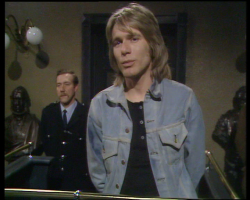
<em>Budgie</em>, the story of small time Soho criminal Ronald ‘Budgie’ Bird, was produced by London Weekend Television and ran over two series, each of thirteen episodes, between 1971 and 1972.<sup id="rf1-5873"><a href="#fn1-5873" title="&lt;em&gt;Budgie&lt;/em&gt;, LWT for ITV, 1971-72." rel="footnote">1</a></sup> Both series explored the liminal world of pornography, police corruption, criminal scams, violence and petty crime, and Budgie’s place within it. While <em>Budgie</em> has come to be affectionately remembered as a cockney comedy-drama with a charming, irrepressible lead character set in 1970s Soho, and as a series which launched an ‘entire fashion craze’, and is indeed all of these things, it would do the series a huge disservice to ignore its other dimensions, in particular those concerned with gender and masculinity identity.<sup id="rf2-5873"><a href="#fn2-5873" title="See for example the Adam Faith Appreciation Society facebook site; Robert Elms, &lt;em&gt;The Way We Wore: A Life in Threads&lt;/em&gt; (London: Picador, 2005), p. 81." rel="footnote">2</a></sup></p>

<hr class="footnotes"><ol class="footnotes" style="list-style-type:decimal"><li id="fn1-5873"><p ><em>Budgie</em>, LWT for ITV, 1971-72.&nbsp;<a href="#rf1-5873" class="backlink" title="Return to footnote 1.">&#8617;</a></p></li><li id="fn2-5873"><p >See for example the Adam Faith Appreciation Society facebook site; Robert Elms, <em>The Way We Wore: A Life in Threads</em> (London: Picador, 2005), p. 81.&nbsp;<a href="#rf2-5873" class="backlink" title="Return to footnote 2.">&#8617;</a></p></li></ol></hr>{"id":5873,"date":"2016-02-17T11:00:14","date_gmt":"2016-02-17T11:00:14","guid":{"rendered":"http:\/\/www.britishtelevisiondrama.org.uk\/?p=5873"},"modified":"2024-08-30T11:36:53","modified_gmt":"2024-08-30T10:36:53","slug":"5873","status":"publish","type":"post","link":"http:\/\/www.britishtelevisiondrama.org.uk\/?p=5873","title":{"rendered":"The Lad and the Loser: <em>Budgie<\/em> (1971-72)"},"content":{"rendered":"<h4>by NIGEL SARRASSA-DYER<\/h4>\n<p>Twenty-six episodes. <b>Writers:<\/b> Keith Waterhouse, Willis Hall, Douglas Livingstone, Jack Trevor Story; <b>Producer:<\/b> Verity Lambert; <b>Directors:<\/b> Moira Armstrong, Alan Gibson, Michael Lindsay-Hogg, Mike Newell, Herbert Wise<\/p>\n<p><img loading=\"lazy\" decoding=\"async\" src=\"http:\/\/www.britishtelevisiondrama.org.uk\/wp-content\/uploads\/2016\/02\/BTVD_Budgie_0-e1455700376643.png\" alt=\"BTVD_Budgie_0\" width=\"250\" height=\"200\" class=\"alignleft size-full wp-image-5893\" \/><br \/>\n<em>Budgie<\/em>, the story of small time Soho criminal Ronald \u2018Budgie\u2019 Bird, was produced by London Weekend Television and ran over two series, each of thirteen episodes, between 1971 and 1972.<sup id=\"rf1-5873\"><a href=\"#fn1-5873\" title=\"&lt;em&gt;Budgie&lt;\/em&gt;, LWT for ITV, 1971-72.\" rel=\"footnote\">1<\/a><\/sup> Both series explored the liminal world of pornography, police corruption, criminal scams, violence and petty crime, and Budgie\u2019s place within it. While <em>Budgie<\/em> has come to be affectionately remembered as a cockney comedy-drama with a charming, irrepressible lead character set in 1970s Soho, and as a series which launched an \u2018entire fashion craze\u2019, and is indeed all of these things, it would do the series a huge disservice to ignore its other dimensions, in particular those concerned with gender and masculinity identity.<sup id=\"rf2-5873\"><a href=\"#fn2-5873\" title=\"See for example the Adam Faith Appreciation Society facebook site; Robert Elms, &lt;em&gt;The Way We Wore: A Life in Threads&lt;\/em&gt; (London: Picador, 2005), p. 81.\" rel=\"footnote\">2<\/a><\/sup><\/p>\n<p><!--more--><\/p>\n<p>As social, economic and cultural changes of the 1970s impacted upon gender relations, a significant number of programmes were able to explore multiple and competing constructions of masculinity. Issues around gender and masculine anxieties featured across a variety of television genres: routinely in sitcoms such as <em>Rising Damp<\/em> and <em>Man about the House<\/em>;<sup id=\"rf3-5873\"><a href=\"#fn3-5873\" title=\"&lt;&lt;em&gt;Rising Damp&lt;\/em&gt;, Yorkshire Television for ITV, 1974-78; &lt;em&gt;Man about the House&lt;\/em&gt;, Thames for ITV, 1973-76.\" rel=\"footnote\">3<\/a><\/sup> as small parts of wider discourses in dramas like <em>The Knowledge<\/em> and <a href=\"http:\/\/www.screenonline.org.uk\/tv\/id\/1044487\/\" target=\"_self\" rel=\"noopener\"><em>Comedians<\/em><\/a>;<sup id=\"rf4-5873\"><a href=\"#fn4-5873\" title=\"&lt;em&gt;The Knowledge&lt;\/em&gt;, Euston\/Thames for ITV, tx. 27 December 1979, wr. Jack Rosenthal, dr. Bob Brooks; &lt;em&gt;Play for Today&lt;\/em&gt;:&#8217;Comedians&#8217;, BBC1, tx. 25 October 1979, wr. Trevor Griffiths, dr. Richard Eyre.\" rel=\"footnote\">4<\/a><\/sup> and in both the documentary <em>The Family<\/em> and the science fiction series <em>Survivors<\/em>.<sup id=\"rf5-5873\"><a href=\"#fn5-5873\" title=\"&lt;em&gt;The Family&lt;\/em&gt;, BBC1, 3 April-26 June 1974; &lt;em&gt;Survivors&lt;\/em&gt;, BBC1, 1975-77.\" rel=\"footnote\">5<\/a><\/sup> With <em>Budgie<\/em>, however, it is the detailed examination of a particular masculinity at a particular time which is central to the narrative as it is played out in the trajectory of Budgie\u2019s decline and fall.<\/p>\n<p>The series was devised and largely written by Keith Waterhouse and Willis Hall, who had achieved considerable success the previous decade. Echoes of <em>Budgie<\/em> can be found in some of Waterhouse\u2019s earlier writing. For example, William Fisher in the 1959 novel <em>Billy Liar<\/em> (later adapted for theatre and cinema by Waterhouse and Hall) is, like Budgie, a dreamer and a fantasist. Similarly Waterhouse and Hall\u2019s script for the 1963 film <em>West 11<\/em><sup id=\"rf6-5873\"><a href=\"#fn6-5873\" title=\"&lt;em&gt;West 11&lt;\/em&gt;, Angel Productions\/ABPC, dr. Michael Winner.\" rel=\"footnote\">6<\/a><\/sup> depicts a particular milieu in London (in this case Notting Hill rather than Soho) in a decade (the 1960s rather than the 1970s) which is part \u2018seedy\u2019, part swinging, part \u2018sleazy\u2019 and peopled by richly idiosyncratic characters.<sup id=\"rf7-5873\"><a href=\"#fn7-5873\" title=\"&#8216;Film Review\u2019, &lt;em&gt;Variety&lt;\/em&gt;, 31 December 1962.\" rel=\"footnote\">7<\/a><\/sup> Even Alfred Lynch\u2019s central character Joe Beckett, while more intelligent and aware than Budgie, bears a striking resemblance to him as a somewhat confused outsider on the fringes of the criminal underworld. Some of Waterhouse\u2019s later work also has echoes of <em>Budgie<\/em>. His novel <em>Soho<\/em>, for example, is set in the district that he knew and loved and was on the verge of disappearing. Similarly his script for the play <em>Jeffrey Bernard is Unwell<\/em> operates, in part, as an elegy or paean for a particular time and place displaying his love for and knowledge of that part of London, something which is no less apparent in <em>Budgie<\/em>.<\/p>\n<p><img loading=\"lazy\" decoding=\"async\" src=\"http:\/\/www.britishtelevisiondrama.org.uk\/wp-content\/uploads\/2016\/02\/BTVD_Budgie_Lambert-e1455703619570.png\" alt=\"BTVD_Budgie_Lambert\" width=\"250\" height=\"200\" class=\"alignleft size-full wp-image-5905\" \/><img loading=\"lazy\" decoding=\"async\" src=\"http:\/\/www.britishtelevisiondrama.org.uk\/wp-content\/uploads\/2016\/02\/BTVD_Budgie_Armstrong-e1455703631593.png\" alt=\"BTVD_Budgie_Armstrong\" width=\"250\" height=\"200\" class=\"alignleft size-full wp-image-5906\" \/><br \/>\n<em>Budgie<\/em> was notable for the involvement of producer Verity Lambert, following her considerable success with <em>Doctor Who<\/em> and preceding her groundbreaking achievements with Euston Films.<sup id=\"rf8-5873\"><a href=\"#fn8-5873\" title=\"&lt;em&gt;Doctor Who&lt;\/em&gt;, BBC\/BBC1, 1963-present.\" rel=\"footnote\">8<\/a><\/sup> A number of distinguished directors were also involved in the production including Jim Goddard who would go on to direct <em>Out<\/em>, Fox and <em>The Black Stuff<\/em>;<sup id=\"rf9-5873\"><a href=\"#fn9-5873\" title=\"&lt;em&gt;Out&lt;\/em&gt;, Thames\/Euston for ITV, 1978; &lt;em&gt;Fox&lt;\/em&gt;, Thames\/Euston for ITV, 1980; &lt;em&gt;The Black Stuff&lt;\/em&gt;, tx. BBC2, 2 January 1980.\" rel=\"footnote\">9<\/a><\/sup> Michael Lindsay-Hogg, whose later work would include several episodes of <a href=\"http:\/\/www.britishtelevisiondrama.org.uk\/?page_id=858\" target=\"_self\" rel=\"noopener\"><em>Play for Today<\/em><\/a>, <em>Brideshead Revisited<\/em> and <em>Bill Brand<\/em>);<sup id=\"rf10-5873\"><a href=\"#fn10-5873\" title=\"&lt;em&gt;Brideshead Revisited&lt;\/em&gt;, Granada for ITV, 1981; &lt;em&gt;Bill Brand&lt;\/em&gt;, Thames for ITV, 1976.\" rel=\"footnote\">10<\/a><\/sup> Mike Newell, who had been building a reputation for himself with crime dramas <em>Spindoe<\/em> and Big Breadwinner Hog and whose later work would take him to Hollywood;<sup id=\"rf11-5873\"><a href=\"#fn11-5873\" title=\"&lt;em&gt;Spindoe&lt;\/em&gt;, Granada for ITV, 1968; &lt;em&gt;Big Breadwinner Hog&lt;\/em&gt;, Granada for ITV, 1969.\" rel=\"footnote\">11<\/a><\/sup> and BAFTA-winning Moira Armstrong, whose career as one of television\u2019s most prolific directors of popular drama, spanning fifty years, would include the acclaimed series <em>Testament of Youth<\/em>.<sup id=\"rf12-5873\"><a href=\"#fn12-5873\" title=\"&lt;em&gt;Testament of Youth&lt;\/em&gt;, BBC2, 1979.\" rel=\"footnote\">12<\/a><\/sup><\/p>\n<p><img loading=\"lazy\" decoding=\"async\" src=\"http:\/\/www.britishtelevisiondrama.org.uk\/wp-content\/uploads\/2016\/02\/BTVD_Budgie_9-e1455700386718.png\" alt=\"BTVD_Budgie_9\" width=\"250\" height=\"200\" class=\"alignleft size-full wp-image-5894\" \/><br \/>\n<em>Budgie<\/em> starred pop singer Adam Faith, who had already made successful forays into acting in a number of British films. Faith&#8217;s personification of Budgie, which became enormously popular with a young male working class audience, is perhaps one of the best  fictional examples of what came to be known as The Lad.<sup id=\"rf13-5873\"><a href=\"#fn13-5873\" title=\"&lt;em&gt;Daily Mirror&lt;\/em&gt;, 13 July 1972; Leon Hunt, &lt;em&gt;British Low Culture: From Safari Suits to Sexploitation &lt;\/em&gt; (London: Routledge, 1998), p. 63.\" rel=\"footnote\">13<\/a><\/sup> Variously described by Robert Elms as \u2018a guttersnipe peacock\u2019, \u2018Jack the Lad\u2019 and \u2018a cheeky, money hungry, street savvy working class guy, obsessed with wearing the right schmutter\u2019, Budgie Bird was able to encapsulate the aspirations of a large and significant section of working class youth.<sup id=\"rf14-5873\"><a href=\"#fn14-5873\" title=\"Elms, p. 81.\" rel=\"footnote\">14<\/a><\/sup> In this sense he personifies what Caughie and Rockett have called the crafty working-class lothario.<sup id=\"rf15-5873\"><a href=\"#fn15-5873\" title=\"John Caughie and Kevin Rockett, &lt;em&gt;The Companion to British and Irish Cinema&lt;\/em&gt; (London: Cassell, 1996), p. 41.\" rel=\"footnote\">15<\/a><\/sup> Being highly aware of his own image and style, confident as an individual and not necessarily operating as part of a homosocial male group, but still holding an unreconstructed attitude towards women, he is perhaps more likely to be seen in the company of women than other men. However, he is less interested in the women than he is in himself. Furthermore, unusually for the time, whilst being resolutely heterosexual Budgie eschews any form of homophobia. Unlike other characters in the series he is neither abashed nor appears threatened when confronted with openly camp men or evidence of same sex liaisons.<\/p>\n<p><img loading=\"lazy\" decoding=\"async\" src=\"http:\/\/www.britishtelevisiondrama.org.uk\/wp-content\/uploads\/2016\/02\/BTVD_Budgie_7-e1455700353757.png\" alt=\"BTVD_Budgie_7\" width=\"250\" height=\"200\" class=\"alignleft size-full wp-image-5891\" \/><br \/>\nIn the early 70s advertisers made a concerted effort to target male consumers, resulting in the emergence of a new language.  Whilst traditional masculine products such as beer and tobacco were marketed more aggressively, new more \u2018feminine\u2019 products like aftershave also entered into advertising.  Leon Hunt sees here the emergence of The Lad, a generally younger man, part pop star, part footballer, willing to incorporate elements of femininity into his lifestyle.<sup id=\"rf16-5873\"><a href=\"#fn16-5873\" title=\"Hunt, p. 63.\" rel=\"footnote\">16<\/a><\/sup> The Lad is resolutely heterosexual but is open to new ideas, styles and fashions. His version of masculinity is fluid but can also be awkward, comic and somewhat vulnerable.<sup id=\"rf17-5873\"><a href=\"#fn17-5873\" title=\"Ibid.\" rel=\"footnote\">17<\/a><\/sup> What he also contributes is a distinctly accessible role model for working class youth and a break with models of traditional working class masculinity, although whether this is a genuine challenge to the dominant paradigms of hegemonic masculinity is debatable.<sup id=\"rf18-5873\"><a href=\"#fn18-5873\" title=\"David Stafford and Caroline Stafford, &lt;em&gt;Big Time: The Life of Adam Faith&lt;\/em&gt; (London: Omnibus, 2015), p. 196.\" rel=\"footnote\">18<\/a><\/sup><\/p>\n<p><img loading=\"lazy\" decoding=\"async\" src=\"http:\/\/www.britishtelevisiondrama.org.uk\/wp-content\/uploads\/2016\/02\/BTVD_Budgie_1-e1455700284550.png\" alt=\"BTVD_Budgie_1\" width=\"250\" height=\"200\" class=\"alignleft size-full wp-image-5885\" \/><br \/>\nWhile working-class men\u2019s interest in designer clothes was a reflection of masculinity that had \u2018partly detached itself from its formative links to traditional class identities\u2019, becoming \u2018aspirational and more narcissistic\u2019, <em>Budgie<\/em> was far from the upper-middle-class fantasies of <em>Jason King<\/em> and <em>The Persuaders<\/em>,<sup id=\"rf19-5873\"><a href=\"#fn19-5873\" title=\"&lt;em&gt;Jason King&lt;\/em&gt;, ITC, 1971-72; &lt;em&gt;The Persuaders&lt;\/em&gt;, ITC, 1971-72.\" rel=\"footnote\">19<\/a><\/sup> its central character owing more to the legacy of dandyism which emerged in working-class personalities like Terence Stamp in the 1960s.<sup id=\"rf20-5873\"><a href=\"#fn20-5873\" title=\"Jonathan Rutherford, \u2018Who&#8217;s That Man?\u2019, in Rowena Chapman and Jonathan Rutherford (editors), &lt;em&gt;Male Order: Unwrapping Masculinity&lt;\/em&gt; (London: Lawrence &#038; Wishart, 1988, repr. 1996), pp. 21-67 [p. 39].\" rel=\"footnote\">20<\/a><\/sup> If, as Robert Shail has argued, figures like Stamp and Michael Caine personified a particular form of metropolitan working class masculinity and they themselves constituted a considerable part of the new meritocracy of the sixties, then Budgie could be seen as the 1970s corollary to this phenomenon.<sup id=\"rf21-5873\"><a href=\"#fn21-5873\" title=\"Robert Shail, \u2018Masculinity and Class: Michael Caine as \u2018Working-Class Hero\u2019, in Phil Powrie, Ann Davies and Bruce Babington (editors), &lt;emThe Trouble With Men: Masculinities in European and Hollywood Cinema&lt;\/em&gt; (London: Wallflower Press, 2004), pp. 66-76 [p. 75].\" rel=\"footnote\">21<\/a><\/sup> With his optimistic approach to life he comes over like a 1960s anachronism, the working class dandy. His look certainly suggests success and affluence with his feathered haircut, flamboyant Carnaby Street suits, tight fitted suede jackets, satin trousers and white clogs.  However, the reality of his situation more accurately reflects the ostensible disillusion of the 1970s. His milieux are not galleries, exclusive clubs or chic discoth\u00e8ques, but strip clubs, gambling dens and dirty bookshops. His escorts are not fashion models and actresses but strippers and check out girls, and the closest he gets to position and status is as the errand boy for a much more successful and socially aspirational working class villain. He is a character who finds every available opportunity for success thwarted as he finds it increasingly impossible to transcend his roots and his place in society. If, as Shail asserts, \u2018the exuberance which marked the working-class emancipations of the early 1960s\u2019 led to a dandified, meritocracy in certain circles, then from the \u2018besieged mentality\u2019 of the 1970s emerged a masculinity, based upon this meritocracy but without many of the concomitant attributes.<sup id=\"rf22-5873\"><a href=\"#fn22-5873\" title=\"Ibid., p. 69.\" rel=\"footnote\">22<\/a><\/sup> The best Budgie can do is look the part.<\/p>\n<p>While on the surface Budgie appears to epitomise The Lad, a working class consumer, confident, stylish and irrepressible, the narratives of both series tend to undercut this image, while providing a space for a deeper exploration of Budgie&#8217;s own masculine frailty. Despite operating on the fringes of Soho&#8217;s criminal world, participating in numerous scams, continually trying to get one over on other characters, it is Budgie himself who is more often, ironically, portrayed as the victim. While he is never violent himself, he is, at times, on the receiving end of violence. While being relatively insensitive to the feelings of Hazel, his girlfriend, and some of his associates he does at other times display a deeply moving sensitivity to others. In an encounter with his former teacher in \u2018Could do Better\u2019, he spends much of the episode listening to the man recount his lonely life since his wife left him.<sup id=\"rf23-5873\"><a href=\"#fn23-5873\" title=\"&lt;em&gt;Budgie&lt;\/em&gt;: &#8216;Could Do Better&#8217;, wr. Willis Hall and Keith Waterhouse, dr. James Goddard, tx. ITV, 14 May 1971.\" rel=\"footnote\">23<\/a><\/sup> In \u2018Twenty-Four Thousand Ball Point Pens\u2019 he has serious doubts about participating in a scam which would leave an elderly woman out of pocket.<sup id=\"rf24-5873\"><a href=\"#fn24-5873\" title=\"&lt;em&gt;Budgie&lt;\/em&gt;: &#8216;Twenty-Four Thousand Ball Point Pens&#8217;, wr. Willis Hall and Keith Waterhouse, dr. Alan Gibson, tx. ITV, 9 June 1972.\" rel=\"footnote\">24<\/a><\/sup> Even more poignantly in \u2018Sunset Mansions, or Whatever Happened to Janey Baib?&#8217; he forms a genuine and affectionate relationship with a somewhat proud but deluded middle aged actress, attempting to comfort her and shield her from the reality of her faded career.<sup id=\"rf25-5873\"><a href=\"#fn25-5873\" title=\"&lt;em&gt;Budgie&lt;\/em&gt;: &#8216;Sunset Mansions, or Whatever Happened to Janey Baib?&#8217;, wr. Willis Hall and Keith Waterhouse, dr. Mike Newell, tx. ITV, 25 June 1971.\" rel=\"footnote\">25<\/a><\/sup><\/p>\n<p><img loading=\"lazy\" decoding=\"async\" src=\"http:\/\/www.britishtelevisiondrama.org.uk\/wp-content\/uploads\/2016\/02\/BTVD_Budgie_5-e1455700327609.png\" alt=\"BTVD_Budgie_5\" width=\"250\" height=\"200\" class=\"alignleft size-full wp-image-5889\" \/><br \/>\nIt is however in the rejection and abuse that he receives at the hands of Charlie Endell, his sometime boss, where his vulnerability reveals itself in a mixture of hurt and bewilderment. Budgie looks to Endell as a mentor, someone to nurture him. He wants to be taken seriously by Endell both professionally and personally; Endell, however, sees Budgie as no more than a minion, and certainly does not want him involved with his own private life or his family. He constantly ridicules Budgie&#8217;s attempts to be a real villain, berates him for not understanding the complexities of business, threatens him if Budgie&#8217;s actions might lead to Endell\u2019s own wife becoming upset. It is Endell who finally arranges for Budgie to be tracked down and badly beaten for his transgressions.<\/p>\n<p><img loading=\"lazy\" decoding=\"async\" src=\"http:\/\/www.britishtelevisiondrama.org.uk\/wp-content\/uploads\/2016\/02\/BTVD_Budgie_12-e1455703176641.png\" alt=\"BTVD_Budgie_12\" width=\"250\" height=\"200\" class=\"alignleft size-full wp-image-5902\" \/><br \/>\nIn the final episode of the second series, Budgie ultimately realises the reality of a masculine hierarchy which positions himself at the bottom and Endell at the top. \u2018It ain&#8217;t a free country, only for the biggest\u2019, he cries. This is followed by a highly symbolic scene in the grounds of a ruined church, accompanied by the sound of church bells, a low angle shot of Endell, silhouetted against the ruins, looming over a quailing Budgie pleading against his punishment.<sup id=\"rf26-5873\"><a href=\"#fn26-5873\" title=\"&lt;em&gt;Budgie&lt;\/em&gt;: &#8216;Run Rabbit, Run Rabbit, Run, Run, Run&#8217;, wr. Keith Waterhouse and Willis Hall, dr. Mike Newell, tx. ITV, 14 July 1972.\" rel=\"footnote\">26<\/a><\/sup><\/p>\n<p>While Budgie appears to see Endell as some kind of surrogate father figure, Endell does not treat Budgie like a son. Why Budgie has turned to Endell to fulfil this role becomes clear in the two-part story \u2018Fiddler on the Hoof\u2019, where his real father is revealed as dissolute, uncaring and highly critical of his son to the point of antagonism.<sup id=\"rf27-5873\"><a href=\"#fn27-5873\" title=\"&lt;em&gt;Budgie&lt;\/em&gt;: &#8216;Fiddler On The Hoof&#8217;, wr. Douglas Livingstone, dr. Michael Lindsay-Hogg, tx. ITV, 11 June 1971 (part 1), 18 June 1971 (part 2).\" rel=\"footnote\">27<\/a><\/sup> In a later episode Budgie\u2019s father fails to inform Budgie of his mother\u2019s death. The most moving scene however, which underscores Budgie\u2019s own vulnerable sensitivity and the lack of sensitivity that others have for him, is when his family and friends gather together to celebrate his sister\u2019s wedding and his errant father turns up only to rant and rail once again against his son. When the family are forced to choose who stays at the party and who goes, it is Budgie who is asked to leave.<\/p>\n<p><img loading=\"lazy\" decoding=\"async\" src=\"http:\/\/www.britishtelevisiondrama.org.uk\/wp-content\/uploads\/2016\/02\/BTVD_Budgie_2a-e1455700362631.png\" alt=\"BTVD_Budgie_2a\" width=\"250\" height=\"200\" class=\"alignleft size-full wp-image-5892\" \/><br \/>\n<em>Budgie<\/em> expresses a disjuncture between male identities founded upon the mythic and reality, between men\u2019s expectations and experiences, and it is indeed the theme music which frequently highlights this. The lyrics used for the second series operate as a litany of maudlin self pity: \u2018I\u2019m nobody&#8217;s fool and I\u2019m nobody&#8217;s friend\u2019. This elegy continues with the line \u2018nobody notices me\u2019, reflecting the eponymous protagonist\u2019s inability to engender any heroic qualities to elevate his endeavours to mythic status. For Budgie there is no possibility of (to use Jefferson&#8217;s terms) \u2018transcendence\u2019 from the \u2018mundane\u2019.<sup id=\"rf28-5873\"><a href=\"#fn28-5873\" title=\"Tony Jefferson, \u2018Theorising Masculine Subjectivity\u2019, in Tim Newburn and Elizabeth A. Stanko (editors), &lt;em&gt;Just Boys Doing Business?: Men, Masculinities and Crime&lt;\/em&gt; (New York: Routledge, 1995), pp. 10-31 [p. 11].\" rel=\"footnote\">28<\/a><\/sup> Indeed the overall narrative trajectory of Budgie\u2019s story, as well as for each individual episode, serves to play out this impossibility. Thus, rather than establish any mythic or heroic status for Budgie, the narrative(s) resolve themselves in a sense of melancholia.<\/p>\n<p><img loading=\"lazy\" decoding=\"async\" src=\"http:\/\/www.britishtelevisiondrama.org.uk\/wp-content\/uploads\/2016\/02\/BTVD_Budgie_4-e1455700317198.png\" alt=\"BTVD_Budgie_4\" width=\"250\" height=\"200\" class=\"alignleft size-full wp-image-5888\" \/><br \/>\nJonathan Rutherford has talked about the broken promises of patriarchy where men invest the meanings of themselves in the structures and images of male superiority. That is where the promise of patriarchy is supposed to lie, in dreams of fame, greatness and of being someone. Yet these dreams rarely bear fruition. The reality of class and racial hierarchies ensure that the majority of men wait for a payoff that rarely comes. What ensues is the \u2018bitterness and disappointments of men let down by the broken promises of patriarchy\u2019, the intangible goals of masculinity that never materialise, \u2018yet he still feels at home in his sexual identity rather than make any attempt to change it\u2019.<sup id=\"rf29-5873\"><a href=\"#fn29-5873\" title=\"Rutherford, p. 54.\" rel=\"footnote\">29<\/a><\/sup> As Roger Horrocks has observed, \u2018patriarchal society has demanded and constructed a fearsome male narcissism\u2019.<sup id=\"rf30-5873\"><a href=\"#fn30-5873\" title=\"Roger Horrocks, &lt;em&gt;Male Myths and and Icons: Masculinity in Popular Culture&lt;\/em&gt; (New York: St Martin\u2019s Press, 1995), p. 20.\" rel=\"footnote\">30<\/a><\/sup> Ultimately, as Budgie\u2019s attempts to achieve mythic status constantly elude him his geniality and the optimism, apparent in the first series, begin to evaporate and the bitterness and disappointment that Rutherford describes become increasingly manifest.<\/p>\n<p>While Budgie conforms to Hunt\u2019s definition of the 70s working class \u2018Lad\u2019, confidently embracing the ostensibly \u2018feminine\u2019 through clothing, style and consumption while retaining many of the characteristics of the dominant paradigms of masculinity, his real persona is far more complex.<sup id=\"rf31-5873\"><a href=\"#fn31-5873\" title=\"Hunt, p. 63.\" rel=\"footnote\">31<\/a><\/sup> With its melancholic theme music used for the first series, plaintively-voiced lyrics for the second series, and narratives which emphasise rejection and failure, <em>Budgie<\/em> reveals its namesake to be far more than a mere signifier for youthful masculine confidence in the 1970s. Budgie himself is lonely and confused, confronted by his own inability to achieve, to become the equivalent of pop star or footballer. More than this, his own apparently confident masculinity becomes increasingly vulnerable, bringing him at times close to tears in a state of bewilderment at the treatment he receives from those he cares for. Ultimately, Budgie is revealed to be equally The Lad and The Loser.<sup id=\"rf32-5873\"><a href=\"#fn32-5873\" title=\"&lt;em&gt;The Loser&lt;\/em&gt; was the original working title for the first series, but LWT Managing Director Rupert Murdoch considered this to be too negative to attract a wide audience &#8211; Stafford and Stafford, p. 88.\" rel=\"footnote\">32<\/a><\/sup><\/p>\n<p><img loading=\"lazy\" decoding=\"async\" src=\"http:\/\/www.britishtelevisiondrama.org.uk\/wp-content\/uploads\/2016\/02\/BTVD_Budgie_3-e1455700305367.png\" alt=\"BTVD_Budgie_3\" width=\"250\" height=\"200\" class=\"alignleft size-full wp-image-5887\" \/><br \/>\nWhile Budgie is the recipient and beneficiary of a wave of trickling down of 1960s permissiveness together with a more relaxed attitude towards gender differences, he continually resorts to manoeuvres which owe more to the power\/gender relations of a previous generation.<sup id=\"rf33-5873\"><a href=\"#fn33-5873\" title=\"Hunt, pp. 21-22.\" rel=\"footnote\">33<\/a><\/sup> Indeed while the age appeared to be permissive, this permission appears to have been granted almost exclusively to men. While Budgie exemplifies this permissive populism this is still purely a male domain. Power and gender relations remain the same. Men are still in charge; patriarchy still exists, men still exercise power both inside and outside mainstream culture. Consequently those men with little power within the masculine hierarchy, like Budgie, attempt to exercise power at moments of conspicuous success \u2013 affirming their masculinity through clothes and money or at all other times through casual misogyny. Thus, the notion of The Lad as a new construction of masculinity is both meretricious and superficial \u2013 the only thing new about him is his style. While Budgie\u2019s masculine performance ostensibly betrays a degree of fluidity the reality becomes increasingly apparent as his aspirations are thwarted.<\/p>\n<p><img loading=\"lazy\" decoding=\"async\" src=\"http:\/\/www.britishtelevisiondrama.org.uk\/wp-content\/uploads\/2016\/02\/BTVD_Budgie_2-e1455700295365.png\" alt=\"BTVD_Budgie_2\" width=\"250\" height=\"200\" class=\"alignleft size-full wp-image-5886\" \/><br \/>\nIn the first series Budgie is at times charming, sensitive, charismatic and appealingly irrepressible. His style and appeal allows one to overlook his shortcomings. Furthermore the fact that he is a loser allows for a sense of sympathy (at his plight). However, in the second series this idea is turned on its head. His irrepressible nature \u2013 having \u2018stood for it\u2019 once again \u2013 can only be seen as stupidity.  And his actions and attitudes, largely through repetition but also through making them increasingly extreme, make the character far less appealing. In \u2018Glory of Fulham\u2019, for example, as success once again eludes him, he becomes more bitter and misogynistic.<sup id=\"rf34-5873\"><a href=\"#fn34-5873\" title=\"&lt;em&gt;Budgie&lt;\/em&gt;: &#8216;Glory of Fulham&#8217;, wr. Keith Waterhouse and Willis Hall, dr. Michael Lindsay-Hogg, tx. ITV, 2 June 1972.\" rel=\"footnote\">34<\/a><\/sup> With his jibes about \u2019women\u2019s lib\u2019 (an echo of Bob Hope&#8217;s tirade at <em>Miss World 1970<\/em>), his exploitation of others, particularly Hazel, becomes more cynical. As he becomes more anxious and his always precarious masculine privilege becomes ever more insecure, his actions are revealed as increasingly pitiful, his behaviour problematic and no longer amusing. As people become less tolerant of him he attempts to assert himself, less through charm and more through direct challenge and confrontation. As his protracted domestic squabbles with Hazel become increasingly bitter, he states that their young son is \u2018your lousy kid\u2019, complains that the child\u2019s crying has woken up his racing greyhound (his latest doomed venture) and threatens violence against Hazel. Even his sexual allure begins to evaporate as he becomes sleazier, his lasciviousness becoming almost predatory. Gradually through the last three episodes, comedy turns to tragedy. This is not simply the tragedy of his own position but also the tragedy he brings upon others (again particularly Hazel) through his thoughtlessness and selfishness. In spite of its comic moments, the mood of the series has darkened considerably.<\/p>\n<p><img loading=\"lazy\" decoding=\"async\" src=\"http:\/\/www.britishtelevisiondrama.org.uk\/wp-content\/uploads\/2016\/03\/BTVD_Budgie_11-e1455701127141.png\" alt=\"BTVD_Budgie_11\" width=\"250\" height=\"200\" class=\"alignleft size-full wp-image-5895\" \/><br \/>\nUltimately, while <em>Budgie<\/em> has come to be fondly remembered as a light drama, with comedic moments, depicting a likeable character\u2019s laddish behaviour and a fixation on clothes, set in a fictional depiction of a lost Soho and its 70s criminal world, it is much more than this.<sup id=\"rf35-5873\"><a href=\"#fn35-5873\" title=\"A number of fan posts and threads on websites and blogs express a nostalgic enthusiasm for the series, see for example Youtube, In the 70s, IMDB, Adventures in Primetime.\" rel=\"footnote\">35<\/a><\/sup> It is a complex examination of working class masculinity through a relatively simple and na\u00efve male character. However, while it opens up interesting discourses around a particular emergent masculinity, any genuine fluidity or transcendence is heavily circumscribed throughout the narrative leaving Budgie trapped within the existing\/persisting class structures, the dominant constructions of masculinity and the limits of his own cognitive abilities. While the series may have constituted part of a shift in representations of masculinity, it was less than a radical challenge to the privileges of patriarchy. While it shows increasing tolerance to non-normative behaviour it nevertheless retains strong elements of misogyny at moments of crisis reverting to residual constructions of masculinity. As Budgie\u2019s desperation becomes more palpable, so his mood degenerates into dark self pity. This has become, ultimately, masculinity at the end of its tether, as he declares in the final scene, \u2018You can\u2019t win, this thing&#8217;s bigger than the both of us. It\u2019s the whole bleedin\u2019 system\u2019.<\/p>\n<p><em>Images of Moira Armstrong and Verity Lambert are taken from the documentary Budgie&#8217;s Birds, which is on the Network DVD release of Budgie.<\/p>\n<p>Originally posted: 17 February 2016.<\/em><\/p>\n<p><body><!-- Start of StatCounter Code --><br \/>\n<script type=\"text\/javascript\">\nvar sc_project=5750652; \nvar sc_invisible=1; \nvar sc_partition=68; \nvar sc_click_stat=1; \nvar sc_security=\"6dd1aa39\"; \n<\/script><\/p>\n<p><script type=\"text\/javascript\"\nsrc=\"http:\/\/www.statcounter.com\/counter\/counter.js\"><\/script><noscript>\n<div<br \/>\nclass=&#8221;statcounter&#8221;><a title=\"wordpress stats \"<br \/>\nhref=&#8221;http:\/\/www.statcounter.com\/wordpress.org\/&#8221;<br \/>\ntarget=&#8221;_blank&#8221;><img class=\"statcounter\"<br \/>\nsrc=&#8221;http:\/\/c.statcounter.com\/5750652\/0\/6dd1aa39\/1\/&#8221;<br \/>\nalt=&#8221;wordpress stats &#8221; ><\/a><\/div>\n<p><\/noscript><br \/>\n<!-- End of StatCounter Code --><\/body><\/p>\n<hr class=\"footnotes\"><ol class=\"footnotes\" style=\"list-style-type:decimal\"><li id=\"fn1-5873\"><p ><em>Budgie<\/em>, LWT for ITV, 1971-72.&nbsp;<a href=\"#rf1-5873\" class=\"backlink\" title=\"Return to footnote 1.\">&#8617;<\/a><\/p><\/li><li id=\"fn2-5873\"><p >See for example the Adam Faith Appreciation Society facebook site; Robert Elms, <em>The Way We Wore: A Life in Threads<\/em> (London: Picador, 2005), p. 81.&nbsp;<a href=\"#rf2-5873\" class=\"backlink\" title=\"Return to footnote 2.\">&#8617;<\/a><\/p><\/li><li id=\"fn3-5873\"><p >&lt;<em>Rising Damp<\/em>, Yorkshire Television for ITV, 1974-78; <em>Man about the House<\/em>, Thames for ITV, 1973-76.&nbsp;<a href=\"#rf3-5873\" class=\"backlink\" title=\"Return to footnote 3.\">&#8617;<\/a><\/p><\/li><li id=\"fn4-5873\"><p ><em>The Knowledge<\/em>, Euston\/Thames for ITV, tx. 27 December 1979, wr. Jack Rosenthal, dr. Bob Brooks; <em>Play for Today<\/em>:&#8217;Comedians&#8217;, BBC1, tx. 25 October 1979, wr. Trevor Griffiths, dr. Richard Eyre.&nbsp;<a href=\"#rf4-5873\" class=\"backlink\" title=\"Return to footnote 4.\">&#8617;<\/a><\/p><\/li><li id=\"fn5-5873\"><p ><em>The Family<\/em>, BBC1, 3 April-26 June 1974; <em>Survivors<\/em>, BBC1, 1975-77.&nbsp;<a href=\"#rf5-5873\" class=\"backlink\" title=\"Return to footnote 5.\">&#8617;<\/a><\/p><\/li><li id=\"fn6-5873\"><p ><em>West 11<\/em>, Angel Productions\/ABPC, dr. Michael Winner.&nbsp;<a href=\"#rf6-5873\" class=\"backlink\" title=\"Return to footnote 6.\">&#8617;<\/a><\/p><\/li><li id=\"fn7-5873\"><p >&#8216;Film Review\u2019, <em>Variety<\/em>, 31 December 1962.&nbsp;<a href=\"#rf7-5873\" class=\"backlink\" title=\"Return to footnote 7.\">&#8617;<\/a><\/p><\/li><li id=\"fn8-5873\"><p ><em>Doctor Who<\/em>, BBC\/BBC1, 1963-present.&nbsp;<a href=\"#rf8-5873\" class=\"backlink\" title=\"Return to footnote 8.\">&#8617;<\/a><\/p><\/li><li id=\"fn9-5873\"><p ><em>Out<\/em>, Thames\/Euston for ITV, 1978; <em>Fox<\/em>, Thames\/Euston for ITV, 1980; <em>The Black Stuff<\/em>, tx. BBC2, 2 January 1980.&nbsp;<a href=\"#rf9-5873\" class=\"backlink\" title=\"Return to footnote 9.\">&#8617;<\/a><\/p><\/li><li id=\"fn10-5873\"><p ><em>Brideshead Revisited<\/em>, Granada for ITV, 1981; <em>Bill Brand<\/em>, Thames for ITV, 1976.&nbsp;<a href=\"#rf10-5873\" class=\"backlink\" title=\"Return to footnote 10.\">&#8617;<\/a><\/p><\/li><li id=\"fn11-5873\"><p ><em>Spindoe<\/em>, Granada for ITV, 1968; <em>Big Breadwinner Hog<\/em>, Granada for ITV, 1969.&nbsp;<a href=\"#rf11-5873\" class=\"backlink\" title=\"Return to footnote 11.\">&#8617;<\/a><\/p><\/li><li id=\"fn12-5873\"><p ><em>Testament of Youth<\/em>, BBC2, 1979.&nbsp;<a href=\"#rf12-5873\" class=\"backlink\" title=\"Return to footnote 12.\">&#8617;<\/a><\/p><\/li><li id=\"fn13-5873\"><p ><em>Daily Mirror<\/em>, 13 July 1972; Leon Hunt, <em>British Low Culture: From Safari Suits to Sexploitation <\/em> (London: Routledge, 1998), p. 63.&nbsp;<a href=\"#rf13-5873\" class=\"backlink\" title=\"Return to footnote 13.\">&#8617;<\/a><\/p><\/li><li id=\"fn14-5873\"><p >Elms, p. 81.&nbsp;<a href=\"#rf14-5873\" class=\"backlink\" title=\"Return to footnote 14.\">&#8617;<\/a><\/p><\/li><li id=\"fn15-5873\"><p >John Caughie and Kevin Rockett, <em>The Companion to British and Irish Cinema<\/em> (London: Cassell, 1996), p. 41.&nbsp;<a href=\"#rf15-5873\" class=\"backlink\" title=\"Return to footnote 15.\">&#8617;<\/a><\/p><\/li><li id=\"fn16-5873\"><p >Hunt, p. 63.&nbsp;<a href=\"#rf16-5873\" class=\"backlink\" title=\"Return to footnote 16.\">&#8617;<\/a><\/p><\/li><li id=\"fn17-5873\"><p >Ibid.&nbsp;<a href=\"#rf17-5873\" class=\"backlink\" title=\"Return to footnote 17.\">&#8617;<\/a><\/p><\/li><li id=\"fn18-5873\"><p >David Stafford and Caroline Stafford, <em>Big Time: The Life of Adam Faith<\/em> (London: Omnibus, 2015), p. 196.&nbsp;<a href=\"#rf18-5873\" class=\"backlink\" title=\"Return to footnote 18.\">&#8617;<\/a><\/p><\/li><li id=\"fn19-5873\"><p ><em>Jason King<\/em>, ITC, 1971-72; <em>The Persuaders<\/em>, ITC, 1971-72.&nbsp;<a href=\"#rf19-5873\" class=\"backlink\" title=\"Return to footnote 19.\">&#8617;<\/a><\/p><\/li><li id=\"fn20-5873\"><p >Jonathan Rutherford, \u2018Who&#8217;s That Man?\u2019, in Rowena Chapman and Jonathan Rutherford (editors), <em>Male Order: Unwrapping Masculinity<\/em> (London: Lawrence &#038; Wishart, 1988, repr. 1996), pp. 21-67 [p. 39].&nbsp;<a href=\"#rf20-5873\" class=\"backlink\" title=\"Return to footnote 20.\">&#8617;<\/a><\/p><\/li><li id=\"fn21-5873\"><p >Robert Shail, \u2018Masculinity and Class: Michael Caine as \u2018Working-Class Hero\u2019, in Phil Powrie, Ann Davies and Bruce Babington (editors), &lt;emThe Trouble With Men: Masculinities in European and Hollywood Cinema<\/em> (London: Wallflower Press, 2004), pp. 66-76 [p. 75].&nbsp;<a href=\"#rf21-5873\" class=\"backlink\" title=\"Return to footnote 21.\">&#8617;<\/a><\/p><\/li><li id=\"fn22-5873\"><p >Ibid., p. 69.&nbsp;<a href=\"#rf22-5873\" class=\"backlink\" title=\"Return to footnote 22.\">&#8617;<\/a><\/p><\/li><li id=\"fn23-5873\"><p ><em>Budgie<\/em>: &#8216;Could Do Better&#8217;, wr. Willis Hall and Keith Waterhouse, dr. James Goddard, tx. ITV, 14 May 1971.&nbsp;<a href=\"#rf23-5873\" class=\"backlink\" title=\"Return to footnote 23.\">&#8617;<\/a><\/p><\/li><li id=\"fn24-5873\"><p ><em>Budgie<\/em>: &#8216;Twenty-Four Thousand Ball Point Pens&#8217;, wr. Willis Hall and Keith Waterhouse, dr. Alan Gibson, tx. ITV, 9 June 1972.&nbsp;<a href=\"#rf24-5873\" class=\"backlink\" title=\"Return to footnote 24.\">&#8617;<\/a><\/p><\/li><li id=\"fn25-5873\"><p ><em>Budgie<\/em>: &#8216;Sunset Mansions, or Whatever Happened to Janey Baib?&#8217;, wr. Willis Hall and Keith Waterhouse, dr. Mike Newell, tx. ITV, 25 June 1971.&nbsp;<a href=\"#rf25-5873\" class=\"backlink\" title=\"Return to footnote 25.\">&#8617;<\/a><\/p><\/li><li id=\"fn26-5873\"><p ><em>Budgie<\/em>: &#8216;Run Rabbit, Run Rabbit, Run, Run, Run&#8217;, wr. Keith Waterhouse and Willis Hall, dr. Mike Newell, tx. ITV, 14 July 1972.&nbsp;<a href=\"#rf26-5873\" class=\"backlink\" title=\"Return to footnote 26.\">&#8617;<\/a><\/p><\/li><li id=\"fn27-5873\"><p ><em>Budgie<\/em>: &#8216;Fiddler On The Hoof&#8217;, wr. Douglas Livingstone, dr. Michael Lindsay-Hogg, tx. ITV, 11 June 1971 (part 1), 18 June 1971 (part 2).&nbsp;<a href=\"#rf27-5873\" class=\"backlink\" title=\"Return to footnote 27.\">&#8617;<\/a><\/p><\/li><li id=\"fn28-5873\"><p >Tony Jefferson, \u2018Theorising Masculine Subjectivity\u2019, in Tim Newburn and Elizabeth A. Stanko (editors), <em>Just Boys Doing Business?: Men, Masculinities and Crime<\/em> (New York: Routledge, 1995), pp. 10-31 [p. 11].&nbsp;<a href=\"#rf28-5873\" class=\"backlink\" title=\"Return to footnote 28.\">&#8617;<\/a><\/p><\/li><li id=\"fn29-5873\"><p >Rutherford, p. 54.&nbsp;<a href=\"#rf29-5873\" class=\"backlink\" title=\"Return to footnote 29.\">&#8617;<\/a><\/p><\/li><li id=\"fn30-5873\"><p >Roger Horrocks, <em>Male Myths and and Icons: Masculinity in Popular Culture<\/em> (New York: St Martin\u2019s Press, 1995), p. 20.&nbsp;<a href=\"#rf30-5873\" class=\"backlink\" title=\"Return to footnote 30.\">&#8617;<\/a><\/p><\/li><li id=\"fn31-5873\"><p >Hunt, p. 63.&nbsp;<a href=\"#rf31-5873\" class=\"backlink\" title=\"Return to footnote 31.\">&#8617;<\/a><\/p><\/li><li id=\"fn32-5873\"><p ><em>The Loser<\/em> was the original working title for the first series, but LWT Managing Director Rupert Murdoch considered this to be too negative to attract a wide audience &#8211; Stafford and Stafford, p. 88.&nbsp;<a href=\"#rf32-5873\" class=\"backlink\" title=\"Return to footnote 32.\">&#8617;<\/a><\/p><\/li><li id=\"fn33-5873\"><p >Hunt, pp. 21-22.&nbsp;<a href=\"#rf33-5873\" class=\"backlink\" title=\"Return to footnote 33.\">&#8617;<\/a><\/p><\/li><li id=\"fn34-5873\"><p ><em>Budgie<\/em>: &#8216;Glory of Fulham&#8217;, wr. Keith Waterhouse and Willis Hall, dr. Michael Lindsay-Hogg, tx. ITV, 2 June 1972.&nbsp;<a href=\"#rf34-5873\" class=\"backlink\" title=\"Return to footnote 34.\">&#8617;<\/a><\/p><\/li><li id=\"fn35-5873\"><p >A number of fan posts and threads on websites and blogs express a nostalgic enthusiasm for the series, see for example Youtube, In the 70s, IMDB, Adventures in Primetime.&nbsp;<a href=\"#rf35-5873\" class=\"backlink\" title=\"Return to footnote 35.\">&#8617;<\/p><\/li><\/p><\/ol><\/hr>","protected":false},"excerpt":{"rendered":null,"protected":false},"author":1,"featured_media":0,"comment_status":"open","ping_status":"open","sticky":false,"template":"","format":"standard","meta":{"footnotes":""},"categories":[137,468],"tags":[37,469,472,471,470,56,473],"class_list":["post-5873","post","type-post","status-publish","format-standard","hentry","category-essays","category-nigel-sarrassa-dyer","tag-1970s","tag-budgie","tag-keith-waterhouse","tag-london-weekend-television","tag-masculinity","tag-verity-lambert","tag-willis-hall"],"_links":{"self":[{"href":"http:\/\/www.britishtelevisiondrama.org.uk\/index.php?rest_route=\/wp\/v2\/posts\/5873","targetHints":{"allow":["GET"]}}],"collection":[{"href":"http:\/\/www.britishtelevisiondrama.org.uk\/index.php?rest_route=\/wp\/v2\/posts"}],"about":[{"href":"http:\/\/www.britishtelevisiondrama.org.uk\/index.php?rest_route=\/wp\/v2\/types\/post"}],"author":[{"embeddable":true,"href":"http:\/\/www.britishtelevisiondrama.org.uk\/index.php?rest_route=\/wp\/v2\/users\/1"}],"replies":[{"embeddable":true,"href":"http:\/\/www.britishtelevisiondrama.org.uk\/index.php?rest_route=%2Fwp%2Fv2%2Fcomments&post=5873"}],"version-history":[{"count":26,"href":"http:\/\/www.britishtelevisiondrama.org.uk\/index.php?rest_route=\/wp\/v2\/posts\/5873\/revisions"}],"predecessor-version":[{"id":8265,"href":"http:\/\/www.britishtelevisiondrama.org.uk\/index.php?rest_route=\/wp\/v2\/posts\/5873\/revisions\/8265"}],"wp:attachment":[{"href":"http:\/\/www.britishtelevisiondrama.org.uk\/index.php?rest_route=%2Fwp%2Fv2%2Fmedia&parent=5873"}],"wp:term":[{"taxonomy":"category","embeddable":true,"href":"http:\/\/www.britishtelevisiondrama.org.uk\/index.php?rest_route=%2Fwp%2Fv2%2Fcategories&post=5873"},{"taxonomy":"post_tag","embeddable":true,"href":"http:\/\/www.britishtelevisiondrama.org.uk\/index.php?rest_route=%2Fwp%2Fv2%2Ftags&post=5873"}],"curies":[{"name":"wp","href":"https:\/\/api.w.org\/{rel}","templated":true}]}}