<h4>by DAVID ROLINSON</h4>
<p><strong>Writer:</strong> Steven Moffat; <strong>Director</strong>: Paul McGuigan</p>
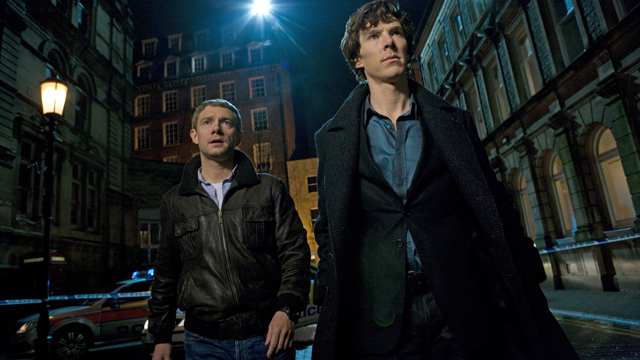
<p><a href="http://www.britishtelevisiondrama.org.uk/wp-content/uploads/2010/08/Sherlock.jpg"><img loading="lazy" decoding="async" class="alignleft size-medium wp-image-632" title="Sherlock: A Study In Pink" src="http://www.britishtelevisiondrama.org.uk/wp-content/uploads/2010/08/Sherlock-300x168.jpg" alt="" width="300" height="168" srcset="http://www.britishtelevisiondrama.org.uk/wp-content/uploads/2010/08/Sherlock-300x168.jpg 300w, http://www.britishtelevisiondrama.org.uk/wp-content/uploads/2010/08/Sherlock.jpg 640w" sizes="auto, (max-width: 300px) 100vw, 300px" /></a></p>
<p>The most impressive thing about <em>A Study in Pink</em>, the brilliant first episode of new series <em>Sherlock</em>, is that, for all the modern-day rebooting and visual invention, its spirit and detail are so faithful to the source work by Sir Arthur Conan Doyle. As in his <em>Doctor Who</em> work, writer Steven Moffat brings a fan’s eye to the strengths and weaknesses of his beloved source material, developing the series format with fellow executive producers Sue Vertue and fellow Holmes and <em>Who</em> expert (and writer of episode 3) Mark Gatiss. <em>A Study in Pink</em> captures the essence of Holmes’s 19th century debut – reworking <em>A Study in Scarlet</em> (1887) and elements of Holmes’s second story, <em>The Sign of Four</em> (1890) – in a package that, with the impressive pace and technique of director Paul McGuigan, makes for one of the 21st century’s sharpest 90 minutes of popular drama to date.</p>{"id":611,"date":"2010-08-03T21:15:29","date_gmt":"2010-08-03T20:15:29","guid":{"rendered":"http:\/\/www.britishtelevisiondrama.org.uk\/?p=611"},"modified":"2024-08-30T11:49:41","modified_gmt":"2024-08-30T10:49:41","slug":"sherlock-a-study-in-pink-2010-and-holmes-on-tv","status":"publish","type":"post","link":"http:\/\/www.britishtelevisiondrama.org.uk\/?p=611","title":{"rendered":"<em>Sherlock<\/em>: <em>A Study in Pink<\/em> (2010) and Holmes on TV"},"content":{"rendered":"<h4>by DAVID ROLINSON<\/h4>\n<p><strong>Writer:<\/strong> Steven Moffat; <strong>Director<\/strong>: Paul McGuigan<\/p>\n<p><a href=\"http:\/\/www.britishtelevisiondrama.org.uk\/wp-content\/uploads\/2010\/08\/Sherlock.jpg\"><img loading=\"lazy\" decoding=\"async\" class=\"alignleft size-medium wp-image-632\" title=\"Sherlock: A Study In Pink\" src=\"http:\/\/www.britishtelevisiondrama.org.uk\/wp-content\/uploads\/2010\/08\/Sherlock-300x168.jpg\" alt=\"\" width=\"300\" height=\"168\" srcset=\"http:\/\/www.britishtelevisiondrama.org.uk\/wp-content\/uploads\/2010\/08\/Sherlock-300x168.jpg 300w, http:\/\/www.britishtelevisiondrama.org.uk\/wp-content\/uploads\/2010\/08\/Sherlock.jpg 640w\" sizes=\"auto, (max-width: 300px) 100vw, 300px\" \/><\/a><\/p>\n<p>The most impressive thing about <em>A Study in Pink<\/em>, the brilliant first episode of new series <em>Sherlock<\/em>, is that, for all the modern-day rebooting and visual invention, its spirit and detail are so faithful to the source work by Sir Arthur Conan Doyle. As in his <em>Doctor Who<\/em> work, writer Steven Moffat brings a fan\u2019s eye to the strengths and weaknesses of his beloved source material, developing the series format with fellow executive producers Sue Vertue and fellow Holmes and <em>Who<\/em> expert (and writer of episode 3) Mark Gatiss. <em>A Study in Pink<\/em> captures the essence of Holmes\u2019s 19th century debut \u2013 reworking <em>A Study in Scarlet<\/em> (1887) and elements of Holmes\u2019s second story, <em>The Sign of Four<\/em> (1890) \u2013 in a package that, with the impressive pace and technique of director Paul McGuigan, makes for one of the 21st century\u2019s sharpest 90 minutes of popular drama to date.<\/p>\n<p><!--more--><\/p>\n<h3>\u2018Not in the canon\u2019: modernity and the limits of iconography<\/h3>\n<p>Critics worrying about modern versions of Holmes are nothing new. Although Moffat and Gatiss are fans of the original sources, they were struck by how the 1940s Holmes films, featuring Basil Rathbone, were \u2018a damn sight more fun than most Sherlock Holmes movies\u2019. Moffat was aware that these were \u2018cheap as chips\u2019 B-movies that fans could see as \u2018a heretical defilement of a sacred text\u2019.<sup id=\"rf1-611\"><a href=\"#fn1-611\" title=\"Steven Moffat, \u2018The fabulous Baker Street boys\u2019, &lt;em&gt;Radio Times&lt;\/em&gt;, 24-30 July 2010, p. 24. We could compare this concern for \u2018heresy\u2019 and fidelity with Moffat and Gatiss\u2019s work on &lt;em&gt;Doctor Who&lt;\/em&gt; and Gatiss\u2019s on a less successful revamp, of &lt;em&gt;Randall and Hopkirk (Deceased)&lt;\/em&gt;. Much of Gatiss\u2019s work, most famously as part of &lt;em&gt;The League of Gentlemen&lt;\/em&gt;, demonstrates his feel for the period.\" rel=\"footnote\">1<\/a><\/sup> From <em>The Voice of Terror<\/em> (1942), the third Rathbone film, onwards, Holmes and Watson are relocated to the Second World War period, but only after a caption almost apologises for time-shifting them, reminding us that they are \u2018ageless, invincible and unchanging\u2019. This could almost be an epigram for <em>A Study in Pink<\/em>. The apology was necessary because critics were already disappointed by adaptations that moved away from period detail and fidelity to Doyle\u2019s originals. However, even a brief study of Holmes on screen can reveal that period detail and fidelity have rarely been central issues.<\/p>\n<p><em>Picturegoer Weekly<\/em> complained that <em>The Speckled Band<\/em> (1931) was \u2018asking for trouble\u2019 by trying to \u2018modernise\u2019 Holmes, because \u2018you cannot divorce Holmes from the period of hansoms and a Baker Street that is long past\u2019.<sup id=\"rf2-611\"><a href=\"#fn2-611\" title=\"Quoted in David Stuart Davies, &lt;em&gt;Starring Sherlock Holmes &lt;\/em&gt;(London: Titan Books, 2001), p. 23.\" rel=\"footnote\">2<\/a><\/sup> David Stuart Davies notes that many reviews of <em>The Missing Rembrandt <\/em>(1932) \u2018made mention of the modernisation of the setting\u2019 as if it \u2018seemed to catch the reviewers unawares\u2019.<sup id=\"rf3-611\"><a href=\"#fn3-611\" title=\"Davies, p. 26.\" rel=\"footnote\">3<\/a><\/sup> However, as Davies replies, \u2018all previous Holmes talkies and most of the silent movies had eschewed the Victorian period for budgetary reasons\u2019.<sup id=\"rf4-611\"><a href=\"#fn4-611\" title=\"Ibid.\" rel=\"footnote\">4<\/a><\/sup> Indeed, Rathbone\u2019s debut, <em>The Hound of the Baskervilles <\/em>(1939), was the first \u2018period\u2019 Holmes. Therefore, updating Holmes is as strong a tradition as attempting fidelity to Holmes\u2019s \u2018proper\u2019 place. But what <em>is<\/em> his &#8216;proper&#8217; place? It may not be a specific time period \u2013 after all, Doyle published new Holmes stories between 1887 and 1927, during which time the world and Doyle\u2019s interests changed \u2013 but an <em>idea<\/em> of period, which took stronger hold after Doyle\u2019s death in 1930.<sup id=\"rf5-611\"><a href=\"#fn5-611\" title=\"Of course, long-running fictional detectives cause problems of unlikely old age for their creators \u2013 Doyle himself restricts Holmes and Watson\u2019s period of activity \u2013 and for their adapters. Television series have creative and practical reasons to format long-running sources into fixed periods: note how &lt;em&gt;Agatha Christie\u2019s Poirot &lt;\/em&gt;(1989-present) condenses Christie\u2019s sources \u2013 which were published between the 1920s and 1970s \u2013 to a Poirot pre-war golden age.\" rel=\"footnote\">5<\/a><\/sup><\/p>\n<div id=\"attachment_622\" style=\"width: 310px\" class=\"wp-caption alignleft\"><a href=\"http:\/\/www.britishtelevisiondrama.org.uk\/wp-content\/uploads\/2010\/08\/HolmesSmoke.png\"><img loading=\"lazy\" decoding=\"async\" aria-describedby=\"caption-attachment-622\" class=\"size-medium wp-image-622\" title=\"HolmesSmoke\" src=\"http:\/\/www.britishtelevisiondrama.org.uk\/wp-content\/uploads\/2010\/08\/HolmesSmoke-300x225.png\" alt=\"\" width=\"300\" height=\"225\" srcset=\"http:\/\/www.britishtelevisiondrama.org.uk\/wp-content\/uploads\/2010\/08\/HolmesSmoke-300x225.png 300w, http:\/\/www.britishtelevisiondrama.org.uk\/wp-content\/uploads\/2010\/08\/HolmesSmoke.png 768w\" sizes=\"auto, (max-width: 300px) 100vw, 300px\" \/><\/a><p id=\"caption-attachment-622\" class=\"wp-caption-text\">Jeremy Brett&#39;s Holmes disappearing into smoke, &#39;The Greek Interpreter&#39;<\/p><\/div>\n<p>Therefore, post-war years see screen versions focus on period iconography which then passes into the popular consciousness. Russell Miller notes how Doyle, early in <em>A Study in Scarlet<\/em>, has \u2018set the blueprint\u2019, with \u2018Victorian London\u2019s murky gaslit cobbled streets swirled in fog, its rattling hansom cabs, its urchins and ragamuffins, and its endless mysteries\u2019.<sup id=\"rf6-611\"><a href=\"#fn6-611\" title=\"Russell Miller, &lt;em&gt;The Adventures of Arthur Conan Doyle &lt;\/em&gt;(London: Harvill Secker, 2008), p. 111.\" rel=\"footnote\">6<\/a><\/sup> Moffat observed that \u2018hundreds of TV and film adaptations\u2019 showed Holmes as \u2018the icon of a bygone age. A lovingly preserved relic; a suitable object for awe; a monolith from ancient times, looming out of the fog.\u2019<sup id=\"rf7-611\"><a href=\"#fn7-611\" title=\"Moffat, p. 23.\" rel=\"footnote\">7<\/a><\/sup> Although Moffat and Gatiss both \u2018loved Victoriana and fogs and melodrama and a nice bit of posh shouting\u2019, they thought \u2018this was not what Sherlock Holmes was meant to be\u2019.<sup id=\"rf8-611\"><a href=\"#fn8-611\" title=\"Ibid, p. 24.\" rel=\"footnote\">8<\/a><\/sup> For Moffat, adaptations rendered Holmes \u2018a period piece\u2019 but Doyle \u2018wasn\u2019t writing a period piece\u2019: <em>The Sign of Four <\/em>doesn\u2019t contain vast \u2018period detail\u2019 because \u2018Doyle was writing fast-paced, contemporary detective thrillers \u2013 he wasn\u2019t wasting time on what you could see from your own window\u2019.<sup id=\"rf9-611\"><a href=\"#fn9-611\" title=\"Ibid.\" rel=\"footnote\">9<\/a><\/sup> Some dramas, therefore, depend too heavily on period iconography. For instance, Matt Frewer\u2019s Sherlock Holmes is quickly established in a Holmesian milieu in <em>The Sign of Four <\/em>(2000) but David Stuart Davies was not alone in despairing at the opening scenes with Holmes walking the street in a Tam O\u2019 Shanter while scraping his violin; for Davies, Frewer&#8217;s <em>The Sign of Four <\/em>improves our sense of Holmes\u2019s abilities when it incorporates \u2018new elements\u2019.<sup id=\"rf10-611\"><a href=\"#fn10-611\" title=\"Davies, p. 179.\" rel=\"footnote\">10<\/a><\/sup> <em>Sherlock<\/em> is keen to stress Holmes\u2019s modernity \u2013 but then, so was Doyle. As Andrew Lycett notes, Doyle builds the \u2018contemporary feel\u2019 of his introduction to Holmes and Watson by flagging them up as Bohemians; furthermore, Doyle often demonstrated \u2018skill at absorbing and reflecting trends, whether literary (Gothicism and sensationalism), cultural (science and its discontents) or social (how two men disport themselves)\u2019.<sup id=\"rf11-611\"><a href=\"#fn11-611\" title=\"Lycett, p. 121.\" rel=\"footnote\">11<\/a><\/sup>. Why shouldn\u2019t future adaptations do what Doyle himself did so often, displaying \u2018the chameleon side of his nature\u2019?<sup id=\"rf12-611\"><a href=\"#fn12-611\" title=\"ibid.\" rel=\"footnote\">12<\/a><\/sup><\/p>\n<p><div id=\"attachment_5291\" style=\"width: 260px\" class=\"wp-caption alignleft\"><img loading=\"lazy\" decoding=\"async\" aria-describedby=\"caption-attachment-5291\" src=\"http:\/\/www.britishtelevisiondrama.org.uk\/wp-content\/uploads\/2015\/10\/BTVD_Sherlock_Crime-Writers-e1444576484197.png\" alt=\"Jeremy Clyde and Michael Cochrane in a scene from &#039;A Scandal in Bohemia&#039; enacted for Crime Writers\" width=\"250\" height=\"206\" class=\"size-full wp-image-5291\" \/><p id=\"caption-attachment-5291\" class=\"wp-caption-text\">Jeremy Clyde and Michael Cochrane in a scene from &#8216;A Scandal in Bohemia&#8217; enacted for <em>Crime Writers<\/em> (1978)<\/p><\/div><br \/>\n<div id=\"attachment_5293\" style=\"width: 260px\" class=\"wp-caption alignleft\"><img loading=\"lazy\" decoding=\"async\" aria-describedby=\"caption-attachment-5293\" src=\"http:\/\/www.britishtelevisiondrama.org.uk\/wp-content\/uploads\/2015\/10\/BTVD_Sherlock_Wilmer-e1444578287606.png\" alt=\"Douglas Wilmer and Nigel Stock in &#039;The Man with the Twisted Lip&#039; (1965)\" width=\"250\" height=\"200\" class=\"size-full wp-image-5293\" \/><p id=\"caption-attachment-5293\" class=\"wp-caption-text\">Douglas Wilmer and Nigel Stock in &#8216;The Man with the Twisted Lip&#8217; (1965)<\/p><\/div><\/p>\n<p>This is not to deny that there are vital elements of Doyle\u2019s Holmes stories that are specific to their time. For Lycett, the \u2018fragile and intriguing creature\u2019 that lay beneath Holmes\u2019s \u2018cerebral exterior\u2019 reflected, amongst other things, the age in which he lived, \u2018in which the certainties of reason were under threat\u2019.<sup id=\"rf13-611\"><a href=\"#fn13-611\" title=\"Andrew Lycett, &lt;em&gt;Conan Doyle: The Man Who Created Sherlock Holmes &lt;\/em&gt;(London: Phoenix, 2008 [Paperback. Original 2007.]), p. 121.\" rel=\"footnote\">13<\/a><\/sup> Locating him in his time period provides a context for his modernity. The Metropolitan Police were only founded in 1828, and major landmarks in the detective thriller genre were still fresh, including Edgar Allan Poe\u2019s <em>The Murders in the Rue Morgue <\/em>(1841) and Wilkie Collins\u2019s <em>The Moonstone <\/em>(1868) which is often seen as the first British detective novel.<sup id=\"rf14-611\"><a href=\"#fn14-611\" title=\"See Miller, pp. 107-109.\" rel=\"footnote\">14<\/a><\/sup> Moffat is right about iconography obscuring Doyle\u2019s achievement, and <em>Sherlock<\/em> superbly returns to Doyle\u2019s spirit \u2013 but several period-based adaptations hold onto period for the same reason of returning to Doyle. Two previous BBC Holmes series of the 1960s saw first Douglas Wilmer and then Peter Cushing battling production circumstances to insist on accuracy and fidelity.<sup id=\"rf15-611\"><a href=\"#fn15-611\" title=\"See Davies, pp. 86-87, 90-91.\" rel=\"footnote\">15<\/a><\/sup> Wilmer&#8217;s insistence on honouring Doyle &#8211; including rewriting scripts himself &#8211; was welcomed, as the <em>Baker Street Journal<\/em> called Wilmer &#8216;quite possibly the best and most accurate Sherlock Holmes ever [&#8230;] the only man who ever got it right&#8217;.<sup id=\"rf16-611\"><a href=\"#fn16-611\" title=\"Quoted in Jonathan McCafferty, &#8216;Douglas Wilmer as Sherlock Holmes&#8217;, in the booklet accompanying the 2015 British Film Institute release of Wilmer&#8217;s &lt;em&gt;Sherlock Holmes&lt;\/em&gt;. Therefore, the surviving Wilmer and Cushing episodes are now available on DVD.\" rel=\"footnote\">16<\/a><\/sup> Then there are dramatisations within documentary series, such as the scenes in <em>Crime Writers<\/em> in which Jeremy Clyde plays Holmes and Michael Cochrane plays Watson; Holmes is placed in his and Doyle&#8217;s contexts to such an extent that Clyde plays Dupin and Raffles in the same episode.<sup id=\"rf17-611\"><a href=\"#fn17-611\" title=\"&lt;em&gt;Crime Writers&lt;\/em&gt;: &#8216;The Great Detective&#8217; (BBC1, 5 November 1978).\" rel=\"footnote\">17<\/a><\/sup> <\/p>\n<p>There are further issues of cultural value at stake: after all, Doyle\u2019s first decade of Holmes writing is \u2018Victorian literature\u2019 but deviations in adaptation are rarely judged as harshly as they are when other Victorian literature is reinterpreted. Indeed, the emphasis on Doyle\u2019s texts in the Granada series (1984-94) was in itself new, as producer Michael Cox convinced executives (who \u2018moaned, \u201cNot corny old Sherlock Holmes again\u201d\u2019) that this was \u2018the exciting genuine article\u2019.<sup id=\"rf18-611\"><a href=\"#fn18-611\" title=\"Davies, p. 122. See Michael Cox memoir, &lt;em&gt;A Study in Celluloid&lt;\/em&gt;.\" rel=\"footnote\">18<\/a><\/sup> Indeed, its early runs including <em>The Adventures of Sherlock Holmes<\/em> (1984-85) and much of <em>The Return of Sherlock Holmes<\/em> (1986-88) are spellbinding, and feature Jeremy Brett as the definitive Holmes (and, with both David Burke and his successor Edward Hardwicke as Watson, the definitive Holmes\/Watson partnership). Avoiding period clich\u00e9 did not have to mean modernising, but could facilitate a return to the text: Brett accepted the role of Holmes when he saw this was \u2018a dark and mysterious character\u2019, and \u2018it wasn\u2019t all pipes and deerstalkers\u2019.<sup id=\"rf19-611\"><a href=\"#fn19-611\" title=\"Davies, p. 122.\" rel=\"footnote\">19<\/a><\/sup> Cushing insisted that \u2018I never had a Meerschaum\u2019 pipe because it\u2019s \u2018not in the canon\u2019 but was used by William Gillette on stage.<sup id=\"rf20-611\"><a href=\"#fn20-611\" title=\"Davies, p. 91.\" rel=\"footnote\">20<\/a><\/sup> Other parts of his popular image derived more from Sidney Paget\u2019s illustrations than Doyle\u2019s prose. The Granada series had a production bible on minor details taken from Doyle\u2019s text, but it\u2019s ironic that one reason this was useful was to keep on top of Doyle\u2019s mistakes! Doyle\u2019s own prose was \u2018riddled with glaring errors and inconsistencies\u2019 because his stories were often \u2018churned out carelessly\u2019.<sup id=\"rf21-611\"><a href=\"#fn21-611\" title=\"Miller, p. 146.\" rel=\"footnote\">21<\/a><\/sup> From snakes with improbable hearing and milk-drinking capacities to seemingly getting Watson\u2019s first name wrong<sup id=\"rf22-611\"><a href=\"#fn22-611\" title=\"\u2018The Man With the Twisted Lip\u2019 and \u2018The Adventure of the Speckled Band\u2019 respectively. Many publications and fan websites try to smooth over problematic details such as John Watson being suddenly addressed as \u2018James\u2019.\" rel=\"footnote\">22<\/a><\/sup> , Doyle seemed not to \u2018keep track of what he had written\u2019 because, according to Miller, \u2018although he earned large sums of money, he cared little for the work that did little, he believed, to enhance his literary stature\u2019.<sup id=\"rf23-611\"><a href=\"#fn23-611\" title=\"Ibid, p. 147.\" rel=\"footnote\">23<\/a><\/sup> Doyle at one point argued that \u2018In short stories it has always seemed to me that so long as you produce your dramatic effect, accuracy of detail matters little.\u2019<sup id=\"rf24-611\"><a href=\"#fn24-611\" title=\"Ibid, p. 147.\" rel=\"footnote\">24<\/a><\/sup><\/p>\n<div id=\"attachment_646\" style=\"width: 200px\" class=\"wp-caption alignleft\"><a href=\"http:\/\/www.britishtelevisiondrama.org.uk\/wp-content\/uploads\/2010\/08\/MurderRooms.jpg\"><img loading=\"lazy\" decoding=\"async\" aria-describedby=\"caption-attachment-646\" src=\"http:\/\/www.britishtelevisiondrama.org.uk\/wp-content\/uploads\/2010\/08\/MurderRooms.jpg\" alt=\"\" title=\"MurderRooms\" width=\"190\" height=\"148\" class=\"size-full wp-image-646\" \/><\/a><p id=\"caption-attachment-646\" class=\"wp-caption-text\">A younger Doyle\/Holmes - the brilliant Murder Rooms<\/p><\/div>\n<p>Longevity has necessarily led many to seek \u2018new\u2019 ways of doing Holmes, from the darker approach \u2013 see <em>Murder By Decree<\/em> (1979) written by John Hopkins \u2013 to the comedic, including N. F. Simpson\u2019s <em>Elementary, My Dear Watson<\/em> (1973) to Billy Wilder\u2019s lovely <em>The Private Life of Sherlock Holmes<\/em> (1969), on which Wilder aimed to treat Holmes and Watson \u2018with respect but not reverence\u2019.<sup id=\"rf25-611\"><a href=\"#fn25-611\" title=\"Davies, p. 93. See Davies on the vogue for very different interpretations of Holmes throughout the 1970s.\" rel=\"footnote\">25<\/a><\/sup> Whether because the early Bretts are intimidatingly definitive or because of institutional drifts from adaptation, modern British programme makers struggle to sell period versions. An interesting precursor to <em>Sherlock<\/em> came with David Pirie\u2019s approach to the BBC in 1999 to tackle <em>A Study in Scarlet<\/em> \u2018because I felt that a younger, more \u201cOscar Wilde\u201d Holmes had never been done\u2019 and an \u2018older\u2019 or \u2018stodgier\u2019 Holmes had unfairly dominated.<sup id=\"rf26-611\"><a href=\"#fn26-611\" title=\"Davies, p. 176.\" rel=\"footnote\">26<\/a><\/sup> David M. Thompson of BBC Films rejected the idea of doing Holmes but in search of a new angle proposed something on Doyle\u2019s inspiration Dr. Joseph Bell, resulting in <em>Murder Rooms: the Dark Beginnings of Sherlock Holmes<\/em> (2000-2001) which paired Bell with Doyle. The brilliant, successful and mysteriously-cancelled <em>Murder Rooms<\/em> showed that new angles could still emphasise Doyle\u2019s achievements.<\/p>\n<div id=\"attachment_614\" style=\"width: 310px\" class=\"wp-caption alignleft\"><a href=\"http:\/\/www.britishtelevisiondrama.org.uk\/wp-content\/uploads\/2010\/08\/Sherlock22nd.jpg\"><img loading=\"lazy\" decoding=\"async\" aria-describedby=\"caption-attachment-614\" class=\"size-medium wp-image-614\" title=\"Sherlock22nd\" src=\"http:\/\/www.britishtelevisiondrama.org.uk\/wp-content\/uploads\/2010\/08\/Sherlock22nd-300x225.jpg\" alt=\"\" width=\"300\" height=\"225\" srcset=\"http:\/\/www.britishtelevisiondrama.org.uk\/wp-content\/uploads\/2010\/08\/Sherlock22nd-300x225.jpg 300w, http:\/\/www.britishtelevisiondrama.org.uk\/wp-content\/uploads\/2010\/08\/Sherlock22nd.jpg 480w\" sizes=\"auto, (max-width: 300px) 100vw, 300px\" \/><\/a><p id=\"caption-attachment-614\" class=\"wp-caption-text\">Future visions: Sherlock Holmes in the 22nd Century<\/p><\/div>\n<div id=\"attachment_616\" style=\"width: 260px\" class=\"wp-caption alignleft\"><a href=\"http:\/\/www.britishtelevisiondrama.org.uk\/wp-content\/uploads\/2010\/08\/SherlockHound.jpg\"><img loading=\"lazy\" decoding=\"async\" aria-describedby=\"caption-attachment-616\" class=\"size-full wp-image-616\" title=\"SherlockHound\" src=\"http:\/\/www.britishtelevisiondrama.org.uk\/wp-content\/uploads\/2010\/08\/SherlockHound.jpg\" alt=\"\" width=\"250\" height=\"188\" \/><\/a><p id=\"caption-attachment-616\" class=\"wp-caption-text\">Faithful Holmes: Sherlock Hound<\/p><\/div>\n<p>For those who decide that the best way to update Holmes is to literally move him into the modern world, there are many potential pitfalls. Time travel or thawing out a cryogenically-frozen Holmes results in the <em>Adam Adamant Lives!<\/em> (1966-67)-type spectacle of an adventurer from the past attempting to use their methods in the modern world, as in <em>The Return of Sherlock Holmes<\/em> (1987) or <em>1994 Baker Street: Sherlock Holmes Returns<\/em> (1993), or the future, as in the animated <em>Sherlock Holmes in the 22nd Century<\/em> which shares with <em>Sherlock<\/em> a desire to revision his stories (1999-2001). Revisioning can also take in different species, as in the surprisingly canon-respecting canine capers of <em>Sherlock Hound<\/em> (1984).<sup id=\"rf27-611\"><a href=\"#fn27-611\" title=\"Again, see Davies.\" rel=\"footnote\">27<\/a><\/sup> Even less apparently outlandish versions see Holmes grasping modern technology: Holmes uses a pocket radio in <em>The Isolated House<\/em> (1914), has an intercom and records conversations in his office in <em>The Speckled Band<\/em> (1931) and even gets involved with a car-immobilising ray in <em>Sherlock Holmes<\/em> (1924). The wartime propaganda service of Rathbone\u2019s Holmes involves a world of Nazis, fast cars and varying technology in several films. David Stuart Davies&#8217;s book <em>Starring Sherlock Holmes<\/em> provides an excellent overview of these and many other productions.<\/p>\n<blockquote>\n<p>&#8216;There is nothing new under the sun. It has all been done before.\u2019 &#8211; Sherlock Holmes, <em>A Study in Scarlet<\/em><sup id=\"rf28-611\"><a href=\"#fn28-611\" title=\"Arthur Conan Doyle, \u2018A Study in Scarlet\u2019, &lt;em&gt;The Complete Illustrated \u2018Strand\u2019&lt;\/em&gt;, p. 21.\" rel=\"footnote\">28<\/a><\/sup><\/p>\n<\/blockquote>\n<p><em>Sherlock<\/em> is packed with modern technology and updated iconography, but their effect is not anachronistic but is in keeping with Doyle: not simply by playful in-jokes (although there are some) but by sharing Doyle\u2019s ability to put detail at service of character. So telegrams, letters and newspaper small ads give way to smartphones and texts, phone apps replace some text books and Holmes\u2019s smoking his way through a \u2018three-pipe problem\u2019 is thwarted by modern London and becomes a three-nicotine-patch problem. Watson\u2019s romantic write-ups for the <em>Strand<\/em> become an online blog which, embracing the meta-potential of new delivery platforms is available for all at <a href=\"http:\/\/www.johnwatsonblog.co.uk\" target=\"_self\" rel=\"noopener\">John Watson Blog<\/a>. Holmes\u2019s monographs become websites, such as another available at <a href=\"http:\/\/www.thescienceofdeduction.co.uk\" target=\"_self\" rel=\"noopener\">The Science of Deduction<\/a>, which appropriately attracts some odd followers \u2013 quite appropriately for Holmes, given that policeman Athelney Jones greets him as \u2018Mr. Theorist\u2019 in <em>The Sign of Four<\/em>.<sup id=\"rf29-611\"><a href=\"#fn29-611\" title=\"Doyle, pp. 81-82.\" rel=\"footnote\">29<\/a><\/sup> Holmes uses a mobile phone, but he insists on texting rather than calling people, which is in keeping with his nature as defined by Doyle (and Watson) and the rendering of his texts on-screen underlines how oddly appropriate modern communication like texts and Twitter are, given the pre-eminence of the written word. Tie-in websites aren\u2019t always particularly essential, but in this case it\u2019s excellent to see such interactivity applied to concepts from Doyle.<\/p>\n<p>It seems to be missing the point, therefore, to see <em>Sherlock<\/em>\u2019s updating as a weak spot, as <a href=\"http:\/\/www.guardian.co.uk\/tv-and-radio\/2010\/jul\/26\/sherlock-orchestra-united-tv-review\" target=\"_self\" rel=\"noopener\">the <em>Guardian<\/em>\u2019s reviewer<\/a> did, arguing that \u2018in blowing away the fog, brightening it up for the 21st century, they&#8217;ve done away with the fear as well. It&#8217;s slick, and quick, and yes, compelling. But there&#8217;s also a sanity about it, a pantomime squeaky-cleanness.\u2019<sup id=\"rf30-611\"><a href=\"#fn30-611\" title=\"The review is very positive about the characterisation. Sam Wollaston, &#8216;TV review: Sherlock and Orchestra United&#8217;, &lt;em&gt;The Guardian&lt;\/em&gt;, 26 July 2010.\" rel=\"footnote\">30<\/a><\/sup> Although the reviewer is positive in other ways, it&#8217;s a little unfair to compare the episode with Doyle\u2019s \u2018The [Adventure of the] Speckled Band\u2019, given that Doyle himself cited that as his favourite story.<sup id=\"rf31-611\"><a href=\"#fn31-611\" title=\"Lycett, p. 268.\" rel=\"footnote\">31<\/a><\/sup> The review risks taking one type of Holmes story and essentialising it as his fixed approach (when Doyle actually differentiated them, hence \u2018Adventure of\u2019, \u2018Mystery of\u2019), underestimating Doyle\u2019s own sense of pace and fun and the way that Moffat builds a sense of darkness that is more complex than the usual over-reliance on fog machines or grisly deaths. Indeed, Watson defines his practice in \u2018The Adventure of the Solitary Cyclist\u2019: his selections \u2018give preference to those cases which derive their interest not so much from the brutality of the crime as from the ingenuity and dramatic quality of the solution\u2019.<sup id=\"rf32-611\"><a href=\"#fn32-611\" title=\"Doyle, p. 599.\" rel=\"footnote\">32<\/a><\/sup> A better comparison would be with <em>A Study in Scarlet<\/em> \u2013 and it\u2019s a comparison that makes <em>A Study in Pink<\/em> even more impressive.<\/p>\n<h3>\u2018Nothing happens to me\u2019: studies in pink and scarlet<\/h3>\n<p><em>A Study in Scarlet<\/em> was the first Holmes story written and published, and through Watson\u2019s prose we experience Holmes and his methods through their first meeting \u2013 however, despite being the subject of the first full-length Holmes adaptation in 1914, it is rarely adapted, and hardly ever with their meeting scene intact. It was written quickly during March and April 1886<sup id=\"rf33-611\"><a href=\"#fn33-611\" title=\"It is often said to have been written over six weeks, although Lycett thinks it may have been finished as early as 11 April. Lycett, p. 123.\" rel=\"footnote\">33<\/a><\/sup> , but Doyle found the story difficult to sell, and it eventually appeared in <em>Beeton\u2019s Christmas Annual<\/em> in December 1887.<sup id=\"rf34-611\"><a href=\"#fn34-611\" title=\"See Miller, pp. 110-114.\" rel=\"footnote\">34<\/a><\/sup> Although it and its follow-up <em>The Sign of Four<\/em> were successful, it was the episodic short stories in the <em>Strand<\/em>, illustrated by Sidney Paget, that cemented Holmes as a household name and form the basis of many adaptations. This essay is long enough without trying to give an overview of Holmes\u2019s long career on film and television<sup id=\"rf35-611\"><a href=\"#fn35-611\" title=\"For a brief list of Holmes\u2019s television career before &lt;em&gt;Sherlock&lt;\/em&gt;, see sites such as &lt;a href=&quot;http:\/\/www.sherlock-holmes.org.uk\/world\/television.php&quot; target=&quot;_self&quot; rel=&quot;noopener&quot;&gt;.\" rel=\"footnote\">35<\/a><\/sup> but it&#8217;s worth considering why visual media have so rarely tackled <em>A Study in Scarlet<\/em>. Partly it\u2019s difficult to replicate the newness of a debut: as Michael Atkinson put it, \u2018How utterly peculiar Sherlock Holmes must have seemed to those unprepared readers\u2019, for whom \u2018the traits that are now familiar, even endearing\u2019 would have seemed \u2018alternately intriguing and appalling \u2013 and eminently mysterious.\u2019<sup id=\"rf36-611\"><a href=\"#fn36-611\" title=\"Michael Atkinson, &lt;em&gt;The Secret Marriage of Sherlock Holmes and Other Eccentric Readings&lt;\/em&gt; (Ann Arbor: University of Michigan Press, 1998 [Paperback. Original 1996.]), p. 65.\" rel=\"footnote\">36<\/a><\/sup> Moreover, there are weaknesses in the plot: <em>Sherlock<\/em> gets around these in various ways, but even its widespread changes are achieved in a way that singles out some of the original\u2019s most impressive ideas and moments and makes them more central than Doyle did.<\/p>\n<p><a href=\"http:\/\/www.britishtelevisiondrama.org.uk\/wp-content\/uploads\/2010\/08\/SherlockWatsonWall.png\"><img loading=\"lazy\" decoding=\"async\" class=\"size-medium wp-image-617\" title=\"SherlockWatsonWall\" src=\"http:\/\/www.britishtelevisiondrama.org.uk\/wp-content\/uploads\/2010\/08\/SherlockWatsonWall-300x230.png\" alt=\"\" width=\"300\" height=\"230\" srcset=\"http:\/\/www.britishtelevisiondrama.org.uk\/wp-content\/uploads\/2010\/08\/SherlockWatsonWall-300x230.png 300w, http:\/\/www.britishtelevisiondrama.org.uk\/wp-content\/uploads\/2010\/08\/SherlockWatsonWall.png 750w\" sizes=\"auto, (max-width: 300px) 100vw, 300px\" \/><\/a><\/p>\n<div id=\"attachment_617\" style=\"width: 310px\" class=\"wp-caption alignleft\"><\/dt>\n<dd class=\"wp-caption-dd\">Nothing happens: Watson<\/dd>\n<\/dl>\n<\/div>\n<p><em>A Study in Pink<\/em> opens with Watson having nightmares about his war service in Afghanistan, illustrated by images of modern warfare: although the <em>Radio Times<\/em> thought this a new development, Doyle&#8217;s <em>A Study in Scarlet<\/em> opens with Watson\u2019s account of how his service in Afghanistan brought him \u2018misfortune and disaster\u2019.<sup id=\"rf37-611\"><a href=\"#fn37-611\" title=\"Doyle, p. 11.\" rel=\"footnote\">37<\/a><\/sup> Whereas Watson\u2019s first-person narration allows Doyle to describe having \u2018my health irretrievably ruined\u2019, which \u2018forebade me from venturing out\u2019 and left him \u2018a lonely man\u2019 in the \u2018great wilderness\u2019 of \u2018cesspool\u2019 London, director Paul McGuigan makes similar points about Watson\u2019s low spirits through dissolves compressing mundane time in his sparse accommodation.<sup id=\"rf38-611\"><a href=\"#fn38-611\" title=\"Doyle, p. 11, except \u2018forebade me from venturing out\u2019, p. 15.\" rel=\"footnote\">38<\/a><\/sup> That repetition captures Watson\u2019s description in the novel of the \u2018monotony of my daily existence\u2019.<sup id=\"rf39-611\"><a href=\"#fn39-611\" title=\"Doyle, p. 15.\" rel=\"footnote\">39<\/a><\/sup> Composed against walls, he is adrift in empty frames, particularly in his meeting with his therapist, in which he says of his life: \u2018Nothing happens to me.\u2019 It may seem surprising to end the pre-titles with this moment (echoes of <em>Crazy Like A Fox<\/em>\u2019s title sequence \u2013 \u2018What could possibly happen?\u2019 \u2013 we can leave to my overactive nerdometer) rather than, say, the melodramatic but mysterious addition to the 1968 Cushing <em>A Study in Scarlet<\/em> (an unseen figure taking the wedding ring, a subsequent clue, from the body of an as-yet-unidentified woman) or the mysterious deaths which follow <em>A Study in Pink<\/em>\u2019s opening titles.<sup id=\"rf40-611\"><a href=\"#fn40-611\" title=\"&lt;em&gt;Sir Arthur Conan Doyle\u2019s Sherlock Holmes&lt;\/em&gt;: \u2018A Study in Scarlet\u2019, tx. 23 September 1968. The story was dramatised by Hugh Leonard.\" rel=\"footnote\">40<\/a><\/sup> However, the Watson sequence is vital: as in Doyle, Watson\u2019s state of mind drives much of what follows. McGuigan\u2019s compositions make a point familiar from Doyle\u2019s prose: Watson, worrying that the reader might think him a \u2018hopeless busybody\u2019 for his interest in Holmes, says:<\/p>\n<blockquote>\n<p>Before pronouncing judgement, however, be it remembered how objectless was my life, and how little there was to engage my attention. [\u2026] I eagerly hailed the little mystery which hung around my companion.<sup id=\"rf41-611\"><a href=\"#fn41-611\" title=\"Doyle, p. 15.\" rel=\"footnote\">41<\/a><\/sup><\/p>\n<\/blockquote>\n<p>With Watson \u2018leading a comfortless, meaningless existence\u2019, he has everything to gain. Martin Freeman combines an understated mournfulness with an eye for the moments when Watson sparkles. He shares that with David Burke and Edward Hardwicke from the Granada series (and, slightly out of our jurisdiction, Michael Williams\u2019s excellent characterisation in the BBC radio series), which stand as excellent examples of getting Watson right. Getting Watson wrong is often associated with the famous performance of Nigel Bruce, which is unfair on Bruce in that the Bruce \u2018silly ass\u2019 Watson is tied to the actor\u2019s screen persona and the cinematic tone of its times, which shape other versions in different ways. There are worse Watsons than Bruce, but the general idea that it\u2019s hard to imagine a genius like Holmes sharing adventures with such a crass blunderer has become a yardstick for judging Watsons. After all, in Doyle\u2019s writing, Watson\u2019s everyman observation and Doyle\/Watson\u2019s prose grounds Holmes\u2019s activities, as was marked by Doyle arriving at the name (after considering Ormond Sacker)<sup id=\"rf42-611\"><a href=\"#fn42-611\" title=\"See Doyle\u2019s letters for his draft document, p. 245.\" rel=\"footnote\">42<\/a><\/sup> because, as Lycett puts it, \u2018like his monicker, he was anonymous \u2013 a foil\u2019 to Holmes<sup id=\"rf43-611\"><a href=\"#fn43-611\" title=\"Lycett, p. 119.\" rel=\"footnote\">43<\/a><\/sup>. Turning Watson into a character rather than narrator loses much: just as trying to \u2018read as Watson reads is to appreciate Conan Doyle\u2019s craft\u2019, and to become \u2018aware that there is something about the genius of the creator that always eludes us\u2019<sup id=\"rf44-611\"><a href=\"#fn44-611\" title=\"Atkinson, p. 12.\" rel=\"footnote\">44<\/a><\/sup> , so we can look between the lines of Watson\u2019s first-person prose for a sense of his motivations. A few adaptations have reflected his damaged past, and how Holmes and Watson gain from each other, but <em>A Study in Pink<\/em> foregrounds it.<\/p>\n<p>After witnessing a series of mysterious deaths involving pills, and realising that they are random (but with the mystery being present not in potential suspects \u2013 as in the Cushing version\u2019s largely faithful dramatisation of Doyle<sup id=\"rf45-611\"><a href=\"#fn45-611\" title=\"\u2018A Study in Scarlet\u2019, 1968.\" rel=\"footnote\">45<\/a><\/sup> \u2013 but in a sense of something happening just outside the frame of each incident, which is confirmed by explanatory flashbacks later). Stangerson, Drebber, Charpentier, Utah: inter-related aspects from Doyle that are replaced by this seemingly random killer \u2013 I\u2019ll come back to their absence, and Moffat\u2019s alternatives, later.<\/p>\n<p>Foregrounding Holmes and Watson involves a sequence of events that have hardly ever been dramatised: realising Watson needs someone to share accommodation with, Stamford takes him to meet Sherlock Holmes, who is experimenting at St Bartholomew\u2019s Hospital. For a long time, \u2018the only filmed version of the meeting\u2019 at Bart\u2019s came in the 1953\/54 Guild Films series starring Ronald Howard, and even then in a different pilot, \u2018The Case of the Cunningham Heritage\u2019.<sup id=\"rf46-611\"><a href=\"#fn46-611\" title=\"Davies, p. 77.\" rel=\"footnote\">46<\/a><\/sup> Holmes has already chronically misread a woman\u2019s desire for coffee, condescendingly assuming she was offering to get him one: quite consistent with <em>The Sign of Four<\/em>, when Watson as ever notices that a woman was attractive and Holmes replies, \u2018Is she? I did not observe\u2019, leading Watson to consider him \u2018positively inhuman [\u2026] an automaton \u2013 a calculating machine\u2019<sup id=\"rf47-611\"><a href=\"#fn47-611\" title=\"Doyle, p. 69.\" rel=\"footnote\">47<\/a><\/sup> Holmes observes \u2013 her changing lipstick in his presence \u2013 but does not deduce. He is instead battering a corpse with a stick, as in Doyle\u2019s original, whose influences include Joseph Bell\u2019s 1839 paper on medical jurisprudence which \u2018described beating corpses with a heavy stick in order to study the effects of bruises produced after death\u2019<sup id=\"rf48-611\"><a href=\"#fn48-611\" title=\"Miller, p. 52.\" rel=\"footnote\">48<\/a><\/sup> or Christison\u2019s intervention into the Burke and Hare case. That latter investigation into \u2018suffocating [&#8230;] victims without damaging them physically\u2019 used \u2018experiments into the bruising of corpses&#8217; which &#8216;helped secure Burke\u2019s conviction\u2019.<sup id=\"rf49-611\"><a href=\"#fn49-611\" title=\"Lycett, pp. 50-51.\" rel=\"footnote\">49<\/a><\/sup> When Watson meets Holmes, he is enthralled by the same thing as us: Holmes\u2019s instant deductions.<\/p>\n<h3>The \u2018best superpower ever\u2019: deductions<\/h3>\n<blockquote>\n<p>\u2018Sometimes you can\u2019t read fast enough \u2013 but I\u2019ll tell you what, it wasn\u2019t the gaslight; it wasn\u2019t the hansom cabs or the fogs or any of the things I\u2019d be told, years later, were SO important to Sherlock Holmes. It was the deductions. No, that\u2019s too dull a word. Let\u2019s call it what it was when I was ten. It was the best superpower ever! Sherlock Holmes glanced at Dr Watson and deduced he\u2019d been to Afghanistan \u2013 and, talk about superpowers, Arthur Conan Doyle made me wait pages to find out how he\u2019d done it.\u2019 &#8211; Moffat.<sup id=\"rf50-611\"><a href=\"#fn50-611\" title=\"Moffat, p. 22.\" rel=\"footnote\">50<\/a><\/sup><\/p>\n<\/blockquote>\n<p>Depictions of Holmes stand and fall by the quality of Holmes\u2019s deductions: the reading of clues (or semiotics \u2013 \u2018the study of signs in a social context\u2019).<sup id=\"rf51-611\"><a href=\"#fn51-611\" title=\"Lycett, p. 123.\" rel=\"footnote\">51<\/a><\/sup> The modern-day setting seems to present greater challenges to the dramatist \u2013 even Doyle was stretching credulity by taking Joseph Bell\u2019s real-life ability to note where patients had been owing to types of clay on their shoes in a small part of Edinburgh and extending that to the whole of London, a credulity which Nigel Williams relates to the reassurance implicit in containing this sprawling city.<sup id=\"rf52-611\"><a href=\"#fn52-611\" title=\"\u2018Sherlock Holmes and the Visionary Doctor\u2019, &lt;em&gt;The Great Detectives&lt;\/em&gt;, tx. BBC2, 16 May 1999.\" rel=\"footnote\">52<\/a><\/sup> The gentlemen and ladies of Doyle\u2019s London could often be traced by markers of individuality marginalised or lost in an age of mass production: specially-made hats, distinctive cigar ash, the re-soling of boots. There are signs here and in episode 2 that some can simply be updated: identifying an airline pilot by his left thumb or an IT designer by their tie (or, during <em>A Study in Pink<\/em>, \u2018something in the media\u2019 from garish nail varnish). However, comparing <em>A Study in Scarlet<\/em> with <em>A Study in Pink<\/em>, Moffat\u2019s Holmes is at least as compelling at deduction, and in places sharper. Holmes\u2019s observation that Watson was in Afghanistan, a vital deduction since it intrigues Watson, is problematic in Doyle\u2019s original. Miller argues that \u2018it hardly stands up to much scrutiny\u2019 with Watson deduced as an army doctor because he is \u2018a gentleman of the military type, but with the air of a military man\u2019, but those deductions aren&#8217;t explained further.<sup id=\"rf53-611\"><a href=\"#fn53-611\" title=\"Miller, p. 112.\" rel=\"footnote\">53<\/a><\/sup> Jumping from Watson holding his arm \u2018in a stiff and unnatural manner\u2019, via his tan, Holmes identifies Afghanistan rather than (as Miller suggests) South Africa. In <em>A Study in Pink<\/em>, we can at least join the deduction, informed by Watson\u2019s haircut, his comment to Stratford and his leaning against a stick \u2013 indeed, the way he leans against that stick attracts a diagnosis of psychosomatic illness which is not only plausible but vital: it\u2019s all the more intriguing for Watson if Holmes has glimpsed some secret, especially if Watson himself isn\u2019t yet aware of it. He must be won round; he&#8217;s more overtly critical in the book, describing Holmes developing \u2018the theory of some arm-chair lounger who evolves all these neat little paradoxes in the seclusion of his own study\u2019<sup id=\"rf54-611\"><a href=\"#fn54-611\" title=\"Doyle, p. 17.\" rel=\"footnote\">54<\/a><\/sup><\/p>\n<blockquote>\n<p>\u2018I\u2019m not a psychopath, Anderson, I\u2019m a high-functioning sociopath \u2013 do your research.\u2019 &#8211; Sherlock, <em>A Study in Pink<\/em><\/p>\n<\/blockquote>\n<p><a href=\"http:\/\/www.britishtelevisiondrama.org.uk\/wp-content\/uploads\/2010\/08\/CushingScarlet.png\"><img loading=\"lazy\" decoding=\"async\" aria-describedby=\"caption-attachment-617\" class=\"size-medium wp-image-631\" title=\"CushingScarlet\" src=\"http:\/\/www.britishtelevisiondrama.org.uk\/wp-content\/uploads\/2010\/08\/CushingScarlet-300x225.png\" alt=\"\" width=\"300\" height=\"225\" srcset=\"http:\/\/www.britishtelevisiondrama.org.uk\/wp-content\/uploads\/2010\/08\/CushingScarlet-300x225.png 300w, http:\/\/www.britishtelevisiondrama.org.uk\/wp-content\/uploads\/2010\/08\/CushingScarlet.png 768w\" sizes=\"auto, (max-width: 300px) 100vw, 300px\" \/><\/a><p id=\"caption-attachment-617\" class=\"wp-caption-text\">Gregson, Watson and Lestrade near &#39;rache&#39; in the Cushing Holmes version of A Study in Scarlet (1968)<\/p><\/div>\n<p>Our first crime scene shows the story\u2019s mixture of respect and playfulness. The female victim here is in a similar position to male victim Drebber in <em>A Study in Scarlet<\/em>: the bare room, the scrawled \u2018rache\u2019, the significant wedding ring. However, the cigar ash and mysterious blood are removed, and moments that Doyle did not develop \u2013 analysis of the body itself, or the \u2018rache\u2019 detail that is ultimately a red herring \u2013 are now developed. \u2018Rache\u2019 is not helpfully scratched by the killer on the wall at his own height but is scratched on the ground by the victim. Holmes\u2019s disagreement with the police over \u2018rache\u2019 is inverted \u2013 this time he dismisses the German translation for revenge in favour of Rachel \u2013 and the wedding ring, rather than fortuitously falling from the body (an indictment of a clumsy killer and incompetent police), is the victim\u2019s ring. The ring leads clues about her character \u2013 these are dazzlingly compiled in quick bursts of text on the screen, culminating in the brutal labelling (Holmes\u2019s mind) of the corpse: \u2018serial adulterer\u2019 (a later character will similarly be labelled \u2018DYING\u2019). In truth, Doyle had not yet developed Holmes\u2019s deductive powers to their later extent: much is explained via a simple telegram researching names found on the body, the killer helpfully not changing their name, and details filled in by the killer\u2019s lengthy backstory. In place of luck and the killer\u2019s mistakes, Moffat\u2019s crime scene provides clues, some deduced by Holmes (her lifestyle and clothing provoking awareness of absent items), and some provided by the victim. When dog cart splashes are replaced by pink suitcase tracks, and that item is found to be missing, we are into playfulness: Holmes and Watson are immediately onto <em>a case<\/em>. Whilst Doyle named his story after a turn of phrase, the \u2018scarlet thread of murder\u2019,<sup id=\"rf55-611\"><a href=\"#fn55-611\" title=\"Doyle, p. 26.\" rel=\"footnote\">55<\/a><\/sup> <em>A Study in Pink<\/em> shows Holmes studying pink.<\/p>\n<div id=\"attachment_636\" style=\"width: 310px\" class=\"wp-caption alignleft\"><a href=\"http:\/\/www.britishtelevisiondrama.org.uk\/wp-content\/uploads\/2010\/08\/SherlockRache.png\"><img loading=\"lazy\" decoding=\"async\" aria-describedby=\"caption-attachment-636\" class=\"size-medium wp-image-636\" title=\"SherlockRache\" src=\"http:\/\/www.britishtelevisiondrama.org.uk\/wp-content\/uploads\/2010\/08\/SherlockRache-300x168.png\" alt=\"\" width=\"300\" height=\"168\" srcset=\"http:\/\/www.britishtelevisiondrama.org.uk\/wp-content\/uploads\/2010\/08\/SherlockRache-300x168.png 300w, http:\/\/www.britishtelevisiondrama.org.uk\/wp-content\/uploads\/2010\/08\/SherlockRache.png 1024w\" sizes=\"auto, (max-width: 300px) 100vw, 300px\" \/><\/a><p id=\"caption-attachment-636\" class=\"wp-caption-text\">Options suggest themselves...<\/p><\/div>\n<p>We are told in Doyle&#8217;s <em>A Study in Scarlet<\/em>: \u2018So swiftly was the examination made, that one would hardly have guessed the minuteness with which it was conducted\u2019.<sup id=\"rf56-611\"><a href=\"#fn56-611\" title=\"Doyle, p. 21.\" rel=\"footnote\">56<\/a><\/sup> To show the minuteness of the crime scene examination, <em>A Study in Pink<\/em> moves into a different time register, akin to the \u2018bullet time\u2019 in which movies slow action scenes to concentrate on detail. In print, Holmes\u2019s deductions are seen through Watson\u2019s eyes: Watson notes Holmes\u2019s behaviour, notes deviations from standard behaviour (albeit sometimes with helpful observations of Holmes deviating from his own standard behaviour), but presents us with conclusions with the step inbetween left hazy until later. It\u2019s difficult to portray on screen without Watson seeming stupid (merely by asking the questions we\u2019re asking or making credible suggestions), with the occasional solution of Watson helping to apply Holmes\u2019s methods. Through graphics, the relative cleanliness of the inside and outside of the wedding ring first produce observations (clean, dirty) then deductions about their wearer\u2019s marital state. In <a href=\"http:\/\/www.independent.co.uk\/arts-entertainment\/tv\/reviews\/the-weekends-tv-sherlock-sun-bbc1bramish-worlds-squarest-teenagers-sun-channel-4-2035302.html\" target=\"_self\" rel=\"noopener\">Tom Sutcliffe\u2019s phrase<\/a>, Sherlock \u2018visualised his thought processes [\u2026] so that his inspirations tag the crime scene like an internet word cloud\u2019.<sup id=\"rf57-611\"><a href=\"#fn57-611\" title=\"Tom Sutcliffe, &#8216;The Weekend&#8217;s TV: Sherlock, Sun, BBC1 Amish: World&#8217;s Squarest Teenagers, Sun, Channel 4&#8217;, &lt;em&gt;The Independent&lt;\/em&gt;, 26 July 2010.\" rel=\"footnote\">57<\/a><\/sup><\/p>\n<div id=\"attachment_638\" style=\"width: 310px\" class=\"wp-caption alignleft\"><a href=\"http:\/\/www.britishtelevisiondrama.org.uk\/wp-content\/uploads\/2010\/08\/SherlockData.png\"><img loading=\"lazy\" decoding=\"async\" aria-describedby=\"caption-attachment-638\" class=\"size-medium wp-image-638\" title=\"SherlockData\" src=\"http:\/\/www.britishtelevisiondrama.org.uk\/wp-content\/uploads\/2010\/08\/SherlockData-300x168.png\" alt=\"\" width=\"300\" height=\"168\" srcset=\"http:\/\/www.britishtelevisiondrama.org.uk\/wp-content\/uploads\/2010\/08\/SherlockData-300x168.png 300w, http:\/\/www.britishtelevisiondrama.org.uk\/wp-content\/uploads\/2010\/08\/SherlockData.png 1024w\" sizes=\"auto, (max-width: 300px) 100vw, 300px\" \/><\/a><p id=\"caption-attachment-638\" class=\"wp-caption-text\">From observation to deduction...<\/p><\/div>\n<p>Far from being gimmicky, the graphics interact not only with characterisation \u2013 Holmes\u2019s head-shaking dismissing the rache\/revenge angle by shaking it off the screen \u2013 but also with shots and compositions. Visual pleasure in Holmes can be a thorny subject: for instance, the Granada series declined when the production team was instructed to \u2018cut out the talk and concentrate on the visuals\u2019.<sup id=\"rf58-611\"><a href=\"#fn58-611\" title=\"Davies, p. 172.\" rel=\"footnote\">58<\/a><\/sup> Detail, pace and character make the deduction scenes as enthralling as action scenes. In this way, Sherlock tackles something that Doyle himself worried about in the early 1890s: how to dramatise Holmes\u2019s deductive process:<\/p>\n<blockquote>\n<p>&#8216;I am well convinced that Holmes is not fitted for dramatic representation. His reasonings and deductions (which are the whole point of the character) would become an intolerable bore upon the stage.&#8217; &#8211; Doyle.<sup id=\"rf59-611\"><a href=\"#fn59-611\" title=\"Arthur Conan Doyle, &lt;em&gt;A Life in Letters&lt;\/em&gt;, edited by Jon Lellenberg, Daniel Stashower and Charles Foley (London: Harper Perennial, 2008) [Original 2007], p. 389. Subsequently referred to as &#8216;&lt;em&gt;Letters&lt;\/em&gt;&#8216;.\" rel=\"footnote\">59<\/a><\/sup><\/p>\n<\/blockquote>\n<p>That seems unthinkable now \u2013 and partly motivated by Doyle\u2019s feeling that the detective story was an \u2018elementary\u2019 form,<sup id=\"rf60-611\"><a href=\"#fn60-611\" title=\"Miller, p. 157.\" rel=\"footnote\">60<\/a><\/sup> and a performed version would represent his \u2018weaker work\u2019, a public emphasis which \u2018unduly obscured my better\u2019.<sup id=\"rf61-611\"><a href=\"#fn61-611\" title=\"&lt;em&gt;Letters&lt;\/em&gt;, p. 398.\" rel=\"footnote\">61<\/a><\/sup> Doyle praised stage Holmes William Gillette for making \u2018the poor hero of the anaemic printed page a very limp object compared with the glamour of your own personality which you infuse into his stage presentment\u2019.<sup id=\"rf62-611\"><a href=\"#fn62-611\" title=\"Ibid, p. 481.\" rel=\"footnote\">62<\/a><\/sup><\/p>\n<p>The same could be said of Benedict Cumberbatch \u2013 Doyle\u2019s stories often brought out Holmes\u2019s contrary nature as cold-blooded calculating machine and a perpetrator of theatricality with a love for the centre-stage \u2013 after deductions Holmes \u2018bowed as if to some applauding crowd conjured up by his imagination\u2019<sup id=\"rf63-611\"><a href=\"#fn63-611\" title=\"Doyle, p. 13.\" rel=\"footnote\">63<\/a><\/sup> \u2013 and (often tactically-applied) charisma. Brett achieved that, sensing that \u2018Men find him fascinating because he is so self-contained and totally in control, while women see him as a challenge: they want to break that icy demeanour and reveal the real emotion beneath.\u2019<sup id=\"rf64-611\"><a href=\"#fn64-611\" title=\"Davies, 127.\" rel=\"footnote\">64<\/a><\/sup> Cumberbatch achieves this too, and is a magnetic, brilliant Holmes. Female reviewers have stressed his sexiness too \u2013 before that causes any great distress, Doyle knew the value of that quality too, when confronted by Paget\u2019s illustrations: he had not imagined Holmes as being so handsome but \u2018from the point of view of my lady readers it was as well\u2019.<sup id=\"rf65-611\"><a href=\"#fn65-611\" title=\"Miller, p. 140.\" rel=\"footnote\">65<\/a><\/sup><\/p>\n<p>A further deductive joy comes with Holmes\u2019s deductions from Watson\u2019s mobile phone. Reworking a sequence from <em>The Sign of Four<\/em> neglects its darker undertones: the playful punchline here \u2013 Holmes deduces a brother when Watson has a sister \u2013 misses prose Watson\u2019s anger about the alcoholism judgement, which critics have related to Doyle\u2019s concerns about his declining father.<sup id=\"rf66-611\"><a href=\"#fn66-611\" title=\"&lt;em&gt;The Great Detectives&lt;\/em&gt;.\" rel=\"footnote\">66<\/a><\/sup> However, it is a superb updating of the deduction, with Cumberbatch\u2019s high-speed, intense delivery sharing Moffat\u2019s love for Doyle\u2019s explanations. Moffat recommends reading the first chapters of <em>The Sign of Four<\/em>, in which Holmes \u2018takes Watson\u2019s pocket watch and only deduces his brother\u2019s entire life and death!!! [\u2026] How clear, how brilliant. A genius writer making exposition (the curse of plot) into a living hero on the page.\u2019<sup id=\"rf67-611\"><a href=\"#fn67-611\" title=\"Moffat, p. 23.\" rel=\"footnote\">67<\/a><\/sup> For the young Moffat, \u2018the best thing ever\u2019 about Holmes\u2019s superpower was that he \u2018explained\u2019.<sup id=\"rf68-611\"><a href=\"#fn68-611\" title=\"Moffat, p. 22.\" rel=\"footnote\">68<\/a><\/sup><\/em><\/em><\/p>\n<div id=\"attachment_685\" style=\"width: 310px\" class=\"wp-caption alignleft\"><a href=\"http:\/\/www.britishtelevisiondrama.org.uk\/wp-content\/uploads\/2010\/08\/HolmesMycroft.png\"><img loading=\"lazy\" decoding=\"async\" aria-describedby=\"caption-attachment-685\" src=\"http:\/\/www.britishtelevisiondrama.org.uk\/wp-content\/uploads\/2010\/08\/HolmesMycroft-300x225.png\" alt=\"\" title=\"HolmesMycroft\" width=\"300\" height=\"225\" class=\"size-medium wp-image-685\" srcset=\"http:\/\/www.britishtelevisiondrama.org.uk\/wp-content\/uploads\/2010\/08\/HolmesMycroft-300x225.png 300w, http:\/\/www.britishtelevisiondrama.org.uk\/wp-content\/uploads\/2010\/08\/HolmesMycroft.png 768w\" sizes=\"auto, (max-width: 300px) 100vw, 300px\" \/><\/a><p id=\"caption-attachment-685\" class=\"wp-caption-text\">Sherlock steps out from behind his more brilliant brother Mycroft, Granada's 'The Greek Interpreter'<\/p><\/div>\n<p>To arrest my galloping word-count I\u2019ll pick out a couple more moments but skip over other joys such as Watson\u2019s encounter with a mysterious figure (although his deductive brilliance and loaded phrases surely made his identity obvious to Doyle fans), Mrs Hudson, and Holmes and Watson setting up home (unlike Doyle, Moffat has Holmes moving in first and rushing the deal, which continues the sense that he has made a deduction about Watson). As the plot develops, the improvements to Doyle are clear: Doyle rarely wrote \u2018whodunit\u2019 plots of the Agatha Christie type, and <em>A Study in Scarlet<\/em> is particularly guilty of withholding information that we need to gauge the brilliance of Holmes\u2019s deductions (while marvelling at his observations). <em>A Study in Pink<\/em>, however, presents clues and builds to moments whose impact depends upon our own rate of deduction.<sup id=\"rf69-611\"><a href=\"#fn69-611\" title=\"See Lycett, p. 122 for an argument about whether Holmes is really practising \u2018deduction\u2019 or \u2018abduction\u2019.\" rel=\"footnote\">69<\/a><\/sup><\/p>\n<p>A chase around modern-day London shows that Holmes still knows his streets and transport details and can use these to his advantage. Again, leaps of logic are depicted through graphics over shots: street maps as mental satnav, and traffic signals from several streets away lending urgency to Holmes and Watson\u2019s journey. They stop a suspect taxi in a moment that, as in so many other Moffat scripts, seems light but in retrospect is heavily loaded. It is a comic scene \u2013 stopping the wrong suspect, performing the kind of cheeky (overzealous cops) volte-face that Spike and Lynda used in Moffat&#8217;s <em>Press Gang<\/em>, then fleeing the police themselves. It is also fun that the suspect is dismissed for being American, if you know the causes of the killings in <em>A Study in Scarlet<\/em>. But the scene has serious beats: the misdirection by which we neither see nor consider the taxi driver (significant given his later words) and the fact that the seemingly injured Watson has sprinted around without his crutch, with no harm. I\u2019m reminded of prose Watson\u2019s description of how he \u2018eagerly hailed the little mystery\u2019 of Holmes, which in itself sounds like hailing a taxi.<sup id=\"rf70-611\"><a href=\"#fn70-611\" title=\"Doyle, p. 15.\" rel=\"footnote\">70<\/a><\/sup> This partly shows the synthesising of elements from <em>The Sign of Four<\/em>: there, Holmes asks Watson to take part in a six-mile \u2018trudge\u2019 and asks \u2018Your leg will stand it?\u2019 (Watson replies, \u2018Oh, yes\u2019).<sup id=\"rf71-611\"><a href=\"#fn71-611\" title=\"Doyle, p. 85.\" rel=\"footnote\">71<\/a><\/sup> Here, Holmes considers Watson\u2019s experience of suffering in Afghanistan then asks, \u2018Want to see some more?\u2019, to which Watson replies, \u2018Hell, yes\u2019. After all, in Doyle\u2019s original, Watson says he is \u2018not strong enough yet to stand much noise or excitement. I had enough of both in Aghanistan\u2019 but then dives into the story.<sup id=\"rf72-611\"><a href=\"#fn72-611\" title=\"Doyle, p. 12.\" rel=\"footnote\">72<\/a><\/sup> Holmes\u2019s diagnosis of psychosomatic injury is a lovely in-joke about Doyle\u2019s textual inconsistencies. His injury changes from his shoulder in <em>A Study in Scarlet<\/em> to his \u2018wounded leg\u2019 which \u2018ached wearily at every change of the weather\u2019 in <em>The Sign of Four<\/em>.<sup id=\"rf73-611\"><a href=\"#fn73-611\" title=\"Doyle, p. 65.\" rel=\"footnote\">73<\/a><\/sup> Later in <em>A Study in Pink<\/em>, Watson admits his injury was in his shoulder. There are other in-jokes in Moffat\u2019s script, but then Doyle loved an in-joke himself. In <em>The Sign of Four<\/em>, Holmes chides Watson\u2019s (therefore Doyle\u2019s) write-up of <em>A Study in Scarlet<\/em> for stressing romance over cold deduction: Lycett observes this as Doyle\u2019s \u2018in-joke about his own craft\u2019.<sup id=\"rf74-611\"><a href=\"#fn74-611\" title=\"Lycett, p. 158.\" rel=\"footnote\">74<\/a><\/sup> Further examples include \u2018The Adventure of the Copper Beeches\u2019 (1892), which opens with Holmes querying Watson\u2019s writing style: \u2018Crime is common. Logic is rare. Therefore it is upon the logic rather than upon the crime that you should dwell. You have degraded what should have been a course of lectures into a series of tales.\u2019<sup id=\"rf75-611\"><a href=\"#fn75-611\" title=\"Doyle, p. 272.\" rel=\"footnote\">75<\/a><\/sup> Sherlock is not the first to play along: Brett episode <em>The Copper Beeches<\/em> ends with Watson then reading the ending of his\/Doyle\u2019s version and receiving Holmes\u2019s apparent approval along with an unseen raised eyebrow.<\/p>\n<h3>\u2018I\u2019m in shock \u2013 look, I\u2019ve got a blanket\u2019: catching a cab<\/h3>\n<p>As in Doyle\u2019s original, the culprit (albeit with a different identity here) is a cab driver who presents people with a choice of two pills \u2013 one fatal, one safe \u2013 and takes the other himself. However, his discovery and capture are superbly developed by Moffat. Doyle has Holmes advertise the dropped wedding ring and hand it to someone who fools Holmes disguised as an old woman \u2013 the killer later calls him a \u2018friend\u2019 and refuses to incriminate him (if unknown to Holmes, why would he need a disguise?), thereby sparing Doyle from providing convincing detail. The 1968 Cushing episode at least gives Holmes the skills to trace the impersonator: a hired actor unaware of the ring\u2019s importance.<sup id=\"rf76-611\"><a href=\"#fn76-611\" title=\"\u2018A Study in Scarlet\u2019, 1968.\" rel=\"footnote\">76<\/a><\/sup> Sutcliffe notes the \u2018slyly oblique\u2019 touch by Moffat: here, the \u2018lost ring\u2019 is converted \u2018into a lost \u201cring\u201d, a mobile phone that can be used to contact the killer directly\u2019.<sup id=\"rf77-611\"><a href=\"#fn77-611\" title=\"Sutcliffe, &lt;em&gt;The Independent&lt;\/em&gt;.\" rel=\"footnote\">77<\/a><\/sup> In both versions, there are police at 221B Baker Street as the cabbie arrives. In Doyle\u2019s version, to everyone\u2019s surprise Holmes grabs the cabbie and unveils the murderer. In Moffat\u2019s version, Holmes is the one surprised. As the GPS tracks the suspect phone to Baker Street, and characters work through the plot so far, Moffat\u2019s mastery of plot pacing helps us to realise the implications before the cab driver\u2019s appearance is almost casually noted, and spookily disembodied in the dark frame. (Is it just me or was Watson\u2019s reminder to the police that the suspected Holmes can\u2019t have the mobile phone because they earlier got a text reply from the killer a piece of post-sync dubbing? Was this added because it was missed as the plot became too involved, or had an explanatory scene been cut?) The resolution comes at the same point as Doyle, but is restricted to rapid explanatory flashbacks as Holmes works it out. In Doyle\u2019s original, the arrival of the killer marks a tailing-off of narrative and dissipation of tension. In <em>Sherlock<\/em>\u2019s version, it marks an escalation of plot and a test of its lead characters.<\/p>\n<p>In <em>A Study in Scarlet<\/em>, the murders are explained via a long flashback (the story&#8217;s second half) to the events which motivated them, in a Mormon community in Utah. This is often seen as the story\u2019s weakness: \u2018crudely divided into two halves\u2019<sup id=\"rf78-611\"><a href=\"#fn78-611\" title=\"Lycett, p. 124.\" rel=\"footnote\">78<\/a><\/sup> to produce a \u2018melodramatic\u2019 section in which \u2018Holmes is entirely absent and sorely missed\u2019.<sup id=\"rf79-611\"><a href=\"#fn79-611\" title=\"Miller, p. 113.\" rel=\"footnote\">79<\/a><\/sup> We shouldn\u2019t dismiss the split between sections out of hand \u2013 Michael Atkinson for instance contrasts the changes in narrative position, prose style and sympathy to argue that \u2018the American saga relates to the London frame narrative as the unconscious relates to the conscious mind\u2019.<sup id=\"rf80-611\"><a href=\"#fn80-611\" title=\"Atkinson, p. 69.\" rel=\"footnote\">80<\/a><\/sup> Also, it\u2019s interesting that Doyle\u2019s description of the American section echoes how we first find Watson: barrenness, inhospitality, a \u2018land of despair\u2019, a wilderness with a seemingly dying man, \u2018complete and heart-subduing silence\u2019.<sup id=\"rf81-611\"><a href=\"#fn81-611\" title=\"Doyle, p. 38.\" rel=\"footnote\">81<\/a><\/sup> However, it explains filmmakers\u2019 reluctance to tackle the story. The 1914 film <em>A Study in Scarlet<\/em> \u2013 with John Ford\u2019s brother Francis as Holmes \u2013 opts to restructure it chronologically, but \u2018Holmes becomes almost a supporting character, appearing fairly late in the proceedings\u2019.<sup id=\"rf82-611\"><a href=\"#fn82-611\" title=\"Davies, p. 14.\" rel=\"footnote\">82<\/a><\/sup> The 1933 <em>A Study in Scarlet<\/em> \u2013 complete with erroneous 221A Baker Street \u2013 uses only the title and none of the plot.<sup id=\"rf83-611\"><a href=\"#fn83-611\" title=\"Davies, p. 31.\" rel=\"footnote\">83<\/a><\/sup> The Cushing episode is very faithful but lacks the Bart\u2019s meeting (unsurprisingly, since the episode was late in the series) and lets brief dialogue replace the Utah section.<sup id=\"rf84-611\"><a href=\"#fn84-611\" title=\"\u2018A Study in Scarlet\u2019, 1968.\" rel=\"footnote\">84<\/a><\/sup> Similar scaling-back occurred with <em>Sherlock Holmes &#038; A Study in Scarlet<\/em> (1984), even though it was an animated feature and so didn\u2019t have to consider overseas locations.<sup id=\"rf85-611\"><a href=\"#fn85-611\" title=\"Davies, p. 119.\" rel=\"footnote\">85<\/a><\/sup><\/p>\n<p>Whilst Jefferson Hope in Doyle\u2019s original provided a choice of pills to mete God\u2019s justice in revenge over two specific people, the killer in <em>Sherlock<\/em> has provided a choice to four random people for a reason that does not directly concern them (it would seem a bit <em>Saw<\/em> or <em>Dark Knight<\/em> if it wasn\u2019t in Doyle\u2019s original). If the explanation is less psychologically grounded, it is also more compelling as a threat. The random nature of the killings builds up an undeveloped but compelling Doyle idea: for Hope, a desire for revenge pre-dated becoming a cabbie \u2013 \u2018what better means could he adapt than to turn cab driver\u2019.<sup id=\"rf86-611\"><a href=\"#fn86-611\" title=\"Doyle, p. 62.\" rel=\"footnote\">86<\/a><\/sup> In Doyle\u2019s version, we know there can\u2019t be any more killings, but here we have a sense of continuing threat. It cranks up the plot, of course \u2013 hence Holmes\u2019s excitement early on when he realises there is a serial killer at work: \u2018Love those \u2013 there\u2019s always something to look forward to\u2019. In Doyle\u2019s own terms, it adds to the mystery and our sense of Holmes\u2019s skill: as Holmes says in \u2018The Adventure of the Naval Treaty\u2019, \u2018The most difficult crime to track is the one which is purposeless\u2019.<sup id=\"rf87-611\"><a href=\"#fn87-611\" title=\"Doyle, p. 420.\" rel=\"footnote\">87<\/a><\/sup> Faced with the choice between handing over the killer \u2013 who admits he would meekly accept arrest \u2013 or understanding what had happened, Holmes leaves the safety of 221B, then containing Watson and many police officers, to place himself in danger. What preoccupies him is another brilliant idea of Doyle\u2019s that he didn\u2019t build up but <em>A Study in Pink<\/em> foregrounds: \u2018How could one man compel another to take poison?\u2019<sup id=\"rf88-611\"><a href=\"#fn88-611\" title=\"Doyle, p. 24.\" rel=\"footnote\">88<\/a><\/sup><\/p>\n<div id=\"attachment_618\" style=\"width: 310px\" class=\"wp-caption alignleft\"><a href=\"http:\/\/www.britishtelevisiondrama.org.uk\/wp-content\/uploads\/2010\/08\/SherlockTitle.png\"><img loading=\"lazy\" decoding=\"async\" aria-describedby=\"caption-attachment-618\" class=\"size-medium wp-image-618\" title=\"SherlockTitle\" src=\"http:\/\/www.britishtelevisiondrama.org.uk\/wp-content\/uploads\/2010\/08\/SherlockTitle-300x230.png\" alt=\"\" width=\"300\" height=\"230\" srcset=\"http:\/\/www.britishtelevisiondrama.org.uk\/wp-content\/uploads\/2010\/08\/SherlockTitle-300x230.png 300w, http:\/\/www.britishtelevisiondrama.org.uk\/wp-content\/uploads\/2010\/08\/SherlockTitle.png 750w\" sizes=\"auto, (max-width: 300px) 100vw, 300px\" \/><\/a><p id=\"caption-attachment-618\" class=\"wp-caption-text\">Still Holmes&#39;s London: Sherlock opening titles<\/p><\/div>\n<p>Holmes can still work out where a journey has taken him within London \u2013 as he does in a cab in <em>The Sign of Four<\/em>.<sup id=\"rf89-611\"><a href=\"#fn89-611\" title=\"Doyle, p. 71.\" rel=\"footnote\">89<\/a><\/sup> The climax quite rightly takes place at a college of further education as Holmes has much to learn and his would-be killer addresses him on subjects close to his own worldview: \u2018Why can\u2019t people think? [\u2026] I know how people think\u2019. Holmes\u2019s flirtation with taking the pill just to see if he has called correctly, or to engage with the killer\u2019s fascinating conundrum, renders in dramatic form something which Doyle raises in dialogue but does not substantiate. In the novel, Stamford muses that he can imagine Holmes administering the latest vegetable alkaloid to someone, \u2018not out of malevolence, but [\u2026] just to determine the effect\u2019.<sup id=\"rf90-611\"><a href=\"#fn90-611\" title=\"Doyle, p. 13.\" rel=\"footnote\">90<\/a><\/sup> The resolution, and Watson\u2019s role in it, demonstrates Moffat\u2019s compelling ability to take moments from Doyle and foreground them, integrate them into the plot and shape our understanding of the characters. There is also room to incorporate the unseen crime figure Moriarty, giving the series what, since I\u2019m writing on a website, I should probably call a \u2018Big Bad\u2019 or \u2018story arc\u2019. Again, the <em>Guardian<\/em>\u2019s reviewer was unimpressed by this (I\u2019m probably returning to this review a lot because most were so uniformly positive), and it could recall a weakness of the Rathbone films \u2013 Moriarty\u2019s many returns, untroubled by trivial details such as his own death in previous films \u2013 but there is a strong precedent for it in the Granada series, when Moriarty popped up in <em>The Red-Headed League<\/em> to build up the importance of the showdown to come in <em>The Final Problem<\/em>.<\/p>\n<p>The work of the opening episode is underlined as the leads stride off together towards the camera in slow-motion, and Mycroft portentously proclaims them \u2018Sherlock Holmes and Doctor Watson\u2019. They are united at this point as the climax underlines what they need from each other and their similarities. Mycroft was right about Watson: \u2018You\u2019re not haunted by the war, Doctor Watson. You miss it. Welcome back.\u2019 Freeman and Cumberbatch have proved themselves an impressive Holmes and Watson, with light and shade. There is playfulness at the implications of two bachelors sharing a flat: \u2018of course we\u2019ll be needing two\u2019 bedrooms; Mrs Hudson consoles Watson with \u2018My husband was just the same\u2019; the restaurant misunderstanding as Holmes says, although \u2018flattered\u2019, that \u2018I\u2019m married to my work\u2019, at which point Freeman allows himself a rare sitcom reaction. Jokes about their marital status are hardly a postmodern phenomenon: Doyle was himself so concerned that he married Watson off at the end of the second story, <em>The Sign of Four<\/em> (the subsequent shift to episodic short stories revealed this to be a format-troubling development, and TV versions such as the Brett and Cushing avoid it). Sherlock\u2019s second episode, <em>The Blind Banker<\/em>, similarly sees Watson finding some romantic interest. The darker aspects of the partnership are also well developed. Freeman adeptly brings out qualities that are again consistent: in Granada\u2019s version of <em>The Crooked Man<\/em>, David Burke brought out just how much Watson enjoys being back amongst soldiers. Holmes avoids questions by gripping a form of crutch \u2013 \u2018I\u2019m in shock \u2013 look, I\u2019ve got a blanket\u2019 \u2013 which is funny because he has already noted its uselessness, but also reminds me of Watson\u2019s walking stick, the need for which is soon addressed again (by contrast, <em>The Sign of Four<\/em> has Watson calling himself \u2018an army surgeon with a weak leg and a weaker bank account\u2019).<sup id=\"rf91-611\"><a href=\"#fn91-611\" title=\"Doyle, p. 69.\" rel=\"footnote\">91<\/a><\/sup> Watson was alone in the frame at the start, apart from his crutch, but now has Holmes \u2013 and Holmes has him: as Holmes says in Doyle&#8217;s &#8216;A Scandal in Bohemia&#8217;, \u2018I am lost without my Boswell\u2019.<sup id=\"rf92-611\"><a href=\"#fn92-611\" title=\"Doyle, p. 120.\" rel=\"footnote\">92<\/a><\/sup> How reliably Watson fulfilled that function is open to question \u2013 he (not Doyle) has been cited as an \u2018unreliable narrator\u2019<sup id=\"rf93-611\"><a href=\"#fn93-611\" title=\"Lycett, p. 120.\" rel=\"footnote\">93<\/a><\/sup> \u2013 so his own contradictions as a character are revealing. I wonder if those contradictions and evasions will colour Watson\u2019s blog?<\/p>\n<p>As in Doyle\u2019s original, we are presented with two very different men \u2013 \u2018an arrogant, unashamedly narcissistic misogynist, a cold, calculating, analytical ascetic who admitted to few emotions\u2019 and \u2018a warm, loyal, salt-of-the-earth chap with a weakness for [\u2026] pretty women, utterly in thrall to his friend\u2019s brilliance\u2019 \u2013 but who form \u2018a symbiotic and timeless friendship\u2019.<sup id=\"rf94-611\"><a href=\"#fn94-611\" title=\"Miller, pp. 111-112.\" rel=\"footnote\">94<\/a><\/sup> This equally applies to this version. Without any <em>Young Sherlock Holmes<\/em> revisionism, this is a partnership of equals starting their journey and with great potential. In a sense they have indeed returned to source. Wanting to do this is hardly a new desire for television \u2013 the makers of the 1953-54 series <em>Sherlock Holmes<\/em> were aware that:<\/p>\n<blockquote>\n<p>&#8216;In <em>A Study in Scarlet<\/em>, when Holmes and Watson first meet, the two men are in their twenties, and yet Holmes is almost always portrayed on screen as being middle-aged, with Watson racing toward senility.&#8217;<sup id=\"rf95-611\"><a href=\"#fn95-611\" title=\"Sheldon Reynolds, paraphrased by Davies, p. 76.\" rel=\"footnote\">95<\/a><\/sup><\/p>\n<\/blockquote>\n<p>It is almost as though <em>Sherlock<\/em> has been less about \u2018updating\u2019 the original text and more about addressing the habits that film and television versions of Sherlock Holmes have fallen into, scraping away the accumulated errors of people who found Doyle\u2019s approach so difficult to adapt. If the Holmes stories were an ideal combination of the short detective form and Doyle\u2019s style, necessitating \u2018rhythm and control\u2019, \u2018sufficient pace to entertain\u2019 and \u2018labyrinthine plots\u2019, the series is ideal.<sup id=\"rf96-611\"><a href=\"#fn96-611\" title=\"Miller, pp. 142-143.\" rel=\"footnote\">96<\/a><\/sup> In line with adaptation theory, <em>Sherlock<\/em> succeeds by focusing not on fidelity to every last detail but in a synthesis of source prose and television techniques to produce a \u2018third text\u2019 \u2013 the fact that the result is more faithful to the spirit of Doyle\u2019s Holmes is a worthy paradox. Adaptations can be too faithful \u2013 the 1921 <em>Hound of the Baskervilles<\/em> was said to lack \u2018pace\u2019 by having \u2018too much \u201cdialogue\u201d\u2019, and radio adapter Bert Coules observed that \u2018Dramatisations have to be dramatic, and what is dramatic in a book is not necessarily dramatic on screen or radio\u2019.<sup id=\"rf97-611\"><a href=\"#fn97-611\" title=\"Davies, pp. 16, 113.\" rel=\"footnote\">97<\/a><\/sup> Doyle himself replied to William Gillette\u2019s query about whether he could marry Holmes off by saying he could marry, murder or do anything he wanted with him.<sup id=\"rf98-611\"><a href=\"#fn98-611\" title=\"Lycett, p. 258.\" rel=\"footnote\">98<\/a><\/sup> We often have to apply this caveat to revisions and adaptations of Holmes. However, <em>A Study in Pink<\/em> doesn\u2019t need that apology. Like Moffat&#8217;s revisioning of another classic &#8211; <em>Jekyll<\/em> (2007) &#8211; it invites reconsideration of the sources as well as standing on its own. Whether the rest of the series lives up to its brilliance is another matter, but on its own merits this is one of television\u2019s greatest responses to Arthur Conan Doyle.<sup id=\"rf99-611\"><a href=\"#fn99-611\" title=\"The second episode, &lt;em&gt;The Blind Banker&lt;\/em&gt;, utilises the same format \u2013 updating the crime scene elements of &lt;em&gt;The Sign of Four&lt;\/em&gt; (episode 1 just takes from it Holmes\/Watson character beats) and the coded messages of &#8216;The Adventure of the Dancing Men&#8217;, among other touches \u2013 but the result is less playful, less complex and feels more like the accumulation of old ideas. It\u2019s also a more obvious example than the first episode of the influence of Moffat and Gatiss\u2019s love for the Rathbone and Bruce movies. However, it builds up the unseen influence of Moriarty and promises to build to a difficult conclusion.\" rel=\"footnote\">99<\/a><\/sup><br \/>\nTHE END<\/p>\n<div id=\"attachment_615\" style=\"width: 310px\" class=\"wp-caption alignleft\"><a href=\"http:\/\/www.britishtelevisiondrama.org.uk\/wp-content\/uploads\/2010\/08\/SherlockTalons.jpg\"><img loading=\"lazy\" decoding=\"async\" aria-describedby=\"caption-attachment-615\" class=\"size-medium wp-image-615\" title=\"SherlockTalons\" src=\"http:\/\/www.britishtelevisiondrama.org.uk\/wp-content\/uploads\/2010\/08\/SherlockTalons-300x225.jpg\" alt=\"\" width=\"300\" height=\"225\" srcset=\"http:\/\/www.britishtelevisiondrama.org.uk\/wp-content\/uploads\/2010\/08\/SherlockTalons-300x225.jpg 300w, http:\/\/www.britishtelevisiondrama.org.uk\/wp-content\/uploads\/2010\/08\/SherlockTalons.jpg 450w\" sizes=\"auto, (max-width: 300px) 100vw, 300px\" \/><\/a><p id=\"caption-attachment-615\" class=\"wp-caption-text\">The Doctor goes Sherlockian in &#39;The Talons of Weng-Chiang&#39;<\/p><\/div>\n<p>P.S. Another aspect of modernisation is inevitable \u2013 changing methods and tastes in film and TV \u2013 and whilst those are beyond this essay, reviewers have been so interested in connections with one particular contemporary programme, <em>Doctor Who<\/em>, that I\u2019ll comment on that briefly. As a child, Moffat felt that \u2018if Doctor Who had been a detective, clearly he\u2019d have been Sherlock Holmes\u2019<sup id=\"rf100-611\"><a href=\"#fn100-611\" title=\"Moffat, &lt;em&gt;Radio Times&lt;\/em&gt;.\" rel=\"footnote\">100<\/a><\/sup> and the happy dovetailing of <em>Sherlock<\/em> with Moffat\u2019s show-runner role on <em>Doctor Who<\/em> can\u2019t escape attention. The stylish camerawork taking Holmes\u2019s point-of-view on significant information recalls the stop-frame sequence in which the Doctor tries to work out which significant detail he\u2019s barely glimpsed in Moffat\u2019s <em>The Eleventh Hour<\/em> (2010). Some dialogue has jumped across: Holmes\u2019s \u2018It\u2019s Christmas!\u2019 appears in similar circumstances in <em>The Vampires of Venice<\/em> (2010), while \u2018What is it like in your funny little brains, it must be so boring\u2019 echoes \u2018Funny little human brains, how do you get around in those things?\u2019 from Moffat\u2019s <em>The Doctor Dances<\/em> (2005). Given Moffat\u2019s playful referencing of lines from his other work in various pieces \u2013 <em>Coupling<\/em>, <em>Press Gang<\/em> and others have cropped up in <em>Who<\/em> \u2013 we can look forward to a version of <em>The Sign of Four<\/em> given that it features a bloke with a missing leg (one for Moffat fans). Cumberbatch\u2019s portrayal of Holmes\u2019s enthusiasm and turns of phrase (&#8216;Love those!&#8217;) inevitably echo similarly-scripted <em>Who<\/em> moments for Matt Smith. Neil Gaiman, the author of <em>A Study in Emerald<\/em> (2004), another audacious reworking of <em>A Study in Scarlet<\/em>, is writing for the 2011 season of <em>Doctor Who<\/em>. As for Holmes\u2019s influence on <em>Who<\/em>, we\u2019d be here all day. <em>The Talons of Weng-Chiang<\/em> (1977) is steeped in Victorian literary and cultural references, paraphrases Holmes dialogue, features a deerstalker and an uncontrollable diminutive assassin (<em>The Sign of Four<\/em>) and presents a variation on the \u2018untold\u2019 Holmes story \u2018The Giant Rat of Sumatra\u2019. Tom Baker, the Doctor at the time, later appeared as Holmes in <em>The Hound of the Baskervilles<\/em> (1982). Was TV movie <em>1994: Baker Street: Sherlock Holmes Returns<\/em> (1993), with the young hero reborn to try out deductions in San Francisco, an inspiration for the <em>Doctor Who<\/em> TV movie (1996)? Holmes and Watson meet the Doctor in Andy Lane\u2019s New Adventure novel <em>All-Consuming Fire<\/em> (1994), with detailed Holmes fan ideas including the presence of brother Sherrinford, about whom Sherlock refuses to talk (other texts incorporate Doyle himself and Mycroft). Watson\u2019s diary is interspersed with passages from the diary of the Doctor\u2019s companion Bernice Summerfield. A sample of Watson\u2019s account in <em>All-Consuming Fire<\/em>: \u2018I embarked upon another account of my adventures with Holmes: <em>The Sign of the Four<\/em>. To my surprise (and, if truth be told, to Holmes\u2019s chagrin) the public rather took to these little amusements, and so I began to write more of them. I composed A Scandal in Bohemia in shorter form as an experiment, and found that its popularity far outstripped either of the two longer works [\u2026] My medical colleague and co-author, Arthur Conan Doyle, became well known to the public.\u2019 Holmes\u2019s response: \u2018Write the book, let the doctor friend of yours pretty it up for you, and then lock it away somewhere.\u2019<sup id=\"rf101-611\"><a href=\"#fn101-611\" title=\"Andy Lane, &lt;em&gt;All-Consuming Fire&lt;\/em&gt; (London: Virgin, 1994, p. 300.\" rel=\"footnote\">101<\/a><\/sup><\/p>\n<p><em>Originally posted: 3 August 2010.<br \/>\nUpdates:<br \/>\n11 October 2015: added Crime Writers and Wilmer images and accompanying text; two very minor revisions.<br \/>\nAugust 2010: minor corrections and addition of endnote relating to the rest of series 1.<\/em><\/p>\n<p>Addition, <em>May 2012: the 1979 Russian television interpretation of Sherlock Holmes is discussed <a href=\"http:\/\/ladydontfallbackwards.wordpress.com\/2012\/05\/04\/review-priklyucheniya-sherloka-kholmsa-i-doktora-vatsona-episodes-1-and-2\/\" target=\"_self\" rel=\"noopener\">here at the blog Lady Don&#8217;t Fall Backwards<\/a>.<\/em><\/p>\n<p><body><!-- Start of StatCounter Code --><br \/>\n<script type=\"text\/javascript\">\nvar sc_project=5750652; \nvar sc_invisible=1; \nvar sc_partition=68; \nvar sc_click_stat=1; \nvar sc_security=\"6dd1aa39\"; \n<\/script><\/p>\n<p><script type=\"text\/javascript\"\nsrc=\"http:\/\/www.statcounter.com\/counter\/counter.js\"><\/script><noscript>\n<div<br \/>\nclass=&#8221;statcounter&#8221;><a title=\"wordpress stats \"<br \/>\nhref=&#8221;http:\/\/www.statcounter.com\/wordpress.org\/&#8221;<br \/>\ntarget=&#8221;_blank&#8221;><img class=\"statcounter\"<br \/>\nsrc=&#8221;http:\/\/c.statcounter.com\/5750652\/0\/6dd1aa39\/1\/&#8221;<br \/>\nalt=&#8221;wordpress stats &#8221; ><\/a><\/div>\n<p><\/noscript><br \/>\n<!-- End of StatCounter Code --><\/body><\/p>\n<hr class=\"footnotes\"><ol class=\"footnotes\" style=\"list-style-type:decimal\"><li id=\"fn1-611\"><p >Steven Moffat, \u2018The fabulous Baker Street boys\u2019, <em>Radio Times<\/em>, 24-30 July 2010, p. 24. We could compare this concern for \u2018heresy\u2019 and fidelity with Moffat and Gatiss\u2019s work on <em>Doctor Who<\/em> and Gatiss\u2019s on a less successful revamp, of <em>Randall and Hopkirk (Deceased)<\/em>. Much of Gatiss\u2019s work, most famously as part of <em>The League of Gentlemen<\/em>, demonstrates his feel for the period.&nbsp;<a href=\"#rf1-611\" class=\"backlink\" title=\"Return to footnote 1.\">&#8617;<\/a><\/p><\/li><li id=\"fn2-611\"><p >Quoted in David Stuart Davies, <em>Starring Sherlock Holmes <\/em>(London: Titan Books, 2001), p. 23.&nbsp;<a href=\"#rf2-611\" class=\"backlink\" title=\"Return to footnote 2.\">&#8617;<\/a><\/p><\/li><li id=\"fn3-611\"><p >Davies, p. 26.&nbsp;<a href=\"#rf3-611\" class=\"backlink\" title=\"Return to footnote 3.\">&#8617;<\/a><\/p><\/li><li id=\"fn4-611\"><p >Ibid.&nbsp;<a href=\"#rf4-611\" class=\"backlink\" title=\"Return to footnote 4.\">&#8617;<\/a><\/p><\/li><li id=\"fn5-611\"><p >Of course, long-running fictional detectives cause problems of unlikely old age for their creators \u2013 Doyle himself restricts Holmes and Watson\u2019s period of activity \u2013 and for their adapters. Television series have creative and practical reasons to format long-running sources into fixed periods: note how <em>Agatha Christie\u2019s Poirot <\/em>(1989-present) condenses Christie\u2019s sources \u2013 which were published between the 1920s and 1970s \u2013 to a Poirot pre-war golden age.&nbsp;<a href=\"#rf5-611\" class=\"backlink\" title=\"Return to footnote 5.\">&#8617;<\/a><\/p><\/li><li id=\"fn6-611\"><p >Russell Miller, <em>The Adventures of Arthur Conan Doyle <\/em>(London: Harvill Secker, 2008), p. 111.&nbsp;<a href=\"#rf6-611\" class=\"backlink\" title=\"Return to footnote 6.\">&#8617;<\/a><\/p><\/li><li id=\"fn7-611\"><p >Moffat, p. 23.&nbsp;<a href=\"#rf7-611\" class=\"backlink\" title=\"Return to footnote 7.\">&#8617;<\/a><\/p><\/li><li id=\"fn8-611\"><p >Ibid, p. 24.&nbsp;<a href=\"#rf8-611\" class=\"backlink\" title=\"Return to footnote 8.\">&#8617;<\/a><\/p><\/li><li id=\"fn9-611\"><p >Ibid.&nbsp;<a href=\"#rf9-611\" class=\"backlink\" title=\"Return to footnote 9.\">&#8617;<\/a><\/p><\/li><li id=\"fn10-611\"><p >Davies, p. 179.&nbsp;<a href=\"#rf10-611\" class=\"backlink\" title=\"Return to footnote 10.\">&#8617;<\/a><\/p><\/li><li id=\"fn11-611\"><p >Lycett, p. 121.&nbsp;<a href=\"#rf11-611\" class=\"backlink\" title=\"Return to footnote 11.\">&#8617;<\/a><\/p><\/li><li id=\"fn12-611\"><p >ibid.&nbsp;<a href=\"#rf12-611\" class=\"backlink\" title=\"Return to footnote 12.\">&#8617;<\/a><\/p><\/li><li id=\"fn13-611\"><p >Andrew Lycett, <em>Conan Doyle: The Man Who Created Sherlock Holmes <\/em>(London: Phoenix, 2008 [Paperback. Original 2007.]), p. 121.&nbsp;<a href=\"#rf13-611\" class=\"backlink\" title=\"Return to footnote 13.\">&#8617;<\/a><\/p><\/li><li id=\"fn14-611\"><p >See Miller, pp. 107-109.&nbsp;<a href=\"#rf14-611\" class=\"backlink\" title=\"Return to footnote 14.\">&#8617;<\/a><\/p><\/li><li id=\"fn15-611\"><p >See Davies, pp. 86-87, 90-91.&nbsp;<a href=\"#rf15-611\" class=\"backlink\" title=\"Return to footnote 15.\">&#8617;<\/a><\/p><\/li><li id=\"fn16-611\"><p >Quoted in Jonathan McCafferty, &#8216;Douglas Wilmer as Sherlock Holmes&#8217;, in the booklet accompanying the 2015 British Film Institute release of Wilmer&#8217;s <em>Sherlock Holmes<\/em>. Therefore, the surviving Wilmer and Cushing episodes are now available on DVD.&nbsp;<a href=\"#rf16-611\" class=\"backlink\" title=\"Return to footnote 16.\">&#8617;<\/a><\/p><\/li><li id=\"fn17-611\"><p ><em>Crime Writers<\/em>: &#8216;The Great Detective&#8217; (BBC1, 5 November 1978).&nbsp;<a href=\"#rf17-611\" class=\"backlink\" title=\"Return to footnote 17.\">&#8617;<\/a><\/p><\/li><li id=\"fn18-611\"><p >Davies, p. 122. See Michael Cox memoir, <em>A Study in Celluloid<\/em>.&nbsp;<a href=\"#rf18-611\" class=\"backlink\" title=\"Return to footnote 18.\">&#8617;<\/a><\/p><\/li><li id=\"fn19-611\"><p >Davies, p. 122.&nbsp;<a href=\"#rf19-611\" class=\"backlink\" title=\"Return to footnote 19.\">&#8617;<\/a><\/p><\/li><li id=\"fn20-611\"><p >Davies, p. 91.&nbsp;<a href=\"#rf20-611\" class=\"backlink\" title=\"Return to footnote 20.\">&#8617;<\/a><\/p><\/li><li id=\"fn21-611\"><p >Miller, p. 146.&nbsp;<a href=\"#rf21-611\" class=\"backlink\" title=\"Return to footnote 21.\">&#8617;<\/a><\/p><\/li><li id=\"fn22-611\"><p >\u2018The Man With the Twisted Lip\u2019 and \u2018The Adventure of the Speckled Band\u2019 respectively. Many publications and fan websites try to smooth over problematic details such as John Watson being suddenly addressed as \u2018James\u2019.&nbsp;<a href=\"#rf22-611\" class=\"backlink\" title=\"Return to footnote 22.\">&#8617;<\/a><\/p><\/li><li id=\"fn23-611\"><p >Ibid, p. 147.&nbsp;<a href=\"#rf23-611\" class=\"backlink\" title=\"Return to footnote 23.\">&#8617;<\/a><\/p><\/li><li id=\"fn24-611\"><p >Ibid, p. 147.&nbsp;<a href=\"#rf24-611\" class=\"backlink\" title=\"Return to footnote 24.\">&#8617;<\/a><\/p><\/li><li id=\"fn25-611\"><p >Davies, p. 93. See Davies on the vogue for very different interpretations of Holmes throughout the 1970s.&nbsp;<a href=\"#rf25-611\" class=\"backlink\" title=\"Return to footnote 25.\">&#8617;<\/a><\/p><\/li><li id=\"fn26-611\"><p >Davies, p. 176.&nbsp;<a href=\"#rf26-611\" class=\"backlink\" title=\"Return to footnote 26.\">&#8617;<\/a><\/p><\/li><li id=\"fn27-611\"><p >Again, see Davies.&nbsp;<a href=\"#rf27-611\" class=\"backlink\" title=\"Return to footnote 27.\">&#8617;<\/a><\/p><\/li><li id=\"fn28-611\"><p >Arthur Conan Doyle, \u2018A Study in Scarlet\u2019, <em>The Complete Illustrated \u2018Strand\u2019<\/em>, p. 21.&nbsp;<a href=\"#rf28-611\" class=\"backlink\" title=\"Return to footnote 28.\">&#8617;<\/a><\/p><\/li><li id=\"fn29-611\"><p >Doyle, pp. 81-82.&nbsp;<a href=\"#rf29-611\" class=\"backlink\" title=\"Return to footnote 29.\">&#8617;<\/a><\/p><\/li><li id=\"fn30-611\"><p >The review is very positive about the characterisation. Sam Wollaston, &#8216;TV review: Sherlock and Orchestra United&#8217;, <em>The Guardian<\/em>, 26 July 2010.&nbsp;<a href=\"#rf30-611\" class=\"backlink\" title=\"Return to footnote 30.\">&#8617;<\/a><\/p><\/li><li id=\"fn31-611\"><p >Lycett, p. 268.&nbsp;<a href=\"#rf31-611\" class=\"backlink\" title=\"Return to footnote 31.\">&#8617;<\/a><\/p><\/li><li id=\"fn32-611\"><p >Doyle, p. 599.&nbsp;<a href=\"#rf32-611\" class=\"backlink\" title=\"Return to footnote 32.\">&#8617;<\/a><\/p><\/li><li id=\"fn33-611\"><p >It is often said to have been written over six weeks, although Lycett thinks it may have been finished as early as 11 April. Lycett, p. 123.&nbsp;<a href=\"#rf33-611\" class=\"backlink\" title=\"Return to footnote 33.\">&#8617;<\/a><\/p><\/li><li id=\"fn34-611\"><p >See Miller, pp. 110-114.&nbsp;<a href=\"#rf34-611\" class=\"backlink\" title=\"Return to footnote 34.\">&#8617;<\/a><\/p><\/li><li id=\"fn35-611\"><p >For a brief list of Holmes\u2019s television career before <em>Sherlock<\/em>, see sites such as <a href=\"http:\/\/www.sherlock-holmes.org.uk\/world\/television.php\" target=\"_self\" rel=\"noopener\">.&nbsp;<a href=\"#rf35-611\" class=\"backlink\" title=\"Return to footnote 35.\">&#8617;<\/a><\/p><\/li><li id=\"fn36-611\"><p >Michael Atkinson, <em>The Secret Marriage of Sherlock Holmes and Other Eccentric Readings<\/em> (Ann Arbor: University of Michigan Press, 1998 [Paperback. Original 1996.]), p. 65.&nbsp;<a href=\"#rf36-611\" class=\"backlink\" title=\"Return to footnote 36.\">&#8617;<\/a><\/p><\/li><li id=\"fn37-611\"><p >Doyle, p. 11.&nbsp;<a href=\"#rf37-611\" class=\"backlink\" title=\"Return to footnote 37.\">&#8617;<\/a><\/p><\/li><li id=\"fn38-611\"><p >Doyle, p. 11, except \u2018forebade me from venturing out\u2019, p. 15.&nbsp;<a href=\"#rf38-611\" class=\"backlink\" title=\"Return to footnote 38.\">&#8617;<\/a><\/p><\/li><li id=\"fn39-611\"><p >Doyle, p. 15.&nbsp;<a href=\"#rf39-611\" class=\"backlink\" title=\"Return to footnote 39.\">&#8617;<\/a><\/p><\/li><li id=\"fn40-611\"><p ><em>Sir Arthur Conan Doyle\u2019s Sherlock Holmes<\/em>: \u2018A Study in Scarlet\u2019, tx. 23 September 1968. The story was dramatised by Hugh Leonard.&nbsp;<a href=\"#rf40-611\" class=\"backlink\" title=\"Return to footnote 40.\">&#8617;<\/a><\/p><\/li><li id=\"fn41-611\"><p >Doyle, p. 15.&nbsp;<a href=\"#rf41-611\" class=\"backlink\" title=\"Return to footnote 41.\">&#8617;<\/a><\/p><\/li><li id=\"fn42-611\"><p >See Doyle\u2019s letters for his draft document, p. 245.&nbsp;<a href=\"#rf42-611\" class=\"backlink\" title=\"Return to footnote 42.\">&#8617;<\/a><\/p><\/li><li id=\"fn43-611\"><p >Lycett, p. 119.&nbsp;<a href=\"#rf43-611\" class=\"backlink\" title=\"Return to footnote 43.\">&#8617;<\/a><\/p><\/li><li id=\"fn44-611\"><p >Atkinson, p. 12.&nbsp;<a href=\"#rf44-611\" class=\"backlink\" title=\"Return to footnote 44.\">&#8617;<\/a><\/p><\/li><li id=\"fn45-611\"><p >\u2018A Study in Scarlet\u2019, 1968.&nbsp;<a href=\"#rf45-611\" class=\"backlink\" title=\"Return to footnote 45.\">&#8617;<\/a><\/p><\/li><li id=\"fn46-611\"><p >Davies, p. 77.&nbsp;<a href=\"#rf46-611\" class=\"backlink\" title=\"Return to footnote 46.\">&#8617;<\/a><\/p><\/li><li id=\"fn47-611\"><p >Doyle, p. 69.&nbsp;<a href=\"#rf47-611\" class=\"backlink\" title=\"Return to footnote 47.\">&#8617;<\/a><\/p><\/li><li id=\"fn48-611\"><p >Miller, p. 52.&nbsp;<a href=\"#rf48-611\" class=\"backlink\" title=\"Return to footnote 48.\">&#8617;<\/a><\/p><\/li><li id=\"fn49-611\"><p >Lycett, pp. 50-51.&nbsp;<a href=\"#rf49-611\" class=\"backlink\" title=\"Return to footnote 49.\">&#8617;<\/a><\/p><\/li><li id=\"fn50-611\"><p >Moffat, p. 22.&nbsp;<a href=\"#rf50-611\" class=\"backlink\" title=\"Return to footnote 50.\">&#8617;<\/a><\/p><\/li><li id=\"fn51-611\"><p >Lycett, p. 123.&nbsp;<a href=\"#rf51-611\" class=\"backlink\" title=\"Return to footnote 51.\">&#8617;<\/a><\/p><\/li><li id=\"fn52-611\"><p >\u2018Sherlock Holmes and the Visionary Doctor\u2019, <em>The Great Detectives<\/em>, tx. BBC2, 16 May 1999.&nbsp;<a href=\"#rf52-611\" class=\"backlink\" title=\"Return to footnote 52.\">&#8617;<\/a><\/p><\/li><li id=\"fn53-611\"><p >Miller, p. 112.&nbsp;<a href=\"#rf53-611\" class=\"backlink\" title=\"Return to footnote 53.\">&#8617;<\/a><\/p><\/li><li id=\"fn54-611\"><p >Doyle, p. 17.&nbsp;<a href=\"#rf54-611\" class=\"backlink\" title=\"Return to footnote 54.\">&#8617;<\/a><\/p><\/li><li id=\"fn55-611\"><p >Doyle, p. 26.&nbsp;<a href=\"#rf55-611\" class=\"backlink\" title=\"Return to footnote 55.\">&#8617;<\/a><\/p><\/li><li id=\"fn56-611\"><p >Doyle, p. 21.&nbsp;<a href=\"#rf56-611\" class=\"backlink\" title=\"Return to footnote 56.\">&#8617;<\/a><\/p><\/li><li id=\"fn57-611\"><p >Tom Sutcliffe, &#8216;The Weekend&#8217;s TV: Sherlock, Sun, BBC1 Amish: World&#8217;s Squarest Teenagers, Sun, Channel 4&#8217;, <em>The Independent<\/em>, 26 July 2010.&nbsp;<a href=\"#rf57-611\" class=\"backlink\" title=\"Return to footnote 57.\">&#8617;<\/a><\/p><\/li><li id=\"fn58-611\"><p >Davies, p. 172.&nbsp;<a href=\"#rf58-611\" class=\"backlink\" title=\"Return to footnote 58.\">&#8617;<\/a><\/p><\/li><li id=\"fn59-611\"><p >Arthur Conan Doyle, <em>A Life in Letters<\/em>, edited by Jon Lellenberg, Daniel Stashower and Charles Foley (London: Harper Perennial, 2008) [Original 2007], p. 389. Subsequently referred to as &#8216;<em>Letters<\/em>&#8216;.&nbsp;<a href=\"#rf59-611\" class=\"backlink\" title=\"Return to footnote 59.\">&#8617;<\/a><\/p><\/li><li id=\"fn60-611\"><p >Miller, p. 157.&nbsp;<a href=\"#rf60-611\" class=\"backlink\" title=\"Return to footnote 60.\">&#8617;<\/a><\/p><\/li><li id=\"fn61-611\"><p ><em>Letters<\/em>, p. 398.&nbsp;<a href=\"#rf61-611\" class=\"backlink\" title=\"Return to footnote 61.\">&#8617;<\/a><\/p><\/li><li id=\"fn62-611\"><p >Ibid, p. 481.&nbsp;<a href=\"#rf62-611\" class=\"backlink\" title=\"Return to footnote 62.\">&#8617;<\/a><\/p><\/li><li id=\"fn63-611\"><p >Doyle, p. 13.&nbsp;<a href=\"#rf63-611\" class=\"backlink\" title=\"Return to footnote 63.\">&#8617;<\/a><\/p><\/li><li id=\"fn64-611\"><p >Davies, 127.&nbsp;<a href=\"#rf64-611\" class=\"backlink\" title=\"Return to footnote 64.\">&#8617;<\/a><\/p><\/li><li id=\"fn65-611\"><p >Miller, p. 140.&nbsp;<a href=\"#rf65-611\" class=\"backlink\" title=\"Return to footnote 65.\">&#8617;<\/a><\/p><\/li><li id=\"fn66-611\"><p ><em>The Great Detectives<\/em>.&nbsp;<a href=\"#rf66-611\" class=\"backlink\" title=\"Return to footnote 66.\">&#8617;<\/a><\/p><\/li><li id=\"fn67-611\"><p >Moffat, p. 23.&nbsp;<a href=\"#rf67-611\" class=\"backlink\" title=\"Return to footnote 67.\">&#8617;<\/a><\/p><\/li><li id=\"fn68-611\"><p >Moffat, p. 22.&nbsp;<a href=\"#rf68-611\" class=\"backlink\" title=\"Return to footnote 68.\">&#8617;<\/a><\/p><\/li><li id=\"fn69-611\"><p >See Lycett, p. 122 for an argument about whether Holmes is really practising \u2018deduction\u2019 or \u2018abduction\u2019.&nbsp;<a href=\"#rf69-611\" class=\"backlink\" title=\"Return to footnote 69.\">&#8617;<\/a><\/p><\/li><li id=\"fn70-611\"><p >Doyle, p. 15.&nbsp;<a href=\"#rf70-611\" class=\"backlink\" title=\"Return to footnote 70.\">&#8617;<\/a><\/p><\/li><li id=\"fn71-611\"><p >Doyle, p. 85.&nbsp;<a href=\"#rf71-611\" class=\"backlink\" title=\"Return to footnote 71.\">&#8617;<\/a><\/p><\/li><li id=\"fn72-611\"><p >Doyle, p. 12.&nbsp;<a href=\"#rf72-611\" class=\"backlink\" title=\"Return to footnote 72.\">&#8617;<\/a><\/p><\/li><li id=\"fn73-611\"><p >Doyle, p. 65.&nbsp;<a href=\"#rf73-611\" class=\"backlink\" title=\"Return to footnote 73.\">&#8617;<\/a><\/p><\/li><li id=\"fn74-611\"><p >Lycett, p. 158.&nbsp;<a href=\"#rf74-611\" class=\"backlink\" title=\"Return to footnote 74.\">&#8617;<\/a><\/p><\/li><li id=\"fn75-611\"><p >Doyle, p. 272.&nbsp;<a href=\"#rf75-611\" class=\"backlink\" title=\"Return to footnote 75.\">&#8617;<\/a><\/p><\/li><li id=\"fn76-611\"><p >\u2018A Study in Scarlet\u2019, 1968.&nbsp;<a href=\"#rf76-611\" class=\"backlink\" title=\"Return to footnote 76.\">&#8617;<\/a><\/p><\/li><li id=\"fn77-611\"><p >Sutcliffe, <em>The Independent<\/em>.&nbsp;<a href=\"#rf77-611\" class=\"backlink\" title=\"Return to footnote 77.\">&#8617;<\/a><\/p><\/li><li id=\"fn78-611\"><p >Lycett, p. 124.&nbsp;<a href=\"#rf78-611\" class=\"backlink\" title=\"Return to footnote 78.\">&#8617;<\/a><\/p><\/li><li id=\"fn79-611\"><p >Miller, p. 113.&nbsp;<a href=\"#rf79-611\" class=\"backlink\" title=\"Return to footnote 79.\">&#8617;<\/a><\/p><\/li><li id=\"fn80-611\"><p >Atkinson, p. 69.&nbsp;<a href=\"#rf80-611\" class=\"backlink\" title=\"Return to footnote 80.\">&#8617;<\/a><\/p><\/li><li id=\"fn81-611\"><p >Doyle, p. 38.&nbsp;<a href=\"#rf81-611\" class=\"backlink\" title=\"Return to footnote 81.\">&#8617;<\/a><\/p><\/li><li id=\"fn82-611\"><p >Davies, p. 14.&nbsp;<a href=\"#rf82-611\" class=\"backlink\" title=\"Return to footnote 82.\">&#8617;<\/a><\/p><\/li><li id=\"fn83-611\"><p >Davies, p. 31.&nbsp;<a href=\"#rf83-611\" class=\"backlink\" title=\"Return to footnote 83.\">&#8617;<\/a><\/p><\/li><li id=\"fn84-611\"><p >\u2018A Study in Scarlet\u2019, 1968.&nbsp;<a href=\"#rf84-611\" class=\"backlink\" title=\"Return to footnote 84.\">&#8617;<\/a><\/p><\/li><li id=\"fn85-611\"><p >Davies, p. 119.&nbsp;<a href=\"#rf85-611\" class=\"backlink\" title=\"Return to footnote 85.\">&#8617;<\/a><\/p><\/li><li id=\"fn86-611\"><p >Doyle, p. 62.&nbsp;<a href=\"#rf86-611\" class=\"backlink\" title=\"Return to footnote 86.\">&#8617;<\/a><\/p><\/li><li id=\"fn87-611\"><p >Doyle, p. 420.&nbsp;<a href=\"#rf87-611\" class=\"backlink\" title=\"Return to footnote 87.\">&#8617;<\/a><\/p><\/li><li id=\"fn88-611\"><p >Doyle, p. 24.&nbsp;<a href=\"#rf88-611\" class=\"backlink\" title=\"Return to footnote 88.\">&#8617;<\/a><\/p><\/li><li id=\"fn89-611\"><p >Doyle, p. 71.&nbsp;<a href=\"#rf89-611\" class=\"backlink\" title=\"Return to footnote 89.\">&#8617;<\/a><\/p><\/li><li id=\"fn90-611\"><p >Doyle, p. 13.&nbsp;<a href=\"#rf90-611\" class=\"backlink\" title=\"Return to footnote 90.\">&#8617;<\/a><\/p><\/li><li id=\"fn91-611\"><p >Doyle, p. 69.&nbsp;<a href=\"#rf91-611\" class=\"backlink\" title=\"Return to footnote 91.\">&#8617;<\/a><\/p><\/li><li id=\"fn92-611\"><p >Doyle, p. 120.&nbsp;<a href=\"#rf92-611\" class=\"backlink\" title=\"Return to footnote 92.\">&#8617;<\/a><\/p><\/li><li id=\"fn93-611\"><p >Lycett, p. 120.&nbsp;<a href=\"#rf93-611\" class=\"backlink\" title=\"Return to footnote 93.\">&#8617;<\/a><\/p><\/li><li id=\"fn94-611\"><p >Miller, pp. 111-112.&nbsp;<a href=\"#rf94-611\" class=\"backlink\" title=\"Return to footnote 94.\">&#8617;<\/a><\/p><\/li><li id=\"fn95-611\"><p >Sheldon Reynolds, paraphrased by Davies, p. 76.&nbsp;<a href=\"#rf95-611\" class=\"backlink\" title=\"Return to footnote 95.\">&#8617;<\/a><\/p><\/li><li id=\"fn96-611\"><p >Miller, pp. 142-143.&nbsp;<a href=\"#rf96-611\" class=\"backlink\" title=\"Return to footnote 96.\">&#8617;<\/a><\/p><\/li><li id=\"fn97-611\"><p >Davies, pp. 16, 113.&nbsp;<a href=\"#rf97-611\" class=\"backlink\" title=\"Return to footnote 97.\">&#8617;<\/a><\/p><\/li><li id=\"fn98-611\"><p >Lycett, p. 258.&nbsp;<a href=\"#rf98-611\" class=\"backlink\" title=\"Return to footnote 98.\">&#8617;<\/a><\/p><\/li><li id=\"fn99-611\"><p >The second episode, <em>The Blind Banker<\/em>, utilises the same format \u2013 updating the crime scene elements of <em>The Sign of Four<\/em> (episode 1 just takes from it Holmes\/Watson character beats) and the coded messages of &#8216;The Adventure of the Dancing Men&#8217;, among other touches \u2013 but the result is less playful, less complex and feels more like the accumulation of old ideas. It\u2019s also a more obvious example than the first episode of the influence of Moffat and Gatiss\u2019s love for the Rathbone and Bruce movies. However, it builds up the unseen influence of Moriarty and promises to build to a difficult conclusion.&nbsp;<a href=\"#rf99-611\" class=\"backlink\" title=\"Return to footnote 99.\">&#8617;<\/a><\/p><\/li><li id=\"fn100-611\"><p >Moffat, <em>Radio Times<\/em>.&nbsp;<a href=\"#rf100-611\" class=\"backlink\" title=\"Return to footnote 100.\">&#8617;<\/a><\/p><\/li><li id=\"fn101-611\"><p >Andy Lane, <em>All-Consuming Fire<\/em> (London: Virgin, 1994, p. 300.&nbsp;<a href=\"#rf101-611\" class=\"backlink\" title=\"Return to footnote 101.\">&#8617;<\/a><\/p><\/li><\/p><\/p><\/ol><\/hr>","protected":false},"excerpt":{"rendered":null,"protected":false},"author":1,"featured_media":0,"comment_status":"open","ping_status":"open","sticky":false,"template":"","format":"standard","meta":{"footnotes":""},"categories":[140,137],"tags":[27,15,92,91,93,90],"class_list":["post-611","post","type-post","status-publish","format-standard","hentry","category-david-rolinson","category-essays","tag-2010s","tag-adaptation","tag-arthur-conan-doyle","tag-paul-mcguigan","tag-sherlock-holmes","tag-steven-moffat"],"_links":{"self":[{"href":"http:\/\/www.britishtelevisiondrama.org.uk\/index.php?rest_route=\/wp\/v2\/posts\/611","targetHints":{"allow":["GET"]}}],"collection":[{"href":"http:\/\/www.britishtelevisiondrama.org.uk\/index.php?rest_route=\/wp\/v2\/posts"}],"about":[{"href":"http:\/\/www.britishtelevisiondrama.org.uk\/index.php?rest_route=\/wp\/v2\/types\/post"}],"author":[{"embeddable":true,"href":"http:\/\/www.britishtelevisiondrama.org.uk\/index.php?rest_route=\/wp\/v2\/users\/1"}],"replies":[{"embeddable":true,"href":"http:\/\/www.britishtelevisiondrama.org.uk\/index.php?rest_route=%2Fwp%2Fv2%2Fcomments&post=611"}],"version-history":[{"count":104,"href":"http:\/\/www.britishtelevisiondrama.org.uk\/index.php?rest_route=\/wp\/v2\/posts\/611\/revisions"}],"predecessor-version":[{"id":8326,"href":"http:\/\/www.britishtelevisiondrama.org.uk\/index.php?rest_route=\/wp\/v2\/posts\/611\/revisions\/8326"}],"wp:attachment":[{"href":"http:\/\/www.britishtelevisiondrama.org.uk\/index.php?rest_route=%2Fwp%2Fv2%2Fmedia&parent=611"}],"wp:term":[{"taxonomy":"category","embeddable":true,"href":"http:\/\/www.britishtelevisiondrama.org.uk\/index.php?rest_route=%2Fwp%2Fv2%2Fcategories&post=611"},{"taxonomy":"post_tag","embeddable":true,"href":"http:\/\/www.britishtelevisiondrama.org.uk\/index.php?rest_route=%2Fwp%2Fv2%2Ftags&post=611"}],"curies":[{"name":"wp","href":"https:\/\/api.w.org\/{rel}","templated":true}]}}