<h4>by DAVID ROLINSON AND SIMON COWARD</h4>
<p><em>Half-Hour Story</em> <b>Writer:</b> Alun Owen; <b>Producer:</b> Stella Richman; <b>Director:</b> Alan Clarke</p>
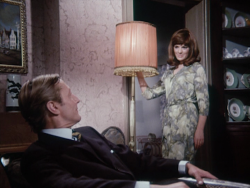
<p><img loading="lazy" decoding="async" src="http://www.britishtelevisiondrama.org.uk/wp-content/uploads/2016/07/BTVD_Georges-Room_1-e1469993104204.png" alt="BTVD_George's Room_1" width="250" height="188" class="alignleft size-full wp-image-6463"/>How and why is <em>George’s Room</em> in colour? Anyone coming to <em>George&#8217;s Room</em> knowing the rest of director Alan Clarke’s plays for Rediffusion’s <em>Half-Hour Story</em> strand thanks to the BFI’s <em>Alan Clarke at the BBC</em> set might wonder why this is the only one in colour and why it looks so different from the others.<sup id="rf1-6434"><a href="#fn1-6434" title="&lt;em&gt;George&#8217;s Room&lt;/em&gt; appears on both DVD and blu-ray versions, while the others appear only on the blu-ray." rel="footnote">1</a></sup> In comparison with the inventive compositions, fast cutting (vision mixing) and ambitious camerawork of plays like <a href="http://www.britishtelevisiondrama.org.uk/?p=6235" target="_self" rel="noopener"><em>Stella</em></a>, <em>George’s Room</em> seems highly conventional in its largely static compositions and its alternation between mid-shots, close-ups and wide two-shots: a reviewer at the time said that the play ‘has almost no movement’ and ‘could easily pass as a radio play’, watching characters ‘speaking or listening’.<sup id="rf2-6434"><a href="#fn2-6434" title="Henry Raynor, ‘Radio play for television’, &lt;em&gt;The Times&lt;/em&gt;, 31 August 1967, p. 5." rel="footnote">2</a></sup> In the circumstances this is perhaps unsurprising. Clarke directed this colour version at Wembley Studios, using the same electronic multi-camera set-up as his black and white <em>Half-Hour Story</em> plays. However, <em>George’s Room</em> adapted this set-up in order to use ‘E-cam’, a system designed to make filmed drama in television studios. There were similar attempts to combine television and film technology elsewhere in the television and cinema industries – as we shall see – but Rediffusion were pioneering the integration of film and the electronic multi-camera studio. <em>George’s Room</em> was the main pilot experiment to test ‘E-cam’, which makes it a fascinating moment in British television drama, a stepping stone to possible futures in the use of colour and the convergence between television and cinema. This essay is the most detailed exploration of <em>George’s Room</em> to date. This might not be surprising, given that those studying Clarke could only access an incomplete version,<sup id="rf3-6434"><a href="#fn3-6434" title="Half of the play, joined with the published script, form the basis of the analysis in Dave Rolinson, &lt;em&gt;Alan Clarke&lt;/em&gt; (Manchester: Manchester University Press, 2005." rel="footnote">3</a></sup> until, as the BFI’s Sam Dunn explained, ‘the missing half […] was discovered hiding in the deep recesses of the National Archive’.<sup id="rf4-6434"><a href="#fn4-6434" title="Sam Dunn, quoted in James Oliver, ‘Sam Dunn, producer of Dissent and Disruption: Alan Clarke at the BBC’, available at &lt;a href=&quot;//www.moviemail.com/blog//2967-Sam-Dunn-producer-of-Dissent-and-Disruption-Alan-Clarke-at-the-BBC-”&quot; target=&quot;“_self”&quot; rel=&quot;noopener&quot;&gt;&lt;em&gt;Moviemail&lt;/em&gt; here.&lt;/a&gt;" rel="footnote">4</a></sup> This essay provides information on different stages – from commissioning to overseas sales – but its main focus is on the play as an experiment in colour and electronic film.</p>

<hr class="footnotes"><ol class="footnotes" style="list-style-type:decimal"><li id="fn1-6434"><p ><em>George&#8217;s Room</em> appears on both DVD and blu-ray versions, while the others appear only on the blu-ray.&nbsp;<a href="#rf1-6434" class="backlink" title="Return to footnote 1.">&#8617;</a></p></li><li id="fn2-6434"><p >Henry Raynor, ‘Radio play for television’, <em>The Times</em>, 31 August 1967, p. 5.&nbsp;<a href="#rf2-6434" class="backlink" title="Return to footnote 2.">&#8617;</a></p></li><li id="fn3-6434"><p >Half of the play, joined with the published script, form the basis of the analysis in Dave Rolinson, <em>Alan Clarke</em> (Manchester: Manchester University Press, 2005.&nbsp;<a href="#rf3-6434" class="backlink" title="Return to footnote 3.">&#8617;</a></p></li><li id="fn4-6434"><p >Sam Dunn, quoted in James Oliver, ‘Sam Dunn, producer of Dissent and Disruption: Alan Clarke at the BBC’, available at <a href="//www.moviemail.com/blog//2967-Sam-Dunn-producer-of-Dissent-and-Disruption-Alan-Clarke-at-the-BBC-”" target="“_self”" rel="noopener"><em>Moviemail</em> here.</a>&nbsp;<a href="#rf4-6434" class="backlink" title="Return to footnote 4.">&#8617;</a></p></li></ol></hr>{"id":6434,"date":"2016-07-31T22:00:39","date_gmt":"2016-07-31T21:00:39","guid":{"rendered":"http:\/\/www.britishtelevisiondrama.org.uk\/?p=6434"},"modified":"2024-08-30T11:36:19","modified_gmt":"2024-08-30T10:36:19","slug":"experiments-in-colour-and-electronic-film-systems-georges-room-1967","status":"publish","type":"post","link":"http:\/\/www.britishtelevisiondrama.org.uk\/?p=6434","title":{"rendered":"Experiments in colour and electronic film systems: <em>George&#8217;s Room<\/em> (1967)"},"content":{"rendered":"<h4>by DAVID ROLINSON AND SIMON COWARD<\/h4>\n<p><em>Half-Hour Story<\/em> <b>Writer:<\/b> Alun Owen; <b>Producer:<\/b> Stella Richman; <b>Director:<\/b> Alan Clarke<\/p>\n<p><img loading=\"lazy\" decoding=\"async\" src=\"http:\/\/www.britishtelevisiondrama.org.uk\/wp-content\/uploads\/2016\/07\/BTVD_Georges-Room_1-e1469993104204.png\" alt=\"BTVD_George's Room_1\" width=\"250\" height=\"188\" class=\"alignleft size-full wp-image-6463\">How and why is <em>George\u2019s Room<\/em> in colour? Anyone coming to <em>George&#8217;s Room<\/em> knowing the rest of director Alan Clarke\u2019s plays for Rediffusion\u2019s <em>Half-Hour Story<\/em> strand thanks to the BFI\u2019s <em>Alan Clarke at the BBC<\/em> set might wonder why this is the only one in colour and why it looks so different from the others.<sup id=\"rf1-6434\"><a href=\"#fn1-6434\" title=\"&lt;em&gt;George&#8217;s Room&lt;\/em&gt; appears on both DVD and blu-ray versions, while the others appear only on the blu-ray.\" rel=\"footnote\">1<\/a><\/sup> In comparison with the inventive compositions, fast cutting (vision mixing) and ambitious camerawork of plays like <a href=\"http:\/\/www.britishtelevisiondrama.org.uk\/?p=6235\" target=\"_self\" rel=\"noopener\"><em>Stella<\/em><\/a>, <em>George\u2019s Room<\/em> seems highly conventional in its largely static compositions and its alternation between mid-shots, close-ups and wide two-shots: a reviewer at the time said that the play \u2018has almost no movement\u2019 and \u2018could easily pass as a radio play\u2019, watching characters \u2018speaking or listening\u2019.<sup id=\"rf2-6434\"><a href=\"#fn2-6434\" title=\"Henry Raynor, \u2018Radio play for television\u2019, &lt;em&gt;The Times&lt;\/em&gt;, 31 August 1967, p. 5.\" rel=\"footnote\">2<\/a><\/sup> In the circumstances this is perhaps unsurprising. Clarke directed this colour version at Wembley Studios, using the same electronic multi-camera set-up as his black and white <em>Half-Hour Story<\/em> plays. However, <em>George\u2019s Room<\/em> adapted this set-up in order to use \u2018E-cam\u2019, a system designed to make filmed drama in television studios. There were similar attempts to combine television and film technology elsewhere in the television and cinema industries \u2013 as we shall see \u2013 but Rediffusion were pioneering the integration of film and the electronic multi-camera studio. <em>George\u2019s Room<\/em> was the main pilot experiment to test \u2018E-cam\u2019, which makes it a fascinating moment in British television drama, a stepping stone to possible futures in the use of colour and the convergence between television and cinema. This essay is the most detailed exploration of <em>George\u2019s Room<\/em> to date. This might not be surprising, given that those studying Clarke could only access an incomplete version,<sup id=\"rf3-6434\"><a href=\"#fn3-6434\" title=\"Half of the play, joined with the published script, form the basis of the analysis in Dave Rolinson, &lt;em&gt;Alan Clarke&lt;\/em&gt; (Manchester: Manchester University Press, 2005.\" rel=\"footnote\">3<\/a><\/sup> until, as the BFI\u2019s Sam Dunn explained, \u2018the missing half [\u2026] was discovered hiding in the deep recesses of the National Archive\u2019.<sup id=\"rf4-6434\"><a href=\"#fn4-6434\" title=\"Sam Dunn, quoted in James Oliver, \u2018Sam Dunn, producer of Dissent and Disruption: Alan Clarke at the BBC\u2019, available at &lt;a href=&quot;\/\/www.moviemail.com\/blog\/\/2967-Sam-Dunn-producer-of-Dissent-and-Disruption-Alan-Clarke-at-the-BBC-\u201d&quot; target=&quot;\u201c_self\u201d&quot; rel=&quot;noopener&quot;&gt;&lt;em&gt;Moviemail&lt;\/em&gt; here.&lt;\/a&gt;\" rel=\"footnote\">4<\/a><\/sup> This essay provides information on different stages \u2013 from commissioning to overseas sales \u2013 but its main focus is on the play as an experiment in colour and electronic film.<\/p>\n<p><!--more--><\/p>\n<p><b>Background: the play<\/b><\/p>\n<p><img loading=\"lazy\" decoding=\"async\" src=\"http:\/\/www.britishtelevisiondrama.org.uk\/wp-content\/uploads\/2016\/07\/BTVD_Georges-Room_Owen-e1469992814875.png\" alt=\"BTVD_George's Room_Owen\" width=\"250\" height=\"188\" class=\"alignleft size-full wp-image-6458\"><em>George\u2019s Room<\/em> is one of several collaborations between writer Alun Owen and director Alan Clarke for <em>Half-Hour Story<\/em>. They all feature an encounter between a man and a woman: the universal themes at work mean that they are sometimes only identified as \u2018Man\u2019 and \u2018Woman\u2019. The man in this play (John Neville) arrives in the hope of renting a room from the woman (Geraldine Moffatt): however, we are told that this is \u2018not merely a room\u2019, but has come to symbolise the continuing influence of her late husband.<\/p>\n<p><img loading=\"lazy\" decoding=\"async\" src=\"http:\/\/www.britishtelevisiondrama.org.uk\/wp-content\/uploads\/2016\/07\/BTVD_doorbell_1-e1469992895541.png\" alt=\"BTVD_George's Room_doorbell_1\" width=\"250\" height=\"188\" class=\"alignleft size-full wp-image-6459\"><img loading=\"lazy\" decoding=\"async\" src=\"http:\/\/www.britishtelevisiondrama.org.uk\/wp-content\/uploads\/2016\/07\/BTVD_doorbell_2-e1469992925902.png\" alt=\"BTVD_George's Room_doorbell_2\" width=\"250\" height=\"188\" class=\"alignright size-full wp-image-6460\">The man\u2019s potential invasion of this space is signposted by the opening shot, the nearest that the play gets to dynamic movement: as the man rings the doorbell we see his shape through the door, which is attributed to her perspective as a reverse zoom finds her sitting watching, clearly thinking about whether or not to answer. As their conversation develops we seem to be back in the territory of <em>Shelter<\/em> as a man tries to draw out the story of an unhappy wife: this device is characteristic of Owen, who later said that he was \u2018much more interested in women than in men and you\u2019d be surprised what they tell me\u2019.<sup id=\"rf5-6434\"><a href=\"#fn5-6434\" title=\"Alun Owen, quoted in Alix Coleman, \u2018Inside Television: The things women tell Alun Owen\u2019, &lt;em&gt;TV Times&lt;\/em&gt; London region, 6 December 1973.\" rel=\"footnote\">5<\/a><\/sup><\/p>\n<p><img loading=\"lazy\" decoding=\"async\" src=\"http:\/\/www.britishtelevisiondrama.org.uk\/wp-content\/uploads\/2016\/07\/BTVD_doorbell_3-e1469992939254.png\" alt=\"BTVD_George's Room_doorbell_3\" width=\"250\" height=\"188\" class=\"alignleft size-full wp-image-6461\">Moffatt\u2019s character in <em>Stella<\/em> used her wit and articulacy to reject her boyfriend\u2019s attempt to control her perspective, but her character in <em>George\u2019s Room<\/em> struggles to rebuild her self-esteem after a controlling relationship \u2013 as one reviewer put it, \u2018the dead George has reduced his widow almost to nonentity\u2019<sup id=\"rf6-6434\"><a href=\"#fn6-6434\" title=\"Raynor.\" rel=\"footnote\">6<\/a><\/sup> \u2013 and Moffatt\u2019s skilful performances evoke these differences. Where Stella eviscerated a man for trying to make his point of view dominant, this woman believes that \u2018Ladies are more passive\u2019 and remarks: \u2018Oh, men! You\u2019re always saying things\u2019. Seeing the play in the context of the gender concerns across Owen\u2019s work in the period makes some sense of what otherwise seem to be crass stage directions in the published theatre version: \u2018She is no more than thirty and very pretty, but not overly bright.\u2019<sup id=\"rf7-6434\"><a href=\"#fn7-6434\" title=\"Alun Owen, &lt;em&gt;George\u2019s Room&lt;\/em&gt; (London: Samuel French, 1968).\" rel=\"footnote\">7<\/a><\/sup> George is an absent presence throughout: he \u2018didn\u2019t approve of femininity\u2019 and moved into the spare room, having lost interest in sex, and she came to fear this room when called in by him on Fridays to collect her housekeeping money. Neville\u2019s character tries to draw her out but is another patriarchal invader, admiring her because \u2018you were made for men\u2019 \u2013 as Lisa Kerrigan puts it, this somehow feels less \u2018unsavoury\u2019 due to Neville\u2019s performance<sup id=\"rf8-6434\"><a href=\"#fn8-6434\" title=\"Lisa Kerrigan, \u2018George\u2019s Room\u2019, &lt;em&gt;Dissent &amp; Disruption: Alan Clarke at the BBC&lt;\/em&gt;, book accompanying blu-ray release (London: British Film Institute, 2016), p. 24.\" rel=\"footnote\">8<\/a><\/sup> \u2013 while noting that \u2018you disturb\u2019, and calling himself \u2018Adam\u2019s heir\u2019 as if a Fall from innocence awaits. He promises to let her \u2018fidget\u2019 in George\u2019s room \u2013 that always-present but never-visible patriarchal space \u2013 in order to control her fears, but is this a way to escape or does it now seem problematic? As Lisa Kerrigan observes in the blu-ray book, he is \u2018the disruptor, pushing liberation where it might not be entirely welcome\u2019, potentially \u2018angel\u2019 or \u2018devil\u2019 in a play that is \u2018playful while exposing the darker underside to relationships\u2019.<sup id=\"rf9-6434\"><a href=\"#fn9-6434\" title=\"Ibid.\" rel=\"footnote\">9<\/a><\/sup><\/p>\n<p><img loading=\"lazy\" decoding=\"async\" src=\"http:\/\/www.britishtelevisiondrama.org.uk\/wp-content\/uploads\/2016\/07\/BTVD_Georges-Room_blocking_1-e1469993575577.png\" alt=\"BTVD_George's Room_blocking_1\" width=\"250\" height=\"188\" class=\"alignleft size-full wp-image-6465\"><img loading=\"lazy\" decoding=\"async\" src=\"http:\/\/www.britishtelevisiondrama.org.uk\/wp-content\/uploads\/2016\/07\/BTVD_Georges-Room_blocking_2-e1469993957423.png\" alt=\"BTVD_George's Room_blocking_2\" width=\"250\" height=\"188\" class=\"alignright size-full wp-image-6466\"><img loading=\"lazy\" decoding=\"async\" src=\"http:\/\/www.britishtelevisiondrama.org.uk\/wp-content\/uploads\/2016\/07\/BTVD_Georges-Room_blocking_3-e1469993971720.png\" alt=\"BTVD_George's Room_blocking_3\" width=\"250\" height=\"188\" class=\"alignleft size-full wp-image-6467\"><img loading=\"lazy\" decoding=\"async\" src=\"http:\/\/www.britishtelevisiondrama.org.uk\/wp-content\/uploads\/2016\/07\/BTVD_Georges-Room_blocking_4-e1469993983514.png\" alt=\"BTVD_George's Room_blocking_4\" width=\"250\" height=\"188\" class=\"alignright size-full wp-image-6468\">Clarke often found a style with which to reinforce the to-and-fro of Owen\u2019s couples. In <em>Stella<\/em> there was fast vision mixing and the use of unsettling angles; in <em>George\u2019s Room<\/em> these are almost absent (though the characters&#8217; opening conversation in the hallway does move relatively quickly between low-angle close-ups, which was one of his signatures). Instead, as in <em>Thief<\/em>, meaning is supported by shifts in blocking, such as the moment in Act 2 in which the woman is foregrounded with the man in the background, which reverses the treatment of a moment in Act 1.<\/p>\n<p>We can explain why <em>George\u2019s Room<\/em> ended up in colour \u2013 in our account of the \u2018E-cam\u2019 experiment \u2013 but we have yet to find in the documentation a definitive reason why this particular play was selected ahead of any others. We cannot rule out coincidence: as we shall see, it was in the studio at a time when the pilot experiments were being made. However, it was clearly a piece by a proven pairing: the highly-acclaimed big-name writer Owen and the burgeoning talent of Clarke, one of the \u2018young team\u2019 that producer Stella Richman named in publicity as having \u2018brought lots of energy and invention to the series\u2019.<sup id=\"rf10-6434\"><a href=\"#fn10-6434\" title=\"&lt;em&gt;Half-Hour Story&lt;\/em&gt; sales brochure, Rediffusion, accessed from Simon Coward&#8217;s own collection, p. 2.\" rel=\"footnote\">10<\/a><\/sup> The fact that the play only required two actors in, effectively, one room may also have helped, but Clarke had already shown that this was no barrier to a more ambitious visual approach than is evidenced in the colour version of <em>George\u2019s Room<\/em>.<\/p>\n<p><b>Commissioning and rehearsal<\/b><\/p>\n<p>Owen was commissioned in May 1967 to deliver a first draft of this as-yet-untitled script by 26 June, followed by a ten-day deadline for acceptance and a ten-day deadline for a final script.<sup id=\"rf11-6434\"><a href=\"#fn11-6434\" title=\"Such commissioning documents do not necessarily prove that a script was not already underway or that the play delivered did not deviate from the version that was commissioned, especially given that the title and contents are not specified on this document \u2013 Script Requisition Form, signed 30 May 1967, &lt;em&gt;George\u2019s Room&lt;\/em&gt; production folder, accessed in British Film Institute library.\" rel=\"footnote\">11<\/a><\/sup> According to initial contracts, rehearsals for <em>George\u2019s Room<\/em> took place on consecutive days between 18-22 July, with a day scheduled for rehearsals and (between 5:00-5:30 p.m.) \u2018promotion filming\u2019 on 24 July.<sup id=\"rf12-6434\"><a href=\"#fn12-6434\" title=\"The files do not confirm whether these rehearsal dates were strictly adhered to or whether fewer or different dates were ultimately used.\" rel=\"footnote\">12<\/a><\/sup> (Most of Clarke\u2019s Rediffusion pieces have a day allocated for \u2018promotion filming\u2019, a phrase which does raise the tantalising prospect of specially-shot trails or the advanced shooting of scenes for trails \u2013 which would be of particular interest for those productions which do not survive in the archives \u2013 but there is no surviving evidence of this. It is more likely that the phrase refers to stills photography.)<sup id=\"rf13-6434\"><a href=\"#fn13-6434\" title=\"See, for instance, the promotional images for &lt;em&gt;Shelter&lt;\/em&gt; and &lt;em&gt;The Gentleman Caller&lt;\/em&gt; in the blu-ray booklet which do not take place on the studio set.\" rel=\"footnote\">13<\/a><\/sup> The rehearsal pattern for <em>George\u2019s Room<\/em> is consistent with other Clarke pieces of the time: <em>The Gentleman Caller<\/em> rehearsed in an unspecified venue between 29 May-6 June 1967 (excluding 4 June) ahead of 7 June recording; <em>Got Yourself Sorted Out At All?<\/em> (an episode of <em>A Man of Our Times<\/em>) rehearsed on unspecified dates between 2 November and 2 December in Clapham Junction BAT 2036 alongside location videotape recording on 27-28 November and ahead of studio recording on 5 December, and <em>Goodnight Albert<\/em> rehearsed between 27-30 December 1967 and 1-4 January 1968 in Room D Television House ahead of studio recording on 5 January.<sup id=\"rf14-6434\"><a href=\"#fn14-6434\" title=\"&lt;em&gt;The Gentleman Caller&lt;\/em&gt; and &lt;em&gt;Goodnight Albert&lt;\/em&gt; schedules accessed in British Film Institute library. &lt;em&gt;A Man of Our Times&lt;\/em&gt; production schedule accessed from independent source.\" rel=\"footnote\">14<\/a><\/sup><\/p>\n<p><b>Studio sessions<\/b><\/p>\n<p>In the documentary accompanying the Clarke set, Geraldine Moffatt recalls having to shoot <em>George\u2019s Room<\/em> twice:<\/p>\n<blockquote><p>[Alan Clarke] made it twice. It was first of all made in black and white and in fact I think there were over 200 cuts [&#8230;] in the black and white version. And I remember that he was quite sad because Rediffusion wiped the black and white version within a few days of doing it, and they retained [&#8230;] the version in colour which we filmed or recorded the next day. And the colour version has less cuts in it than the black and white version.<sup id=\"rf15-6434\"><a href=\"#fn15-6434\" title=\"Geraldine Moffatt, interviewed in&lt;em&gt; Out of His Own Light&lt;\/em&gt;, extra on &lt;em&gt;Alan Clarke at the BBC&lt;\/em&gt; (British Film Institute, 2016).\" rel=\"footnote\">15<\/a><\/sup><\/p><\/blockquote>\n<p>The production documents provide further information.<sup id=\"rf16-6434\"><a href=\"#fn16-6434\" title=\"&lt;em&gt;George\u2019s Room&lt;\/em&gt;, Associated Rediffusion file ART\/534 folder 1, viewed at the British Film Institute library in 2016.\" rel=\"footnote\">16<\/a><\/sup> The two versions were shot in Wembley\u2019s Studio 5A: on Tuesday 25 July and Wednesday 26 July respectively. Moffatt\u2019s memory may indicate that plans changed from those in the documents, but it appears that the Tuesday session was planned for the colour episode, given that the recording session is marked \u2018PHOT\/REC\u2019 while Wednesday\u2019s is marked \u2018VTR\u2019 and the scheduled working day is noticeably long. Between 8:00 a.m. and 10:00 a.m. there was a combined period of setting, lighting, make-up and line-up. There were two camera rehearsal periods between 10:00 a.m. and 1:00 p.m. and between 2:00 and 6:30 p.m (punctuated by the lunch break between 1:00 and 2:00 p.m.). After a dinner break (6:30 to 7.30 p.m.), there was the usual make-up and line-up session between 7:30 and 8:30 p.m. The play was simultaneously recorded and photographed [filmed] between 8:30 and 9:30 p.m. On Wednesday, the black and white version was recorded. After setting and lighting (11:30 a.m. \u2013 12:30 p.m.) and a lunch break (12:30 \u2013 1:30 p.m.), a camera rehearsal took place between 1:30 and 4:00 p.m. followed by make-up and line-up (4:00 \u2013 5:00 p.m.). The play was then recorded between 5:00 and 5:45 p.m. before the sets were struck between 5:45 and 6:30 p.m. The same crew appears to have worked on both versions, including Derek Cochrane and Crew 2 on cameras and Brian Penny on sound, though it would be useful to be able to clarify the joint credit for Bill Lee and Tony Hepher for lighting, given the demands of lighting for \u2018E-cam\u2019 which this essay will now outline.<sup id=\"rf17-6434\"><a href=\"#fn17-6434\" title=\"There may be two contracts for overseas sales given that one has \u201cFILM\u201d written at the top in pen. \u201c30th Aug. \u201867\u201d is written as the transmission date; the capital A matches that in signatures by Clarke elsewhere in the production files.\" rel=\"footnote\">17<\/a><\/sup><\/p>\n<p><b>\u2018E-cam\u2019<\/b><\/p>\n<p>Rediffusion Television\u2019s in-house magazine <em>Fusion<\/em><sup id=\"rf18-6434\"><a href=\"#fn18-6434\" title=\"&lt;em&gt;Fusion&lt;\/em&gt; was Rediffusion Television\u2019s (and before that Associated-Rediffusion\u2019s) house magazine. It was published, usually quarterly, from 1958 to 1967.\" rel=\"footnote\">18<\/a><\/sup> explained that<\/p>\n<blockquote><p>[E-cam] stands for electronic cameras, a system of using film cameras in the same way as television cameras but recording the end product on film instead of tape. While other organisations have worked on the system with single cameras, Rediffusion Television was the first to make a film in TV studios using an integrated, multi-camera system.<sup id=\"rf19-6434\"><a href=\"#fn19-6434\" title=\"\u2018e-cam\u2019, &lt;em&gt;Fusion&lt;\/em&gt; Number 48\/49 double issue, Christmas 1967, p. 43.\" rel=\"footnote\">19<\/a><\/sup><\/p><\/blockquote>\n<p>This text introduces an article in which the engineer-in-charge of \u2018E-cam ops.\u2019, Mike Metcalfe, wrote an account of the \u2018E-cam\u2019 process. <em>George\u2019s Room<\/em> was one of the \u2018pilot experiments\u2019. The other was \u2018scenes from\u2019 <em>The Small Rebellion of Jess Calvert<\/em>, though sadly none of that <em>Summer Playhouse<\/em> production is known to exist and the fate of the &#8216;E-cam&#8217; footage is presently unclear.<sup id=\"rf20-6434\"><a href=\"#fn20-6434\" title=\"&lt;em&gt;Summer Playhouse&lt;\/em&gt;: \u2018The Small Rebellion of Jess Calvert\u2019, tx. ITV, 7 August 1967. Wr. Alec Travis, dr. Peter Moffatt. It is unclear from the wording whether this production was in colour or just on film \u2013 E-cam could be used for colour or black and white \u2013 and the piece does not state that the scenes were shown in the &lt;em&gt;Summer Playhouse&lt;\/em&gt; broadcast. It is possible that the play happened to be in the studio at the right time \u2013 we are only aware of one recording date for the broadcast version \u2013 9 July 1967 \u2013 and that the sets were re-used.\" rel=\"footnote\">20<\/a><\/sup> According to Metcalfe, E-cam was motivated by \u2018a desire to produce high quality film programmes by television methods\u2019.<sup id=\"rf21-6434\"><a href=\"#fn21-6434\" title=\"Metcalfe, \u2018e-cam\u2019, p. 43.\" rel=\"footnote\">21<\/a><\/sup> Of course many British television dramas had been made on film \u2013 for instance <em>The Adventures of Robin Hood<\/em> (1955-59) \u2013 and there would be many more made entirely on film or in a \u2018pie-bald\u2019 mixture of videotaped studio interiors and filmed exteriors (or filmed interiors using former cinematic sites such as Ealing Studios). Therefore, the key distinction here is \u2018by television methods\u2019, which for the majority of productions involved recording on video in the electronic multi-camera studio. Some academics, in particular Deborah Jaramillo, have recently critiqued the tendency in academic and broadsheet writing about television to privilege the \u2018cinematic\u2019, to the extent that \u2018cinematic\u2019 has become a problematic superlative which perpetuates an \u2018antiquated [\u2026] hierarchy\u2019 rather than engaging television\u2019s specific characteristics and strengths.<sup id=\"rf22-6434\"><a href=\"#fn22-6434\" title=\"Deborah Jaramillo, \u2018Rescuing television from the \u201ccinematic\u201d: The perils of dismissing television style\u2019, in Jason Jacobs and Steven Peacock (editors), &lt;em&gt;Television Aesthetics and Style&lt;\/em&gt; (London: Routledge), pp. 67-75. For a recent reply more tied to British dramas such as &lt;em&gt;Happy Valley&lt;\/em&gt;, see Helen Piper, \u2018Television drama and the problem of television aesthetics: home, nation, universe\u2019, &lt;em&gt;Screen&lt;\/em&gt;, Volume 57, Number 2, 2016, pp. 163-183.\" rel=\"footnote\">22<\/a><\/sup> The multi-camera studio would be the home for a great many radical and innovative dramas over the decades, often building on the advances of experimental theatre at a time when \u2018theatricality\u2019 was not a pejorative term but a marker of one of television\u2019s strengths (though admittedly some programme makers were very keen to get away from the studio and onto film or into cinema).<\/p>\n<p>These issues make \u2018E-cam\u2019 an even more fascinating moment in British television technology. According to Metcalfe, this \u2018long-standing dream\u2019 of combining film and television methods would \u2018reduce production costs\u2019 and \u2018overcome the serious technical problems associated with the international exchange of programmes for television\u2019. In particular, there was already the need to convert programmes so that they could be played in countries with different line standards, and these issues would be multiplied with the introduction of differing colour standards. Making drama on film would bypass such problems given the telecine equipment in television studios: \u2018film has become the universal currency of programme exchange\u2019.<sup id=\"rf23-6434\"><a href=\"#fn23-6434\" title=\"Metcalfe, \u2018e-cam\u2019, p. 43.\" rel=\"footnote\">23<\/a><\/sup> During this period, for companies in the UK hoping to interest international buyers in their wares, there were two primary options: originate the programme on 35mm film with the intention of selling it to one of the American networks, or produce the programme on videotape and provide any purchasers with a set of telerecordings on 16mm or 35mm film. By 1967, there was a third option in occasional operation \u2013 that of recording the programme on tape in NTSC format, which usually meant performing the production twice. While this system was used for some variety and light entertainment shows such as Rediffusion\u2019s <em>Hippodrome<\/em> and ATV\u2019s <em>Piccadilly Palace<\/em> this was rarely considered for drama as the <em>de facto<\/em> standard for American drama series \u2013 excluding daily serials, soaps \u2013 was 35mm film in any case.<\/p>\n<p>Metcalfe\u2019s piece reminds us that television dramas are tied with technological histories as well as questions of aesthetics and identity. For example, John Caughie responded to a <em>TV Times<\/em> piece celebrating the \u2018dollar-earning capacity\u2019 of <em>The Adventures of Robin Hood<\/em> (given its American success) by noting that the BBC had been \u2018slow to commit itself to the high-cost, high-risk strategy of shooting series on film for the uncertainties of foreign taste\u2019 but by 1961 was \u2018recording its <em>Maigret<\/em> series simultaneously on Ampex tape, 16mm and 35mm film, using the cheaper techniques of drama\u2019 to try to appeal to the international market.<sup id=\"rf24-6434\"><a href=\"#fn24-6434\" title=\"John Caughie, &lt;em&gt;Television Drama: Realism, Modernism and British Culture&lt;\/em&gt; (Oxford: Oxford University Press, 2000, p. 55.\" rel=\"footnote\">24<\/a><\/sup> Caughie notes that films of events had sold abroad in the past but<\/p>\n<blockquote><p>now what had been conceived as purely national and cultural production [drama] had the potential to enter the international market as a commodity. Much of the subsequent development of British television drama \u2013 the shift from single play to art film, the rise of the classic serial [\u2026] the shift to film technology and aesthetics \u2013 can be dated from the moment at which drama becomes simultaneously expensive, recordable, and marketable.<sup id=\"rf25-6434\"><a href=\"#fn25-6434\" title=\"Ibid, pp. 54-55.\" rel=\"footnote\">25<\/a><\/sup><\/p><\/blockquote>\n<p>The American success of <em>The Adventures of Robin Hood<\/em> showed it to be a saleable commodity in more senses than one. Making drama entirely on film was more time-consuming and expensive than working in multi-camera studios, whose economies of scale meant a large volume and variety of drama, and Caughie\u2019s study later demonstrates that filmed drama had positive and negative impacts on that volume and variety and the very idea of television drama as \u2018national and cultural production\u2019.<\/p>\n<p>Metcalfe observes that there had already been attempts at \u2018coupling a television camera to a film camera in order to monitor the scene remotely and to facilitate the control of several cameras\u2019.<sup id=\"rf26-6434\"><a href=\"#fn26-6434\" title=\"Metcalfe, \u2018e-cam\u2019, p. 44.\" rel=\"footnote\">26<\/a><\/sup> This latest attempt at \u2018Electronicam\u2019 used an Arriflex 35 mm film camera, \u2018developed by Arnold &amp; Richter of Munich\u2019 from the \u2018photo-recording system\u2019 that they devised in 1955 (a collaboration with Dumont in New York which Metcalfe discusses). Rediffusion\u2019s engineers collaborated with Fernseh to produce a \u2018television channel\u2019.<sup id=\"rf27-6434\"><a href=\"#fn27-6434\" title=\"This channel \u2018using a Plumbicon picture tube and embodying the latest circuitry\u2019.\" rel=\"footnote\">27<\/a><\/sup> Metcalfe\u2019s article includes several photographs of the technology in use, including an Arri Electronic Cam unit supplied by Rank Audio Visual Limited.<sup id=\"rf28-6434\"><a href=\"#fn28-6434\" title=\"Ibid.\" rel=\"footnote\">28<\/a><\/sup><\/p>\n<p>Metcalfe explains the process in his article, and although we will not quote this description at length because it is an intricate technical account, we can pick out a few features which help us to understand how <em>George\u2019s Room<\/em> will have been produced. A \u2018specially designed reflex shutter\u2019, \u2018reflecting segments\u2019, \u2018correcting lenses\u2019, a \u2018Plumbicon camera attached to the side of the film camera\u2019 and a \u2018monitor viewfinder mounted at the back of the camera\u2019 that is used \u2018in exactly the same way as a television camera\u2019<sup id=\"rf29-6434\"><a href=\"#fn29-6434\" title=\"Ibid., p. 44.\" rel=\"footnote\">29<\/a><\/sup> all mean that:<\/p>\n<blockquote><p>The cameraman [\u2026] has normal control of zoom, focus and framing etc. The television picture is also available to monitors in the various control rooms.<\/p>\n<p>The method of operation follows closely that of a standard television studio production. Pictures from all cameras are permanently available to the director whether the film is running or not. Rehearsal takes place in the usual manner and film is only exposed for the actual transmission\/take. [\u2026] The actual transmission\/take is accomplished by pressing the appropriate button on the simple vision mixer panel which starts the film camera and switches its television picture to \u2018transmission\u2019<sup id=\"rf30-6434\"><a href=\"#fn30-6434\" title=\"Ibid., pp. 44-45.\" rel=\"footnote\">30<\/a><\/sup><\/p><\/blockquote>\n<p>This description tallies with the \u2018e. cam procedure\u2019 which was provided at the start of Clarke\u2019s camera script for <em>George\u2019s Room<\/em>, which includes notes to wait for the red light to come on (and \u2018check cameras on remotes\u2019), then for the blue light (for sound recording), then to mark the first camera with the clapper.<sup id=\"rf31-6434\"><a href=\"#fn31-6434\" title=\"&lt;em&gt;George\u2019s Room&lt;\/em&gt; camera script, p. I \u2013 1. Accessed at the British Film Institute library.\" rel=\"footnote\">31<\/a><\/sup> The lighting director could maintain \u2018the close exposure tolerances required for successful colour filming\u2019 thanks to remote operation of each camera\u2019s lens iris and monitoring facilities.<sup id=\"rf32-6434\"><a href=\"#fn32-6434\" title=\"Metcalfe, \u2018e-cam\u2019, p. 45.\" rel=\"footnote\">32<\/a><\/sup> Sound was recorded as usual \u2013 \u2018on sprocketed magnetic tape running in synchronisation with the film cameras\u2019 \u2013 but each camera had its own \u2018cue tone\u2019 to help \u2018the later assembly of the processed film\u2019.<sup id=\"rf33-6434\"><a href=\"#fn33-6434\" title=\"Ibid.\" rel=\"footnote\">33<\/a><\/sup><\/p>\n<p>The director needed to plan carefully as always but with some different considerations. For instance, the magazine on each camera held 1,000 feet of film (as Metcalfe points out, 10 minutes of running time), so the director needed to pre-plan sequences to make the best use of them; to help, the control desk contained \u2018footage counters\u2019 estimating the amount of film to be used by each camera in a forthcoming take.<sup id=\"rf34-6434\"><a href=\"#fn34-6434\" title=\"Ibid.\" rel=\"footnote\">34<\/a><\/sup><\/p>\n<p>This process might help to explain why Clarke in <em>George\u2019s Room<\/em> avoids the kind of fast cutting (that is, vision mixing) that is a characteristic of much of his early work at Rediffusion. As Metcalfe explains, \u2018Cutting from one camera to another is achieved by pressing the appropriate buttons, and after a delay of approximately 1\/3 second, to enable the camera motor to attain speed, the vision is automatically switched and the film exposed.\u2019<sup id=\"rf35-6434\"><a href=\"#fn35-6434\" title=\"Ibid.\" rel=\"footnote\">35<\/a><\/sup> However, Metcalfe also demonstrates that the need for fast cutting had been anticipated: \u2018For fast cutting sequences an extra button is provided enabling the selected cameras to stay running while cutting between them, thus obviating the running-up delay. This method, of course, is wasteful of film and should only be used for short periods. As it is not possible to fade or mix between the film cameras, the vision mixer is a simple \u2018cut only\u2019 device.\u2019<sup id=\"rf36-6434\"><a href=\"#fn36-6434\" title=\"Ibid. Bridget Booth was credited as vision mixing &lt;em&gt;George\u2019s Room&lt;\/em&gt; &#8211; &lt;em&gt;George&#8217;s Room&lt;\/em&gt; camera script, British Film Institute library.\" rel=\"footnote\">36<\/a><\/sup><\/p>\n<p><b>Colour<\/b><\/p>\n<p>Colour would exacerbate the technical problems in international sales which Metcalfe discussed above, because, as he noted, colour systems also varied around the world. However, colour also posed specific challenges in the British context, with the slow and sporadic rollout of colour television and issues raised by its use. The timing of <em>George\u2019s Room<\/em> is vital, coming as it did in 1967. BBC 2 switched to a full programme of colour in December 1967 \u2013 one of its flagships being a colour production of William Makepeace Thackeray\u2019s <em>Vanity Fair<\/em> which echoed the use of the same novel, adapted via the play <em>Becky Sharp<\/em>, as the first feature film to use the new full-colour \u2018three-strip\u2019 Technicolor process in 1935. But while that particular book may have been selected for its colour potential, the television adaptation of \u2018the classic novel\u2019 had been a staple of the BBC\u2019s second channel since its inception, so the advent of colour was hardly pushing the channel to break new dramatic ground. BBC 1 and the ITV companies in London, the south-east, the midlands and the north followed suit in November 1969, with the majority of the remaining independent companies converting by 1971.<sup id=\"rf37-6434\"><a href=\"#fn37-6434\" title=\"Only Border Television in 1973, and Channel Television in 1976 took longer.\" rel=\"footnote\">37<\/a><\/sup> It is hard to see any significant change in the types of drama carried by BBC 1 and ITV over this period. Both sides benefited from colour material already produced: with BBC 1 being able air colour programmes previously shown on BBC 2, and ITV having the opportunity to give a first UK colour broadcast to some of the British film series which had previously only been shown in black and white. Fewer than 2% of households had colour television licenses by April 1970, so few can have appreciated these early opportunities.<\/p>\n<p>Recent studies of the arrival of colour at the BBC include Leah Panos&#8217;s 2015 study of &#8216;the diverse range of chromatic aesthetics developed during the early colour period&#8217; through analysis of three pieces directed by Rudolph Cartier between 1967 and 1969; these show how colour &#8216;instigated various changes within the BBC at material, practical and conceptual levels&#8217;, from studios to marketing and value.<sup id=\"rf38-6434\"><a href=\"#fn38-6434\" title=\"Leah Panos, &#8216;The Arrival of Colour in BBC Drama and Rudolph Cartier&#8217;s Colour Productions&#8217;, &lt;em&gt;Critical Studies in Television&lt;\/em&gt;, Volume 10, Number 3, p. 101.\" rel=\"footnote\">38<\/a><\/sup><\/p>\n<p>In 2016, Helen Wheatley devoted a chapter of her book <em>Spectacular Television<\/em> to these early years of colour television at the BBC and valuably places programmes like <em>Vanity Fair<\/em>, and the necessarily slow-take up by audiences mentioned above, in interweaving technological, institutional, cultural and aesthetic contexts. Wheatley discusses different genres including variety and sport, but picks up on tendencies of \u2018chromophobia\u2019 in television (comparable with those in Film Studies) to note the view that:<\/p>\n<blockquote><p>whereas, on the one hand, colour had the potential to add new layers of meaning to a production of television fiction and could, therefore, be used in expressive, and eloquent, ways, on the other hand, it might also be seen as producing a more superficial \u2018prettifying\u2019 of the television drama, offering an increased sense of spectacle and an attention to the surface of the image rather than producing greater depth of meaning.<sup id=\"rf39-6434\"><a href=\"#fn39-6434\" title=\"Helen Wheatley, &lt;em&gt;Spectacular Television: Exploring Televisual Pleasure&lt;\/em&gt; (London: I.B. Tauris, 2016), p. 58.\" rel=\"footnote\">39<\/a><\/sup><\/p><\/blockquote>\n<p>This potential for \u2018chromophobia\u2019 has an equivalent history in British cinema in which, as Sarah Street noted, the \u2018cinema of \u201cquality\u201d persisted as an aesthetic style associated with black and white\u2019 and, when colour was used, there was a preference for \u2018\u201ccautious neutralised\u201d colour that posed little threat to clear narrative comprehension\u2019.<sup id=\"rf40-6434\"><a href=\"#fn40-6434\" title=\"Sarah Street, &lt;em&gt;Colour Films in Britain&lt;\/em&gt; (Basingstoke: Palgrave Macmillan\/British Film Institute, 2012), pp. 1, 111. See also Simon Brown, Sarah Street and Elizabeth Watkins (editors), &lt;em&gt;British Colour Cinema: Practices and Theories&lt;\/em&gt; (Basingstoke: Palgrave Macmillan, 2013).\" rel=\"footnote\">40<\/a><\/sup> Therefore, part of the reason for the critical disdain that for a while followed Michael Powell and Emeric Pressburger was the use of vivid colour in their films: the man most responsible for delivering this, director of photography Jack Cardiff, himself noted that there was a danger of being seen as \u2018vulgar\u2019 or \u2018pretentious\u2019 by using colour \u2013 the stock-in-trade of less critically-accepted horror, melodrama or fantasy films \u2013 and yet now Powell, Pressburger and Cardiff films such as <em>Black Narcissus<\/em> are acclaimed for the ways in which we are, as Martin Scorsese put it, \u2018bathed in colour\u2019.<sup id=\"rf41-6434\"><a href=\"#fn41-6434\" title=\"See at the very least Jack Cardiff, &lt;em&gt;Magic Hour: A Life in Movies&lt;\/em&gt; (London: Faber, 1996) and the documentary &lt;em&gt;Cameraman: The Life and Work of Jack Cardiff&lt;\/em&gt; (2010).\" rel=\"footnote\">41<\/a><\/sup><\/p>\n<p>Wheatley demonstrates that those on the BBC\u2019s \u2018Colour Familiarisation Course\u2019 were also warned about colour that looks \u2018gaudy\u2019,<sup id=\"rf42-6434\"><a href=\"#fn42-6434\" title=\"Wheatley, p. 69.\" rel=\"footnote\">42<\/a><\/sup> and how the BBC sought to avoid the kind of colours used by the Americans<sup id=\"rf43-6434\"><a href=\"#fn43-6434\" title=\"Ibid., p. 59.\" rel=\"footnote\">43<\/a><\/sup> and to achieve \u2018realist colour\u2019 rather than \u2018spectacular colour\u2019.<sup id=\"rf44-6434\"><a href=\"#fn44-6434\" title=\"Ibid, p. 64-65.\" rel=\"footnote\">44<\/a><\/sup> At Rediffusion, the muted colours in <em>George\u2019s Room<\/em> place this production in the \u2018realist colour\u2019 camp \u2013 discreetly contributing to mise-en-sc\u00e8ne to add to our understanding of place and therefore, in the logic of the woman\u2019s situation, character \u2013  though as always we are in the hands of the available print. (As Wheatley reminds us, over and above problems for Film Studies in the possibility that film prints in cinemas may not match their makers\u2019 intentions, in television there are the vagaries of signals and each viewer\u2019s individual television\u2019s settings.) At this stage, the very presence of colour \u2013 for those few able to afford colour sets or those who attended the BBC\u2019s big public events held to promote colour television \u2013 is the spectacle.<sup id=\"rf45-6434\"><a href=\"#fn45-6434\" title=\"Wheatley discusses the BBC\u2019s promotional &lt;em&gt;Colour Comes to Town&lt;\/em&gt; event in September 1967, just one of the many events that her book valuably uses to demonstrate other forms of spectacle around, if not on, television. Ibid., pp. 63-64.\" rel=\"footnote\">45<\/a><\/sup><\/p>\n<p><strong>Add-a-Vision<\/strong><\/p>\n<p><em>George\u2019s Room<\/em> may now seem like an anomaly, not only in terms of Clarke\u2019s career (<em>Half-Hour Story<\/em> soon ended, Rediffusion soon gave way to Thames Television and Clarke soon moved to the BBC notwithstanding a few sporadic ITV productions) but also in terms of the \u2018E-cam\u2019 experiment. Intriguingly, however, variations on the concept persisted for several years and in different ways.<\/p>\n<p>Developments around \u2018E-cam\u2019 in this period were not merely an attempt to bring the language of film production into the video studio: instead, film studios sought to gain from technological convergence by using electronic aids. Associated British Productions released a glossy brochure describing themselves as \u2018the first major motion picture studios in the world to install Add-a-Vision\u2019, a system manufactured by Prowest Electronics.<sup id=\"rf46-6434\"><a href=\"#fn46-6434\" title=\"\u2018Add-a-vision\u2019, p. 2. We do not know the precise date of publication but it is likely to be 1968 given the coverage by John Weston quoted later in the article and, given the identity of the programme makers shown in the brochure working on &lt;em&gt;The Avengers&lt;\/em&gt;, it is almost certainly no earlier than November 1967.\" rel=\"footnote\">46<\/a><\/sup> This \u2018unique new equipment\u2019 provided \u2018the marrying of television techniques to motion picture production, by the addition of a T.V. camera to a B.N.C. Mitchell Camera\u2019.<sup id=\"rf47-6434\"><a href=\"#fn47-6434\" title=\"Ibid., pp. 2, 5. This document too discusses the Plumbicon camera feeding \u2018information to an electronic control unit\u2019, a picture and waveform monitor \u2013 as discussed in the Rediffusion piece but not quoted in our essay \u2013 as well as a 10:1 zoom lens. Ibid., p. 5.\" rel=\"footnote\">47<\/a><\/sup><\/p>\n<p>The programmes on which the system was used include a play filmed for ATV\u2019s <em>Love Story<\/em> strand at <em>their<\/em> Elstree studios, but the brochure understandably focuses on an Associated British production, <em>The Avengers<\/em>.<sup id=\"rf48-6434\"><a href=\"#fn48-6434\" title=\"Filmed in colour on 2 August 1967, the &lt;em&gt;Love Story&lt;\/em&gt; play was directed by Rex Firkin, who had previously worked entirely on videotape but gained the opportunity to direct the one episode of filmed anthology series &lt;em&gt;Journey to the Unknown&lt;\/em&gt; that used the Add-a-Vision process.\" rel=\"footnote\">48<\/a><\/sup> The brochure explains that using the system, with a B.N.C. Mitchell Camera, generates benefits including: savings in production time by removing the need for a \u2018post mortem\u2019 after each take, reducing time needed for camera line-up and rehearsals, providing \u2018instant rushes\u2019 via a video tape recorder, providing zoom lenses, reducing the number of people on the set (who could consult monitors) and helping camera operators and lighting cameramen to maintain focus and exposure. The brochure quotes several people working on <em>The Avengers<\/em>, including director Don Sharp, who felt \u2018very great enthusiasm\u2019 for a system which saved 10% of his time per episode and \u2018improved the performance of all the artistes\u2019: he stated that \u2018I shall feel lost, deprived of a great aid, when I go back to conventional shooting.\u2019<sup id=\"rf49-6434\"><a href=\"#fn49-6434\" title=\"Ibid., p. 3.\" rel=\"footnote\">49<\/a><\/sup><\/p>\n<p>The \u2018Add-a-Vision\u2019 brochure notes that Elstree had anticipated the use of \u2018electronic aids\u2019 and a movement to \u2018multi-camera usage and new lighting techniques\u2019, and so installed its new stages with \u2018a television type lighting grid and vision and sound control rooms.\u2019<sup id=\"rf50-6434\"><a href=\"#fn50-6434\" title=\"Ibid., p. 2.\" rel=\"footnote\">50<\/a><\/sup> In 1965, Elstree technicians investigated \u2018the only existing system in operation\u2019, in Munich (Munich is important here as well as in the Rediffusion story, as Arnold &amp; Richter of Munich collaborated on the 1955 New York tests mentioned by Metcalfe), and developed their own system. The authors anticipated the simultaneous use of \u2018up to four Add-a-Vision cameras\u2019 as in a multi-camera television studio and the expansion of its video facilities (V.T.R. machines, such as those used on <em>George\u2019s Room<\/em>) and colour telecine. The brochure speculated on future developments, including \u2018remote control of zoom, focus and iris\u2019 and \u2018a location camera vehicle\u2019. Around the same time, in March 1968, \u2018Add-a-Vision\u2019 was profiled in <em>The Stage and Television Today<\/em>.<sup id=\"rf51-6434\"><a href=\"#fn51-6434\" title=\"John Weston, \u2018New British system an important step forward\u2019, &lt;em&gt;The Stage and Television Today&lt;\/em&gt;, 21 March 1968, p. 18. The piece includes a behind-the-scenes photograph familiar from the Elstree brochure, albeit cropped and free from diagrams.\" rel=\"footnote\">51<\/a><\/sup> Here, John Weston pondered on how television and film production techniques \u2018have developed in totally different ways in spite of the fact that the end results, in the case of a drama at least, may be very similar indeed\u2019.<sup id=\"rf52-6434\"><a href=\"#fn52-6434\" title=\"Ibid.\" rel=\"footnote\">52<\/a><\/sup> Though largely processing material from the Elstree brochure, Weston quotes Maurice Gorham\u2019s belief \u2013 in the 1949 book <em>Television, Medium of the Future<\/em> \u2013 that \u2018Television production is a more flexible method than film production\u2019; for Weston, the system predicted by Gorham had at last arrived and provided \u2018an important step forward\u2019 for British television.<sup id=\"rf53-6434\"><a href=\"#fn53-6434\" title=\"Ibid. Weston quotes Maurice Gorham, &lt;em&gt;Television, Medium of the Future&lt;\/em&gt; (London: Percival Marshall, 1949). Gorham was a former head of BBC Television.\" rel=\"footnote\">53<\/a><\/sup><\/p>\n<p>As late as February 1970 \u2018Add-a-Vision\u2019 and \u2018E-cam\u2019 were discussed by Peter Graham Scott at a Royal Television Society meeting on \u2018film versus television techniques\u2019.<sup id=\"rf54-6434\"><a href=\"#fn54-6434\" title=\"Anonymous, \u2018Discussion on different production techniques\u2019, &lt;em&gt;The Stage and Television Today&lt;\/em&gt;, 29 January 1970, p. 12. This referred to the Royal Television Society Midland Centre meeting, ATV\u2019s Studio Centre, 25 February 1970.\" rel=\"footnote\">54<\/a><\/sup> Having worked at the BBC, Rediffusion and in feature films, Graham Scott had recently set up Challenge Productions Ltd. in order to \u2018pioneer new and economical production methods\u2019. His emphasis was to be on \u2018productivity\u2019, but again noting the benefits for feature films as well as for television.<\/p>\n<p><strong>Broadcast<\/strong><\/p>\n<p><em>George\u2019s Room<\/em> was broadcast at 9.00pm on 30 August 1967 in most ITV regions \u2013 except Scottish, TWW and Teledu Cymru<sup id=\"rf55-6434\"><a href=\"#fn55-6434\" title=\"Both Simon Coward and Ian Greaves have researched the regional variations of these plays and at present it appears as though TWW never showed &lt;em&gt;George\u2019s Room&lt;\/em&gt; (or, it seems, any other &lt;em&gt;Half-Hour Story&lt;\/em&gt;; Teledu Cymru may have done but we have yet to find a date and time; and though STV showed some earlier plays after joining &lt;em&gt;Half-Hour Story&lt;\/em&gt; midway we have yet to establish whether these included this play. We welcome corrections!\" rel=\"footnote\">55<\/a><\/sup> \u2013 unlike the widespread regional variations which affected some of Clarke\u2019s earlier plays.<sup id=\"rf56-6434\"><a href=\"#fn56-6434\" title=\"See the programme list appendix, containing crucial research by Ian Greaves, in Dave Rolinson, &lt;em&gt;Alan Clarke&lt;\/em&gt; (Manchester: Manchester University Press, 2005).\" rel=\"footnote\">56<\/a><\/sup> It replaced another scheduled play \u2013 <em>Quick on the Takeover<\/em> \u2013 so late that the latter play was billed in all listings magazines and all of the newspaper listings that we have consulted to date. However, for the purposes of this article, we will move on to what happened next\u2026<\/p>\n<p><strong>Overseas sales<\/strong><\/p>\n<p>Given Metcalfe\u2019s statement that \u2018the E-cam system can be a vital link in the chain of international programme exchange\u2019<sup id=\"rf57-6434\"><a href=\"#fn57-6434\" title=\"Ibid., p. 45\" rel=\"footnote\">57<\/a><\/sup>, it is worth looking at overseas sales: did E-cam have an effect here? The production files are not conclusive, though <em>George\u2019s Room<\/em> was one of the plays that interested overseas buyers. Global Television Services handled overseas sales for Rediffusion, and the files show them making contact regarding a number of <em>Half-Hour Story<\/em> plays. Much more research is required on the history of British television\u2019s overseas sales \u2013 and it is anyway too large a topic for this essay \u2013 but it would be particularly interesting to trace the overseas sales of different regional ITV companies. (By comparison, the history of the BBC\u2019s overseas sales has been more widely researched, in particular those programmes that are missing-believed-wiped, in particular when those programmes are <em>Doctor Who<\/em>.) However, we can make a start on <em>Half-Hour Story<\/em>.<\/p>\n<p>The Sales Brochure for <em>Half-Hour Story<\/em>\u2019s first series lists eighteen available plays, including <em>George\u2019s Room<\/em>.<sup id=\"rf58-6434\"><a href=\"#fn58-6434\" title=\"However, a typewritten note is appended to explain that one of the eighteen, &lt;em&gt;Robert&lt;\/em&gt;, is not available. This is possibly because it was an adaptation of a previously-published short story and not an original work.\" rel=\"footnote\">58<\/a><\/sup> The text for <em>George\u2019s Room<\/em> reads as follows:<\/p>\n<blockquote><p>Geraldine Moffatt and John Neville star in an intriguing story about a landlady who has a room to let. When a gentleman calls to inquire about the room, it transpires that the room belonged to her late husband, and that whoever is to be the new occupant is going to have to preserve it in its original state, in memory of the dead husband. The man insists on changing the furniture around, thereby breaking the spell.<\/p>\n<p>The press in London were particularly enthusiastic about this episode, and Robert Ottoway of the Daily Sketch said, \u201cThis probing first meeting between a would-be lodger and his bashful landlady has all the virtues of concentration we associated with master short-story writers\u201d. Mr. Ottoway had this to say about <em>Half-Hour Story<\/em>: \u201cThis series has turned into the most reliable entertainment of the summer.\u201d<sup id=\"rf59-6434\"><a href=\"#fn59-6434\" title=\"&lt;em&gt;Half-Hour Story&lt;\/em&gt; Sales Brochure.\" rel=\"footnote\">59<\/a><\/sup><\/p><\/blockquote>\n<p>Various production files contain some of the paper trail for global sales of <em>Half-Hour Story<\/em> plays. Some of these files generate potential sources of new research into Clarke and Rediffusion\u2019s international reception \u2013 for instance the Dutch press made contact for promotional material for the broadcast of <em>The Gentleman Caller<\/em> \u2013 and possibly even sources of inquiry regarding those plays which are still missing believed wiped. For now, we can briefly trace the international appeal of <em>George\u2019s Room<\/em>. In November 1967, Global noted that Sweden were interested in six episodes, naming <em>George\u2019s Room<\/em> alongside <em>Dead Certainty<\/em>, <em>Necklace<\/em> and <em>No Sale at Newhaven<\/em>.<sup id=\"rf60-6434\"><a href=\"#fn60-6434\" title=\"Internal memo, Programme Sales to Copyright Officer, 9 November 1967. Accessed at British Film Institute library.\" rel=\"footnote\">60<\/a><\/sup> By January 1968, Owen had agreed to the authorisation of a broadcast of <em>George\u2019s Room<\/em> in Holland and Belgium;<sup id=\"rf61-6434\"><a href=\"#fn61-6434\" title=\"Internal memo, Programme Sales to Contracts Officer, 26 January 1968. This followed an internal to the Contracts Officer on 22 January 1968. Accessed at British Film Institute library.\" rel=\"footnote\">61<\/a><\/sup> Holland were similarly interested in Owen and Clarke\u2019s <em>Shelter<\/em> after stated interest in <em>Gone and Never Called Me Mother<\/em>.<sup id=\"rf62-6434\"><a href=\"#fn62-6434\" title=\"As above, 23 January 1968.\" rel=\"footnote\">62<\/a><\/sup> By March 1968, agreement had been reached with agents regarding the broadcast in Norway of <em>George\u2019s Room<\/em>,<sup id=\"rf63-6434\"><a href=\"#fn63-6434\" title=\"Memo as above, 11 March 1968.\" rel=\"footnote\">63<\/a><\/sup> and in Eire of <em>George\u2019s Room<\/em> as well as <em>Hawks and Doves<\/em>.<sup id=\"rf64-6434\"><a href=\"#fn64-6434\" title=\"Memo as above, 11 March 1968. A letter to Owen of 12 March 1968 confirms Owen\u2019s agreement to their right to sell to Norway and Eire.\" rel=\"footnote\">64<\/a><\/sup> Nigeria and Portugal expressed an interest in <em>George\u2019s Room<\/em>, as was discussed in February 1969 and June 1969 respectively.<sup id=\"rf65-6434\"><a href=\"#fn65-6434\" title=\"Letters to Alun Owen from two individuals, 14 February 1969 and 26 June 1969. There is further information on Portugal in a letter from 26 June 1969.\" rel=\"footnote\">65<\/a><\/sup> By the end of 1969 there was interest from Zambia and Malaysia.<sup id=\"rf66-6434\"><a href=\"#fn66-6434\" title=\"There is a little confusion in the files here. A note from 18 November 1969 mentions an enquiry from Zambia but this has been crossed out and replaced with Malaysia (similarly, Malaysia replaced Nigeria in a comparable document from 14 February 1969). Zambia are mentioned in a letter from 24 December 1969.\" rel=\"footnote\">66<\/a><\/sup> In all cases, Rediffusion contacted writers in order to exercise options in the contracts, which stipulated rates for different nations and types of broadcast.<sup id=\"rf67-6434\"><a href=\"#fn67-6434\" title=\"Without giving away commercial information such as fees, it is worth noting that the territories included the USA, Canada, Australia and New Zealand, fourteen named countries (ranging from Bermuda and Sierra Leone to Malta and Nyasaland), the British Commonwealth and \u2018other territories\u2019 \u2013 2 June 1967 agreement sent to Owen by the Contracts section. Overseas fees were set in accordance with the Screen Writers Guild agreement.\" rel=\"footnote\">67<\/a><\/sup> Rediffusion had the right \u2018to acquire options on overseas rights\u2019 within a certain time period, and the option was initially exercisable within twelve months.<sup id=\"rf68-6434\"><a href=\"#fn68-6434\" title=\"The specific dates for the option and the exercising of it are given in Owen\u2019s contract in the files; exceptions can be negotiated. Of course, the writer\u2019s contract also stipulated fees for such things as revisions and repeats on British television. The files contain completed sales payments forms not only for Owen but also for John Neville and Geraldine Moffatt.\" rel=\"footnote\">68<\/a><\/sup> The use of music could sometimes add complications, but <em>George\u2019s Room<\/em> is noted as containing only the series\u2019 theme music.<sup id=\"rf69-6434\"><a href=\"#fn69-6434\" title=\"2 April 1968 Programme exported form for Norway sale, &lt;em&gt;George\u2019s Room&lt;\/em&gt;, Associated Rediffusion file ART\/534, folder 2. Indeed, the music cue sheet in the same folder lists only the signature music at the start, end and either side of the commercial break.\" rel=\"footnote\">69<\/a><\/sup><\/p>\n<p>Further research is needed to discover the impact of the colour version on overseas sales of <em>George\u2019s Room<\/em> or, indeed, whether the colour and black and white versions were both made available. Moffatt\u2019s memory (quoted above) is that the black and white recording was very quickly wiped, though given the widespread practice of wiping television recordings after telerecordings or film prints had been made of them, this statement does not preclude the continued existence of a print for overseas sales. The surviving documentation is unclear: a document sent to Global Television has a typed note added, stating that \u2018A 16 mm COLOUR PRINT OF THIS EPISODE IS ALSO AVAILABLE\u2019,<sup id=\"rf70-6434\"><a href=\"#fn70-6434\" title=\"Accessed in British Film Institute library.\" rel=\"footnote\">70<\/a><\/sup> which indicates that a black and white version (print or telerecording) was the primary version available (unless a black and white copy was instead struck from the colour film, which would be counter-intuitive given that a black and white programme was made). It is the case that some national broadcasters continued to depend upon black and white programmes for many years, even at a time when British broadcasters were wiping them as colour came to dominate. It was possible to produce black and white telerecordings of colour productions and for much of the 1970s a significant proportion of their sales would be in that format. A result is that some colour programmes were wiped and now only survive as black and white sales copies.<\/p>\n<p>Some <em>Half-Hour Story<\/em> plays had an afterlife: London Weekend Television repeated (or, from the perspective of young broadcaster LWT, showed for the first time) a few in 1971. These appear to have included several of Clarke\u2019s: <em>Shelter<\/em>, <em>Which of These Two Ladies is He Married To?<\/em>, <em>Nothing\u2019s Ever Over\u2026<\/em> and <em>George\u2019s Room<\/em>.<sup id=\"rf71-6434\"><a href=\"#fn71-6434\" title=\"The repeats ran on mostly consecutive Fridays, beginning on 8 January 1971, and appeared to include &lt;em&gt;Shelter&lt;\/em&gt;, &lt;em&gt;Which of These Two Ladies is He Married To?&lt;\/em&gt;, &lt;em&gt;It\u2019s Only Us&lt;\/em&gt;, &lt;em&gt;The Pub Fighter&lt;\/em&gt;, &lt;em&gt;George\u2019s Room&lt;\/em&gt;, &lt;em&gt;Do You Play Requests?&lt;\/em&gt;, &lt;em&gt;Robert&lt;\/em&gt;, &lt;em&gt;Nothing\u2019s Ever Over&lt;\/em&gt; and Dead Certainty. It is noteworthy that this list includes two of the Clarke plays that are currently believed to be lost.\" rel=\"footnote\">71<\/a><\/sup> <em>George\u2019s Room<\/em> was repeated on 8 February 1971: was this a colour version? Listings in <em>TV Times<\/em> and newspapers list all the repeats as being in black and white, but this need not be conclusive. The first few weeks of the repeat run coincided with the 1970\/71 colour strike, but its end was reported the day before <em>George\u2019s Room<\/em> was repeated, although colour production was not due to resume until the following week. This strike may still have been an issue <em>if<\/em> the play had needed to be transferred to tape by LWT and this had already been carried out. It seems likely that colour broadcasting had resumed by the time <em>George\u2019s Room<\/em> was shown. We are still investigating the repeat broadcast and will update this post if we learn any more. Meanwhile, at time of writing, only the colour version of <em>George\u2019s Room<\/em> is known to exist.<\/p>\n<p><strong>Conclusion<\/strong><\/p>\n<p><img loading=\"lazy\" decoding=\"async\" src=\"http:\/\/www.britishtelevisiondrama.org.uk\/wp-content\/uploads\/2016\/07\/BTVD_Georges-Room_hall-e1469993081667.png\" alt=\"BTVD_George's Room_hall\" width=\"250\" height=\"188\" class=\"alignleft size-full wp-image-6462\">In another example of its afterlife, <em>George\u2019s Room<\/em> was shown at the eighth International Television Festival at Monte Carlo in 1968 \u2013 Geraldine Moffatt attended, giving interviews at the Festival Club at the Hotel de Paris.<sup id=\"rf72-6434\"><a href=\"#fn72-6434\" title=\"Alice Kennedy, \u2018Three prizes for Britain at Monte Carlo\u2019, &lt;em&gt;The Stage and Television Today&lt;\/em&gt;, 22 February 1968, p. 9.\" rel=\"footnote\">72<\/a><\/sup> Owen\u2019s play script was published by Samuel French in 1968.<sup id=\"rf73-6434\"><a href=\"#fn73-6434\" title=\"Alun Owen, &lt;em&gt;George\u2019s Room&lt;\/em&gt; (London: Samuel French, 1968), Scene II, p. 18.\" rel=\"footnote\">73<\/a><\/sup> The surviving colour television version ends before this published version, which ends with both characters walking into George\u2019s room. This might not indicate a difference between the colour and black and white version because, as with the similar publication of <em>Shelter<\/em> (another Owen-Clarke production), this published version was in the form of a theatre production. This gave stage directions and a diagram of the set layout for the stage, not for the television production. However, it is clear from Moffatt\u2019s interview on the BFI collection that there were marked differences between the colour and black and white version. Without seeing the two of these together, or as yet being able to compare different camera scripts, it is difficult to know the extent to which \u2018E-cam\u2019 specifically altered Clarke\u2019s approach. It differs from his other <em>Half-Hour Story<\/em> pieces, but he was always keen to explore different styles to find the suitable form for the content and this version of <em>George\u2019s Room<\/em> is another example of the quality of Clarke\u2019s early work at Rediffusion. In December 1967, Owen and Clarke won \u2018Golden Star\u2019 awards from Rediffusion for their contributions to the station\u2019s output, although it was Owen\u2019s citation that picked out <em>George\u2019s Room<\/em> whereas Clarke\u2019s named the now-lost <em>Which of These Two Ladies Is He Married To?<\/em> and \u2018other plays in the same series\u2019.<sup id=\"rf74-6434\"><a href=\"#fn74-6434\" title=\"Anonymous, \u2018Two actresses win awards from Rediffusion\u2019, &lt;em&gt;The Stage and Television Today&lt;\/em&gt;, 14 December 1967, p. 11. Also reported in Sarah Snow, \u2018Play bill\u2019, &lt;em&gt;TV Times&lt;\/em&gt;, London region, 30 December 1967, p. 10. Each \u2018Golden Star Award\u2019 was \u00a31,000, \u2018presented by the board of directors of Rediffusion for outstanding contributions to the company\u2019s programmes during the year ended October 31\u2019. This is presumably the award to which Questors Theatre referred when profiling Clarke, one of their former directors, for winning \u2018Best Director of the Year\u2019 for ITV &#8211; Anonymous, \u2018Best director of the year Alan Clarke\u2019, &lt;em&gt;Questopics&lt;\/em&gt;, February 1968. The same piece states that &lt;em&gt;George\u2019s Room&lt;\/em&gt; was nominated for the Montreux television festival.\" rel=\"footnote\">74<\/a><\/sup><\/p>\n<p><em>Thanks to the British Film Institute.<\/em><\/p>\n<p><em>Simon Coward is a member of Kaleidoscope: anyone with any interest in archive television should visit <a href=\"http:\/\/www.kaleidoscopepublishing.co.uk\/about.html\" target=\"_self\" rel=\"noopener\">Kaleidoscope<\/a> for more information.<\/p>\n<p>This research is ongoing and the authors welcome any corrections or further information.<\/p>\n<p><\/em><em>Originally posted: 31 July 2016.<br \/>\nUpdates:<br \/>\n1 August 2016: minor typographical corrections.<\/em><\/p>\n<p><!-- Start of StatCounter Code --><\/p>\n<p><script type=\"text\/javascript\">\nvar sc_project=5750652; \nvar sc_invisible=1; \nvar sc_partition=68; \nvar sc_click_stat=1; \nvar sc_security=\"6dd1aa39\"; \n<\/script><\/p>\n<p><script type=\"text\/javascript\" src=\"http:\/\/www.statcounter.com\/counter\/counter.js\"><\/script><noscript>&lt;br \/&gt;<br \/>\n&lt;div&lt;br &gt;&lt;\/div&gt;<br \/>\nclass=&#8221;statcounter&#8221;&gt;&lt;a title=&#8221;wordpress stats &#8220;&lt;br &gt;&lt;\/a&gt;&lt;br \/&gt;<br \/>\nhref=&#8221;http:\/\/www.statcounter.com\/wordpress.org\/&#8221;&lt;br \/&gt;&lt;br \/&gt;<br \/>\ntarget=&#8221;_blank&#8221;&gt;&lt;img class=&#8221;statcounter&#8221;&lt;br \/&gt;&lt;br \/&gt;<br \/>\nsrc=&#8221;http:\/\/c.statcounter.com\/5750652\/0\/6dd1aa39\/1\/&#8221;&lt;br \/&gt;&lt;br \/&gt;<br \/>\nalt=&#8221;wordpress stats &#8221; &gt;&lt;\/a&gt;&lt;\/div&gt;<br \/>\n&lt;p&gt;<\/noscript><\/p>\n<p><!-- End of StatCounter Code --><\/p>\n<hr class=\"footnotes\"><ol class=\"footnotes\" style=\"list-style-type:decimal\"><li id=\"fn1-6434\"><p ><em>George&#8217;s Room<\/em> appears on both DVD and blu-ray versions, while the others appear only on the blu-ray.&nbsp;<a href=\"#rf1-6434\" class=\"backlink\" title=\"Return to footnote 1.\">&#8617;<\/a><\/p><\/li><li id=\"fn2-6434\"><p >Henry Raynor, \u2018Radio play for television\u2019, <em>The Times<\/em>, 31 August 1967, p. 5.&nbsp;<a href=\"#rf2-6434\" class=\"backlink\" title=\"Return to footnote 2.\">&#8617;<\/a><\/p><\/li><li id=\"fn3-6434\"><p >Half of the play, joined with the published script, form the basis of the analysis in Dave Rolinson, <em>Alan Clarke<\/em> (Manchester: Manchester University Press, 2005.&nbsp;<a href=\"#rf3-6434\" class=\"backlink\" title=\"Return to footnote 3.\">&#8617;<\/a><\/p><\/li><li id=\"fn4-6434\"><p >Sam Dunn, quoted in James Oliver, \u2018Sam Dunn, producer of Dissent and Disruption: Alan Clarke at the BBC\u2019, available at <a href=\"\/\/www.moviemail.com\/blog\/\/2967-Sam-Dunn-producer-of-Dissent-and-Disruption-Alan-Clarke-at-the-BBC-\u201d\" target=\"\u201c_self\u201d\" rel=\"noopener\"><em>Moviemail<\/em> here.<\/a>&nbsp;<a href=\"#rf4-6434\" class=\"backlink\" title=\"Return to footnote 4.\">&#8617;<\/a><\/p><\/li><li id=\"fn5-6434\"><p >Alun Owen, quoted in Alix Coleman, \u2018Inside Television: The things women tell Alun Owen\u2019, <em>TV Times<\/em> London region, 6 December 1973.&nbsp;<a href=\"#rf5-6434\" class=\"backlink\" title=\"Return to footnote 5.\">&#8617;<\/a><\/p><\/li><li id=\"fn6-6434\"><p >Raynor.&nbsp;<a href=\"#rf6-6434\" class=\"backlink\" title=\"Return to footnote 6.\">&#8617;<\/a><\/p><\/li><li id=\"fn7-6434\"><p >Alun Owen, <em>George\u2019s Room<\/em> (London: Samuel French, 1968).&nbsp;<a href=\"#rf7-6434\" class=\"backlink\" title=\"Return to footnote 7.\">&#8617;<\/a><\/p><\/li><li id=\"fn8-6434\"><p >Lisa Kerrigan, \u2018George\u2019s Room\u2019, <em>Dissent &amp; Disruption: Alan Clarke at the BBC<\/em>, book accompanying blu-ray release (London: British Film Institute, 2016), p. 24.&nbsp;<a href=\"#rf8-6434\" class=\"backlink\" title=\"Return to footnote 8.\">&#8617;<\/a><\/p><\/li><li id=\"fn9-6434\"><p >Ibid.&nbsp;<a href=\"#rf9-6434\" class=\"backlink\" title=\"Return to footnote 9.\">&#8617;<\/a><\/p><\/li><li id=\"fn10-6434\"><p ><em>Half-Hour Story<\/em> sales brochure, Rediffusion, accessed from Simon Coward&#8217;s own collection, p. 2.&nbsp;<a href=\"#rf10-6434\" class=\"backlink\" title=\"Return to footnote 10.\">&#8617;<\/a><\/p><\/li><li id=\"fn11-6434\"><p >Such commissioning documents do not necessarily prove that a script was not already underway or that the play delivered did not deviate from the version that was commissioned, especially given that the title and contents are not specified on this document \u2013 Script Requisition Form, signed 30 May 1967, <em>George\u2019s Room<\/em> production folder, accessed in British Film Institute library.&nbsp;<a href=\"#rf11-6434\" class=\"backlink\" title=\"Return to footnote 11.\">&#8617;<\/a><\/p><\/li><li id=\"fn12-6434\"><p >The files do not confirm whether these rehearsal dates were strictly adhered to or whether fewer or different dates were ultimately used.&nbsp;<a href=\"#rf12-6434\" class=\"backlink\" title=\"Return to footnote 12.\">&#8617;<\/a><\/p><\/li><li id=\"fn13-6434\"><p >See, for instance, the promotional images for <em>Shelter<\/em> and <em>The Gentleman Caller<\/em> in the blu-ray booklet which do not take place on the studio set.&nbsp;<a href=\"#rf13-6434\" class=\"backlink\" title=\"Return to footnote 13.\">&#8617;<\/a><\/p><\/li><li id=\"fn14-6434\"><p ><em>The Gentleman Caller<\/em> and <em>Goodnight Albert<\/em> schedules accessed in British Film Institute library. <em>A Man of Our Times<\/em> production schedule accessed from independent source.&nbsp;<a href=\"#rf14-6434\" class=\"backlink\" title=\"Return to footnote 14.\">&#8617;<\/a><\/p><\/li><li id=\"fn15-6434\"><p >Geraldine Moffatt, interviewed in<em> Out of His Own Light<\/em>, extra on <em>Alan Clarke at the BBC<\/em> (British Film Institute, 2016).&nbsp;<a href=\"#rf15-6434\" class=\"backlink\" title=\"Return to footnote 15.\">&#8617;<\/a><\/p><\/li><li id=\"fn16-6434\"><p ><em>George\u2019s Room<\/em>, Associated Rediffusion file ART\/534 folder 1, viewed at the British Film Institute library in 2016.&nbsp;<a href=\"#rf16-6434\" class=\"backlink\" title=\"Return to footnote 16.\">&#8617;<\/a><\/p><\/li><li id=\"fn17-6434\"><p >There may be two contracts for overseas sales given that one has \u201cFILM\u201d written at the top in pen. \u201c30th Aug. \u201867\u201d is written as the transmission date; the capital A matches that in signatures by Clarke elsewhere in the production files.&nbsp;<a href=\"#rf17-6434\" class=\"backlink\" title=\"Return to footnote 17.\">&#8617;<\/a><\/p><\/li><li id=\"fn18-6434\"><p ><em>Fusion<\/em> was Rediffusion Television\u2019s (and before that Associated-Rediffusion\u2019s) house magazine. It was published, usually quarterly, from 1958 to 1967.&nbsp;<a href=\"#rf18-6434\" class=\"backlink\" title=\"Return to footnote 18.\">&#8617;<\/a><\/p><\/li><li id=\"fn19-6434\"><p >\u2018e-cam\u2019, <em>Fusion<\/em> Number 48\/49 double issue, Christmas 1967, p. 43.&nbsp;<a href=\"#rf19-6434\" class=\"backlink\" title=\"Return to footnote 19.\">&#8617;<\/a><\/p><\/li><li id=\"fn20-6434\"><p ><em>Summer Playhouse<\/em>: \u2018The Small Rebellion of Jess Calvert\u2019, tx. ITV, 7 August 1967. Wr. Alec Travis, dr. Peter Moffatt. It is unclear from the wording whether this production was in colour or just on film \u2013 E-cam could be used for colour or black and white \u2013 and the piece does not state that the scenes were shown in the <em>Summer Playhouse<\/em> broadcast. It is possible that the play happened to be in the studio at the right time \u2013 we are only aware of one recording date for the broadcast version \u2013 9 July 1967 \u2013 and that the sets were re-used.&nbsp;<a href=\"#rf20-6434\" class=\"backlink\" title=\"Return to footnote 20.\">&#8617;<\/a><\/p><\/li><li id=\"fn21-6434\"><p >Metcalfe, \u2018e-cam\u2019, p. 43.&nbsp;<a href=\"#rf21-6434\" class=\"backlink\" title=\"Return to footnote 21.\">&#8617;<\/a><\/p><\/li><li id=\"fn22-6434\"><p >Deborah Jaramillo, \u2018Rescuing television from the \u201ccinematic\u201d: The perils of dismissing television style\u2019, in Jason Jacobs and Steven Peacock (editors), <em>Television Aesthetics and Style<\/em> (London: Routledge), pp. 67-75. For a recent reply more tied to British dramas such as <em>Happy Valley<\/em>, see Helen Piper, \u2018Television drama and the problem of television aesthetics: home, nation, universe\u2019, <em>Screen<\/em>, Volume 57, Number 2, 2016, pp. 163-183.&nbsp;<a href=\"#rf22-6434\" class=\"backlink\" title=\"Return to footnote 22.\">&#8617;<\/a><\/p><\/li><li id=\"fn23-6434\"><p >Metcalfe, \u2018e-cam\u2019, p. 43.&nbsp;<a href=\"#rf23-6434\" class=\"backlink\" title=\"Return to footnote 23.\">&#8617;<\/a><\/p><\/li><li id=\"fn24-6434\"><p >John Caughie, <em>Television Drama: Realism, Modernism and British Culture<\/em> (Oxford: Oxford University Press, 2000, p. 55.&nbsp;<a href=\"#rf24-6434\" class=\"backlink\" title=\"Return to footnote 24.\">&#8617;<\/a><\/p><\/li><li id=\"fn25-6434\"><p >Ibid, pp. 54-55.&nbsp;<a href=\"#rf25-6434\" class=\"backlink\" title=\"Return to footnote 25.\">&#8617;<\/a><\/p><\/li><li id=\"fn26-6434\"><p >Metcalfe, \u2018e-cam\u2019, p. 44.&nbsp;<a href=\"#rf26-6434\" class=\"backlink\" title=\"Return to footnote 26.\">&#8617;<\/a><\/p><\/li><li id=\"fn27-6434\"><p >This channel \u2018using a Plumbicon picture tube and embodying the latest circuitry\u2019.&nbsp;<a href=\"#rf27-6434\" class=\"backlink\" title=\"Return to footnote 27.\">&#8617;<\/a><\/p><\/li><li id=\"fn28-6434\"><p >Ibid.&nbsp;<a href=\"#rf28-6434\" class=\"backlink\" title=\"Return to footnote 28.\">&#8617;<\/a><\/p><\/li><li id=\"fn29-6434\"><p >Ibid., p. 44.&nbsp;<a href=\"#rf29-6434\" class=\"backlink\" title=\"Return to footnote 29.\">&#8617;<\/a><\/p><\/li><li id=\"fn30-6434\"><p >Ibid., pp. 44-45.&nbsp;<a href=\"#rf30-6434\" class=\"backlink\" title=\"Return to footnote 30.\">&#8617;<\/a><\/p><\/li><li id=\"fn31-6434\"><p ><em>George\u2019s Room<\/em> camera script, p. I \u2013 1. Accessed at the British Film Institute library.&nbsp;<a href=\"#rf31-6434\" class=\"backlink\" title=\"Return to footnote 31.\">&#8617;<\/a><\/p><\/li><li id=\"fn32-6434\"><p >Metcalfe, \u2018e-cam\u2019, p. 45.&nbsp;<a href=\"#rf32-6434\" class=\"backlink\" title=\"Return to footnote 32.\">&#8617;<\/a><\/p><\/li><li id=\"fn33-6434\"><p >Ibid.&nbsp;<a href=\"#rf33-6434\" class=\"backlink\" title=\"Return to footnote 33.\">&#8617;<\/a><\/p><\/li><li id=\"fn34-6434\"><p >Ibid.&nbsp;<a href=\"#rf34-6434\" class=\"backlink\" title=\"Return to footnote 34.\">&#8617;<\/a><\/p><\/li><li id=\"fn35-6434\"><p >Ibid.&nbsp;<a href=\"#rf35-6434\" class=\"backlink\" title=\"Return to footnote 35.\">&#8617;<\/a><\/p><\/li><li id=\"fn36-6434\"><p >Ibid. Bridget Booth was credited as vision mixing <em>George\u2019s Room<\/em> &#8211; <em>George&#8217;s Room<\/em> camera script, British Film Institute library.&nbsp;<a href=\"#rf36-6434\" class=\"backlink\" title=\"Return to footnote 36.\">&#8617;<\/a><\/p><\/li><li id=\"fn37-6434\"><p >Only Border Television in 1973, and Channel Television in 1976 took longer.&nbsp;<a href=\"#rf37-6434\" class=\"backlink\" title=\"Return to footnote 37.\">&#8617;<\/a><\/p><\/li><li id=\"fn38-6434\"><p >Leah Panos, &#8216;The Arrival of Colour in BBC Drama and Rudolph Cartier&#8217;s Colour Productions&#8217;, <em>Critical Studies in Television<\/em>, Volume 10, Number 3, p. 101.&nbsp;<a href=\"#rf38-6434\" class=\"backlink\" title=\"Return to footnote 38.\">&#8617;<\/a><\/p><\/li><li id=\"fn39-6434\"><p >Helen Wheatley, <em>Spectacular Television: Exploring Televisual Pleasure<\/em> (London: I.B. Tauris, 2016), p. 58.&nbsp;<a href=\"#rf39-6434\" class=\"backlink\" title=\"Return to footnote 39.\">&#8617;<\/a><\/p><\/li><li id=\"fn40-6434\"><p >Sarah Street, <em>Colour Films in Britain<\/em> (Basingstoke: Palgrave Macmillan\/British Film Institute, 2012), pp. 1, 111. See also Simon Brown, Sarah Street and Elizabeth Watkins (editors), <em>British Colour Cinema: Practices and Theories<\/em> (Basingstoke: Palgrave Macmillan, 2013).&nbsp;<a href=\"#rf40-6434\" class=\"backlink\" title=\"Return to footnote 40.\">&#8617;<\/a><\/p><\/li><li id=\"fn41-6434\"><p >See at the very least Jack Cardiff, <em>Magic Hour: A Life in Movies<\/em> (London: Faber, 1996) and the documentary <em>Cameraman: The Life and Work of Jack Cardiff<\/em> (2010).&nbsp;<a href=\"#rf41-6434\" class=\"backlink\" title=\"Return to footnote 41.\">&#8617;<\/a><\/p><\/li><li id=\"fn42-6434\"><p >Wheatley, p. 69.&nbsp;<a href=\"#rf42-6434\" class=\"backlink\" title=\"Return to footnote 42.\">&#8617;<\/a><\/p><\/li><li id=\"fn43-6434\"><p >Ibid., p. 59.&nbsp;<a href=\"#rf43-6434\" class=\"backlink\" title=\"Return to footnote 43.\">&#8617;<\/a><\/p><\/li><li id=\"fn44-6434\"><p >Ibid, p. 64-65.&nbsp;<a href=\"#rf44-6434\" class=\"backlink\" title=\"Return to footnote 44.\">&#8617;<\/a><\/p><\/li><li id=\"fn45-6434\"><p >Wheatley discusses the BBC\u2019s promotional <em>Colour Comes to Town<\/em> event in September 1967, just one of the many events that her book valuably uses to demonstrate other forms of spectacle around, if not on, television. Ibid., pp. 63-64.&nbsp;<a href=\"#rf45-6434\" class=\"backlink\" title=\"Return to footnote 45.\">&#8617;<\/a><\/p><\/li><li id=\"fn46-6434\"><p >\u2018Add-a-vision\u2019, p. 2. We do not know the precise date of publication but it is likely to be 1968 given the coverage by John Weston quoted later in the article and, given the identity of the programme makers shown in the brochure working on <em>The Avengers<\/em>, it is almost certainly no earlier than November 1967.&nbsp;<a href=\"#rf46-6434\" class=\"backlink\" title=\"Return to footnote 46.\">&#8617;<\/a><\/p><\/li><li id=\"fn47-6434\"><p >Ibid., pp. 2, 5. This document too discusses the Plumbicon camera feeding \u2018information to an electronic control unit\u2019, a picture and waveform monitor \u2013 as discussed in the Rediffusion piece but not quoted in our essay \u2013 as well as a 10:1 zoom lens. Ibid., p. 5.&nbsp;<a href=\"#rf47-6434\" class=\"backlink\" title=\"Return to footnote 47.\">&#8617;<\/a><\/p><\/li><li id=\"fn48-6434\"><p >Filmed in colour on 2 August 1967, the <em>Love Story<\/em> play was directed by Rex Firkin, who had previously worked entirely on videotape but gained the opportunity to direct the one episode of filmed anthology series <em>Journey to the Unknown<\/em> that used the Add-a-Vision process.&nbsp;<a href=\"#rf48-6434\" class=\"backlink\" title=\"Return to footnote 48.\">&#8617;<\/a><\/p><\/li><li id=\"fn49-6434\"><p >Ibid., p. 3.&nbsp;<a href=\"#rf49-6434\" class=\"backlink\" title=\"Return to footnote 49.\">&#8617;<\/a><\/p><\/li><li id=\"fn50-6434\"><p >Ibid., p. 2.&nbsp;<a href=\"#rf50-6434\" class=\"backlink\" title=\"Return to footnote 50.\">&#8617;<\/a><\/p><\/li><li id=\"fn51-6434\"><p >John Weston, \u2018New British system an important step forward\u2019, <em>The Stage and Television Today<\/em>, 21 March 1968, p. 18. The piece includes a behind-the-scenes photograph familiar from the Elstree brochure, albeit cropped and free from diagrams.&nbsp;<a href=\"#rf51-6434\" class=\"backlink\" title=\"Return to footnote 51.\">&#8617;<\/a><\/p><\/li><li id=\"fn52-6434\"><p >Ibid.&nbsp;<a href=\"#rf52-6434\" class=\"backlink\" title=\"Return to footnote 52.\">&#8617;<\/a><\/p><\/li><li id=\"fn53-6434\"><p >Ibid. Weston quotes Maurice Gorham, <em>Television, Medium of the Future<\/em> (London: Percival Marshall, 1949). Gorham was a former head of BBC Television.&nbsp;<a href=\"#rf53-6434\" class=\"backlink\" title=\"Return to footnote 53.\">&#8617;<\/a><\/p><\/li><li id=\"fn54-6434\"><p >Anonymous, \u2018Discussion on different production techniques\u2019, <em>The Stage and Television Today<\/em>, 29 January 1970, p. 12. This referred to the Royal Television Society Midland Centre meeting, ATV\u2019s Studio Centre, 25 February 1970.&nbsp;<a href=\"#rf54-6434\" class=\"backlink\" title=\"Return to footnote 54.\">&#8617;<\/a><\/p><\/li><li id=\"fn55-6434\"><p >Both Simon Coward and Ian Greaves have researched the regional variations of these plays and at present it appears as though TWW never showed <em>George\u2019s Room<\/em> (or, it seems, any other <em>Half-Hour Story<\/em>; Teledu Cymru may have done but we have yet to find a date and time; and though STV showed some earlier plays after joining <em>Half-Hour Story<\/em> midway we have yet to establish whether these included this play. We welcome corrections!&nbsp;<a href=\"#rf55-6434\" class=\"backlink\" title=\"Return to footnote 55.\">&#8617;<\/a><\/p><\/li><li id=\"fn56-6434\"><p >See the programme list appendix, containing crucial research by Ian Greaves, in Dave Rolinson, <em>Alan Clarke<\/em> (Manchester: Manchester University Press, 2005).&nbsp;<a href=\"#rf56-6434\" class=\"backlink\" title=\"Return to footnote 56.\">&#8617;<\/a><\/p><\/li><li id=\"fn57-6434\"><p >Ibid., p. 45&nbsp;<a href=\"#rf57-6434\" class=\"backlink\" title=\"Return to footnote 57.\">&#8617;<\/a><\/p><\/li><li id=\"fn58-6434\"><p >However, a typewritten note is appended to explain that one of the eighteen, <em>Robert<\/em>, is not available. This is possibly because it was an adaptation of a previously-published short story and not an original work.&nbsp;<a href=\"#rf58-6434\" class=\"backlink\" title=\"Return to footnote 58.\">&#8617;<\/a><\/p><\/li><li id=\"fn59-6434\"><p ><em>Half-Hour Story<\/em> Sales Brochure.&nbsp;<a href=\"#rf59-6434\" class=\"backlink\" title=\"Return to footnote 59.\">&#8617;<\/a><\/p><\/li><li id=\"fn60-6434\"><p >Internal memo, Programme Sales to Copyright Officer, 9 November 1967. Accessed at British Film Institute library.&nbsp;<a href=\"#rf60-6434\" class=\"backlink\" title=\"Return to footnote 60.\">&#8617;<\/a><\/p><\/li><li id=\"fn61-6434\"><p >Internal memo, Programme Sales to Contracts Officer, 26 January 1968. This followed an internal to the Contracts Officer on 22 January 1968. Accessed at British Film Institute library.&nbsp;<a href=\"#rf61-6434\" class=\"backlink\" title=\"Return to footnote 61.\">&#8617;<\/a><\/p><\/li><li id=\"fn62-6434\"><p >As above, 23 January 1968.&nbsp;<a href=\"#rf62-6434\" class=\"backlink\" title=\"Return to footnote 62.\">&#8617;<\/a><\/p><\/li><li id=\"fn63-6434\"><p >Memo as above, 11 March 1968.&nbsp;<a href=\"#rf63-6434\" class=\"backlink\" title=\"Return to footnote 63.\">&#8617;<\/a><\/p><\/li><li id=\"fn64-6434\"><p >Memo as above, 11 March 1968. A letter to Owen of 12 March 1968 confirms Owen\u2019s agreement to their right to sell to Norway and Eire.&nbsp;<a href=\"#rf64-6434\" class=\"backlink\" title=\"Return to footnote 64.\">&#8617;<\/a><\/p><\/li><li id=\"fn65-6434\"><p >Letters to Alun Owen from two individuals, 14 February 1969 and 26 June 1969. There is further information on Portugal in a letter from 26 June 1969.&nbsp;<a href=\"#rf65-6434\" class=\"backlink\" title=\"Return to footnote 65.\">&#8617;<\/a><\/p><\/li><li id=\"fn66-6434\"><p >There is a little confusion in the files here. A note from 18 November 1969 mentions an enquiry from Zambia but this has been crossed out and replaced with Malaysia (similarly, Malaysia replaced Nigeria in a comparable document from 14 February 1969). Zambia are mentioned in a letter from 24 December 1969.&nbsp;<a href=\"#rf66-6434\" class=\"backlink\" title=\"Return to footnote 66.\">&#8617;<\/a><\/p><\/li><li id=\"fn67-6434\"><p >Without giving away commercial information such as fees, it is worth noting that the territories included the USA, Canada, Australia and New Zealand, fourteen named countries (ranging from Bermuda and Sierra Leone to Malta and Nyasaland), the British Commonwealth and \u2018other territories\u2019 \u2013 2 June 1967 agreement sent to Owen by the Contracts section. Overseas fees were set in accordance with the Screen Writers Guild agreement.&nbsp;<a href=\"#rf67-6434\" class=\"backlink\" title=\"Return to footnote 67.\">&#8617;<\/a><\/p><\/li><li id=\"fn68-6434\"><p >The specific dates for the option and the exercising of it are given in Owen\u2019s contract in the files; exceptions can be negotiated. Of course, the writer\u2019s contract also stipulated fees for such things as revisions and repeats on British television. The files contain completed sales payments forms not only for Owen but also for John Neville and Geraldine Moffatt.&nbsp;<a href=\"#rf68-6434\" class=\"backlink\" title=\"Return to footnote 68.\">&#8617;<\/a><\/p><\/li><li id=\"fn69-6434\"><p >2 April 1968 Programme exported form for Norway sale, <em>George\u2019s Room<\/em>, Associated Rediffusion file ART\/534, folder 2. Indeed, the music cue sheet in the same folder lists only the signature music at the start, end and either side of the commercial break.&nbsp;<a href=\"#rf69-6434\" class=\"backlink\" title=\"Return to footnote 69.\">&#8617;<\/a><\/p><\/li><li id=\"fn70-6434\"><p >Accessed in British Film Institute library.&nbsp;<a href=\"#rf70-6434\" class=\"backlink\" title=\"Return to footnote 70.\">&#8617;<\/a><\/p><\/li><li id=\"fn71-6434\"><p >The repeats ran on mostly consecutive Fridays, beginning on 8 January 1971, and appeared to include <em>Shelter<\/em>, <em>Which of These Two Ladies is He Married To?<\/em>, <em>It\u2019s Only Us<\/em>, <em>The Pub Fighter<\/em>, <em>George\u2019s Room<\/em>, <em>Do You Play Requests?<\/em>, <em>Robert<\/em>, <em>Nothing\u2019s Ever Over<\/em> and Dead Certainty. It is noteworthy that this list includes two of the Clarke plays that are currently believed to be lost.&nbsp;<a href=\"#rf71-6434\" class=\"backlink\" title=\"Return to footnote 71.\">&#8617;<\/a><\/p><\/li><li id=\"fn72-6434\"><p >Alice Kennedy, \u2018Three prizes for Britain at Monte Carlo\u2019, <em>The Stage and Television Today<\/em>, 22 February 1968, p. 9.&nbsp;<a href=\"#rf72-6434\" class=\"backlink\" title=\"Return to footnote 72.\">&#8617;<\/a><\/p><\/li><li id=\"fn73-6434\"><p >Alun Owen, <em>George\u2019s Room<\/em> (London: Samuel French, 1968), Scene II, p. 18.&nbsp;<a href=\"#rf73-6434\" class=\"backlink\" title=\"Return to footnote 73.\">&#8617;<\/a><\/p><\/li><li id=\"fn74-6434\"><p >Anonymous, \u2018Two actresses win awards from Rediffusion\u2019, <em>The Stage and Television Today<\/em>, 14 December 1967, p. 11. Also reported in Sarah Snow, \u2018Play bill\u2019, <em>TV Times<\/em>, London region, 30 December 1967, p. 10. Each \u2018Golden Star Award\u2019 was \u00a31,000, \u2018presented by the board of directors of Rediffusion for outstanding contributions to the company\u2019s programmes during the year ended October 31\u2019. This is presumably the award to which Questors Theatre referred when profiling Clarke, one of their former directors, for winning \u2018Best Director of the Year\u2019 for ITV &#8211; Anonymous, \u2018Best director of the year Alan Clarke\u2019, <em>Questopics<\/em>, February 1968. The same piece states that <em>George\u2019s Room<\/em> was nominated for the Montreux television festival.&nbsp;<a href=\"#rf74-6434\" class=\"backlink\" title=\"Return to footnote 74.\">&#8617;<\/a><\/p><\/li><\/ol><\/hr><\/img><\/img><\/img><\/img><\/img><\/img><\/img><\/img><\/img><\/img>","protected":false},"excerpt":{"rendered":null,"protected":false},"author":1,"featured_media":0,"comment_status":"open","ping_status":"open","sticky":false,"template":"","format":"standard","meta":{"footnotes":""},"categories":[140,137,480],"tags":[30,35,477,482,483,478,481],"class_list":["post-6434","post","type-post","status-publish","format-standard","hentry","category-david-rolinson","category-essays","category-simon-coward","tag-1960s","tag-alan-clarke","tag-alun-owen","tag-colour-television","tag-electronic-film","tag-half-hour-story","tag-rediffusion"],"_links":{"self":[{"href":"http:\/\/www.britishtelevisiondrama.org.uk\/index.php?rest_route=\/wp\/v2\/posts\/6434","targetHints":{"allow":["GET"]}}],"collection":[{"href":"http:\/\/www.britishtelevisiondrama.org.uk\/index.php?rest_route=\/wp\/v2\/posts"}],"about":[{"href":"http:\/\/www.britishtelevisiondrama.org.uk\/index.php?rest_route=\/wp\/v2\/types\/post"}],"author":[{"embeddable":true,"href":"http:\/\/www.britishtelevisiondrama.org.uk\/index.php?rest_route=\/wp\/v2\/users\/1"}],"replies":[{"embeddable":true,"href":"http:\/\/www.britishtelevisiondrama.org.uk\/index.php?rest_route=%2Fwp%2Fv2%2Fcomments&post=6434"}],"version-history":[{"count":55,"href":"http:\/\/www.britishtelevisiondrama.org.uk\/index.php?rest_route=\/wp\/v2\/posts\/6434\/revisions"}],"predecessor-version":[{"id":8261,"href":"http:\/\/www.britishtelevisiondrama.org.uk\/index.php?rest_route=\/wp\/v2\/posts\/6434\/revisions\/8261"}],"wp:attachment":[{"href":"http:\/\/www.britishtelevisiondrama.org.uk\/index.php?rest_route=%2Fwp%2Fv2%2Fmedia&parent=6434"}],"wp:term":[{"taxonomy":"category","embeddable":true,"href":"http:\/\/www.britishtelevisiondrama.org.uk\/index.php?rest_route=%2Fwp%2Fv2%2Fcategories&post=6434"},{"taxonomy":"post_tag","embeddable":true,"href":"http:\/\/www.britishtelevisiondrama.org.uk\/index.php?rest_route=%2Fwp%2Fv2%2Ftags&post=6434"}],"curies":[{"name":"wp","href":"https:\/\/api.w.org\/{rel}","templated":true}]}}