<h4>by DAVID ROLINSON</h4>
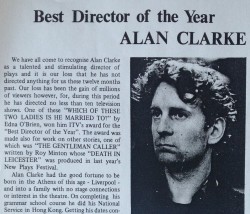
<p><img loading="lazy" decoding="async" src="http://www.britishtelevisiondrama.org.uk/wp-content/uploads/2016/03/1967_Clarke_Questopics_DirectorofYear_CROPPED-e1458141437844.jpg" alt="1967_Clarke_Questopics_DirectorofYear_CROPPED" width="250" height="214" class="alignleft size-full wp-image-6041" /><br />
Alan Clarke was neglected for a long time by television scholars and, because all but three of his approximately sixteen screen credits between 1967 and 1989 were for television, film scholars. This has changed in recent years: see Richard Kelly’s 1998 book of interviews<sup id="rf1-862"><a href="#fn1-862" title="Richard Kelly (editor), &lt;i&gt;Alan Clarke&lt;/i&gt; (London: Faber, 1998" rel="footnote">1</a></sup> and my book from 2005, the first (and, I hope, not last) critical study of Clarke’s work.<sup id="rf2-862"><a href="#fn2-862" title="Dave Rolinson, &lt;i&gt;Alan Clarke&lt;/i&gt; (Manchester: Manchester University Press, 2005)." rel="footnote">2</a></sup> Best of all, in May 2016, the vast majority of Clarke&#8217;s surviving work will be made available &#8211; much of it for the first time and some of it after previously being thought lost &#8211; in the BFI DVD and blu ray releases <a href="http://shop.bfi.org.uk/dissent-disruption-the-complete-alan-clarke-at-the-bbc-limited-edition-blu-ray-box-set.html#.Vul-jPmLSM8" target="_self" rel="noopener"><em>Dissent &#038; Disruption: Alan Clarke at the BBC</em></a>. Now everyone can find out what people have been so excited about. However, Clarke was first and foremost a television director, and as wonderful as it is that film fans are discovering Clarke, his work must be seen in the context of British television drama rather than as an aberration from it. Discussions of Clarke understandably prioritise his mid-to-late 1980s work, but this particular biography is designed to accompany the essays on this site about the dozen productions he made for <i>Play for Today</i>, which form around one-fifth of his total output. </p>

<hr class="footnotes"><ol class="footnotes" style="list-style-type:decimal"><li id="fn1-862"><p >Richard Kelly (editor), <i>Alan Clarke</i> (London: Faber, 1998&nbsp;<a href="#rf1-862" class="backlink" title="Return to footnote 1.">&#8617;</a></p></li><li id="fn2-862"><p >Dave Rolinson, <i>Alan Clarke</i> (Manchester: Manchester University Press, 2005).&nbsp;<a href="#rf2-862" class="backlink" title="Return to footnote 2.">&#8617;</a></p></li></ol></hr>{"id":862,"date":"2010-11-04T20:51:24","date_gmt":"2010-11-04T20:51:24","guid":{"rendered":"http:\/\/www.britishtelevisiondrama.org.uk\/?p=862"},"modified":"2024-08-30T11:48:34","modified_gmt":"2024-08-30T10:48:34","slug":"alan-clarke-play-for-today-biography","status":"publish","type":"post","link":"http:\/\/www.britishtelevisiondrama.org.uk\/?p=862","title":{"rendered":"Alan Clarke: <em>Play for Today<\/em> Biography"},"content":{"rendered":"<h4>by DAVID ROLINSON<\/h4>\n<p><img loading=\"lazy\" decoding=\"async\" src=\"http:\/\/www.britishtelevisiondrama.org.uk\/wp-content\/uploads\/2016\/03\/1967_Clarke_Questopics_DirectorofYear_CROPPED-e1458141437844.jpg\" alt=\"1967_Clarke_Questopics_DirectorofYear_CROPPED\" width=\"250\" height=\"214\" class=\"alignleft size-full wp-image-6041\" \/><br \/>\nAlan Clarke was neglected for a long time by television scholars and, because all but three of his approximately sixteen screen credits between 1967 and 1989 were for television, film scholars. This has changed in recent years: see Richard Kelly\u2019s 1998 book of interviews<sup id=\"rf1-862\"><a href=\"#fn1-862\" title=\"Richard Kelly (editor), &lt;i&gt;Alan Clarke&lt;\/i&gt; (London: Faber, 1998\" rel=\"footnote\">1<\/a><\/sup> and my book from 2005, the first (and, I hope, not last) critical study of Clarke\u2019s work.<sup id=\"rf2-862\"><a href=\"#fn2-862\" title=\"Dave Rolinson, &lt;i&gt;Alan Clarke&lt;\/i&gt; (Manchester: Manchester University Press, 2005).\" rel=\"footnote\">2<\/a><\/sup> Best of all, in May 2016, the vast majority of Clarke&#8217;s surviving work will be made available &#8211; much of it for the first time and some of it after previously being thought lost &#8211; in the BFI DVD and blu ray releases <a href=\"http:\/\/shop.bfi.org.uk\/dissent-disruption-the-complete-alan-clarke-at-the-bbc-limited-edition-blu-ray-box-set.html#.Vul-jPmLSM8\" target=\"_self\" rel=\"noopener\"><em>Dissent &#038; Disruption: Alan Clarke at the BBC<\/em><\/a>. Now everyone can find out what people have been so excited about. However, Clarke was first and foremost a television director, and as wonderful as it is that film fans are discovering Clarke, his work must be seen in the context of British television drama rather than as an aberration from it. Discussions of Clarke understandably prioritise his mid-to-late 1980s work, but this particular biography is designed to accompany the essays on this site about the dozen productions he made for <i>Play for Today<\/i>, which form around one-fifth of his total output. <\/p>\n<p><!--more--><\/p>\n<p>Elsewhere, I raised the argument that the television play could form a kind of \u2018studio system\u2019 in which directors could develop: few directors grasped this opportunity as powerfully as did Clarke,<sup id=\"rf3-862\"><a href=\"#fn3-862\" title=\"Dave Rolinson, &#8216;The Last Studio System: A Case For British Television Films&#8217;, in Paul Newland (editor), &lt;em&gt;Don&#8217;t Look Now: British Cinema of the 1970s&lt;\/em&gt; (Bristol: Intellect, 2010), pp. 164-176. See also the Introductory essay on &lt;em&gt;Play for Today&lt;\/em&gt; on this site.\" rel=\"footnote\">3<\/a><\/sup> whose <i>Play for Today<\/i> work epitomises W. Stephen Gilbert\u2019s description \u2013 in an obituary after Clarke\u2019s untimely death from cancer at the age of 54 \u2013 as \u2018an unswerving champion of the individual voice and the noncomformist vision\u2019.<sup id=\"rf4-862\"><a href=\"#fn4-862\" title=\"W. Stephen Gilbert, \u2018Alan Clarke\u2019 obituary, &lt;i&gt;Guardian&lt;\/i&gt;, 26 July 1990, p. 13. David Hare recalls Clarke making an analogy between 1930s and 40s Hollywood and the BBC as a place in which a director could do \u2018a lot of different work\u2019 &#8211; Kelly, &lt;i&gt;Alan Clarke&lt;\/i&gt;, p. 67.\" rel=\"footnote\">4<\/a><\/sup> These pieces give a hearing to the \u2018individual voice\u2019 of characters (often unsympathetic characters): underdogs, the institutionalised (<i>A Life is For Ever<\/i>, <i>A Follower for Emily<\/i>, <a href=\"http:\/\/www.britishtelevisiondrama.org.uk\/?p=3570\" target=\"_self\" rel=\"noopener\"><i>Funny Farm<\/i><\/a>, <i>Scum<\/i>) and the brutalised (<i>Nina<\/i>, <i>Psy-Warriors<\/i>). He became, in the phrase of David Hare, a \u2018driven filmmaker\u2019, motivated to speak \u2018on behalf of people whom he feels are getting a raw deal [and] by a passion to express what he doesn\u2019t see expressed anywhere else in the culture\u2019.<sup id=\"rf5-862\"><a href=\"#fn5-862\" title=\"&lt;i&gt;Alan Clarke &#8211; &#8216;His Own Man&#8217;&lt;\/i&gt;.\" rel=\"footnote\">5<\/a><\/sup><\/p>\n<p><img loading=\"lazy\" decoding=\"async\" src=\"http:\/\/www.britishtelevisiondrama.org.uk\/wp-content\/uploads\/2016\/03\/1959_Clarke_Ryerson_football-e1458141842818.jpg\" alt=\"1959_Clarke_Ryerson_football\" width=\"170\" height=\"300\" class=\"alignleft size-full wp-image-6046\" \/><br \/>\nLike several other key writers and directors from this period, Clarke came from a working-class background. The BFI\u2019s database records his birthplace as Seacombe.<sup id=\"rf6-862\"><a href=\"#fn6-862\" title=\"This corrects a statement I made in the 2003 version of this essay. For the BFI database, see http:\/\/www.bfi.org.uk\/filmtvinfo\/ftvdb\/.\" rel=\"footnote\">6<\/a><\/sup>) He passed his Eleven Plus to go to grammar school. Taking an unorthodox route into television, Clarke emigrated to Canada in 1957 (after National Service), and, according to the Questors Theatre\u2019s newsletter <i>Questopics<\/i>, had a \u2018masterfully improvised\u2019 career: \u2018furniture remover, income tax assessor, miner, railway brakesman and chain-ganger, baker\u2019s assistant, dance M.C. and a disc jockey at a skating rink\u2019.<sup id=\"rf7-862\"><a href=\"#fn7-862\" title=\"Anonymous (presumably Alfred Emmet), \u2018Best Director of the Year Alan Clarke\u2019, &lt;i&gt;Questopics&lt;\/i&gt;, February. Many thanks to Questors archivist Carla Field for this and other pieces on Clarke\u2019s theatre work.\" rel=\"footnote\">7<\/a><\/sup> <\/p>\n<p><img loading=\"lazy\" decoding=\"async\" src=\"http:\/\/www.britishtelevisiondrama.org.uk\/wp-content\/uploads\/2016\/03\/1950s_Ryerson_prospectus_1-e1458141789752.jpg\" alt=\"1950s_Ryerson_prospectus_1\" width=\"250\" height=\"210\" class=\"alignright size-full wp-image-6043\" \/><br \/>\nBetween 1958 and 1961 he studied Radio and Television Arts at the Ryerson Institute of Technology in Toronto, a pioneering course which gave him \u2018training in broadcast methods\u2019, including opportunities to make \u2018closed-circuit productions of which several are taped and kinescoped during the year for further telecasting by co-operating private television stations\u2019.<sup id=\"rf8-862\"><a href=\"#fn8-862\" title=\"Many thanks to John E Twomey, Professor Emeritus at Ryerson, for programmes of study and other helpful archive material from the Ryerson Institute of Technology.\" rel=\"footnote\">8<\/a><\/sup> <\/p>\n<p><img loading=\"lazy\" decoding=\"async\" src=\"http:\/\/www.britishtelevisiondrama.org.uk\/wp-content\/uploads\/2016\/03\/1961_Clarke_Ryerson_bio-e1458141821676.jpg\" alt=\"1961_Clarke_Ryerson_bio\" width=\"250\" height=\"404\" class=\"alignleft size-full wp-image-6044\" \/><br \/>\n<img loading=\"lazy\" decoding=\"async\" src=\"http:\/\/www.britishtelevisiondrama.org.uk\/wp-content\/uploads\/2016\/03\/1966_Questors_Clarke_Questopics-e1458141520752.jpg\" alt=\"1966_Questors_Clarke_Questopics\" width=\"250\" height=\"121\" class=\"alignright size-full wp-image-6042\" \/><br \/>\nReturning to Britain after graduation, Clarke worked as an Assistant Floor Manager at ATV and later Associated Rediffusion, on &nbsp;productions including <i>Ready Steady Go<\/i>. Between 1962 and 1966 he also directed various plays at the Questors Theatre in Ealing, and a touring production of James Saunders\u2019s <i>Neighbours<\/i>&nbsp;in Paris and Berlin. In my book I quote a &#8216;facetious&#8217; article that Clarke wrote for the Questors newsletter in response to speculation about his &#8216;striking&#8217; and &#8216;original&#8217; forthcoming production of <em>Macbeth<\/em>.<\/p>\n<p>At last gaining entry onto a director\u2019s course, Clarke served an apprenticeship directing Epilogues. At ITV between 1967 and 1969 Clarke directed plays for the strands <i>Half Hour Story<\/i> (1967-68), <i>Company of Five<\/i> (1968) and <i>Saturday Night Theatre (1969-71)<\/i>, and episodes of series: the Ian Hendry vehicle <i>The Informer<\/i> (1966-67), the hugely acclaimed serial <i>A Man Of Our Times<\/i> (1968) and the massively publicised hit <i>The Gold Robbers<\/i> (1969). His early work, particularly his plays with Alun Owen, were distinctive: ITV awarded him Director of the Year for 1967.<sup id=\"rf9-862\"><a href=\"#fn9-862\" title=\"Rolinson, &lt;i&gt;Alan Clarke&lt;\/i&gt;.\" rel=\"footnote\">9<\/a><\/sup> I&#8217;ve been delighted to return to his early work for Rediffusion for my own contributions to the <em>Dissent &#038; Disruption<\/em> release, some of them until recently thought lost (<em>The Gentleman Caller<\/em>, <em>The Fifty-Seventh Saturday<\/em>, <em>Thief<\/em> plus, for my own interest, half of <em>George&#8217;s Room<\/em>) and for pieces to come on this site.<\/p>\n<p>More biographically-based critics than myself have drawn correlations between the director and his productions. Like some of his protagonists, Clarke was an individual who collided with institutions: for the dissident Yuri in <i>Nina<\/i>, welcomed into a different class group in which his causes are empathised with but patronised, read Clarke the director and defender of threatened cuts to <i>Funny Farm<\/i> or the banning of <i>Scum<\/i>; for Trevor in <i>Made in Britain<\/i> hurling a paving stone through a Job Centre window, read Clarke, sometimes with writer Roy Minton, trashing restaurants or being arrested barely hours into arriving on location in Halifax. (see Richard Kelly\u2019s book for these and other stories).<sup id=\"rf10-862\"><a href=\"#fn10-862\" title=\"Kelly, &lt;i&gt;Alan Clarke&lt;\/i&gt;.\" rel=\"footnote\">10<\/a><\/sup> I&#8217;m less interested in those sorts of connections, although the sense of commitment is an element that his friends and collaborators have drawn attention to: he has often been described as \u2018his own man\u2019, a phrase reminiscent of Roy Minton&#8217;s description of the lead character of <i>Scum<\/i>: \u2018Carlin is his own man, not one of the shadows of this world. You meet him and you remember him\u2019.<sup id=\"rf11-862\"><a href=\"#fn11-862\" title=\"Roy Minton, Scum (London: Arrow Books, 1979), p. 14. (Page reference from 1982 edition.) \" rel=\"footnote\">11<\/a><\/sup><\/p>\n<p>Realist innovations are often associated with the extension of representation to previously neglected social groups, and, according to Stephen Frears, Clarke was attracted to the medium because \u2018one of the things that television told was the history of ordinary working-class people in England\u2019.<sup id=\"rf12-862\"><a href=\"#fn12-862\" title=\"&lt;i&gt;Alan Clarke &#8211; &#8216;His Own Man&#8217;&lt;\/i&gt;\" rel=\"footnote\">12<\/a><\/sup> Such concerns made Clarke synonymous with a tough, sparse observational style, and the visceral social realism and unyielding concern with institutional life that drove <i>Scum<\/i>. However, there is more to Clarke than this. His work was strikingly varied. He brought a masterful surety of tone to the colossal, mythic <i>Penda\u2019s Fen<\/i> and to the intimate emotion of <i>Diane<\/i> and <i>Nina<\/i>, which are just two examples of a strand of female-centred, female-titled and (in the case of <em>Nina<\/em> and others) female-authored. He also excelled with the disorienting <a href=\"https:\/\/blogs.reading.ac.uk\/spaces-of-television\/2014\/02\/24\/the-stripped-down-studio-space-play-for-today-psy-warriors-bbc-12581-centre-play-the-saliva-milkshake-bbc-6175\/\" target=\"_self\" rel=\"noopener\">studio conceptualising of <i>Psy-Warriors<\/i><\/a> and <i>Stars of the Roller State Disco <\/i>and<i>&nbsp;<\/i>his rigorous stagings of Alexander Solzhenitsyn\u2019s <i>The Love-Girl and the Innocent<\/i>, Georg B\u00fcchner\u2019s <i>Danton\u2019s Death<\/i> and Bertolt Brecht\u2019s <i>Baal<\/i>. Belying his reputation for mischief is the professionalism required to build such a vast output \u2013 David Hare speaks for many of Clarke\u2019s collaborators in saying that \u2018Underneath Alan\u2019s apparently casual manner \u2013 often late, often saying he didn\u2019t know what he was doing, scruffy, apparently undisciplined \u2013 hours and hours of thought had gone in, mostly at night, where he\u2019d been working on the script in bed at three o\u2019 clock in the morning\u2019.<sup id=\"rf13-862\"><a href=\"#fn13-862\" title=\"Ibid.\" rel=\"footnote\">13<\/a><\/sup><\/p>\n<p>He has been praised and cited as a major influence by various filmmakers. These include people who worked with him (such as Danny Boyle, Tim Roth and Gary Oldman), people who met him (Paul Greengrass), and people who simply admired his films (such as <a href=\"http:\/\/www.theguardian.com\/film\/2015\/aug\/13\/bill-hader-im-a-fraud-i-really-shouldnt-be-here-trainwreck-amy-schumer\" target=\"_self\" rel=\"noopener\">Bill Hader in 2015<\/a> and Shane Meadows, especially in <i>This is England<\/i> (2007) and its television sequels,<sup id=\"rf14-862\"><a href=\"#fn14-862\" title=\"See David Rolinson and Faye Woods, \u2018Is This England \u201986 and \u201988? Memory, haunting and return through television seriality\u2019, in Martin Fradley, Sarah Godfrey and Melanie Williams (editors), Shane Meadows: Critical Essays (Edinburgh University Press).\" rel=\"footnote\">14<\/a><\/sup> or Harmony Korine, whose namedropping prompted one critic to call Clarke the \u2018father of NYC cool\u2019).<sup id=\"rf15-862\"><a href=\"#fn15-862\" title=\"Mark Venner, \u2018\u2018I\u2019m the Daddy now! Or how great British realist Alan Clarke can be father of NYC cool\u2019 in &lt;i&gt;Film Ireland&lt;\/i&gt;, Number 83, October\/November 2001, pp. 20-23.\" rel=\"footnote\">15<\/a><\/sup> However, notwithstanding the occasional welcome comment such as Gavin Millar&#8217;s brief observation in 1983 that Clarke is &#8216;one of the best British directors around&#8217;,<sup id=\"rf16-862\"><a href=\"#fn16-862\" title=\"Gavin Millar, &#8216;British images&#8217;, &lt;em&gt;The Listener&lt;\/em&gt;, 2 June 1983, p. 37. But Millar is discussing the cinema version of &lt;em&gt;Scum&lt;\/em&gt;, broadcast on Channel Four that week.\" rel=\"footnote\">16<\/a><\/sup> in the wider film culture his work was ignored for too long \u2013 the film magazine <i>Cahiers du Cinema<\/i> seemed to discover a new talent after Clarke\u2019s <i>Elephant<\/i>(1989) was cited by Gus Van Sant as an influence on his own <i>Elephant<\/i> (2003).<sup id=\"rf17-862\"><a href=\"#fn17-862\" title=\"Jean-Philippe Tess\u00e9, \u2018De l\u2019origine d\u2019une esp\u00e8ce\u2019, &lt;i&gt;Cahiers du cinema&lt;\/i&gt;, October 2003, 15.\" rel=\"footnote\">17<\/a><\/sup> BAFTA\u2019s greatest honour to his work came posthumously, naming their Outstanding Creative Contribution to Television award after him. Some critics made polemical and perceptive claims for his greatness: David Thomson in his <em>Biographical Dictionary of Film<\/em> (in which some sacred cows of Hollywood and British cinema fare less well),<sup id=\"rf18-862\"><a href=\"#fn18-862\" title=\"&#8216;Alan Clarke\u2019, Biographical Dictionary of Film, London, Andr\u00e9 Deutsch, 1995 edition, pp. 131-133.\" rel=\"footnote\">18<\/a><\/sup> and Richard Kelly\u2019s invaluable passion, compiling a book of interviews and overseeing a two-month retrospective at the National Film Theatre in 2002, the point of both being to argue for Clarke as \u2018the most important British film-maker to have emerged in the last thirty years\u2019.<sup id=\"rf19-862\"><a href=\"#fn19-862\" title=\"Kelly, &lt;i&gt;Alan Clarke&lt;\/i&gt;, p. xxi. Mark Shivas bemoaned the lack of acknowledgement during Clarke\u2019s lifetime, remembering that he told Clarke that \u2018had he been called Clarkovsky rather than plain old Alan Clarke, he would have had an international reputation\u2019 &#8211; Ibid, pp. 225-226.\" rel=\"footnote\">19<\/a><\/sup> Like Ken Loach, during Clarke\u2019s lifetime he was more appreciated abroad, winning international television prizes.<\/p>\n<p>One explanation for Clarke\u2019s relative neglect by critics during his lifetime may be the perceived ephemerality of the television play. None of his television plays have been repeated on terrestrial television since 1991, and although all three of his cinema films (the <i>Scum<\/i> remake (1979), <i>Billy the Kid and the Green Baize Vampire<\/i> (1986) and <i>Rita, Sue and Bob Too<\/i> (1987)) have been released on DVD, releases of his television plays have been more haphazard, until the Blue Underground <i>Alan Clarke Collection<\/i> and, in 2016, <em>Dissent &#038; Disruption<\/em>. More work has been released in recent years: <em>Fast Hands<\/em> within <em>Plays for Britain<\/em>, <em>Horatio Bottomley<\/em> within <em>The Edwardians<\/em>, and his episode of <em>The Gold Robbers<\/em> within the release of that series. It\u2019s wonderful to see cinema screenings of his work &#8211; the most complete season to date is running at BFI Southbank in March and April 2016 &#8211; but until the <em>Dissent &#038; Disruption<\/em> set it seemed to conflict with Clarke&#8217;s engagement with audiences that we could only view some of his work in film archives or at cinema screenings: as David Thomson wrote of the NFT season in 2002, \u2018if only the season was playing where it ought to be, and where it is most needed \u2013 on the television screen\u2019.<sup id=\"rf20-862\"><a href=\"#fn20-862\" title=\"David Thomson, \u2018They don\u2019t make \u2018em like him anymore\u2019, &lt;i&gt;Independent on Sunday&lt;\/i&gt;, Arts Etc, 2 March 2002. See also \u2018Walkers in the world: Alan Clarke\u2019, &lt;i&gt;Film Comment&lt;\/i&gt;, 29:3, May-June 1993, pp. 78-83. Other Clarke retrospectives include Edinburgh in 1998 and London&#8217;s Riverside in 2005.\" rel=\"footnote\">20<\/a><\/sup> Film critics and academics (with notable exceptions like Julian Petley and John Hill) neglected television work with generalisations about it being \u2018uncinematic\u2019 (though this did not extend to European directors who worked for television, like Bernardo Bertolucci on <i>The Spider\u2019s Stratagem<\/i> (1970)) though Clarke, like Dennis Potter, may not have enjoyed the anti-television rhetoric of much current writing on television&#8217;s &#8216;cinematic&#8217; qualities.<\/p>\n<p>Even critics comfortable with television have found it hard to focus discussions of television dramas around their directors. Howard Schuman has summarised the reasons for this:<\/p>\n<blockquote><p>In the context of British television, the title \u2018director\u2019 invokes deeply ingrained prejudices. Auteurist critical approaches to the golden age of television drama\u2026 usually focus on the writer, because television prided itself on being a writers\u2019 medium. Directors were often regarded as little more than opinionated camera-movers.<sup id=\"rf21-862\"><a href=\"#fn21-862\" title=\"Howard Schuman, \u2018Alan Clarke: in it for life\u2019, &lt;i&gt;Sight and Sound&lt;\/i&gt;, 8:9, September 1998, p. 18.\" rel=\"footnote\">21<\/a><\/sup><\/p><\/blockquote>\n<p>I discuss academic debates on television directors as authors \u2013 the prioritisation of writers, the \u2018uncinematic\u2019 aesthetic debate and so on \u2013 in my book.<sup id=\"rf22-862\"><a href=\"#fn22-862\" title=\"See Rolinson, &lt;i&gt;Alan Clarke&lt;\/i&gt;. I tackle the subject more broadly in &lt;em&gt;Don&#8217;t Look Now&lt;\/em&gt;.\" rel=\"footnote\">22<\/a><\/sup> As of October 2015, there are twelve books in Manchester University Press\u2019s \u2018Television Series\u2019 of monographs about television authors, but most are about writers and only one (my 2005 book on  Clarke) on a director. However, even if his <i>Play for Today<\/i> work often demonstrates a director \u2018serving\u2019 the script, there is more to those plays than this indicates. If <i>Penda\u2019s Fen<\/i> is distinctively David Rudkin\u2019s vision, Rudkin has spoken highly of Clarke\u2019s treatment of it.<sup id=\"rf23-862\"><a href=\"#fn23-862\" title=\"For instance, when I conducted a Q&amp;A with David Rudkin on stage after a screening of &lt;i&gt;Penda\u2019s Fen&lt;\/i&gt; at Manchester Cornerhouse in October 2006.\" rel=\"footnote\">23<\/a><\/sup> Even when Clarke had work allocated to him by television\u2019s \u2018studio system\u2019, it helped him to develop according to David Thomson, who said Clarke was lucky \u2018to be a director in a writers\u2019 medium. Every film school in the world would benefit from seeing how a directorial personality can be sharpened and matured by keeping company with adventurous producers and good writing\u2019. Clarke learnt \u2018to acquire versatility with the camera and sure speed with the actors\u2019, and when his \u2018own style and preoccupations\u2019 emerged, \u2018they were all the stronger in their solid grounding\u2019.<sup id=\"rf24-862\"><a href=\"#fn24-862\" title=\"Thomson, &#8216;They don&#8217;t make &#8217;em like him any more&#8217;.\" rel=\"footnote\">24<\/a><\/sup> Emerge they did. As Simon Hattenstone argues, \u2018Although Clarke hardly ever wrote his own films, he was an auteur. He cajoled and teased every nuance out of the scripts, and the finished work always seemed to belong more to him than the writer\u2019.<sup id=\"rf25-862\"><a href=\"#fn25-862\" title=\"Simon Hattenstone, \u2018Hitting where it hurt\u2019, &lt;i&gt;Guardian&lt;\/i&gt;, \u2018Review\u2019 section, 1 August 1998, p. 4.\" rel=\"footnote\">25<\/a><\/sup> Many others would agree, including producer Mark Shivas, who felt that Clarke\u2019s work had \u2018an unmistakable individuality and authenticity\u2019 which made him \u2018a real auteur in a way that very few British directors are\u2019.<sup id=\"rf26-862\"><a href=\"#fn26-862\" title=\"Mark Shivas, postscript to David Hare, \u2018A camera for the people\u2019, &lt;i&gt;Guardian&lt;\/i&gt;, 27 July 1990, 35.\" rel=\"footnote\">26<\/a><\/sup><\/p>\n<p>This is a sound description of Clarke\u2019s later work in the 1980s, a brilliant sequence of filmed dramas which dissect Thatcher\u2019s Britain, shot through with formal innovation and his distinctively personal use of Steadicam: <i>Made in Britain<\/i> (1983), <i>Christine<\/i> (1987) and <i>Road<\/i> (1987), the Northern Ireland pieces <a href=\"http:\/\/www.britishtelevisiondrama.org.uk\/?p=2931\" target=\"_self\" rel=\"noopener\"><i>Contact<\/i> (1985)<\/a> and <i>Elephant<\/i>, and his final broadcast drama, <i>The Firm<\/i> (1989). His <i>Play for Today<\/i> work, even when recorded on multi-camera video and Outside Broadcast (which are less respected by critics) is not merely a foreshadowing of his later auteur period; indeed, the studio <i>Psy-Warriors<\/i> (1981) is  one of his most distinctive pieces.<\/p>\n<p>The balance between the voice and the vision, or, as Mark Shivas puts it, \u2018individuality and authenticity\u2019, epitomises his <i>Play for Today<\/i> work. \u2018Authenticity\u2019 sums up the near-to-the-knuckle performances, the researched journalistic drive behind his more overtly crusading pieces, a concern for the everyday realities of previously-undocumented lives, and a complex realist style which can balance observation of and a strident invitation to participate with his characters. The thematic concerns of these plays include authority and the inner space of individuals, institutionalisation, and incarceration in both literal and figurative terms. Promoting <i>Beloved Enemy<\/i> (1981), Clarke identified his interest in \u2018boxes \u2013 people being somewhere they don\u2019t want to be, or wanting to be somewhere they can\u2019t get into\u2019.<sup id=\"rf27-862\"><a href=\"#fn27-862\" title=\"Benedict Nightingale, \u2018Nasty business\u2019, &lt;i&gt;Radio Times&lt;\/i&gt;, 7-13 February 1981, p. 15.\" rel=\"footnote\">27<\/a><\/sup> It\u2019s appropriate that he should choose the imagery of a box, as arguably only Dennis Potter can rival his dedication to the box \u2013 television. Clarke exploited the freedom television drama (during this period of experimentation and institutional confidence) gave him in contrast to commercial cinema. Television mattered, and as a result Clarke leaves behind a tremendous body of work. Danny Boyle, director of <i>Trainspotting<\/i> (1996), <i>28 Days Later<\/i> (2002) and <i>Slumdog Millionaire<\/i> (2008), described Clarke as &#8216;one of the most gifted, innovative and radical British film-makers&#8217;, who &#8216;transcended the boundaries of his profession&#8217;,<sup id=\"rf28-862\"><a href=\"#fn28-862\" title=\"&lt;i&gt;Alan Clarke &#8211; His Own Man&#8217;&lt;\/i&gt;,documentary made by 400 Blows Productions, tx Film Four, 18 September 2000.\" rel=\"footnote\">28<\/a><\/sup> and Paul Greengrass, director of <i>Bloody Sunday<\/i> (2002), <i>United 93<\/i> (2006) and two <i>Bourne<\/i> films to date, has eulogised &#8216;unquestionably the finest body of work created by a British director&#8217;.<sup id=\"rf29-862\"><a href=\"#fn29-862\" title=\"Paul Greengrass, \u2018My Hero: Alan Clarke\u2019, &lt;i&gt;Guardian&lt;\/i&gt;, G2, 1 February 2002, p. 8.\" rel=\"footnote\">29<\/a><\/sup> Virtually all of it was made for, and facilitated by, British television, and his <i>Play for Today<\/i> productions are an esoteric, spiky and impressive part of that work.<\/em><\/p>\n<p><em>Originally posted: 6 September 2003 on the old Mausoleum Club version of this site.<br \/>\nUpdates:<br \/>\n2006: transferred to the old University of Hull version of this site.<br \/>\n2009: transferred to new Play for Today mini-site initially separate from the British Television Drama site<br \/>\n4 November 2010: transferred to main Play for Today site, with different URL<br \/>\n16 January 2014: added Millar quotation.<br \/>\n25 February 2014: very slight alteration to include link to February 2014 Psy-Warriors screening notes.<br \/>\n27 October 2015: rewrote some sections, moved some points to endnotes and deleted others, updated DVD release information, added Hader link and Meadows source.<br \/>\n16 March 2016: added college and theatre pictures from my own collection, cropped to respect their sources; rewrote introduction to mention 2016 releases; added mentions of the release and season elsewhere; added brief qualification to point about the &#8216;cinematic&#8217;; minor typographical revisions throughout.<br \/>\n31 March 2016: added one sentence to first paragraph to rework it and moved tribute quotations from first to final paragraph; replaced a few individual words throughout in order to reduce repetition (e.g. &#8216;dramas&#8217;) or clarify meaning of material added earlier in March.<br \/>\n4 March 2017: standardised presentation of &#8216;Updates&#8217; legacy information (2003, 2006, 2009, 2010) in line with current site practice; removed &#8216;(first published: 2003)&#8217; from byline as a result.<\/em><\/p>\n<p><!-- Start of StatCounter Code --><\/p>\n<p><script type=\"text\/javascript\">\nvar sc_project=5750652; \nvar sc_invisible=1; \nvar sc_partition=68; \nvar sc_click_stat=1; \nvar sc_security=\"6dd1aa39\"; \n<\/script><\/p>\n<p><script type=\"text\/javascript\" src=\"http:\/\/www.statcounter.com\/counter\/counter.js\"><\/script><noscript>&lt;br \/&gt;<br \/>\n&lt;div&lt;br &gt;&lt;\/div&gt;<br \/>\nclass=&#8221;statcounter&#8221;&gt;&lt;a title=&#8221;wordpress stats &#8220;&lt;br &gt;&lt;\/a&gt;&lt;br \/&gt;<br \/>\nhref=&#8221;http:\/\/www.statcounter.com\/wordpress.org\/&#8221;&lt;br \/&gt;&lt;br \/&gt;<br \/>\ntarget=&#8221;_blank&#8221;&gt;&lt;img class=&#8221;statcounter&#8221;&lt;br \/&gt;&lt;br \/&gt;<br \/>\nsrc=&#8221;http:\/\/c.statcounter.com\/5750652\/0\/6dd1aa39\/1\/&#8221;&lt;br \/&gt;&lt;br \/&gt;<br \/>\nalt=&#8221;wordpress stats &#8221; &gt;&lt;\/a&gt;&lt;\/div&gt;<br \/>\n&lt;p&gt;<\/noscript><\/p>\n<p><!-- End of StatCounter Code --><\/p>\n<p><\/em><em><\/em><em><\/em><em><\/em><em><\/em><\/p>\n<hr class=\"footnotes\"><ol class=\"footnotes\" style=\"list-style-type:decimal\"><li id=\"fn1-862\"><p >Richard Kelly (editor), <i>Alan Clarke<\/i> (London: Faber, 1998&nbsp;<a href=\"#rf1-862\" class=\"backlink\" title=\"Return to footnote 1.\">&#8617;<\/a><\/p><\/li><li id=\"fn2-862\"><p >Dave Rolinson, <i>Alan Clarke<\/i> (Manchester: Manchester University Press, 2005).&nbsp;<a href=\"#rf2-862\" class=\"backlink\" title=\"Return to footnote 2.\">&#8617;<\/a><\/p><\/li><li id=\"fn3-862\"><p >Dave Rolinson, &#8216;The Last Studio System: A Case For British Television Films&#8217;, in Paul Newland (editor), <em>Don&#8217;t Look Now: British Cinema of the 1970s<\/em> (Bristol: Intellect, 2010), pp. 164-176. See also the Introductory essay on <em>Play for Today<\/em> on this site.&nbsp;<a href=\"#rf3-862\" class=\"backlink\" title=\"Return to footnote 3.\">&#8617;<\/a><\/p><\/li><li id=\"fn4-862\"><p >W. Stephen Gilbert, \u2018Alan Clarke\u2019 obituary, <i>Guardian<\/i>, 26 July 1990, p. 13. David Hare recalls Clarke making an analogy between 1930s and 40s Hollywood and the BBC as a place in which a director could do \u2018a lot of different work\u2019 &#8211; Kelly, <i>Alan Clarke<\/i>, p. 67.&nbsp;<a href=\"#rf4-862\" class=\"backlink\" title=\"Return to footnote 4.\">&#8617;<\/a><\/p><\/li><li id=\"fn5-862\"><p ><i>Alan Clarke &#8211; &#8216;His Own Man&#8217;<\/i>.&nbsp;<a href=\"#rf5-862\" class=\"backlink\" title=\"Return to footnote 5.\">&#8617;<\/a><\/p><\/li><li id=\"fn6-862\"><p >This corrects a statement I made in the 2003 version of this essay. For the BFI database, see http:\/\/www.bfi.org.uk\/filmtvinfo\/ftvdb\/.&nbsp;<a href=\"#rf6-862\" class=\"backlink\" title=\"Return to footnote 6.\">&#8617;<\/a><\/p><\/li><li id=\"fn7-862\"><p >Anonymous (presumably Alfred Emmet), \u2018Best Director of the Year Alan Clarke\u2019, <i>Questopics<\/i>, February. Many thanks to Questors archivist Carla Field for this and other pieces on Clarke\u2019s theatre work.&nbsp;<a href=\"#rf7-862\" class=\"backlink\" title=\"Return to footnote 7.\">&#8617;<\/a><\/p><\/li><li id=\"fn8-862\"><p >Many thanks to John E Twomey, Professor Emeritus at Ryerson, for programmes of study and other helpful archive material from the Ryerson Institute of Technology.&nbsp;<a href=\"#rf8-862\" class=\"backlink\" title=\"Return to footnote 8.\">&#8617;<\/a><\/p><\/li><li id=\"fn9-862\"><p >Rolinson, <i>Alan Clarke<\/i>.&nbsp;<a href=\"#rf9-862\" class=\"backlink\" title=\"Return to footnote 9.\">&#8617;<\/a><\/p><\/li><li id=\"fn10-862\"><p >Kelly, <i>Alan Clarke<\/i>.&nbsp;<a href=\"#rf10-862\" class=\"backlink\" title=\"Return to footnote 10.\">&#8617;<\/a><\/p><\/li><li id=\"fn11-862\"><p >Roy Minton, Scum (London: Arrow Books, 1979), p. 14. (Page reference from 1982 edition.) &nbsp;<a href=\"#rf11-862\" class=\"backlink\" title=\"Return to footnote 11.\">&#8617;<\/a><\/p><\/li><li id=\"fn12-862\"><p ><i>Alan Clarke &#8211; &#8216;His Own Man&#8217;<\/i>&nbsp;<a href=\"#rf12-862\" class=\"backlink\" title=\"Return to footnote 12.\">&#8617;<\/a><\/p><\/li><li id=\"fn13-862\"><p >Ibid.&nbsp;<a href=\"#rf13-862\" class=\"backlink\" title=\"Return to footnote 13.\">&#8617;<\/a><\/p><\/li><li id=\"fn14-862\"><p >See David Rolinson and Faye Woods, \u2018Is This England \u201986 and \u201988? Memory, haunting and return through television seriality\u2019, in Martin Fradley, Sarah Godfrey and Melanie Williams (editors), Shane Meadows: Critical Essays (Edinburgh University Press).&nbsp;<a href=\"#rf14-862\" class=\"backlink\" title=\"Return to footnote 14.\">&#8617;<\/a><\/p><\/li><li id=\"fn15-862\"><p >Mark Venner, \u2018\u2018I\u2019m the Daddy now! Or how great British realist Alan Clarke can be father of NYC cool\u2019 in <i>Film Ireland<\/i>, Number 83, October\/November 2001, pp. 20-23.&nbsp;<a href=\"#rf15-862\" class=\"backlink\" title=\"Return to footnote 15.\">&#8617;<\/a><\/p><\/li><li id=\"fn16-862\"><p >Gavin Millar, &#8216;British images&#8217;, <em>The Listener<\/em>, 2 June 1983, p. 37. But Millar is discussing the cinema version of <em>Scum<\/em>, broadcast on Channel Four that week.&nbsp;<a href=\"#rf16-862\" class=\"backlink\" title=\"Return to footnote 16.\">&#8617;<\/a><\/p><\/li><li id=\"fn17-862\"><p >Jean-Philippe Tess\u00e9, \u2018De l\u2019origine d\u2019une esp\u00e8ce\u2019, <i>Cahiers du cinema<\/i>, October 2003, 15.&nbsp;<a href=\"#rf17-862\" class=\"backlink\" title=\"Return to footnote 17.\">&#8617;<\/a><\/p><\/li><li id=\"fn18-862\"><p >&#8216;Alan Clarke\u2019, Biographical Dictionary of Film, London, Andr\u00e9 Deutsch, 1995 edition, pp. 131-133.&nbsp;<a href=\"#rf18-862\" class=\"backlink\" title=\"Return to footnote 18.\">&#8617;<\/a><\/p><\/li><li id=\"fn19-862\"><p >Kelly, <i>Alan Clarke<\/i>, p. xxi. Mark Shivas bemoaned the lack of acknowledgement during Clarke\u2019s lifetime, remembering that he told Clarke that \u2018had he been called Clarkovsky rather than plain old Alan Clarke, he would have had an international reputation\u2019 &#8211; Ibid, pp. 225-226.&nbsp;<a href=\"#rf19-862\" class=\"backlink\" title=\"Return to footnote 19.\">&#8617;<\/a><\/p><\/li><li id=\"fn20-862\"><p >David Thomson, \u2018They don\u2019t make \u2018em like him anymore\u2019, <i>Independent on Sunday<\/i>, Arts Etc, 2 March 2002. See also \u2018Walkers in the world: Alan Clarke\u2019, <i>Film Comment<\/i>, 29:3, May-June 1993, pp. 78-83. Other Clarke retrospectives include Edinburgh in 1998 and London&#8217;s Riverside in 2005.&nbsp;<a href=\"#rf20-862\" class=\"backlink\" title=\"Return to footnote 20.\">&#8617;<\/a><\/p><\/li><li id=\"fn21-862\"><p >Howard Schuman, \u2018Alan Clarke: in it for life\u2019, <i>Sight and Sound<\/i>, 8:9, September 1998, p. 18.&nbsp;<a href=\"#rf21-862\" class=\"backlink\" title=\"Return to footnote 21.\">&#8617;<\/a><\/p><\/li><li id=\"fn22-862\"><p >See Rolinson, <i>Alan Clarke<\/i>. I tackle the subject more broadly in <em>Don&#8217;t Look Now<\/em>.&nbsp;<a href=\"#rf22-862\" class=\"backlink\" title=\"Return to footnote 22.\">&#8617;<\/a><\/p><\/li><li id=\"fn23-862\"><p >For instance, when I conducted a Q&amp;A with David Rudkin on stage after a screening of <i>Penda\u2019s Fen<\/i> at Manchester Cornerhouse in October 2006.&nbsp;<a href=\"#rf23-862\" class=\"backlink\" title=\"Return to footnote 23.\">&#8617;<\/a><\/p><\/li><li id=\"fn24-862\"><p >Thomson, &#8216;They don&#8217;t make &#8217;em like him any more&#8217;.&nbsp;<a href=\"#rf24-862\" class=\"backlink\" title=\"Return to footnote 24.\">&#8617;<\/a><\/p><\/li><li id=\"fn25-862\"><p >Simon Hattenstone, \u2018Hitting where it hurt\u2019, <i>Guardian<\/i>, \u2018Review\u2019 section, 1 August 1998, p. 4.&nbsp;<a href=\"#rf25-862\" class=\"backlink\" title=\"Return to footnote 25.\">&#8617;<\/a><\/p><\/li><li id=\"fn26-862\"><p >Mark Shivas, postscript to David Hare, \u2018A camera for the people\u2019, <i>Guardian<\/i>, 27 July 1990, 35.&nbsp;<a href=\"#rf26-862\" class=\"backlink\" title=\"Return to footnote 26.\">&#8617;<\/a><\/p><\/li><li id=\"fn27-862\"><p >Benedict Nightingale, \u2018Nasty business\u2019, <i>Radio Times<\/i>, 7-13 February 1981, p. 15.&nbsp;<a href=\"#rf27-862\" class=\"backlink\" title=\"Return to footnote 27.\">&#8617;<\/a><\/p><\/li><li id=\"fn28-862\"><p ><i>Alan Clarke &#8211; His Own Man&#8217;<\/i>,documentary made by 400 Blows Productions, tx Film Four, 18 September 2000.&nbsp;<a href=\"#rf28-862\" class=\"backlink\" title=\"Return to footnote 28.\">&#8617;<\/a><\/p><\/li><li id=\"fn29-862\"><p >Paul Greengrass, \u2018My Hero: Alan Clarke\u2019, <i>Guardian<\/i>, G2, 1 February 2002, p. 8.&nbsp;<a href=\"#rf29-862\" class=\"backlink\" title=\"Return to footnote 29.\">&#8617;<\/a><\/p><\/li><\/ol><\/hr>","protected":false},"excerpt":{"rendered":null,"protected":false},"author":1,"featured_media":0,"comment_status":"open","ping_status":"open","sticky":false,"template":"","format":"standard","meta":{"footnotes":""},"categories":[13,140],"tags":[35,462,85,86,81,16,42],"class_list":["post-862","post","type-post","status-publish","format-standard","hentry","category-biographies","category-david-rolinson","tag-alan-clarke","tag-biographies","tag-david-hare","tag-david-rudkin","tag-drama-documentary","tag-play-for-today","tag-stephen-frears"],"_links":{"self":[{"href":"http:\/\/www.britishtelevisiondrama.org.uk\/index.php?rest_route=\/wp\/v2\/posts\/862","targetHints":{"allow":["GET"]}}],"collection":[{"href":"http:\/\/www.britishtelevisiondrama.org.uk\/index.php?rest_route=\/wp\/v2\/posts"}],"about":[{"href":"http:\/\/www.britishtelevisiondrama.org.uk\/index.php?rest_route=\/wp\/v2\/types\/post"}],"author":[{"embeddable":true,"href":"http:\/\/www.britishtelevisiondrama.org.uk\/index.php?rest_route=\/wp\/v2\/users\/1"}],"replies":[{"embeddable":true,"href":"http:\/\/www.britishtelevisiondrama.org.uk\/index.php?rest_route=%2Fwp%2Fv2%2Fcomments&post=862"}],"version-history":[{"count":62,"href":"http:\/\/www.britishtelevisiondrama.org.uk\/index.php?rest_route=\/wp\/v2\/posts\/862\/revisions"}],"predecessor-version":[{"id":8324,"href":"http:\/\/www.britishtelevisiondrama.org.uk\/index.php?rest_route=\/wp\/v2\/posts\/862\/revisions\/8324"}],"wp:attachment":[{"href":"http:\/\/www.britishtelevisiondrama.org.uk\/index.php?rest_route=%2Fwp%2Fv2%2Fmedia&parent=862"}],"wp:term":[{"taxonomy":"category","embeddable":true,"href":"http:\/\/www.britishtelevisiondrama.org.uk\/index.php?rest_route=%2Fwp%2Fv2%2Fcategories&post=862"},{"taxonomy":"post_tag","embeddable":true,"href":"http:\/\/www.britishtelevisiondrama.org.uk\/index.php?rest_route=%2Fwp%2Fv2%2Ftags&post=862"}],"curies":[{"name":"wp","href":"https:\/\/api.w.org\/{rel}","templated":true}]}}