<h4>by DAVID ROLINSON</h4>
<p><em>Play for Today </em><strong>Writer:</strong> Alan Bennett; <b>Director:</b> Stephen Frears; <b>Producer:</b> Innes Lloyd</p>
<blockquote><p><em>&#8216;Knocking-off time&#8230;&#8217;</em></p></blockquote>
<p><img loading="lazy" decoding="async" src="http://www.britishtelevisiondrama.org.uk/wp-content/uploads/2017/01/BTVD_Sunset_sunset-e1485162566373.png" alt="" width="250" height="188" class="alignleft size-full wp-image-6575" /></p>
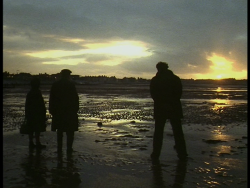
<p><i>Sunset Across the Bay</i> follows a retired couple who move from Leeds to the seaside resort of Morecambe. Their struggle to adapt to retirement produces humour through the observation of Northern dialogue and idiosyncrasies, but moves towards tragedy.<sup id="rf1-919"><a href="#fn1-919" title="This essay owes a debt of gratitude to the Arts and Humanities Research Council, who provided me with vital research leave in 2008 to research the films of Stephen Frears." rel="footnote">1</a></sup> One of many impressive collaborations between writer Alan Bennett and director Stephen Frears, the play combines understated emotional power and a sense of the social impact of urban planning with a skilful deployment of technique that builds mood, character and theme.</p>

<hr class="footnotes"><ol class="footnotes" style="list-style-type:decimal"><li id="fn1-919"><p >This essay owes a debt of gratitude to the Arts and Humanities Research Council, who provided me with vital research leave in 2008 to research the films of Stephen Frears.&nbsp;<a href="#rf1-919" class="backlink" title="Return to footnote 1.">&#8617;</a></p></li></ol></hr>{"id":919,"date":"2010-11-04T22:11:04","date_gmt":"2010-11-04T22:11:04","guid":{"rendered":"http:\/\/www.britishtelevisiondrama.org.uk\/?p=919"},"modified":"2024-08-30T11:47:15","modified_gmt":"2024-08-30T10:47:15","slug":"play-for-today-sunset-across-the-bay-1975","status":"publish","type":"post","link":"http:\/\/www.britishtelevisiondrama.org.uk\/?p=919","title":{"rendered":"<em>Sunset Across the Bay<\/em> (1975)"},"content":{"rendered":"<h4>by DAVID ROLINSON<\/h4>\n<p><em>Play for Today <\/em><strong>Writer:<\/strong> Alan Bennett; <b>Director:<\/b> Stephen Frears; <b>Producer:<\/b> Innes Lloyd<\/p>\n<blockquote><p><em>&#8216;Knocking-off time&#8230;&#8217;<\/em><\/p>\n<\/blockquote>\n<p><img loading=\"lazy\" decoding=\"async\" src=\"http:\/\/www.britishtelevisiondrama.org.uk\/wp-content\/uploads\/2017\/01\/BTVD_Sunset_sunset-e1485162566373.png\" alt=\"\" width=\"250\" height=\"188\" class=\"alignleft size-full wp-image-6575\" \/><\/p>\n<p><i>Sunset Across the Bay<\/i> follows a retired couple who move from Leeds to the seaside resort of Morecambe. Their struggle to adapt to retirement produces humour through the observation of Northern dialogue and idiosyncrasies, but moves towards tragedy.<sup id=\"rf1-919\"><a href=\"#fn1-919\" title=\"This essay owes a debt of gratitude to the Arts and Humanities Research Council, who provided me with vital research leave in 2008 to research the films of Stephen Frears.\" rel=\"footnote\">1<\/a><\/sup> One of many impressive collaborations between writer Alan Bennett and director Stephen Frears, the play combines understated emotional power and a sense of the social impact of urban planning with a skilful deployment of technique that builds mood, character and theme.<\/p>\n<p><!--more--><\/p>\n<p>The play (if not the published script) opens with Mrs Liversidge\u2019s spiritedly inept performance of Ivor Novello\u2019s <i>We\u2019ll Gather Lilacs in the Spring Again<\/i>.<sup id=\"rf2-919\"><a href=\"#fn2-919\" title=\"This scene is absent from Bennett (2003), p. 33.\" rel=\"footnote\">2<\/a><\/sup> Its heightened, \u2018florid\u2019 delivery is so different from Mam and Dad\u2019s prosaic understatement that it has been called an \u2018ironic prologue\u2019.<sup id=\"rf3-919\"><a href=\"#fn3-919\" title=\"O\u2019 Mealy, p. 21. Indeed, Dad makes clear his distaste for another Mrs Liversidge performance later in the play.\" rel=\"footnote\">3<\/a><\/sup> However, the song\u2019s lyrics anticipate key moments (\u2018never leave me\u2019\u2026 \u2018when you come home once more\u2019), create a relevant sense of moving on by looking backwards (gathering lilacs &#8216;again&#8217;) and foreshadow Mam&#8217;s moment of articulacy in the Lake District later, when she performs a poem featuring daffodils.<\/p>\n<p>We first see Mam and Dad in bed in their Victorian terraced house in Leeds, with mise-en-scene and sound reinforcing ideas in Bennett&#8217;s dialogue: for instance, we pan with his hand as he looks at his watch while we hear a distant bell, drawing attention to time as he does not have long left at work (or, more morbidly, at all), with a life governed by routine. The tweaking of Dad\u2019s line from \u2018I\u2019m not retired yet\u2019 to \u2018We\u2019re not retired yet\u2019 reminds us that Mam\u2019s life is changing too.<sup id=\"rf4-919\"><a href=\"#fn4-919\" title=\"Alan Bennett, script (2003), p. 33. Because the published version of Bennett\u2019s script does not indicate drafts and process, I will only comment on differences between it and the final play when they reveal something that helps to read the play.\" rel=\"footnote\">4<\/a><\/sup> Framing and soundtrack remind us of work routine in the Leeds scenes, with details that are absent when we get to Morecambe but, as Kara McKechnie observes, that Leeds\/Morecambe contrast should not hide the sense that their relocation just increases \u2018their displacement in a world that has already ceased to be theirs\u2019.<sup id=\"rf5-919\"><a href=\"#fn5-919\" title=\"Kara McKechnie, &lt;i&gt;Alan Bennett&lt;\/i&gt; (Manchester: Manchester University Press, 2007), p. 59.\" rel=\"footnote\">5<\/a><\/sup><\/p>\n<p>The characters\u2019 landscape is expressed in the next few scenes. Mam visits a friend in a \u2018half-demolished, half-developed slum area in Leeds\u2019, and has a \u2018slow and disconnected\u2019 conversation, between two people who \u2018aren\u2019t really talking to one another, or listening much\u2019.<sup id=\"rf6-919\"><a href=\"#fn6-919\" title=\"Bennett (2003), p. 33\" rel=\"footnote\">6<\/a><\/sup> This is evoked by Frears shooting from outside the council flat, placing Mam and her friend in separate window panes (while the railway noise requested in the script reminds us that working life goes on), and confines Mam in the frame (as windows often do during the play): visuals and performance replace Bennett\u2019s omitted line \u2018I\u2019m smothered in here\u2019.<sup id=\"rf7-919\"><a href=\"#fn7-919\" title=\"Bennett (2003), p. 34\" rel=\"footnote\">7<\/a><\/sup> <i>Sunset Across the Bay<\/i> shares themes with Alan Plater and Brian Parker&#8217;s <i>Land of Green Ginger<\/i>, a <i>Play for Today<\/i> shot in 1972 just 60-odd miles away in Hull.<sup id=\"rf8-919\"><a href=\"#fn8-919\" title=\"Compare, for instance, Plater&#8217;s play&#8217;s depiction of relocation from Hessle Road to Bransholme, with Mam&#8217;s view here that \u2018I wouldn\u2019t go in one of them tall blocks. Moortown, Seacroft. I don\u2019t want to be dumped on the outskirts.\u2019\" rel=\"footnote\">8<\/a><\/sup> There, characters relocated to new estates coped with enforced relocation, whose negative effects were considered by Plater<sup id=\"rf9-919\"><a href=\"#fn9-919\" title=\"See this site\u2019s interview with Alan Plater &lt;a href=&quot;http:\/\/britishtelevisiondrama.org.uk\/playfortoday\/land-of-green-ginger-alan-plater01&quot; target=&quot;_top&quot; rel=&quot;noopener&quot;&gt;here&lt;\/a&gt;.\" rel=\"footnote\">9<\/a><\/sup> in light of Jane Jacobs\u2019s pioneering urban planning study <i>The Life and Death of Great American Cities<\/i>, which saw people \u2018expropriated, and uprooted much as if they were the subjects of a conquering power\u2019.<sup id=\"rf10-919\"><a href=\"#fn10-919\" title=\"Jane Jacobs, &lt;i&gt;The Life and Death of Great American Cities&lt;\/i&gt; (New York: Vintage, 1961). Page references from 1989 edition.\" rel=\"footnote\">10<\/a><\/sup> Jacobs argued the need for walkable streets, estates \u2018rewoven back into the fabric\u2019 of cities, and commercial, cultural and social \u2018diversity\u2019<sup id=\"rf11-919\"><a href=\"#fn11-919\" title=\"Ibid, p. 92\" rel=\"footnote\">11<\/a><\/sup> rather than fixed \u2018cultural zones\u2019. Bennett&#8217;s line about walking the street without seeing \u2018a person to speak to\u2019, or the wish of one resident to punish the architect, chimes with Jacobs and Plater.<\/p>\n<p><img loading=\"lazy\" decoding=\"async\" src=\"http:\/\/www.britishtelevisiondrama.org.uk\/wp-content\/uploads\/2017\/01\/BTVD_Sunset_work-e1485162614755.png\" alt=\"\" width=\"250\" height=\"188\" class=\"alignleft size-full wp-image-6579\" \/><\/p>\n<p>Dad\u2019s walk home from his last day of work at Whitaker&#8217;s is highly significant, and is more than the \u2018montage\u2019 suggested in the script.<sup id=\"rf12-919\"><a href=\"#fn12-919\" title=\"Bennett (2003), p. 35\" rel=\"footnote\">12<\/a><\/sup> Dad&#8217;s walk may bring to mind \u2018walking\u2019 scenes in Italian neo-realist or British New Wave films but this is not Arthur Seaton asserting his youthful masculinity across industrial landscapes in Karel Reisz\u2019s <i>Saturday Night and Sunday Morning<\/i> (1960). The shots are largely static, often featuring empty frames into which Dad walks, usually small in the bottom quarter of compositions which are built in horizontal quarters or thirds (sky\/background buildings; mid-ground roads or canals; foreground grass, path or waste land). The shot is held while Dad crosses the frame (generally from right to left) then leaves or nears its edge before a cut to a similar shot. This style is used again in Morecambe scenes, its similarities flagging up differences in Dad\u2019s situation. During his walk, Dad has an internal monologue (not in the published script). He is not sorry about retiring, but reminisces about Whitaker&#8217;s building tanks during the Second World War, during which there is a sense of purpose in work and concern about its loss (even the title of the radio programme that visited his workplace, as it did many others, hints at retirement: <i>Worker&#8217;s Playtime<\/i>). The depth of compositions in this sequence disproves the critical stereotype of television drama as an inherently small-screen form that cannot centre meaning in mise-en-sc\u00e9ne.<sup id=\"rf13-919\"><a href=\"#fn13-919\" title=\"For more on this, see Dave Rolinson, \u2018The last studio system: a case for British television films\u2019, in Paul Newland (editor), &lt;i&gt;Don\u2019t Look Now: British Cinema of the 1970s&lt;\/i&gt; (forthcoming, Intellect, 2010).\" rel=\"footnote\">13<\/a><\/sup><\/p>\n<p>Leeds location filming and voice-overs combine again to place images of demolition and new construction alongside Dad\u2019s thoughts about Leeds being founded by monks who set up what became Kirkstall Abbey (echoing Bennett\u2019s expertise in medieval history) and confusion about which street a flyover replaced. This geographical disorientation underlines the changes that he will experience to his actual and metaphorical landscape. The remorselessness of change is stressed through editing, with rhyming cuts between flyovers and barriers, and an interest in motorways as a problematic symbol of progress, as in Rhys Adrian\u2019s <i>The Foxtrot<\/i>.<sup id=\"rf14-919\"><a href=\"#fn14-919\" title=\"See &lt;a href=&quot;http:\/\/britishtelevisiondrama.org.uk\/playfortoday\/the-foxtrot&quot; target=&quot;_top&quot; rel=&quot;noopener&quot;&gt;our essay on &lt;i&gt;The Foxtrot&lt;\/i&gt;\" rel=\"footnote\">14<\/a><\/sup> Dad\u2019s thoughts replace Bennett\u2019s published sequence of city centre images over which Mam spoke a voice-over about change,<sup id=\"rf15-919\"><a href=\"#fn15-919\" title=\"Bennett 2003, pp. 36-37\" rel=\"footnote\">15<\/a><\/sup> seeing \u2018no pleasure\u2019 in shopping when cars are prioritised over people. The further omission of another Mam voice-over<sup id=\"rf16-919\"><a href=\"#fn16-919\" title=\"This speech concerns boarding houses. Bennett (2003), p. 49.\" rel=\"footnote\">16<\/a><\/sup> denies us a sense of Mam\u2019s thoughts, which gives a sense of Dad\u2019s voice dominating (indeed he directs us &#8211; when he says &#8216;look at it&#8217;, we do) and will add ambiguity to the play\u2019s final scenes.<\/p>\n<p>Like <i>Land of Green Ginger<\/i>, <i>Sunset Across the Bay<\/i> shifts from personal experience to social critique. Plater had earlier written factual pieces on Hull\u2019s architecture, and Bennett later wrote about Leeds, noting that in the 1960s \u2018avarice and stupidity got to the wheel of the bulldozer\u2019, and ruined the chance for Leeds to become an \u2018architectural showpiece\u2019, instead it was just replumbed and made \u2018like anywhere else\u2019.<sup id=\"rf17-919\"><a href=\"#fn17-919\" title=\"Bennett (2005), pp. 501-502\" rel=\"footnote\">17<\/a><\/sup> In a piece on Leeds&#8217;s County Arcade (a shopping area, thereby echoing his unused voice-over for Mam), Bennett lamented \u2018architectural murder\u2019.<sup id=\"rf18-919\"><a href=\"#fn18-919\" title=\"Bennett (2005), p. 520\" rel=\"footnote\">18<\/a><\/sup><\/p>\n<p><img loading=\"lazy\" decoding=\"async\" src=\"http:\/\/www.britishtelevisiondrama.org.uk\/wp-content\/uploads\/2017\/01\/BTVD_Sunset_bed-e1485162587430.png\" alt=\"\" width=\"250\" height=\"188\" class=\"alignleft size-full wp-image-6577\" \/><\/p>\n<p>Dad explains their Morecambe move while on the allotments (Bennett recalled former music-hall star Albert Modley\u2019s role as Dad\u2019s friend in this scene, including the tricky negotiation of Modley\u2019s reliance on his famous prop hat and catchphrase).<sup id=\"rf19-919\"><a href=\"#fn19-919\" title=\"Bennett, who had seen Modley on stage, felt he was \u2018covering up his uncertainty\u2019 with his old devices of \u2018laughing and stock phrases like \u201cBy! It\u2019s a beggar is this\u201d, but felt it was \u2018entirely authentic\u2019 until Mrs Modley insisted Modley be allowed to wear \u2018The Cap\u2019 from his music-hall days so that the audience would recognise him. Due to subterfuge from the cameraman regarding which were rehearsal shots and which filmed, Modley \u2018proceeded to act his socks off\u2019 but \u2018there was actually no film in the camera\u2019 \u2013 Bennett (2005), pp. 420, 422.\" rel=\"footnote\">19<\/a><\/sup> But tensions show in a bed conversation between Mam and Dad, with Mam&#8217;s nostalgic rendering of a song (on Empire Day, itself a marker of former glories) plus gossip about scandal which prompts a past-tense exchange: Mam&#8217;s comment that &#8216;we were happy&#8217; and Dad&#8217;s snapped reply, &#8216;I&#8217;m not saying we weren&#8217;t&#8217;. The scene ends with Mam only just noticing a crack in the ceiling that looks like \u2018a man spoking a pipe\u2019: a lovely Bennett touch that also implies that Mam may be the only one noticing cracks between them.<\/p>\n<p><img loading=\"lazy\" decoding=\"async\" src=\"http:\/\/www.britishtelevisiondrama.org.uk\/wp-content\/uploads\/2017\/01\/BTVD_Sunset_demolition-e1485162576730.png\" alt=\"\" width=\"250\" height=\"188\" class=\"alignleft size-full wp-image-6576\" \/><\/p>\n<p>Leaving, they pass other houses being torn down in this wave of so-called slum clearances (although Mam speaks against &#8216;vandals that live out at Adel and Lawnswood&#8217; who make these decisions). Their journey combines the humour of Mam&#8217;s interest in the coach&#8217;s toilet (Dad doesn&#8217;t need to use it, so she chides him for having &#8216;no spirit of adventure&#8217;), and apparent optimism about the relocation (&#8216;bye bye, mucky Leeds&#8217;) reflected in jolly organ music, with a nagging sense of doubt conveyed by composition and editing, not least a cutaway back to the old house, barred and confining, scored by the organ music ending on an ominous chord. Michael Brooke argues that \u2018Their world has vanished literally as well as metaphorically\u2026 They don\u2019t want to move forward but they can\u2019t move back, so they remain in a limbo\u2019.<sup id=\"rf20-919\"><a href=\"#fn20-919\" title=\"Michael Brooke, &lt;a href=&quot;http:\/\/www.screenonline.org.uk\/tv\/id\/962951\/index.html&quot; target=&quot;_top&quot; rel=&quot;noopener&quot;&gt;&#8216;&lt;i&gt;Sunset Across the Bay&lt;\/i&gt;&#8216;&lt;\/a&gt;, &lt;i&gt;Screenonline&lt;\/i&gt;.\" rel=\"footnote\">20<\/a><\/sup><\/p>\n<p>Morecambe: more to come? Mam and Dad encounter a well-meaning, nosy landlady, and old neighbours who watch life through windows (shots sometimes parallel them with Mam). Mam and Dad face changes in routine: trying to get a Leeds newspaper, thinking it too late in life to discover yoghurt, drinking tea at 2 a.m. because they are \u2018retired now\u2019 and, most pointedly, Dad going for a walk at 7.30 a.m., altered from the script&#8217;s 6.00 a.m., which was a time even more indicative of work.<sup id=\"rf21-919\"><a href=\"#fn21-919\" title=\"Bennett (2003), p. 46.\" rel=\"footnote\">21<\/a><\/sup> Editing and compositions resemble his earlier walk home from Whitaker&#8217;s &#8211; for instance, shots in which sky occupies the top third of frames where the urban landscape was earlier, as a result of which, according to Kara McKechnie, \u2018Once in Morecambe, open, sparse frames dominate the style\u2019 &#8211; similarities heighten differences. Retirement \u2018destabilises the comfortable routine of their life together\u2019.<sup id=\"rf22-919\"><a href=\"#fn22-919\" title=\"McKechnie, p. 60.\" rel=\"footnote\">22<\/a><\/sup> Dad occasionally chats with or just watches other working men, but at first is, according to Bennett\u2019s script, \u2018breathing in and obviously enjoying himself\u2019.<sup id=\"rf23-919\"><a href=\"#fn23-919\" title=\"Bennett 2003, p. 46.\" rel=\"footnote\">23<\/a><\/sup><\/p>\n<p>Mam and Dad meet a woman at a bus shelter looking out at the sea, and although her conversation (&#8216;I have my main meal at night&#8217;) makes Dad call her a &#8216;boring woman&#8217;, as if she has not adapted to losing her husband (Dad wonders if it was &#8216;a happy release&#8217;), she has been more successful at maintaining normality after a life-changing event. Her lack of a husband (flagged up in a symmetrical shot opposite Mam and Dad) serves also to foreshadow Dad\u2019s later departure (which makes Dad\u2019s \u2018happy release\u2019 jibe more affecting). Also, the woman displays unexpected depths, returning (not in the published script) to ask: \u2018Have you ever thought about the sea?&#8230; How wonderful it is. It comes in, and it goes out\u2019. Dad\u2019s reply is prosaic \u2013 \u2018It\u2019s the tides. It\u2019s to do with the moon\u2019 \u2013 but the boring woman thinks \u2018people take it too much for granted\u2019, a pointed moment given that Mam then engages Dad with a less poetic topic of debate (\u2018Look at that feller\u2019s trousers\u2019). Mam, whom Dad elsewhere chides for being \u2018morbid\u2019 for talking about their age, may be tactically changing the subject. When Dad is not around, the boring woman speaks about her decision to stop resuscitating her husband, as he \u2018wasn\u2019t like my husband, not at the finish\u2019 and she feels that \u2018the body knows best\u2019.<\/p>\n<p>Dad later asserts his work identity, reminding Mam that he &#8216;had six men under me\u2019.<sup id=\"rf24-919\"><a href=\"#fn24-919\" title=\"This echoes other characters in Bennett\/Frears workplace and former-workplace pieces such as &lt;i&gt;A Visit from Miss Prothero&lt;\/i&gt; and &lt;i&gt;Doris and Doreen&lt;\/i&gt;.\" rel=\"footnote\">24<\/a><\/sup> But retirement affects them both \u2013 her role as the wife of a worker has changed too. Their aimlessness leads them to an old-age pensioners meeting at the Gospel Hall, singing \u2018I\u2019m H-A-P-P-Y\u2019 (and later insisting that he is not) and experiencing Miss Liversidge, whose opinion that \u2018the body is the mind\u2019 echoes the boring woman. Therefore, Games called this play \u2018Bennett\u2019s most forthright statement yet about the damage that retirement swiftly wreaks on the human body, which is paralleled with the enormous ball-and-chain thump that brings down whole terraces\u2019.<sup id=\"rf25-919\"><a href=\"#fn25-919\" title=\"Games.\" rel=\"footnote\">25<\/a><\/sup><\/p>\n<p>During their son Bertram\u2019s visit from Australia, they are at their happiest (he sings &#8216;I&#8217;m H-A-P-P-Y&#8217; without sarcasm), returning to the set role of parents (they refer to each other as Mam and Dad for most of the play). This results in charming humour, in Mam\u2019s wariness about how she should behave in a slightly upmarket hotel, and, as Bertram drives them to the Lake District, memories of travel sickness (have they too been suffering a form of travel sickness?). At the Lake District, Mam expresses herself by reciting William Wordsworth, learnt (admittedly by rote) at Green Lane School fifty-five years earlier:<\/p>\n<blockquote>\n<p>\u2018Daffodils by Ullswater.<br \/>\nI wandered lonely as a cloud<br \/>\nThat floats on high o\u2019er vales and hills.<br \/>\nThen all at once I saw a crowd,<br \/>\nA host of golden daffodils.<br \/>\nWhen oft upon my couch I lie,<br \/>\nIn vacant or in pensive mood\u2026\u2019<sup id=\"rf26-919\"><a href=\"#fn26-919\" title=\"The lines here are quoted from Bennett\u2019s script (2003), p. 59. The last two lines are actually the first two lines of the fourth stanza, not the first stanza.\" rel=\"footnote\">26<\/a><\/sup><\/p>\n<\/blockquote>\n<p>The Lake District was Wordsworth\u2019s birthplace<sup id=\"rf27-919\"><a href=\"#fn27-919\" title=\"Bennett\u2019s work might also be related to Wordsworth\u2019s use of everyday speech.\" rel=\"footnote\">27<\/a><\/sup>, and the poem resonates with Mam\u2019s situation, given James A. Butler\u2019s observations that the poem\u2019s speaker is \u2018remote from the natural world\u2019, embracing a \u2018vision of unity\u2019 and \u2018finding in his memories continuing renewal for future times\u2019.<sup id=\"rf28-919\"><a href=\"#fn28-919\" title=\"James A. Butler, \u2018Poetry 1798-1807: Lyrical Ballads and Poems, in Two Volumes\u2019, in Stephen Gill (editor), The Cambridge Companion to Wordsworth (2003), p. 51.\" rel=\"footnote\">28<\/a><\/sup> These provide a way of reading the distanced wandering in Morecambe long shots, and characters whose discourse is largely rooted in memory (the fact that Wordsworth was looking back, two years after observing the daffodils, parallels the past tense at work in the scene: Mam\u2019s recitation from school, her memories of Gran\u2019s description of sunsets and Dad\u2019s wartime memories). Joseph H. O\u2019 Mealy also relates the scene to the opening sequence\u2019s references to lilacs, and notes Bennett\u2019s interest in marginalized people pushed \u2018away from the Wordsworthian romantic sublime of a world saturated with daffodils and lilacs and toward Matthew Arnold\u2019s modern world, dominated by the \u201cunplum\u2019d, salt, estranging sea\u201d.\u2019<sup id=\"rf29-919\"><a href=\"#fn29-919\" title=\"O\u2019 Mealy, p. 23.\" rel=\"footnote\">29<\/a><\/sup> Mam begins \u2018I wandered lonely\u2019 in a mid-shot which excludes her husband and son, followed by a pan to the right (a shot largely associated with Dad\u2019s wanderings), which is interesting because so far she has wandered not alone but with Dad. The Wordsworth parallels offer further interest: Wordsworth witnessed the daffodils with his sister Dorothy, but excluded her from his account: finding this characteristic of Wordsworth, Butler observed \u2018his appropriation of some of her language \u2013 as he concentrates solely on his own moods.\u2019<sup id=\"rf30-919\"><a href=\"#fn30-919\" title=\"Butler, p. 51. As Butler notes, Dorothy \u2018breathlessly conveys the immediate sensation\u2019 in her journal, but Wordsworth waits two years. Ibid.\" rel=\"footnote\">30<\/a><\/sup> Does this reflect on her relationship with Dad post-retirement? Had Mam continued her recitation, she would have reached the phrase \u2018the bliss of solitude\u2019.<\/p>\n<p>A dissolve between two elegantly-composed landscape shots takes us from the Lake District to the three family members looking out at the sunset across the bay at Morecambe.<sup id=\"rf31-919\"><a href=\"#fn31-919\" title=\"\u2018Sands. West End of Morecambe, looking over to Grange.\u2019 Bennett (2003), p. 59.\" rel=\"footnote\">31<\/a><\/sup> During the dissolve, a tree briefly occupies the same part of the frame as Mam: is this emphasizing her strength, or the epiphanic moment of her recitation? After all, nature was for Wordsworth \u2018a symbol of the spirit beyond the rational understanding of man\u2019, associating the \u2018wonder and excitement\u2019 of the sublime with childhood and mourning \u2018how, as an adult, his imaginative powers have declined\u2019.<sup id=\"rf32-919\"><a href=\"#fn32-919\" title=\"Michael Ravitch and Diane Ravitch (editors), &lt;i&gt;The English Reader: What Every Literate Person Needs to Know&lt;\/i&gt; (Oxford: Oxford University Press, 2006), p. 164.\" rel=\"footnote\">32<\/a><\/sup> There are marked differences in dialogue: Mam\u2019s vision has almost changed (\u2018This morning, Grange was ever so plain\u2019), while Dad rejects moving to Australia because \u2018I can\u2019t see what difference it makes where we are\u2019. His work-based phrase for going home, as he talks about \u2018knocking-off time\u2019, seems almost defeatist: and the end soon comes.<\/p>\n<p>Visiting the cinema (where, relevantly, we hear the phrase \u2018The past is a foreign country: they do things differently there\u2019 in a trailer for the Joseph Losey\/Harold Pinter film version of L.P. Hartley\u2019s <i>The Go-Between<\/i>), Dad underlines his resistance to change by bemoaning modern cinema&#8217;s \u2018right funny endings\u2019, but the play has one to come. Outside, he feels unwell but, after sitting on a bench looking out to sea, walks on. Dad goes into a public toilet to \u2018shed a tear\u2019, a euphemism that might suggest \u2018a depth of unspoken sorrow that perhaps even he cannot fathom\u2019.<sup id=\"rf33-919\"><a href=\"#fn33-919\" title=\"O\u2019 Mealy, p. 23.\" rel=\"footnote\">33<\/a><\/sup> Mam moves around in static frames as time passes slowly, until we discover that he has had a stroke: only when the ambulance arrives do they drop their labels and call each other Alice and Frank. <\/p>\n<p>Mam\u2019s hospital visit to ailing Dad is a painfully economical sequence. There is the shot\/reverse-shot cutting sequence in which Dad does not overtly return Mam\u2019s gaze (this with compositions recalling earlier bed scenes between them), as if confirming the boring woman\u2019s earlier statement about her husband no longer being himself. Then there is a long-held shot of Mam walking down a corridor out of the ward as trolley-bearers pass. This is as spare a depiction of institutional space as Alan Clarke\u2019s work from the period.<sup id=\"rf34-919\"><a href=\"#fn34-919\" title=\"For instance, &lt;i&gt;Funny Farm&lt;\/i&gt;, &lt;i&gt;A Follower for Emily&lt;\/i&gt; or the later scenes of &lt;i&gt;Fast Hands&lt;\/i&gt; &#8211; see Dave Rolinson, &lt;i&gt;Alan Clarke&lt;\/i&gt; (Manchester: Manchester University Press, 2005). This scene is stripped of details in Bennett\u2019s published script including character touches and the life-as-normal jollity of hospital staff.\" rel=\"footnote\">34<\/a><\/sup> Three understated scenes conclude the play, including a poignant shot of Mam alone in bed, on Dad\u2019s side.<\/p>\n<p><img loading=\"lazy\" decoding=\"async\" src=\"http:\/\/www.britishtelevisiondrama.org.uk\/wp-content\/uploads\/2017\/01\/BTVD_Sunset_beach-e1485162553503.png\" alt=\"\" width=\"250\" height=\"188\" class=\"alignleft size-full wp-image-6574\" \/><\/p>\n<p>The ending is surprisingly ambiguous: Mam walks the seafront, initially in a very long shot that recalls Dad\u2019s earlier wanderings. She acknowledges the boring woman who looks out from the bus shelter, and Mam walks on, exiting the frame. The space in which she finds herself could indicate loss and \u2018an increase in Mam\u2019s isolation\u2019,<sup id=\"rf35-919\"><a href=\"#fn35-919\" title=\"McKechnie 2007, p. 61.\" rel=\"footnote\">35<\/a><\/sup> as in Bennett\u2019s description of \u2018Vast empty sands, with the tide out\u2019 and Mam\u2019s \u2018little smile\u2019.<sup id=\"rf36-919\"><a href=\"#fn36-919\" title=\"Bennett 2003, p. 65.\" rel=\"footnote\">36<\/a><\/sup> But the fact that she is no longer looking from windows or (unlike the boring woman) the bus shelter, and is walking what was Dad\u2019s space, might also suggest a kind of freedom.<\/p>\n<p>This was Bennett\u2019s second transmitted television play after <i>A Day Out<\/i><sup id=\"rf37-919\"><a href=\"#fn37-919\" title=\"BBC2, 24 December 1972\" rel=\"footnote\">37<\/a><\/sup>, which had also been directed by Frears and produced by another Bennett regular, Innes Lloyd. Sharing the critical convention that television drama is a writer\u2019s medium,<sup id=\"rf38-919\"><a href=\"#fn38-919\" title=\"See this site\u2019s Introduction.\" rel=\"footnote\">38<\/a><\/sup> critics have seen in it Bennett&#8217;s movement towards &#8216;genuine Bennett territory&#8217; because he moves from \u2018the historian\u2019s distance\u2019 to \u2018the observer\u2019s personal proximity\u2019<sup id=\"rf39-919\"><a href=\"#fn39-919\" title=\"Joseph H. O&#8217; Mealy, &lt;i&gt;Alan Bennett: A Critical Introduction&lt;\/i&gt; (London: Routlege, 2001, p. 21.\" rel=\"footnote\">39<\/a><\/sup> and anticipates later plays that feature &#8216;people on the margins being pushed further off the map&#8217; in &#8216;the landscape of the aging and changing north\u2019<sup id=\"rf40-919\"><a href=\"#fn40-919\" title=\"Ibid, p. 23. This could, for instance, describe several plays in his impressive six-play run on ITV at the decade&#8217;s end, produced (and in some cases directed) by Frears, such as &lt;i&gt;Me, I&#8217;m Afraid of Virginia Woolf&lt;\/i&gt; (ITV, 2 February 1978) and, albeit set in London, &lt;i&gt;One Fine Day&lt;\/i&gt; (ITV, 17 February 1979).\" rel=\"footnote\">40<\/a><\/sup> and is \u2018the first&#8217; of many &#8216;Bennett plays about the concerns of the elderly\u2019, which facilitates \u2018his gift for investing the outwardly mundane with immense poignancy&#8217;.<sup id=\"rf41-919\"><a href=\"#fn41-919\" title=\"Ibid.\" rel=\"footnote\">41<\/a><\/sup> The play\u2019s place in Frears\u2019s development as a director is less often remarked upon, despite correlations with, for example, the changing Liverpool streets explored in <i>Gumshoe<\/i> (1971).<\/p>\n<p>Critics who are more biographically-inclined than me have seen the plot as \u2018essentially the story of how Walter and Lilian Bennett left Leeds to go and live in Clapham in 1966\u2019.<sup id=\"rf42-919\"><a href=\"#fn42-919\" title=\"Alexander Games, &lt;i&gt;Backing into the Limelight: the Biography of Alan Bennett&lt;\/i&gt; (Headline, 2001, p. 71.).\" rel=\"footnote\">42<\/a><\/sup> Bennett accepted that \u201cMam\u201d and \u201cDad\u201d \u2018were not unlike my parents&#8217;, but argued that &#8216;whereas in the play their lives are lonely and unhappy and their expectations from retirement unfulfilled, Mam and Dad\u2019s retirement, even with Mam\u2019s depression, was one of the happiest times of their lives\u2019,<sup id=\"rf43-919\"><a href=\"#fn43-919\" title=\"Alan Bennett, &lt;i&gt;Untold Stories&lt;\/i&gt; (2005), p. 47.\" rel=\"footnote\">43<\/a><\/sup> a &#8216;heyday&#8217; in which they were &#8216;laughing, still silly and full of fun\u2019.<sup id=\"rf44-919\"><a href=\"#fn44-919\" title=\"Bennett, &lt;i&gt;Telling Tales&lt;\/i&gt; (London: BBC Books, 2000).\" rel=\"footnote\">44<\/a><\/sup> However, the play&#8217;s sad plot development made Bennett worry about prophecy as if he was, bizarrely, \u2018in some degree responsible\u2019 for his own father\u2019s heart attack, which took place in August 1974, between the writing and filming of the play.<\/p>\n<p><a href=\"http:\/\/www.britishtelevisiondrama.org.uk\/wp-content\/uploads\/2010\/11\/Alan-Bennett-At-The-BBC_DVD-cover.jpg\"><img loading=\"lazy\" decoding=\"async\" src=\"http:\/\/www.britishtelevisiondrama.org.uk\/wp-content\/uploads\/2010\/11\/Alan-Bennett-At-The-BBC_DVD-cover-125x150.jpg\" alt=\"\" title=\"Alan Bennett At The BBC_DVD cover\" width=\"125\" height=\"150\" class=\"alignleft size-thumbnail wp-image-928\" \/><\/a><br \/>\n<em>Since this piece was written, Sunset Across the Bay has been released on DVD, in the excellent collection Alan Bennett at the BBC.<\/em><\/p>\n<p><em>Originally posted: 30 September 2009 on the old Play for Today mini-site version of this site.<br \/>\nUpdates:<br \/>\n4 November 2010: first appearance of this essay on the main British Television Drama site, moved from a different URL, as all the pieces from the old mini-site were transferred to the main site.<br \/>\n23 January 2017: added images to add to and replace old compressed or missing images; standardised punctuation either side of endnote markers; minor single-word alterations; removed several endnotes on future research plans.<br \/>\n4 March 2017: standardised presentation of &#8216;Updates&#8217; legacy information (2009, 2010) in line with current site practice.<\/em><\/p>\n<p><body><!-- Start of StatCounter Code --><br \/>\n<script type=\"text\/javascript\">\nvar sc_project=5750652; \nvar sc_invisible=1; \nvar sc_partition=68; \nvar sc_click_stat=1; \nvar sc_security=\"6dd1aa39\"; \n<\/script><\/p>\n<p><script type=\"text\/javascript\"\nsrc=\"http:\/\/www.statcounter.com\/counter\/counter.js\"><\/script><noscript>\n<div<br \/>\nclass=&#8221;statcounter&#8221;><a title=\"wordpress stats \"<br \/>\nhref=&#8221;http:\/\/www.statcounter.com\/wordpress.org\/&#8221;<br \/>\ntarget=&#8221;_blank&#8221;><img class=\"statcounter\"<br \/>\nsrc=&#8221;http:\/\/c.statcounter.com\/5750652\/0\/6dd1aa39\/1\/&#8221;<br \/>\nalt=&#8221;wordpress stats &#8221; ><\/a><\/div>\n<p><\/noscript><br \/>\n<!-- End of StatCounter Code --><\/body><\/p>\n<hr class=\"footnotes\"><ol class=\"footnotes\" style=\"list-style-type:decimal\"><li id=\"fn1-919\"><p >This essay owes a debt of gratitude to the Arts and Humanities Research Council, who provided me with vital research leave in 2008 to research the films of Stephen Frears.&nbsp;<a href=\"#rf1-919\" class=\"backlink\" title=\"Return to footnote 1.\">&#8617;<\/a><\/p><\/li><li id=\"fn2-919\"><p >This scene is absent from Bennett (2003), p. 33.&nbsp;<a href=\"#rf2-919\" class=\"backlink\" title=\"Return to footnote 2.\">&#8617;<\/a><\/p><\/li><li id=\"fn3-919\"><p >O\u2019 Mealy, p. 21. Indeed, Dad makes clear his distaste for another Mrs Liversidge performance later in the play.&nbsp;<a href=\"#rf3-919\" class=\"backlink\" title=\"Return to footnote 3.\">&#8617;<\/a><\/p><\/li><li id=\"fn4-919\"><p >Alan Bennett, script (2003), p. 33. Because the published version of Bennett\u2019s script does not indicate drafts and process, I will only comment on differences between it and the final play when they reveal something that helps to read the play.&nbsp;<a href=\"#rf4-919\" class=\"backlink\" title=\"Return to footnote 4.\">&#8617;<\/a><\/p><\/li><li id=\"fn5-919\"><p >Kara McKechnie, <i>Alan Bennett<\/i> (Manchester: Manchester University Press, 2007), p. 59.&nbsp;<a href=\"#rf5-919\" class=\"backlink\" title=\"Return to footnote 5.\">&#8617;<\/a><\/p><\/li><li id=\"fn6-919\"><p >Bennett (2003), p. 33&nbsp;<a href=\"#rf6-919\" class=\"backlink\" title=\"Return to footnote 6.\">&#8617;<\/a><\/p><\/li><li id=\"fn7-919\"><p >Bennett (2003), p. 34&nbsp;<a href=\"#rf7-919\" class=\"backlink\" title=\"Return to footnote 7.\">&#8617;<\/a><\/p><\/li><li id=\"fn8-919\"><p >Compare, for instance, Plater&#8217;s play&#8217;s depiction of relocation from Hessle Road to Bransholme, with Mam&#8217;s view here that \u2018I wouldn\u2019t go in one of them tall blocks. Moortown, Seacroft. I don\u2019t want to be dumped on the outskirts.\u2019&nbsp;<a href=\"#rf8-919\" class=\"backlink\" title=\"Return to footnote 8.\">&#8617;<\/a><\/p><\/li><li id=\"fn9-919\"><p >See this site\u2019s interview with Alan Plater <a href=\"http:\/\/britishtelevisiondrama.org.uk\/playfortoday\/land-of-green-ginger-alan-plater01\" target=\"_top\" rel=\"noopener\">here<\/a>.&nbsp;<a href=\"#rf9-919\" class=\"backlink\" title=\"Return to footnote 9.\">&#8617;<\/a><\/p><\/li><li id=\"fn10-919\"><p >Jane Jacobs, <i>The Life and Death of Great American Cities<\/i> (New York: Vintage, 1961). Page references from 1989 edition.&nbsp;<a href=\"#rf10-919\" class=\"backlink\" title=\"Return to footnote 10.\">&#8617;<\/a><\/p><\/li><li id=\"fn11-919\"><p >Ibid, p. 92&nbsp;<a href=\"#rf11-919\" class=\"backlink\" title=\"Return to footnote 11.\">&#8617;<\/a><\/p><\/li><li id=\"fn12-919\"><p >Bennett (2003), p. 35&nbsp;<a href=\"#rf12-919\" class=\"backlink\" title=\"Return to footnote 12.\">&#8617;<\/a><\/p><\/li><li id=\"fn13-919\"><p >For more on this, see Dave Rolinson, \u2018The last studio system: a case for British television films\u2019, in Paul Newland (editor), <i>Don\u2019t Look Now: British Cinema of the 1970s<\/i> (forthcoming, Intellect, 2010).&nbsp;<a href=\"#rf13-919\" class=\"backlink\" title=\"Return to footnote 13.\">&#8617;<\/a><\/p><\/li><li id=\"fn14-919\"><p >See <a href=\"http:\/\/britishtelevisiondrama.org.uk\/playfortoday\/the-foxtrot\" target=\"_top\" rel=\"noopener\">our essay on <i>The Foxtrot<\/i>&nbsp;<a href=\"#rf14-919\" class=\"backlink\" title=\"Return to footnote 14.\">&#8617;<\/a><\/p><\/li><li id=\"fn15-919\"><p >Bennett 2003, pp. 36-37&nbsp;<a href=\"#rf15-919\" class=\"backlink\" title=\"Return to footnote 15.\">&#8617;<\/a><\/p><\/li><li id=\"fn16-919\"><p >This speech concerns boarding houses. Bennett (2003), p. 49.&nbsp;<a href=\"#rf16-919\" class=\"backlink\" title=\"Return to footnote 16.\">&#8617;<\/a><\/p><\/li><li id=\"fn17-919\"><p >Bennett (2005), pp. 501-502&nbsp;<a href=\"#rf17-919\" class=\"backlink\" title=\"Return to footnote 17.\">&#8617;<\/a><\/p><\/li><li id=\"fn18-919\"><p >Bennett (2005), p. 520&nbsp;<a href=\"#rf18-919\" class=\"backlink\" title=\"Return to footnote 18.\">&#8617;<\/a><\/p><\/li><li id=\"fn19-919\"><p >Bennett, who had seen Modley on stage, felt he was \u2018covering up his uncertainty\u2019 with his old devices of \u2018laughing and stock phrases like \u201cBy! It\u2019s a beggar is this\u201d, but felt it was \u2018entirely authentic\u2019 until Mrs Modley insisted Modley be allowed to wear \u2018The Cap\u2019 from his music-hall days so that the audience would recognise him. Due to subterfuge from the cameraman regarding which were rehearsal shots and which filmed, Modley \u2018proceeded to act his socks off\u2019 but \u2018there was actually no film in the camera\u2019 \u2013 Bennett (2005), pp. 420, 422.&nbsp;<a href=\"#rf19-919\" class=\"backlink\" title=\"Return to footnote 19.\">&#8617;<\/a><\/p><\/li><li id=\"fn20-919\"><p >Michael Brooke, <a href=\"http:\/\/www.screenonline.org.uk\/tv\/id\/962951\/index.html\" target=\"_top\" rel=\"noopener\">&#8216;<i>Sunset Across the Bay<\/i>&#8216;<\/a>, <i>Screenonline<\/i>.&nbsp;<a href=\"#rf20-919\" class=\"backlink\" title=\"Return to footnote 20.\">&#8617;<\/a><\/p><\/li><li id=\"fn21-919\"><p >Bennett (2003), p. 46.&nbsp;<a href=\"#rf21-919\" class=\"backlink\" title=\"Return to footnote 21.\">&#8617;<\/a><\/p><\/li><li id=\"fn22-919\"><p >McKechnie, p. 60.&nbsp;<a href=\"#rf22-919\" class=\"backlink\" title=\"Return to footnote 22.\">&#8617;<\/a><\/p><\/li><li id=\"fn23-919\"><p >Bennett 2003, p. 46.&nbsp;<a href=\"#rf23-919\" class=\"backlink\" title=\"Return to footnote 23.\">&#8617;<\/a><\/p><\/li><li id=\"fn24-919\"><p >This echoes other characters in Bennett\/Frears workplace and former-workplace pieces such as <i>A Visit from Miss Prothero<\/i> and <i>Doris and Doreen<\/i>.&nbsp;<a href=\"#rf24-919\" class=\"backlink\" title=\"Return to footnote 24.\">&#8617;<\/a><\/p><\/li><li id=\"fn25-919\"><p >Games.&nbsp;<a href=\"#rf25-919\" class=\"backlink\" title=\"Return to footnote 25.\">&#8617;<\/a><\/p><\/li><li id=\"fn26-919\"><p >The lines here are quoted from Bennett\u2019s script (2003), p. 59. The last two lines are actually the first two lines of the fourth stanza, not the first stanza.&nbsp;<a href=\"#rf26-919\" class=\"backlink\" title=\"Return to footnote 26.\">&#8617;<\/a><\/p><\/li><li id=\"fn27-919\"><p >Bennett\u2019s work might also be related to Wordsworth\u2019s use of everyday speech.&nbsp;<a href=\"#rf27-919\" class=\"backlink\" title=\"Return to footnote 27.\">&#8617;<\/a><\/p><\/li><li id=\"fn28-919\"><p >James A. Butler, \u2018Poetry 1798-1807: Lyrical Ballads and Poems, in Two Volumes\u2019, in Stephen Gill (editor), The Cambridge Companion to Wordsworth (2003), p. 51.&nbsp;<a href=\"#rf28-919\" class=\"backlink\" title=\"Return to footnote 28.\">&#8617;<\/a><\/p><\/li><li id=\"fn29-919\"><p >O\u2019 Mealy, p. 23.&nbsp;<a href=\"#rf29-919\" class=\"backlink\" title=\"Return to footnote 29.\">&#8617;<\/a><\/p><\/li><li id=\"fn30-919\"><p >Butler, p. 51. As Butler notes, Dorothy \u2018breathlessly conveys the immediate sensation\u2019 in her journal, but Wordsworth waits two years. Ibid.&nbsp;<a href=\"#rf30-919\" class=\"backlink\" title=\"Return to footnote 30.\">&#8617;<\/a><\/p><\/li><li id=\"fn31-919\"><p >\u2018Sands. West End of Morecambe, looking over to Grange.\u2019 Bennett (2003), p. 59.&nbsp;<a href=\"#rf31-919\" class=\"backlink\" title=\"Return to footnote 31.\">&#8617;<\/a><\/p><\/li><li id=\"fn32-919\"><p >Michael Ravitch and Diane Ravitch (editors), <i>The English Reader: What Every Literate Person Needs to Know<\/i> (Oxford: Oxford University Press, 2006), p. 164.&nbsp;<a href=\"#rf32-919\" class=\"backlink\" title=\"Return to footnote 32.\">&#8617;<\/a><\/p><\/li><li id=\"fn33-919\"><p >O\u2019 Mealy, p. 23.&nbsp;<a href=\"#rf33-919\" class=\"backlink\" title=\"Return to footnote 33.\">&#8617;<\/a><\/p><\/li><li id=\"fn34-919\"><p >For instance, <i>Funny Farm<\/i>, <i>A Follower for Emily<\/i> or the later scenes of <i>Fast Hands<\/i> &#8211; see Dave Rolinson, <i>Alan Clarke<\/i> (Manchester: Manchester University Press, 2005). This scene is stripped of details in Bennett\u2019s published script including character touches and the life-as-normal jollity of hospital staff.&nbsp;<a href=\"#rf34-919\" class=\"backlink\" title=\"Return to footnote 34.\">&#8617;<\/a><\/p><\/li><li id=\"fn35-919\"><p >McKechnie 2007, p. 61.&nbsp;<a href=\"#rf35-919\" class=\"backlink\" title=\"Return to footnote 35.\">&#8617;<\/a><\/p><\/li><li id=\"fn36-919\"><p >Bennett 2003, p. 65.&nbsp;<a href=\"#rf36-919\" class=\"backlink\" title=\"Return to footnote 36.\">&#8617;<\/a><\/p><\/li><li id=\"fn37-919\"><p >BBC2, 24 December 1972&nbsp;<a href=\"#rf37-919\" class=\"backlink\" title=\"Return to footnote 37.\">&#8617;<\/a><\/p><\/li><li id=\"fn38-919\"><p >See this site\u2019s Introduction.&nbsp;<a href=\"#rf38-919\" class=\"backlink\" title=\"Return to footnote 38.\">&#8617;<\/a><\/p><\/li><li id=\"fn39-919\"><p >Joseph H. O&#8217; Mealy, <i>Alan Bennett: A Critical Introduction<\/i> (London: Routlege, 2001, p. 21.&nbsp;<a href=\"#rf39-919\" class=\"backlink\" title=\"Return to footnote 39.\">&#8617;<\/a><\/p><\/li><li id=\"fn40-919\"><p >Ibid, p. 23. This could, for instance, describe several plays in his impressive six-play run on ITV at the decade&#8217;s end, produced (and in some cases directed) by Frears, such as <i>Me, I&#8217;m Afraid of Virginia Woolf<\/i> (ITV, 2 February 1978) and, albeit set in London, <i>One Fine Day<\/i> (ITV, 17 February 1979).&nbsp;<a href=\"#rf40-919\" class=\"backlink\" title=\"Return to footnote 40.\">&#8617;<\/a><\/p><\/li><li id=\"fn41-919\"><p >Ibid.&nbsp;<a href=\"#rf41-919\" class=\"backlink\" title=\"Return to footnote 41.\">&#8617;<\/a><\/p><\/li><li id=\"fn42-919\"><p >Alexander Games, <i>Backing into the Limelight: the Biography of Alan Bennett<\/i> (Headline, 2001, p. 71.).&nbsp;<a href=\"#rf42-919\" class=\"backlink\" title=\"Return to footnote 42.\">&#8617;<\/a><\/p><\/li><li id=\"fn43-919\"><p >Alan Bennett, <i>Untold Stories<\/i> (2005), p. 47.&nbsp;<a href=\"#rf43-919\" class=\"backlink\" title=\"Return to footnote 43.\">&#8617;<\/a><\/p><\/li><li id=\"fn44-919\"><p >Bennett, <i>Telling Tales<\/i> (London: BBC Books, 2000).&nbsp;<a href=\"#rf44-919\" class=\"backlink\" title=\"Return to footnote 44.\">&#8617;<\/a><\/p><\/li><\/p><\/ol><\/hr>","protected":false},"excerpt":{"rendered":null,"protected":false},"author":1,"featured_media":0,"comment_status":"open","ping_status":"open","sticky":false,"template":"","format":"standard","meta":{"footnotes":""},"categories":[140,137],"tags":[37,41,33,16,42],"class_list":["post-919","post","type-post","status-publish","format-standard","hentry","category-david-rolinson","category-essays","tag-1970s","tag-alan-bennett","tag-alan-plater","tag-play-for-today","tag-stephen-frears"],"_links":{"self":[{"href":"http:\/\/www.britishtelevisiondrama.org.uk\/index.php?rest_route=\/wp\/v2\/posts\/919","targetHints":{"allow":["GET"]}}],"collection":[{"href":"http:\/\/www.britishtelevisiondrama.org.uk\/index.php?rest_route=\/wp\/v2\/posts"}],"about":[{"href":"http:\/\/www.britishtelevisiondrama.org.uk\/index.php?rest_route=\/wp\/v2\/types\/post"}],"author":[{"embeddable":true,"href":"http:\/\/www.britishtelevisiondrama.org.uk\/index.php?rest_route=\/wp\/v2\/users\/1"}],"replies":[{"embeddable":true,"href":"http:\/\/www.britishtelevisiondrama.org.uk\/index.php?rest_route=%2Fwp%2Fv2%2Fcomments&post=919"}],"version-history":[{"count":30,"href":"http:\/\/www.britishtelevisiondrama.org.uk\/index.php?rest_route=\/wp\/v2\/posts\/919\/revisions"}],"predecessor-version":[{"id":8317,"href":"http:\/\/www.britishtelevisiondrama.org.uk\/index.php?rest_route=\/wp\/v2\/posts\/919\/revisions\/8317"}],"wp:attachment":[{"href":"http:\/\/www.britishtelevisiondrama.org.uk\/index.php?rest_route=%2Fwp%2Fv2%2Fmedia&parent=919"}],"wp:term":[{"taxonomy":"category","embeddable":true,"href":"http:\/\/www.britishtelevisiondrama.org.uk\/index.php?rest_route=%2Fwp%2Fv2%2Fcategories&post=919"},{"taxonomy":"post_tag","embeddable":true,"href":"http:\/\/www.britishtelevisiondrama.org.uk\/index.php?rest_route=%2Fwp%2Fv2%2Ftags&post=919"}],"curies":[{"name":"wp","href":"https:\/\/api.w.org\/{rel}","templated":true}]}}