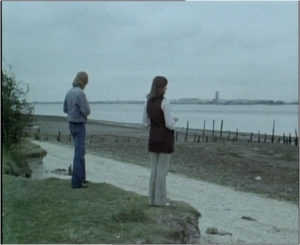
Interview recorded in London on 3 July 2006
Play for Today Writer: Alan Plater; Director: Brian Parker; Producer: David Rose
This piece assumes background knowledge of the play.1 For a short essay and synopsis, see my piece for Screenonline. For detailed analysis and mention of other Plater sources, see my article ‘The Surprise of a Large Town: Regional Landscape in Alan Plater’s Land of Green Ginger’, Journal of British Cinema and Television, 4:2, November 2007, pp. 285-306, available in print or online. Plater also wrote the lovely memoir Doggin’ Around. If you want to research Plater’s work, I can provide a full interview transcript; I strongly recommend the University of Hull’s Alan Plater archive at the Hull History Centre. I am eternally grateful to Alan Plater (who sadly passed away in 2010) and Shirley Rubenstein for their time, warmth and generosity.
[ATV] had a project to do a 6-part series called A Tale of Six Cities […] and I wrote a play, and it was actually called The Surprise of a Large Town, from Philip Larkin’s poem.2 The project came to nothing […] they never made this series, and I just put it on a shelf. Cut to early ‘70s: David Rose is Head of Drama for BBC in Birmingham at Pebble Mill and he called me up […] – he would often do this – he said, “I need a 60-minute play or a half-hour piece, have you got anything on the shelf that we could look at?” I said, well, I’ve got this thing about Hull but you’d have to go to Hull. By this time of course it was now accepted you could actually go out on location and make plays on location. Because when I first wrote it, it was going to be studio-based with some little inserts. And that, I think, scared them a bit, because they would’ve had to send a camera to Hull and some actors and so on. So there’d been a cultural change by the time David approached me.
I have selected only a few quotations from a detailed interview, and have left out my questions which sometimes prompted points – for instance, a ‘house style’ at BBC Birmingham – but every word here was spoken by Alan Plater and has not been twisted out of context. Where comments have been moved from a different stage of the interview, this is indicated in footnotes. Italicised text in [brackets] offers further guidance and ellipses are indicated by […]) ↩
Larkin’s poem, titled Here, is discussed in my article. ↩
Interview recorded in London on 3 July 2006<\/em><\/p>\n Play for Today <\/em>Writer:<\/b> Alan Plater; Director:<\/b> Brian Parker; Producer:<\/b> David Rose<\/p>\n This piece assumes background knowledge of the play.1<\/a><\/sup> For a short essay and synopsis, see my piece for Screenonline<\/em><\/a>. For detailed analysis and mention of other Plater sources, see my article \u2018The Surprise of a Large Town: Regional Landscape in Alan Plater\u2019s Land of Green Ginger\u2019, Journal of British Cinema and Television, 4:2, November 2007, pp. 285-306, available in print or online.<\/a> Plater also wrote the lovely memoir Doggin\u2019 Around. If you want to research Plater\u2019s work, I can provide a full interview transcript; I strongly recommend the University of Hull’s Alan Plater archive at the Hull History Centre<\/a>. I am eternally grateful to Alan Plater (who sadly passed away in 2010) and Shirley Rubenstein for their time, warmth and generosity.<\/i><\/p>\n [ATV] had a project to do a 6-part series called A Tale of Six Cities<\/i> […] and I wrote a play, and it was actually called The Surprise of a Large Town<\/i>, from Philip Larkin\u2019s poem.2<\/a><\/sup> The project came to nothing […] they never made this series, and I just put it on a shelf. Cut to early \u201870s: David Rose is Head of Drama for BBC in Birmingham at Pebble Mill and he called me up […] \u2013 he would often do this \u2013 he said, \u201cI need a 60-minute play or a half-hour piece, have you got anything on the shelf that we could look at?\u201d I said, well, I\u2019ve got this thing about Hull but you\u2019d have to go to Hull. By this time of course it was now accepted you could actually go out on location and make plays on location. Because when I first wrote it, it was going to be studio-based with some little inserts. And that, I think, scared them a bit, because they would\u2019ve had to send a camera to Hull and some actors and so on. So there\u2019d been a cultural change by the time David approached me.<\/p>\n <\/p>\n I sent him the script in its original form. I do remember getting clearance from Philip\u2019s publishers […] because I was going to quote little bits from the poem Here<\/i> as a kind of musical chorus going through. Anyway, David read it, said yeah this is interesting, but we can do the whole thing on location if you like. So okay, I said I\u2019ll start again. Same basic story, trawlerman comes home, girl living in London, all the rest. And by this time I\u2019d got to know the Watersons and had worked with them, done occasional gigs with them around Hull, the [East<\/em>] Riding. So I said could we use the Watersons. So David listened to the music, said let\u2019s do it. So that\u2019s it, I wrote it […] changed the title from The Surprise of a Large Town<\/i> to Land of Green Ginger<\/i>, which has a lovely kind of metaphorical quality it seemed to me. And it was all very quick and comfortable.<\/p>\n I\u2019d worked with [director Brian Parker] on Z-Cars<\/i> and Softly Softly<\/i> so that was a well-established team. Brian later directed one of the Beiderbecke<\/i> series, so we kept popping up in each other\u2019s lives over a period. I did get much more involved with it than with most plays, because of the setting […] Brian came up to Hull and I […] showed him all the locations. I actually told him: \u201cWe\u2019ll see him walking down that road there\u201d \u2013 I didn\u2019t quite do a camera script or a storyboard, but I talked him through […] it was a very detailed kind of preparation period. And what is on the screen is pretty well exactly what I wrote, plus what I talked to Brian about, plus of course what the actors gave it \u2013 there\u2019s John [Flanagan<\/em>] and Gwen [Taylor<\/em>], who were then relatively new and unknown. […]<\/p>\n There are some directors who\u2019ll read a script and ignore all the stage directions. […] Because I trained as an architect, I\u2019ve got a bit of visual sense. I actually know where I want the camera to be. I\u2019ve had some major rows with directors about this […] they don\u2019t like you interfering with what they see as their prerogative. It isn\u2019t really, because film writing is about the pictures as well as the people and what they\u2019re doing. I just describe what they\u2019re doing, what they\u2019re saying. Not necessarily how they\u2019re saying it, because that varies from actor to actor.<\/p>\n It is a very specific screenplay […] because I knew the area, better than any of the people who were gonna be in it and involved with it, so it seemed obvious and sensible. David was very happy with it and he didn\u2019t complain and Brian Parker didn\u2019t complain, and it worked […] I did spend a lot of time with them [on set<\/em>] on Green Ginger<\/i> because it was handy and local. I think I was more involved on a day-to-day basis with Brian Parker than I would have been normally. Not exactly holding his hand, but just\u2026 I was interested. I wanted it to be right, that was the big thing: it had to be right.3<\/a><\/sup><\/p>\n [David Rose<\/em>] did some amazing work […] in that period, aside from the fact that he was the best patron I ever had inside British television, if you look at the span of the work, the first producer to give Alan Bleasdale airtime.4<\/a><\/sup> The actual content of the work was very diverse, you had things like Gangsters<\/i> came out of that period, and that was probably the first of the really hard-hitting, brutal crime-cop shows, to the very gentle things that I suppose I do. I don\u2019t do violence \u2013 it\u2019s not what I do, guv. But yeah, I think there was a house style, mainly because we had the same in-house technical crew, the same camera crews, the sound people. So there would be that kind of consistency. It was always a great plus-factor to have in-house people. […]5<\/a><\/sup><\/p>\n I\u2019ve always been a bit resistant to conventional narrative. When I was a kid, late teens, early twenties, I would go to the New Theatre in Hull, to see the weekly rep company we had in those days, and there\u2019d be all these people\u2026 there\u2019s always one set, and it was generally a domestic setting, and the big climax at the end of the first act was almost always the girl saying \u201cDaddy, I\u2019m pregnant\u201d\u2026 \u201cWoah! That\u2019s terrible!\u201d I think, \u201cI\u2019m not very interested in this.\u201d What I\u2019m interested in is people being, not people doing. So many plays seem to be inventing stuff to happen to people, instead of digging into their lives, what are the real issues. And it\u2019s in Green Ginger<\/i>, it\u2019s a real issue: \u201cI\u2019m in love with a guy who\u2019s away for three weeks at a time catching fish, and I\u2019m not prepared to deal into that.\u201d That\u2019s a much bigger issue, actually. And for the guy himself: \u201cI\u2019ve got what I want. I\u2019ve got me skipper\u2019s ticket, that\u2019s what I\u2019ve been working for for the last ten years. And I\u2019ve grafted and I\u2019ve worked and possibly bribed one or two people along the way, and I\u2019ve got it. I\u2019m supposed to chuck all that up, and what? Work behind a bar, or a building site?\u201d<\/p>\n And there was this remarkable kind of culture \u2013 I was an observer, I had no direct involvement \u2013 but there was a remarkable culture of the fishing industry […] in the fish merchant\u2019s club, for example. Our nextdoor neighbour for a while, til they moved up in the world and moved to Kirk Ella, he was a fish merchant \u2013 he\u2019d worked on the trawlers. The story is that he had a big win on the Irish sweep and bought himself into a fish merchant company, with a place on the dock in Hull and an office in Fleetwood […] He [spent time<\/em>] on the dock in the fish merchant\u2019s club, playing snooker for high stakes. And it was also the place where all the gossip about Hull City emanated, because the Chairman of the City board at that time was a fish merchant, or there was a connection. So, it was a whole culture. The club has long gone and the fish dock has long gone. All that stuff is much more interesting than \u201cI think I\u2019m going to have a baby\u201d or \u201cI want to marry the wrong man\u201d. There was this kind of domestic trivia, it\u2019s like dramatised versions of births, deaths and marriage columns in the local paper. We should actually be living through a very good period from this point of view, because I think the soaps have taken over all that stuff, the domestic trivia plotting, that\u2019s the bread-and-butter of soap opera. So the people who are doing what I like to call \u201cproper drama\u201d [laughs<\/em>] can look at other things and, in my view, other, more interesting things.<\/p>\n I\u2019m far enough away from a lot of the things I\u2019ve written: I think a recurring theme is work. And it\u2019s probably because, having trained as an architect, I trained to do a proper job. Having done that proper job for a couple of years and then escaped from it, I\u2019m very conscious of the way work defines people. Almost all the plays I do are about people working or about their relationship with work and, through that work, their relationship with society round about.6<\/a><\/sup> […] So I\u2019ve rarely written about people just as social units, as social beings. I don\u2019t write very much about families just as families, but about families as their lives are either enriched or corrupted, or limited, by the need to earn a living.<\/p>\n I\u2019m a bit of a classical Greek in that respect. A lot of my stage plays observe the classical unities, because it\u2019s a good way of focusing: say, \u201cokay, put it all in a day.\u201d You\u2019ve got a bunch of characters, of every age, every background, put all of that into a day, and that really focuses everybody\u2019s minds.7<\/a><\/sup> […] The theatrical parallel is probably Chekhov, because Chekhov if you like invented, perfected, refined this, not a lot goes on in Chekhov, except you see the entire bleeding world on the stage in front of you, you see. Whole communities bracing themselves for the revolution, actually, but not quite sure what to do about it, they\u2019re kind of paralysed. As Maureen Lipman says, they sit there in the middle distance and dreaming of Moscow, but that\u2019s fine, that\u2019ll do for me. I mean, narrative, what is narrative? Does it involve having to have someone hitting someone or murdering someone? Well, no, not really. […]<\/p>\n I remember John Hopkins \u2013 who was script editor on Z Cars<\/i> and the best writer of the time, he was the guv\u2019nor \u2013 introduced me to Ermanno Olmi, the great Italian neo-realist. At his behest I saw a film called Il Posto<\/i>, The Job<\/i>. It\u2019s just about\u2026 It\u2019s The Office<\/i>, but they\u2019re not as nasty, they\u2019re just these people who go to the office everyday. All that happens is one of them dies. The one who dies, we\u2019ve seen him in his lunch hours, writing what\u2019s obviously a novel or a story or something, and after he dies they find this, \u201cWhat\u2019s this?\u201d, call it \u2018personal\u2019 and throw it in the waste paper basket. And that\u2019s the story! This man\u2019s life is dumped in a waste paper basket. I might have mis-remembered it […] Or a marvellous movie called Tree of the Wooden Clogs<\/i>, which runs for about three hours, is about a peasant community in Italy, and a kid needs some clogs because he\u2019s going to school, and dad chops down a tree to make the clogs, and the tree belongs to the land owner, and he finds out, and he loses his job, and then they\u2019re thrown out. And that\u2019s all it\u2019s about, chopping down a tree and making a pair of clogs. And it\u2019s about everything. And it looks magnificent, and beautifully acted \u2013 beautifully non-acted, if you like. So, yeah, I think all that stuff did kind of burnish its way\u2026<\/p>\n We all need a tough patron. The whole of art from the beginning of time hinges on the patron. I have this invented story about Michelangelo getting the job of painting the Sistine Chapel, and he gets a phone call from his agent to say, \u201cHey, we\u2019ve got a really good gig for you.\u201d \u201cOh, what\u2019s that?\u201d he said. \u201cYou\u2019re going to paint the ceiling of the Sistine Chapel.\u201d \u201cWow\u201d, he said, \u201cThat\u2019s a big one.\u201d \u201cThat\u2019s the biggest, mate. That\u2019s the biggest, baby\u201d. \u201cOh, when do I\u2026\u201d He said, \u201cThere is just one snag: you can paint anything you like\u2026\u201d \u201cYeah?\u201d \u201cExcept it has to be to the greater glory of God.\u201d And Michelangelo said, \u201cOh, shit!\u201d […] this really winged its way home when I was an architect, that you can\u2019t be a better designer as an architect than your client\u2019s imagination will permit you to be. The level I was operating at, it didn\u2019t matter: I was doing at best case the odd little house or bathroom and veranda extensions and a shop front here and there. But at the higher levels, the reason there was so much mediocre architecture in Hull in the immediate post-war period was the people commissioning the stuff weren\u2019t bright enough to see that it was mediocre. I mean, things have got much better since then, hence The Deep8<\/a><\/sup>) and the football stadium9<\/a><\/sup>, and so on […]<\/p>\n I used my common sense \u2013 there were one or two things where I thought that the audience outside of Hull won\u2019t understand this, so I\u2019ll offer a word of explanation […] The only compromises would be with the accents of the principal characters.10<\/a><\/sup> […] Once we\u2019d cast John and Gwen, I said, \u201cwell, for the locals\u201d \u2013 because you were tied into Equity membership of course, there [were<\/em>] very strong union things happening then \u2013 if people were in the Variety Artists Association, that qualified them. So, the locals in it, like Clive Hunter, the taxi driver, he was in the Variety Artists Association, so he could be in it. The woman who plays John\u2019s mum, she was a local Variety club performer.11<\/a><\/sup> They were all club acts. Clive was lovely \u2013 I knew him quite well, because he actually used to work in the music store on Spring Bank […] The support players […] were all Hull-based.<\/p>\n [On the play\u2019s use of music.<\/em>] I went round to the Watersons\u2019 house.12<\/a><\/sup> At that time they were living off Spring Bank. And I told them the story, in broad terms. And I said, “look, I need songs that will illustrate these ideas…” North Country Maid<\/i> I knew, because that\u2019s kind of almost a folk standard, and I\u2019d got all their recorded work anyway, up until that point. And they went through their archive and suggested songs. Of course, they made the useful point that most sea songs are not specific to any particular area, because\u2026 if you could sing a sailor song\u2026 because they were travelling the world, they would just change the names of the pubs and the women to suit where they were. I think the song is actually called Outward and Homeward Bound<\/i>, \u201chere comes so-and-so with his three weeks\u2019 pay\u201d. I just changed the words to match the play. They\u2019re all folk standards, I think some of them were in the Penguin Book of English Folk Song<\/i> […] None of them were specially written, but they were adapted. I dropped in place names and pub names, and character names, indeed \u2013 I dropped in the boy\u2019s character name to match. That\u2019s the folk tradition, that\u2019s what\u2019s always happened with the folk process.13<\/a><\/sup> […]<\/p>\n [We<\/em>] set up a proper session at The Haworth Arms\u2026 which at that time was a regular music venue, a jazz and folk venue. […] It might have been that they suggested that this would work, or somebody suggested that this would work better than what I\u2019d written, or maybe by the time we got to doing it, I\u2019d spent more time with Mike and Norma… […] the Blue Bell used to be the folk venue. I think that it might have been that the Haworth was better to shoot in, because the Blue Bell was long and thin, because I\u2019ve seen documentaries \u2013 they did a documentary about the Watersons14<\/a><\/sup>, and it\u2019s a long, thin room, and there\u2019s only one camera angle, which is the front-on view, whereas the Haworth is a bigger room and you can do cutaways and things\u2026<\/p>\n [I highlighted the exciting cut to the music performance scene \u2013 a shift from the Watersons’ music as background\/non-diegetic sound to them performing\/diegetic sound – discussed at length in my article.<\/em>] It\u2019s my favourite moment, actually, is the cut: \u201cOh, God, these are real people\u201d. Because […] it might have been done in a television play prior to that [but<\/em>] normally television music, even in those days, was something you heard, and we assumed it was being played on a piece of tape, or it had been recorded in a studio, or was just from the archive somewhere, but suddenly to meet head-on: \u201cAh, these people are part of the same community\u201d, which they were. It gave it a special sort of reality. […]<\/p>\n I think [being closely involved with the production<\/em>] was a good decision because, of course, there was a huge row afterwards. […] There were a lot of letters to the Hull<\/i> [Daily<\/i>] Mail<\/i> saying, how dare you say these things about Hull. And I made the point that, if you looked at the addresses on the letters, all the letters complaining were from outside of Hull \u2013 they were from Anlaby, Cottingham \u2013 and all the letters supporting me were [from Hull<\/em>]. It was almost as clear as that. But David, bless him, said \u201clet\u2019s meet \u2018em head on\u201d. What we did at Spring Street was, we ran the film to anyone who wanted to come […] David came up, we had an open discussion, which was broadcast live I think on Radio Humberside. I think Jim Hawkins organised that. That was almost unique \u2013 unique in my experience, a play having this kind of impact, this kind of feedback and the audience \u2013 the subject if you like \u2013 talking back at me.15<\/a><\/sup> […]<\/p>\n A full house, a really lively, passionate debate about: does one have a duty, if you\u2019re writing about a specific place, are you there to do PR on its behalf? \u201cNo\u201d is the simple answer, you\u2019re not. That was a recurring theme. There used to be a programme on the BBC called Talkback<\/i> […] where viewers could challenge what they\u2019d seen, and they would have the programme-makers there […] The recurring one was the image of the North as presented on television. I\u2019d get the phone call: would you be available to do Talkback<\/i> next week, and I would say, \u201cOh, is it the image of the North as presented on BBC television?\u201d and they\u2019d say, \u201cYes, it\u2019s that one again.\u201d And I\u2019d say, \u201cWell, I\u2019ve done it all before, but I\u2019ll do it again.\u201d<\/p>\n At that time, the thinking was, the North needed people to come in and invest their money and build factories, reinvigorate the economy. We had, you\u2019d have industrialists in the [TV<\/em>] audience saying all this, or local councillors, saying all this: my responsibility. I said, okay, […] imagine I\u2019m a big industrialist, and I\u2019m thinking, I\u2019m gonna build a big factory in Hull, or in Newcastle, or in Liverpool, but before I do, I\u2019m gonna watch this play, to make sure that…. I said, I don\u2019t do that. I want good rail communications, good road communications, I want a skilled workforce, or maybe an unskilled workforce, I want all the basic services that will enable me to build… I don\u2019t want to watch a play to make my mind up, it\u2019s absolute nonsense. There was a lot of that about. People are very protective, and that\u2019s okay. They\u2019ve very protective of their communities and their cities and towns and everything, and they don\u2019t like it if it\u2019s… I wasn\u2019t saying everyone\u2019s a load of drugs and drug-crazed adolescents beating up the place. […]<\/p>\n I wasn\u2019t going to attack Hull, I was living there, I\u2019d lived there a greater lump of my life in Hull than anywhere else.16<\/a><\/sup> I\u2019m interested in what makes particular areas particular. So I\u2019ve written a lot about Tyneside, which is my birthplace, about what\u2019s happening in Newcastle and Gateshead, the North East generally. I\u2019ve written about South Wales, I\u2019ve written about the Orkneys. It\u2019s always about, how does this community hang together? I tend to turn off drama \u2013 not physically, but sort of emotionally \u2013 where it\u2019s telling me that this family, this community is dysfunctional because\u2026 I would rather write this family, this community is functional despite\u2026 It\u2019s the same story, you\u2019ve turned it around. […] I mean, I\u2019m 71 years old and no-one has ever hit me. I haven\u2019t lived a particularly sheltered life \u2013 I\u2019ve travelled around the world, been to dozens, hundreds of football matches, when you went on terraces. So, for me to depict a violent society would be hypocrisy, would be telling a lie.17<\/a><\/sup><\/p>\n [I quoted stage directions from Plater\u2019s original script and asked if they had achieved the tricky balance between surrealism, naturalism and lyricism: Alan\u2019s description of a shot of the River Hull read, \u2018If it\u2019s a little misty and magical, all the better\u2019 to capture Hull. I then asked if he thought Brian Parker had achieved it.<\/em>] A hell of a direction! […] Yes, I do actually. We looked at it last year when BBC4 did this documentary about me, and they re-ran it […] I actually said to Shirley: “that was quite good, wasn\u2019t it?” [laughs<\/em>] And it looked terrific. And that shot from the ferry \u2013 you can see the medieval town.<\/p>\n And you still can, to a large extent. And there isn\u2019t anywhere like it \u2013 I think that\u2019s really my central point, whether it\u2019s Hull, whether it\u2019s Newcastle, Gateshead, Liverpool. These places are all unique, and we should cherish their uniqueness. It worries me when everyone \u2013 increasingly \u2013 they all have a Holiday Inn or a Malmaison, several Pizza Expresses, and all this homogenisation of places. And the more people are prepared to battle for what is unique, the better \u2013 and all power to them. […] Wherever you go, it is the same shops. We were in Cardiff last year, we were taken out for supper on the dock area, near the big new concert hall, and it\u2019s lovely, and all these wine bars and Italian restaurants and things. But you look around and say, \u201cThis is not that different from […] Sydney […] or the downtown area in Boston. Where is Cardiff in this”? And maybe this is just what we laughingly call progress and globalisation, and I don\u2019t expect writing a few plays about it is going to stop it. Backing my play against people like Rupert Murdoch, the smart money\u2019s going to be on Murdoch every time.<\/p>\n Joan Littlewood did a lot of work in Hull I think just before the war and possibly just after as well, for BBC Radio. She did documentaries, early documentaries. She said you could walk the streets of Hull and hear the people speaking poetry. [thinks<\/em>] \u201cthat\u2019s interesting\u201d. She didn\u2019t mean iambic pentameters, but that in all regional accents there is a kind of poetic element. Admittedly you\u2019ve got to dig around, you\u2019ve got to distill it. You don\u2019t walk down Whitefriargate and think, \u201cWow, listen to all that poetry\u201d. It\u2019s not that, it\u2019s much more complex than that. But I think there is a poetic streak in all [Northern, Scottish, Welsh<\/em>] accents […] I think it\u2019s one of the jobs of a writer with regional roots to sing that song for them. Tom Hadaway, great Tyneside writer \u2013 died a couple of years back18<\/a><\/sup> \u2013 Tom had been a fish merchant and a fisherman in North Shields, started writing plays, wrote a wonderful play set on a North Shields fish quay, a television play. And afterwards people said, \u201cWell, it\u2019s wonderful, Tom, but people on a North Shields fish quay don\u2019t talk like that.\u201d And he said, \u201cBut that\u2019s what they want to say, and I help them to say it\u201d. And I think that you\u2019re giving voice to the dream, if you like, and if that\u2019s lyricism of a kind then that\u2019s what it is.<\/p>\n [On the playful scene in which Sally hears a journalist is writing a piece on the regions and likes Hull the best so far, and replies, \u2018Lucky old us\u2019.<\/em>] We get beaten over the heads a lot with post-modern irony \u2013 people have been doing irony in Hull and in the North for hundreds of years […] There\u2019s a great moment \u2013 I\u2019m often quoting this. Something had happened in Hull, so all the national press and the telly went up there, it might have been the North Hull by-election or trawler disasters, one of those things that happen about once a year, so it would happen they\u2019d all show up\u2026 So they interviewed this bloke. The reporter made some slighting remark about the city, and he said, \u201cIt\u2019s alright for you, you want to try living here.\u201d You can pick the bones out of that \u2013 it\u2019s like it\u2019s a challenge to your machismo to be able to survive in this city; on the other hand I\u2019m not moving. One of the most interesting things\u2013 the world is full of interesting things \u2013 somebody with nothing better to do did a survey about four years ago of people who were happy with the place they lived in, are you happy, unhappy to live where you are. […] More people were happy to live in Barnsley than anywhere else to live. […] Where I\u2019m maybe different from some of my colleagues in the trade, I identify equally \u2013 or in a different way \u2013 with Tyneside, because that was the birthplace and there\u2019s something equally special about that. And I can, using the experience of two places, trying to penetrate the mystery of what they\u2019re about, you can go and apply that to other communities and it\u2019s interesting what then emerges. […]19<\/a><\/sup> <\/p>\n It\u2019s way out of left field, but in the early 90s we did a research trip to Jamaica for a project with Lenny Henry that never happened. We met an academic in Jamaica who said the history of the world is a history of great migrations\u2026 went into the black diaspora and all that. It suddenly occurs to me that the history of Hull, or Newcastle, or any of the Northern industrial cities \u2013 this idea of the migration is crucial to understanding how some communities to some extent disintegrated and others had this estate malaise, if you like. It\u2019s in Tom Courtenay\u2019s book about his mum: she had this lovely house with a bathroom and everything and wasn\u2019t happy.20<\/a><\/sup> And it\u2019s this lack of understanding by the people who make the decisions in high places on how communities work. And if they\u2019d done a serious job of rehabilitation down the Hessle Road and Holderness Road, and kept the community \u2013 now, this all presupposed at the time that the fishing industry was going to stay, and that the docks would stay, in their labour-intensive form, which they didn\u2019t. So, that immediately would have thrown a number of jokers into the pack. I think it is acknowledged now that they got it wrong \u2013 […] it wasn\u2019t unique to Hull, the multi-storey bit, all of which was blown out of the water anyway architecturally and from a planning point of view by a woman called Jane Jacobs who died only this year, an American writer who wrote a book called The Death and Life of Great American Cities<\/i>, about Boston, largely about Boston21<\/a><\/sup>. She said tall buildings don\u2019t equal high density, this a myth that\u2019s put about by architects who want to build tall buildings [laughs<\/em>].<\/p>\n But\u2026 I believe something was lost when people were moved out. I think something is always lost when people are moved other than when they ask to. If they\u2019re told, virtually you\u2019re told they\u2019re going. It\u2019s a forced migration, and that\u2019s never made people happy ever in the history of the world. [After much discussion of changes around Hessle Road.<\/em>] [Jane Jacobs<\/em>] said the mistake the planners make is to think in zones, and she was all against, \u201cWe\u2019ll have a cultural zone here\u201d. She said no, you don\u2019t do that, you have bits of culture all over the place. Don\u2019t knock down a little theatre and build a bigger one, build another little one somewhere else. What makes cities interesting \u2013 this was her thesis \u2013 was the diversity, of finding six different things in the same street. So she would have been horrified by Starbucks and Pizza Express and all this stuff [laughs<\/em>].<\/p>\n [On the ‘metaphorical’ use of Land of Green Ginger, a small street in Hull’s Old Town but also a title with mythical connotations. At one stage Sally and Mike wonder \u2018Shall we look for it?\u2019, it\u2019s barely a minute away, but for the rest of the play they walk away from it.<\/em>] I think it is a kind of metaphor for their relationship, that I think she knows that there should be an answer to their dilemma, and if they look really, really hard they would find it, but it\u2019s not immediately apparent, so they kind of quit, and say, line across the ledger, turn the page, start again, look for somebody else. I mean, that\u2019s really what it\u2019s about. It\u2019s a very sad little piece, really. It\u2019s about unrequited love, or sort of semi-requited, and it\u2019s kind of a blues, really.<\/p>\n [On the use of the Humber Bridge.<\/em>] I think I would\u2019ve argued that the bridge symbolised some mythological future when it\u2019s all gonna be alright, because at the time I didn\u2019t think we\u2019d ever get this damn bridge […]22<\/a><\/sup> Oddly enough, the Bridge came back to haunt me in a cheerful way. I did a play about Peggy Ramsay, my agent, called Peggy for You<\/i>, in which she tells the story \u2013 Peggy Ramsay, the character, tells the story, but this actually happened. She came to Hull and I took her to see the Bridge being built. Then she goes on in the play to elaborate on this to this young writer: \u201cThe Bridge is rather like your play, darling. All plays are the same, you take the audience by the hand and you lead them across the Bridge, and the far end of the Bridge is in the mist and you can\u2019t see the other end. You get to the other side of the Bridge and the mist clears and the audience says, \u201cMy God, this is a wonderful place, thank you for bringing us here.\u201d All plays are like that.\u201d And the young man says, \u201cOh, and mine\u2026?\u201d [And she says,<\/em>] \u201cNo, darling. When we finish your play, we\u2019re still at the same side of the river.\u201d […]<\/p>\n If you like, the sole justification of being a writer is, you tell the truth. The truth that you see. I was saying this the other day, that I think there are two types of writers: those who look out the window and those who look in a mirror. The ones who look in mirrors tend to be poets, and maybe novelists, and on the whole, I think, certainly the playwrights I admire look out the window.23<\/a><\/sup><\/p>\n Originally posted: 24 July 2009 on the old Play for Today mini-site version of this site. <\/a><\/p>\n<\/p>\n
\nUpdates:
\n4 November 2010: first appearance of this essay on the main British Television Drama site, moved from a different URL, as all the pieces from the old mini-site were transferred to the main site.
\n5 February 2017: minor presentational amendments, not changing content.
\n4 March 2017: standardised presentation of ‘Updates’ legacy information (2009, 2010) in line with current site practice; minor presentational amendments, italicising inserted text; reinstated interview text that had disappeared owing to a recent coding error.<\/em><\/p>\n
\n