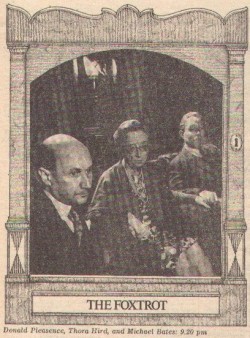
Play for Today Writer: Rhys Adrian; Director: Philip Saville; Producer: Irene Shubik
“I have a great fondness for the past, the way things were.”
The Foxtrot offers further proof of the wide variety of approaches and subject matter in Play for Today: a self-aware sex comedy about a ménage-a-trois between Michael Bates, Donald Pleasence and Thora Hird is far removed from the intensity and political commitment of plays from the same period such as When the Bough Breaks and The Rank and File. However, newspaper reviews were mixed – stressing its strengths and weaknesses, praising some elements and criticising what some saw as its self-awareness and obscurity. Given that some reviewers used The Foxtrot to question the very purpose of Play for Today as a strand, the following essay uses newspaper reviews of The Foxtrot – depending more heavily on reviews than the site’s essays usually do – in order to trace some of the ways in which Play for Today was a contested space.1
The essay’s focus is on reviewers’ contestation but subsequent studies should develop the idea, at the very least into archival holdings on audience and institutional responses. ↩
Play for Today <\/em>Writer:<\/strong> Rhys Adrian; Director:<\/b> Philip Saville; Producer:<\/b> Irene Shubik<\/p>\n “I have a great fondness for the past, the way things were.”<\/p>\n<\/blockquote>\n The Foxtrot<\/em> offers further proof of the wide variety of approaches and subject matter in Play for Today<\/EM>: a self-aware sex comedy about a m\u00e9nage-a-trois<\/EM> between Michael Bates, Donald Pleasence and Thora Hird is far removed from the intensity and political commitment of plays from the same period such as When the Bough Breaks<\/EM> and The Rank and File<\/EM>. However, newspaper reviews were mixed – stressing its strengths and weaknesses, praising some elements and criticising what some saw as its self-awareness and obscurity. Given that some reviewers used The Foxtrot<\/em> to question the very purpose of Play for Today<\/em> as a strand, the following essay uses newspaper reviews of The Foxtrot<\/em> – depending more heavily on reviews than the site’s essays usually do – in order to trace some of the ways in which Play for Today<\/em> was a contested space.1<\/a><\/sup><\/p>\n <\/p>\n The play is in part a domestic character study showing the rewards and frustrations of married life for couples nearing retirement age. The dialogue is well-observed, often cloying in its repetitions; as Chris Dunkley argued, “Rhys Adrian reveals a frighteningly accurate ear for the appalling banality of everyday conversation”.2<\/a><\/sup> Two couples dominate: Arthur (Michael Bates) and Gwen (Thora Hird), and Harry (John Collin) and Maisie (Diana King). Gwen seems a little too friendly with Tom (Donald Pleasence), recently returned after a long absence… Before the play’s delicious twist, the plot seems quite obvious: not so much a 60s sex comedy as a sex comedy of the nearly-60s, characters living in the shadow of a motorway who all seem to struggle with the changing pace of modern Britain (resulting in “depressing scenes of man’s individual subjugation to progress”).3<\/a><\/sup> Hence the significance of the foxtrot as a metaphor for sex, particularly changing partners, and for life lived at a slower pace.<\/p>\n A pre-title sequence demonstrates that The Foxtrot <\/EM>is also highly self-conscious. In the pub, Tom addresses the camera: “You wouldn’t think I was 57, would you?” The comment is greeted with canned laughter. Saville cuts to Tom walking down the street. Tom, too, addresses the camera: his comment that “I’m only 56” is also greeted with canned laughter. After the titles, Tom is asked by a canvasser about his sex life and his attitude towards permissiveness. At this point, the first of the play’s self-conscious inter-titles interrupts the action: “Gwen hasn’t told Arthur about Tom”. Arthur tells Gwen about his attempts to turn the questions back on the girl, resulting in a two-fingered “gesture” (in response to which Thora Hird’s facial response is priceless). In the pub, Harry warns Arthur that he could have been on Candid Camera<\/EM>: “I can hear the laughter now… ‘Look at this one here, we’ll get a giggle out of this one here’, they thought. Sex, big joke”. The play’s older characters are sometimes juxtaposed with permissive youths for comic effect, as in a later scene in which Arthur and Gwen revisit a pub only to find the refitted “concept” bar, the New Fox and Hounds (a name which aptly sums up the crass collision between tradition and modernity), and are uncomfortably anachronistic. However, Tom’s reaction to Arthur’s story, and the subsequent plot, demonstrate that, contrary to media stereotypes, sex and the more mature citizen are not that separate.<\/p>\n Another caption introduces “A tender scene” in bed between Arthur and Gwen. Arthur describes a visit to Tom’s place, and evidence of Tom’s vanity:<\/p>\n He opened the door wearing sunglasses and a wig. When he saw it was me, he denied he was himself, said he would go and fetch himself. He went away, came back without the sunglasses and the wig. When I asked who had opened the door, he said it was a friend… I didn’t know he was vain about his hair. He’s not vain about his teeth. <\/p>\n<\/blockquote>\n Pleasence charmingly brings out the character’s vanity; indeed, at one point his character is seen in bed moshing to a guitar riff, resplendent in shades and a suspect toupee. Later, he brings out the character’s humility, as we realise that Tom is the play’s most obvious victim of an identity crisis. However, he is not the only character who “denied he was himself”. Like the others, he is, according to Mary Malone, “re-running the past, like an old film. And so fond of his memories that he even has his old snapshots re-photographed every three years to keep them bright”. Malone added that “I don’t remember enjoying any three people more than Donald Pleasence, Thora Hird and Michael Bates. Tom and Gwen and Arthur will be with me forever”.4<\/a><\/sup> Pleasence told the Radio Times <\/EM>that he took this, his first BBC role in three years5<\/a><\/sup>, because “I like the work of the director Philip Saville and, especially, I like what the play has to say about people. It’s an enormously funny story and there’s a marvellous coup de television<\/EM>, a shock reversal of situation”.6<\/a><\/sup><\/p>\n In a bedtime conversation with husband Harry, Maisie speculates on Tom and Gwen’s relationship, and Tom’s similarity to Arthur and Gwen’s son. Harry is more concerned with his lack of nocturnal conjugal action, and with the disturbance of his sleep by the oppressive, constant motorway traffic, which leaves him awake and sobered up, wasting the effects of his night out: “Look at me, I’m back at work! Right here, right here!” The motorway has eaten into his garden, symbolising, as the Radio Times <\/EM>put it, “the erosion of people by progress”.7<\/a><\/sup> As Harry intones “Big bloody bang!”, Saville dissolves to shots of traffic. <\/p>\n Dancing with Gwen in the section captioned ‘The Fox Trot’, Tom makes his feelings known – “I still love you, Gwen” – but is told that “You went away, Tom… silly boy”. The play’s most self-conscious device is introduced after the caption “The Tom, Gwen and Arthur Show”. As Gwen and Arthur watch an American TV programme, Tom enters the room, to be greeted by the programme’s soundtrack: “Gosh, it’s Tom!” Television continues to interact with the play’s events, most disturbingly in the death of Gwen’s dad, Walter, while watching a Western. “You been an evil, wicked old man”, the characters say. As Walter reaches into his dressing gown, the characters think someone is reaching for a gun, and fire – Walter jerks, and his hand slides down the bars of his headboard in lingering Western fashion. The TV characters’ comments on the dead man (who was the same age as Walter) again echo the “real world”.<\/p>\n In a scene captioned “After the funeral”, Tom proclaims that “It’s not my bloody world anymore, mate” and, tiring of another character’s life story, laments: “I’ve heard a million life stories in my time, all of them abject”. Although Harry complains that “There’s nothing abject about me”, Chris Dunkley noted that “characters reveal a terrifying subconscious awareness of the uselessness of their own lives: ‘abject’ is a word which features large”.8<\/a><\/sup> Gwen is upset at the speed of the cremation service, symbolic of the quicker pace of life. Maisie notices that Tom and Arthur both put a hand on either shoulder. Later, Arthur matter-of-factly tells Tom over a pint that his son resembled Tom. His son, who now lives in America, becomes one of the play’s contested memories: the photograph displayed during Tom’s comments supports his argument, but Tom’s counter-argument (that the son resembles Arthur) is illustrated with a different photograph. This difference is emphasised when the two pictures are shown together.<\/p>\n We eventually discover the truth: Gwen is married to Tom, who discovered her cheating on him with Arthur, and ultimately left. Gwen suggests that Tom moves in with her and Arthur, to which Arthur agrees. The play ends with Gwen watching TV with Tom and Arthur at either side of her, both holding her hand. This lovely ending subverts the play’s theme of nostalgia: although the ending is a regression which stands against the theme of “progress”, Gwen has not been yearning for a slower, more sedate past, but has got things “the way they were” in an unexpected and clearly permissive way. As the play-within-a-play puts it, “This certainly adds a new dimension to things!” <\/p>\n During the end credits, Saville cuts between the three characters’ delighted reactions to a programme, and the programme itself: a farce in which Americans named Tom, Arthur and Gwen sneak between rooms at night (“Good night Tom! Good night Arthur!”), to prolonged canned laughter. It’s a provocative ending, both reflecting the characters and continuing the play’s fascination with television. According to Mary Malone, the play finally addressed the quandary: “Why don’t we see people watching telly on the telly… Plays reflect life don’t they? And we’re always watching telly”.9<\/a><\/sup> Repeatedly, viewers are shot from behind the television set, as if reflecting back the view from the screen. Earlier, in one such composition, Harry complained about the programmes which Maisie watched, rebuffing her statement that he watched it too with “Yeah, but I don’t take it in. I push it back”. In a way, this is what The Foxtrot <\/EM>invites us to do, pushing us back from identification with its alienating use of television, captions and photographs (a device which compares with Douglas Livingstone and Alan Clarke’s use of Donald McGill postcards in I Can’t See My Little Willie<\/EM>). This recurring motif seems a bit cheeky; as Chris Dunkley asked, “Would Rhys Adrian prefer the real viewer to switch off?”10<\/a><\/sup>. <\/p>\n Certainly some of the critics wanted to switch off. In a prolonged attack in the Financial Times<\/em>, T. C. Worsley expressed surprise at other critics’ praise for The Foxtrot<\/EM>. He found the play “appallingly ill-constructed… pretentiously directed” and “fundamentally patronising”. Worsley wondered whether he had “failed to see… the ‘calculation’ behind the disordered and arbitrary construction”, for instance experiencing “boredom at the repetitious insistence on the banality of the lives described” rather than, as other critics had, noting “that this was the point of the exercise”. The “fragmentary and the arbitrary” praised by critics were not “substitutes for selective and purposive preparation”. Whether or not the play’s banalities were deliberate, they remained banalities; whether or not the play’s fragmented scenes were deliberate, they “had no dramatic impact in themselves and little connection with each other” and “did not initiate a narrative – or delineate characters”. Worsley condemned Saville’s direction as “gimmicky”, chiefly because of the use of intertitles.11<\/a><\/sup><\/p>\n Other reviewers were impressed. Peter Fiddick declared it “the best television play I have seen in years”, and admired its “miraculous combination of precise characterisation and dialogue and bold television technique”. The “sheer confidence of the production” included “impressionistic back projections” and “hard indoor lighting (‘under the shadow of the flyover’)”, which made this a play which “must be seen again soon”.12<\/a><\/sup> Sean Day-Lewis called it a “tragi-comedy, laced with a maze of superbly calculated twists all cleverly camouflaged under seemingly fragmentary and arbitrary construction”, which displayed Adrian’s “considerable talent for compassionate comedy” and Saville’s “stylish and resourceful production”.13<\/a><\/sup>. Worsley quoted a further Sunday newspaper critic who described it as “engrossing, original, wise, sad, and sometimes very funny”14<\/a><\/sup>. Day-Lewis began his review with a statement which implies that this is precisely the kind of production which the strand needed: “Having inherited the ‘Wednesday Play’ tradition of innovation and social concern, ‘Play for Today’ became established in the autumn as the best hope for original television drama”15<\/a><\/sup> Martin Jackson agreed that “Adrian has a keen ear for the language of ordinary folk and a gift for comedy”, that the play was “strikingly photographed” by Saville, and featured “faultless performances of marvellously observed characters”.16<\/a><\/sup><\/p>\n However, Jackson also separated the play into two plays, praising the first for its depiction of “the laughter, the fears and frustrations that come with the 50th birthday, the missed opportunities, the broken promises, and counterfeit memories”, but finding the other aspects “puzzling”. He asked, in response to the Radio Times<\/em> reference to “the erosion of progress”, “What about the erosion of the simple art of storytelling?”17<\/a><\/sup> Similarly, Virginia Ironside wondered whether her inability “to grasp the point” of the play was due to her being “thick as a post” or “whether he’d written a baffling play”, which she found “maddening” as “it was all written with such polish, such confidence”.18<\/a><\/sup> According to Jackson, this baffling quality made it typical of the strand: “The BBC ought to make an award… to any viewer who can puzzle out those 70-minute conundrums that pose as [Play for Today<\/i>]”.19<\/a><\/sup> Elaborating on this theme, Worsley awarded it “nought for interest, nought for enjoyment and even nought for significance which is the grounds on which this kind of thing is usually justified”. Although Worsley criticises himself for not seeing the play’s significance, his criticisms are interesting because they raise issues of Play for Today<\/EM>‘s identity as a strand: “I take the Play for Today <\/i>series very seriously, because it is now the last resort in the BBC schedules for continuing what the BBC could genuinely claim they were doing in the late Sixties – carrying on, in Lord Normanbrook’s useful phrase, the Nation’s dialogue with itself… The BBC has in my view in the last few years opted out from all this: it has turned to escapism and the past”. With its “air of being ‘advanced’ and ‘significant'”, and with its contemporary concerns, The Foxtrot<\/EM> qualified enough for Worsley to “admit publicly that I was wrong about it”, before adding: “But it was a stinker”.20<\/a><\/sup> <\/p>\n It seems ironic that a play negotiating the relationship between past and present drew critical attention because of its success or failure in meeting past standards. Not one of the most famous or acclaimed Play for Today<\/i> productions, this critical reception suggests the play was quite routine. Given what passes for “routine” drama today, this might tempt us to share the play’s characters’ own nostalgia for “the way things were”, in television at least. As producer Irene Shubik argued in response to the play’s critics, this was indeed a play for<\/EM> today: “of any play I have ever produced, this one would give a visitor from another age the truest picture of life in urban England, 1970s style.” Furthermore, for Shubik, “this was a play that could not have fitted any other medium: a true television creation.”21<\/a><\/sup><\/p>\n Originally posted: 2004 on a previous version of this site.\n
 <\/p>\n
\n
\nUpdates:
\n2006: transferred to the old University of Hull version of this site.
\n2009: transferred to new Play for Today mini-site initially separate from the British Television Drama site
\n4 November 2010: first appearance of this essay on the main British Television Drama site, moved from a different URL, as all the pieces from the old mini-site were transferred to the main site.
\n24 November 2014: minor typographical corrections; rewrote first paragraph; abbreviated one quotation; reinstated Radio Times image.
\n4 March 2017: standardised presentation of ‘Updates’ legacy information (2003, 2006, 2009) in line with current site practice; removed ‘first published’ date from byline as a result.<\/em><\/p>\n
\n