Out of this World (1962)

by OLIVER WAKE

Writers: Clive Exton, Leon Griffiths, Leo Lehman, Terry Nation, Julian Bond, Bruce Stewart, Richard Waring, Denis Butler; Adapted from: John Wyndham, Rog Philips, Isaac Asimov, Tom Godwin, Philip K Dick, Robert Moore Williams, Katherine Maclean, Raymond F. Jones, Frank Crisp, Clifford D Simak, Arthur Sellings; Directors: Charles Jarrott, Jonathan Alwyn, Douglas James, Paul Bernard, Peter Hammond, Guy Verney, Richmond Harding, John Knight, Don Leaver, John Knight, Alan Cooke
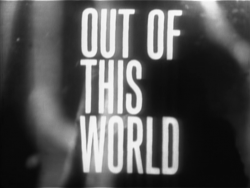
BTVD_Robot_2

There are many reasons why a television series may languish in obscurity, perhaps primarily because it simply does not merit any interest. However, this is not the case with ABC’s 1962 series Out of This World – British television’s first science fiction anthology – which suffers obscurity due to two factors independent of the programme itself. Only one episode exists in full, leaving little scope for re-evaluation, and the series has long been overshadowed by its celebrated longer-running BBC cousin Out of the Unknown. However, Out of This World is not just worthy of attention as a curiosity, but as an original and successful series in its own right.
The War Game (1965)

by DAVID ROLINSON

Writer and Director: Peter Watkins

“The probability of total destruction increases with time and, in the course of the months and years throughout which we are told to expect the Cold War to continue, it becomes almost a certainty”.1

WatkinsGameBlastgrab

The War Game is one of television’s most notorious banned programmes. A harrowing dramatised documentary portraying the after-effects of nuclear holocaust and calling for public education in nuclear deterrent policy, it was made by the BBC for 1965 broadcast but was not transmitted for twenty years. Among the reasons given for the ban were its brutally graphic scenes, its apparent left-wing bias and its controversial fusion of journalistic fact and hugely alarmist fiction, although there is now evidence that it fell victim to the political suppression of nuclear discussion that was happening at the time across all media. Its director, Peter Watkins, quit the BBC and fought to get it a cinema release abroad, resulting in critical acclaim and a Best Documentary Oscar. After its eventual transmission in 1985, critics agreed that the BBC had suppressed one of the greatest dramas ever made.


  1. Bertrand Russell, Has Man A Future?, 1961.