
by DAVID ROLINSON
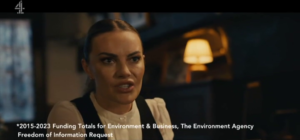 Dirty Business (2026),1 a docudrama about sewage pollution by private water companies and the failures of the Environment Agency, cites sources and provides corroborating information through the use of on-screen captions. For example, when a whistleblower alleges that huge profits have been made whilst using “cuts as a smokescreen” for inaction, the information is cited via an on-screen caption led by an asterisk: the information comes from the “2015-2023 Funding Totals for Environment & Business, The Environment Agency” and that information was accessed due to a “Freedom of Information Request”. Through devices such as these “television footnotes”,2 Dirty Business provides a reminder of the importance of “captioning”, which, as Derek Paget observed, “consists in direct address to an audience whether in the form of speech in voice-over, or of on-screen graphical patterns of words (still and rolling), or of both these things simultaneously”.3 Paget argued that captions have various functions, serving to “set the scene, put the audience in touch with ‘out-of-story’ events and characters, negotiate representation codes, guard against legal repercussions and pitch claims for authenticity of varying kinds”.4 The caption is a form of “label”, or “signpost”, providing “weight” or the “anchoring of images”.5

 It is unusual for a docudrama to use on-screen captions during scenes to provide such footnotes. However, a more familiar form of captioning appeared at the start of Dirty Business. The episode begins with two successive captions. The first one states that “This drama is based on real events, extensive interviews and research”. The second states that “Some dialogue, characters and scenes – including some depictions of pollution – have been recreated for the purposes of dramatisation”.6 Such opening captions are disclaimers, which, as Paget argued, are a “specialised kind” of caption.7 This article explores a wide range of docudramas to discuss what disclaimers do and how they do this: for example, when a disclaimer warns that a docudrama is “based on a true story”, what does this claim mean and how does the visual presentation of that claim reinforce it? The article builds on the discussion of disclaimers in my new book, An Adventure in Space and Time (2026), reproducing some of that discussion but substantially extending it and providing many more examples.8
The disclaimer emphasises the fact that some creative treatment is inevitable in the process of dramatising research: this signposts docudrama’s mediating strategies but it also emphasises the documentary value of docudrama. As Paget observed, “the failsafe mechanism of ‘labelling’” was developed by programme makers at Granada and “taken up by British regulators and policy makers”.9 One Granada programme maker, Leslie Woodhead, noted “the crucial importance of fastidious labelling and signposting” in docudrama.10 This helps to demonstrate the “variety of sources of varying status” from which the docudrama will be “derived” – for example, on Three Days in Szczecin (1976),11 Woodhead and writer Boleslaw Sulik drew from “a smuggled tape recording” but also “the imaginative recreation of dialogue” after “debriefing witnesses”, so it was “vital to signpost material to avoid as far as possible a confusion in the audience about levels of credibility”.12 These practices are not restricted to opening disclaimers: Woodhead described wanting to signpost “on a continuing basis” while planning a docudrama about Solidarity in Gdansk shipyards: therefore, Woodhead noted, even “before moving from research to scripting, we’re exploring ways of building into the form strategies to permit the continuous clarification of sources, and status – in effect to try to evolve a kind of ‘television footnotes’”.13
However, disclaimers have been necessary given that, as Paget argued, the “essential ambiguity of the image […] has crucial significance in law”, because “ambiguous assumptions and structures underlie our interpretation of images”.14 Labelling is vital because docudrama is “hazardous and vulnerable”: for example, Woodhead noted the international political controversy that accompanied Death of a Princess (1980),15 despite or because of its attempt to explore “alternate realities, the power of myth, and the elusiveness of objective truth”.16 Granada colleague Ian McBride observed that production teams called the disclaimer “the health warning”, which was “written largely by the lawyer to the everlasting pain and disgust of the writer and director”, explaining “that composite characters are portrayed and dialogue has been created, that chronology has been changed – but that it’s a true story”.17 As Paget observed, disclaimers can serve as a “fending off of criticism”.18 The use of disclaimers to guard against legal repercussions has a wider history. Natalie Zemon Davis observed that, after the damages awarded against MGM for defamation after Rasputin and the Empress (1934), many “films have used some version of this disclaimer: ‘The events and characters depicted in this photoplay are fictitious. Any similarity to actual persons, living or dead, is purely coincidental’”, even when a film’s account is drawn from collaboration with its historical subject.19 Davis was writing specifically about history films, whose claims to authenticity are comparable to but different from those of docudramas. Paget observed that, in these “litigious times”, the old “standard rubric, such as ‘No reference is intended to persons living or dead’ or ‘Based on a True Story’, has been superseded by ‘law-sensitive disclaimers’”20
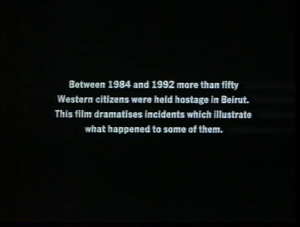 In those terms, Paget noted the phrase “No endorsement has been sought or received from anyone depicted”21 in the following long, scrolling disclaimer that appears at the start of Hostages (1990):
Between 1984 and 1992 more than fifty Western citizens were held hostage in Beirut. This film dramatises incidents which illustrate what happened to some of them. Dialogue has been created based upon publicly available material, interviews with former hostages, their friends and relatives, diplomats and politicians from the United States, Europe and the Middle East. No endorsement has been sought or received from anyone depicted. To compress six years into two hours, chronology has been changed and some events have been amalgamated. The names of minor characters have also been altered.22
Therefore, docudramas have evolved specific methods to present disclaimers, with dominant practices but variations in wording and visual presentation. Playwright David Edgar argued that “You could chart the history of the docudrama by tracing its use of captions”,23 and, partly taking on that challenge, Paget asked, “has there been an observable process of historical change in the form that is enshrined graphically?”24 This article will therefore study the methods used in various docudramas, not quite charting the history of the docudrama through captions but examining recent docudrama practice.
A docudrama which seeks to explore the causes and nature of historical events, in particular tragedies or miscarriages of justice, will open with captions which emphasise its rigorous research, documentary value, or function as record.25 In short, it defends its seriousness, contrary to Bill Nichols’s argument that docudrama exists outside the “discourse of sobriety” associated with documentary.26 Soberly presenting disclaimers as “white letters” on a “black frame”, as noted by McBride,27 has become so ubiquitous as to form one marker of docudrama as a genre. However, as Paget observed, “stylistic flourishes” emerged alongside “new technologies of factual inscription”,28 and programme makers have sought alternatives to words, given industry concerns that written text might form a “hiatus” in the programme, leading to fears about “the logocentric dimension upon which the programme category once depended”.29
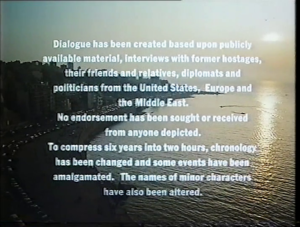 The most widespread labelling practice first provides an evidential base then acknowledges the creative process required to communicate that evidence. The Hostages disclaimer (above) clarifies research sources but also the creative process required to depict its findings: “To compress six years into two hours, chronology has been changed and some events have been amalgamated. The names of minor characters have also been altered”. McBride’s use of the word “composite” (above) usefully explains such amalgamation of several characters or events, but the word is rarely used in disclaimers in British docudramas: Paget noted the lengthy warning before the end credits of Hollywood film Dead Man Walking (1995) about “composite and fictional characters and incidents”,30 whilst the American serial The Looming Tower (2018) states that “This story is inspired by actual events. Certain characters, characterizations, incidents, locations and dialogue were fictionalized or composited for dramatic purposes”.31
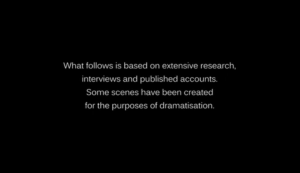 Appropriate Adult (2011)32 and The Moorside (2017)33 both state that “This is a true story. What follows is based on extensive research, interviews and published accounts. Some scenes have been created for the purposes of dramatisation”. This combination recurs, with minor variations, across various docudramas. Little Boy Blue (2017)34 and Murdered for Being Different (2017)35 both state that “What follows is based on extensive research, interviews and published accounts”, the former adding that “Some names have been changed. Some scenes have been created for the purposes of dramatisation” and the latter that “Some characters have been created for dramatic purposes”. The Salisbury Poisonings (2020)36 establishes its evidential base in part by recapping the events it is dramatising, but it connects that base to the creative process by emphasising the programme’s narrative focus on the people who were caught up in events: “In 2018 the people of Salisbury were faced with an unprecedented crisis. A chemical weapons attack on a British city. Based on first-hand accounts and extensive interviews, this is their story”. Similarly, Coalition (2015)37 states that “This drama is based on real events and extensive research and interviews with key people who were there”, and that “Some aspects of dialogue and character have been devised for the purposes of dramatisation”. A Song for Jenny (2015)38 clarifies that “Some scenes and the order of events have been altered for dramatic purposes”.
Such statements support a claim to documentary value in the tradition of the British documentary film movement, in films such as Night Mail (1936),39 whose postal train interiors were shot in the studio, reconstructing or reenacting “prior witnessed reality”: therefore, as Brian Winston argued, their “claim on the real […] was not that the camera filmed things as they were happening, but that it filmed things as they had happened and been witnessed”.40 Documentary makers saw such techniques of restaging as “sincere and justifiable reconstruction” because it was the only way to record events.41 Docudrama disclaimers often invoke types of witnessing, which is again significant in documentary terms: after all, as Winston argued, documentary can mobilise witnessing in different ways (whether “the witness of the camera and/or the film-maker/informant/subject”), but “Without witness there can be no claim on the real, no ‘documentary value’, no documentary”.42
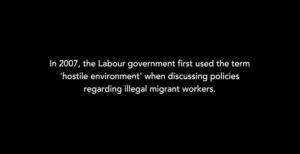
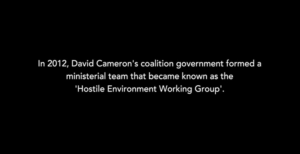
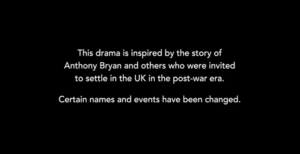 When a docudrama seeks to expose institutional failings such as the 2018 Windrush scandal, a declaration of narrative focus can be a statement of editorial intent: Sitting in Limbo (2020)43 opens with captions that note the use by successive British governments of the term “hostile environment” around migrant workers in 2007 and 2012 respectively, and archive footage of David Cameron and Theresa May speaking about immigration, to establish political context, before a caption explains that “This drama is inspired by the story of Anthony Bryan and others who were invited to settle in the UK in the post-war era. Certain names and events have been changed”. The phrase “invited to settle” adds an element missing from the politicians’ rhetoric on immigration. (Glasgow Girls (2014)44 also provided context: “Wars in Iraq, Somalia and the former Yugoslavia mean millions of people have fled persecution and brutality” and “Many of those seeking asylum are sent to Glasgow”. This appeared in the same week as other BBC programmes about immigration.) The phrase “inspired by” in the Sitting in Limbo disclaimer echoes the “based on” defence of dramatisation,45 but some disclaimers discuss being inspired by their subjects, as we shall see.
In establishing an evidential base, disclaimers often prioritise the use of written evidence. The Man Who Crossed Hitler (2011)46 opts for “Based on real events and court testimony”. A caption in The Legion Hall Bombing (1978)47 states that it is “Taken from the transcript of a trial held at Belfast City Commission, September 1976”. Instead of appearing against a sober black background, these words appear against a shot of seats in the courtroom set, emphasising the source material of this Play for Today and its grounding in the record of the legal process that it critiques. Bloody Sunday (2002)48 calls itself “a dramatisation of events in Northern Ireland on 30th January 1972” and explains that “Some scenes and dialogue have been created, but what follows reflects documented evidence”. This disclaimer’s white-on-black lettering is designed to resemble typewriter type. The Interrogation of Tony Martin (2018)49 is able to label itself not only as “a true story” but as a “verbatim drama” by stating that “every word” is “taken from police interviews”.
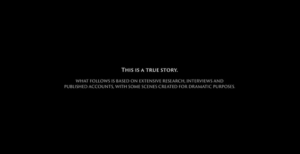 Disclaimers that reference written evidence and take a visual form that resembles written evidence, as if claiming a greater evidential status for written or “documented” evidence, echo discussions about the documentary value of docudrama but also definitions of documentary. Alberto Cavalcanti, who made documentary and fiction, once said, “I hate the word ‘documentary’. I think it smells of dust and boredom”.50 As I have asked elsewhere, is the word “documentary” a noun, with the result that we can call a film “a documentary”, or is it an adjective, as if saying that something has evidential value like a legal document?51 After all, Derek Paget is able to state that, in comparison with researched drama such as NYPD Blue (1993-2005),52 “To be a docudrama is to be altogether closer to documents – to factual templates”. Notwithstanding the health warnings that historians give to documents, labelling can make specific claims: for example, the two-part history documentary Armada: 12 Days to Save England (2015)53 superimposed over an actor the statement “The drama scenes in this series are based on new academic research and historical documents”. The word “published” does something similar in The Sixth Commandment (2023)54: “This is a true story. What follows is based on extensive research, interviews and published accounts, with some scenes created for dramatic purposes”. This wording from “This is” through to “accounts” is identical to the disclaimer used by Litvinenko (2023),55 but that split its disclaimer across three frames, with the third providing additional clarification that some names, scenes and characters have been created.
 The presentation of those last two examples as white writing on a black background is typical of current practice. This sober device presents particularly detailed labelling when a docudrama questions institutional narratives, as in Derailed (2005)56 on rail safety and Stockwell (2009),57 a documentary with dramatised sequences, about a killing by police. Derailed states that “This is a dramatisation of real events. Although minor alterations have been made to chronology and some scenes created to aid clarity”, it “is based wholly on inquiry transcripts and personal accounts”. The disclaimer also states that “Some news footage has been used”, which is necessary but also another archival claim. (The Dirty Business disclaimer that I quoted earlier ends by clarifying that archival footage will be used but also that there will be further in-text captioning, as it states that “All real-life pollution footage is labelled”.) Stockwell calls itself “a true story based on the testimony of police officers and eyewitnesses”. Therefore, although it states that “Some events have been simplified and some characters and dialogue created for the purposes of dramatisation”, it connects these creative acts with documented official practices by adding that “Most names are codenames given by the Court to protect individual officers’ identities”.
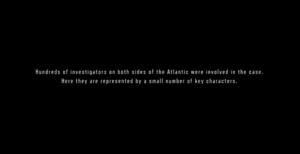 Such determination to provide detail is epitomised by The Bombing of Pan Am 103 (2025),58 which states that “What follows is based on extensive research and interviews with the investigators, victims’ relatives and residents of the Lockerbie community”, and its warning that “Some characters have been created and merged and scenes added for the purposes of dramatisation” followed an explanation that “Hundreds of investigators on both sides of the Atlantic were involved in the case. Here they are represented by a small number of key characters”. Death of a Princess used a caption which explained that it was “Based on interviews recorded in London, Paris, Beirut and Arabia between July and November 1978”, but it was not insulated from the controversy that followed, despite that acknowledgement of details such as places, which are particularly significant given that controversy.
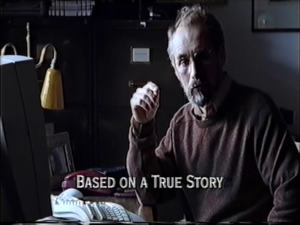 Some disclaimers shed less light on process. A necessarily more general claim opens Three Families (2021)59 – “Based on true stories. All names have been changed” – whilst The Government Inspector (2005)60 superimposes “Based on a true story” in capitals over Mark Rylance’s performance as David Kelly. The phrase “based on a true story” acknowledges its own tensions – non-fiction’s own narrative structures and the amount of latitude permitted by the disclaimer that its reconstruction is “based on” research – but does not necessarily resolve them. As Paget noted, disclaimers do not necessarily anchor films to the “out-of-story world”, being different from the “informative caption” in ways that potentially weaken “the mixed form’s efforts to gain weight from an adjacency to fact”.61 Such adjacency underscores similar minimal disclaimers: Bradford Riots (2006)62 states that “This is a drama based on real events”, United (2011)63 that “The following story is based on real events”, and The Great Train Robbery (2013)64 that “The following drama is based on real events”. A Very English Scandal (2018)65 has the standard “Based on a true story” whereas The Wipers Times (2013)66 states that “This is a true story”. This phrasing is simultaneously bold (this is true, not based on truth) and uncertain: “story” is a word common to fiction and non-fiction, so its use here does not clarify the process by which a story/event is turned into a story/programme.
Therefore, as Natalie Zemon Davis argued of a voice-over in La Retour de Martin Guerre (1982)67 that described that film as “not a tale of adventure or imaginary fable, but a pure, true story”,68 such claims risk saying that “True history simply exists out there, and is as available to be drawn upon as legend” whereas, for Davis, “our knowledge of the past is something we struggle for; it comes from somewhere, is created, fought over, and changed”.69 Such fighting takes place in the opening of the Peter Watkins docudrama Culloden (1964),70 from voice-over and dramatisation to the captions that signpost a position: “An account of one of the most mishandled and brutal battles ever fought in Britain. An account of its tragic aftermath. An account of the men responsible for it. An account of the men, women and children who suffered because of it”.
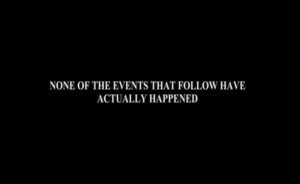 Some disclaimers are understated or seem incomplete as if encouraging active spectatorship. The Lost Honour of Christopher Jefferies (2014)71 states that “What follows is drama based on real events…” By the end of the docudrama’s account of how newspapers treated Jefferies, it is difficult to see those three dots without adding “terrifyingly” or reading them as a disgusted tailing-off. UKIP: The First 100 Days (2015)72 is a hypothetical piece about future events, so its disclaimer statement that “None of the events that follow have actually happened” warns about the potential consequences of the forthcoming election, as if the sentence could be concluded with “yet”. Speculative pieces have specific needs when claiming evidential value. Therefore, Dirty War (2004),73 which speculated about a bioterrorist “dirty bomb” attack on London, stated in white capitals on a black background: “This film is fiction, but the events portrayed and the information about UK emergency planning are based on extensive research”. Elsewhere,74 I have discussed the techniques used in the conditional tense docudrama, with its “what if?” approach, in pieces such as The Day Britain Stopped (2003).75
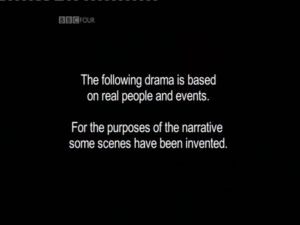 The disclaimers that open biographical docudramas about celebrities and public figures also require a range of methods. Maxwell (2007)76 explains that it “dramatises the final stages of Robert Maxwell’s life. The sequence of events has been altered and some scenes and minor characters are fictional”. Relating invention to minor characters confirms the inevitability of dramatic compression. Archie (2024)77 splits across two slides “This is a true story” and “What follows is based on extensive interviews and intensive research. Some scenes and characters have been created for the purposes of dramatisation”. This reinforces the familiar adjective “extensive” with the further adjective “intensive”. Lucan (2013)78 faced gaps in the historical record, so its disclaimer prefaces the familiar claim that “Some scenes and characters have been created for dramatic purposes” with the statement that “Much of this story is based on fact, though we have also included an element of speculation”. Some television and showbiz biopics continue conventional methods: Eric & Ernie (2011)79 states that “What follows is a dramatised version of a true story…”, and Hattie (2011)80 states that “This film is based on a true story” and “Some events have been created or changed”. Micro Men (2009)81 explains that it “is based on real people and events”, but “For the purposes of the narrative some scenes have been invented”. The use of “purposes” indicates that some disclaimers are more forthcoming about the purpose and nature of changes. Therefore, Burton and Taylor (2013)82 explains that it “is based on a true story. Some scenes and events have been created or modified for dramatic effect”, whilst Shirley (2011)83 adds a modifying “but” to explain that it “is based on a true story, but some scenes and events have been created or modified for dramatic effect”.

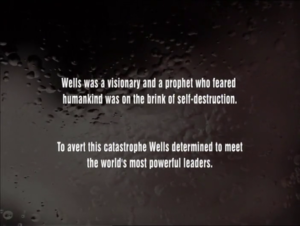 Some disclaimers relate their invention, and journalistic and archival research, to having been inspired by their subjects, who are therefore worthy of study. Bert & Dickie (2012)84 states that it “is based upon and inspired by real events and people. Some scenes and dialogue have been invented”, whilst Castles in the Sky (2014)85 “is inspired by real events and the life of Robert Watson Watt”, though “Some characters and scenes have been created for dramatic purposes”. Wodehouse in Exile (2013)86 simply states that “This film is inspired by real events”, but other writer-led programmes, especially those associated with arts programming, give captions a curatorial function. For example, H.G. Wells: War with the World (2006)87 explains that its subject was “the founding father of science fiction”, lists his key works, calls him “a visionary and a prophet”, clarifies that it presents “the story of his life, loves and utopian ideas” and that “All the words spoken by Wells are taken from his autobiography and other writings”, and sets the scene of his 1934 visit to Joseph Stalin in Moscow.
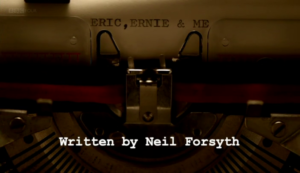 Others relate their authorship to that of their subjects: Daphne (2007)88 simply has an author credit resembling those given to the programme’s makers – “Based on letters by Daphne du Maurier” – whilst Arthur & George (2015)89 presents the disclaimer “The following is based on true events” with an ornate first letter “T” as if handwritten, thereby alluding to its subject, writer Arthur Conan Doyle. A biopic focusing on television writer Eddie Braben, Eric, Ernie & Me (2017),90 has a functional disclaimer stating “The following is a dramatised story based on real events” but its title sequence superimposes the credit “Written by Neil Forsyth” on a typewriter, in horizontal balance with the programme title which has been typed as if by Braben.
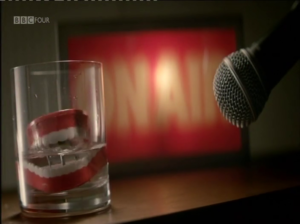 Some disclaimers are presented in the idiom of their subject, using and citing the individual people and their works as inspiration for the creative process of making that docudrama. For example, The Best Possible Taste (2012)91 opens with a pair of false teeth that not only state that “it’s based on a true story” but also warn that the programme will contain “naughty bits”, in the phrase and manner (in vocal impersonation) of its subject, DJ and comedian Kenny Everett. My new book includes substantial discussions of the disclaimer that opens An Adventure in Space and Time, which is presented in the idiom of a 1960s BBC television continuity announcement of the sort that would have preceded its subject – 1960s Doctor Who – on broadcast and includes an unacknowledged quotation from a Doctor Who story.
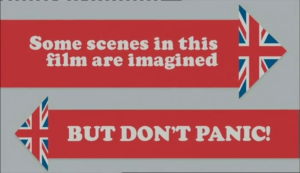
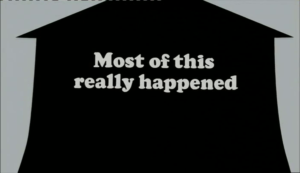 My book discusses other examples,92 including We’re Doomed – The Dad’s Army Story (2015),93 which presents its disclaimer in the style of the opening titles of an episode of BBC sitcom Dad’s Army (1968-77),94 the docudrama’s subject. That sitcom, set during the Second World War, presents its titles and writers in arrow-shaped boxes replicating military movements across a map of Europe. Each arrow that swipes across the screen is headed by a Union Flag arrowhead or appears in black as a large aggressive Nazi sweep. A Union Flag swipes left to right to say that “Some scenes in this film are imagined”, and beneath it another swipes right to left to shout: “BUT DON’T PANIC!” This statement echoes Lance-Corporal Jones (Clive Dunn) from Dad’s Army, whose tendency to give the reassuring statement “DON’T PANIC!” in a non-reassuring hysterical shout is replicated in the block capitals and exclamation mark. The title “we’re doomed” refers to another Dad’s Army catchphrase, the lugubrious prognostication of Private Fraser (John Laurie), and indicates that the docudrama claims to reveal the surprisingly difficult process of persuading the BBC to make what would become one of their most successful and best-loved programmes. Both statements are then obliterated from the screen by one huge black arrow that rises all-conqueringly from the bottom of the screen. The statement “Most of this really happened” is presented in white text on the black arrow, which replicates the visual style of the Dad’s Army titles and the sober disclaimers mentioned earlier.
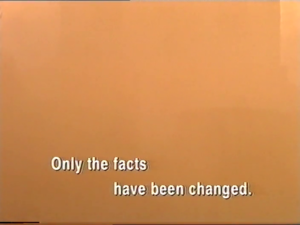 That statement, “Most of this really happened”, also reminds us that even conventional biopics make playful use of labelling. The Deal (2003)95 moves from a statement that “Although some scenes and dialogue have been invented, this film is based on actual events and parliamentary record” to an epigram: “Much of what follows is true”. It attributes the quotation to the film Butch Cassidy and the Sundance Kid (1969),96 a playful reference point for the relationship between Labour politicians Tony Blair and Gordon Brown. Filth: The Mary Whitehouse Story (2008)97 advises that “The story you are about to see really took place” but adds “only with less swearing and more nudity”, not taking entirely seriously the concerns of clean-up-TV campaigner Mary Whitehouse. Mock-biopics are beyond the scope of this piece, but their disclaimers are comparable. Therefore, Jeffrey Archer: The Truth (2002)98 states that “This story is based on real events” before adding the punchline: “Only the facts have been changed” (rather than the names). Coup! (2006)99 uses huge lettering to drive home its punchline: “Some of the names have been changed…” “…and some of them haven’t”.
As I have explained elsewhere,100 the idiomatic presentation of disclaimers is a regular feature of recent reflexive docudramas. As Jonathan Bignell observed, docudrama “has mutated into a wide range of forms and formats, with a range of modes of address and aesthetic tone” as part of “a larger process of negotiation, experiment and competition with related fictional and factual television forms”.101 Paget identified docudrama’s movement into a phase of “hybridisation”, seeing the boundaries between documentary and drama as creatively “porous” instead of accepting criticisms that the boundaries are deceptively “blurred”.102 Those developments have included docudramas which question the representational capacity of the media including docudramas themselves, resulting in varying degrees of reflexivity.103 That trend has been reflected in some disclaimers: Paget perceptively noted that the “firmly indexical ‘Mark This!’ of the caption’s pre-lapsarian innocence has given way to the relativising nudge and the self-deprecatory wink of post-modern knowledge”.104 Holy Flying Circus (2011)105 is a usefully excessive example of this, as a knowingly unreliable account of the opposition faced by the makers of Monty Python’s Life of Brian (1979)106 and the docudrama’s own reception and status at BBC Four, which is often presented in the Monty Python style and tone: as Python member and Life of Brian director Terry Jones observed, Holy Flying Circus is “very funny, but a mix of fantasy and reality”.107 Its disclaimer is playfully excessive, as a depiction of Jesus Christ tells the camera that “Most of what you are about to see never actually happened. It’s largely made up”, before making a parallel with the Bible that a character played by Eric Idle (as played by Steve Punt) suspects may be “controversial”. The idiomatic nature of the pre-title sequence is heightened by rolling captions that heckle their docudrama labelling in ways that emulate Python devices (“In London. In 1979. Have I just said that? I’ve lost track”). Playful disclaimers have appeared in various forms of fiction: for example, Hollywood horror film I Walked with a Zombie (1943)108 opens with the warning that “The characters and events depicted in this photoplay are fictional. Any similarity to actual persons, living, dead or possessed, is purely coincidental”.
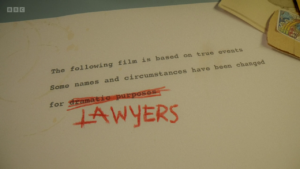 However, playful disclaimers do not necessarily destabilise the docudramas that follow. Then Barbara Met Alan (2022)109 presents its disclaimer after five minutes, as if on a piece of paper: “The following film is based on true events. Some names and circumstances have been changed for dramatic purposes”. Generated crayon writing then crosses out “dramatic purposes” and replaces it with “LAWYERS”. As I have discussed elsewhere,110 the written disclaimer that opens Marvellous (2014)111 has conventional wording – “based on a true story” – but it appears in large bold block capitals against a yellow background. The presentation of the title in block capitals as “MARVELLOUS” similarly deviates from sober presentation and signposts its joyful tone in celebrating the unlikely but true life of Neil Baldwin, a man with learning disabilities who has served as a registered clown and in roles at a University and in English professional football.
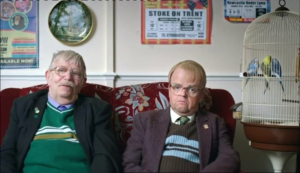 Early in Marvellous, before the written disclaimer, the docudrama provides a distinctive visual disclaimer: the real Baldwin sits beside actor Toby Jones, in character as Baldwin. Baldwin says to camera that “This is my story!”, and Baldwin/Jones adds: “Right!” This appearance serves the main functions of a disclaimer discussed above: it is supportive and qualifying. It indicates the necessity of dramatic choices: indeed, the docudrama itself will flag those up. For example, Baldwin appears again later, to say that the scene then being dramatised – Baldwin scoring a goal for Stoke City in a friendly amidst frenzied celebrations – did not happen.112 However, this knowingly excessive presentation is an appropriate reflection of the incredible fact that he did once play as a substitute for Stoke in a friendly. Baldwin’s opening cameo is also supportive, showing Baldwin’s involvement with the programme.
Actors and the people they play have appeared as part of other docudrama disclaimers. Invasion (1980),113 which uses transcripts to recreate the events surrounding the Soviet Union’s 1968 invasion of Czechoslovakia, opens with archive footage before showing the real Zdenek Mlynar at a checkpoint. The use of archival sources (potentially including Mlynar) is foregrounded in the disclaimer, which is provided by a voice-over by Leslie Woodhead, the docudrama’s director, rather than in writing. That voice-over includes the statement that “His account, recorded for us under detailed cross-examination, and supplemented by independent research in Western Europe and Czechoslovakia, forms the basis of the filmed reconstruction that follows. It is as accurate as our research can make it”. Echoing the order of events in written disclaimers discussed above, the voice-over moves from establishing its evidential, journalistic base to the need for dramatic mediation: “All the characters in these events are real people represented by actors”. This is demonstrated visually as actor Paul Chapman – the actor who will be playing Mlynar – enters the scene to stand next to, and talk to, Mlynar.
As I have argued elsewhere,114 some techniques in docudrama shed light on the concept of the “body too many”, given that Nichols argued that historical fiction involves “a body too many, namely that of an actor”, whose “very presence testifies to a gap between the text and the life to which it refers”.115 Drawing from this, Paget observed that “In the body of the actor […] a kind of excess is enacted”.116 Belén Vidal noted that the subject and actor in the film American Splendor (2003)117 “exist not in excess of each other, but visually side by side”, which enacts the body too many with “an emphatic duplication of bodies/subjects – a ‘beside-the-body-ness,’ so to speak”.118 Although such “beside-the-bodyness” in docudrama has been placed in the context of “the deconstruction of the centred self” in postmodernism,119 such doubling in Invasion underlines the docudrama’s re-enactment methods to emphasise the journalistic research and intentions behind that re-enactment. Such appearances by the real people who have been re-enacted can potentially indicate their involvement or even endorsement, but their presence reiterates two major recurring elements of disclaimers: evidence and the inevitability of mediation.120
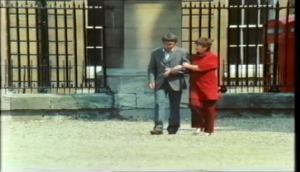
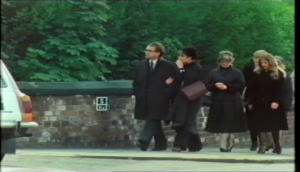 Enemies of the State (1983)121 foregrounds its status as the story of Zdena Tomin. That is how the docudrama was billed – its TV Times listing called it “the story of how one woman took on a Communist government”, and how “housewife” Zdena Tomin “rose to become the dissidents’ leader”.122 The pre-title sequence accompanies footage of a reenactment of events on 16 March 1977 with a voice-over that describes this as “a day I won’t forget”. Present-day footage of the real Tomin and her husband Julius appears whilst a voiceover states that “This is a true story and my name is Zdena Tomin”. The voice-over explains that “This is a personal account of how a group of people stood up for their rights in a Communist country and how they were then harassed and jailed.” There is a cut to Zoe Wanamaker and Paul Freeman appearing in the reenactment, as the voice-over states: “To tell the story, English actors play our friends and the parts of myself and my husband” (indeed, the cut comes on the word “story”). Again, this draws attention to representation (and, before the voice-over even began, the reenactment depicted a film crew and photographer) and to the potential subjectivity of “a personal account” but as a way to “tell the story” of what happened. The end credits state that “Zdena Tomin’s voice [was] read by Eva Kolouchová”.
Meanwhile, in Hillsborough (1996),123 Tracey Wilkinson plays Jan Spearritt stating to camera that “The Chief Constable of South Yorkshire said we shouldn’t do the programme. It’ll upset the families of the dead. I’m one of those families. My son died at Hillsborough. And I want the truth”. This is the second disclaimer, following a written disclaimer that states that “This film is a dramatised reconstruction of events between 1989 and 1991. Although there have been minor changes to chronology and certain events have been dramatised to aid clarity, this drama is based entirely on fact using court transcripts and eye witness reports”. There is a sense of competing stories – the docudrama and its disclaimers reinforce the ways in which families and others contest the stories told by the police, The Sun and the state – but the families’ account is now effectively the official record, as the docudrama’s devasting account has since been devastatingly vindicated.124 There is a sense that disclaimers can make visible, or even play a part in, the sort of process that we heard about earlier: “our knowledge of the past is something we struggle for; it comes from somewhere, is created, fought over, and changed”.125
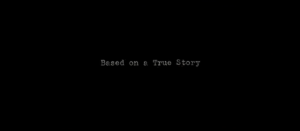
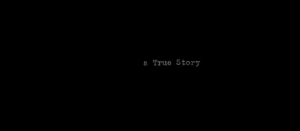 In that respect, the disclaimer that opens Against the Law126 raises interesting, even political, tensions. Against the Law explores events leading up to the “1967 Sexual Offences Act, which decriminalised homosexual acts in England and Wales between adult males, in private”.127 It combines dramatisation with participant interviews to provide testimony of what it was like to be a gay man in the period depicted by the docudrama. The disclaimer begins in familiar ways, as white text on a black background states “Based on a True Story”. Graphics and sound create the sense that the words have been typed across the screen, a technique which is motivated by the preceding scenes in which (Daniel Mays as) Peter Wildeblood, the author of the book on which the programme is based, types at a typewriter. The phrase “Based on” disappears, leaving on screen only “a True Story”. We have seen disclaimers that have used a minimalist “This is a true story” (above), and this phrase affirms the centrality of these experiences, but this very act of insisting that this story is true is conducted by an act of erasure (the word “act” has multiple meanings in this historical context). This disclaimer plays with visibility and invisibility: what felt in 2017 like a cautiously optimistic depiction of the arrival of “legislation [which] marks the beginning of this journey” towards equality128 feels in 2026 (also) like a warning.
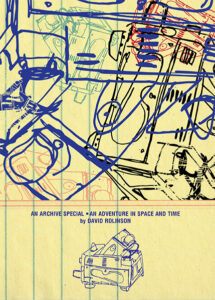 An Adventure in Space and Time (2013)129 opens with a disclaimer that is presented in the idiom of a period BBC continuity announcement, with a voice-over announcement spoken over an imitation 1963 BBC ident: “This is the BBC. The following programme is based on actual events. It is important to remember, however, that you can’t rewrite history. Not one line. Except perhaps when you embark on an adventure in space and time”. I have argued that this disclaimer “is typical of docudrama disclaimers: it asserts that this docudrama is true/real, depicting researched/documented/evidenced events […] whilst also signposting docudrama’s mediating strategies. Therefore, it asserts that it creates/modifies/invents/alters/simplifies, in a process that is inevitable, ingrained in the genre and accepted by those who choose to continue watching”.130 To see how it does that, how it refers to a Doctor Who historical story (without acknowledgement) to do this, how the disclaimer helps us to understand paratexts, and how disclaimers and docudrama practices help us to understand historiography and what (and how) school teachers were teaching in 1963, and how disclaimers can help us to understand the nature of docudrama and the nature of documentary, An Adventure in Space and Time is out now.
Originally posted: 1 June 2026
Dirty Business, wr./dr. Joseph Bullman, tx. Channel 4, 23-25 February 2026. The images in this article come from episode 3, tx. Channel 4, 25 February 2026. ↩
This phrase will be discussed later in this article. It comes from Leslie Woodhead, ‘The Guardian Lecture’, in Alan Rosenthal (editor), Why Docudrama? Fact-Fiction on Film and TV (Carbondale, IL: Southern Illinois University Press, 1999), p. 109. ↩
Derek Paget, ‘Disclaimers, Denials and Direct Address: Captioning in Docudrama’, in John Izod and Richard Kilborn, with Matthew Hibberd (editors), From Grierson to the Docu-Soap: Breaking the Boundaries (Luton: University of Luton Press, 2000), p. 199. ↩
Derek Paget, No Other Way to Tell It: Docudrama on Film and Television (Manchester, Manchester University Press, 2011), p. 103. Second Edition. ↩
Paget, ‘Disclaimers, Denials and Direct Address’, p. 199. Paget is replying to phrases from (respectively) John Willis, ‘Tainted by the Fiction Faction’, Guardian Media Supplement, 16 November 1998, p. 9 and John Tagg, The Burden of Representation: Essays on Photographies and Histories (London: Macmillan, 1988). ↩
The final sentence in this disclaimer will be discussed later in this article. ↩
Paget, No Other Way to Tell It, p. 103. Second Edition. Paget referred to the disclaimer as a “specialised kind of opening or closing caption”, but this article focuses on opening captions. ↩
David Rolinson, An Adventure in Space and Time (Edinburgh: Obverse, 2026). Some of the discussion in this article, and that book, also returns to David Rolinson, ‘British Docudrama: New Directions in Reflexivity’, in Tobias Ebbrecht-Hartmann and Derek Paget (editors), Docudrama on European Television: A Selective Survey. Basingstoke: Palgrave Macmillan, 2016), pp. 199-227. ↩
Paget, No Other Way to Tell It, p. 99. Second Edition. ↩
Woodhead, ‘The Guardian Lecture’, p. 110. ↩
Three Days in Szczecin, wr. Boleslaw Sulik, dr. Leslie Woodhead, tx. ITV, 21 September 1976. ↩
Woodhead, ‘The Guardian Lecture’, p. 109 ↩
Ibid. Rolinson, An Adventure in Space and Time, looks at how the makers of An Adventure in Space and Time considered (but decided against) the use of techniques comparable with on-screen television footnotes. ↩
Paget, ‘Disclaimers, Denial and Direct Address’, p. 199. ↩
Death of a Princess, wr. Anthony Thomas and David Fanning, dr. Anthony Thomas, tx. ITV, 9 April 1980. For a short introduction to Death of a Princess, see David Rolinson, ‘Death of a Princess’, Screenonline, British Film Institute, undated (but written in April 2005 and posted in October 2005), available here. ↩
Woodhead, ‘The Guardian Lecture’, p. 110 ↩
Ian McBride, ‘Where are we going and how and why’. In Alan Rosenthal (editor), Why Docudrama? Fact-Fiction on Film and TV (Carbondale, IL: Southern Illinois University Press, 1999), p. 112. ↩
Paget, No Other Way to Tell It, p. 103. Second Edition ↩
Natalie Zemon Davis, ‘“Any Resemblance to Persons Living or Dead”: film and the challenge of authenticity’, Historical Journal of Film, Radio and Television, 8(3), 1988, p. 269 ↩
Paget, No Other Way to Tell It, p. 103. Second Edition. ↩
Ibid., p. 98. ↩
Hostages, wr. Bernard MacLaverty, dr. David Wheatley, tx. ITV, 23 September 1992. Here, as in the rest of the essay, I have quoted the disclaimer directly from the programme itself. I have bundled the text together into one paragraph, unlike its split presentation in the programme. ↩
David Edgar, Keynote address at the conference Reality time: A conference about factual drama on stage and screen, University of Birmingham, UK, 1996, quoted in Paget, ‘Disclaimers, Denials and Direct Address’, p. 198. ↩
Paget, ‘Disclaimers, Denials and Direct Address’, p. 198. ↩
McBride noted that “the first thing that usually comes on the screen is a black frame with one word in small white letters: ‘disclaimer.’” – McBride, ‘Where are we going and how and why’, p. 112. However, it is now so unusual for the word “disclaimer” to appear in a disclaimer that I have omitted this from the discussion. ↩
Bill Nichols, Representing reality: Issues and concepts in documentary (Bloomington: Indiana University Press, 1991), p. 60. ↩
McBride, ‘Where are we going and how and why’, p. 112. ↩
Paget, ‘Disclaimers, Denials and Direct Address’, p. 202. ↩
Ibid., p. 205. ↩
Paget, No Other Way to Tell It, p. 103. Second Edition. Dead Man Walking, wr./dr. Tim Robbins, 1995 ↩
The Looming Tower, various, tx. Hulu, 28 February – 18 April 2018. The image here is taken from the start of episode 1, which was shown in the UK on BBC Two on 26 April 2019. ↩
Appropriate Adult, wr. Neil McKay, dr. Julian Jarrold, tx. ITV, 4-11 September 2011. ↩
The Moorside, wr. Neil McKay, dr. Paul Whittington, tx. BBC One, 7-14 February 2017. The images accompanying this paragraph are from The Moorside. ↩
Little Boy Blue, wr. Jeff Pope, dr. Paul Whittington, tx. ITV, 24 April-15 May 2017. ↩
Murdered for Being Different, wr. Nick Leather, dr. Paul Andrew Williams, tx. BBC Three, 18 June 2017. ↩
The Salisbury Poisonings, wr. Adam Patterson and Declan Lawn, dr. Saul Dibb, tx. BBC One, 14-16 June 2020. ↩
Coalition, wr. James Graham, dr. Alex Holmes, tx. Channel 4, 28 March 2015. ↩
A Song for Jenny, wr. Frank McGuinness, dr. Brian Percival, tx. 5 July 2015. ↩
Night Mail, dr. Basil Wright and Harry Watt, 1936. ↩
Brian Winston, Fires Were Started- (London: British Film Institute, 1999), p. 20. ↩
Winston draws the phrase from documentary makers themselves, as in a definition of documentary from 1948 – see Brian Winston, Claiming the Real II – Documentary: Grierson and Beyond (London: British Film Institute/Palgrave Macmillan, 2018), p. 129. ↩
Brian Winston, ‘Introduction’, in Brian Winston (editor), The documentary film book (London: British Film Institute/Palgrave Macmillan), p. 8. ↩
Sitting in Limbo, wr. Stephen S. Thompson, dr. Stella Corradi, tx. BBC One, 8 June 2020. ↩
Glasgow Girls, wr. Joe Barton and Brian Welsh, dr. Brian Welsh, tx. BBC One, tx. BBC Three, 15 July 2014, BBC One Scotland, 19 July 2014. ↩
My use of the phrase “based on” in this article refers to the wording of disclaimers and is not directly related to the useful phrases provided by John Corner when he recommended asking questions of docudrama in relation to “referentiality”: “What tightness of relationship does the programme claim with real events? Is it using a ‘based on’ licence or attempting as faithful as possible a ‘reconstruction’?” – John Corner, The Art of Record: A Critical Introduction to Documentary (Manchester: Manchester University Press, 1996), p. 42. ↩
The Man Who Crossed Hitler, wr. Mark Hayhurst, dr. Justin Hardy, tx. BBC Two, 21 August 2011. ↩
Play for Today: ‘The Legion Hall Bombing’, wr. Caryl Churchill, dr. Roland Joffé, tx. BBC One, 22 August 1978. For a short introduction to The Legion Hall Bombing, see David Rolinson, ‘The Legion Hall Bombing’, Screenonline, British Film Institute, undated (but written in January 2005 and posted around April 2005), available here. ↩
Bloody Sunday, wr./dr. Paul Greengrass, tx. ITV1, 20 January 2002. ↩
The Interrogation of Tony Martin, wr./dr. David Nath, tx. Channel 4, 18 November 2018. ↩
Quoted in Elizabeth Sussex, The Rise and Fall of the British Documentary (Berkeley: University of California Press, 1975), p. 170. ↩
For useful accounts of the etymology and use of the word “documentary” over the centuries, see Paget, No Other Way to Tell It and Winston, Claiming the Real II. My question, which I have asked in lectures over the years and most recently in An Adventure in Space and Time, arises from those discussions. ↩
NPYD Blue, various, created by Steven Bochco and David Milch, tx. ABC, 1993-2005. ↩
Armada: 12 Days to Save England, dr. Robin Dashwood, tx. BBC Two, 24-31 May 2015 ↩
The Sixth Commandment, wr. Sarah Phelps, dr. Saul Dibb, tx. BBC One, 17-25 July 2023. The image accompanying this paragraph is the disclaimer from episode 1 of this programme. ↩
Litvinenko, wr. George Kay, dr. Jim Field Smith, tx. ITV, 19-22 June 2023 ↩
Derailed, wr. Stephen Greenhorn, dr. Kenneth Glenaan, tx. BBC One, 20 September 2005. This was a single play but it was shown in two parts because it was split either side of the BBC News at Ten. The image accompanying this paragraph is from this programme. ↩
Stockwell, wr. Steve Walsh, James Reid, Jonathan Rudd, dr. Jonathan Rudd, tx. ITV, 21 January 2009. ↩
The Bombing of Pan Am 103, wr. Jonathan Lee and Gillian Roger Park, dr. Michael Keillor, tx. BBC One, 18 May – 2 June 2025. The image accompanying this paragraph come from this programme. Some of this docudrama was shot in the building that my office is in: indeed, the front entrance posed as the entrance to FBI Quantico. ↩
Three Families, wr. Gwyneth Hughes, dr. Alex Kalymnios, tx. BBC One, 10-11 May 2021. ↩
The Government Inspector, wr./dr. Peter Kosminsky, tx. Channel 4, 17 March 2005. The second image accompanying this paragraph is taken from this programme. ↩
Paget, ‘Disclaimers, Denials and Direct Address’, p. 200. ↩
Bradford Riots, wr./dr. Neil Biswas, tx. Channel 4, 4 May 2006. The first image accompanying this paragraph is taken from this programme. ↩
United, wr. Chris Chibnall, dr. James Strong, tx. BBC2, 24 April 2011. ↩
The Great Train Robbery, wr. Chris Chibnall, dr. Julian Jarrold and James Strong, tx. BBC1, 18-19 December 2013. ↩
A Very English Scandal, wr. Russell T. Davies, based on A Very English Scandal by John Preston, dr. Stephen Frears, tx. BBC1, 20 May-3 June 2018. ↩
The Wipers Times, wr. Ian Hislop and Nick Newman, tx. BBC Two, 11 September 2013. ↩
Le retour de Martin Guerre [The Return of Martin Guerre], dr. Daniel Vigne, 1982. ↩
Natalie Zemon Davis’s translation of “pas un conte aventureux ou invention fabuleuse, mais une pure et vraie histoire” – see the next citation. ↩
Natalie Zemon Davis, ‘Any Resemblance to Persons Living or Dead’, p. 270. ↩
Culloden, wr./dr. Peter Watkins, tx. BBC One, 15 December 1964. For a short introduction to Culloden, see David Rolinson, ‘Culloden’, Screenonline, British Film Institute, undated (but written in October 2004 and posted in December 2004), available here. ↩
The Lost Honour of Christopher Jefferies, wr. Peter Morgan, dr. Roger Michell, tx. ITV, 10-11 December 2014. ↩
UKIP: The First 100 Days, wr./dr. Chris Atkins, tx. Channel 4, 16 February 2015. The image accompanying this paragraph is taken from this programme. ↩
Dirty War, wr. Daniel Percival and Lizzie Mickery, dr. Lance Percival, tx. BBC One, 26 September 2004. ↩
See Rolinson, ‘New Directions in Reflexivity’. ↩
The Day Britain Stopped, wr. Simon Finch and Gabriel Range, dr. Gabriel Range, tx. BBC Two, 13 May 2003 ↩
Maxwell, wr. Craig Warner, dr. Colin Barr, tx. BBC Two, 4 May 2007. ↩
Archie, wr. Jeff Pope, dr. Paul Andrew Williams, tx. ITV, 23 November-13 December 2023. ↩
Lucan, wr. Jeff Pope, based on The Gamblers by John Pearson, dr. Adrian Shergold, tx. ITV, 11 December 2013. ↩
Eric & Ernie, wr. Peter Bowker, dr. Jonny Campbell, tx. BBC Two, 1 January 2011. ↩
Hattie, wr. Stephen Russell, based on Hattie: The Authored Biography of Hattie Jacques by Andy Merriman, dr. Dan Zeff, tx. BBC Four, 19 January 2011. ↩
Micro Men, wr. Tony Saint, dr. Saul Metzstein, tx. BBC Four, 8 October 2009. ↩
Burton and Taylor, wr. William Ivory, dr. Richard Laxton, tx. BBC Four, 22 July 2013. ↩
Shirley, wr. Shelagh Stephenson, dr. Colin Teague, tx. BBC Two, 29 September 2011. ↩
Bert & Dickie, wr. William Ivory, dr. David Blair, tx. BBC One, 25 July 2012. ↩
Castles in the Sky, wr. Ian Kershaw, dr. Gillies McKinnon, tx. BBC Two, 4 September 2014. Castles in the Sky and An Adventure in Space and Time are discussed in David Rolinson, ‘Docudrama – Notes #1: TV sets & TV Centre’, British Television Drama, 30 September 2014, available here. ↩
Wodehouse in Exile, wr. Nigel Williams, dr. Tim Fywell, tx. BBC Four, 25 March 2013. ↩
H.G. Wells: War with the World, wr./dr. James Kent, based on writing by HG Wells, tx. BBC Two, 30 September 2006. The images accompanying this paragraph are taken from this programme. ↩
Daphne, wr. Amy Jenkins, based on letters by Daphne du Maurier, dr. Clare Beavan, tx. BBC Two, 15 February 2007. ↩
Arthur & George, wr. Ed Whitmore, based on Arthur & George by Julian Barnes, dr. Stuart Orme, 2-16 March 2015. ↩
Eric, Ernie & Me, wr. Neil Thompson, dr. Dan Zeff, tx. BBC Four, 29 December 2017. The image accompanying this paragraph is taken from this programme. ↩
Kenny Everett: The Best Possible Taste, wr. Tim Whitnall, dr. James Strong, tx. BBC Four, 3 October 2012. The image accompanying this paragraph is taken from this programme. This disclaimer is also mentioned in Rolinson, ‘British Docudrama: New Reflections in Reflexivity’. ↩
This paragraph and the next paragraph reproduce material from Rolinson, An Adventure in Space and Time, but with slight additions. ↩
We’re Doomed – The Dad’s Army Story, wr. Stephen Russell, dr. Stephen Bendelack, tx. BBC Two, 22 December 2015. The images accompanying this paragraph are taken from this programme. ↩
Dad’s Army, created and written by Jimmy Perry and David Croft, dr. David Croft, Harold Snoad, Bob Spiers, tx. BBC One, 1968-1977. ↩
The Deal, wr. Peter Morgan, dr. Stephen Frears, tx. Channel 4, 28 September 2003. ↩
Butch Cassidy and the Sundance Kid, wr. William Goldman, dr. George Roy Hill, 1969 ↩
Filth: The Mary Whitehouse Story, wr. Amanda Coe, dr. Andy de Emmony, tx. BBC Two, 28 May 2008. The images accompanying this paragraph are taken from this programme. ↩
Jeffrey Archer: The Truth, wr./dr. Guy Jenkin, tx. BBC Two, 1 December 2002. The image accompanying this paragraph is taken from this programme. ↩
Coup!, wr. John Fortune, dr. Simon Cellan Jones, tx. BBC Two, 30 June 2006. ↩
This paragraph and the next paragraph reproduce material from Rolinson, ‘British Docudrama: New Directions in Reflexivity’ and Rolinson, An Adventure in Space and Time, but with slight additions, deletions, or changes. See ‘British Docudrama: New Directions in Reflexivity’ for more on reflexivity as a tendency in recent British docudrama. ↩
Jonathan Bignell, ‘Docudramatizing the real: Developments in British TV docudrama since 1990’, Studies in Documentary Film, Volume 4, Number 3, 2010, p. 196. ↩
Paget, No Other Way to Tell It, p. 293 and elsewhere – see Rolinson, An Adventure in Space and Time for more detailed discussion and citation. ↩
Rolinson, An Adventure in Space and Time and ‘British Docudrama: New Directions in Reflexivity’ discuss some of the methods used in texts including the film 24 Hour Party People, wr. Frank Cottrell-Boyce, dr. Michael Winterbottom, 2002. ↩
Paget, ‘Disclaimers, Denials and Direct Address’, p. 205. ↩
Holy Flying Circus, wr. Tony Roche, dr. Owen Harris, tx. BBC Four, 19 October 2011. ↩
Monty Python’s Life of Brian, wr. Graham Chapman, John Cleese, Terry Gilliam, Eric Idle, Terry Jones, Michael Palin, dr. Terry Jones, 1979. ↩
Terry Jones quoted in Andrew Duncan, ‘The joke that died’, Radio Times, 15-21 October 2011, p. 12. ↩
I Walked with a Zombie, wr. Curt Siodmak, Ardel Way, dr. Jacques Tourneur, 1943. ↩
Then Barbara Met Alan, wr. Jack Thorne and Genevieve Barr, dr. Bruce Goodison, Amit Sharma, tx. BBC Two, 21 March 2022. The image accompanying this paragraph is taken from this programme ↩
I have never discussed Then Barbara Met Alan before but the following discussion of Marvellous selects some points from Rolinson, ‘British Docudrama – New Directions in Reflexivity’ and those points were partly revisited in Rolinson, An Adventure in Space and Time. ↩
Marvellous, wr. Peter Bowker, dr. Julian Farino, tx. BBC Two, 25 September 2014. The image accompanying the next paragraph is taken from this programme. ↩
This device echoes moments in 24 Hour Party People, as discussed in Rolinson, ‘British Docudrama – New Directions in Reflexivity’ and Rolinson, An Adventure in Space and Time. ↩
Invasion, wr. David Boulton, dr. Leslie Woodhead, tx. ITV, 19 August 1980. For a short introduction to Invasion, see David Rolinson, ‘Invasion’, Screenonline, British Film Institute, undated (but posted on 1 November 2005), available here. ↩
This paragraph reproduces material from Rolinson, ‘British Docudrama – New Directions in Reflexivity’ and Rolinson, An Adventure in Space and Time. ↩
Nichols, Representing Reality, p. 249. ↩
Paget, No Other Way to Tell It, p. 158. ↩
American Splendor, dr. Shari Springer Berman and Robert Pulcini, 2003. ↩
Belén Vidal, ‘Introduction: The Biopic and its Critical Contexts’, in Tom Brown and Belén Vidal (editors), The Biopic in Contemporary Film Culture (London: Routledge, 2014), p. 15. ↩
Ibid. ↩
For a short discussion of how the inevitability of mediation is a factor in documentary, not just docudrama, and that neither documentary nor docudrama can be judged in a reductive binary between objectivity/fact and subjectivity/fiction, see Rolinson, An Adventure in Space and Time. ↩
Enemies of the State, wr. Zdena Tomin, dr. Eva Kolouchová, tx. ITV, 15 March 1983. The images accompanying this paragraph are taken from this programme. ↩
Enemies of the State listing, TV Times, 12-18 March 1983, p. 44 ↩
Hillsborough, wr. Jimmy McGovern, dr. Charles McDougall, tx. ITV, 5 December 1996. ↩
For a short introduction to Hillsborough, see David Rolinson, ‘Hillsborough’, Screenonline, British Film Institute, undated (but written in November 2004 and posted in January 2005), available here. ↩
Natalie Zemon Davis, ‘Any Resemblance to Persons Living or Dead’, p. 270. ↩
Against the Law, wr. Brian Fillis, adapted from the book by Peter Wildeblood, dr. Fergus O’ Brien, tx. BBC Two, 26 July 2017. ↩
Anonymous, ‘Against the Law’, BBC Two, BBC, available here. ↩
Anonymous, ‘Against the Law’, BBC Two, BBC, available here. ↩
An Adventure in Space and Time, wr. Mark Gatiss, dr. Terry McDonough, tx. BBC Two, 21 November 2013. ↩
Rolinson, An Adventure in Space and Time, p. 81. ↩