
by DAVID ROLINSON
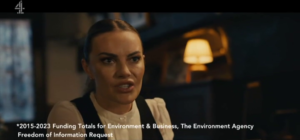 Dirty Business (2026),1 a docudrama about sewage pollution by private water companies and the failures of the Environment Agency, cites sources and provides corroborating information through the use of on-screen captions. For example, when a whistleblower alleges that huge profits have been made whilst using “cuts as a smokescreen” for inaction, the information is cited via an on-screen caption led by an asterisk: the information comes from the “2015-2023 Funding Totals for Environment & Business, The Environment Agency” and that information was accessed due to a “Freedom of Information Request”. Through devices such as these “television footnotes”,2 Dirty Business provides a reminder of the importance of “captioning”, which, as Derek Paget observed, “consists in direct address to an audience whether in the form of speech in voice-over, or of on-screen graphical patterns of words (still and rolling), or of both these things simultaneously”.3 Paget argued that captions have various functions, serving to “set the scene, put the audience in touch with ‘out-of-story’ events and characters, negotiate representation codes, guard against legal repercussions and pitch claims for authenticity of varying kinds”.4 The caption is a form of “label”, or “signpost”, providing “weight” or the “anchoring of images”.5

 It is unusual for a docudrama to use on-screen captions during scenes to provide such footnotes. However, a more familiar form of captioning appeared at the start of Dirty Business. The episode begins with two successive captions. The first one states that “This drama is based on real events, extensive interviews and research”. The second states that “Some dialogue, characters and scenes – including some depictions of pollution – have been recreated for the purposes of dramatisation”.6 Such opening captions are disclaimers, which, as Paget argued, are a “specialised kind” of caption.7 This article explores a wide range of docudramas to discuss what disclaimers do and how they do this: for example, when a disclaimer warns that a docudrama is “based on a true story”, what does this claim mean and how does the visual presentation of that claim reinforce it? The article builds on the discussion of disclaimers in my new book, An Adventure in Space and Time (2026), reproducing some of that discussion but substantially extending it and providing many more examples.8
Dirty Business, wr./dr. Joseph Bullman, tx. Channel 4, 23-25 February 2026. The images in this article come from episode 3, tx. Channel 4, 25 February 2026. ↩
This phrase will be discussed later in this article. It comes from Leslie Woodhead, ‘The Guardian Lecture’, in Alan Rosenthal (editor), Why Docudrama? Fact-Fiction on Film and TV (Carbondale, IL: Southern Illinois University Press, 1999), p. 109. ↩
Derek Paget, ‘Disclaimers, Denials and Direct Address: Captioning in Docudrama’, in John Izod and Richard Kilborn, with Matthew Hibberd (editors), From Grierson to the Docu-Soap: Breaking the Boundaries (Luton: University of Luton Press, 2000), p. 199. ↩
Derek Paget, No Other Way to Tell It: Docudrama on Film and Television (Manchester, Manchester University Press, 2011), p. 103. Second Edition. ↩
Paget, ‘Disclaimers, Denials and Direct Address’, p. 199. Paget is replying to phrases from (respectively) John Willis, ‘Tainted by the Fiction Faction’, Guardian Media Supplement, 16 November 1998, p. 9 and John Tagg, The Burden of Representation: Essays on Photographies and Histories (London: Macmillan, 1988). ↩
The final sentence in this disclaimer will be discussed later in this article. ↩
Paget, No Other Way to Tell It, p. 103. Second Edition. Paget referred to the disclaimer as a “specialised kind of opening or closing caption”, but this article focuses on opening captions. ↩
David Rolinson, An Adventure in Space and Time (Edinburgh: Obverse, 2026). Some of the discussion in this article, and that book, also returns to David Rolinson, ‘British Docudrama: New Directions in Reflexivity’, in Tobias Ebbrecht-Hartmann and Derek Paget (editors), Docudrama on European Television: A Selective Survey. Basingstoke: Palgrave Macmillan, 2016), pp. 199-227. ↩