The Falklands Factor (1983)

by OLIVER WAKE

Play for Today Writer: Don Shaw; Director: Colin Bucksey; Producer: Louis Marks

“I hope no-one ever needs to go to war over the Falklands, or for that matter, any writer write about them.”

The short but bloody Falklands war between Britain and Argentina played out over two and a half months in 1982. Television drama responded with a handful of plays about the conflict, most of which seemed to excite almost as much controversy as the war itself. (See Disputed Territory: Drama and the Falklands.) The earliest of these was Don Shaw’s The Falklands Factor, which was broadcast in April 1983, just ten months after hostilities in the South Atlantic had concluded.

Specialising in contemporary drama, the BBC’s Play for Today anthology was the natural home for such a recent subject, however The Falklands Factor is actually a historical drama, Shaw having chosen to dramatise a little known incident from the eighteenth century to put the more recent conflict into historic context and draw parallels between the two crises. The reader must excuse the passages which follow detailing brief parts of the Falkland islands’ convoluted history, without which the meaning of the play and this essay will be impossible to convey.
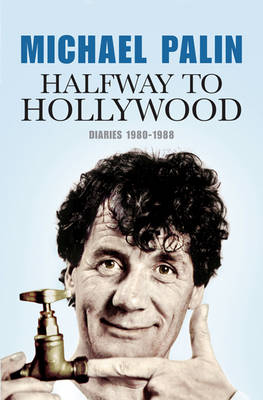
Michael Palin, Halfway to Hollywood: Diaries 1980-1988 (2009)

by DAVID ROLINSON

For anyone interested in British television drama or cinema, this second volume of Michael Palin’s diaries is just as engrossing as the first. Although some reviewers wonder if this book will be about ‘the less exciting stuff that happened in between’ the peak period of Monty Python covered in the first volume and the travel programmes that Palin embarks upon as this volume closes, it is all the more enjoyable and rewarding for its grounding in the reality of solo writing and the production process.1

For visitors to this site, I recommend Palin’s detailed coverage of East of Ipswich (1987)2, from gestation and writing through castinPalinHalfwayCoverpicg, production, post-production, critical reception and awards nominations (plus Palin’s unusually scathing comment that the London Film Festival were ‘Snobs’ to pass on it).3 I’ve adored East of Ipswich for many years, so I’m delighted to see Palin assert that ‘Nothing I’ve done gives me as much unqualified pleasure’ and that ‘I’ve never felt something done as close to the way I wanted it done as this’.4 Other material relevant to British television drama includes Palin’s script for Number 27 (1988)5 which starred the legendary Joyce Carey, working relationships with Tristram Powell, Charles Sturridge, Innes Lloyd and others, and television’s importance in British filmmaking: with fifteen films made a year and directors like Gavin Millar and Alan Clarke involved, ‘this shabbily-appointed fifth floor at TV Centre is where the British Film Industry exists’.6 Palin details the postponement of Sturridge’s Troubles (1988) after a week of filming with Palin in a major role, after which it was remounted without him.7

  1. Alfred Hickling, The Guardian, 17 October 2009. 

  2. Screen Two: ‘East of Ipswich’, tx. BBC2, 1 February 1987. 

  3. Palin, p. 435. 

  4. Palin, pp. 447, 425 

  5. BBC, 23 October 1988 

  6. Palin, p. 416 

  7. Adaptation of the novel by J.G. Farrell. A dispute over the cinematography escalated. The remounted version was ultimately transmitted on ITV in two parts, 1 and 8 May 1988. 

A Very British Coup (1988)

by JOHN WHEATCROFT

Writer: Alan Plater; Adapted from Chris Mullin; Director: Mick Jackson


Political drama which carries a left-wing punch can usually expect to find a few dissenters among the majority of journalists – or at least their employers – for whom such views are anathema; it’s easy to review the politics rather than the art. It’s a huge testimony to Alan Plater’s skill as a dramatist that A Very British Coup was received with equal acclaim by commentators from every shade of the political spectrum. Plater believes that the right-wing press can sometimes be more generous than the left, so long as they understand that no attempt is being made to convert them.1


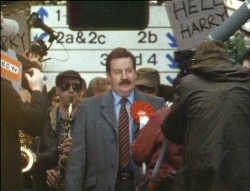
The three-part Channel 4 dramatisation2 of Chris Mullin’s 1982 novel of the same name, A Very British Coup is about the election of a genuinely socialist government, headed by former steel worker Harry Perkins (Ray McAnally). The drama is hardly a call to arms to vote Labour, because, as Plater points out, no government has ever pursued such an agenda.3 However, Perkins proves to be a different kettle of fish, as even his opponents such as Secret Service head Sir Percy Browne (Alan MacNaughton) have to admit, and he will not be deflected. Perkins continues on his socialist path with something as close to total integrity as politics allows. This makes A Very British Coup quite different from many left-leaning dramas, as Mark Lawson remarked: ‘Political drama on television tends to pursue the view that Labour leaders willingly surrender their beliefs in power. A Very British Coup is about something darker, the theft of good intentions.’4


  1. Alan Plater, telephone interview with John Wheatcroft, 19 May 2009. 

  2. The three episodes were first broadcast on 19 June, 26 June and 3 July 1988 respectively. 

  3. Plater, telephone interview. 

  4. Mark Lawson, The Independent, 20 June 1988.