Hitching Your Wagon to a Star: Some random and rambling reflections on Alfred Hitchcock and The Girl (2012)

by NEIL SINYARD

Writer: Gwyneth Hughes; Based on (book): Donald Spoto, Spellbound by Beauty; Producer: Amanda Jenks; Director:Julian Jarrold
BTVD_TheGirl_01
There is a compelling moment in Strindberg’s The Father when a doctor is recalling a production of Ibsen’s Ghosts and being dismayed by Mrs Alving’s vilification of her late husband. ‘I thought to myself,’ says the Doctor, ‘What a damned shame the fellow’s dead and can’t defend himself!’

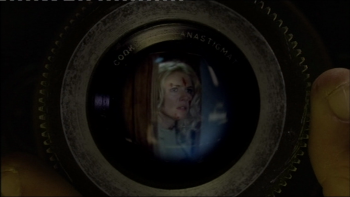
I felt a bit like that whilst watching the BBC/HBO production The Girl,1 Julian Jarrold’s film about the deteriorating relationship between Alfred Hitchcock and his new discovery Tippi Hedren during the making of The Birds (1963) and Marnie (1964). Dramatic characterisation comes perilously close to character assassination. Jarrold’s previous TV piece, the award-winning Appropriate Adult, was also rooted in reality and had certainly confirmed his aptitude for exploring the dark side of human personality; and The Girl is a powerful and progressively harrowing film about sexual harassment, psychological cruelty, and the abuse of power.2 I think the two leading performances are superb. Toby Jones’s mimicry of Hitchcock is masterly, but he also probes to the melancholy behind the façade; and Sienna Miller likewise conveys a tough and courageous resilience beneath the actress’s surface elegance. At the outset, however, the film claims to be based on extensive research (though there is no mention of Tony Lee Moral’s richly detailed book on the making of Marnie3 ) and thus is purporting to be an accurate account of events. On the level of veracity rather than drama, the film becomes more problematic.
  1. The Girl, tx. BBC2, 26 December 2012. 

  2. Appropriate Adult, tx. ITV, 4 and 11 September 2011. 

  3. Tony Lee Moral, Hitchcock and the Making of Marnie (Scarecrow Press, 2005). 

Ian Curteis

by OLIVER WAKE

Television career overview

BTVD_Curteis_Row docu 1
This piece was revised and updated in 2014 and 2015.

Ian Curteis is an fascinating figure in the world of British television drama. He achieved great success in the 1970s as a writer of plays exploring real events and historical figures but thereafter found his work sometimes frustrated, with cancelled projects and related controversies. Accounts differ as to whether these frustrations were the result of political censorship or the more mundane reasons common in broadcasting. This essay presents an overview of Curteis’s television career, incorporating material from a variety of contrasting sources, including Curteis himself, which illustrates why his work is so interesting and, sometimes, divisive.

Stalingrad (1963)

by OLIVER WAKE

This piece was substantially revised in December 2014.

Festival Writer: Rudolph Cartier; Adapted and translated from: Theodore Plievier (novel), Claus Hubalek (play from novel); Director: Rudolph Cartier

The early 1960s was a transitional period for BBC television drama. New techniques, notably a move away from live transmissions in favour of pre-recording, enabled more ambitious and polished productions. Subject matter was changing too, with specially written television plays and series overcoming the BBC’s previous reliance on material drawn from the theatre or popular novels. Of course, these changes didn’t happen overnight, and a number of programmes of the period provide a snapshot of television drama in transition, containing elements of both the old and the new, sometimes uneasily colliding in the one production. One such drama is Stalingrad, from late 1963, which has roots in both a novel and its stage adaptation, but also attempts to make the material ‘televisual’, achieving mixed results.1 Here, we’ll examine the play, to see how it came to be made in a mix of styles and how critics and audiences reacted to it.


  1. Festival: ‘Stalingrad’, BBC2, tx. 4 December 1964. 

The Rank and File (1971)

by JOHN WILLIAMS

Play for Today Writer: Jim Allen; Director: Kenneth Loach; Producer: Graeme McDonald

‘I go along with Trotsky, that life is beautiful, that the future generation cleanses all the oppression, violence and evil’

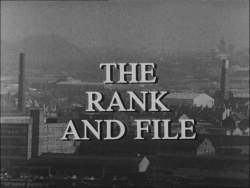
Most of Ken Loach’s work for television has attracted at least some critical writing because of his towering reputation in the cinema. Even so, The Rank and File has generally been overlooked in favour of the first Loach/Allen Wednesday Play collaboration The Big Flame (1969), and both writer and director seem to have mixed feelings about the piece. Allen stated that the play ‘was written in three weeks…if you get too didactic, politically or otherwise, as I probably did in The Rank and File, it can be a lantern lecture’,1 and Loach has commented that ‘the [films] we’ve done that show their age badly are the ones where you’re trying to catch the headlines and be topical…some of the films from the early seventies’.2 However Rank…, while superficially similar to The Big Flame, was written for specific reasons about a recent strike, rather than a (prophetic) vision of a political occupation. And Loach’s own reference to topicality should lead us consider that one of the strengths of the Play for Today strand lay in the ability, as in this case, to move with astonishing speed from a real-life event to a fictional representation in just under 11 months. The urgency of such a representation is not diminished just because the events that inspired Rank… have become obscure footnotes in twentieth century industrial relations, but I’d like to try and illuminate some of the historical background to the play, and also look at what it tells us about the role of politics, specifically Trotskyite politics, in the BBC Plays department at the time.


  1. Jacob Leigh, The Cinema of Ken Loach: Art in the Service of the People (London: Wallflower Press, 2002), p.101. 

  2. Simon Hattenstone interview with Ken Loach, The Guardian, 28 October 1998. Interview online here

The Falklands Factor (1983)

by OLIVER WAKE

Play for Today Writer: Don Shaw; Director: Colin Bucksey; Producer: Louis Marks

“I hope no-one ever needs to go to war over the Falklands, or for that matter, any writer write about them.”

The short but bloody Falklands war between Britain and Argentina played out over two and a half months in 1982. Television drama responded with a handful of plays about the conflict, most of which seemed to excite almost as much controversy as the war itself. (See Disputed Territory: Drama and the Falklands.) The earliest of these was Don Shaw’s The Falklands Factor, which was broadcast in April 1983, just ten months after hostilities in the South Atlantic had concluded.

Specialising in contemporary drama, the BBC’s Play for Today anthology was the natural home for such a recent subject, however The Falklands Factor is actually a historical drama, Shaw having chosen to dramatise a little known incident from the eighteenth century to put the more recent conflict into historic context and draw parallels between the two crises. The reader must excuse the passages which follow detailing brief parts of the Falkland islands’ convoluted history, without which the meaning of the play and this essay will be impossible to convey.