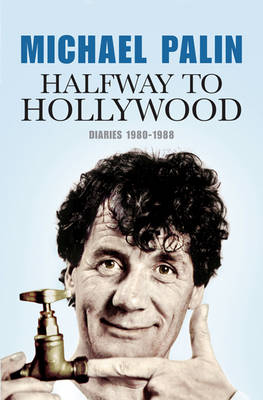
Michael Palin, Halfway to Hollywood: Diaries 1980-1988 (2009)

by DAVID ROLINSON

For anyone interested in British television drama or cinema, this second volume of Michael Palin’s diaries is just as engrossing as the first. Although some reviewers wonder if this book will be about ‘the less exciting stuff that happened in between’ the peak period of Monty Python covered in the first volume and the travel programmes that Palin embarks upon as this volume closes, it is all the more enjoyable and rewarding for its grounding in the reality of solo writing and the production process.1

For visitors to this site, I recommend Palin’s detailed coverage of East of Ipswich (1987)2, from gestation and writing through castinPalinHalfwayCoverpicg, production, post-production, critical reception and awards nominations (plus Palin’s unusually scathing comment that the London Film Festival were ‘Snobs’ to pass on it).3 I’ve adored East of Ipswich for many years, so I’m delighted to see Palin assert that ‘Nothing I’ve done gives me as much unqualified pleasure’ and that ‘I’ve never felt something done as close to the way I wanted it done as this’.4 Other material relevant to British television drama includes Palin’s script for Number 27 (1988)5 which starred the legendary Joyce Carey, working relationships with Tristram Powell, Charles Sturridge, Innes Lloyd and others, and television’s importance in British filmmaking: with fifteen films made a year and directors like Gavin Millar and Alan Clarke involved, ‘this shabbily-appointed fifth floor at TV Centre is where the British Film Industry exists’.6 Palin details the postponement of Sturridge’s Troubles (1988) after a week of filming with Palin in a major role, after which it was remounted without him.7

  1. Alfred Hickling, The Guardian, 17 October 2009. 

  2. Screen Two:‘East of Ipswich’, tx. BBC2, 1 February 1987. 

  3. Palin, p. 435. 

  4. Palin, pp. 447, 425 

  5. BBC, 23 October 1988 

  6. Palin, p. 416 

  7. Adaptation of the novel by J.G. Farrell. A dispute over the cinematography escalated. The remounted version was ultimately transmitted on ITV in two parts, 1 and 8 May 1988. 

Out of this World (1962)

by OLIVER WAKE

Writers: Clive Exton, Leon Griffiths, Leo Lehman, Terry Nation, Julian Bond, Bruce Stewart, Richard Waring, Denis Butler; Adapted from: John Wyndham, Rog Philips, Isaac Asimov, Tom Godwin, Philip K Dick, Robert Moore Williams, Katherine Maclean, Raymond F. Jones, Frank Crisp, Clifford D Simak, Arthur Sellings; Directors: Charles Jarrott, Jonathan Alwyn, Douglas James, Paul Bernard, Peter Hammond, Guy Verney, Richmond Harding, John Knight, Don Leaver, John Knight, Alan Cooke

BTVD_Robot_2

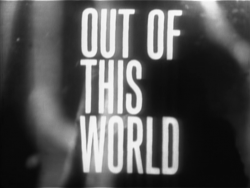
There are many reasons why a television series may languish in obscurity, perhaps primarily because it simply does not merit any interest. However, this is not the case with ABC’s 1962 series Out of This World – British television’s first science fiction anthology – which suffers obscurity due to two factors independent of the programme itself. Only one episode exists in full, leaving little scope for re-evaluation, and the series has long been overshadowed by its celebrated longer-running BBC cousin Out of the Unknown. However, Out of This World is not just worthy of attention as a curiosity, but as an original and successful series in its own right.

Mrs Wickens in the Fall (1957)

by OLIVER WAKE

Writer: Nigel Kneale; Director: Michael Elliott

The work of Nigel Kneale is held in high regard by television drama enthusiasts, and by those with an interest in the science fiction and horror genres especially. His scriptwriting work, spanning five decades, produced a number of prophetic, macabre and disturbing pieces that have lingered long in the minds of viewers. It was these productions which made Kneale’s reputation, yet he wrote a great deal more besides. It would be a shame to ignore Kneale’s work in the discipline that we could call, perhaps pretentiously, ‘straight’ or ‘serious’ drama, much of which is as powerful and worthy of discussion as his better known material. One of these dramas is Mrs Wickens in the Fall from 1957, a play which has received little attention despite the script having been published in a 1960 compendium of television plays.1 This article is an attempt to redress that imbalance slightly.


  1. Sunday-Night Theatre: ‘Mrs Wickens in the Fall’, BBC, tx. 8 September 1957. The text was published in: Michael Barry (editor), The Television Playwright (London: Michael Joseph Ltd, 1960), p. 150. 

A Very British Coup (1988)

by JOHN WHEATCROFT

Writer: Alan Plater; Adapted from Chris Mullin; Director: Mick Jackson


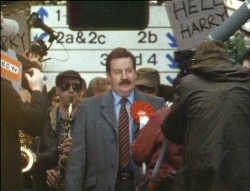
Political drama which carries a left-wing punch can usually expect to find a few dissenters among the majority of journalists – or at least their employers – for whom such views are anathema; it’s easy to review the politics rather than the art. It’s a huge testimony to Alan Plater’s skill as a dramatist that A Very British Coup was received with equal acclaim by commentators from every shade of the political spectrum. Plater believes that the right-wing press can sometimes be more generous than the left, so long as they understand that no attempt is being made to convert them.1


The three-part Channel 4 dramatisation2 of Chris Mullin’s 1982 novel of the same name, A Very British Coup is about the election of a genuinely socialist government, headed by former steel worker Harry Perkins (Ray McAnally). The drama is hardly a call to arms to vote Labour, because, as Plater points out, no government has ever pursued such an agenda.3 However, Perkins proves to be a different kettle of fish, as even his opponents such as Secret Service head Sir Percy Browne (Alan MacNaughton) have to admit, and he will not be deflected. Perkins continues on his socialist path with something as close to total integrity as politics allows. This makes A Very British Coup quite different from many left-leaning dramas, as Mark Lawson remarked: ‘Political drama on television tends to pursue the view that Labour leaders willingly surrender their beliefs in power. A Very British Coup is about something darker, the theft of good intentions.’4


  1. Alan Plater, telephone interview with John Wheatcroft, 19 May 2009. 

  2. The three episodes were first broadcast on 19 June, 26 June and 3 July 1988 respectively. 

  3. Plater, telephone interview. 

  4. Mark Lawson, The Independent, 20 June 1988. 

The War Game (1965)

by DAVID ROLINSON

Writer and Director: Peter Watkins

The probability of total destruction increases with time and, in the course of the months and years throughout which we are told to expect the Cold War to continue, it becomes almost a certainty’1.

WatkinsGameBlastgrab

The War Game is one of television’s most notorious banned programmes. A harrowing dramatised documentary portraying the after-effects of nuclear holocaust and calling for public education in nuclear deterrent policy, it was made by the BBC for 1965 broadcast but was not transmitted for twenty years. Among the reasons given for the ban were its brutally graphic scenes, its apparent left-wing bias and its controversial fusion of journalistic fact and hugely alarmist fiction, although there is now evidence that it fell victim to the political suppression of nuclear discussion that was happening at the time across all media. Its director, Peter Watkins, quit the BBC and fought to get it a cinema release abroad, resulting in critical acclaim and a Best Documentary Oscar. After its eventual transmission in 1985, critics agreed that the BBC had suppressed one of the greatest dramas ever made.


  1. Bertrand Russell, Has Man A Future?, 1961.